



Abstract
The World’s Student Christian Federation established the European Student Relief (ESR) organization in 1920 in order to respond to the refugee and hunger crises emerging in the wake of World War I in Europe. Although nearly forgotten today, it was the first truly international ecumenical relief agency in the world. This article tells the story of ESR in reference to its efforts at building interorganizational coalitions and as a force for “internationalism.” The ESR’s story is instructive as the world marks the hundredth anniversary of the end of World War I and is once again confronted with refugee crises.
Keywords
On November 11, 2018, many people in the world will mark the hundredth anniversary of the World War I armistice that ended the fighting on the western front of Europe. The war cost the lives of at least 9.5 million soldiers from six continents—primarily from Europe and Russia—with devastation from civilian deaths just as high. The long-term effects on Christian mission, theology, and church life are hard to exaggerate. Few people remember, however, that fighting continued in many places well after the armistice was signed, and even after the Treaty of Versailles in June 1919: the Russian Civil War (1917–22), the Russo-Polish War (1920), the Greco-Turkish war (1919–22), revolutions in Hungary (1918–20), and the French occupation of the Ruhr area of Germany in 1923–24. 1 This strife does not include many other acts of violence toward religious and other minorities—especially Jews—that took place in Europe in the 1920s. Four million people were killed after the war (between 1919 and 1923); this number exceeds the combined World War I deaths of Britain, France, and the United States. 2
Refugee populations in Europe soared during the postwar years. Warfare was just one of the reasons for the refugee crisis in Europe after WWI, but the dissolution of empires and the formation, in their place, of nations whose leaders aspired to be ethnically and religiously homogenous caused even more of a refugee crisis. Ethnic nationalism had existed in the German, Russian, and Austro-Hungarian Empires before the war, but political leaders became more strident in their nationalism after the war’s end in the new states that replaced empires. This change spelled disaster for many of the 20 million people who lived outside of states where a majority of their ethno-cultural group resided. These millions ranged from people representing sizable minorities within a country who sometimes chose to stay, to persons who were literally stateless and deemed unacceptable by governments. 3 Famine too, most notably in Russia, caused refugee populations to rise dramatically.
In this context of war, paramilitary violence, refugee movements, and famine, the World’s Student Christian Federation (WSCF) responded by establishing the European Student Relief (ESR) in August 1920. 4 Although few people have heard of it, the ESR may be considered the first international ecumenical relief agency. It predated by decades the development agencies related to the World Council of Churches, as well as nation-specific ecumenical relief agencies like Church World Service (USA) or Christian Aid (Britain). 5 The ESR at first focused primarily on food relief for university students, many of whom were refugees from Europe, Russia, and Asia Minor. The ESR expanded its work to include provision of clothing, books, housing, heating fuel, employment bureaus, self-help work programs, medical relief, and other forms of financial assistance. What set it apart from other organizations seeking to address the postwar crisis—like the Red Cross and Save the Children—was that the ESR was a branch of a world Christian student organization and, as such, focused on university students as aid recipients; furthermore, it differed from other organizations in the financial donors they sought and the volunteer aid workers they recruited.
Despite the ESR’s contributions, it has yet to receive serious scholarly attention. The only substantial review of the ESR’s history is Ruth Rouse’s 1925 book Rebuilding Europe: The Student Chapter in Post-war Reconstruction, written (for fund-raising purposes) in July 1924, a year after her resignation from the ESR. 6 More recently, Georgina Brewis discussed the ESR in a chapter of her book on British student volunteering, but Brewis focused only on British student involvement in the organization. 7 Several scholars have unknowingly made reference to the work of the ESR, ascribing its work instead to the YMCA/YWCA without recognizing the connection these organizations had to the ESR or even that the ESR existed. 8
After briefly reviewing the early months of the work of ESR, I focus on two themes: ESR’s interorganizational collaboration and its promotion of internationalism. These themes were most salient in shaping the group’s organizational identity, and they simultaneously express the organization’s most significant challenges. It was critical for the leaders of the ESR to be seen as cooperative among the dozens of student organizations that made up the WSCF. ESR leaders sought to make broad ownership a reality, even as the majority of the organization’s funding came from students in the United States. As a promoter of internationalism, the ESR received praise from the League of Nations and contributed to the hope that the Great War would indeed be the “war to end all wars.” 9 The ESR’s distinctive “Christian internationalism” similarly called for a strengthening of Christian fellowship across cultural and national boundaries. Many saw this vision as a foretaste of God’s kingdom and a major goal of Christian missionary effort. 10 The ESR’s efforts in these areas and others shaped many student leaders who later became involved in world ecumenical movements. This study also offers a new perspective on the histories of several Christian nongovernmental organizations that were established around the same time as ESR and are now celebrating their centenaries. 11
The early establishment of the ESR
In the 1920s the ESR responded to crises in more than twenty countries in Europe, the Near East, and Russia. A thorough review of the ESR’s work in so many countries over two decades is beyond the scope of this article. The change of the organization’s name from European Student Relief to International Student Service (ISS) in 1925 serves as an approximate end point to this study, although the ISS continued to operate throughout the 1930s. 13 By 1925, however, most of Europe, Russia, and the Near East saw a return to a greater measure of peace, and the annual expenditures of the ESR, in turn, declined dramatically. 14
The ESR started small but eventually captured the imaginations and financial resources of students and other persons from more than forty countries. The ESR raised US$2 million in its first five years 15 (the equivalent of approximately $27.5 million in 2018). The ESR’s formal beginning can be traced to an August 1920 gathering of the WSCF in St. Beatenberg, Switzerland, which called for the founding of the organization as a branch of the WSCF. A less formal beginning point—an exchange of letters between Christian student leaders in Vienna, Austria, and the WSCF offices in London—better illustrates the challenging context of strained relationships caused by the war and famine in which students found themselves.
In December 1919 Herbert Petrick of the Vienna Christocratic Student Union wrote WSCF leader Ruth Rouse a letter urging her to visit Vienna. Petrick told her about the famine taking place there and noted that while children were being looked after by the American Vienna Public Feeding program, “for the grown up students nobody cares.” 16 The desperate plight of the Viennese people in 1919 would not have been news to Rouse. Die Hungerkatastrophe (as it was called) in Austria was at the center stage of international humanitarian attention, but students in Vienna did not feel they had yet received the attention they deserved. 17
The Vienna student leaders had earlier written the head of the WSCF and YMCA, John R. Mott, to urge that organization to purchase a building to provide Viennese students with the lodging and food they desperately needed. They noted with exasperation that “Dr. Mott has once again put us off till the future. . . . We know that Dr. Mott is not in close touch with the German Student Christian Movement, but we in Vienna are not the German Student Christian movement, and therefore his distrust of us is very painful to us. . . . Dr. Mott hesitates because we are in communication with Berlin and Berlin is distrustful of us because we are in relation with Mott. Both are wrong.” 18 German, Austrian, and American relationships were strained enough because of strongly lingering animosities between countries so recently at war with one another. The added strained relationship between John R. Mott and German students stemmed from Mott’s participation in a Wilson administration US diplomatic mission to Russia led by Elihu Root during the war. 19
In February 1920, two months after receiving Petrick’s letter, Ruth Rouse visited the Viennese students and was deeply moved by the desperate situation she witnessed there. “India in time of famine, the ruins of Adana, French towns under air-raid bombardment, devastated war areas, San Francisco after the earthquake, prisoners of war camps, internment camps, refugee camps—I have seen them all, but Vienna as I saw it February 1920 remains burnt in my memory as a yet nearer thing to Hell.” 20 Rouse launched an immediate appeal to the forty WSCF-affiliated student groups around the world, and in one month’s time the federation received 175,000 Swiss francs (the equivalent of $30,000 in 1920) for aid to Vienna.
After several months of fund-raising and organizing, the ESR expanded beyond Vienna to address student needs in eleven countries prioritized at the organization’s August 1920 founding meeting in St. Beatenberg. 21 Approximately 70,000 students in 120 institutions of higher learning received aid in the ESR’s first year. 22 In descending order of aid given from 1920 through 1921, the ESR worked in Austria, Germany, Poland, Hungary, Asia Minor, Estonia, and Czechoslovakia. 23 The focus of the work changed dramatically and quickly for some of these countries; in Germany and Austria the ESR very quickly removed its foreign personnel and, by 1923, functioned through German and Austrian student groups by sending funds directly to them. 24
By contrast, student group infrastructure was virtually nonexistent for student refugee groups the ESR sought to help and, as a result, the ESR frequently played a more direct role where refugees were concerned. Throughout the ESR’s first six years, the situation of student refugees in many countries—mostly from Russia—was dire. 25 In some cases, the ESR viewed entire student populations as refugees because of the realignment of borders. This was the case, for example, with Hungarian students, many of whom were from the newly configured states of Romania, Yugoslavia, and Czechoslovakia. 26
Figure 2 shows that what began as an effort to address food shortages and even famine situations in the new states of the former Austro-Hungarian Empire and Germany became, by the spring and summer of 1922, a relief effort increasingly focused on the Soviet famine and the already existing Russian refugee crisis. Figure 2 also reveals the dramatic shifts in funding amounts, changes in the countries and regions receiving aid, and the importance of the American Relief Administration (ARA) as a major organizational partner for the ESR.

“Struggling On.” The ESR used this image of a struggling European student in its 1922 fund-raising efforts. Note the church ruins in the background. 12
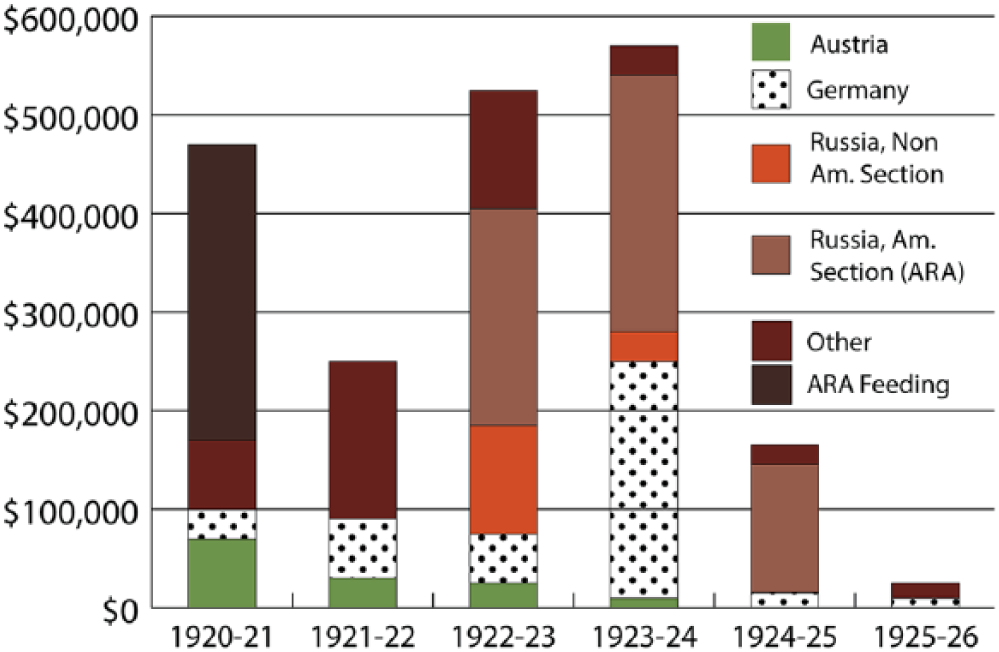
ESR aid per year by country 27
No other organization was as important financially as the ARA in the ESR’s work, especially when addressing food shortages in central Europe and Russia. Herbert Hoover served as head of the ARA after having accomplished a great deal in famine relief in Belgium and other countries during the war. The ARA was established by the US government in February 1919, and it continued as a governmental aid organization until June 1919. After that time the ARA continued as a private aid organization under Hoover’s leadership and partnered with several organizations, including the ESR, providing food relief until the summer of 1922 in Europe and until 1923 in Soviet Russia. Even though the ARA after June 1919 was a private organization, US law restricted direct aid to countries that had not been at war with the United States. Hoover frequently went around this restriction by working with other organizations that delivered aid provided to them by the ARA. 28 The ESR was one of those organizations, although in some cases (Germany) the ARA still was not able to provide financial support to the ESR’s work with students. 29
The rise in financial contributions in 1922 (identified as the “Russia, Am. Section” in fig. 2) refers to ARA feeding centers in Russia funded by American students (mostly through the YMCA/YWCA). The non-American sections of ESR feeding in Russia were from funds raised among non-American students for the ESR. The ARA had been involved in feeding efforts in Russia prior to this date, but most of the work among students did not emerge until early 1922, after fund-raising appeals in the world’s universities took place (mostly in Europe and the United States). 30 Feeding stations were set up in student centers in Russia, with the American section with ARA oversight in charge of some cities containing students, while the non-American (and non-ARA) ESR feeding focused on other locales. The ESR faced new challenges working with Russian émigré students during the famine, as feelings of hopelessness set in after Russian students in Prague and Berlin heard news of starving family members. 31
What is not depicted in the figures above was the new refugee situation stemming from the conflict between Greece and Turkey and the 1921 and 1923 treaties between those two nations. The situation in this region also prompted a response from the ESR, although the response was far less robust than the ESR’s reactions to the crises in northern Europe or in Russia. 32 Between 1920 and 1923 less than $40,000 was spent to help mostly Christian refugees in Greece and Asia Minor. Cultural differences and prejudice between American and European students and between Greek and Turkish students complicated the response. Ecumenical relations also proved difficult as ESR officials reported challenges working with the Greek Orthodox Church of Smyrna. 33 A growing bias against Christian organizations at colleges founded by missionaries in Turkey and Lebanon also made it difficult for the WSCF and, by extension, the ESR, to develop relationships in those places. 34 The situation between Greece and Turkey received less attention as a result.
The work of the ESR was not uniform in any of the twenty countries in which it worked. Even within a country, ESR leaders sometimes disagreed, and the best course of action and activities often varied from city to city. Nevertheless, the ESR was still able to feed tens of thousands of students and provide an assortment of other forms of assistance, whether students were in their home countries or were refugees, and whether they were Christians, Jews, Muslims, or atheists.
Interorganizational collaboration
Early in 1920, when Ruth Rouse began marshalling the resources of the WSCF around the world, she also immediately began to organize aid with other organizations already on the ground in Vienna. She met with five women’s societies at the University of Vienna that represented diverse political and religious points of view. Rouse described them as including “the Roman Catholic Society, the Socialist Society (anti-Christian), the Zionist Society, the German National Society (anti-Semitic and anti-foreign) and the Academic Women’s Union (practically Jewish).” 35 These groups constituted the beginning of a local relief committee; the ESR’s collaboration with them was a foreshadowing of just how seriously the organization took its religiously and politically inclusive mandate, and how difficult it was going to be to work in the midst of nationalist and anti-Semitic feelings among students.
The ESR went on to collaborate with well over a dozen organizations—many of which worked in multiple countries, as did the ESR. These included British organizations such as Save the Children and the Imperial War Relief Fund; the Red Cross in both its international and American expressions; Pax Romana, a Roman Catholic student organization; and the International Confederation of Students, which was established to bring together national student organizations of League of Nations members. 36 Three other organizations were especially vital for the ESR’s relief efforts in these early years: The YMCA/YWCA; the Religious Society of Friends (Quakers), in both its American and British manifestations; and the American Relief Administration (ARA).
The YMCA/YWCA was clearly the most important organization in terms of assisting the ESR with personnel to do their work. The groups had already staffed relief stations for soldiers and others throughout Europe during the war, so it only made sense for the ESR to continue to use their personnel in the postwar relief effort. 37 In the first three years of ESR’s work in Europe, twenty-two staff members (who received salaries from the YMCA/YWCA) served with the organization. This number was nearly one-fifth of the ESR staff (115 in total) at work at this time. 38 In some locations, such as Czechoslovakia and Poland, YMCA staff initiated student relief efforts even before the formal launch of the ESR at St. Beatenberg in August 1920. 39 Collaboration between the ESR and YMCA personnel usually worked well, since ESR executive secretary Conrad Hoffmann already knew so many of the staff members who had served with him in Europe during the war. In striking contrast to his YMCA boss, John R. Mott, Conrad Hoffmann was the YMCA man whom the Germans trusted more than anyone else. He was the only American permitted to remain in Germany after the United States entered the war in 1917. 40
For a number of reasons, however, the use of YMCA/YWCA personnel sometimes caused difficulties for the ESR. The organization’s dependence on the American YMCA/YWCA made the ESR vulnerable to critiques that the ESR was not as much of a global student effort as they claimed it was. In fact, students from the United States did donate far more as a group than students from any other country. (In the first year, for example, if gifts from American students channeled through the ARA are included, the US portion of the ESR budget was nearly 75% of the total.) 41 Although American students donated the most funding, ESR staff emphasized multinational support; American YMCA secretaries in Europe posted signs in feeding centers that stressed their food aid came from the students of the WSCF and not from the American YMCA. 42 Even stationery used in correspondence tried to make this distinction clear.
The ESR’s association with the YMCA also prompted Europeans in the ESR to raise concerns about the ESR being perceived as culturally insensitive and excessively “dominated by American interests.” 43 The latter concern was not entirely unfounded, as subsequent historians have stressed the ways the United States utilized food aid during and after the war to accomplish certain foreign policy objectives. 44 The ESR’s affiliation with the YMCA also prompted ecumenical tension from time to time, since the YMCA was rightly perceived as a largely Protestant group, even though it sometimes actively encouraged Orthodox student groups in exile in both Berlin and Paris. 45
Although a much smaller organization than the YMCA/YWCA, the Religious Society of Friends (in both its American and British expressions) contributed significantly to relief efforts in the work of the ESR, which were also critical in helping it get started in Austria, Germany, and Russia. In all three locations the Religious Society of Friends was involved before ESR began its work. In Germany, Friends provided aid for students until April 1921, at which point the ESR was finally able to take over. 46
The American Friends Service Committee (AFSC) was the only Western organization functioning in Russia when signs of famine finally started to receive attention by the government in Moscow. 47 A report from an ESR staff worker conveys, in an interaction with Quakers, the desperate nature of the famine situation she found there: “As we were sitting down to our evening meal with the ‘Friends’ the news was brought in that a man had fallen across the gateway. Could not something be done? . . . The truth was that the collective problem was already so overwhelming that it was almost a crime to consider an individual case. Meanwhile pillow and blankets had been taken out, but within about six minutes, the merciful end had come.” 48 The AFSC continued its work in Russia throughout the famine years. It became adept at avoiding political ties too close to anti-Communist US policy while also being independent enough to earn the trust of moderates in America who organized the Russian Famine Fund in September 1921. 49 ESR staff and the YMCA took a similar political stance, and this decision probably contributed to good relations between the Friends and the ESR.
As noted above, among all the organizations with which the ESR partnered, none were financially or logistically more important than the ARA. It began its work for European students at around the same time as the ESR. Hoover began receiving appeals from students throughout Europe in the spring of 1920, urging the United States to include aid for students—in addition to children, which it had been doing for some time—in the ARA’s relief scheme. The timing of these appeals coincided with Rouse’s letter to WSCF members worldwide after her visit to Vienna. Although no direct causal relationship with Rouse’s appeal can be determined, it seems likely that her communiqué contributed to the ARA receiving two large gifts for a total of $500,000 to assist “the intellectual class.” 50
Two months after the ESR’s formal beginning at the WSCF’s St. Beatenberg Conference in August 1920, Herbert Hoover also wrote a letter to John R. Mott suggesting that the YMCA/YWCA work together with the ARA to address the needs of university students and professors in Europe. It seems that at this time Hoover did not know about the recent establishment of the ESR but believed that the YMCA/YWCA would likely be an apt partner. Indeed, it was. Mott quickly responded in the affirmative, and shortly thereafter a Student Relief Fund appeal was sent out by the ARA to American university students. 51
ESR leadership criticized the involvement and tactics of the ARA in the Student Friendship Fund annual campaign among university students in the United States, a financial campaign operated by the YMCA/YWCA since 1916. YMCA/YWCA staff and the WSCF knew how to raise money among university students, but the ARA apparently did not learn from their experience, and a confusing set of appeals to students resulted in some donations being sent to the wrong organizations and in some appeals bearing little fruit. 52 ARA representatives also expressed frustration with the ESR in February 1921 because the ESR had used only 10 percent of the $200,000 grant provided by the ARA in November 1920 to begin feeding programs among university students. 53
Finally, ESR leadership (and especially Ruth Rouse) were concerned that the ARA was interested in taking over student feeding operations entirely and, in doing so, was going to emphasize that its feeding efforts came from American students alone. Rouse saw this situation as a “big spiritual issue” that violated the spirit of cooperation of the ESR. “It has been wonderful the enthusiasm which has greeted the idea of all students giving together for the neediest: this has provoked giving, where it was at first withheld. Still more important is it that the students of Central Europe should continue to feel that all their comrades in belligerent and neutral lands are uniting to help them. This has done an immense amount to break down fear and suspicion and hatred, and is a much bigger thing than the feeding itself.” 54 The arrangement the ARA had worked out with the AFSC in November 1919 suggests the kind of arrangement the ARA probably sought to have with the ESR. 55 The ARA, however, according to Ruth Rouse, seemed to have had difficulty understanding that, as an international relief organization, certain procedures needed to be put in place in order to avoid the public impression that the ESR was solely an American organization.
In spite of these challenges, the ESR, YMCA/YWCA, and the ARA had a remarkable level of interdependence. John R. Mott served as a vital intermediary between all three of these organizations as a result of his leadership of the international YMCA and his ties to Herbert Hoover. 56 Other persons served a similar role at more local levels. In Russia, for example, the “American section” of the ESR was led by YMCA man E. T. Colton, who simultaneously served as a YMCA representative in Russia and on Herbert Hoover’s staff of the ARA. 57
Interorganizational collaboration took a great deal of the energy of the ESR staff throughout its first five years. In the initial months ESR leadership seemingly paid more attention to establishing interorganizational ties than to direct relief delivery as Conrad Hoffmann remained in the United States for quite some time before beginning his administrative duties at the ESR’s Geneva headquarters. Ruth Rouse often took the lead in clarifying relationships with the ARA and was persistent in trying to develop relationships with other groups as well, which never bore fruit. Efforts to collaborate with other organizations were nonetheless an important complement to the practical work carried out by the dozens of ESR workers at feeding stations throughout Europe and Russia.
Internationalism
The First World War placed in bold relief the stark ugliness of nationalism and shook the easy optimism of liberal Protestantism during this period. Cultural and Christian internationalism nonetheless flourished after World War I. The optimism of seeing World War I as the “war to end all wars” was based on the confidence many had that diplomacy and cross-cultural exchange would prevent such tragedies in the future. 58 After the war, the YMCA/YWCA, student Christian movements that together composed the WSCF, and countless more secular organizations—most prominently the League of Nations—were committed to promoting a cultural (and, for some, Christian) internationalism both in the United States and in Europe. As an organization embedded within the WSCF and one that frequently and substantially availed itself of YMCA/YWCA staff, the ESR was the vanguard of internationalist rhetoric and action in the first half of the 1920s. No other single Christian organization was more committed to promoting a cultural and Christian internationalism ideologically while simultaneously confronting strong grassroots challenges to that internationalist project in the form of nationalist and racist students.
From the beginning, the WSCF was eager to stress the international dimension of the student relief enterprise, which extended well beyond the United States and Europe. In one of the first “Student Service Bulletins” that went out to the WSCF constituency around the world, Ruth Rouse was quick to note that students from Japan and India were “some of the first countries to respond to our original letter on behalf of Vienna.” The student secretary from India, Miss Elizabeth Zachariah, signaled India’s place in the growing internationalist discourse, which until this time had mostly been limited to Western nations and, to some extent, Japan. 59 “It is a wonderful stimulus to our growing world-relationships, I feel, and I am very anxious that young India should have a share in the sufferings of the world. . . . I do hope that this will be a means whereby our Christian students, at least, may feel that, at this time, when we are so taken up with our national development, we have international relationships too, that bring to us privileges as well as responsibility, and are ours to fulfil.” 60
The first annual report of the ESR, titled “A Study in Internationalism,” likewise clearly highlighted the organization’s focus. The very first page of the report listed the twenty-six countries from which donations had been received, the eleven countries that were aid recipients, and the twenty nations from which ESR personnel had come. ESR letterhead for years afterward listed the names of the countries that were involved in the organization around its motto, Ut Omnes Unum Sint (“that they all may be one,” quoting the Vulgate of John 17:21). 62 In the Bible this passage references Christian unity; for the ESR it implicitly expressed internationalist hopes as well. Figure 3 most poignantly illustrates the ESR’s internationalist aspirations.
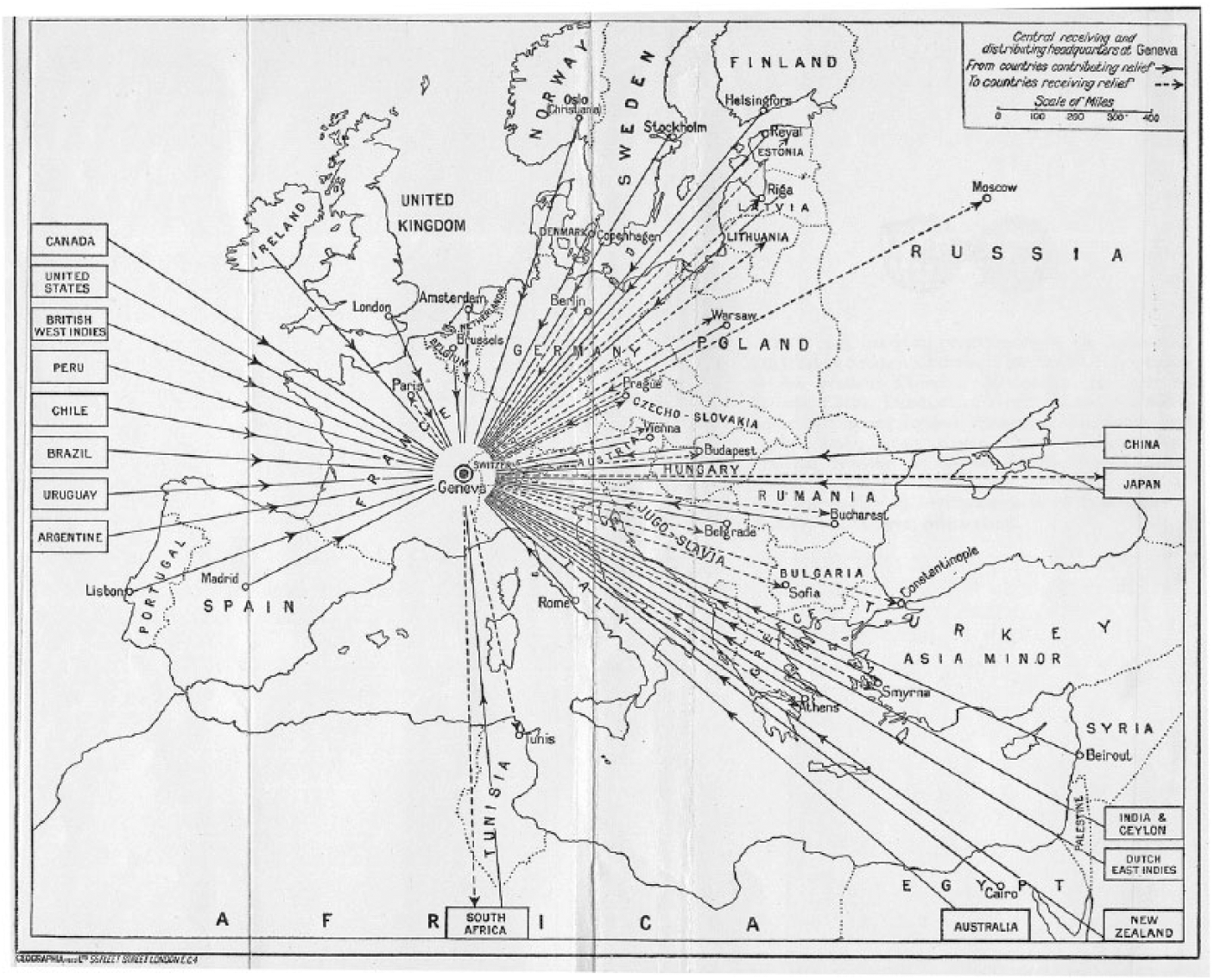
Map showing sources and recipients of ESR donations 61
Perhaps the greatest contribution the ESR made in its efforts to promote a Christian internationalism is the way it influenced the lives of key leaders of the early to mid twentieth-century mission and ecumenical movement. Willem A. Visser ‘t Hooft, the first general secretary of the World Council of Churches (WCC), had his first experience of international leadership at an ESR student conference in Turnov, Czechoslovakia. He was a twenty-one-year-old student leader in Holland when, in April 1922, he was asked by Conrad Hoffmann to serve as the secretary for the Turnov conference of eighty students from more than two dozen countries. There, in heated debate, he demonstrated his leadership potential in resolving a conflict about how to express the very essence of the ESR’s “international responsibility.” 63 A Jewish student from Cambridge named Harold M. Abrahams joined Visser ‘t Hooft in appealing for international friendship. (Abrahams later became an Olympic track star featured in the 1981 Academy Award–winning film Chariots of Fire.) Many others in the ESR believed that animosities toward Jews and others could be overcome at conferences like these and that a bold new internationalism could be born.
In the years following the 1922 Turnov gathering, however, it became more difficult for the ESR to embody its internationalist ideals. Nationalistic and anti-Semitic feelings persisted throughout the first five years of the ESR’s work in Austria and in several other countries. In a 1924 report from Austrian student leaders at an ESR conference, the Austrian leadership was unapologetic in stating that they “have little use for an internationalism which attempts to eliminate or destroy national consciousness.” The report went even further, stating that the “Austrian students are without question anti-Semitic. We are prepared at all times to explain this attitude although we do not believe that such explanation belongs here [in the report].” 64
Anti-Semitism in the ESR was not confined to written reports. Ruth Rouse proved her mettle in her ability to break up an impending fight at an ESR breakfast in Vienna shortly after a German nationalist student group wrecked a Jewish cafeteria.
At our breakfast all was peace till about 9am, when a small band of stick-bearing Deutsch National students came into the buffet . . . shouting and being aggressive. In my calmest manner I walked up to them with a large smile and my sixteen words of German (three of which are not polite), I explained it was no use their acting like this—I didn’t know who was Jew and who Gentile and didn’t wish to—either we worked for all or none—if they turned anybody out, I should also go with the food. All the aggressors were very polite, except one. I told his companions kindly to help him and themselves out.
65
As this incident illustrates, the barriers to internationalism within the ESR were sometimes insurmountable.
A year after the Turnov gathering the ESR once again gathered in Parad, Hungary, where conflict seemed more prevalent than ever before. The ten-day gathering of 125 delegates from thirty-four nations was much more representative of the whole ESR than the gathering at Turnov, but only seventeen students at Parad had attended Turnov. There were far fewer British or American representatives and many more from central Europe. Japan and China also sent representatives. Persons representing Protestant, Roman Catholic, Orthodox, and Jewish perspectives were present, as was one Muslim woman from Constantinople.
Ruth Rouse’s confidential report about the Parad gathering reveals just how challenging it was to bring about a common sense of unity. Rouse noted that from her perspective “the whole conference was dominated by a struggle between good and evil; the battle swayed backwards and forwards in individuals, in groups, in the conference as a whole. Throughout the fight centred round international and interracial points. The real question was, ‘Would the Mind of Christ triumph?’” 66
The points of conflict were legion. Arguments erupted during the conference between Austrian students and Jews (who requested and were granted permission to come as a Jewish-only delegation from Germany, Austria, and Poland), Greeks and Turks, and Romanians and Hungarians. But at the end of the ten-day conference the very public conflict between the French and German students at the start of the gathering was matched by an equally public reconciliation between a French and German delegate. Rouse made a moving report of the incident: “There was silence; then thunders of clapping which somehow did not seem irreverent: then silence again, and sobs, not from the girls alone. Mr. Hoffmann spoke, something that was all but a prayer, and helped, but I don’t remember what he said. That was the end. I have never felt such an atmosphere: it was the Coming of the Holy Ghost, clear shining after rain.” 67
The ESR worked for interracial reconciliation in informal ways, as well as, from the very beginning, by promoting international student exchanges between countries. Students stayed for periods of three months to four years, and Rouse praised international student exchanges as “the strongest factor of all in bringing about international understanding. Small wonder that to-day the students in Buenos Aires, Argentina, know more of Saratov, Brno and Zagreb than they did of Rio four years ago. . . . Negro students in South Africa can give you points on the university situation in Prussia.” 68
The Christian internationalism expressed in student exchanges or in remarks by Hoffmann and Rouse at student conferences had its strongest secular expression in the collaborative work the ESR did with the League of Nations. Established just eight months prior to the ESR in January 1920, the League of Nations did not begin to collaborate with the ESR until late in 1922 or early 1923. The ESR worked most closely with the League of Nations’ International Committee on Intellectual Cooperation (ICIC) and the High Commission for Refugees. The former office was one of thirteen organizations established by the League of Nations to serve the League in an advisory capacity on technical or legal matters. The ICIC was somewhat different, as its purpose remained vaguely defined in terms of cultural internationalism to “examine international questions regarding intellectual cooperation.” 69
One of the undersecretaries with oversight of the ICIC was Dr. Inazo Nitobé, the foremost Japanese internationalist and a Quaker. 70 His role was to work specifically in transnational intellectual cooperation with the League’s ICIC. 71 He briefly served on the ESR’s Executive Committee from 1923 through 1924 and sought to promote the work of the ESR by getting it officially recognized as an organization worthy of support from the League of Nations. 72 But the effectiveness of this collaboration between the ESR and the League was ultimately short-lived and limited. On at least one occasion, Nitobe’s work to promote the ESR fell short when ESR leadership noted that in a list of organizations working with student refugees, the ESR was left off the list, while other organizations that were far less engaged in this work were included. 73
The other advisory organization with which the ESR worked, the High Commission for Russian Refugees within the League of Nations, established in June 1921, was overseen from the beginning by the Norwegian explorer and humanitarian Fridtjof Nansen. 74 Nansen had by this time already repatriated more than 400,000 prisoners of war, including many Russians; his good reputation in private humanitarian organizations made Nansen ideally suited to coordinate refugee relief efforts for the League of Nations. From the start of the ESR’s work in Russia late in 1921, it was in contact with both the American Relief Administration and Nansen’s High Commission for Russian Refugees. Over the next several years, however, their work with the ARA would be much more significant as Nansen’s High Commission (sometimes also called the International Committee for Russian Relief) was limited in its funding and contributed perhaps only one-tenth of the aid that the ARA did. 75
Nansen and his Commission for Russian Refugees were still important for the ESR’s work in Russia. Nansen was the most high-profile internationalist, with the possible exception of Herbert Hoover, to assist in publicizing the ESR’s work with students around the world. Nansen’s close relationship to the Soviet regime facilitated the ESR’s ability to gain entrance to the country, and for two years the non-American section of the ESR worked under the auspices of the Nansen mission. 76
Nansen was suspect in the eyes of many people in the West for being too closely aligned with Vladimir Lenin’s Russia, and evidence certainly supports this suspicion. 77 Paradoxically, the ESR’s “non-American” student feeding stations, which operated under the Nansen mission’s auspices, faced a much greater challenge to remain nondiscriminatory toward Russian students than the ARA-funded ESR feeding stations. Nansen’s work was perceived by the Soviets as the organization more easily swayed by the Soviet regime than the ARA. The ESR representative in charge of oversight of the American section of the ESR, E. T. Colton, wrote that in contrast to the Nansen mission in Russia, the ARA “insists on absolute independence and control, and gets it, and of course the government does not like it because instead of helping their stalled machinery to get into action, a great, independent foreign organization comes in and does what the government failed to do.” 78
The ESR’s experience in Russia, combined with the challenge of working in the midst of growing anti-Semitism, surely tempered the cultural and Christian internationalism that the ESR proclaimed in its first two years. The ESR was able to remain in Soviet Russia serving Russian students for nearly two years after both the ARA and the Nansen mission withdrew during the summer of 1923, but it never got any easier to maintain its policy of nondiscrimination in a regime that so stridently discriminated on the basis of political allegiances and in opposition to the Christian faith.
Conclusion
As the ESR worked to collaborate with other organizations in food aid efforts and to promote a new kind of Christian internationalism, it also faced challenges from within to maintain its Christian identity and still remain open to participation from students of other religions. The ESR was a branch of the WSCF, which was led by many persons who believed the WSCF had an evangelistic purpose, even if the firmness of this evangelistic commitment was undergoing dramatic revision in statements of the WSCF “basis” during the early years of the ESR. 79 From the start, ESR director Conrad Hoffmann thought about the ESR’s purpose as closely integrated with the WSCF’s Christian mission. “We represent a Christian Organization, and must reveal to these seeking men and women the one Christ the One and Only who can solve the world’s chaos. . . . The Question is one of making our work more efficient and effectual, and more than merely supplying the physical needs. As we face this great possibility of directing human relationships, let us look into the deepest depths of our souls, and see what makes us instruments of God for this work. How can we become more worthy in His hands?” 80 Not all of the ESR workers assembled at this gathering agreed with Hoffmann, and the conference subsequently endorsed a more secularized statement of the ESR’s purpose.
Ruth Rouse also stressed the inherently Christian character of the ESR at many of its student conferences. At the Parad, Czechoslovakia, conference in 1923, Rouse’s desire to bring to the ESR more evangelistic content reached a peak. She wrote, “It would have been so easy then to pass over to an open presentation of Christ as Lord and Saviour that last night, so easy to go on to prayer. But honour seemed to forbid. They were so ready. In a talk I gave in the middle of the conference on ‘Secrets of ESR Success,’ I preached Faith as the Victory, and the meaning of the Cross as strongly as ever I have done, though veiled in a parable. None seemed stumbled and they were very responsive. But one longs for a more direct witness.” 81
Both Ruth Rouse and Conrad Hoffmann continued to long “for a more direct witness.” Ruth Rouse’s resignation at the ESR’s Elmau conference in 1924 coincided with a decision at that conference to further secularize the ESR. Rouse went on to become the educational secretary for the Missionary Council of the Church of England. 82 Conrad Hoffmann left the ESR for similar reasons. In conversation with a colleague in the middle of 1927, Hoffmann expressed his desire to undertake “work of a more positively religious character.” 83 A few years after stepping down from leadership in the ESR, he became the director of the International Missionary Council’s Department on the Christian Approach to the Jews. 84
In spite of Rouse’s and Hoffmann’s efforts, the ESR was ultimately not able to embody for the WSCF an understanding of Christian mission that embraced evangelism as well as relief, and, in fact, may be seen as exhibiting those aspects of the WSCF with which conservative students most disagreed. The formation of the Inter Varsity Fellowship of Evangelical Unions in 1928 was perhaps, in part, a reaction to the growing programmatic priority the ESR received in the WSCF, along with its corresponding neglect of evangelism. 85
Even with these failures and the precipitous decline of the ESR after 1925, the organization was at the forefront in grappling with a number of missiological challenges after the First World War, including the practical and pressing need to feed hungry student refugees. Many of those missiological challenges—like the refugee crisis confronting the European continent in the twenty-first century—are once again familiar. 86 The ESR’s work in developing relationships with the League of Nations after World War I warrants further examination for scholarly understanding of Christian engagement in the public square on matters of foreign policy. The extent to which the ESR strove to develop a thick network of collaborative efforts with other Christian organizations and quasi-governmental ones (like the ARA) is also noteworthy in an age where the proliferation of NGOs “going alone” remains a serious problem. The ESR in the early 1920s may have been the organization that best expressed Christian students’ great hopes for the future for a fellowship that was unapologetically Christian and yet sincerely open to persons from other faiths. The ESR was ultimately not able to maintain a robust Christian identity while still including persons of other faiths, but its attempt to do so may still be instructive for contemporary efforts to develop interfaith friendships even within Christian organizations. Finally, the ESR played a role in shaping the legacy of major ecumenical leaders like Ruth Rouse and John R. Mott, while it also served as a proving ground for a new generation of ecumenical leaders like Visser ‘t Hooft. It helped to instill a kind of ecumenical vision for him and others. A century later, this vision surely needs to be reimagined as new ecumenical networks around the world emerge to accomplish similar tasks.
Footnotes
Funding
This research received no specific grant from any funding agency in the public, commercial, or not-for-profit sectors.
Notes
Author biography