



Abstract
The pastoral responsibility of training children in faith requires an effective method of catechesis. This task, however, is often neglected or poorly practiced in some places. In the context of the Roman Catholic Church in Nigeria, catechesis for children faces many challenges, for it has not been updated since the missionary era. This article addresses this problem by applying a pastoral methodology of kairology for updating children’s catechesis. In a thematic format, it clarifies what needs to be done and how to go about it.
Catechesis for children, which involves leading and guiding children in Christian faith, is part of basic pastoral responsibility. This pastoral duty needs to be constantly reviewed and renewed in light of contemporary challenges. Such reassessment is based on a dynamic understanding of pastoral theology, whose subject is “the existence and activity of the Church in the current circumstances.” 1 This article addresses the pastoral practice of catechizing children by the Catholic Church in Nigeria. I shall systematically apply the pastoral methodology of kairology, which, together with criteria of criteriology and praxeology, are predicated upon the popular see-judge-act methodology. This three-step paradigm, attributed to Belgian Cardinal J. Cardijn (1882–1967), has long been a predominant methodology, eventually finding its way into John XXIII’s Mater et Magister (1961, §236). 2 I shall locate this catechesis within the Scriptures and the Tradition of the church. This study is meant to expose the current shortcomings in carrying out this pastoral demand and to suggest ways of effectively correcting the deficiencies. Any such updating requires that we pay attention to the cultural, political, economic, social, and religious challenges, as I shall explore below.
Catechesis for children within the Gospels and the Tradition
As outlined by the church, the objectives of children’s catechesis flow from the life and teachings of Jesus Christ. In the Gospel accounts, Christ demands that children be allowed to come to him, “for it is to such as these that the kingdom of God belongs.” (Mark 10:14 and Luke 18:16; see also Matt. 19:14). That is, catechesis for children is a way of introducing them to the life and teaching of Jesus and to participation in the community of the faithful. Jesus exhibited this love and desire to bring children closer to himself in many other parts of the Gospels. He healed children suffering from various ailments (John 4:49–53), delivered children possessed by an evil spirit (Luke 9:38–43), and even raised dead children (Mark 5:38–43; Luke 8:51–56).
Catechesis for children is truly a means of initiating, from their earliest stages of development, an encounter between them and Jesus. It will teach them to be influenced and guided by him, and it will cause them to grow in the knowledge of faith. Through the knowledge imparted to these children during catechetical sessions, they are led deeper into the mysteries of God, the Trinity, Christ, and the church. In the Scriptures, we see how Christ thanked the Father for revealing the mysteries of the kingdom to children (Luke 10:21). Even though this comment is to be understood metaphorically, it is clear that the docility and open-mindedness of children make them more receptive to the Word of God and the teachings of the church, unlike the critical and often skeptical minds of most adults, the so-called wise and learned. Through catechesis, therefore, children may become acquainted with divine realities and may be protected from sin and its consequences.
Likewise, in the Tradition of the church, teaching children on matters relating to their faith occupies a central position. We find the earliest voices in the Pauline and Johannine epistles. In the Epistles to the Ephesians and the Colossians, Paul advised children to be obedient to their parents and also admonished parents on how to treat their children (Eph. 6:1–4; Col. 3:20–21). In 2 John 4 the Scripture says, “I rejoiced greatly on meeting some of your children who live in accordance with the truth, according to the command we have received from the Father.” Such passages testify to the practice of catechesis for children in the early church. 3
Modern catechism, starting from the Tridentine Catechism, which was adapted in the catechism of Peter Canisius (1521–97), 4 catechisms of E. Auger (1515–91), 5 catechisms of Robert Bellarmine (1542–1621), 6 the 1551 Syllabus of Christian Doctrine of Jerome Martinez (1532–1618), the 1599 Christian Doctrine of Gaspare Astete (1537–1607), and others incorporated the methodological structure for catechism of children. Turibius Alfonso de Mongrovejo (1538–1606) ordered the compilation of a Catechismo mínimo for children, which was later called Synodal Catechism. Meanwhile, Bellarmine’s Brief Christian Doctrine (1597), which was specifically designed for children, seems to have been expressly approved by Pope Clement VIII. This was done in 1598, and Clement VIII afterward ordered all members of the Confraternity of Christian Doctrine (CCD) in Rome to make exclusive use of the Bellarmine method. 7 This practice was developed further beyond the sixteenth century.
Ikenna P. Okpaleke with children after their First Holy Communion, on March 31, 2013, at Saints Anthony and Jude Parish, Umungasi, Catholic Diocese of Aba, Nigeria.
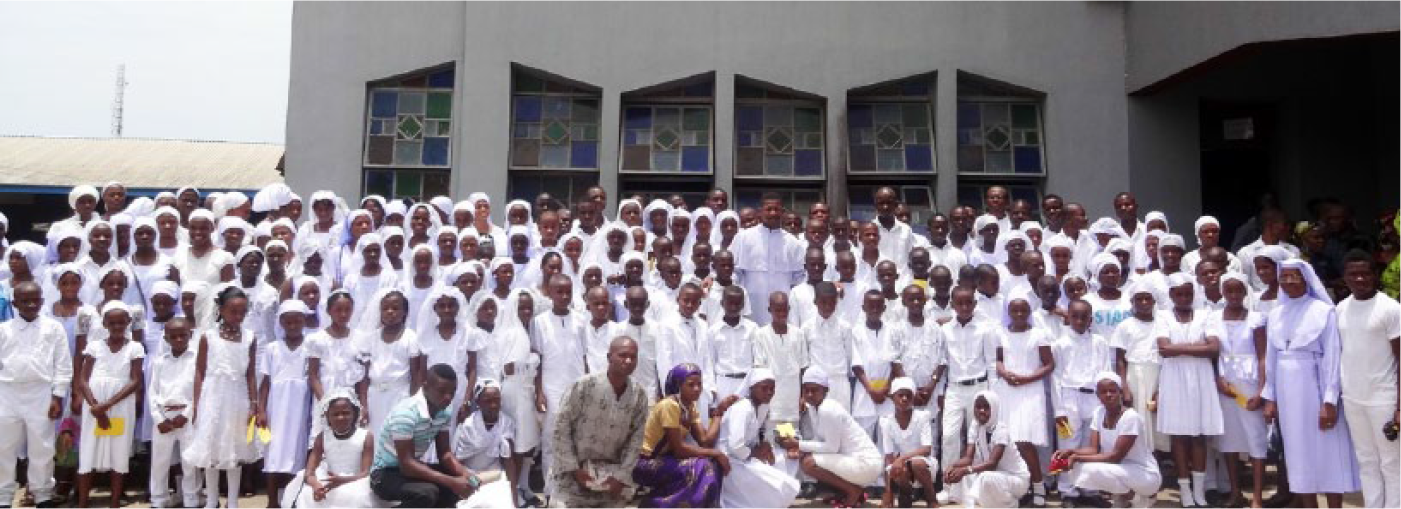
Up to the period of Vatican II, catechesis in general and for children in particular witnessed a tremendous development. Today, debates surrounding catechesis have intensified, new perspectives for pastoral catechesis are outlined, and fresh under-takings are multiplied. 8 While in some places these innovations align with the general ecclesial aims and objectives of catechesis, in others, the tendency is to adapt catechesis to the desires of the society, in which case some essential aspects of the faith may be partially or completely sidelined. 9
Pastoral paradigm of kairology and catechesis
Kairology, as it applies to the pastoral praxis of catechesis for children, considers the current practice of this pastoral activity. Derived from the Greek kairos (a critical or opportune moment), kairology is essentially sociological in nature. As a methodology of pastoral practice, it “entails a theological-sociological or theological-psychological analysis of the current situation of the redeeming Church activity, making use of empirical studies.” 10 It raises the questions of how catechesis for children is practiced today, especially as it conforms to or deviates from the general aims and objectives of catechesis. What methods are used today for the catechesis for children? What are the circumstances in which this pastoral activity is being practiced? What factors influence the set aims and objectives of this program in our contemporary society? These are the basic questions that I address in this section. It is important, however, to contextualize the practice within the African understanding of life, which can be generally applied to the Nigerian context.
Catechesis for children within an African worldview
In order to properly contextualize the pastoral practice of the catechesis of children within the traditional African worldview, we must review African traditions and cultures, particularly African religious practices. We consider here the education of children with respect to African religious beliefs, norms, and practices. One should, of course, be careful not to apply the term “African” homogeneously but to pay attention to what obtains in specific African communities.
In a typical traditional African society, such as Igboland of southeastern Nigeria, the father has the primary responsibility for teaching his children about the faith. This is especially so with the male children, as the girls are mostly left to the care of their mothers. The father teaches his sons primarily through instruction and action. At sacred hours (esp. early morning or very late in the evening), fathers tell their sons about the worship of God, how God acts when offended, the secret of success in life, the customs of the land, and the catalog of abominations to avoid, and so on. Also he takes along his sons when he goes to perform rituals, namely, actions that express faith. For instance, the son could be taken along when there is a need to offer sacrifices, to consult the oracle, to carry out morning libation, to pray to the personal spirit (chi), and so forth. The son thus learns by observation. Parental example remains at the center of religious, or catechetical, upbringing of children. According to an Igbo saying, “Nwa ewu na-ele nne ya anya n’ọnụ, ọ mụta ịta ọgbụrị” (The kid of a goat learns how eat grass by observing its mother eating). This methodology of instruction and action applies to Christian catechesis for children. Beyond the recitative pedagogy of catechesis, children are equally expected to learn by observing adults, especially parents and godparents, who ideally serve as role models in the faith.
Another effective practice found in the traditional African culture is the practice of “tales by moonlight.” This is the practice of telling children stories, myths, and legends in the evening under the glow of moonlight. As an essential aspect of African oral tradition, this method of interaction has proved effective in communicating morals and faith to children. The practice is set in an atmosphere devoid of fear and intimidation, giving children the freedom to ask questions concerning the spiritual and moral implications of the tales. Within an interactive setting, children are encouraged to derive the moral lessons of the stories themselves. By so doing, the values are learned better than when simply committed to memory without any reflection, as is often the case in children’s catechetical practice in most parishes. These tales are not just fictitious, other-worldly constructs but are mostly myths that have existential relevance in the society.
Situating catechesis for children in today’s society
Times have changed, and times are changing. Today’s society has undergone radical transformation in many areas of life, and such changes should be of prime concern in any catechetical program of the church. I examine this concern under four areas of interest, namely, ecumenical relations, politics, culture, and economics. All of these have important implications for how we organize the catechetical instruction of children in Nigeria today.
In relation to other ecclesial communities
Given the plurality of Christian denominations, which include Orthodox churches, Protestants, African Indigenous Churches, and Pentecostals, there is urgent need to reassess our Catholic catechism for children based on the practices and influence coming from these various Christian communities. A particular level of challenge comes from the Pentecostal churches, which have a very definite approach to catechizing children. For instance, Pentecostals devote much time to the study of the sacred Scriptures during their Sunday School programs. 11 Children are taught directly from the Bible. Using a variety of teaching aids, teachers introduce children to biblical stories, especially the life of Christ, which is explained to them in pictorial forms. Furthermore, they are trained to memorize Scripture passages and to recite freely from the Bible. Very early, they are given opportunities to share, even preach, the Word of God to others. The general impression is that they are taught that the Bible alone has the answers to all of life’s questions. To some extent, this method is creeping into the Roman Catholic Church in Nigeria, which is evident in the religious groups that many children attend, such as Block Rosary, Holy Childhood, or Legion of Mary. Some of the instructors in such gatherings teach the children from the Bible and exhort them to read their Bibles at home. This influence coming from the Pentecostal Church is welcome, though effort should be made to relate the Scripture to their experiences in the world of today without at the same time implying that the Bible offers a propositional or prescriptive solution to all the challenges of life. It is therefore the work of the Catholic Church in Nigeria to find ways of adapting and extending this new trend to other children who do not belong to these religious associations.
Again, Pentecostal churches always include a special ministry for children apart from the Sunday service for adults. During Sunday services, children meet in a different place and are under the care of the youth pastor. In this gathering, the children have their own choir, teachers, and so on. In the Catholic Church in Nigeria this is not entirely strange. There has been an effort in some parishes to have children’s Mass on Sundays. The only problem here is that children are often out of control during Mass because they receive no special attention, unlike in the Pentecostal churches, although a few Catholic priests are gifted in handling a group of children. But it must be noted that Catholic priests in Nigeria do not receive any pastoral training in children’s or youth ministries. Also, some Catholic parishes have a children’s choir, 12 Boys Scouts (who serve as ministers of hospitality, i.e., as church wardens), children lectors, altar boys and altar girls, all of whom participate actively at Sunday eucharistic celebrations. Yet, there is need also for “youth priests” (following the Pentecostal model of “youth pastor”) who are specially trained to minister to children and youth.
In relation to politics
Catechesis for children must also be a tool for preparing children to become good citizens and leaders. Since the political terrain of our society is riddled with potholes of corruption, catechesis for children can serve as an opportunity to train children to pursue justice, fairness, and character.
Catechesis for children provides an avenue for training children in the rudimentary principles of leadership. Opportunities could be creatively provided for children to develop their ability to organize and lead small groups. Models of successful leadership in the Scriptures could be used to teach and instruct them. A comparative study of these models and those we have today in both the church and society could also be helpful.
The civic duties of citizens can be integrated within catechesis, since there is nothing contradictory between being a good Christian and a good citizen, except where the demands of citizenship radically oppose the Gospel. It is important that children know their social duties, obligations, and responsibilities, as well as their rights and privileges. Their knowledge of basic human rights and the implications of antisocial behavior could be a sure way of restoring sanity to society. The modern program of “enlightenment” should be done in the light of the Scriptures and faith of the church.
In relation to culture
With regard to our traditional African culture, we have already seen the pedagogical tool of narrativity. Often, the element of narrativity is not strongly applied in teaching the children about the life of Jesus, as expressed in the Gospels. Narrativity is capable of creating vivid pictures in the minds of the children of what is taught. As such, narratives from the Gospels should be told in the way people like to narrate legends and stories, drawing on every resource of memory, imagination, intelligence, and heart.
Cathechists could sometimes use songs that reflect the content of the catechism or doctrine. This is an important factor in traditional culture, for songs are bound up with every important moment of life: joy, death, sorrow, and so forth. The main stages of the life of Christ could thus be told with songs and conveyed to children in ways that are hard to forget. A classic example of such use of song is a popular Fatima song among Igbo Catholics: “N’obodo Fatima, na 1917, eze nwanyi nk’enigwe biakwutere umuaka ito” (In 1917 in the town of Fatima, the Queen of Heaven visited the three children).
Proverbs, which often express concrete life experiences, can also be helpful. In proverbs, instructions that communicate experiences of joy, suffering, love, and hate are conveyed in a subtle but profound manner. The Gospel of Christ and God’s wisdom, as taught during catechism classes, should be deployed to throw the light of faith on such proverbs. And in a critical manner, the Gospel can also be used to reformulate some of these proverbs. One example is the Igbo proverb “Egbe bere, ugo bere; nke si ibe ya ebena, nku kwaa ya” (Let the kite perch, let the eagle perch; should either one keep the other from perching, let its wings break), which could be reformulated by replacing “nku kwaa ya” (let its wings break) with “ya gosi ya ebe o ga ebe” (let it show the other where to perch).
With regard to the contemporary culture, one discovers that catechesis for children suffers adversely. In today’s society, where there is much emphasis on individualism, parents tend to rent flats and effectively lock up their children while the parents are away. Such individualism, which does not recognize the right of the other to contribute in the formation of one’s child without express authorization, makes it difficult to persuade parents to allow their children to attend catechism classes. Parents often react angrily when their children are punished by others, even with the use of noncorporal measures.
Also, the problem of insecurity contributes to the hesitant attitude some parents have regarding allowing their children to go for catechism. Prominent cases of kidnapping of children in our society today affect the turnout of children for catechetical instructions.
The current pop culture provides a dangerous substitute for catechesis. Instead of learning Christian hymns, children are quickly captured by the sounds and lyrics, steps and bounces of hip-hop music, both local and foreign. Instead of memorizing the litany of the Blessed Virgin Mary, they learn the names of different artists. Instead of watching the lives of saints, they train their eyes on Hollywood and Nollywood movies with minimal parental control. Instead of reading their Bibles, they read romantic novels and magazines. Instead of examining their life experiences in relation to the Gospel, they analyze European soccer. Instead of belonging to and attending prayer meetings of religious groups (such as Legion of Mary, Sacred Heart, and St. Jude), they devote themselves to foreign sports clubs (such as Manchester United, Chelsea, Arsenal, and Liverpool). This all is quite unfortunate. We need to creatively find ways of drawing the attention of our children toward matters of faith.
Meanwhile, contemporary media culture, with its liberalized window, can be either negative or positive in its influence on the current practice of catechesis for children. On the one hand, it provides children with much and confusing religious materials, such that they suffer a kind of confusion or crisis of doctrine at an early stage in life. On the other hand, it is also an effective means of reaching them—assuming that we have catechism classes that extend beyond the church compound into their very homes, and even rooms. In other words, there is a need to take catechesis into social media, including WhatsApp, YouTube, Twitter, Instagram, and so on. The church needs to reach out to our children wherever they are, using all means available.
In relation to the economy
Is there really an economic aspect of catechesis for children in our parishes? Yes, in that some parish priests allow for compromises to be made regarding the qualification of candidates for reception of the sacraments. Since some of the Catholic parishes require funds for the maintenance of the parish, those who come for the sacraments are often asked to make some financial contribution. The consequence is that priests can be tempted to compromise standards in order to have as many children admitted to the sacrament as possible. As reaction to this practice, some parents withhold their children and wards from attending catechism classes until the last minute, since neither their regular attendance nor passing of the examinations is considered necessary for their admission to the sacraments.
This monetization of the sacraments, which is close to the sin of simony, is gradually destroying the foundation of catechesis for children in some parishes. It is adversely affecting the level of the knowledge of Catholic doctrine and practice, since people are no longer well prepared before they receive the sacraments. Virtually all they need to do is to pay a fee and have their names appear in the list of those receiving either First Holy Communion or Confirmation. Some bishops in some dioceses, however, are trying to stop this practice by subjecting the candidates (esp. for Confirmation) to serious scrutiny in the church before the sacrament can be administered. Many candidates have been disqualified through this method. But must we wait for the bishop to disqualify someone randomly on the day of reception of the sacraments? We need to put a check on the materialistic tendencies of those priests who sacrifice their pastoral duty on the altar of money.
Observations concerning the teaching of catechesis for children in parishes today
Beyond the areas of attention that I have presented above, I present here some further facts, based on my personal observation in various parishes where catechetical instruction for children is carried out. These observations are random, not systematic. The practices and my observations are limited to Nigeria, specifically within the southeastern part of the country:
Catechism classes are often organized for children specifically in immediate preparation for the reception of the sacraments, especially Confirmation and Holy Eucharist. There are also classes for children who did not receive infant baptism.
Often the children are left in the hands of lay instructors, some of whom are not well informed on matters regarding the doctrines of the church. Sometimes, the children are even left to be instructed by their fellow children, whose duty is simply to read out the lessons for others to repeat.
Ecclesiastically approved catechism booklets are used in the instruction of the children. Some parishes, mostly in the urban areas, do improve their classes by adding other simple prayer booklets, so as to teach the children the basic traditional prayers of the Catholic Church.
The normal teaching method is that of making the children memorize the question-and-answer format of the instructions, with little or no effort at explaining to them the meaning of what they memorize. Often the doctrines are not interpreted in relation to their daily experiences.
In most places, especially in most of the parishes in southeastern Nigeria, seminarians on an annual six-week apostolic work are assigned the primary duty of teaching catechism to children preparing for the sacraments. The parish priest, who is the chief catechist of the parish, often does not create time to instruct or even supervise what is being taught these children and how they are being taught.
At the end of the catechism classes and before the reception of the particular sacrament, the children undergo examinations, which can be either overly difficult or overly simple, depending on the parish. That is, most dioceses have no standard curriculum and syllabus for instructions and examinations.
The above issues suggest that the children are not taught with instructional materials such as movies, animation films, and pictures, which could help them grasp what they are being taught.
There is no differentiated catechetical instruction for the various age brackets of the children, since these classes are not regular in most parishes. Children commence catechetical classes only when the need arises. In other words, there are no specifically post–First Holy Communion classes or post-Confirmation catechism classes for the children in order to deepen their knowledge of the faith and to lead them to a maturity of faith.
In most cases, the Bible is never used in instructing these children. This lack accounts for the catechists’ poor knowledge of Scripture, especially the common biblical stories. One must acknowledge that the CCD is quite active in some parishes more than in others.
The instructions are sometimes hurriedly given, such that some children cannot follow the pace of the instructors, most of whom are impatient with slow or poor responses of the children. In other words, the different learning capabilities of children are not always taken into account during catechetical processes.
There are cases of excessive corporal punishment of children who fail to answer questions correctly, come late to catechism classes, or misbehave during the classes. For this reason, some children are afraid to attend catechism classes.
The above observations are mostly negative and subjective. My desire is simply to call attention to the necessity of revision in these areas. Since the observations pertain to practical issues, solutions may require adapting measures specific to each context. Catechetical instructors when professionally trained, officially deployed, and adequately remunerated by the diocese could represent a general way of improving the teaching of catechesis in most of our dioceses.
Conclusion
The spiritual life and growth of children are primary responsibilities of the church, as it is also for parents. Catechesis for children is the most appropriate pastoral setting for bringing children closer to Christ. This ecclesiastical companionship of children toward maturity of faith must be organized in a way that promotes their growth and development, not only spiritually but also socially, culturally, and otherwise. Laxity and aberrations must be avoided, while pastoral innovations, creativity, and commitment must be seriously encouraged. Only by paying equal attention to the ecclesiological, sociological, and cultural elements of the pastoral practice of catechesis for children in today’s context can the effectiveness of the pastoral methodology of kairology be maintained.
Footnotes
Notes
Author biography