



Abstract
In writings by Nellie Arnott, who taught for the American Board of Commissioners for Foreign Missions in Angola from 1905 to 1912, we find a complex interplay between affiliation and distancing in portrayals of her students and their communities. A somewhat different version of Arnott and her students appears in narratives written by editors and contributors to her main publication venue, Mission Studies: Woman’s Work in Foreign Lands. This essay investigates discursive tensions between her own narrative stance and that of her magazine managers, whose views on racial issues often displayed stereotypical bias against, and limited knowledge about, Angola.
We begin with stage directions and an excerpt from a play script for children, published in the early twentieth century in a periodical sponsored by a Chicago-based women’s mission organization:
(Seventh child, representing Africa)
And now ’tis quite another scene, Africa’s girls with tight-curled hair Are met in Kamundongo’s school And learning to be Christians there. To teach them, we’ve Miss Arnott sent In darkness of the heathen night, But when our mission work has spread The morn shall come with gospel light. These boys and girls, like us may come To Christ, and have their sins forgiven, And may our Kamundongo school Help them to learn the way to heaven.
Missionary literature for children
Thus reads the “Africa” portion of a “Children’s Christmas Program,” written by a Mrs. Norton of Three Oaks, Michigan, and printed in the journal Mission Studies: Woman’s Work in Foreign Lands in December 1907 (376). As one in a series of vignettes depicting children being served by Protestant missions all over the world, “Africa” invites its audience to celebrate the work of one teacher—Nellie Arnott—and her students. Through a progression of portraits, including mission stations in sites such as China and Japan, this theatrical narrative also envisions a community fostered through shared transnational prayer. “So still may all the children come. . . . To Him to pray . . . And try to please Him day by day,” concludes the Christmas pageant script. However, Arnott’s own request for her juvenile readers in the US to “pray for the children of Africa” foretold a plan and rationale for educational worship that conflicted, to some degree, with the goals of Mission Studies editors, as they sought to manage children’s worship practices themselves. 1
“Miss Arnott” was Nellie Jane Arnott, a Congregational missionary of the American Board of Commissioners for Foreign Missions (ABCFM), who in 1905 went to teach at one of its West Central Africa mission stations, located in Kamundongo, Portuguese West Africa (or Angola). Arnott, though hired under the auspices of the male-run ABCFM in Boston, was financially supported by the Woman’s Board of Missions of the Interior (WBMI) in Chicago, the Midwestern counterpart of the ABCFM’s Woman’s Board of Missions in Boston. 2 Mission Studies, the official journal of the WBMI, was under the long-time editorship of Sarah Pollock, a former missionary to India. The journal was widely read in Congregational homes in the Midwest, the region under the WBMI’s jurisdiction. Articles for adults and children included letters and information from missionaries, contributions from WBMI leaders, and submissions by journal readers and supporters. 3
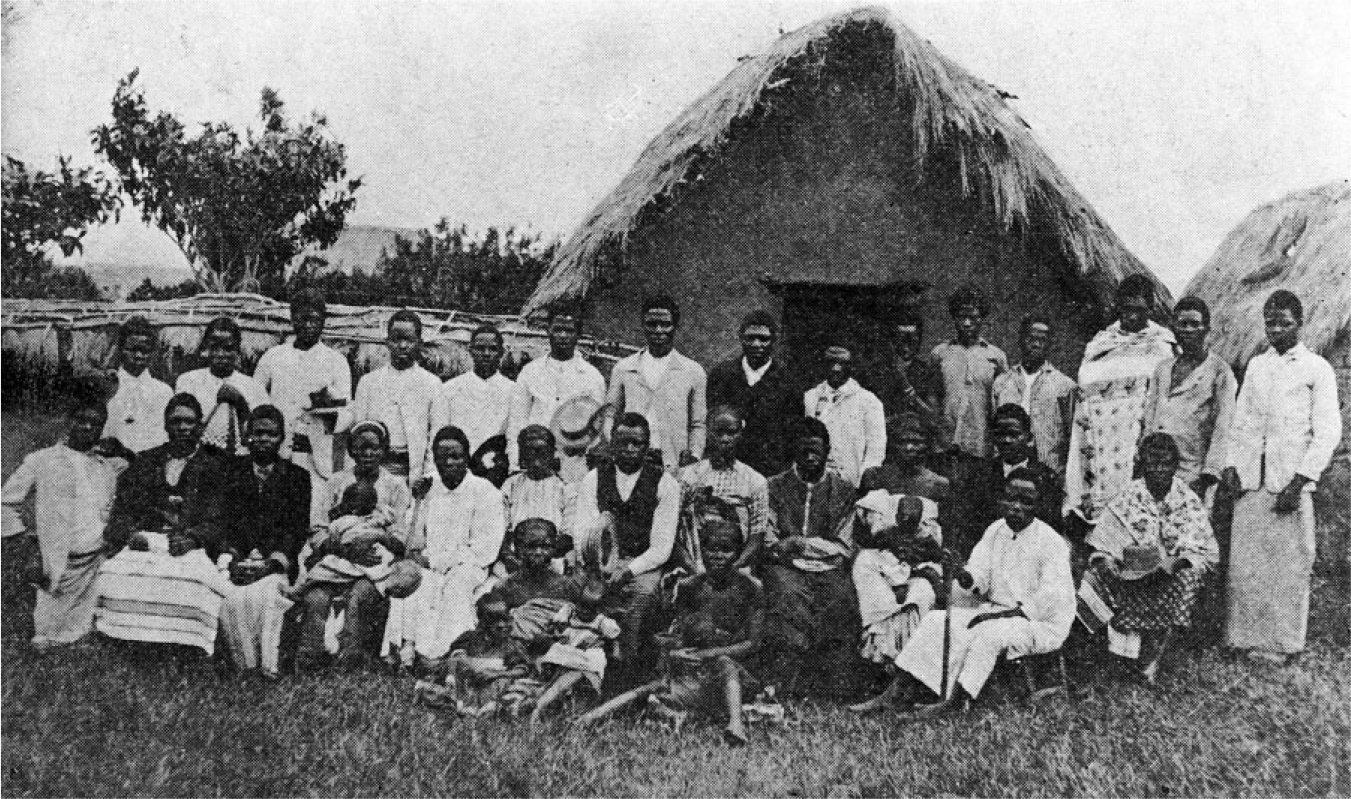
Nellie Jane Arnott taught at a mission station in Kamundongo, Angola (above), from 1905 to 1912. Known as a children’s missionary, she used adventure stories and geography lessons to engage Sunday School students “as if they were joining the mission journey,” according to a published report. (Nellie Jane Arnott Darling Papers, 1905–43, BANC MSS 92/901 z, box 2, vol. 1. Courtesy of The Bancroft Library, University of California, Berkeley).
Like other recurring portrayals of Arnott and her work, this performative section from Norton’s theatrical script affiliated with a then-familiar mix of hybrid genres aimed at youthful audiences, but with an assumption that adult mediators would manage children’s engagement with such texts. One dimension of this multilayered management process would have involved the Sunday School teacher’s direction of child learners’ interpretive worship. Earlier on, interventions by the periodical’s editors represented another layer of mediation, an ongoing process that repeatedly wove together conventions of mission texts seeking to teach children Protestant Christian principles while also recruiting their support of the foreign mission movement. Within this network, Arnott regularly crafted stories for youthful readers, presenting herself as “mothering” not only the mission children whom she taught in Africa but also US Congregational children as she educated them about her work abroad.
Within this web of complex storytelling, as Rennie B. Schoeplfin has documented in a study of medical missionary literature for children, narratives drew from several genre traditions: travelogues, biographical profiles of heroic men and women, and accounts of “heathen” and the “uncivilized” places where they lived. Unabashedly didactic, these stories often encouraged children to support foreign missions by raising funds. But connecting to mission work through personal and collaborative prayer was another important pathway promoted through these narratives. That is, while learning about mission work, the foreign children it served and its adult leaders, young white, largely middle-class US readers, were taught to pray for its success, thereby strengthening their own identities as enlightened Protestant Christians. By engaging in such stories through embodied performances at Sunday School, children could form a prayerful alliance with the Christianizing endeavors being carried out far away. 4
Nellie Jane Arnott
Arnott, an Iowa resident who served in Angola from 1905 to 1912, had attended Moody Bible Institute in Chicago and had taken a kindergarten-training course at Oberlin College (Oberlin, OH). She had also taught for five years in American Missionary Association schools in Savannah, GA, and Meridian, MS. 5 The WBMI identified Arnott as a “children’s missionary,” not only because of her teaching in Angola but also because of her Mission Studies articles specifically directed at child readers. These stories represented only one among a notable array of genres that Arnott produced during her mission service, including “circular letters” mailed to adult supporters (but often including messages to children) via a resending chain, official reports to the ABCFM, and articles for multiple periodical audiences, not to mention her diary writing and personal correspondence. 6 Given her prolific textual production, it’s unsurprising that, as the poem above indicates, Arnott herself became a “character” in accounts that multiple contributors to Mission Studies prepared for children.
Although a detailed analysis of Arnott’s own texts for children is beyond the scope of this article, we do want to highlight the contrasting goals between her writings and those about her, like the play-within-a-play referenced in our opening. By calling on American children to embody their Angolan counterparts, Arnott herself, her teaching, and stories about Arnott exemplify the ongoing efforts of Sunday School educators and Mission Studies author-editors to link prayerful performance of racial difference with a view of the foreign mission enterprise as continually inscribing racial hierarchy, even while envisioning a transnational community through a shared commitment to conversion of the “heathen.” For Arnott, Christian living, not race, was the important marker of distinction; her Umbundu students, she believed, could eventually become teachers, ministers, and other leaders, forming a “stream of blessing . . . for Africa’s future.” Furthermore, while Mission Studies writers certainly encouraged general prayers for Arnott and her work, they also sought to raise funds through their dramas and lessons for youth. Arnott only indirectly mentioned the need for donations in her children’s writings; rather, she stressed that her readers’ prayers were essential to the success of the Angola Mission and her Umbundu students. She wanted her own readers at home to understand that Umbundu children were worthy of their prayers not merely because they were “heathens” but because they were “just as dear to the Father as any one of us.” 7 Her religious views, Arnott had written in a letter to the ABCFM when applying for mission service, were in accord with those expressed in What the Bible Teaches by Reuben A. Torrey, head of Moody Bible Institute when she attended. We can thus surmise that she believed that effective prayers for her Umbundu students should address their particular situation and needs. Furthermore, she had faith that the prayers of her youthful readers would have, as Torrey proposed, “especial power” if they “had real unity of desire” in asking for a “specific thing.” Her articles for children consequently had a didactic purpose in order to prepare her young readers for fruitful prayer and worship. 8
US and British Sunday School literature
Stories about Arnott’s experiences in Angola came at a time when US Sunday Schools began to develop teaching techniques that, besides providing spiritual growth, sought to make classes fun; WBMI lessons frequently involved play-oriented activities such as dramas and imaginary travel. Consistent with the “Suggestions for Sunday-School Workers” offered in an article for the Biblical World in March 1900, this approach for blending study of foreign mission teachers and students with performances of those roles could help foster the development of social and spiritual virtue through a strategic mix of study and worship. Thus, as “Suggestions” indicated, while the “principal aim” of Sunday School during this time was “to give a knowledge of the Bible,” it also promoted virtue through prayer-informed activities. Accordingly, this essay opined, “The well-ordered Sunday school becomes the children’s church, and is for most children their only place of worship” (179). In providing age-appropriate pathways to worship, Sunday Schools tapped into engaging teaching techniques attuned with Progressive Era innovations in pedagogy, including learning that moved through “stages” to “constantly touch the experience of the learner” through appealing activities and “conversational method” rather than excessive focus on factual transmission (181). 9
Meanwhile, though not overtly advocating empire, as British (and British colonial) Sunday School literature often did, lessons for Protestant children in the US reflected widening national trends in the American nation’s domestic and foreign policy as the US expanded its international interests. 10 In comparing American worship programs for Protestant youth with those for children elsewhere in the Anglophone world, we find a common bias against the peoples of non-European areas of the world. In the words of Margot Hillel, “Concepts of ‘whiteness”’ emphasizing “security, safety and love” were contrasted with images of “danger, rejection and heathenism” in Anglophone children’s mission texts published at the height of the British Empire. In the US such ideas, according to Karen Sánchez-Eppler, reflected “worries over how to incorporate the nation’s own racial and religious others”; she argues that “connections between domesticity and world mission, home and nation, faith and race that Sunday school stories find unproblematic nevertheless work[ed] to prop repressive imperialist policies and practices.” 11
US colonial and mission context
As Arnott traveled to Angola in 1905, the US was coming to terms with its new role as a colonial power. Affirming racial hierarchies, Americans told themselves that they would uplift indigenous peoples of Hawaii, the Philippines, and Cuba, preparing the colonized for eventual independence. Missions abroad formed a piece of these uplift efforts, as spreading the blessings of Western civilization was a major rationale for evangelical work abroad. 12 Unlike ABCFM teachers and ministers in areas like Hawaii, however, those in Angola had an uneasy relationship with the colonial power, Portugal, as Catholic authorities were suspicious of Protestant missionaries and often accused them of taking the side of Umbundu people in disputes over land and other issues. 13
During Arnott’s service in Angola, the American Protestant women’s foreign missionary movement was in its peak years, encompassing not only missionaries themselves but also supporters at home; some 3 million women held formal membership in female missionary societies by 1915, according to historian Patricia Hill. 14 In an era in which secular travelogues were widely read, missionary journalists like women writing for Mission Studies wrote accounts of remote areas of the world that could be read as Christian adventure stories. 15 Missionary literature was also in many ways an extension of the “domestic literacy narratives” of an earlier generation, as maternal female missionaries sought to Christianize and civilize not only their own children but, more broadly, the children of the world. 16 Through Mission Studies’ writing for American youth, the children themselves could become part of the narrative, acting out the work that female missionaries were doing with children of foreign lands.
In several articles about Arnott’s work in Angola, adventure stories and geography lessons blended in with approaches for engaging Sunday School students as if they were joining the mission journey. A 1908 article offered detailed instructions for a program about her school. “Invite the children to go on a long trip with you for the August meeting, and as a large part of the trip will be by water those who have sailor suits might wear them.” Directions continued that the leader should have “a map of the world, and one of Africa if possible.” After being informed that they were going to visit Miss Arnott, the children were to imagine the journey “to New York by rail, then by boat to Lisbon, changing there to a Portuguese steamer bound for Benguella, 860 miles below the Equator on the west coast of Africa.” An accompanying article told the children that “of course you know that before the missionaries go to them[,] the people of Africa have no books, no letters, and no schools.” But Miss Arnott has “learned the strange language” and now “has charge of three schools with 189 pupils.” 17 In an October 1908 story by May J. Johnston, children were to imagine traveling inland to Kamundongo station, journeying “up from the low malarial coast, across a plateau, over the mountains, through ravines, seeing monkeys, hippopotami, . . . hearing of lions, leopards and a robber tribe of men, camping by night, walking in the steep places, in all going two hundred miles into the interior.” These exciting accounts for US children left no doubt about the need for Christian missionaries to tame not only wild lands, but “heathen” peoples. 18 And performing such scenes would position Sunday School children as social actors, not merely “playing at” the role of missionary but embodying it.
Mission and racial stereotypes
Mission supporters often believed then that indigenous Africans were starting from a primitive stage of evolutionary development, as US textbooks commonly presented the world “according to levels of ‘progress’ attained by different races.” 19 Mission Studies editor Sarah Pollock exemplified this misconception in her description of Umbundu women of West Central Africa: “Their moral debasement is beyond all comparison. . . . Their mind is dull [and] shadowed by superstitious fears. Their present life is narrow, sordid, vile.” Of course Christian intervention led to “transformation,” but any improvements had to overcome great obstacles. Usually referencing “Africa” rather than a more specific Portuguese West Africa or Angola, Sunday School lessons likewise implied that missionary intervention there was not only more needed but also more difficult than elsewhere. 20 For example, in the poem with which this essay began, Miss Arnott taught “Africa’s girls with tight-curled hair” who lived “in darkness of the heathen night.” In contrast, “another scene,” referenced in the first line of the poem, depicted Japan, where children wore “garments gay,” as they “marched around in merry play [o]r cheerful work,” with “bright eyes shin[ing].” Though neither performers nor audience were urged to visit Africa’s “heathen night,” the child narrator representing Japan was “sure I’d like to go there now.” 21 In a Mission Studies drama providing even further contrast, a child representing Japan referenced enjoyable birthday celebrations in his homeland, while a Chinese child invoked a “very happy time” at New Year’s. The child representing Africa, however, described witnessing a terrifying ceremony in which “witch-doctors . . . catch a chicken and twist its head off and pour the blood on their heads and drink some of it.” 22
Other dramas in Mission Studies reveal a similar perception of Africa’s need, intertwined with stereotypes about children of African descent in America. In December 1908 a lengthy play entitled “A Dull Christmas” was based on the premise that several American children, ill with sore throats, had stayed at home while their parents went off to a neighborhood gathering. In a touch of modernity, Santa Claus used his “airship” to transport children from foreign mission schools to visit the sick children. After a “visit” from a girl mission student from a “happy home” in China, the script noted a “little negro [sic] boy” would appear, representing “Miss Arnott’s school in Africa.” Stage directions for the play suggested that children representing all of the areas except “Africa” should wear homemade “costumes” of their country, with the girl representing Japan carrying a bouquet of chrysanthemums. 23 Directions for the “little African,” in contrast, prescribed that he should “be dressed in rather poor American clothing, with his face and hands blackened.” If having child actors in blackface was not unusual in the early twentieth century, the coded description of “poor American” clothing, like the reference to “tight-curled” hair above, linked Angola’s children with the racially inscribed American “pickaninnies” discussed by scholar Robin Bernstein in her Racial Innocence study. 24 Furthermore, to literally perform these racialized stereotypes in a Sunday School setting inscribed the ideology in the context of worship. Recurring characterizations of Africa as “dark” and “heathen” were then typical of children’s religious literature, according to Sánchez-Eppler, as “the rhetoric of religious education remain[ed] deeply mired in the language of race,” and “imagery of religious conversion—out of the darkness and into the light—allie[d] religious education with racial and national norms.” 25
Arnott as missionary heroine
Nellie Arnott herself, not surprisingly, was presented in Mission Studies as doing courageous work to address the shortcomings of African children, thereby bringing them into a transnational Christian community through their learning, especially about religion. 26 Even though Arnott lived “among people who are all black, who wear very little clothing and who live in little huts made out of straw and mud,” read one Mission Studies account, she taught “children to read and write in the Umbundu language”; when children heard “the beautiful, sweet Bible stories” from her, they wanted to “learn to read these stories for themselves.” A “Thanksgiving Festival” article published shortly after her departure for Angola suggested, “We may render deeply grateful thanks . . . that our Miss Nellie J. Arnott . . . has gone to West Central Africa to carry light and love to our dark sisters imprisoned in ignorance and superstition.” 27 Arnott herself thus became a missionary heroine.
Thankful from dirt and superstition They’re led to know the right, Thanks for Miss Arnott, so bright and cheery, Who teaches with all her might.
In this September 1908 “Thank Offering” “response” poem that American children could recite in honor of Arnott’s teaching, we can visualize the US Sunday Schoolers thereby invoking, through a prayer-like performance, how Arnott’s African students were moving from “dirt and superstition” to a Christian “right” life. 28 Accordingly, under Arnott’s skillful hand, the little boy who would visit American children on Santa’s airship in the piece mentioned above was making great progress in his religious studies: “I have just finished reading the gospel of John. . . . And I know several Psalms,” his character said. For the US-based child readers, this characterization of their African counterpart as studying the Gospel and being able to recite “several Psalms” would set up a potential transnational affiliation based in shared prayerful expression of Christian identity. Yet, this affiliation was simultaneously undercut by the African child’s clownish appearance, leaving the impression that, while he might “read” the Bible, he would be unlikely to understand it. 29
Prayer over pennies
Arnott’s own emphasis on creating intercultural bonds through prayer is notable in this context. Despite the mission movement’s frequent promotion of children’s donations, which sometimes took precedence over their prayers, Arnott herself seemed resistant to soliciting children’s pennies; rather, she requested that “the mission bands pray for the children in Africa that they may grow up to love and serve Jesus.” 30 In contrast, for many Sunday School managers of the period, including in the WBMI, seeking youthful donations was a key responsibility; for children, this duty became the “White Child’s Burden,” in the words of Karen Li Miller; children’s “saving of money” to support mission work “correlated with the saving of souls.” For Miller, incorporating fund-raising into Protestant children’s worship services thus cast children’s place in America’s emerging consumer economy in moral and self-sacrificial terms, a move implicitly critiqued by Arnott as a misdirection of religious energy away from prayer itself. 31
Articles in Mission Studies often pointed out that while children were too young to go to foreign lands themselves, their contributions were vital to foreign missionaries’ success. So, after giving thanks for other mission fields, the above “Thank Offering” poem ended:
Thankful for gifts that we can send, Let’s make the nickels dance. Thanks that the gifts mean here and elsewhere, Advance, advance, advance!
Not only could children contribute directly; they could also learn self-denial and sharing in the bargain. “You cannot go yourselves, but by denying yourselves some of the things you like, perhaps, you can bring your money to help send those who can go,” advised a 1910 Mission Studies children’s essay. Appeals for money often took a clever turn; for example, children were to pretend they were visiting Miss Arnott’s school by traveling on a “railroad,” with chairs representing train cars, and on a “steamship,” using their contributions to purchase “tickets” for the journey. 32
Arnott’s missionary goals
Arnott’s attitude about prayer over pennies wasn’t the only way that her perspective differed from that of US-based WBMI storytellers. Arnott, with the benefit of being in Angola, displayed somewhat less stereotypical views of Umbundu peoples than we see in Mission Studies. 33 Her own articles for the periodical, while certainly not free of racist and colonialist rhetoric, sought to educate her American readers about the intelligence of the children whom she taught and their promise for the future of Angola. For Arnott, effective prayers for her work depended upon an understanding that their abilities made Umbundu Christians capable of full participation in a global faith community. 34 For instance, in a children’s article titled “House Building in Africa,” she celebrated the time and skill involved in the construction of traditional Umbundu houses, countering, intentionally or not, the oft-repeated implication in Mission Studies that (non-Christian) Umbundu peoples lived in hastily constructed, flimsy huts. Wanting youthful readers at home to connect with Umbundu children, Arnott wrote about her school, cozy with its “big fireplace,” where she taught her students to “read, write and do numbers.” A children’s Christmas celebration at Kamundongo station, Arnott explained, while different from one in America, involved familiar elements, including a special dinner, decorations, and gifts. 35
When Arnott left for Angola in 1905, she believed that her goal for mission service was to “love & bring [Umbundu] children to Jesus.” 36 She gradually came to see the need for educational institutions, particularly a boarding school where young women, while continuing some of their traditional agricultural roles, could be trained as teachers or as assistants to Christianized husbands in ministering to the Umbundu population. Reflecting her complex stance toward local practices, two children’s articles describing the need for such a school made clear Arnott’s opposition to customs in which girls were married, often involuntarily, at a young age; in her view a school could rescue them from harmful practices and prepare them for Christian domesticity. In soliciting prayers for her work, she envisioned such Christianized leadership: “It pays to give one’s life to the training of native teachers,” Arnott wrote. “They are the ones who must reach the Angola population.” 37
Back from Africa
When she returned home on furlough in August 1912, Arnott spent several months speaking and letter-writing to raise money for the girls’ school. Having become a self-conscious advocate for the region of her mission service, she lamented the lack of interest in the West Central Africa work among her home-based mission movement colleagues, writing in her diary after attending the 1912 WBMI annual meeting: “I feel very much discouraged for it seems as though Africa has little show with so many voices speaking for China & other more attractive countries.” 38
While visiting her parents in California, Arnott unexpectedly became reacquainted with her former fiancé, Paul Darling, a Santa Monica businessman. He had asked Arnott to marry him before she departed for Angola, but she refused, believing that God had called her to African service. Early in her mission term, Arnott agonized over whether or not she had made the correct decision, but in 1907 she wrote to Darling that she planned to remain in Angola. When he proposed again during her furlough, she accepted, though not without inner anguish. “To withdraw from the Mission nearly kills me,” she confided to her diary (March 7, 1913). Arnott and Darling married on May 1, 1913, and what was intended as a temporary leave from Kamundongo became a permanent return to the US. 39
While we do not know Arnott’s thoughts on her portrayal in Mission Studies, we do know that she continued to correspond with her students and celebrate their accomplishments. For example, a student who signed his name Yoano wrote her many years later, “All of the work of God you performed here is still in place. You planted the seed and that seed has borne much fruit, from which we eat, along with our children and so many whom you did not know when you were here in Kamundongo.” 40
At the office of Mission Studies, meanwhile, the need for a Nellie Arnott “character” persisted, at least in the short term, as the magazine featured instructions even after she had married to “let the children build little huts out of brown paper. . . . Tell them of . . . Mrs. Nellie Arnott Darling’s schools.” 41 Managing children’s worship practices through such play as building “huts” and imaginary travel experiences encouraged youthful donations as well as prayers for missions that reaffirmed goals for the movement in line with the WBMI’s US-based perspective. For Mission Studies editors, Arnott was useful not so much because of her own perceptions, but through embodying a figurative “Nellie Arnott,” who could be manipulated to further the goals of the magazine’s editors and the larger pedagogical agenda of the American foreign mission movement in her era.
Footnotes
Notes
Author biographies