




Abstract
In this article I explain the meaning and the importance of a vision, as well as how mission and values help to achieve a vision. Knowing the vision, mission, and values for our lives helps us understand what we must achieve in life. I therefore propose that discovering and strengthening the purpose of our Christian life should include an understanding that working with others involves a dimensional mission theology of reciprocal collaboration. If we want to leave a spiritual inheritance, we need to inspire others. Sharing with clarity one’s vision, mission, and values is significant within God’s kingdom mission.
God gives us life with a purpose within his redemptive mission. I begin with a text of the prophet Habakkuk: And the “Write the vision; make it plain on tablets, so he may run who reads it. For still the vision awaits its appointed time; it hastens to the end—it will not lie. If it seems slow, wait for it; it will surely come; it will not delay.” Hab. 2:2–3 ESV
What a fascinating truth to remind us that the vision God has for his people will take place, even if it seems to be delayed! Time flies by, but any vision that emerges from God’s heart will be accomplished according to God’s mission activity. 1 We show here how a vision helps us to understand God’s plan, which must be done in collaboration with others.
Just as every person has a vision, every institution is born of a vision and lives for a mission. Values are like the foundations, the beliefs on which everything is built and which determine how the vision and mission are worked out. Knowing the vision, mission, and values for our lives helps us understand what we must achieve in life. I briefly show here why a vision for life is needed and also show the connection between the vision, mission, and values of our life purpose. Working together is much better than working in isolation. An interconnected approach with reciprocal collaboration 2 thus provides a theological understanding that will support a vision for the benefit of God’s kingdom.
Vision
A vision is a constructive concept: the ability to see beyond what we perceive in front of us. It defines and describes what one hopes to achieve in the future. We can say that one is born to inspire others with a vision that is aimed at developing and implementing what one wants to achieve in one’s life, which determines the goals and objectives that one wants to achieve. A vision therefore expresses the aspirations and fundamental purpose of what I can achieve during my life; it helps me to understand what my life is centered on.
Within a theological approach, vision includes the way God communicates his will for the future and is therefore the revelation of each person’s purpose. It is a conscious discernment (involving feeling, thinking, and doing) of what God wants a person to achieve in the future, and it is the ability to find the right way to make it happen. Vision is the answer to the question, What do we want to achieve in the next twenty to thirty years?
Expressed briefly, a vision describes what you want to show, convey, or achieve in the future. It is something that should be achievable and possible over time. A vision can include factors such as people, collaborators, countries, benefit, and influence.
In its narrowest sense, like seeing something in a dream-like manner, there was a vision given to Moses, who saw the burning bush (Exod. 3:3); Ezekiel, who had a vision of the valley of the dry bones (Ezek. 37:1–28); Daniel, with a vision of the seventy weeks (Dan. 9:20–27); Peter’s vision to evangelize the gentiles (Acts 10:9–10); and Paul’s Macedonian call (Acts 16:6–10). In contrast, in its widest sense, here I suggest other people in the Bible with a clear vision: Noah (building the ark), Nehemiah (rebuilding the walls of Jerusalem and the faith of the nation), John the Baptist (calling the people to repentance), and Peter (his vision for righteous relationships in society—see 1 Peter 2:11–3:12 etc.). In any vision given by God, the Holy Spirit manifests wisdom, purity, truth, and righteousness. These examples make clear that God gives conviction and power to carry out his vision.
The Lord Jesus teaches us about the significance of a vision. On the road to Emmaus (Luke 24:13–45) Jesus, through his resurrection from the dead, reveals the power of his saving vision for the world. To the two people who entered into dialogue with him, Jesus explained the Scriptures, opening their eyes and minds to understand his vision to bring salvation. Thus, when the mind is opened, a vision is understood. A vision inspires, influences, transforms, and involves others.
Mission
The word “mission” refers to an active concept: it is a response to the understanding of my vision; it is the reason for my existence. Mission defines what a person is dedicated to, explains the particular type of service and specific domain in which it is to be developed, and shapes a person’s public image. Mission is what I must do to fulfill a vision. Mission lays the stress on the present, vision on the future long-term. Moreover, mission includes the use of gifts, which help define what a person should do. From a theological point of view, mission provides the reason to live for a particular form of service in the kingdom of God for the benefit of others. 3 Mission is the answer to the question, What is my reason for living?
There are at least five differences between vision and mission:
Vision involves a conviction regarding a God-given idea, whereas mission is oriented to putting that idea and conviction into practice. With a vision, I look toward the future; with mission, I look at the present.
A vision inspires and explains a conviction regarding an idea, while mission is about dedication to implementing a vision.
Vision involves a mental picture of what we want to accomplish in the future, while mission is the present state of what I do and what I live for.
A vision is described in such a way that it inspires something that lies ahead in the future, while mission describes what is to be done, who must do it, and how one should do it.
Vision helps me to find out where I want to go, while mission helps me to understand what I am called to do.
In thinking through practical experience, the vision that God has given me is the following: “To influence others in the building of two-way bridges in the fulfillment of God’s mission.” The mission that accompanies this vision is this: “To develop a mission theology of reciprocal collaboration for better and effective mission collaboration and to mobilize missionaries to collaborate in the fulfillment of God’s mission.” Over the years I, working with Mission for the Third Millennium, have organized mission conferences in different countries, including the United Kingdom, Spain, Peru, the United States, and Germany. 4 In addition, we collaborate with institutions that are involved in the church’s mission, in consultations and conferences aimed at mobilizing missionaries and promoting a missionary theology of reciprocal collaboration.
Regarding structure, and since mission is what I have to do to fulfill a vision, we might say that structure is the skeleton of a vision. It involves the framework that gives support to a vision’s administration. It is what gives consistency to everything that is done in putting a vision into practice. Therefore, apart from inspiring and influencing others, a vision achieves its end through translation, structuring, being made visible, and becoming readable and communicable to others.
Values
Values are descriptive concepts that help to regulate and ground the practical activity of a vision and mission. In this sense, I provide the following definition of values: Values relate to our beliefs, which influence behavior, and all values are developed and practiced through different rules, which are principles that control, regulate, and direct people’s behavior. In this sense, some values are changeable, and other never change, regardless of family ties, class standing, national interest, cultural values and religious identity, or justice, freedom, and democracy. From a human perspective, the resolution of conflicts over values should be addressed by the community to make decisions that all members must obey certain values. 5 In the case of global issues, the value of democracy, human rights, diversity, and freedom have become substantial and have priority for this present generation. 6 In contrast, from a theological perspective, the theology of the kingdom of God is based on unchangeable values that are universal values. These kingdom values include love, justice, righteousness, hope, compassion, mercy, honesty, fidelity, joy, equality, brotherhood, harmony, and unity. 7 Accordingly, these Christian values are universal and unchangeable for all followers of Christ.
Values in the Christian life are meant to be transformative, for instance, in the transformation of a community to reflect kingdom values, which include values of love, hope, justice, righteousness, and compassion. 8 This theological approach can help change distorted cultural values and evil social structures. 9 Also, this approach indicates that God’s kingdom has ethical values that challenge all cultures, which was proclaimed by Jesus during his ministry.
The values that accompany a vision become unalterable. They help us to understand what glorifies God and to know what edifies me and what does not. Since values define what we believe and what we are, they are permanent, cannot be changed, and demand that we act according to them. These are kingdom values that do not change, in contrast to human values, which can change. 10
Some values do change. For example, in previous centuries (and still in some countries) the value of maintaining “family honor,” even by killing those who offend the family (e.g., Exod. 21:22–24) is high. Now, society would see that behavior as wrong. In contrast, Christian values do not change. They are things we consider unalterable, and all those who share a vision, wherever they may be, live by them. The values that underpin a vision define what we believe as we seek to bring about a vision. They are the rules that determine our day-to-day behavior in fulfilling a vision. For this reason, we say that values have a universal character; that is, they can be fulfilled by everyone, regardless of their context. At the same time, particular values need to be applied to each different vision to strengthen its foundations. Each vision can establish its own values according to the patterns of biblical behavior.
Values define the way we work and do things as we seek to achieve a vision and to carry out our mission. Values answer the question, What do I believe in, and how do I behave in my life? To make things practical, I list here ten values that I consider essential to a vision and mission, namely, to be:

For instance, in the case of Pentecostal services, instead of doing them merely out of obligation, the emotional experience increases motivation to live a holy life,. Beliefs and experiences of participants help them to strengthen their belief and cultural spirituality. 11 These two values become fundamental in their vision and mission for evangelization and discipleship.
To sum up, mission, vision, and values are of such a nature that they communicate both the inward and the outward aspects of an idea and the actions for carrying it out. Those who are committed to a vision can communicate it in different ways and by different means, as well as offer a global approach to what a vision is about, where it is headed, and where the main points for relating to, inspiring, influencing, and involving others may be found.
Strategy
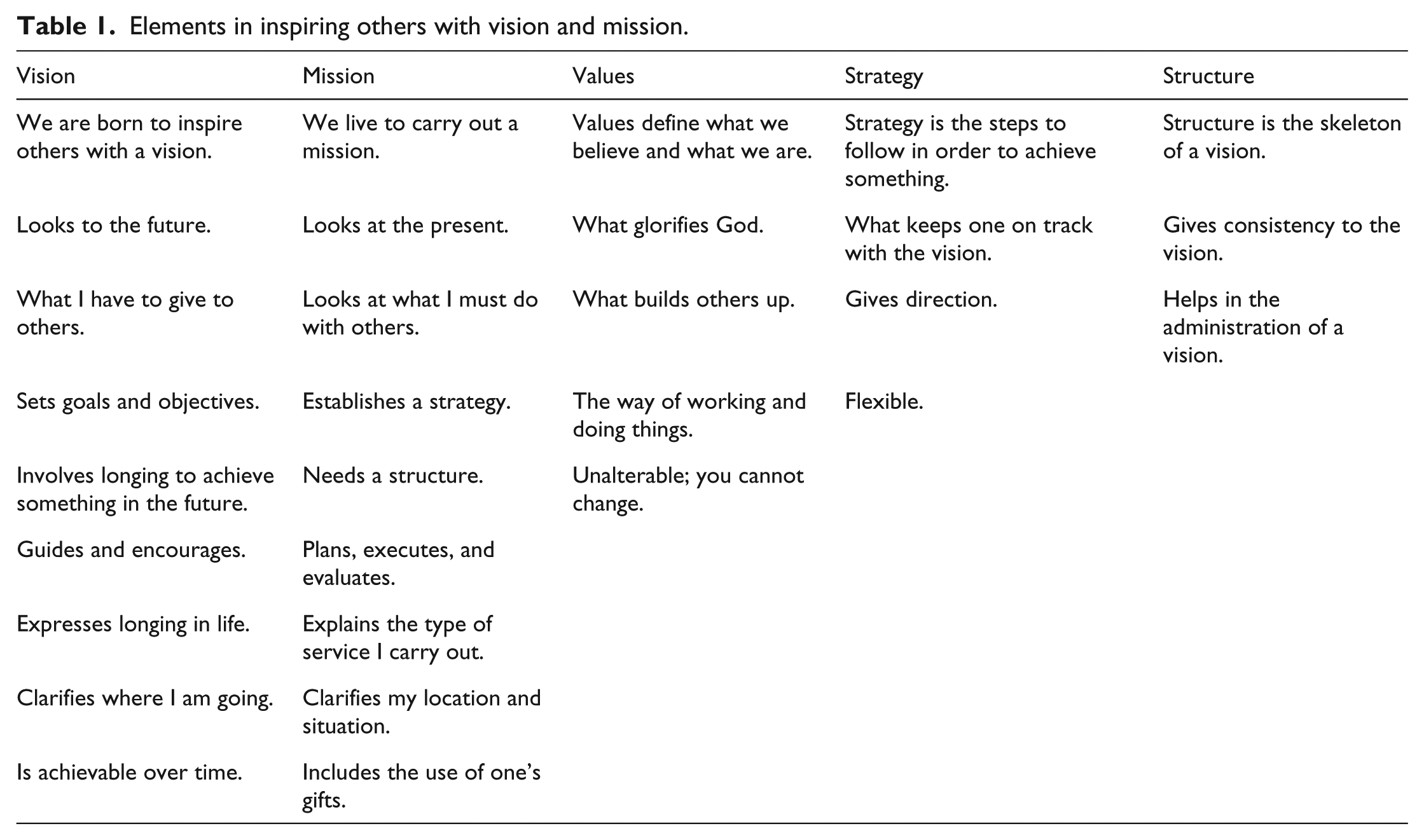
We understand that every vision and mission involve the development of a strategy, which outlines the steps that are to be followed in achieving an end; that is, every vision is fulfilled through a strategy. This understanding helps us to avoid the mistake of deviating from the vision and required direction. A strategy keeps us on track with the vision and the purpose of our life. God shows us what must come first, second, and third as we fulfill a vision and carry out our mission. We know that while God does not change in his being, he does change in his ways of acting and in his strategy. This means that we can adapt and be flexible in the changes of each generation. (See table 1.)
Elements in inspiring others with vision and mission.
Why inspire others with a vision and mission?
As we look to the past, we see men and women who developed a vision and left a mark that continues to inspire people. If we want to leave a spiritual inheritance, we need to inspire others. Within a biblical perspective, we will first pray in secret, and then this prayer-fellowship with God will be reflected in what we do. Traces left behind as a worthwhile memorial are the spiritual heritage of faithfulness to God, of the kind of prayer that inspires and challenges, and of a celebration of life that God gives joyfully. For this reason, a vision is both taught and caught. From a biblical and theological perspective, we inspire others for the benefit of God’s kingdom 12 and ultimately for the glory of God. 13 The fact that knowing why I should inspire others will help the church’s mission activity and help understand Christians’ life purpose, which is to serve God in what he has established for each one.
Within mission history, some people who still influence Christianity today include John Wesley, founder of the Methodist movement; Charles Spurgeon, known as the prince of preachers; and Billy Graham, the best-known evangelist of the twentieth century. Some other major influences in Christian mission are William Carey, with his missionary work in India; Hudson Taylor, with his vision to go to China; Robert Moffat, with his missionary vision to Cape Town in South Africa; George Müller, with his vision of orphanage houses, where he eventually was caring for 10,000 children in Bristol, England.
In the context of the Southern Hemisphere, some of the great Christian visionaries of Latin America, Asia, and Africa are: Manoel de Melo (stimulator of the growth of Pentecostalism in Brazil and campaigner for democracy) Samuel Escobar (conveyor of a vision for Integral Mission, which has changed evangelical approaches to mission) Bishop V. Samuel Azariah (founder of the first two indigenous Indian mission societies, which had a vision for Indians becoming missionaries) Dora Yu Lingzhi (Chinese evangelist whose vision was for China to become a Christian nation) Ni To-Sheng (or Watchman Nee—great teacher of the Christian life in China and beyond) Samuel Ajayi Crowther (missionary and first Nigerian bishop, whose vision was for Africans to bring Africans to Christ) David Bosch (missiologist; his seminal text Transforming Mission provided a clear vision for mission for years) Kwame Bediako (theologian and teacher whose vision was for contextual theology in Africa).
All of these without exception—and many other examples could be mentioned here—serve as a source of inspiration for discovering the means to carry out a vision: how to share it, how to influence others, and how to learn from the achievements at a given point in life and from there to see the vision through to its full accomplishment. The persons listed here have one thing in common: they tried to accomplish their vision, and in doing so, they became part of God’s mission activity.
I suggest that we all need a goal that is worth achieving. A vision that comes from the triune God gives us a reason for living because by it we know where we are going and what we will obtain. When we know the way to go, then we begin to inspire, influence, and involve others. Then mission collaboration has emerged. This inspiration is a conviction that is conveyed with assurance and peace. Once it inspires others, it spreads, and its effect influences still others. It is the process that happens when you are certain of a vision that God has given you to carry out. It can be found in your work, in your company, in teaching, in shepherding, or in missionary service. We can all have a vision that inspires, spreads, and leads to the advancement of the kingdom of God. 14 Why? Because we have understood that we have an opportunity to serve God, to do what we must for the good of others. People will not be able to forget such a conviction; it is the inheritance that we leave behind. They will remember us for what we did, not for what we did not manage to do.
Every vision requires that we discover how to carry it out, when, and with whom, all for God’s glory. In this sense, we are cooperating collaborators, coparticipants with God in his kingdom.
15
In the Great Commission (Matt. 28:18–20) we find the best description of the inspiring and influential vision of Jesus and the basis for his church’s mission: And Jesus came and said to them, “All authority in heaven and on earth has been given to me. Go therefore and make disciples of all nations, baptizing them in the name of the Father and of the Son and of the Holy Spirit, teaching them to observe all that I have commanded you. And behold, I am with you always, to the end of the age.” (ESV)
This text sums up a christological vision of Jesus’s redemptive mission, which includes the promise of his continued presence with his church in global evangelization. Therefore, a proper christological understanding 16 is essential if this vision is to inspire us.
In the dialogue between Jesus and his disciples in Acts 1:7–8, Jesus clarifies that his redemptive vision requires divine power in order to be carried out: He said to them, “It is not for you to know times or seasons that the Father has fixed by his own authority. But you will receive power when the Holy Spirit has come upon you” (ESV). Within this biblical fact we find the “motor” of mission: the promised Holy Spirit, who gives power to every vision, for the good of God’s kingdom. Hence the blessing that comes when we are influenced by the redemptive vision of Jesus, which promises us the Spirit’s power, making it possible to live a life of involvement in his vision of salvation.
Vision and mission in reciprocal collaboration
Collaboration is contrary to isolation and competition; reciprocity is against indifference and disagreement. In this sense, my definition of reciprocal collaboration is that we are the body of Christ, and our different gifts and resources must be shared with one another to accomplish the missio Dei, while taking into account the political, cultural, and social context of our times. Reciprocal collaboration also involves wise agreements, neither simplistic nor pragmatic, that is, quality collaboration not quantity, thus complementing one another. 17 According to Philippians 1:5, there is a foundational reciprocal theology to apply as a pivotal element within God’s church. In fact, God’s vision rests on the theological understanding that we—the church—must engage in helping one another in reciprocal agreement of better mission collaboration.
Within a world that is increasingly polarized by political uncertainty, fragmented by the violence of civil wars and cultural segregation, and despite limitations of multicultural intentionality in mission, there are still opportunities to share God’s vision by strengthening a bifocal view of vision and reciprocal contextual collaboration for global mission to achieve things in a better collaborative way. 18
In the New Testament the church needed apostles and prophets for its growth and development, but then the internal dynamism of the Holy Spirit took over the church to grow and, in consequence, to inspire others with the powerful proclamation of the Good News. In this manner, a spontaneous reciprocal collaboration began to grow within the church. 19 Here, I mention three networks that could become an inspiration in our service to God because of their vision and mission accomplished so far.
World Evangelical Alliance (WEA), begun in England in 1846. 20 It envisions a global network of Evangelical Alliances united in mission and effective in speaking to national, regional, and global issues, resulting in Christlike transformation. Today WEA operates with its regional and national alliances, commissions (theology, religious liberty, mission, youth, women, and information technology), affiliated specialized ministries, and organizational ministries. WEA is a network of churches in 129 nations that have joined to give a worldwide identity, voice, and platform to more than 600 million evangelical Christians.
Fraternidad Teológica Latinoamericana (FTL, Latin American Theological Fraternity), begun in 1970 in Cochabamba, Bolivia, with a vision to open spaces of theological reflection on the Bible and its meaning for human beings and societies in Latin America, doing so in dialogue between professionals, students, academics, and local congregations. 21 The vision of FTL: “We desire a Latin American Church which, transformed by the Word and the Spirit, ferments all areas of the life of our people as an agent of the Kingdom of God and his righteousness. 22 The mission of FTL: “The FTL as part of the Church encourages friendly spaces for dialogue and biblical-theological reflection from Latin America.”
COMIBAM, the Iberoamerican Missionary Cooperation, began in Saõ Paulo, Brazil, in 1987 and now is operating in twenty-four countries, sending 13,500 missionaries with a vision of Ibero Americans taking the whole Gospel to all ethnic groups. 23 Its mission is to serve the body of Christ in Latin America and to cooperate in the generation of reflection, services, and opportunities to spread the Gospel to the ends of the earth.
Strengthening and discovering the purpose of our Christian life should include an understanding that to work with others has a multidimensional mission theology of reciprocal collaboration. 24 This aspect becomes essential because of its complementary work between collaborators and its emphasis on quality relationships rather than on structures. Accordingly, reciprocal collaboration becomes an indispensable, essential condition for the fulfillment of God’s given vision to the church’s mission in the twenty-first century.
Conclusion
It is good for each Christian to understand and define a clear vision, mission, and values as he or she seeks to achieve the purpose that God has established for his church. We need, as clearly as possible, answers to questions regarding our goal for the future (vision), our reason for living (mission), and the rules and behavior required to achieve those things together (values). These three aspects reflect who we are, where we are, where we are going, and with whom we will achieve God’s plans in mission collaboration. It is good and necessary to share these with others so that our vision, mission, and values might inspire, influence, and involve others, for the glory of God, which is a fundamental aspect in mission collaboration for the twenty-first century.
Footnotes
Notes
Author biography