




Abstract
In his 1998 article titled “God Inside Out: Toward a Missionary Theology of the Holy Spirit,” Stephen Bevans referred to Johannes Hoekendijk’s 1964 publication The Church Inside Out as his starting point. This article follows Bevans’s lead in exploring Hoekendijk’s legacy and contribution to theology and mission today. At key points I draw the connection of Hoekendijk’s thinking with that of Bevans, highlighting in the end the manner in which they both agree that the church itself is not of ultimate importance to God, but the world into which the Spirit still sends us in mission.
One of the most important things Christians need to know about the church is that the church is not of ultimate importance. —Bevans and Schroeder, Constants in Context
Stephen B. Bevans, SVD, has been one of the most important voices in world Christian theology in our generation. 1 His work has ranged widely across the fields of historical and dogmatic theology. His global perspective has been one that embraces the multiplicity of local contextual methods and experiences, connecting them not only with one another but with the history of Christian traditions through the ages. Drawing upon the insight of Vatican II that “the pilgrim Church is missionary by her very nature” (Ad gentes 1.1), Bevans has pursued the implications of a “full-blown Catholic missionary ecclesiology” 2 to the Trinitarian depths of “transcending immanence.” 3
Bevans on Hoekendijk
The 1998 article where Bevans worked out some of the pneumatological implications of this notion of “transcending immanence” was titled “God Inside Out: Toward a Missionary Theology of the Holy Spirit.” Concerning the phrase “God Inside Out,” Bevans wrote, “I intend this title to be reminiscent of Johannes Hoekendijk’s challenging ideas in ecclesiology and in particular of the title of one of his books, The Church Inside Out. Hoekendijk insisted that the essential nature of the church (its ‘inside,’ its ad intra nature) is not to be discovered by focusing on the church but on the church’s mission (its ‘outside’ or ad extra character). The church is radically ‘eccentric’ and ‘centrifugal.’” 4
In the pages that follow I pursue Bevans’s lead to explore the theology of Johannes Christiaan “Hans” Hoekendijk along the lines Bevans is proposing. In doing so, I want to highlight the implications of the statement by Bevans and Schroeder above, that the church itself is not of ultimate importance. As Mihály Kránitz has argued, the concept of catholicity is often mistakenly limited to ecclesiology: “But such ecclesiocentrism is quite the opposite of a catholicity which points to ‘all things,’ the catholicity of the Triune God, and the catholicity of the Gospel. The church’s catholicity is linked to humanity, not simply because the church is fully part of humanity, but above all because she is a model of humanity.” 5
Hoekendijk and his work
Hoekendijk was born in 1912 in Indonesia to parents who were conservative Dutch missionaries in the Reformed Church. His family returned to the Netherlands when he was thirteen years of age. Hoekendijk graduated from the State University of Utrecht in 1941 but because of the war was unable to pursue his goal of returning to Indonesia as a missionary. Instead, he became involved with the Dutch Christian Student Movement and with the resistance against the Nazis. Part of his work, before he was imprisoned, entailed efforts to protect Jewish youth. He did make it to Indonesia after the war, but his wife’s health challenges forced them to return to the Netherlands. In 1948 Hoekendijk completed his doctorate in theology at Utrecht with a dissertation titled “Kerk en volk in de Duitse zendingswetenschap” (Church and people in German missiology). 6 After graduating, he took a position with the Dutch Missionary Council (DMC), which was part of the International Missionary Council (IMC). “The Church in Missionary Thinking,” one of his most important essays, was published in 1952 as a preparatory paper for the World Missionary Conference held that year in Willingen, Germany. 7 He eventually became a professor of biblical and practical theology in the State University of Utrecht before joining the faculty of Union Theological Seminary in New York in 1965. He died in 1975 of an apparent heart attack while swimming in Long Island Sound. 8
I had encountered Hoekendijk’s work prior to my arrival at Union in 1980 to begin doctoral studies in ecumenics and world Christianity. I had not paid him much attention, however, until a conversation with Arthur Glasser, who had served with the China Inland Mission and then later as dean of the School of World Missions at Fuller Theological Seminary, alerted me to Hoekendijk’s significance. I had called Professor Glasser in his office at Fuller one afternoon to talk about an upcoming article in the journal Missiology, which he edited. Hearing that I was at Union, he told me that he had studied there as well with Hoekendijk in the late 1960s. Looking back, Glasser told me, it was a rich experience. He certainly did not endorse all of Hoekendijk’s ideas, he said, but he found Hoekendijk’s book The Church Inside Out a really important work. 9 I needed to be sure to read it. I did and have deeply appreciated it ever since.
Several years later I had begun to teach at New York Theological Seminary (NYTS) when I learned that Hoekendijk’s work had made a major impact on the thinking of George W. “Bill” Webber, president of NYTS from 1969 to 1981, as he reshaped theological education for the city. Webber, who remained on the NYTS faculty until 1999, told me several times that he, Letty Russell, and others who had been part of East Harlem Protestant Parish and then Metropolitan Urban Service Training in New York City had taken Hoekendijk’s ideas on mission and the church and applied them to their work in the urban context. 10 I came to appreciate Hoekendijk even more through this lens. During the 1980s Glasser and Webber represented opposite ends of the Protestant theological spectrum for most people. The fact that Hoekendijk had been important for both of them gave me a greater appreciation for his work.
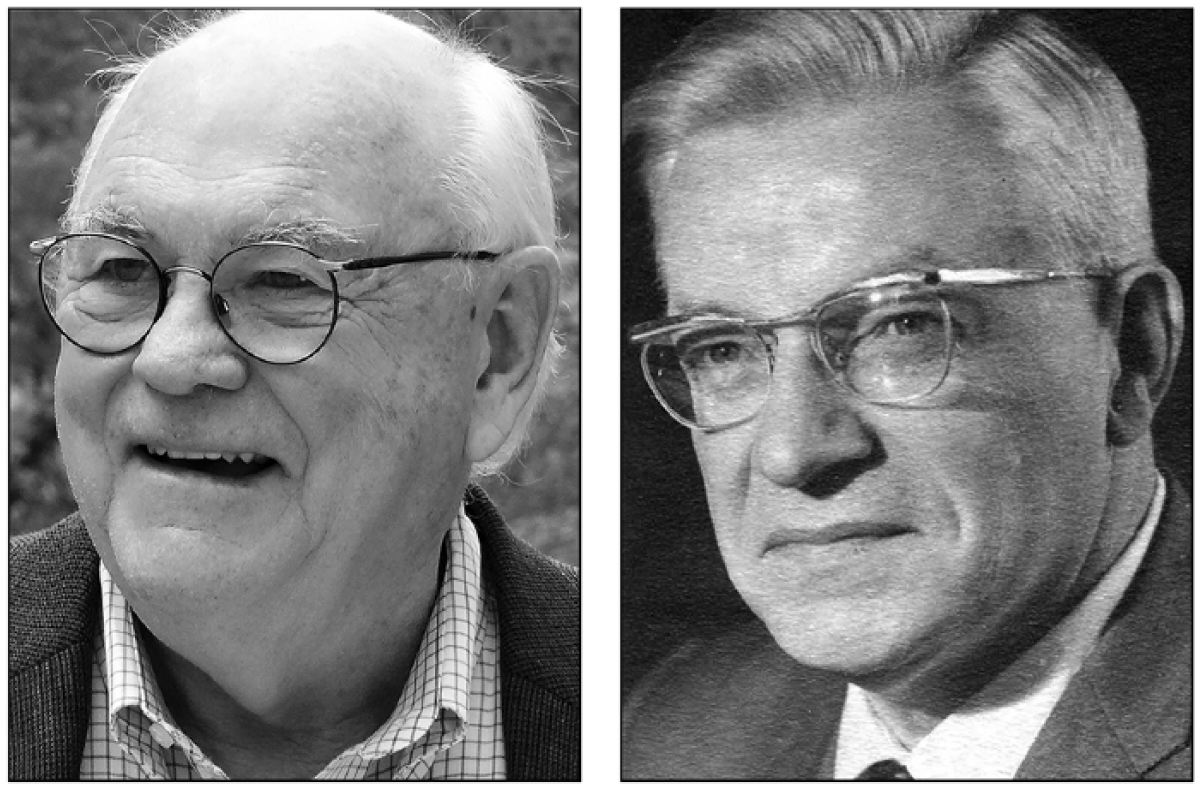
Stephen B. Bevans (left) and Johannes C. Hoekendijk
Webber, Russell, and Hoekendijk had jointly taught several courses at NYTS in the late 1960s. They had also been part of a study group earlier that decade on the topic “Missionary Structure of the Congregation,” which had been sponsored by the Department on Studies in Evangelism of the World Council of Churches. The final document of that project was published under the title The Church for Others: Two Reports on the Missionary Structure of the Congregation. 11 Webber’s dissertation at Columbia University, which he completed four years earlier in 1963, was titled “The Missionary Structures of the Congregation: A Study of the Emerging Pattern of Congregational Life Based on the Experience of Protestantism in the Inner City.” From Webber, I first encountered the concept of the missionary structure of the local congregation and the theological contours of the “missional church” movement. 12
A number of theologians from across the theological spectrum have criticized Hoekendijk over the past several decades. Many have done so without bothering to read him carefully. There has been a considerable amount of theological sloganeering around his name, and many of his key arguments regarding church, mission, and the world have been misrepresented in ways that are a caricature of his work. 13 The phrase that one hears most often used to discredit him, which was also closely associated with the 1968 Uppsala Assembly of the World Council of Churches, “the world sets the agenda,” 14 is a prime case in point. Where the phrase “the agenda of the world” appears in the North American portion of the 1967 report The Church for Others, it is immediately followed by a reference to the challenge that the civil rights movement was posing to Protestant churches in the US. 15 The study was calling upon churches to turn their attention to such movements for justice taking place throughout the world. Few in North America in any branch of the church today would deny that the civil rights movement and Dr. Martin Luther King Jr. in particular were and are agenda-setting for the churches and theology. 16
Newbigin on Hoekendijk
Those who are part of the missional church movement, whose work I admire and applaud, often cite Lesslie Newbigin, Hoekendijk’s colleague in the ecumenical movement, as a primary source for their thinking. Without question, Newbigin was an important early formulator of the missional church concept in the 1950s, doing so in the wake of the Willingen meeting of the International Missionary Council in 1952 and the subsequent discussion of missio Dei that emerged from it. In a footnote in his 1952 Kerr Lectures, which were published the following year as The Household of God: Lectures on the Nature of the Church, Newbigin explicitly acknowledged that he was “deeply indebted” to Hoekendijk’s study outline for his own thinking on the relationship between mission and church. 17 Newbigin expressed concern that Hoekendijk might be going too far in making the church a function of the apostolate and mission. Newbigin summarized this concern about Hoekendijk’s possible overemphasis on mission as follows: “In other words, just as we must insist that a Church which has ceased to be a mission contradicts part of the essential character of the Church, so we must also say that a mission which is not at the same time truly a Church is not a true expression of the divine apostolate. An unchurchly mission is as much a monstrosity as an unmissionary Church.” 18 I say that Newbigin expressed a concern for Hoekendijk’s possible overemphasis because Newbigin himself spoke of the possibility of overstating Hoekendijk’s point. At the beginning of his discussion of Hoekendijk, Bishop Newbigin noted explicitly that he might be misreading his colleague. The passage just quoted ends by stating: “Having entered this caveat, however, against a possible exaggeration, let us re-state the main point with which we are concerned in this lecture, that the very general belief of Christians in most Churches that the Church can exist without being a mission involves a radical contradiction of the truth of the Church’s being, and that no recovery of the true wholeness of the Church’s nature is possible without a recovery of its radically missionary character.” 19
I agree with Newbigin here, that mission is not what the church does, but what the church is. I also think that Hoekendijk has far too much to say for us to ignore him today, starting with the radical notion of the missionary structure of the local congregation. Furthermore, Bevans and I are not alone in turning back to this Dutch missiologist for help in thinking through some of the issues facing world Christianity more generally today. Others are beginning to look anew at Hoekendijk’s work as well. Perhaps we can even call it a “Hoekendijk spring.” 20
“Church” and “mission” are not separate
The starting point for the discussion is a fundamental reconsideration of the relationship between the terms “church” and “mission.” For Hoekendijk, the terms are two ways of naming the same historical reality. Mission is not what the church does in the world; mission is what the church is. The word “mission” is another way of naming the nature of the Christian church, while the term “church” is another way of naming the nature of the Christian mission. This is what Hoekendijk was getting at with the phrase the “missionary structure” of the local congregation. 21 As he said at one point, “That which cannot serve as ‘order of missions’ has no right to exist as order of the church.” 22
The separation of church and mission is a legacy of Western Christendom that was reinforced in the modern colonial era. The separation of missiology from theology has roots in the Latin churches in the thirteenth century in what eventually became Western Europe. The separation was reified by the division of the world in the modern era by Western theologians into Christian lands and mission lands. The lingering impact of such thinking still affects us today. Look at the manner in which “missiology” and “ecclesiology” are pursued in separate departments and at times even in separate schools in our Western theological academies.
Consider the long history of documents produced in the ecumenical movement by the Faith and Order Commission of the World Council of Churches, starting with the most recent statement, The Church: Towards a Common Vision (2013). Faith and Order persists in speaking of “the Church [in English translations with a capital “C”] and its mission [in English translations with a lower case “m”].” 23 “Mission” is persistently reduced to being a function of the church and not a way of naming the nature or identity of the church. In this thinking, mission names what the church does, not what the church is. A church can still be a church without being a mission or being engaged in mission. The previous Faith and Order study document was even more blatant. It was titled The Nature and Mission of the Church. 24 Throughout its pages one encounters the argument that the nature of the church is named by the biblical term koinōnia, or communion, while what this communion does in the world is its mission. 25
There has been a persistent criticism of this separation of mission and church, or mission and communion, by other ecumenical voices outside Faith and Order over the past several decades. Newbigin’s contribution to the discussion has already been noted. The East Asia Council of Churches in 1961 cautioned against diminishing what it called the “missionary consciousness” of churches in Asia in the ecumenical search for confessional unity. 26 Johannes Blauw’s 1962 study The Missionary Nature of the Church provided a substantial biblical basis for the thesis. 27 More recently the close relationship between communion and mission in all areas of ecumenical reflection and work has been made in the essays in Michael W. Goheen and Margaret O’Gara’s edited collection That the World May Believe. 28 Hoekendijk was one of these voices in the ecumenical movement, warning that the reduction of the nature of the church to koinōnia, and the separation of the church’s nature from its mission, would be a dangerous course to follow. 29
The church as mission and communion
A strand of theological reflection that began in Roman Catholic circles after Vatican II provides a helpful way forward for me to talk about the relationship between communion and mission. It is this strand that informs the work of Bevans and other Catholic thinkers today. According to paragraph 2 of Ad gentes (“Decree on the Church’s Missionary Activity”), the church is missionary by its very nature. Placed alongside some of the other documents of Vatican II, one might say here that communion and mission are two ways of representing the nature of the church. That is because communion and mission mutually imply one another, said John Paul II, noting that the Spirit both gathers the church together in unity and sends the church forth to the ends of the earth in mission. 30 Following this notion of gathering and dispersing, Morris Pelzel has argued that communion and mission represent the inner and outer dimensions of the life of the church. 31 The Roman Catholic term for the eucharistic service, “the Mass,” Pelzel notes, comes from the words of dismissal at the end of the liturgy and is of the same root as “mission.” 32
The analysis of the nature of the church being communion and mission in its inner and outer dimensions is helpful. It resolves the lingering question that Newbigin posed to Hoekendijk concerning Hoekendijk’s failure to account for worship as the end or goal of the church in the world. Hoekendijk did not disregard worship as an expression of the nature of the church. He did argue, however, that “in the New Testament the wall between liturgy and diakonia has become transparent, and both have been placed in the context of pro-existence.” 33 In some ways his thinking here prefigures the argument that some Orthodox theologians have made recently regarding the manner in which the “liturgy after the liturgy” continues worship in the world by offering the sacrifice not on the high altar of the church but, according to John Chrysostom, on the altar of the neighbor’s heart. 34
The apostolicity of the church
Still the question remains, how are these two dimensions to be integrated? Here is where I think Hoekendijk’s greatest contribution lies. The integration we are seeking, he argued, is found in the specific mark of apostolicity, in the apostolic nature of the church, or what he called the “apostolate.” 35 The church is apostolic in its nature, which for Hoekendijk meant that the church is sent. One of his more radical assertions on this point was that the nature of the church is defined by its participation in Christ’s apostolic ministry. 36 It is common, he noted, “to think of the apostolate, as a function of the Church. Credo ecclesiam apostolicam is often interpreted as: ‘I believe in the church, which has an apostolic function.’” Would it not be truer to the New Testament, however, to turn this around and say, “I believe in the church, which is a function of the apostolate, that is, an instrument of God’s redemptive action in this world?” 37 According to the pages of the New Testament, Hoekendijk asserted, “the church is set in this world with the sole purpose of carrying the gospel to the ends of the earth.” 38 Furthermore, it is not only the hierarchy or the clergy who carry the apostolic mantle, for the whole church shares in the mission of the apostles to the ends of the earth. 39 In other words, “The church is a function of the apostolate. . . . A church that knows she is a function of the apostolate and that her very ground of existence lies in the proclamation of the Kingdom to the world, does not engage in missions, but she herself becomes mission, she becomes the living outreach of God to the world.” 40 Hoekendijk argued here that the proclamation of the coming reign of God in the Gospel formed the apostolate, which exists for the salvation of the world. The direct step in the argument from the Gospel to the apostolate was intentional. He wrote: “Thus the gospel and the apostolate belong intrinsically together. Through the apostolate the gospel comes to ‘fulfillment’ (Rom. 15:19; cf. Col. 1:24) and is brought to its destination. In the apostolate, God continues to struggle with the world for the sake of the world. Its subject is ‘the apostle Jesus’ (Heb. 3:1). . . . The realm of the apostolate is the oikoumene.” 41 The Gospel leads to the apostolate, in other words, not to the church.
From this insight emerged his fundamental theological critique of ecclesiocentrism. It was and remains a critique of Christendom and its established churches, which in the 1950s and 1960s was also a critique of those churches that were perceived at least by the dominant sectors of society in North America to be normative, or “mainline.” There is no room in Hoekendijk’s thinking for a settled structure called “the church.” Instead, the church is a dynamic entity serving salvific ends that reach beyond itself. As Bevans and Schroeder wrote in the epigraph that begins this article, “One of the most important things Christians need to know about the church is that the church is not of ultimate importance.” 42 Similarly for Hoekendijk, the church is neither the starting point nor the ending point of the Gospel or of human history. It can therefore be mentioned only in passing. Elsewhere he wrote that the church is called (i.e., its apostolate is) to participate in God’s wider work of redemption in history, which exists beyond the historical boundaries of the church itself. “The church has no fixed place at all in this context, it happens insofar as it actually proclaims the Kingdom to the world. The church has no other existence than in actu Christi, that is, in actu Apostoli. Consequently it cannot be firmly established but will always remain the paroikia, a temporary settlement which can never become a permanent home.” 43
The church and the Gospel
The emphasis here upon the Gospel and not the church has enormous consequences for understanding the missional nature of the church for Hoekendijk.
Where the gospel comes, missionary situations originate, everywhere and always. It is impossible to designate a part as “missionary” somewhere in space or somewhere in time, which apparently can be distinguished (according to any criteria available) from the other “nonmissionary” parts. . . . One who wants to speak authentically about a “missionary” situation has to know that he speaks about the whole world and the whole of history, qualified as they both are by the cross and resurrection of Jesus Christ. . . . That which cannot serve as “order of missions” has no right to exist as order of the church.
44
The practical consequences were likewise significant: “This much is self-evident: mission does not start at the walls of the church, somewhere on the periphery, but it has its source in the very heart of the church: there, where the gospel again and again constitutes an apostolic body anew.” 45
Hoekendijk never deviated from his firm conviction that the source and goal of mission is the Gospel of Jesus Christ, who was raised by the Spirit. Here he followed a line of theological argument similar to one that Jürgen Moltmann would later pursue in The Church in the Power of the Spirit. 46 Hoekendijk also was keenly aware of the manner in which the Spirit was at work in the world in mission and the apostolate. “The gift of the Spirit is a presupposition of the mission to the Gentiles. The preaching of the gospel to the ends of the earth is specifically made dependent on the reception of the Spirit,” he wrote. 47 “It is true that the apostolate retains a relative independence beside the gift of the Spirit insofar as it is instituted in a separate and preceding act (Matt. 28:18ff.; Luke 24:47ff.; Acts 1:6ff.; John 20:21f.); nevertheless, apostolate and Spirit are always so intimately related (John 20:21f.) that Paul eventually can speak of his apostolate as diakonia tou pneumatos [ministry of the Spirit] (II Cor. 3:8).” 48
Hoekendijk did not dismiss the church as theologically insignificant. He rejected the notion of a territorial church, as well as a church that was structured only for itself, but he did not reject or deny the church as a historical reality. For Hoekendijk, the location of salvation that Jesus proclaimed in the form of the coming kingdom of God was in the world, not in the church. The church participates in what God is doing in the world. In this sense the horizons of the kingdom of God and the horizons of human history become one eschatologically for Hoekendijk. His 1967 publication The Church for Others formulated this insight in directional terms: “In the past it has been customary to maintain that God is related to the world through the Church. When we sharpen this view into a formula the sequence would be: God—Church—world. This has been understood to mean that God is primarily related to the Church and only secondarily to the world by means of the Church.” 49 Instead, the authors of the study argued, the direction ought to be “God—world—church.” An entire section of The Church for Others unfolds the implications of this insight. 50 Hoekendijk did not disagree with this reformulation, nor with the correlating shift from an ecclesiocentric to an oikocentric perspective. 51 Flett points out, however, that Hoekendijk preferred what he considered to be the more biblical ordering of “kingdom-gospel-apostolate-world” or “kingdom-apostolate-oikoumene.” Hoekendijk’s original formulation of the pattern that is found in his 1948 dissertation, notes Flett, was “kingdom-Spirit-community-history.” 52
Bevans on the significance of the Spirit
It is the presence of the Spirit in the earlier formulation of the pattern that catches my attention here. Hoekendijk steadfastly refused to confine the living Christ to the institutional structures of the church. This meant that the church had no permanent structures of its own. They were drawn from the world around it and needed always to be dynamic in relation to the patterns of culture into which the church was moving. This is precisely what Bevans pursues in his own work on global and contextual theologies. 53 But Bevans’s article “God Inside Out” returns to Hoekendijk’s initial formulation in a way that moves eschatologically from kingdom to Spirit to the community or church in history. In doing so, it uncovers the missionary structure not just of the church but of the Spirit. I have argued elsewhere that the critique of established ecclesial structures in Christendom was at the heart of the Pentecostal and charismatic renewal movements in the twentieth century. 54 It is an argument that evangelicals, emergents, missionals, and many others are now making as well. 55 Were he with us today, Hoekendijk would most likely agree. 56
Bevans has helped us to remember that we can move in this eccentric direction only in the power of the Spirit. He quotes William R. Burrows to this effect: “‘Spirit’ injects an uncontrollable, effervescent element into the structure of Christian existence.” 57 Or as Bevans concludes succinctly: “The Spirit is the Spirit as God turned inside out; the Spirit given to Jesus turned him inside out and opened him up to the vision of God’s reign among women and men; the Spirit lavished through Jesus turns his disciples inside out as they include unthinkable people and go to unthinkable places. Thinking missiologically about the Holy Spirit can turn the church inside out, perhaps making it more responsive to where God is really leading it in today’s world.” 58 We are indeed indebted to Bevans for interpreting for us in a fresh way Hoekendijk’s insights and, more important, for reminding us that theology is about responding to the call of the risen Christ as we are sent by the Spirit into the world today.
Footnotes
Notes
Author biography