




Abstract
This article marks the thirty-seventh year of including statistical information on World Christianity and mission in the International Bulletin of Mission Research. This year it includes details on some of the most frequently asked questions in quantifying mission and global Christianity: the number of missionaries worldwide, global access to the gospel, and the burgeoning Pentecostal/Charismatic movement. The article also provides brief methodological reflections on how the future of this kind of research might change, given the realities of COVID-19.
Keywords
In 1985 David B. Barrett produced the first statistical table in this series in the January issue of this journal, then named the International Bulletin of Missionary Research. He produced this table three years after publishing his comprehensive and highly popular World Christian Encyclopedia (Oxford University Press, 1982; 2nd ed., 2001; 3rd ed., Edinburgh University Press, 2019). Its purpose was to lay out, in summary form, an annual update of the most significant global and regional statistics relevant to understanding the current status of global Christianity. The following tables continue the tradition of this series, presenting the most recent overview of statistics related to global Christianity and mission. The data appear in comparative perspective and offer estimates for the years 1900, 1970, 2000, 2021, 2025, and 2050. Each set of tables since 1985 has provided a brief commentary to help situate the data, provide further context, and elaborate on implications of the data. This article represents the thirty-seventh year of providing annual statistics in the International Bulletin of Mission Research. It summarizes the most significant global and regional figures relevant to understanding the current status of global Christianity and mission.
This year’s article reveals an important methodological note regarding the task of quantifying mission and religious affiliation worldwide: the demography of religion has a significant lag time when it comes to real-time events. Demographers need time—typically years—to collect, triangulate, and analyze data before reporting on trends and making estimates for the future. This lag time makes it impossible for us to comment on one of today’s most pressing issues: the global COVID-19 pandemic. We’ve been a part of many conversations among both academics and practitioners about what the impact of COVID-19 could be for mission, church, scholarship, religious affiliation, and many other areas. COVID-19 has already impacted our data collection, and we anticipate it will continue to do so for some time. It is more difficult to reach contacts in other parts of the world; all of our speaking engagements and networking travel were canceled in 2020, and our own lives and those of all our research associates were interrupted, causing delays. We won’t know the true impact of COVID-19 on World Christianity and mission for some time. As a result, all the figures presented in this article reflect pre-coronavirus realities. We will need a few years to “catch up” to the demographic impact, especially concerning where birth rates have been impacted and where the greatest untimely deaths have occurred.
The year 2020 was supposed to be particularly significant for us with the release of the third edition of the World Christian Encyclopedia. We had events scheduled in dozens of cities around the world to share our findings with churches, mission organizations, and academics. With all of those events canceled, we’re using this year’s issue of the IBMR to highlight the top three questions we’ve been asked in the last year about the state of Christianity and mission worldwide, using findings from the Encyclopedia as our guide: missionary statistics, access to the gospel (also known as world evangelization), and the Pentecostal/Charismatic movement.
How many missionaries are there in the world, and where are they coming from?
The concept of who a missionary is has evolved since the beginning of the twentieth century, making it much more difficult to assess how many missionaries there are in the world. The proportion of long-term missionaries from the Global North is on the decline (227,000 sent in 2021, which is 53 percent of the total of 430,000, down from 88 percent of the total in 1970). Since the 1980s and 1990s there has been a dramatic explosion of the number of short-term missionaries, particularly youth, who spend as little as a week outside their own cultural context performing an array of service-oriented projects. The number of short-term missionaries is notoriously difficult to quantify, with estimates ranging from half a million to two million from the United States alone. Missionaries here (table 4) are defined as Christians of all traditions who cross national borders for a period of two years or more. Not included are short-term international missionaries or national workers who serve in their own countries.
The number of missionaries being sent from countries in the Global South is on the rise, with 203,000 (47 percent of the total) in 2021, up from 31,000 (12 percent of the total) in 1970. Northern America and Europe continue to send the bulk of cross-cultural missionaries today (53 percent), but Brazil, South Korea, the Philippines, and China each send large numbers as well. This is partly because of more resources available in the Global North versus South for investment in foreign mission, and because of the longer history of the foreign missionary movement in the West.
However, a striking reality for the global mission movement is that the countries with the most Christians receive the largest numbers of missionaries. This makes some sense if one considers that invitations are a major avenue for missionary sending. Sponsorships are also more likely in places with large Christian populations. Thus, missionaries today are sent from everywhere and received everywhere. However, there remains an imbalance in that the countries most needing Christian missionaries tend to receive the fewest. One dramatic example is Brazil (a majority Christian country), which receives a total of 20,000 missionaries, whereas Bangladesh (a majority Muslim country), with nearly as many people, receives only 1,000 missionaries. An increasing number of Protestants and Independents are being sent to Africa and Asia, as well as being sent from there. Many factors, however, such as church tradition, governmental politics, and financial resources impact the ability of Christians to send missionaries from their own country. In addition, many missionaries in the Global South serve as national workers in their own countries.
How many people still lack access to the Christian gospel?
A related question regarding the missionary movement is that of “world evangelization,” or, as we now also call it, access to the Christian gospel or message (table 4). Evangelized persons are those who have had an adequate opportunity to hear the Christian message and to respond to it, whether positively or negatively. Evangelization among a language or people group is measured by a series of variables including presence of Christians, availability of Christian media (film, radio, Scriptures in print and online), missionary presence, and level of religious freedom. Like “mission,” the term “evangelism” expanded throughout the twentieth century to include much more than the spoken proclamation of Christianity. Friendship across differences, whether they be religious, ethnic, or cultural differences, is an increasingly essential aspect of evangelism where words alone (printed, broadcast, or preached) have failed to have the desired impact.
In 1900 Middle Africa and Western Africa were among the least-evangelized regions of the world. In 2021, however, Africa is 77 percent evangelized (and 49 percent Christian). Christianity in Africa grew mostly by the witness and evangelistic efforts of Africans and their creation of autonomous, local, and indigenized churches. Despite being a major recipient of Western missions for centuries, Asia was the least evangelized (18 percent) in 1900 and continues to be less evangelized today (60 percent, compared to 77 percent for Africa and over 96 percent for Europe, Latin America, North America, and Oceania). In 1900 Nepal and five other countries had no access to the gospel at all, while in 2021 only three countries are less than one-quarter evangelized. As Christianity becomes increasingly diverse, the concern arises of peoples and languages without access to Christianity. The universality of Christianity, however, tends to propel Christians into contact with those who have not encountered the religion. While Christians in different traditions approach interacting with diversity in various ways, it is possible to identify where Christian witness is present and where it is not. At least 4,000 cultures (out of 14,000) have not encountered Christianity, most of which are Muslim, Hindu, or Buddhist in the Global South.
What is the status of the Pentecostal/Charismatic movement worldwide?
The Pentecostal/Charismatic movement is one of the fastest-growing trends in World Christianity today, and it has been for some time (table 3). This movement grew from 58 million in 1970 to 656 million in 2021. The Global South is home to 86 percent of all Pentecostals/Charismatics in the world.
Global Population, Global Cities, and Urban Mission, 1900–2050

New non-Christians per day migrating to urban centers.
Column % p.a. trend. Average annual rate of change, 2000–2021, as % per year.
Sources: World Population Prospects: The 2017 Revision (New York: United Nations, 2017); World Urbanization Prospects: The 2018 Revision (New York: United Nations, 2018); UNESCO Institute
for Statistics (2005–13); and Todd M. Johnson and Gina A. Zurlo, eds., World Christian Database (Leiden: Brill, accessed July 2020).
IBMR 45(1).
Global Religion, 1900–2050

Note: Religions do not add up to the total because religions with fewer adherents are not listed.
(0–1, 1=most diverse). The Religious Diversity Index methodology is described in Todd M. Johnson and Brian J. Grim, The World’s Religions in Figures (Chichester: Wiley-Blackwell), ch. 3.
Column % p.a. trend. Average annual rate of change, 2000–2021, as % per year.
Source: Todd M. Johnson and Gina A. Zurlo, eds., World Christian Database (Leiden: Brill, accessed July 2020).
IBMR 45(1).
Global Christianity by Tradition, 1900–2050
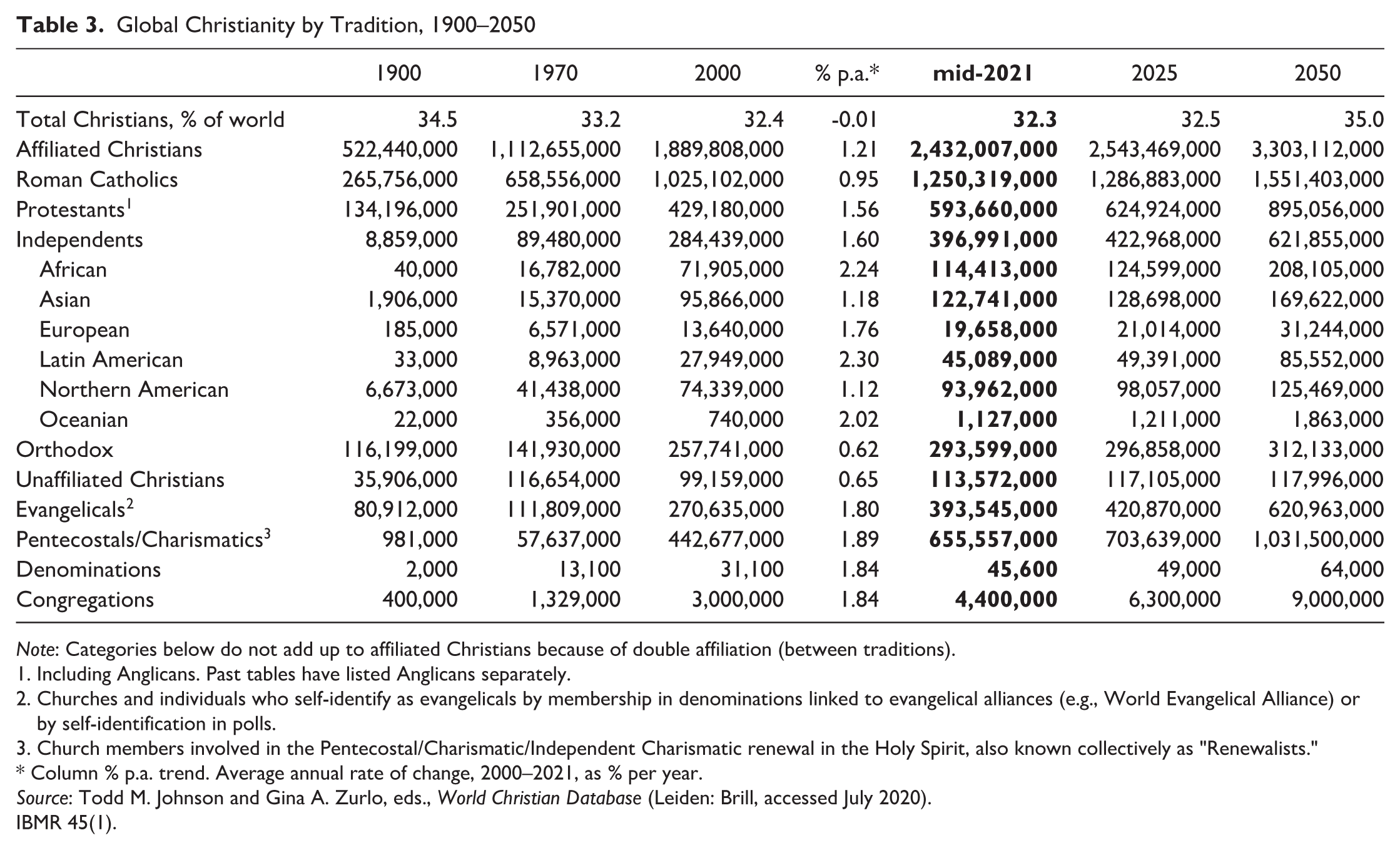
Note: Categories below do not add up to affiliated Christians because of double affiliation (between traditions).
Including Anglicans. Past tables have listed Anglicans separately.
Churches and individuals who self-identify as evangelicals by membership in denominations linked to evangelical alliances (e.g., World Evangelical Alliance) or by self-identification in polls.
Church members involved in the Pentecostal/Charismatic/Independent Charismatic renewal in the Holy Spirit, also known collectively as "Renewalists."
Column % p.a. trend. Average annual rate of change, 2000–2021, as % per year.
Source: Todd M. Johnson and Gina A. Zurlo, eds., World Christian Database (Leiden: Brill, accessed July 2020).
IBMR 45(1).
Christians by Continent and Christian Mission and Evangelization, 1900–2050

Ten-year total for decade ending in the given year. World totals of current long-term trend. See David B. Barrett and Todd M. Johnson, World Christian Trends (Pasadena, CA: William Carey Library, 2001), pt. 4, "Martyrology."
Percentage of all Christians living in countries ⩾80% Christian.
Defined in World Christian Trends, pt. 25, "Macroevangelistics."
Column % p.a. trend. Average annual rate of change, 2000–2021, as % per year.
Source: Todd M. Johnson and Gina A. Zurlo, eds., World Christian Database (Leiden: Brill, accessed July 2020).
IBMR 45(1).
Christian Media and Finance, 1900–2050
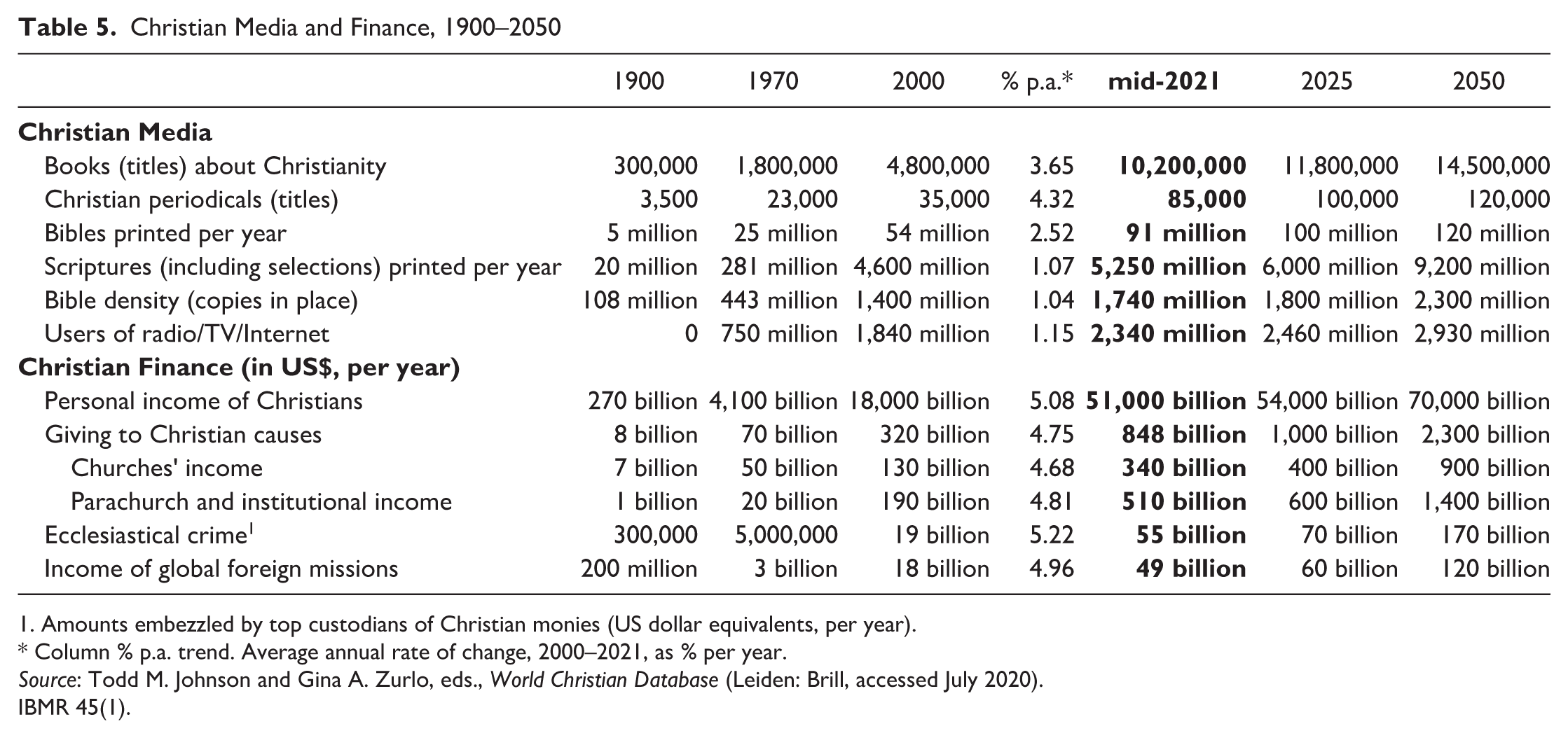
Amounts embezzled by top custodians of Christian monies (US dollar equivalents, per year).
Column % p.a. trend. Average annual rate of change, 2000–2021, as % per year.
Source: Todd M. Johnson and Gina A. Zurlo, eds., World Christian Database (Leiden: Brill, accessed July 2020).
IBMR 45(1).
It is useful to divide the movement into three kinds, or types. First, Pentecostals are members of the explicitly Pentecostal denominations, characterized by a new experience of the Holy Spirit that many other Christians historically considered to be somewhat unusual. Pentecostal denominations that are part of Protestantism include the Assemblies of God, the International Church of the Foursquare Gospel, and the Church of God of Prophecy. Subcategories of Pentecostal denominations include Oneness, Baptistic, Holiness, and Apostolic.
Second, the roots of Charismatics go back to early Pentecostalism, but rapid expansion since 1960 (later called the Charismatic renewal) has made this type larger than classic Pentecostalism. Charismatics usually describe themselves as having been “renewed in the Spirit” and as experiencing the Spirit’s supernatural and miraculous power. They remain and form organized renewal groups within their historical non-Pentecostal denominations (Catholic, Orthodox, or Protestant) instead of leaving to join Pentecostal denominations. The largest Charismatic movement today is the Catholic Charismatic renewal, found in significant numbers mainly across Latin America. The largest Catholic Charismatic populations are in Brazil (61 million), the Philippines (26 million), and the United States (19 million), though the highest concentrations of Catholic charismatics are in Guatemala (34 percent of the country), Puerto Rico (31 percent), and Brazil (29 percent).
Thousands of other churches and movements resemble Pentecostals and Charismatics but do not fit their definitions. These constitute a third Pentecostal/Charismatic type, called Independent Charismatics, which often predates the first two types. Part of the rationale for this term is that they are largely found in the Independent Christian tradition—that is, outside of historic Catholic, Orthodox, and Protestant churches. Independent Charismatics are present mainly in the Global South, in denominations and church networks that originate from outside of Western Christianity. While found in many of the same countries as Pentecostals and Charismatics, Independent Charismatics are largest in the United States (33 million), China (30 million), and Nigeria (27 million), and over one-third of the populations of Eswatini (before April 2018, Swaziland), Zimbabwe, and South Africa are Independent Charismatics. These traditions often grow by planting new churches or by breaking off from existing denominations.
However, despite its increasing popularity, the movement has struggled, with many of its megachurches dominated by bold personalities, leading to problems with leadership in the second generation. Some have tried to keep control within biological families, often making the situation worse. Lack of theological training is also a challenge for these rapidly expanding churches and networks.
Conclusion
These topics—mission, evangelism, and Pentecostal/Charismatics—represent only three of the subject areas we study, but they are the three that have generated the most queries we have recently received. Looking forward from 2021, we will continue to track trends in global Christianity that we think will continue for the next thirty years. The most significant of these trends is the continued shift of Christianity from North to South. In 2021 a total of 1.7 billion Christians (67 percent) are found in the Global South. Projecting religious affiliation at the country level, it is probable that by 2050 there will be 2.6 billion Christians (77 percent) in the Global South. This trend means that mission, evangelism, and the Pentecostal/Charismatic movement will be increasingly in the hands of emerging Christian leaders in Asia, Africa, Latin America, and Oceania. In addition, questions concerning the sources of theology, the languages of worship, the schisms of denominations, the role of women in the church, and a host of other issues will continue to top the list of global Christian concerns in the future.
Footnotes
Funding
The authors received no financial support for the research, authorship, and/or publication of this article.
Author biographies
This article was prepared by staff at the Center for the Study of Global Christianity at Gordon-Conwell Theological Seminary, South Hamilton, MA: from left to right:  and follow us on Twitter @CSGC.