



Abstract

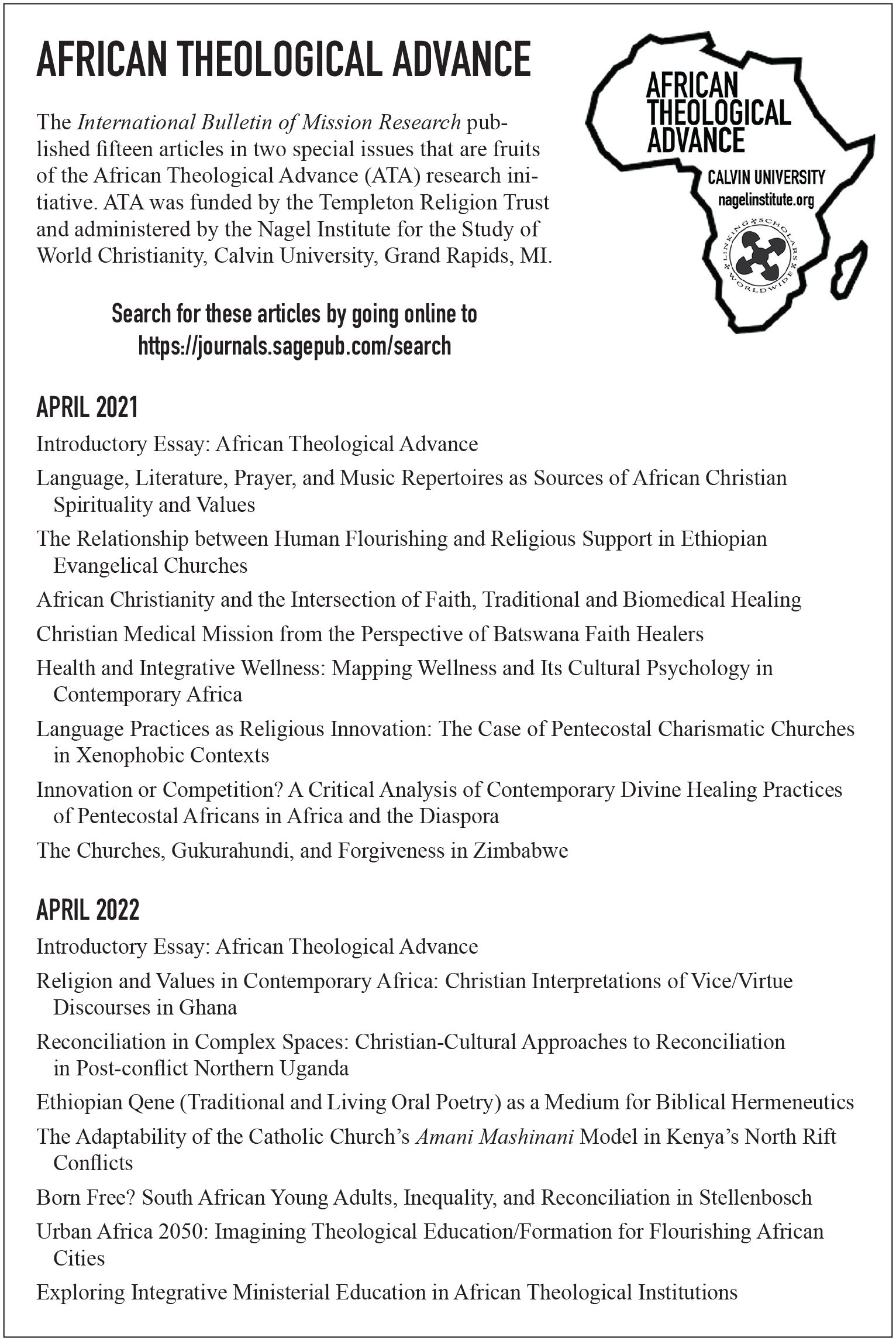
This issue of the International Bulletin of Mission Research includes seven articles that are fruits of the African Theological Advance research initiative, which was funded by the Templeton Religion Trust and administered by the Nagel Institute for the Study of World Christianity of Calvin University, Grand Rapids, Michigan. Eight articles from the same research activity were published in the April 2021 issue of this journal.
The African Theological Advance research initiative provided funding and support for two-year research and curricular development projects in theology and other disciplines to African Christian scholars working in theological seminaries or universities with postgraduate theology programs. All projects addressed issues related broadly to gospel and culture in Africa by drawing on interdisciplinary methods and insights. The initiative called on researchers to focus on one of the following four areas:
African spirituality and values
science and religion, particularly health and healing
religious innovation and competition
forgiveness, peacemaking, and reconciliation.
The reader will see evidence of the four topical areas in the articles published here.
Conceptually and methodologically, the research initiative sought to foster fruitful cross-fertilization between social scientists, religious studies experts, and theologians. Programmatically, this cross-fertilization took place during a weeklong workshop in March 2019 in Pretoria, South Africa, where the researchers gave progress reports of their work, and then during a weeklong culminating conference, held in March 2020 in Kigali, Rwanda, with the presentations of research findings. In Pretoria and in Kigali, the teams of researchers from southern, eastern, and western Africa were afforded opportunities for interdisciplinary conversations and collaboration.
Fifteen papers were presented during the Kigali conference, which was attended by all grant recipients, mentors, research directors, selection committee members, and invited keynote speakers. All papers benefited from feedback, comments, and suggestions from conference participants. Sustained interdisciplinary and international conversations and collaboration enhanced the quality of the research projects and the final products.
Charles Nkomo, Reflections on Nature, 2018, 24” x 48” acrylic on canvas. Used with permission of the artist. To view this and other color paintings by Nkomo, go online to www.marymartinart.com/charlesnkomo.html. A Nagel Institute for the Study of World Christianity partner, Nkomo finds fulfillment as an abstract expressionist. He was born and raised in Bulawayo, Zimbabwe’s second largest city, near Matobo National Park.

The reader will note that the seven articles address the issues envisaged in the research initiative by grounding them in specific settings. For example, in the first article, J. Kwabena Asamoah-Gyadu, Vivian Dzokoto, Annabella Osei Tutu, Abraham Kenin, and Amanda Stahl write on religion and values in contemporary Africa. They do so by examining (per the subtitle of their article) “Christian Interpretations of Vice/Virtue Discourses in Ghana.” The pattern of the first article is discernible in the remaining six.
Three articles explore aspects of religious innovation by probing hermeneutics and theological education. Daniel Assefa and Tekletsadik Belachew analyze Qene, the traditional oral poetry of Ethiopia, in order to ascertain its role for hermeneutics, theological studies, and the transmission of values. For his article, Stephan de Beer conducted research in fifteen cities in order to imagine theological education for urban Africa in 2050. The article by Marilyn Naidoo, the fruit of research conducted in Ghana, South Africa, and Zambia, proposes integration as an innovative way forward for ministerial education and formation in Africa.
Three articles focus on reconciliation. Nadine Bowers Du Toit, Dion Foster, Elisabet le Roux, and Shantelle Weber assess reconciliation by examining the lived experiences of young people in Stellenbosch, South Africa. Susan Mbula Kilonzo and Kennedy Onkware explore forgiveness and reconciliation in Kenya’s North Rift region by assessing the usefulness of a “peace at grassroots” (called Amani mashinani) model. Elias O. Opongo investigates the complexity of reconciliation in northern Uganda by exploring the dynamics of Christian and cultural approaches to reconciliation.
The seven articles published here complete an important aspect of the dissemination of the research produced through the African Theological Advance initiative. By publishing the fifteen articles, the International Bulletin of Mission Research offers valuable resources to scholars of religion and to theological educators in Africa and beyond.
Footnotes
Funding
The author received research grants from the Nagel Institute for the Study of World Christianity, Calvin University, Grand Rapids, MI, USA, which were funded by the Templeton Religion Trust, Nassau, Bahamas.
Author biography