




Abstract
The Congregation for the Evangelization of Peoples, commonly called Propaganda Fide, turned four hundred years old on January 6, 2022. Here we try to answer three fundamental questions about the Congregation: Why? For what purpose? Has it succeeded in reaching its objectives? We present here only the highlights of the history and activity of this organ of the Holy See in the service of the missionary world, including its coordination of the work of evangelization, missionary formation, and missionary cooperation.
Keywords
In the history of the expansion of Christianity, the founding of the Vatican’s Congregation for the Propagation of the Faith, today called the Congregation for the Evangelization of Peoples, was without a doubt a significant event. This year we are glad to celebrate its quadricentennial. 1 Regarding the Congregation, we ask three fundamental questions: Why? For what purpose? And, Has it succeeded in reaching its objectives?
Why?
This Vatican congregation, which this year is marking the jubilee of four centuries of history, has the task of promoting, coordinating, and directing the missionary activity of the Catholic Church around the world. In the New Testament Christ gives a precise mandate to the church. According to the Synoptic Gospels the community of disciples was sent by Christ to train and baptize (Matt 28:19), to preach the Gospel and baptize (Mark 16:15–16), to preach conversion and the forgiveness of sins and to be his witnesses (Luke 24:47; Acts 1:8).
Each evangelist underlines a little different aspect in the mandate. 2 While the Synoptic Gospels insist on proclaiming (Mark) or on community formation (Matthew) or on witnessing (Luke), John, who is the only one to speak explicitly about a mandate, emphasizes that the Trinity is the source and goal of the mission (see John 17:3; 20:21).
Christ entrusted other tasks to his community of disciples: they must be “the salt of the earth” (Matt 5:13), “the light” (Matt 5:14), “the leaven” (Luke 13:20–21) for humanity, to which they were sent or in the middle of which they are found. These images express an active role of the church in the world, fulfilled with life and not only with works.
We can observe that God has a constant design of salvation regarding humankind and the world. This plan was revealed in the Word incarnate, his Son Jesus Christ, through whom God communicated to humankind in a full and definitive way (Heb 1:1–2). Now the redeeming mission of Christ is continued in the world through the means of the church, bearer of the evangelical message of its Teacher. Then, since the whole church is the universal sign of redemption and it is all missionary, as Vatican Council II would confirm three centuries later, 3 it carries out this mission by sending its representatives and collaborators, priests, religious and lay, who bring to fruition the redeeming action within the world. Given this view of the church, why create a central institution, a missionary office?
From an analysis of the political, economic, social, and cultural context of the period in which the Congregation for the Propagation of the Faith was founded, one can better pinpoint and bring out its meaning and its historical importance. All expressions of seventeenth-century life converged and crystallized in the so-called politics of equilibrium among the great European powers, each covetous of supremacy, with the colonial empires of the Catholic monarchies (Portugal, Spain, France) and those of the Protestant countries (Holland, England) following one another. 4 In this context enters the founding of the Congregation, placing itself in its birth as the most representative act of the tangible presence of the post-Tridentine papacy in the political world of that age. In fact, the establishment of a center for missionary activity highlights a firm desire for emancipating religion from politics. The priority granted to the religious element in respect to every other consideration prepared the way for a new extension of “mission,” directed with priority to the preaching of the gospel and respectful of the authentic values of the peoples being evangelized.
A brief analysis of the missionary situation of the sixteenth century will help us to better evaluate the importance of the institution of this new Vatican office. After the influence on the world of Greco-Roman culture and after the glorious era of the missions among the Germanic and Slavic populations, the church was blocked in its missionary activity by Islam. 5
With the discoveries of the new worlds, the missionary impulse increased, however, for the church found itself facing new challenges and new difficulties. For Spain and Portugal, two monarchies that remained faithful to the papacy, the colonial expansion meant the evangelization of conquered peoples. The concession of many privileges and powers from the pope to the sovereigns of these nations with regard to their territories’ missions initiated the phenomenon well known to history as the patronato. 6 Unfortunately, with the passing of time, the drawbacks of this system appeared, above all when it was a matter of the involvement of missionary activity in colonialism. Moreover, toward the end of the sixteenth century and the beginnings of the seventeenth, other more serious problems arose, such as the lack of training of the native clergy, poor missionary adaptation, and especially the rivalries among the religious orders on missionary territories, very often revealing themselves simply as an instrument in the hands of European monarchs. The church began to look for an effective remedy to eliminate these evils and began considering the creation of a special office in Rome. 7 With such an institution, the direction and coordination of missionary activity would be returned under the control of the pope. Unfortunately, all the initiatives that arose before the pontificate of Gregory XV (1621–23) failed because they lacked solid organization and formation, but also because the kings of Spain did not tolerate the Roman curia presuming to meddle in the missionary affairs of their empire. 8
For what purpose?
On January 6, 1622, Feast of the Epiphany, Gregory XV instituted the Congregation for the Propagation of the Faith (see fig. 1). It was to be the central, supreme organ for the propagation of the Roman Catholic faith, as can be read in the documents of the time. The Congregation had a twofold assignment of promoting and organizing missionary activity among pagan people and of aiming for union with the Orthodox and Protestant churches. The answer to our question For what purpose? we find in Gregory’s detailed program, which can be summarized in a few fundamental points. (1) The first aim was to carry out the transformation of the missions from a colonial phenomenon into a movement uniquely ecclesiastical and spiritual. (2) Then, the missionaries were to be liberated from every political act of meddling, above all from “patronage”—the Spanish patronato and the Portuguese padroado. (3) Afterward, there was encouraging the training of indigenous clergy, as a result of establishing national episcopal hierarchies in missionary territories. (4) Subsequently, the aim was to structure a uniform program for missionary work. (5) Lastly, as an innovation in missionary doctrine, the goal was to respect the culture and customs of the people, converting them to the faith with the pastoral method alone, without any semblance of compulsion and without imposing on them European civilization. 9

Gregory XV, founder of the Congregation for the Propagation of the Faith in January 1622. Pope Gregory XV, Giovanni Francesco Barbieri, 1622, oil on canvas, 52.6 × 38.7 inches. Source (public domain): https://commons.wikimedia.org/wiki/File:Gregorius_XV,_by_Guercino,_1622.jpg.
We must note that the Congregation for the Propagation of the Faith, in addition to its purely missionary task, also had to see to two other very important and essential activities for the church. In the first place, there was to be dialogue with the Orthodox churches and the churches of the Reformation, with the objective of restoring the unity of the church. Second, pastoral care needed to be organized among the minorities of Catholic faithful living in the diaspora of the separate churches or where Islam had triumphed. This second task might now seem strange, but “mission” in that time meant also every extraordinary pastoral care conducted among the Catholics in the diaspora.
Gregory XV, learning the lesson from failed attempts to create a missionary office in the past, in order to assure the survival of the new congregation, was careful to provide it with a solid internal organization, with sufficient financial means, and with regular income, for example, from donations associated with the so-called cardinal rings (anelli cardinalizi). 10 Also, there were a few privileges, including a collection of alms and exemption from registration fees for documents in the Roman curia.
With the bull Inscrutabili divinae, issued on June 22, 1622, 11 by Gregory XV, the development period of the Congregation began. Other fundamental pontifical documents followed: Romanum decet (with the same date), Cum inter multiplices (December 14, 1622), Cum nuper (June 13, 1623), and Immortalis Dei (August 1, 1627).
The new Congregation thus became the ordinary and exclusive instrument of the Holy Father and Holy See through the exercise of jurisdiction over all missions and missionary cooperation. With Lettera circolare 12 sent to the nuncios and to the bishops, the new office presented itself to the Catholic world by invoking the collaboration of everyone and asking reports on the state of the church and missions in the territories dependent on their jurisdiction.
Spiritual rights—or better, the Congregation’s own faculties—conferred in the same bull of creation guaranteed it a full, unlimited power in the vast field of the church’s missionary activity. From the beginning, the directives and the decisions of this new office touched the competences and legitimate interests of other organs of the Roman Curia, just reformed by Sixtus V (1585–90). In the missions’ territories this Congregation had exclusive jurisdiction and there in place of other offices, with the sole exception of the Apostolic Penitentiary. 13 When it is a question of problems relative to rites and to sacraments, especially in regions inhabited by schismatics and heretics, its activity overlapped with that of the Holy Office, competent in doctrinal questions throughout the church and, from 1658, also in the mission territories, based on a decision of Alexander VII (1655–67).
The young Congregation immediately sensed a need to examine the general situation of the missionary church. It asked for information from nuncios, bishops, superiors general, and other persons knowledgeable on the subject so that it could document the situation and make suggestions on better methods to be adopted to spread the faith. In short, the Propaganda Fide thus became the Holy See’s most informed office on the real conditions of the church in missionary territories.
In order to better organize the complex, vast work of the Congregation, first of all a universal jurisdiction was adopted, sanctioned by the Divisio provinciarum orbis terrarum and codified by Giovanni Battista Agucchi, by which the globe as then known was divided into thirteen parts, each entrusted to a cardinal protector. 14 This jurisdiction was not theoretical but was based on an information network that was to be extended over the whole world, also relying on intermediate centers responsible for transmitting information.
The information collected throughout the world merged into two reports: the Quattro parti del mondo (1631) of Francesco Ingoli and the Relazione sullo stato di Propaganda Fide (1678) of Urbano Cerri. At the end of each section, both texts presented proposals for intervention and recapitulation of the initiatives assumed by Propaganda Fide.
Not being able to free itself from collaboration with the nation-states, Propaganda Fide developed an intervention strategy centered on the natio, understood as a specific ethnolinguistic and religious reality within a concrete political entity in which missionaries moved. The first phase of the Congregation’s action was the knowledge of these nationes through the informative work of the nunci, ambassadors, bishops, agents, merchants, and others. 15
Subsequently the work concentrated on the organization of an ad hoc missionary strategy that foresaw, according to F. Ingoli, first secretary of the Congregation, the ending of missions as a colonial phenomenon and their transformation into a movement purely ecclesiastical and spiritual, and the dissolution of any political bond between the missionaries and the political authorities (often hostile to the propagation of the faith), the training of indigenous clergy, and at the same time the study of the languages and the culture in order to arrive at the creation of a local ecclesiastical hierarchy. In Rome, a broad push was given to the institution of multiethnic realities, or to works for the dissemination and knowledge of the cultures of the nationes. 16
In addition to missionary work, the Congregation covered the role of control through the regular clergy, which, in those territories where an episcopal jurisdiction was missing, claimed extended powers. Thus, many contrasts quickly sprung up involving many religious orders, above all among the orders that before Propaganda Fide were in possession of a “missionary monopoly,” such as between the Jesuits and the Holy See.
Although it had a mainly spiritual aim, the Congregation as it was founded was not able to have direct control over international affairs, above all because the territories to which the missionaries were posted, from then onward dependents of this office, were areas over which European sovereigns or the regions under their direct patronal control governed, as mentioned above.
For some historians, in its first years of life the Congregation had found its reason for existence in confuting the logic of the patronato and in its plan for renewal of the apostolate based on pontifical universalism. 17
Has it succeeded in reaching its objectives?
Consider several areas of the Congregation’s activities, as well as its current organization and some statistics.
Instruction to the vicars apostolic
The young Congregation found itself facing several problems linked with international politics, above all the Spanish and Portuguese royal patronato. The Portuguese padroado was much more complex to manage. First of all was the lack of an ecclesiastical hierarchy over the missionary territories, which depended on the king of Portugal. Second was the specific modalities of settlement on the part of the Portuguese, who did not occupy the territory by expanding their influence from the coast toward the hinterland but instead limited themselves to establishing commercial ports, leaving uncontrolled vast areas without any missionary activity.
In order to overcome these issues, the Holy See affirmed that the Portuguese patronal rights were valid only where there was effective control on the part of the crown. The intention of Propaganda Fide was that of establishing a church composed of dioceses and ruled by bishops. In order to fulfill that intention, it decided to send out vicars apostolic to be able to create in situ a native nucleus of a church free from Portuguese influence. 18
In 1659 the Congregation for the Propagation of the Faith prepared Istruzione per i vicari apostolici della Cina e dell’Indocina (Instruction to the vicars apostolic of China and of Indochina). 19 This document constitutes one of the more significant missionary declarations of the Catholic hierarchy in all of the history of evangelization; it is often called the Magna Carta of Propaganda Fide. 20 In the text of the Instruction, which remains a compendium of missiology of vast breadth, a few basic points are clearly reflected: necessity of a particular vocation to go on a mission, economic cooperation with the missions on behalf of the faithful, independence from the jurisdiction of the Portuguese patronato in Asia, training of an indigenous clergy, detachment from the political affairs of the place, promotion of a spirit of poverty, communication to Propaganda Fide about all the controversies that might arise on missionary territories, appreciation and respect for the local cultures and languages, and the importance of study to resolve missionary problems. In particular, the passage that concerns the commitment to inculturation, with the prohibition of resisting or rejecting the customs and traditions of the country, except those in contrast with faith and morality, is one of the most cited by modern scholars of missiology. These ideas, cited in the decree Ad gentes from Vatican II, 21 anticipate today’s missionary practice.
Missionary training/formation
Among the more important results that marked the life of the Congregation for the Propagation of the Faith in these four centuries of history, one cannot forget the enormous contribution to the training of missionaries, to the study and development of missiology, and to the apostolate of the press as an important means for the communication of the faith. The Pontifical Urban College, founded in 1627 by Pope Urban VIII (1623–44) to receive seminarians from mission countries, 22 has prepared generations of indigenous priests and also the greater part of bishops from the young churches. Today in Rome, together with seminarians selected and sent by the bishops to the Urban College, there are priests who are completing their theological and pastoral training in the pontifical colleges of St. Peter Apostle and St. Paul Apostle.
Cultural and scientific activity of the Congregation began immediately after its founding. Urban VIII, with the bull Immortalis Dei Filius of August 1, 1627, founded the Pontifical Athenaeum “De Propaganda Fide” with faculties of theology and philosophy. At the same Athenaeum, which carried the name of its founder, the Pontifical Scientific Missionary Institute was erected on September 1, 1933, with the right to confer academic degrees in missiological and legal disciplines. John XXIII (1958–63) in his motu proprio Fidei Propagandae of October 1, 1962, decorated the Athenaeum with the title of Pontifical Urban University. Presently there are Faculties of Theology, Philosophy, Canon Law, and Missiology, with the Institute of Missionary Catechesis attached. Also located there is the Pontifical Missionary Library, created in 1925, today included in the structure of the university library; however, it safeguards its own identity and character from that of Urban College.
On the occasion of the Holy Year of 1925, Supreme Pontiff Pius XI (1922–39) promoted the idea of a missionary exhibition in the Vatican. The Holy Father wanted the exhibition to bring together the largest possible number of publications concerning the missionary ministry and the Catholic missions, prepared by them or having inspired them in whatever way, whether in the past or in that historical moment and covering the entire book production. As 1925 was coming to an end, the pope decided to establish a permanent library on the theme of the missions to serve learned research in the future. Subsequently, the books collected for that event—maps, grammars, and dictionaries of indigenous languages, catechisms, sacred stories, theological commentaries, and books concerning the history of religion, topography, ethnography of the countries with missionary activity—were donated to Propaganda Fide and formed the Pontifical Missionary Library. More works were added to enrich the published collection, and it now is a collection unique in the whole world. 23
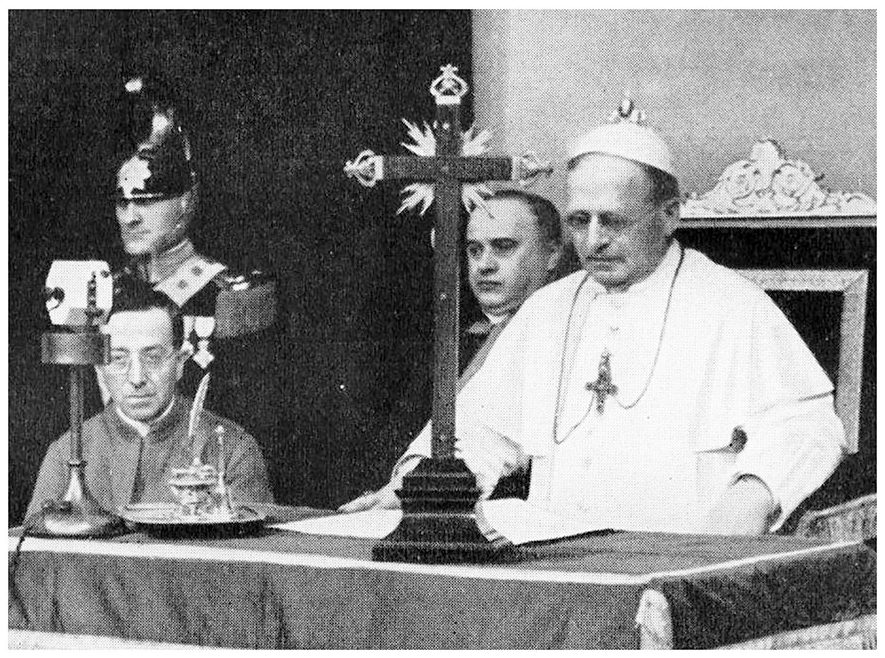
Pope Pius XI photographed during the first pontifical speech on the radio in 1931. Source (public domain): https://en.wikipedia.org/wiki/Cardinals_created_by_Pius_XI#/media/File:Papst_Pius_XI.,_Radio_Vatikan_1931JS.jpg. For more on Pius XI, see Josef Metzler, “The Legacy of Pius XI,” International Bulletin of Missionary Research 17, no. 2 (April 1993): 62–65.

In 1925 Pius XI sponsored a Vatican exhibition on Catholic missions, featuring an enormous collection of books related in any way to the missions. After the exhibition, the books were donated to Propaganda Fide and became the Pontifical Missionary Library. Telling the story of this exhibition is John J. Considine, The Vatican Mission Exposition: A Window on the World (New York: Macmillan, 1925). For more, see Angelyn Dries, “The 1925 Vatican Mission Exposition and the Interface between Catholic Mission Theory and World Religions,” International Bulletin of Mission Research 40, no. 2 (April 2016): 119–32. This figure, as well as figures 4 and 5, are from the author.
One cannot forget the support of the Congregation at the birth and development of missiology as a discipline of theology. At the Athenaeum de Propaganda Fide the Bibliotheca Missionum (1916–74) was published, the fundamental work for the study of the history of evangelism. It is a collection of thirty volumes that gather together all the documents, not only Catholic, with missionary influence produced from the end of the Middle Ages to Vatican Council II. The Bibliographia Missionaria (1935–2016), published continuously by the Pontifical Urban University, continued on this monumental work with annual volumes.
Apostolate of the press—Polyglot Typography
The Polyglot Typography of the Sacred Congregation was founded before the birth of Urban College for the missionary apostolate. 24 The apostolate of the press was in fact considered from the beginning as an important means for the communication of the faith. Already in the same year as the founding of the Congregation de Propaganda Fide there was talk of printing books in foreign languages. Seven years after the founding, the print shop owned more than ten different typefaces for different languages. 25
The publication of the Biblia Sacra Arabica S.C. de Propaganda Fide iussu edita in 1671 after about fifty years of work merits special attention. In fact, the translation work was started in 1622 when the special commission requested particular attention for this edition, as it was destined for the Muslims. 26

Coats of arms of Polyglot Typography.

Propaganda Fide’s three-volume translation of the Bible into Arabic.
Missionary cooperation
In order to make missionary cooperation more efficient, there must be, first of all, a tight collaboration among the bodies responsible for missionary activity. Having arisen in churches of ancient Christianity to support the work of missionaries among non-Christian peoples, the Pontifical Mission Societies have become an institution of the universal church and of each particular church. 27 They are the institution intended to promote missionary cooperation of every particular church, of every bishop, of every parish, of every community, of every family, and of every person. 28
As a favorite instrument of the pope to fulfill his missionary duty in his role as pastor of the universal church, the societies are a privileged expression of the unity and at the same time of the universality of missionary work. 29 The societies constitute a unique institution that includes four distinct branches. 30 They have in common the primary and principal goal of promoting the universal missionary spirit within the people of God. They operate in close collaboration with the Congregation for the Evangelization of Peoples, which coordinates the missionary task united in goals with the particular churches and with the various missionary bodies present in the whole ecclesiastical community.
The advancement and training of the universal missionary spirit are promoted as the primary activity by each of the four societies, in relation to the sector and scope of activity in which each one of them exists. Three of the societies—Propagation of the Faith, 31 St. Peter the Apostle, 32 and Holy Childhood 33 —are dedicated with much commitment and with various initiatives to the raising of relief and aid to be distributed to all the churches in missionary territories. The fourth—Missionary Union 34 —is dedicated exclusively to the missionary training of leaders and active participants in the Christian communities. Its task is to promote the other societies and to be their soul.
The organization and promotion of the activities of the annual World Mission Day has been entrusted to the Propagation of the Faith society. It coordinates the activity of the central solidarity fund, with which the pope can support the missionaries and the evangelization activities of the churches recently formed, with creation and support of the necessary structures for human advancement, narrowly linked to the proclaiming of the gospel. The World Mission Day was instituted in 1926 by Pius XI, who welcomed the request to establish a day of prayers and promotion for missionary work to be celebrated on the same day throughout the world, collecting on this occasion an offering for the missions. 35 This Sunday unites all the children of the church in the commitment of solidarity and sharing of aid and material goods for the mission ad gentes.
The St. Peter the Apostle society makes contributions to the development of the local clergy and continues to carry out an important role for the relief that it offers. In the young churches, its help allows seminarians, the houses of training, and centers of higher study to adequately prepare the indigenous vocations for the tasks of the apostolate.
The Pontifical Association of the Holy Childhood, addressing children up to adolescence, sees to supporting, with skilled and targeted pedagogic action, their openness to charity and Christian solidarity. From its founding the motto of the association continues to be “Children helping children,” first and foremost with prayer and trying to meet them halfway with their own savings.
Current organization of the Congregation and its scope
Vatican Council II reemphasized the missionary nature of the church and the joint responsibility of the College of Bishops and the individual bishops with their particular churches in the mission commitment ad gentes. After the reorganization of the Roman curia desired by Paul VI (1963–78), the Congregation for the Propagation of the Faith assumed the name Congregation for the Evangelization of Peoples, or Propaganda Fide. 36 The decree Ad gentes had redefined the function of the missionary office with guidance regarding the composition of its directive organs. It affirms, “For all missions and for the whole of missionary activity there should be only one competent office, namely that of the ‘Propagation of the Faith,’ which should direct and coordinate, throughout the world, both missionary work itself and missionary cooperation. However, the law of the Oriental Churches is to remain untouched.” And thus the need that “this office must be both an instrument of administration and an organ of dynamic direction, which makes use of scientific methods and means suited to the conditions of modern times, always taking into consideration present-day research in matters of theology, of methodology and missionary pastoral procedure.” 37
According to the apostolic constitution Pastor bonus of June 28, 1988, “It pertains to the Congregation for the Evangelization of Peoples to direct and coordinate throughout the world the actual work of spreading the Gospel as well as missionary cooperation, without prejudice to the competence of the Congregation for the Oriental Churches” (art. 85). In addition, the office has direct and exclusive competence in its territories, except the competence of other offices in various matters (arts. 88, 89). In their own territories the Congregation instituted and split the missionary circumscriptions in accordance with expediency. It presided over the governing of the missions and examined all the questions and reports sent by the Ordinaries and Episcopal Conferences. The societies of apostolic life established for the benefit of the missions remained subject to the Congregation (art. 90, §2). In the end, the Congregation administers its own property and the other assets meant for the missions through a special office (art. 92).
Some statistics
As it does every year, in view of World Mission Day, which celebrated its ninety-fifth anniversary on Sunday, October 24, 2021, Fides News Service offers statistics chosen to give an overview of the missionary church all over the world. 38
The
Conclusion
During the Congregation’s four hundred years of life, Propaganda Fide has added various features into its missionary program, such as the establishment of new, typically missionary religious orders, creation of missionary institutes for secular priests, help for the spiritual and material development of people among whom evangelizing activity takes place, development of missiology, and participation of the lay in missionary activity. This last point, promoted by Pius XI and encouraged by John XXIII in his encyclical Princeps pastorum (1959), was laid out in a definitive and solemn way, as the authentic responsibility of the lay, only in Vatican Council II in its decree Ad gentes. In this way the participation of the lay in missionary activity became one of the well-known characteristics of the postcouncil missionary church. It is necessary to underline that from the beginning Propaganda Fide tried to spread the missionary spirit throughout the entire church, inspiring all the faithful to help the missions with prayers, sacrifices, and material aid. What we call today missionary cooperation of the lay was already considered in 1622 by cardinals who were members of the Congregation, with their proposal of establishing a Universal Mission Day.
In trying to give a summary judgment on the activity of Propaganda Fide during its four centuries of life, we ought to stress that it has had a prominent role in the church. We can mention four principal aspects of its contribution. In the first place, on the level of the universal church, the Congregation has mobilized the entire church for missions in the awareness that it is all substantially missionary, recalling in the conscience of all the faithful their responsibility for the spreading of the gospel. On the missionary level, what has been done is clear from the historical study of the development of the church in these last four hundred years. Another aspect concerns the activity on the ecumenical level for the union of the Christian churches, a task that the Congregation undertook from the beginning of its existence up to the creation of the Secretariat for Promoting Christian Unity as a permanent organ of the Holy See after Vatican II. The fourth aspect concerns the spiritual and material development of the people. In this case, the numbers cited above well describe the range of the activities of the Congregation in the areas of its jurisdiction.
From the perspective of four centuries, we ought to be hesitant to assert that the history of the Congregation is free of imperfections, of errors and misunderstandings, of the human element that the Holy Spirit makes use of in his evangelizing action. Pope John Paul II (1978–2005) thus began his missionary encyclical Redemptoris missio (1990): “The mission of Christ the Redeemer, which is entrusted to the Church, is still very far from completion. . . . We must commit ourselves wholeheartedly to its service. It is the Spirit who impels us to proclaim the great works of God: ‘For if I preach the Gospel, that gives me no ground for boasting. For necessity is laid upon me. Woe to me if I do not preach the Gospel!’ (1 Cor 9:16).” 47 The awareness of our own insufficiencies ought to be a valid incentive for us, people of the twenty-first century, and to future generations so that we and they dedicate with greater commitment all our own spiritual and material strength to the cause of evangelization and the progress of the peoples.
Footnotes
Notes
Author biography