



Abstract
In this article, I revisit the formulations of anthropologist Pierre Sanchis about "urban popular culture," with the aim of making comparisons with Pentecostal growth in the peripheries beginning in the 2000s. This growth has revealed comparisons between existing cultural references and new aesthetic and grammatical forms, with repercussions in social interactions, the economy, and local and supralocal politics. These observations are based on fieldwork conducted in Rio de Janeiro favelas. The empirical material that supports the analysis proposed here is also based on data from research conducted at the Universidade Federal Fluminense, which mapped worship places in Rio de Janeiro.
Editor’s note: This article by Professor Christina Vital da Cunha was originally published in Portuguese as “Cultura pentecostal em periferias cariocas: Grafites e agenciamentos políticos nacionais,” Plural: Revista de ciências sociais 28, no. 1 (2021): 80–108, https://doi.org/10.11606/issn.2176-8099.pcso.2021.188462. Plural, a journal published by the Department of Sociology, University of São Paulo, Brazil, granted the IBMR permission to translate, publish, and sublicense the article in English throughout the world and in all languages other than the primary article language. This is the first article published in OMSC’s “Translations of Christian Scholarship” initiative, which invests in the professional translation of articles and essays from Africa, Asia, Eastern Europe, Latin America, the Middle East, and Oceania in any field in the theological curriculum. Our goal is to bring new voices to IBMR readers and foster new conversations that reflect the world church in all its diversity.
To analyze the most recent cultural transformations existing in urban Brazil, it seems appropriate to revisit the contributions of Pierre Sanchis (1928–2018). 1 In the field of the social science of religion, 2 Sanchis was prominent in considering Catholicism as a key element in shaping a “national culture,” establishing markers of social interaction, as well as its moral reference values. Among the less wealthy urban segments, Catholicism determined what Sanchis called traditional urban popular culture. He defined this cultural form as having “little moralistic rigor, little civic discipline, anarchic, though often intense, and from a religious point of view, a porosity of identities that allowed everyone to participate at the same time in multiple institutional definitions.” 3 With the growing presence of Pentecostal Evangelicals in the public space, as confirmed by their numbers in IBGE censuses since, mainly, the 1990s, 4 scholars began to reflect on the reactions of the Catholic Church to this growth, as well as on the possible establishment of a “Pentecostal culture” in Brazil. These studies sometimes highlighted processes of assimilation of the secular culture into the new cultural form, 5 and sometimes interpreted it as a rupture, as confrontation by a new culture of a prevailing culture and order.
In this article, I wish to include myself in a set of studies that focus on the powerful analytical confluence between religions and cities. 6 More specifically, I intend to analyze the shaping of a Pentecostal culture in the peripheries, considering that the increase in the number of Pentecostal churches and their faithful has caused changes in various spheres of social life in these locations, such as social interaction, economy, aesthetics, 7 politics, landscapes, and the grammar articulated daily by its residents, 8 whether or not they are formally linked to a Pentecostal Evangelical institution. Within the limits of these pages, I will deal with just a few aspects of these changes, such as local social interaction and supralocal political agencies, having already presented, in other publications, data that supported the analysis of other interfaces of this social phenomenon. 9
In methodological terms, it is perhaps important to point out that I will deal here with “Pentecostal culture in the peripheries,” a phrase with many qualifications. The term “culture” is a great abstraction. Also the notion of “Pentecostal culture” tends to produce an essentialized perception of Evangelicals without highlighting the differences that mark the actions and doctrines of the various denominations in this category. However, I would like to defend it in this work proposal, as it seems to me especially effective for thinking about various situations that mark social life in these city territories, with reverberations in supralocal political life. 10
It is worth emphasizing that my interest is less on institutionalized Pentecostal experience, with its attention to the norms and theologies of churches, and more on the diffusion of images and aesthetics, on the ways in which people activate, manipulate, and use moral references from Pentecostalism in social life in the peripheries, forming a cultural base permeable to narratives produced and/or disseminated by Evangelical leaders, even forging approximations between social worlds until now not noted in the literature, such as, for example, the world of crime. 11 My reflections are therefore directed toward a diffuse, nondenominational 12 modality that has been shown to be growing in Brazil in the last decade.
Throughout the ethnography carried out intermittently between 1996 and 2015 in the Acari favela (located between neighborhoods in the North Zone of Rio de Janeiro City) and comparatively in Morro Santa Marta (located in Rio’s South Zone) between 2005 and 2010, 13 I interviewed Evangelical and nonreligious residents, drug dealers, presidents of neighborhood associations, religious leaders, and missionaries. 14 In these interactions, also in unsystematic field visits after the period of academic training, I could observe the institutional commitment of countless residents to the churches they attended, as well as, on the part of other actors, the diffuse uses of specific words or expressions that circulated among Pentecostal Evangelicals.
After the period of processing these fundamental experiences, a common experience for researchers at the end of their work, the set of situations experienced in the field inspired and encouraged me to try to give an analytical form to the complex Pentecostal presence and influence in the favelas. In addition to these experiences, the broader political context and the research conducted later on the varieties of Evangelical presence in the media and in politics were also important in shaping this interest. In more detail, the present analyses draw on long-term ethnography and on material resulting from the research “Mapeamento de templos religiosos no Rio de Janeiro, 2006 a 2016” (Mapping religious temples 15 in Rio de Janeiro, 2006 to 2016), conducted in a partnership between the Universidade Federal Fluminense (UFF) and the Fundação Palmares (Palmares Foundation, Brasília). 16
Pentecostalism in patterns and numbers
The arrival of Pentecostalism in Brazil in 1910 and its subsequent spread have seemed to constitute “a direct challenge to traditional Brazil.” 17 The “Brazilian knack,” which adapts norms and suggests behaviors that balance law and custom, was coming to an end with the modernity imposed by this new Christianity. 18 From this perspective, Pentecostalism represents a cultural and ethical break with the patterns on which Brazilian society was based and with the current religious traditions. The social perception of Pentecostalism as an exclusivist and ascetic religion, a religion of rupture, a “solvent” of social bonds and cultural heritage, 19 is still current in Brazil, although we can identify numerous cultural compositions and continuities. Thus, what the scholarly work began to reflect on was the “Brazilianization” of Pentecostalism. Pierre Sanchis suggests that between the Pentecostalization of Brazilian culture and the Brazilianization of Pentecostalism, the Universal 20 is the clear proof that the latter movement was the more successful. 21 Countless other studies added to the diagnosis, which established that the break of Pentecostalism with the national parameters was only partial. 22 In this same sense, Joel Robbins attributes the success of global Pentecostalism to its ability to adapt “on its own terms.” 23 Its growth would be the result of these adaptations, at the same time as its modern, Western character is identified with neoliberalism.
The cultural adaptation “on its own terms,” as noted by Robbins, was observed by Sanchis in the rituals of Pentecostalism, beginning in the 1990s: “Pentecostal worship, markedly musical, emotional, made up of collectively regulated individual explosions, found its specific but plausible place among the ‘feasts’ that have always marked the religious daily life of popular Brazilians.” 24
Numbers of Evangelicals in the peripheries
By the 1990s, Evangelicals were a growing religious segment in terms of their presence in different spheres of Brazilian social life—in the media, as well as in politics, economy, and culture. In 1980, according to IBGE data, the percentage of those who declared themselves Evangelicals in Brazil was 6.6. In 1990, they constituted 9 percent of the national population, 25 with Catholics accounting for 83.8 percent. Beginning in the 1970s, Evangelicals were quite active publicly, but little was known about them, strengthening a general feeling that they were the others in relation to us Catholics. 26
In the 2000s, Evangelicals totaled 15.5 percent, while Catholics fell to 73.8 percent of the national population. Based on IBGE microdata, César Jacob produced religious maps of the city and metropolitan region of Rio de Janeiro, identifying the incidence of religions by area. Catholicism was more present along the coastal strip, “which extends from Recreio dos Bandeirantes to the city center, passing through Barra da Tijuca, São Conrado, Leblon, Ipanema, Copacabana, Leme, Botafogo, and Flamengo. To this range are added Gávea and Jardim Botânico.” In this strip, Catholics represented almost 80 percent of the population. Conversely, in most municipalities in the periphery, the Catholic religion represented less than “48% of its inhabitants. The percentages of Catholics are even smaller in areas of Nova Iguaçu, Belford Roxo and São Gonçalo, between 41% and 30%.” 27
In the survey “Mapeamento de templos religiosos no Rio de Janeiro, 2006–2016,” we confirmed the emergence of 4,031 temples (i.e., places of religious worship) in the city in a ten-year period, which represents more than one place created per day in the period. Following the trend that Jacob pointed out in georeferencing the religion of the city’s inhabitants, the UFF mapping research found that Evangelical denominations created most of their temples in peripheral areas and in areas with lower per capita income. In the South Zone, West Zone 1 (Barra da Tijuca and Recreio dos Bandeirantes), and the Central Zone, the lowest percentage of temples in the total was registered (respectively, 2.93, 2.16, and 2.65 percent). The West Zone 2 (Bangu, Realengo, Deodoro, Paciência, and Padre Miguel, among others) and the North Zone were those in which the highest percentage of new temples was registered in the ten-year period, as shown in table 1. It is worth noting that in West Zone 2 the largest number of temples created belonged to Evangelical denominations, and in the North Zone, the largest number belonged to Catholic denominations and Afro-Brazilian religions.
Percentage of temples opened in two city areas between 2006 and 2016.
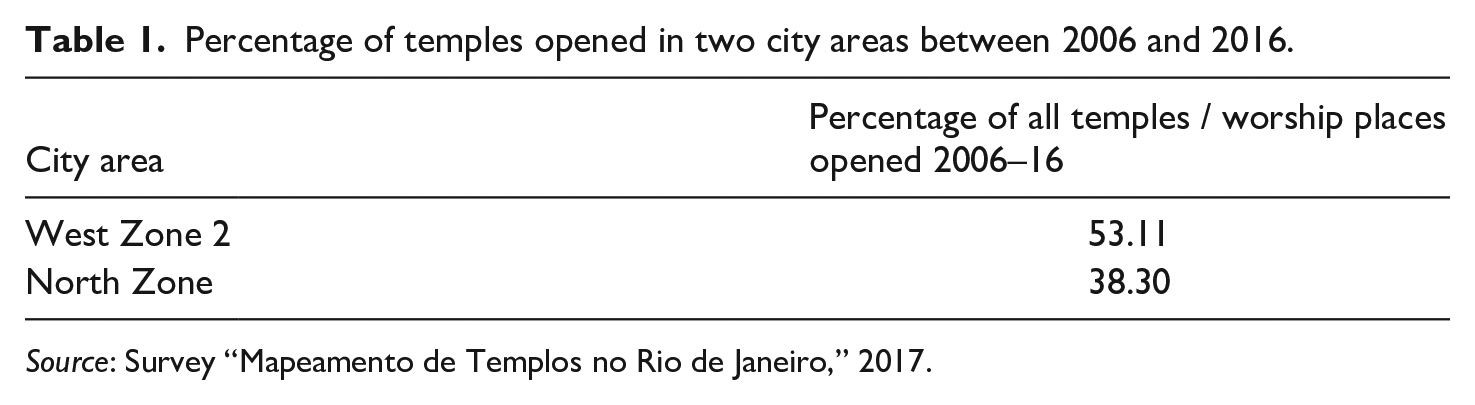
Source: Survey “Mapeamento de Templos no Rio de Janeiro,” 2017.
Of the total number of temples opened in the city between 2006 and 2010, around 13 percent were located in favelas. In recent years only Evangelical and Afro-Brazilian religions have created worship facilities in these areas, as shown in table 2.
Percentage of temples opened in favelas between 2006 and 2016, by religion.
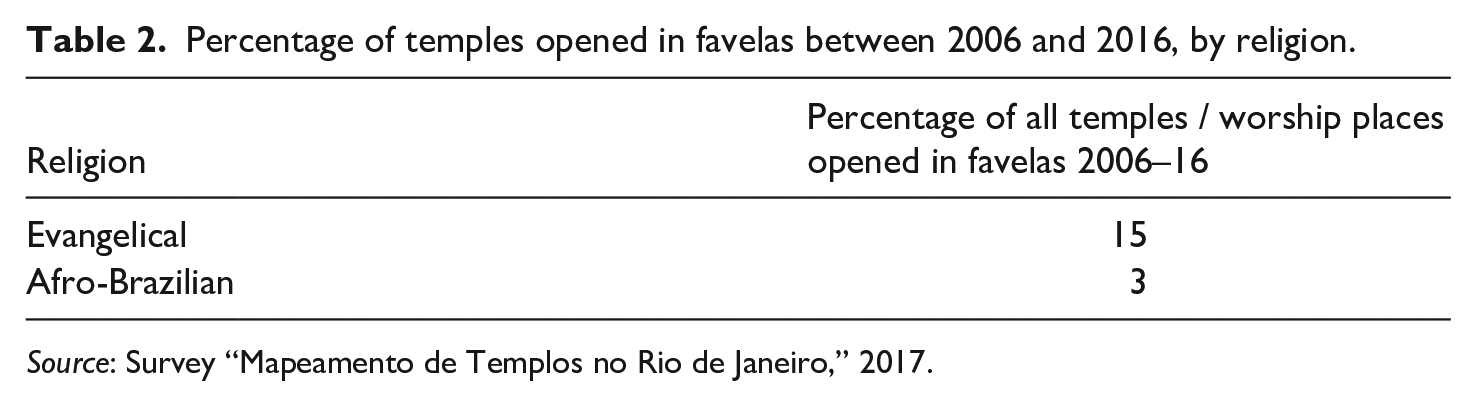
Source: Survey “Mapeamento de Templos no Rio de Janeiro,” 2017.
Among the three largest religious groups in Brazil, according to the IBGE classification, Evangelical denominations were the ones that registered by far the most temples in recent years, as shown in table 3. And of all Evangelical churches in Rio de Janeiro in this same decade, the Pentecostal church Assembly of God was responsible for registering 45 percent of them.
Percentage of temples opened between 2006 and 2016, by religion.
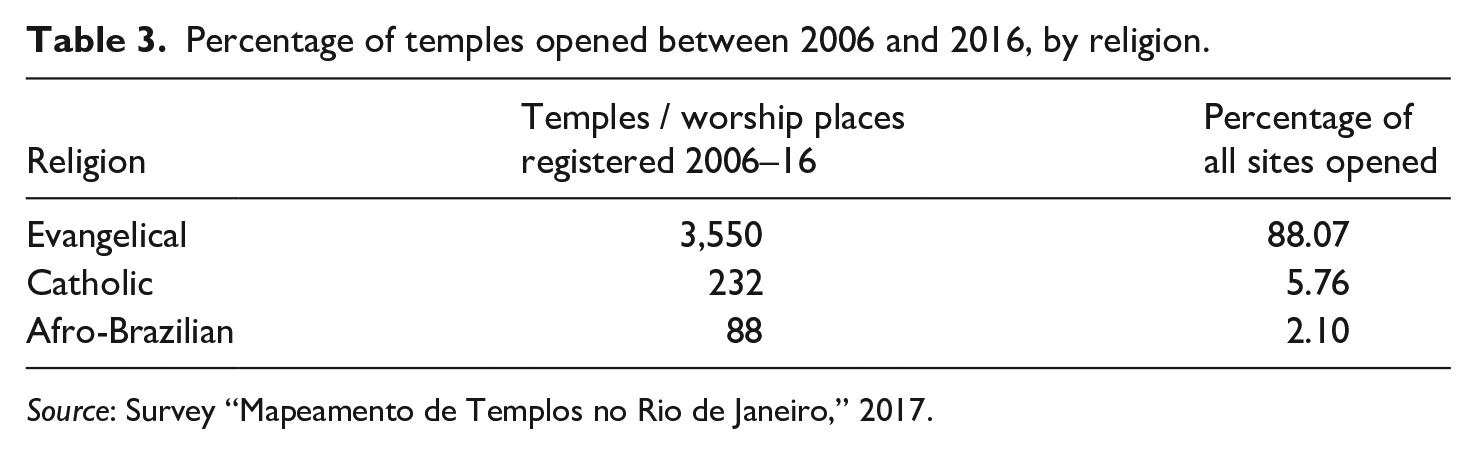
Source: Survey “Mapeamento de Templos no Rio de Janeiro,” 2017.
In 2010, according to IBGE data, Evangelicals constituted 22.2 percent of the national population, and Catholics, 64.6 percent, which represented a drop of almost 10 percent, compared with the previous census. Pentecostals have grown in the middle and upper strata of society. IBGE data attest that the increase in Evangelicals in Brazil since 1970 is more significant in urban areas and, above all, in its geographic and social peripheries. In quantitative terms, 87 percent of those who declared themselves Evangelicals in Brazil in 2000 lived in urban areas. By 2010, this percentage had risen to 89.50.
Various ethnographies have monitored this growth of Pentecostalism in favelas and suburbs, analyzing its impacts. 28 In the following section, building on previous studies, I will focus on data collected from my fieldwork in the Acari favela. It allows us to analyze more recent changes in terms of the population’s modes of expression and local organization, including those of drug dealers. To this point, I have largely focused on statistics and a review of the literature on Pentecostalism in Brazil. In what follows I will use a “reading of images” as a methodological resource. My objective is to “search for uses of images not as illustrations but as documents that, like others, build models and conceptions.” 29
Therefore, I believe that images (in this specific case, graffiti and mural paintings in favelas) exert a kind of agency, gaining a central role in this work. As such, they actualize and recall religious feelings in the terms proposed by Bruno Latour. 30 More than expressing a rationally captured message, the images produce feelings in the receiver. The exercise of “unfreezing” the images—that is, of following the flow of images produced—is, according to Latour, a sine qua non for understanding the processes of mutual transformation (of senders and receivers) that I intend to reflect on. The search for visibility, an important aspect in shaping the “public Evangelical culture,” 31 is highlighted in my analysis of the context of the peripheries, which in turn will allow us to reflect also on contemporary political agency in Brazil.
My aim here is to analyze in situ the changes, perceptions, and strategies of the authors of these images. If, as we saw earlier, the literature emphasizes the importance of the body and music in rituals and in the Evangelical religious experience more generally, here I will highlight the images produced by treating them as community codes—even if imagined—of a Pentecostal identity. 32
Within the limits of this article, it will not be possible to review the concept of identity. It seems important to say, however, that I do not treat identity as a kind of emanation “from the way of being of a particular group, nor as the immediate result of their living conditions.” 33 Identities are constructed discursively and depend on a social mediation process in which various human and nonhuman agents participate. Identity is thus the result of configurations (especially of disputes and agreements) always situationally defined in a certain space and time. Thus, to speak of identity is to speak of differences. Differences assume an absolutely fundamental place in social relations; “between individuals, the differences are much more important than the similarities.” 34 As also Philippe Poutignat and Jocelyne Streiff-Fernart point out, the concept of identity refers to a range of identification possibilities, which reveals its vitality and analytical possibilities. 35 Even so, and increasingly, we observe how the activation of a religious identity produces an internal force that can revert to different social capitals. 36 In this sense, Erving Goffman’s notion of virtual social identity is valid insofar as it refers to expectations in relation to individuals in interaction situations. 37
Three decades of paintings in Acari
The paintings made in the 1990s and 2000s by residents and/or artists hired by drug dealers in the Acari favela have been analyzed in previous works as a way to access social dynamics present in that locality, 38 which mirrors changes present in other places of the city. In the 1990s, for example, the most frequent religious symbols in images and paintings displayed in public spaces in the Acari favela were Saints Cosmas and Damian, Saint George, Saint Jerome, and Our Lady of Aparecida. 39 (See fig. 1.) It was still common to see images of Zé Pelintra on altars or small saint-houses made of cement and covered with tiles on street corners in the favelas. 40 In several paintings, Catholic symbols appeared with reference to corresponding images in Umbanda or Candomblé. For example, we found Salve Doum, 41 Xangô, 42 and Ogum 43 beside the paintings of the saints.
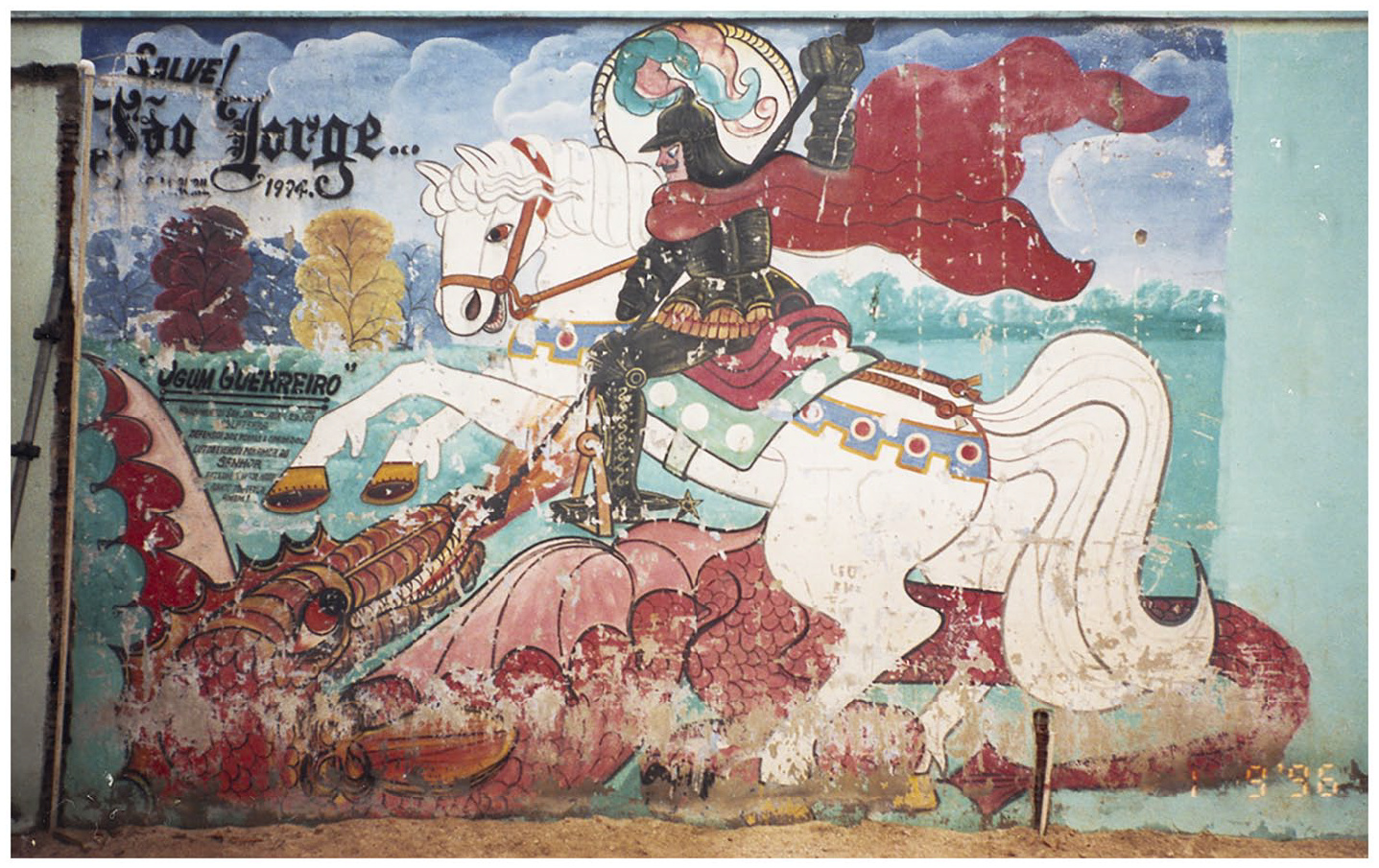
Medieval aesthetics: Saint George and the dragon. Author not identified. Acari favela. Photo: Marcos Alvito, 1996.
At the time, the local terreiros (Afro-Brazilian temples) had routine activities open to Acari residents and “children of saints” residing in other parts of the city. Local drug dealers also frequented the terreiros, asked for cowrie-shell divination and for protection from the orixás, made offerings, and contributed to the feasts of the saints. Mainly on the days of Saint George and of Saints Cosmas and Damian, there were fireworks, feasts, and in the latter case, distribution of sweets and toys to local children.
Inspired by Marcel Mauss’s discussion of magic, 44 Yvonne Maggie emphasizes that it has the characteristic of being hidden, “hiding from the collective and the public, limiting itself to more individual and private spaces.” However, she continues, magic “overflows the spatial limits of the house where the rituals are performed and insists on appearing in public places in a mysterious way, in secret—in orders, offerings, ebó sacrifices, 45 spells.” 46 In Acari, magic, as well as the beliefs of residents and drug dealers, overflowed the boundaries of houses and temples, not in a mysterious way, but ostentatiously occupying streets with their sacred icons, chants, and prayers.
In the 1990s, the growth in the number of Evangelicals in Acari could already be perceived. This growth expressed itself in the formation of an Evangelical landscape comprising (1) temples, (2) banners and posters announcing services, campaigns, testimonies, praises, and celebrations, (3) the formation of a soundscape, in the terms used by Martijn Oosterbaan, 47 (4) gospel businesses, and (5) the more austere clothes of women and men in comparison to the way non-Evangelical residents of the favela dressed. Precisely at the end of this decade, the conversion of a drug dealer, leader of the so-called Terceiro Comando (Third Command) gang, transformed the murals of the favela, revealing and thus at the same time altering the relative prestige that Evangelicals and the religious of the Afro-Brazilian matrix had in the favela.
In the 2000s, Evangelicals occupied the favela landscape once and for all. The growth in the number of temples was in the order of almost 50 percent, while the terreiros stopped conducting public activities. 48 Paintings of saints, music icons, and ethnic references, as well as soccer symbols, gradually gave way to Bible quotations. In reading these images, we notice their agency and the combinations of meanings between the text and the aesthetic form used. Thus, the images (text and form) referred to the Old Testament, to the God of War, and to the God of David. (See fig. 2.)
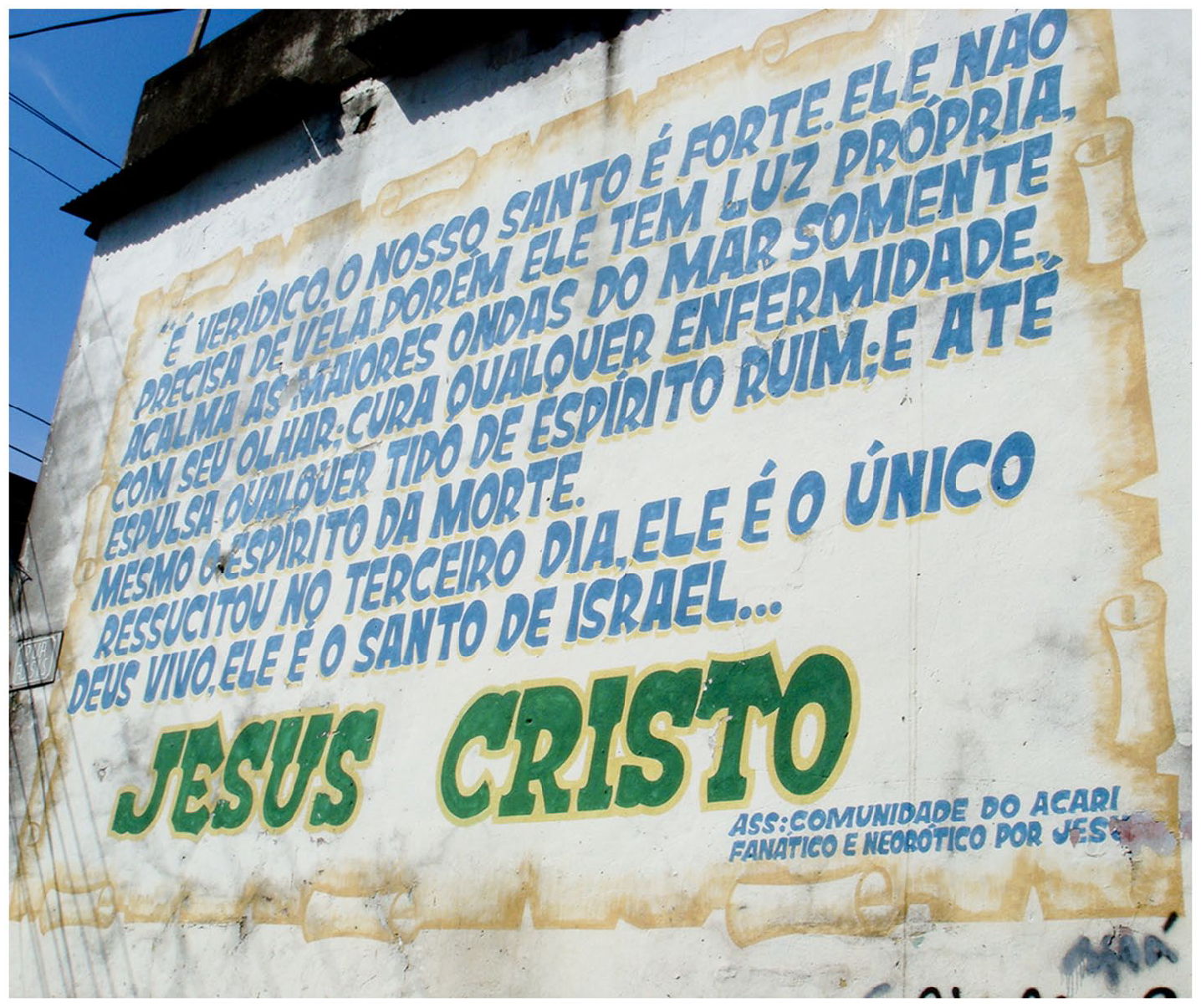
“It is true, our saint is strong. He doesn't need a candle, but he has his own light. He calms the biggest waves of the sea with just a look. He heals every disease. He casts out every kind of evil spirit, even the spirit of death. He rose up on the third day. He is the only living God. He is the saint of Israel, . . Jesus Christ. [signed:] Acari community, fanatic and neurotic for Jesus. Acari favela. Photo: Christina Vital, 2008.
During this period, the then most wanted drug lord of the Terceiro Comando, born and raised in Acari, converted to the Assembly of God of the Last Days. Since his conversion and his return from a short period spent in prison, now as a drug lord and at the same time an Evangelical, a series of changes occurred in the management of the drug trade in line with changes in the local political and economic spheres. An update of the former crime dynamics took place, based now on religious arguments. The process of destroying Catholic and Afro-Brazilian images, initially carried out by police officers who occupied the favela in the mid-1990s, 49 continued its course and now had the encouragement of the traffickers themselves, who financed local artists to create mural paintings with biblical texts.
According to what can be identified through observing the images, the growth in the number of Evangelical places of worship, and interviews with residents, as well as following the suggestions of Benedict Anderson, 50 at that time the paintings in Acari made visible an identity marked by a predominantly religious form. According to Anderson, the efficiency of these symbols occurred within a specific community logic, in which, despite the conflicts always present in the daily life of any social group, the announced identity and collectivity seemed “essential, natural” because they were shared. Given the hierarchical relationships established in the favela, the images reinforced at different times an intrinsic relationship between that collectivity and the religious universes, sometimes Catholic or Afro-Brazilian, sometimes Pentecostal. The images thus functioned as agents in their context.
Accompanying the moving images was a methodological strategy that was not planned from the beginning but that made it possible to produce keys of analysis for each situation. Thus, by the 2010s, more specifically by 2013, the images in Acari had changed. They were still Evangelical, but now they had a different aesthetic. Old Testament quotations in the paintings were replaced by new messages. Along with the wide use of the New Testament, a set of texts, words, and colors began appearing that together formed a motivational landscape referring to joy and good living and that encouraged faith, peace, and love. The shape of the letters was now rounded, no longer Old English fonts or others identified as appearing on papyrus or ancient sacred manuscript scrolls. The youthful identity of the new messages emerged through the aesthetics of graffiti, but also through the use of characters from popular comic books, as can be seen in figures 3 and 4.

Evangelical graffito—“Ide e palti dicípulos entre todas as nações” [Go and make disciples among all nations], Matthew 28:19. Chararacters from the Smilingüido comics. Acari favela. Photo: Christina Vital, 2013.
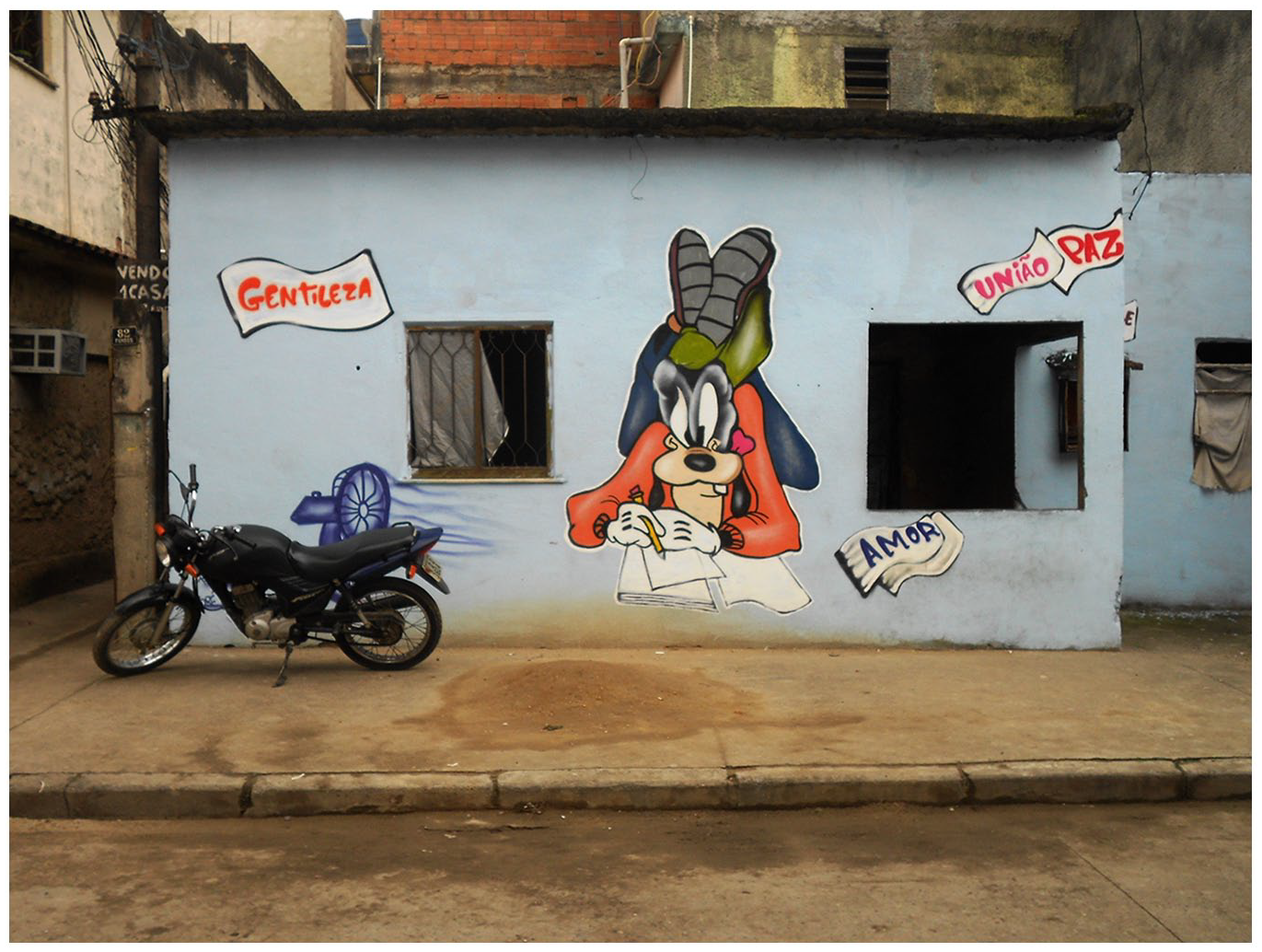
Motivational Evangelical graffito—“Gentileza, Amor, União, Paz” [kindness, love, unity, peace]. Character from the Smilingüido comics. Acari favela. Photo: Christina Vital, 2013.
The paintings now were signed; they were identified with an artistic collective (e.g., Os grafiteiros de Jesus, “The graffiti artists of Jesus”) or some of them, with a particular artist (e.g., André Soldado, “André Soldier”). The new aesthetic caught my attention; the graffiti in murals was different. 51 The images changed; the underlying motivational religious message was “sweet” (as Gilberto Freyre used to say about Christianity in Brazil), and it corresponded at the same time to changes in the way of evangelization and to actions of Evangelical youth, as well as to other dynamics of local drug dealers. In an interview I conducted in April 2017 with one of the artists of the crew responsible for the 2013 Acari graffiti, I learned that the paintings were financed by the favela’s drug traffickers. The artistic project was conceived and offered to them by an Evangelical young man who attended the Assembleia de Deus dos Últimos Dias (Assembly of God of the Last Days). The commitment was to paint all the walls of the favela for a weekly fee distributed by this intermediary to the graffiti artists. The style and texts were selected by the creator of the project, aiming to produce a more “pleasant, encouraging” landscape, as the interviewed graffiti artist said.
The destruction of previous images, as pointed out separately by Michael Taussig, Robert Musil, and Roger Sansi, 52 throws a surprising visibility on them, unfreezing them, taking them out of the invisibility to which they were destined by their great visibility in their context. 53 The religious graffiti that emerged in 2013 drew attention to the past and the present. They also were a marker of a new moment in trafficking management. More specifically, the previous images, mostly produced at the request of the drug lord then in power, expressed a link to the religious narrative of the “spiritual battle” through its integration into the Pentecostal church Assembly of God of the Last Days and through the political prestige that this denomination enjoyed among drug dealers and some of the residents of the favela. After this drug lord’s exclusion from this church and his unsuccessful efforts to create an independent denomination based in Brasília, the paintings changed. The new heads of the local drug trade, accepting the proposal of an Evangelical who negotiated the relationship with the professionals responsible for the new paintings, represented a new chapter in the practice of crime and in relations with religious leaders.
In 2015, the head of the local drug trade was a young drug dealer and Umbanda adherent, but the funding to expand the murals with biblical messages continued. At the gate of the sports ground formerly known as the Quadra de Areia (Sand field), there is a huge graffito referring to Jesus. In the 1990s the same wall showed a painting of Bob Marley on a marijuana leaf. In the following decade, a similar wall featured a Bible text in the shape of a parchment. In 2013 and 2015 new paintings with Christian references emerged. (See figs. 5–7.)
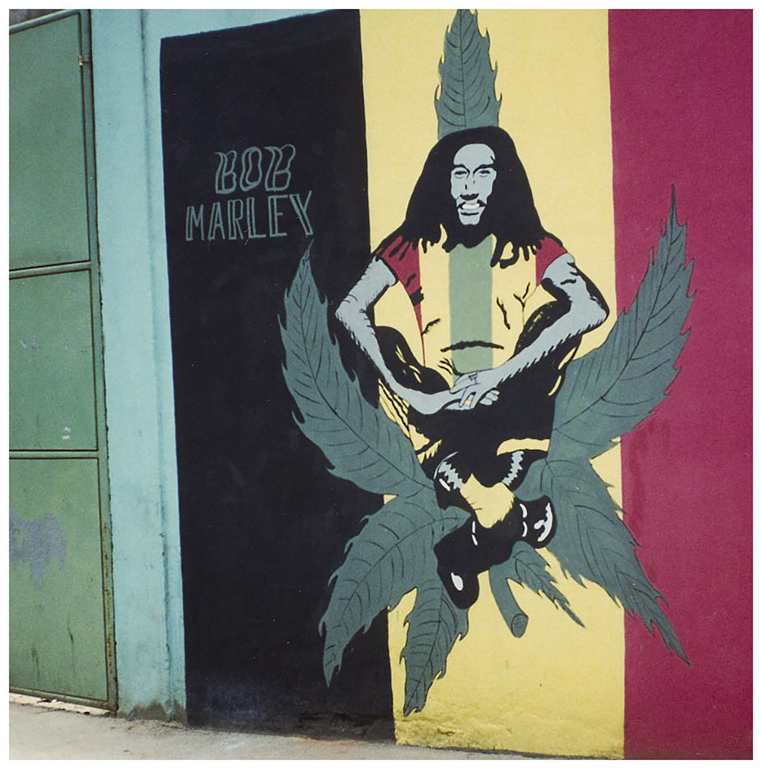
Wall at the right side of the gate of the Quadra de Areia (Areia Sports Ground). Photo: Marcos Alvito, 1996.
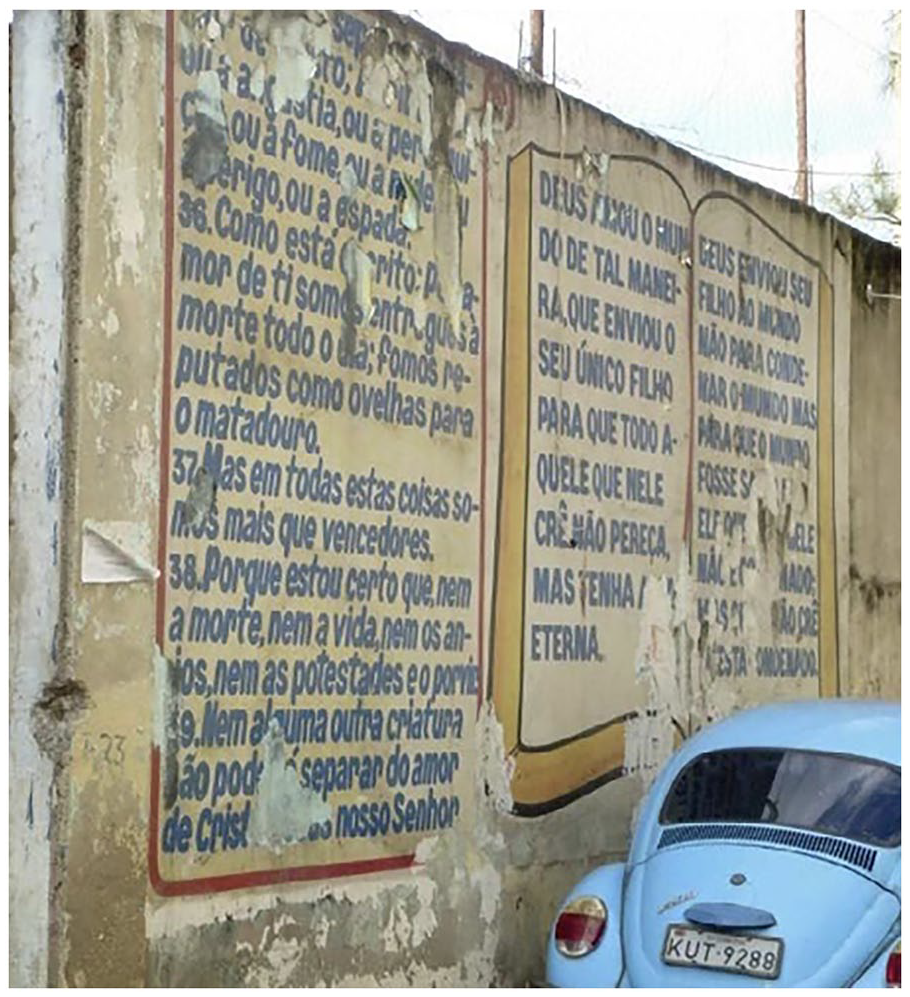
Wall at the right side of the gate of the Quadra de Areia, quoting Romans 8:35–39. Photo: Christina Vital, 2006.
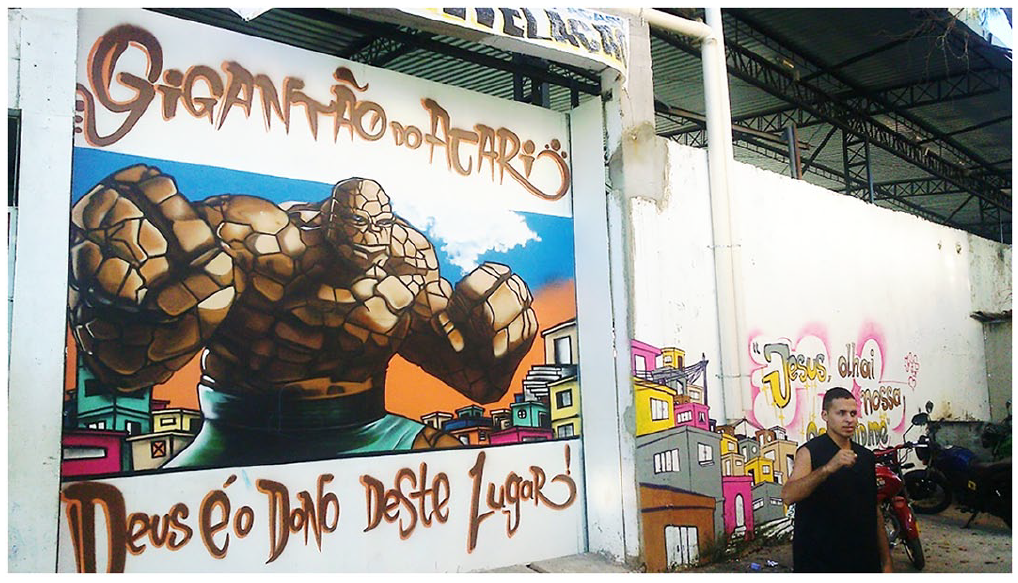
Graffiti on the gate and the wall of the Quadra de Acari (Acari Sports Ground). On the wall at the right: “Jesus, look after our community.” On the gate: “Giant of Acari” and “God is the owner of this place.” Photo: Christina Vital, 2015.
The Quadra de Areia is identified as a privileged (but not exclusive) space for the social interaction of drug traffickers among themselves and with other residents of Acari, 54 being the venue for soccer games, card games, funk balls, 55 and some gospel shows financed, according to residents, by the drug dealers themselves. Now there are different games on the multipurpose ground. A new aesthetic presents itself, but the presence of drug dealers is unmistakable. The current head of drug trafficking decorated the interior of the sports ground with graffiti (commissioned from artists from Rio de Janeiro) that refer to ethnic, music, and sports icons. (See fig. 8.)
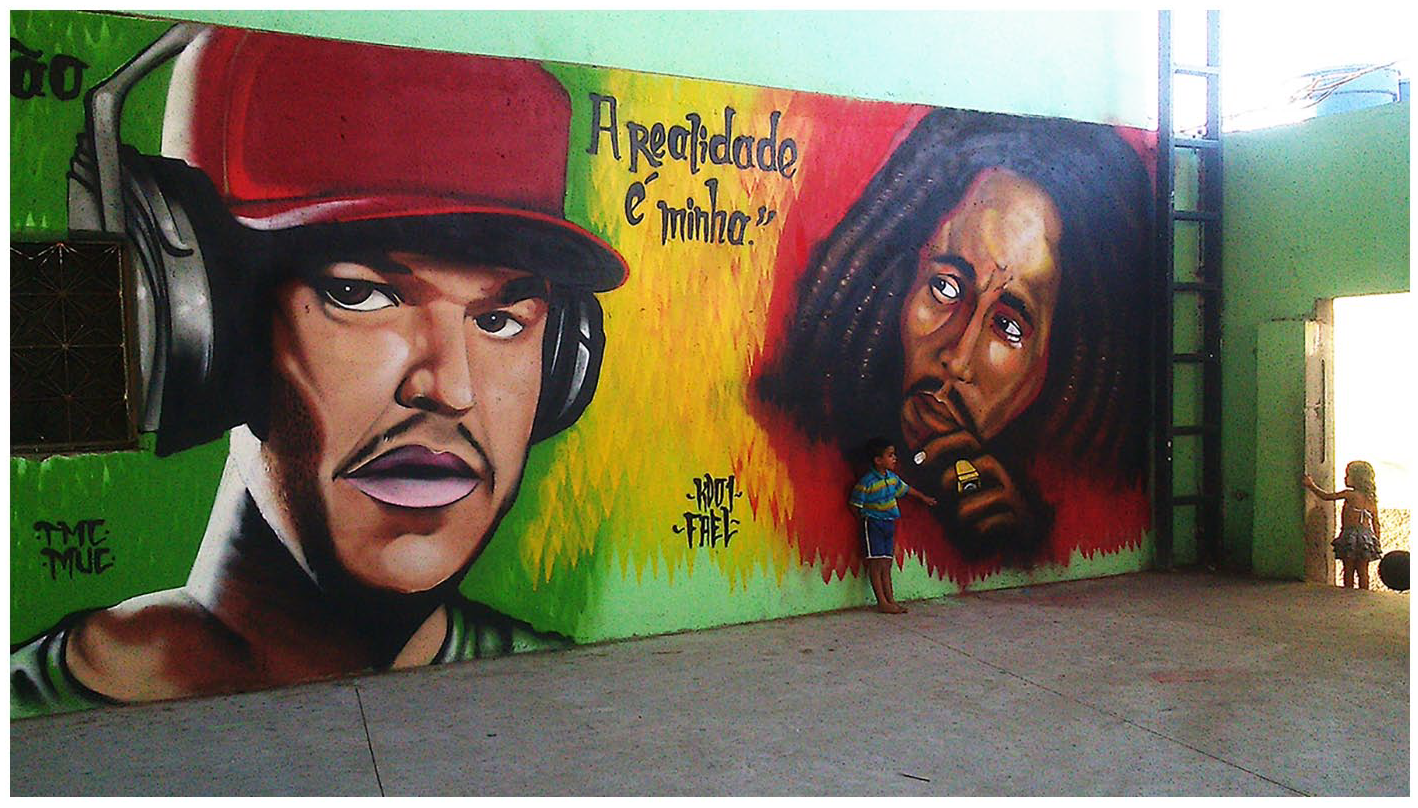
Graffiti inside the Quadra de Acari. Between the icons of hip-hop and reggae: “The opinion is yours, the reality is mine.” Photo: Christina Vital, 2015.
Inside the sports ground there is also a rat shown in a wall painting more than four meters high. The rat refers to the drug dealer’s pet, which drug lords in the 1980s and 1990s often kept, as reported in newspapers at the time and in books by various authors. 56
It is noteworthy that on the outside of the sports ground, the symbols used are Christian, promoting a youthful aesthetic and an Evangelical grammar, considering Jesus as part of this grammar, as André Droogers developed in an article on Brazilian minimal religion. 57 Droogers argued that Catholic hegemony in Brazil was also communicated by the use of the word “God” and the names of saints in public spaces. This changed with the growth of Evangelicals in the country. From then on, “Jesus” and other terms started to be used, either playfully in comedy programs to characterize suburban (Evangelical) believers, or in a colloquial way in the daily communication of middle and lower-class residents, mainly in neighborhoods of the North Zone, favelas, and peripheries of Rio de Janeiro and other cities.
Examples of these terms, which refer to the theology of prosperity and dominion and/or ritual emphases of Pentecostal churches, are the following: victory, battle, confirmation, spiritual warfare, trial, fear of the Lord, having to bend, the heat of the Holy Spirit, I can do all things through him who strengthens me, I am more than a conqueror, in the name of Jesus, the Word has power, the blood of Jesus has power, the joy of the Lord is our strength, healing, anointing, blessed, blessing, slippers of fire, glory, hallelujah, amen, it’s bound, sealed, vessel, servant, strong man/woman, work, for the honor and for the glory, evil, trembling, God will use you tremendously, God is with you, mantle, peace of the Lord.
Such words and images are articulated for the revival of religious feelings and identities, and at the same time they express the dominance of drug dealers. The control of the territories is expressed through religion and guns.
These terms in the daily lives of residents of favelas and other peripheries signify either adherence or criticism. They reveal domination and dispute, religion as a practice, and feelings that unite, but also as a device of domination. Use of these terms is a means of seeking protection and identification between residents and drug dealers, a way also of communicating moral agreement and belonging, relationships and in-group adherence, even if partial. In the speech of a resident, speculations about these grammatical and aesthetic uses emerge. In the exercises of moral cleanliness of some Evangelical interviewees, especially women, the religious affiliation of drug dealers and of some other residents who would not give “good testimony” was always the target of doubt and speculation. For example, a resident of the Acari favela made the following comments during an interview in January 2009: The people who were linked to Candomblé, who believed in images, no longer believe in them. And they went more to the Evangelical side, let’s say. Not that everyone believes. Many attend the service, but, so, it’s . . . they even attend asking for protection. As they used to go to the Macumba centers and ask for protection; they closed their bodies, used a guide.
58
. . . Nowadays, it has changed. Now they go to church, ask for prayer, and carry their Bibles in their pocket. It’s something—well, it’s really very cool. Before, they walked with a guide, with patuá,
59
and nowadays, they go to church, ask for prayer, carry those little leaflets in their pockets, carry a Bible in their pockets, those editions with the New Testament and Psalms, but they are out there in the world. So, I don’t know what security they have. I don’t know if it’s the same vision they had; the guide protected them, and the Bible too will protect them. . . . I don’t know what their vision is.
These religious terms have become a common mode of expression, a code that communicates social places, sometimes humor, but in any case, expressive of a social base that, if not institutionally linked to the churches that profess the Christian faith in a Pentecostal style, usually has in this religious universe a reference they must deal with, either to experience the comfort of being among equals or to understand and refute. The empirical data collected in the field present an additional challenge for those who intend to analyze social life in the peripheries. That is, to investigate political, economic, or crime dynamics, it is necessary to consider the codes and moral references of Pentecostal and other religions that are present, even if only slightly, in these domains.
The paintings inside the sports ground and the painting on its gate are emblematic of this movement of concealment and revelation of beliefs and values, of the relationship between drug dealers and the Evangelical “imagined community” around them. Inside, the paintings are “worldly”; on the outside, they conform with what the “imagined community” identifies itself with. We can think of on and off the court as distinct moral regions, 60 whose respective grammar and aesthetics are distinctive markers. On the outside, the relationship is with the surrounding society, which expects a certain behavior and which presents itself based on certain images; on the inside, we have the revelation of a self as it intersects with others. Although owning weapons makes any type of direct negotiation between residents and drug dealers unequal, 61 the local drug trade depends not only on control of the population through fear but also on bonds of affection and reciprocity that sustain peaceful coexistence between the two sides. In this sense, even though the local drug lord is not Evangelical, in the common area of the favela he finances Christian graffiti. Inside the sports court, nonnegotiable territory under his control, the graffiti have other forms and their own aesthetic and textual messages.
Final considerations
The social dynamics observable through fieldwork in favelas and discussed in the specialized literature provide us with elements for understanding the shaping of a Pentecostal culture in the periphery. 62 This Pentecostalized mode of expression is encompassing, and it hybridizes with other religious factors, leaving many areas of culture (e.g., the symbolic, aesthetic, grammatical, political, and moral) open for debate as to which factors are determinative. The culture does not exclude, but it continually evolves, morally and ritually. It draws on the common Christian base that already existed and on equally widespread beliefs in spirits and other entities in the supernatural world.
The existing Pentecostalism thus takes advantage of a set of moral and religious references, updating them in its own terms, as analyzed by Robbins. 63 Pentecostals, for example, do not deny the force of the Catholic message, but they judge it to be wrong because of what they identify as idolatry of saints and of the Virgin Mary. At the same time, they do not deny the strength of entities and orixás from Umbanda and Candomblé; on the contrary, they attribute to them great evil power, strong and demonic, which therefore should be resisted. Thus, in the peripheries, Pentecostal grammar and its moral values are increasingly being transformed into common codes, which emerge in various ways in bodies, in minds, and on walls.
This “Pentecostal culture,” which has been growing in the peripheries and favelas and spreading in society, contesting the national secular culture, represents in part a challenge to traditional Brazil, as Sanchis has argued. 64 It is disruptive; it is a “solvent” for family ties because it breaks with the previous collectivity. It is predatory and extractive, as it “systematically extracts members from other collectivities.” 65
In favelas and peripheries today, Pentecostal networks act by reinforcing the sense of family ties of friendship, kinship, and neighborhood, producing ontological security. They present themselves as a fundamental lifestyle in the urban environment that is disputed between forces of good and evil. 66 They gain strength in diffusion, in gradually making secular (common to all, without distinction) what they have updated in their doctrines and rituals. They offer spiritual comfort and specialized listening, since there is a growing number of pastors, missionaries, deacons, and church members who are trained in psychology and offer listening and means for their interlocutors to “work on their emotions,” in the terms of Arlie Hochschild. 67 They are functional elements of its growth and expansion, as Birman critically points out, 68 but they should always be remembered in the analysis because they produce experiences, existential impacts, and are not opposed to other explanations that consider more theological and doctrinal aspects, as well as performative aspects of their leaders.
Conflicts break out and routinely dissipate, which the specialized literature has covered. It is noteworthy, however, that the presence of Pentecostal references in the “front” moral region (e.g., the wall of the sports ground) and their concealment in the “back” moral region (e.g., the internal part of the sports ground) do not invalidate their analysis as a common code. On the contrary, being in the front region is indicative not of what is “true” but of what is socially imposed, what communicates positively at each time.
In this sense, following a thread of history allows us to say that the bases of what Pierre Sanchis called in the 1990s a “traditional urban popular culture,” which involved Catholicism and religions of the Afro-Brazilian matrix, have changed drastically. Today, the foundations of this Pentecostal culture in the periphery update existing Pentecostal beliefs, producing new social interactions, urban movements of people, and urban social movements, with Evangelical young people engaged in the struggle for a more just and egalitarian society, with more respect for human rights and a reduction in racism. Now mothers whose children were victims of police violence and of “urban violence” gain strength in reading Bible texts to fortify their political actions in society, along with new aesthetics, music, and grammars, 69 as we can see in the documentary Auto de resistência, by Natasha Neri and Lula Carvalho. 70
The growth in the number of Evangelicals in the social base has been changing the institutional politics, causing them to assume an increasing importance in elections since the redemocratization 71 and, markedly, from 2010 to the present day. 72 Political agencies organize themselves in relation to the growing Evangelical base in society. If the C class 73 corresponds to more than 50 percent of the national electorate, and Evangelicals are mostly in this social class, then we can understand the candidates’ mobilization of Evangelical narratives and aesthetics. In the 2018 general elections, for example, most victorious candidates mobilized feelings of opposition, conflict, and war of a supposed good against a supposed evil, in many cases directly resorting to a grammar of eschatological “spiritual warfare,” as well as a rhetoric of loss. 74
The strategic use of these aesthetic and discursive resources was widely influenced by Evangelical leaders, who present themselves as true defenders of the “Word,” inspired by the 2016 US elections. 75 In addition to political strategies based on data and statistics, the growth of the Pentecostal base in Brazil (whether institutional or in diffuse, “cultural” terms) signals a growing awareness of a certain moral framework. Campaigns diagnose and organize themselves in terms of these expectations, in terms of these references that touch the minds and hearts of a growing and heterogeneous group.
Thus, I could say that the traits of a Pentecostal culture in the peripheries today would be, very succinctly, marked by:
valuing entrepreneurship and discipline for success as a result of various influences, among which I would highlight the prosperity gospel 76 and the Positive Confession. 77 These beliefs promote feelings of confidence in the present and the future, personal empowerment, and bodily manifestations of the Holy Spirit. In addition to encouraging the opening of one’s own business, one’s engagement in cultural, artistic, and sport projects (often conducted by religious institutions) is valued and advertised as a powerful instiller of this “discipline for success.”
the notion that personal effort produces victories, which provides the basis for the previous item. It is important to highlight that in a social context of vulnerability, in which the State offers its services only precariously, “relying on oneself” and on more or less organic networks of neighborhood and kinship have always been resources for survival. However, there is an emphasis on individual efforts, although these networks continue to provide support when available.
a moral valuation of the nuclear family and defined gender roles for men and women.
from a religious point of view, a decrease in what Sanchis called “a porosity of identities that allowed everyone to participate at the same time in multiple institutional definitions.” 78
extensive use of metaphors and analogies that refer to war (between good and evil), dispute (of souls by antagonistic forces), tribulation (individuals’ daily struggle for material and spiritual survival), all forms inspired by dominianism, 79 which marks the doctrines and rituals of Pentecostal and Neo-Pentecostal churches today.
This Pentecostal culture in the periphery is the result of many processes that are endogenous and exogenous to the churches and to local social interactions. Its advancement and the establishment that is forged amid conflicts, resistances, passionate affiliations, and constraints is not undisputed, as nothing is in social terms; rather, it is being constantly updated.
Relevant bibliography not cited in the text or the notes
Footnotes
Notes
Author biography