




Abstract
This article reflects on the interface between missiology (and mission) and spirituality (including spirituality in practice). It explores the relationship between the two disciplines and introduces the mission spirituality spiral, which can be used both as an analytic and as a mobilizing tool. Mission and spirituality are explored at their core. Their cohesiveness and inseparability lead to the notion of mission spirituality, which takes shape in the mission spirituality spiral. The article explains the dimensions of the spiral, which flow one into the other and culminate in the discernment of transformative ways of being in mission.
Within the history of Christianity, the church discerned and developed understandings of mission both theologically and in practice. Groundbreaking mission discernments, events, and publications have followed one another. For example, at the 1910 World Missionary Conference in Edinburgh, Anglican and Protestant missionary societies, among other things, laid foundations for ecumenical dialogue. In the Catholic Church, the Second Vatican Council (1962–65), with its Decree on the Church’s Missionary Activity, Ad gentes, rooted the reality of mission in the missio Dei. In 1968 the Conference of Latin American Bishops (CELAM), meeting in Medellín, Colombia, analyzed, reflected on, and discerned the reality of Latin America, which cried out for the transformation of unjust structures. With his apostolic exhortation Evangelii nuntiandi (1975), Pope Paul VI expanded the understanding of mission. In his encyclical Redemptoris missio (1990), Pope John Paul II developed a systematic theology of mission and discerned the areopagi (or critical cultural centers) of mission. In the footsteps of the above and other developments on mission and missiology, today, in a (post)pandemic time, rethinking and therefore discerning new ways of being in mission become paramount.
What I (throughout, Lepori) call the mission spirituality spiral can be a useful and relevant tool for this discernment. I developed it further from the pastoral circle of Insertion–Analysis–Theological Reflection–Pastoral Planning devised by Holland and Henriot. 1 I also have drawn on further developments of Kritzinger, 2 Karecki, 3 and Cochrane, De Gruchy, and Petersen. 4 Used as a mobilizing tool, the spiral leads to discerning transformative ways of being in mission. By exploring mission and spirituality, I came to the insight that both have at their core an encounter and relationship with the triune God.
At the core of mission and spirituality
Mission
Mission is a complex reality with many facets. Various scholars have defined it by introducing the preposition “as”: 5 mission as reconciliation, as witness, as prophetic dialogue, as “option for the poor,” as inter gentes, and so forth. All these are ways of bringing forth God’s mission.
Maintaining the fundamental validity of missio Dei as the paradigm of mission, mission is thus rooted in God’s work. 6 Missio Dei is not primarily an activity of the church but is God’s attribute. There is only one mission, and that is God’s mission.
Maintaining with LaCugna that the world was created “ex amore, ex condilectione, that is out of divine love,” God is always with God’s creatures. God’s desire is “to become fully one with each of us, to eradicate sin and death, and to live with us for all eternity.” 7 Since the first act of creation, God has been active in history through God’s Spirit. God has been speaking to human beings through prophets (see Heb 1:1), as God sent and still sends them to God’s people. 8 Through the incarnation of Jesus, God revealed God’s face to all humanity.
God is the only one who saves, and God does so by manifesting Godself “to our first parents from the very beginning,” 9 by encountering and entering into relationship with humanity. God’s mission is primarily that God and humanity meet. 10 Encounter with God is liberating and transformative. The accounts of encounters between people and God in the Old Testament (e.g., Exod 3) and Jesus and the Holy Spirit in the New Testament result in a liberation and transformation of the person encountered. In the New Testament, those who encountered Jesus experienced a personal liberation from sin, from fear, from what prevented them from being free within. This liberation brings about transformation and conversion in one’s life. These changes in turn lead to readiness to witness to what one has received from God to an awareness of the need for transformation in society and in the world, and consequently to commit to working for its transformation.
The church is called, and has the privilege, to participate in the missio Dei. As God’s mission is to encounter humanity, participating in the missio Dei consequently means, first, to live in a deep relationship with the triune God and then to find ways to “facilitate” the encounter of others with the triune God. This encounter will transform them and move them to make a commitment to participate in God’s mission. All the other dimensions of mission—option for the poor, witness, proclamation, prophecy, liberation, inculturation, reconciliation, justice, peace, care of creation, and more—will necessarily flow from the God-person mutual knowing, the reciprocal relationship, so that others “may have life, and have it abundantly” (John 10:10). We need to remember that all these dimensions are (possible) places of encounter with God.
Spirituality
Like mission, spirituality is a complex phenomenon. Nowadays, it has become a holistic phenomenon that is not relegated only to the person’s inner life. The body has become important and plays a relevant part in spirituality. Reiki, sacred dance, yoga, and other related forms are increasingly popular in the sphere of spirituality. Spirituality is “no longer considered as an individual endeavour; it is performed in social settings,” 11 in prayer groups, group meditation, and group discernment. Gutiérrez considers it also and foremost a journey of an entire people. 12 Today, spirituality sets its focus on the mystical, rather than just on dogmatic frameworks or ascetic practices. Through the influence of Eastern spiritualities, mysticism becomes unbounded and, at the same time, moves away from dualistic thinking. 13
I agree with scholars who, in one way or other, recognize that the core of Christian spirituality lies in one’s experience of the triune God. This experience is an encounter that is not isolated or one-off but involves one’s whole life and is ongoing. Certainly, one cannot “produce” an encounter with the triune God. However, one needs to have a certain openness, availability, and attentiveness. Spending (or some may say “wasting”) time in prayer, contemplation, reading and meditating on God’s Word, participating in the sacraments, and contemplating humanity, the world, and the cosmos in evolution toward wholeness may lead to a genuine encounter with God.
The experience of encounter with God can certainly happen when a person sets time aside for it. Jesus himself spent time in solitude and intimacy with the Father and took disciples aside to be with them in private. However, one can experience such an encounter also in everyday life situations. Attentiveness is therefore of the utmost importance in order to perceive God’s presence. Genuine encounter with God brings about transformation in the person and necessarily urges her or him to reach out to others. Christian spirituality is a lifelong journey of personal and social transformation, 14 not toward perfection but toward wholeness for oneself and others. 15
Mission and spirituality share at their core the encounter with the triune God and thus are “cohesive and inseparable,” just as soul and body are cohesive and inseparable. “Rootedness in the discipleship of Jesus is the only means we have of creating the ‘dynamism for mission’ which evangelization today so desperately needs, and without which . . . evangelization will never be fully Christian.” 16
Being “cohesive and inseparable,” mission and spirituality must find the integration of mutuality in one’s life: mission has a spirituality, and spirituality informs mission. The result is a concept of mission spirituality where being and doing, prayer and action constitute a whole. We cannot replace one with the other.
Mission spirituality spiral
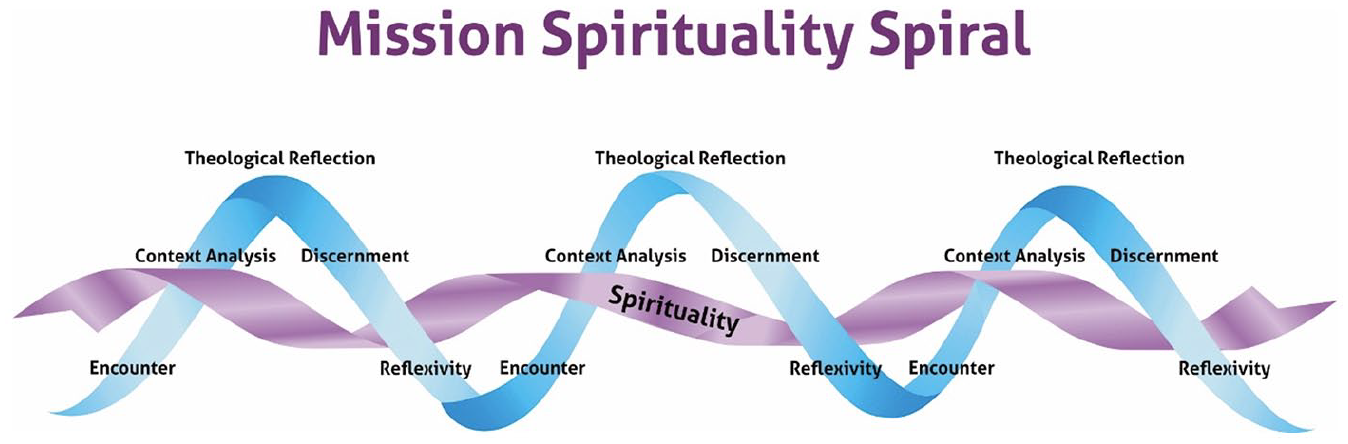
The notion of mission spirituality takes shape in what I call the mission spirituality spiral. I developed a spiral because with it each approach “does not simply retrace old steps but breaks new grounds.” 17 A spiral denotes a continuous and ever-deepening ongoing process. It consists of six dimensions: Spirituality (encounter with the triune God), Encounter (with the others and the context), Context Analysis, Theological Reflection (encounter with Scripture and Tradition), Discernment (for transformative ways of being in mission), and Reflexivity. It aims to discern transformative ways of being in mission.
Spirituality
Spirituality is at the core of the spiral, informing and shaping each dimension. It is an ongoing experience, involving the whole person “in the project of life integration through self-transcendence toward the ultimate value one perceives.” 18 It involves relationship with the Absolute, participation in the life of the Trinity, which brings about transformation and integration of all aspects of human experience. Spirituality informs the whole of life, produces freedom, and necessarily aspires to enhance and promote dignity, especially of the poor and marginalized. Without spirituality, one could certainly do many good deeds, but they are not the equivalent of mission in a Christian sense.
Encounter
From genuine encounter with God, the call to genuine encounter and relationship with others emerges. 19 A genuine (mission) encounter must have certain characteristics:
It is
It is a
It carries the
It is
It privileges the
We are called to encounter others in their
Attitudes of simplicity, (bold) humility,
The kind of encounter I propose derives from living in a context with local people, especially among the poor and marginalized. It implies spending time with the people at the same level (in German: auf Augenhöhe), listening to them—to their joys and sorrows. In due time, this kind of encounter will develop into mutual acquaintance and friendship.
How does spirituality inform mission encounters? In the encounter and relationship with the triune God, one “experiences” the relationality and the mutual indwelling of the Trinity and is similarly called to live this relationality and mutual indwelling with others. 23
Context analysis
Context analysis is a critical analysis of the social, political, historical, economic, and ecclesial situation of that context. It “examines causes, probes consequences, delineates linkages, and identifies actors” and cultural aspects. 24 It helps situate experiences against a broader background. Thus, it allows us to grasp the reality that must be dealt with, in relation to the lives of the people.
It is not simply an analysis of the needs of the people. Needs analysis, in fact, makes those who do it problems solvers. This position gives them power and forgets about the importance of seeking what gives life. By doing context analysis, instead, the risk of limiting the responses to social welfare is overcome. Local people are involved in context analysis and are empowered in carrying out the transformational process. 25
Spirituality accompanies and informs context analysis. God creates ex amore 26 and thus is continuously creating the world (creatio continua ex amore). Creation “actively takes place in the present moment as divine love expresses itself in finite being open to more being and love.” 27 God is present in the world and can be experienced in everyday life and in the situations that must be analyzed. Therefore, when doing context analysis, both the context and the situation that are to be analyzed, as well as the people living in that context and in that situation, are “holy ground,” where God manifests Godself.
Theological reflection
For Holland and Henriot theological reflection is “an effort to understand more broadly and deeply the analysed experience in the light of living faith, scripture, church social teaching, and the resources of Tradition. The Word of God brought to bear upon the situation raises new questions, suggests new insights, and opens new responses.” 28 In this line, the dimension of theological reflection in the spiral is contextualized and starts from below, that is, from the spiritual experience and interpretation of Scripture and Tradition of a person or a community in a specific context, and then it looks at and links to the interpretation of Scripture and Tradition of the church. Although spiritual experience can be considered as not “critical” or “distinctive” enough, 29 people claim its certainty and truth. Because of the ambiguities that spiritual experience bears, its genuineness always needs to be discerned. This experience, brought into dialogue with the situation of the context, the Word of God, and Tradition, leads to discernment.
For theological reflection to be fruitful and transformative, it is important to assume the standpoint of exploration, which is the place in between tradition and experience. 30 Entering the experience of theological reflection as an explorer means not to know what feelings and images will arise or what thoughts (including the hidden ones) will be discovered. These are part of the lived experience of encounter with others, with the context, and they lead one into conversation with Scripture and the wisdom of Tradition, while allowing questions to assume the primacy. Theological reflection, like context analysis, “is not a neutral approach, a purely ‘scientific’ and ‘objective’ view of reality.” 31 In both context analysis and theological reflection, one always bears a subjective starting point, which necessarily includes one’s feelings as part of one’s being. Furthermore, theological reflection can happen only in a prayerful environment.
Discernment for transformative ways of being in mission
The previous dimensions of the spiral are intended to culminate in discernment, so as to lead into new ways of being in mission. Discernment is not a method but a process in which we undergo a critical reflection on the human and religious experience. 32 We need this process because our experiences are rooted in ambiguities. This process happens at a deeper spiritual level through openness to the Holy Spirit, prayer, and critical reflection, also through pondering ways of being in mission that seek to bring transformation in a particular context. The certitude of discernment is a limit. Its result cannot be absolutely sure and cannot be proved. One can have only a “subjective certitude.” 33
Lonsdale explains that, before making a decision regarding their future, St. Ignatius and his companions agreed upon the method of a communal discernment. 34 This method can also be used in a discernment process for new ways of being in mission. There must be a common basis for discernment upon which the group agrees. The group is aware that there are different opinions about how to achieve this end. It is indispensable that each member takes time for prolonged and assiduous prayer to receive enlightenment from God. Each member must be fully informed about the situation—I call this context analysis. Each member must make sure that the conclusion at which he or she has arrived is as objective as possible. In sharing the personal decision with the others, one must be able to trust and to humbly listen to the others. As the whole process has been led by the Holy Spirit, the moment of making the decision is not merely a matter of the majority, as in a democracy. Rather, it happens in openness and depth, where biases, prejudices, and the desire of seeing one’s own decision to be adopted all must be set aside.
The aim of discernment is to find new and transformative ways of being in mission. I choose not to use the word strategies for mission, because that is more appropriate in the commercial world of competitive enterprises. This enterprise way of thinking and doing mission has been prevalent for a long time and to some extent still is. It is not the way we should go. Through discernment and the other dimensions of the spiral, we must find transformative ways of being in mission. Action must be prompted by the Spirit and thus must happen in bold humility.
Reflexivity
The whole process should feature reflexivity. When embarking on the spiral, one (or a community) must engage reflexively throughout the use of the spiral. Swinton and Mowat define reflexivity as “the process of critical self-reflection carried out by the researcher throughout the research process that enables her [sic] to monitor and respond to her contribution to the proceedings.” 35 Those who embark upon the mission spirituality spiral are to critically reflect on themselves and on the way their experiences, values, and faith shape the progression along the spiral.
When engaging in mission, one hopes to contribute to the transformation of others’ lives and contexts. But “if there is integrity in a transformative relationship, all parties must experience transformation.” 36 Thus, self-transformation is also part of reflexivity.
An important question to ask is: Has the experience of progressing along the spiral brought learning and transformation, not only to the people in a particular context, but also to the ones who embarked on the mission spirituality spiral process? In other words, how have the experiences of encounter with God, with other(s), with the context, with Scripture and Tradition, and with discernment affected and possibly changed those engaging in this process?
The starting point for those serving in a given context can be the critical reflection on (and self-evaluation of) their way of being in mission. Moreover, by giving local people the responsibility to evaluate them, new and more relevant ways of being in mission can be enhanced.
I have earlier emphasized that spirituality informs mission encounter. In fact, it is encounter and relationship with the triune God that transforms the person from the inside and opens for him or her the possibility for genuine encounters, which in turn bring about more personal and social transformation. The World Council of Churches reminds us that genuine “mission spirituality is always transformative.” 37 At the same time, the experience of mission shapes spirituality. Through mission encounters new perceptions of God, new approaches to prayer and liturgy are experienced.
When embarking on self-critical reflection throughout the spiral, this reflection does not, or should not, happen in a vacuum but must happen in the presence of God. One must reflect, in a continuous discernment in the Spirit, on how personal transformation through encounter with others, the context, the Word of God, and Tradition has occurred.
The relevance of the mission spirituality spiral
The spiral integrates missiology (and the practice of mission) and spirituality as a discipline (and spirituality in daily life). Interface and the mutual shaping of mission and spirituality occur in the use of the spiral.
Used as mobilizing tool, the spiral, which starts from below, leads to discernment of concrete ways of being in a given mission context. These ways become concrete actions, especially among the poor and marginalized. These ways are transformative, both for those who embark on the spiral and for the local people and local church. Being constantly present throughout the spiral, spirituality ensures that the discerned ways of being in mission, or the actions to be taken, bring about development or social transformation that may generate life in abundance, at all levels, in a holistic way, in a continuous evolution toward wholeness.
When can the spiral be used?
As a mobilizing tool, the mission spirituality spiral can be continuously used for discernment of religious congregations, in parishes, and in everyday life. For both great and small discernments, by starting it anew, the spiral acquires depth.
The ecumenical use of the mission spirituality spiral needs to be emphasized. In fact, the encounter with the triune God, with others, with context and its analysis, with Scripture, and to a certain extent with Tradition is something Catholics have in common with other Christian denominations. Therefore, discernment and reflexivity can certainly find a place in ecumenical circles. Models for collaboration and ecumenism can be developed with the use of the spiral.
Religious communities and their congregations can use it as an analytic tool to study the (mission) spirituality of their founder or foundress and to investigate how the members have appropriated that spirituality and how it is lived now, in the twenty-first century.
Conclusion
With the use of the mission spirituality spiral—which is more a process starting from below (from the experience and the context) than a methodology or a technique—encounter with the triune God informs and shapes the other dimensions that are seamlessly linked and flow into one another. Building on incarnational principles of the various encounters and continuous reflection on those encounters brings about transformative ways of being in mission. These ways become concrete actions, especially among the poor and marginalized. These ways are transformative, both for those who embark on the spiral and for the local people and the local church.
The mission spirituality spiral, by involving all the human, social, and spiritual dimensions of a person, provides a way to that wholeness to which humanity is called, for both those who embark on it and for those who benefit from it. The study of the mission spirituality of a religious congregation by means of the mission spirituality spiral used as an analytic tool can highlight its strengths and weaknesses, thus enhancing new possible actions to be taken.
Footnotes
Notes
Author biographies