



Abstract
Anchored in the Incarnation as a model for cross-cultural ministry, this “pilgrimage” chronicles my life-long effort to connect anthropological insights with mission practice. I note how a linguist, four anthropologists, and an historian—Eugene Nida, Charles Kraft, Alan Tippett, Paul Hiebert, Louis Luzbetak, and Andrew Walls—contributed to my formation as a missiological anthropologist. Two themes that have been the hallmark of my research, teaching, writing, and training are contextualization and incarnational identification. The venues in which my pilgrimage has occurred have been as a mission volunteer in the Congo, a United Methodist missionary in Papua New Guinea and the Solomon Islands, a professor of anthropology in the E. Stanley Jones School of World Mission and Evangelism at Asbury Theological Seminary, a trainer of several thousand missionaries, a member of the American Bible Society Board of Trustees, and various roles in the American Society of Missiology.
“So, you want to be an anthropologist? We’ve never met a Christian anthropologist, so why do you think you can become the first one? And even if you succeed and have a fancy degree and what’s left of your faith, there’s nothing of value in anthropology for missionary work.” That was the response I received from my missionary colleagues when, as a twenty-four-year-old mission volunteer in Central Africa, I announced that I was going to go to graduate school in anthropology instead of medicine.
My missionary colleagues were correct statistically. There are very few Christian anthropologists, and, unfortunately, I have met a few who indeed lost their faith in the process of studying anthropology, including a handful of people who had been missionaries. But my colleagues were wrong when they said anthropology had nothing to contribute to cross-cultural ministry. My pilgrimage in mission has been all about contributing anthropological knowledge, insights, and wisdom to encourage cross-cultural witnesses to become more effective and thrive, not just survive, in cross-cultural ministry.
Beginning years
I was born in Lexington, Kentucky, in 1947. My father had served in World War II as an army chaplain, and the GI Bill enabled him to finish his theological training at Asbury Theological Seminary. I was born in January of his senior year and would return as a professor thirty-seven years later. The Free Methodist Church in which I grew up had an unspoken pyramid of spirituality—parishioners at the bottom, pastors in the middle and missionaries at the top. At the very top of this hypothetical spiritual pyramid were medical missionaries. Albert Schweitzer and Paul Carlson were my high school heroes. I wanted to become like them, minus the martyrdom that Carlson experienced. Looking back now on over seventy-five years, I love the fact that God starts with where we are in order to transform us into what God wants us to become. God took my less than Christlike motives and turned them into my commitment to join Jesus in his mission and, thereby, further the kingdom of God.
I transferred from Spring Arbor College to Seattle Pacific College for my junior year in the fall of 1967. My new advisor, Frank Kline, who had served as a missionary in India for twenty-five years, asked me what I wanted to become. I had taken all the prerequisites for medical school and when I told him I wanted to become a medical missionary, his immediate response was, “Then you’d better take a course in anthropology.” “What’s that about?” I inquired. He told me it was the study of people and their cultures, and I naïvely asked, “Is that important? Do I need to know that stuff?” So, I took his advice, and my life would never be the same.
When I graduated from college in 1969 it was the height of the Vietnam War and I knew I would likely be drafted into the army. At the same time, my church invited me to go to the Democratic Republic of Congo for two years to help restart the mission that had been abandoned because of rebel uprisings. They were looking for two young men who were expendable, so I volunteered and thereby got a religious exemption from the draft. I asked God to lead me during those two years in discerning my future—should I go into medicine or anthropology? Before leaving Seattle, I became engaged to Laurie (née Delores Bishop) who was two years behind me in college. Initially, while in the Congo, I thought I would take the vocational route of a medical missionary because I saw so much human suffering, and that was before HIV/AIDS invaded the continent. But then as I observed my missionary colleagues, they were so preoccupied with bibles, books, and band-aids—the traditional avenues of mission work—that they seemed to have little time or even less interest in understanding the African people at the deep worldview level, and in contextualizing their various ministries to fit the African context.
I returned to the United States in 1971, married Laurie, and began what I have called a ten-year wilderness as I studied anthropology. I felt that my church turned their back on me, my family didn’t understand me, and no one believed in what I felt God was calling me to do. It was a long and lonely time, and I almost quit on several occasions. But God gave me the resilience to stay the course and I completed a PhD in anthropology in 1980 from Southern Illinois University.
Launching into cross-cultural ministry
During my dissertation fieldwork with Laurie in the Solomon Islands (1977–78), the director of the Melanesian Institute for Social and Pastoral Service in Papua New Guinea learned about my research and invited me to join their staff as soon as I completed my dissertation. So, at the request of the United Church of Papua New Guinea and the Solomon Islands, we were appointed in 1979 by the Board of Global Ministries of the United Methodist Church to join the Melanesian Institute that served the four mainline denominations. Located in the mile-high city of Goroka in the New Guinea Highlands, I was put straight to work researching, training, and writing with the goal of helping the churches to connect the gospel more deeply with the Melanesian cultures. It was what I had trained to do and I loved it. I hoped to be able to stay there for at least twenty years. But that wasn’t going to happen.
Friends and books along the way in my pilgrimage
No pilgrimage occurs in isolation. God brought particular people and books into my life at just the right time and enabled me to build a foundation for my vocation as a missiological anthropologist—researching, writing, teaching, and training. I will start in chronological order and highlight six people and their books, among many others, who have profoundly shaped me and my missiological anthropology.
Contextualization and incarnational identification
The two dominant themes in my writing, teaching, and training have been the importance of contextualization as a way of relating the gospel to culture, and the Incarnation as a model for cross-cultural ministry.
In June 1996 the American Society of Missiology annual meeting was held at Techny Towers. Dean Gilliland from Fuller Seminary was the ASM president that year. He chose the topic of contextualization for our theme, and invited me to give the keynote address. I was the editor of Missiology at the time, and the presentations at the annual meeting were always published in the January issue the following year. At the conclusion of my talk, Gerald Anderson made a beeline to the podium and said it would appear self-serving if I published my presentation in Missiology. He would help me out of my dilemma and publish it in the International Bulletin of Missionary Research. I eventually agreed, and the editors turned my nascent presentation into an article that continues to be read and cited today more than anything else I have written: “Contextualization: The Theory, the Gap, the Challenge” (1997: 2–7). I have continued writing on contextualization, which I define as the communication of the gospel in word and deed, and establishing the church in ways that make sense to people within their local cultural context. We present Christianity in such a way that it meets people’s deepest needs and penetrates their worldview, thus allowing them to follow Christ and remain within their own culture. I believe it is the lack of contextualization as well as a misunderstanding of what contextualization is that leads to Christianity being perceived as a foreign religion in many parts of the non-Western world (Whiteman 2022, 2023).
The dominant biblical motif that has guided my writing, teaching, and especially my training has been the Incarnation as a model for mission (Whiteman 2003). I don’t remember the date, but I remember the time and place where I first made the connection between the theology of Incarnation and the practice of mission as incarnational identification. I was attending a chapel service at Asbury Theological Seminary, and the text was Philippians 2:5–8.
The attitude you should have is the one that Christ Jesus had: He always had the nature of God, but he did not think that by force he should try to remain or become equal with God. Instead of this, of his own free will he gave up all he had and took the nature of a servant. He became like a human being and appeared in human likeness. He was humble and walked the path of obedience all the way to death—his death on the cross (Good News Translation).
Suddenly, I saw an old and familiar passage in a new light. It was an epiphany. The apostle Paul was saying that we must have the same attitude as Jesus had. And so, in the same way that God entered Jewish culture in the brown-skinned person of Jesus 2,000 years ago, in Roman-occupied Palestine in the backwaters of the Roman Empire, we must also be willing to enter the culture of the people among whom we serve, to speak their language, adjust our lifestyle to theirs, to understand their worldview and religious values, and to laugh and weep with them. We must be willing to live within the narrow confines of their culture, in the same way that Jesus lived within the cultural constraints of his day, and to empty ourselves of our power, position, privilege, prestige, and prejudice. Incarnational identification frequently means downward mobility, which is counterintuitive for many, but the way of the cross is never easy or comfortable (Whiteman 2005). It is even more difficult in cross-cultural missionary life. Over these years of experiencing many cultures, studying them, and writing and teaching missiological anthropology, I have learned the importance of uniting contextualization with incarnational identification. Together, they have become the dominant themes in my life and teaching. As S. D. Gordon, a missionary leader in the early days of the YMCA, said, “Jesus is God spelled out in language that [human beings] can understand.”
My emphasis on incarnational identification for cross-cultural witnesses has occasionally been misunderstood and misinterpreted as my advocating “going native.” Occasionally I have been called the “prophet of doom and gloom” when it comes to missionary lifestyles, because I advocate living as close to the people we serve as possible. Once at a retreat center where I was speaking, I overheard a couple talking about my “radical teaching” in the room next door. The walls of that spartan facility were so thin, that I could hear everything they said, including “If we had listened to Whiteman, we would be sleeping on the floor.” Whatever sacrifices we may make in order to live like and among the people we serve, they will be repaid in huge dividends of deep personal relationships, a sense of fulfillment, and more effective and lasting ministry.
Of course, we can’t become “native” because our parents weren’t native, but we can go a long way in identifying with others and become an acceptable outsider in our cross-cultural ministry.
Vocational landmarks in my pilgrimage
I earned a degree in anthropology to become a better missionary, never with the desire to become a professor of missiological anthropology. When I was given the job at the Melanesian Institute in Papua New Guinea, researching, writing, and teaching on connecting the gospel to Melanesian cultures, I was hoping to stay there throughout my missional vocation—at least twenty years. I remember a response to my teaching from a Melanesian pastor who said, “Do you mean we don’t have to become like Australians in order to become Christians?” The thought of contextualizing the gospel in a Melanesian context was a new idea for him.
On our family’s first home assignment from Papua New Guinea, I was speaking in United Methodist churches and sharing our experience. My message was simple. Our ministry in Melanesia was to help Melanesians become followers of Jesus and remain Melanesians, not to make American Methodist Christians out of them. One older lady in the audience asked in astonishment, “Did you invent this way of doing mission work? I’ve never heard anything like this before.” I assured her that I didn’t invent it, nor did John Wesley, but it was a decision made by the early church in the Jerusalem Council recorded in Acts 15. Gentiles could become followers of Jesus without having to become culturally Jews, and by extension we don’t have to deny our birth identity in order to affirm our second birth identity as followers of Jesus.
Unfortunately, missiological anthropologists are “rare birds” as I call them, and there are even fewer in the Wesleyan tradition. So, when Asbury Theological Seminary decided to start a graduate school of world mission they needed a Christian anthropologist, with mission experience, in the Wesleyan tradition. They scoured the earth and found one young man in the jungles of New Guinea. I told them to go away and leave me alone. I had no interest in such a position. All my training as an anthropologist had led to what I was already doing, and I couldn’t countenance the thought of doing anything else. Eventually I came to realize that in order to be faithful in following Jesus I would have to say “Yes” to the invitation. I joined the founding faculty of the new E. Stanley Jones School of World Mission and Evangelism at Asbury Theological Seminary, in Wilmore, Kentucky in the fall of 1984.
I discovered my love of teaching and mentoring at Asbury. My “Anthropology for Christian Mission” class grew from fourteen students in my first semester to 180 by the time I left twenty-one years later. I was as surprised as anyone with the popularity of the course, but it confirmed for me that people in ministry need more than just academic tools to exegete the biblical text. They also need to acquire skills to exegete the cultural context of their ministry and learn how to incarnationally identify with the people they serve and contextualize their presentation of the gospel, living it out in the cultures where they will serve.
In the fall of 1988, I was still finding my way as a Professor of Cultural Anthropology at Asbury when I was asked by the American Society of Missiology to become the next editor of the journal Missiology. Asbury’s E. Stanley Jones School of World Mission and Evangelism was still in its infancy, and I thought perhaps it would be good for our school to house the journal. I wrote to Alan Tippett in Australia for his advice. He had been the first editor of Missiology. In one of the last letters he wrote, weeks before he died, he gave me his blessing as long as I would agree to write a book on the use of ethnohistory in missiological research. My dissertation had used the perspective of ethnohistory in telling the story of the impact of Christianity in the Solomon Islands, and Tippett did not want to see this valuable research methodology fade away.
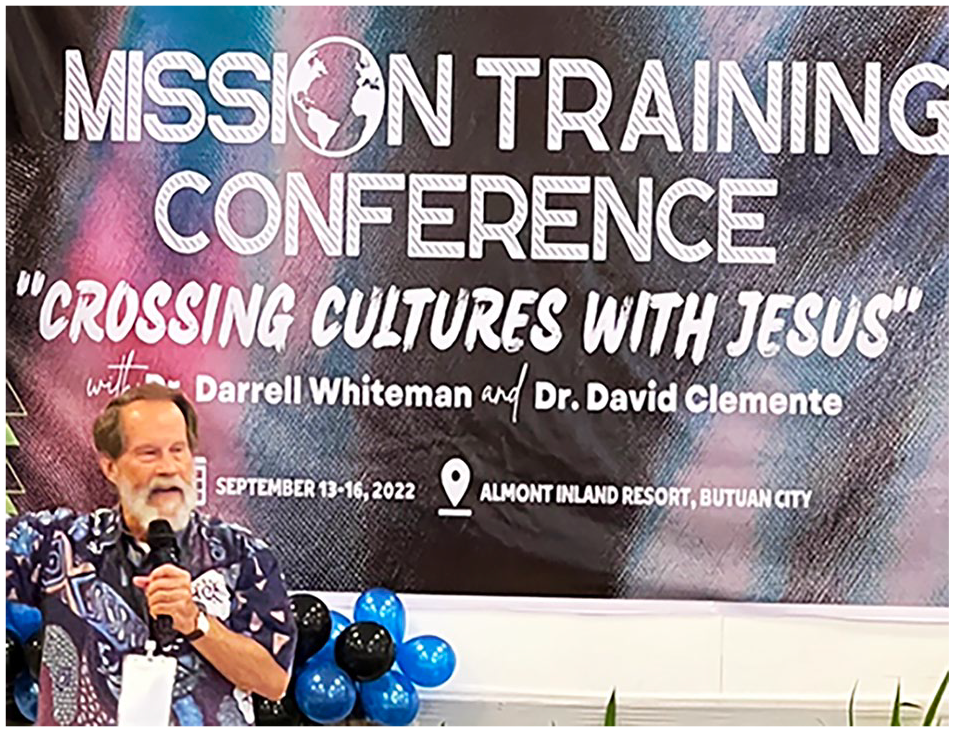
Darrell L. Whiteman leading a training session in September 2022 on “Crossing Cultures with Jesus” for seventy Free Methodist Filipino missionaries, pastors, and church workers in Butuan City, Philippines.
I knew that if I took on the role of editor that I would probably do less writing myself. I felt, as editor, it would be an opportunity to help shape the emerging discipline of missiology and make sure we never forgot our forerunner of Missiology, Practical Anthropology (1953–72). I enjoyed the role of editor but it was very time-consuming. When the Asbury Seminary administration asked me to become the dean of the E. Stanley Jones School, they said I would have to give up my role as editor of Missiology. I reluctantly agreed to do that as long as the journal could stay at Asbury, and that is when my colleague Terry Muck took over as editor in 2002.
In our lifelong pilgrimage, we are sometimes invited to do things and serve in ways to which we would never aspire. That is the case when I was asked to serve on the Board of Trustees of the American Bible Society, a position I held for twenty-seven years. I chaired the Translation Committee for a number of those years. The invitation first came early in my years at Asbury, and so I kept turning them down. I was still developing courses, had recently agreed to accept the role of editor of Missiology, and had a full plate of mentoring doctoral students. I simply wasn’t interested. In 1988 when they called for the nth time and I declined again, the voice on the other end of the call said, “You know why we’re inviting you to join the Board of Trustees, don’t you?” I responded, “I have no idea. I’m an anthropologist, not a biblical scholar or linguist. I don’t know why you want me.” The person quickly responded, “Because Dr. Nida told us to invite you.” “Oh, that’s different,” I said as I acquiesced to their request. I enjoyed bringing my anthropological and missiological perspectives to Board discussions and decisions and I continued my friendship with Eugene Nida, until his death at age ninety-six in 2011.
Anthropology and Mission
Over the years I have come to define myself as a missiological anthropologist because, for me, anthropology and mission are inseparable. However, as rare as anthropologists who identify as Christian are, many of them maintain a safe academic distance between anthropology and mission. When I began teaching at Asbury Seminary in 1984, I began attending the annual meeting of the American Anthropological Association, and from time to time I would deliver papers or organize symposiums at the meetings. I began discovering a few Christian graduate students and professors in university departments of anthropology who felt lonely and isolated from other Christian anthropologists. Some of those I met were also struggling to maintain their faith in the face of the critique from the doctrine of cultural relativism that is so dominant in academic anthropology. One year, while attending the meetings, I read in the official program guide an event called, “Quakers meet for breakfast.” That inspired me to create the Network of Christian Anthropologists, and from 1989 to the present, we have always been listed in the official program. A group of sometimes up to 25–30 graduate students and professors would gather every year. The network fulfilled its function of encouraging Christian anthropologists to integrate their faith with their discipline, and to connect us with each other. Today the Network of Christian Anthropologists is administered by Brian Howell at Wheaton College, Wheaton, Illinois, and continues to meet every year at the American Anthropological Association annual meeting.
Cross-cultural Ministry Training
The final path of my pilgrimage in mission has been my role as a trainer for cross-cultural ministry. Harkening back to my early years as a young missionary volunteer in Central Africa, I could not understand why cross-cultural witnesses were so poorly trained in cross-cultural awareness and understanding. Why did missionaries want to plant churches that looked similar to their churches back home, sing the same hymns, have the same church polity, even worship at the same 11:00 hour on Sunday morning? This observation probably contributed to my decision to become an anthropologist and apply those insights to mission practice. I remember thinking at the time, “Perhaps someday I can help train missionaries in anthropology to enable them to become more effective and last longer.”
That opportunity came in 1985 when I was invited by the Southern Baptist Foreign Mission Board (now International Mission Board) to help with their orientation training. Over thirteen years, for two intensive days, six to eight times a year, I would train missionary candidates on the challenges of crossing cultural barriers with the gospel, explain why North Americans have such problems, and suggest strategies for overcoming these barriers. Although not Baptist in my theology or polity, I came to love and appreciate those cross-cultural witnesses who taught me as much as I may have taught them. The International Mission Board sponsored two of my sabbaticals from Asbury, enabling my family and me to live in Hong Kong in 1992 and Singapore in 1995 while I did research on the cross-cultural adjustment of Southern Baptist missionaries. Hundreds of hours of interviewing first- and second-term missionaries gave me a huge database for understanding the issues of cross-cultural adjustments that missionaries face. I remember interviewing one missionary who had fallen into deep culture shock and was struggling to survive. She got out her notes from my orientation training on culture shock which she said saved her emotionally. Then she said to me, “I don’t remember anything you taught us, but I never forgot your stories.” I smiled and said, “Then you remember everything I taught, because it’s all in the stories.” Perhaps, telling stories to illustrate principles and theories has become the hallmark of my teaching and training.
Meanwhile, after serving as a member of the board of the Mission Society for United Methodists (now TMS-Global), I was invited to join the staff in 2005 where I served as vice president for training and resident missiologist. In this capacity I began doing more training with non-Western cross-cultural witnesses. When I retired in 2014, and after serving as the interim executive director of the Overseas Ministries Study Center and interim editor of the
Many years ago, I discovered that I shared the same birthday, January 3rd, with E. Stanley Jones. That piqued my interest in him and his writing even more. His early bestseller The Christ of the Indian Road (1925) was a model of contextualization and his approach to mission and evangelism was clearly in the mode of incarnational identification. Our school of world mission and evangelism at Asbury was named after him, and even today when I teach courses on evangelism, I introduce students to this classic book. I learned that when Brother Stanley, as he was affectionally called, turned seventy-five he asked the Lord for ten more years of effective ministry. When he turned eighty-five, he is reputed to have said, “Oh, . . .why didn’t I ask for twenty?” So, when I turned seventy-five, I decided I shouldn’t make the same mistake as Jones did, and only ask for ten more years. Only the Lord knows how long my pilgrimage will continue. But I know that as long as I have breath, I want to enable people in diverse cultures to know that they do not have to abandon their birth identity in order to affirm their second birth identity as followers of Jesus. The good news of the gospel must be proclaimed and lived out in such a way that people will hear and experience it as good news that is relevant to their culture and comprehensible in their own language. To God be the glory.
Footnotes
Notes
Author biography