



Abstract
The (under-)representation of women on corporate boards is much debated among the public as well as in academia. In our exploratory article, we contribute to the literature by investigating women directors’ perceived roles by interviewing female as well as male board members and by employing the critical incident technique to address potential problems of social acceptancy. In the perception of board members, women directors fulfil three roles: they widen the boards’ perspectives and thus act as (unique) experts, they objectify discussions and they act as mediators.
Motivation
The role that women directors play on boards is much debated among the public as well as in academia. While from an equal opportunities perspective a larger share of women on boards is without doubt highly desirable, the theoretical and empirical literature on the effects of women directors is inconclusive (for recent overviews of the literature, see e.g. Joecks et al., 2013; Post and Byron, 2015). Specifically, it is unclear which mechanism might drive the link between women directors and firm performance.
In our exploratory article, we try to shed light on this issue and investigate how board members perceive women directors’ roles on supervisory boards. With the help of a qualitative study – interviewing female as well as male board members (for a discussion on the explanatory power of qualitative research in human resource management (HRM), see Ridder and Hoon, 2009) – we analyse how women directors on supervisory boards are perceived in their roles. To address potential problems of social acceptancy, we apply the critical incident technique (Flanagan, 1954), asking respondents to first describe a typical situation on their board and only then discuss the role of women directors in that specific situation. In so doing, we keep our interviewees from simply reporting gender stereotypes without backing this up with women directors’ own personal experience. We add and contribute to the scarce qualitative research on women directors (Kakabadse et al., 2015; Krawiec et al., 2013) by employing the critical incident technique and by representing not only the self-perception, but also the outside perception of women directors’ role – hopefully shedding more light on the effects of women’s representation on supervisory boards.
Our interviewees serve on supervisory boards in German firms. In a two-tier system such as the German one, supervisory boards are strictly separated from management boards. The supervisory board’s task is to advise and control the management board. The supervisory boards we study are co-determined, that is, there are shareholder representatives as well as employee representatives on the boards. While our exploratory analysis is embedded in the context of a two-tier system, our results also extend to other governance structures and are generalizable beyond our specific context.
In our material, we find evidence for women directors being perceived in three different roles:
1. Our interviewees perceive women directors as (unique) experts (a) by being highly qualified and (b) by adding new perspectives and additional expertise to the boardroom.
2. They perceive them as objectifying and de-emotionalizing boardroom discussions.
3. They perceive them as mediators who help strike the balance between different opinions on the board.
The article is structured as follows. In the section on women’s board representation we review the literature on women directors and how women’s representation might affect board work and firm performance. The subsequent section on context, method and data briefly describes the institutional background of our study and then elaborates on our method and the resulting material. The section on typical work situations informs on the critical incidents described by the interviewees, and the section on perceived women directors’ roles elaborates on the different roles women directors are perceived to play by our interview partners. The final section discusses our findings, gives a first indication of when and how women directors are perceived in specific roles, and relates our findings to the existing theoretical and empirical literature – highlighting how our exploratory results might enhance our understanding of the link between female board representation and corporate performance.
Women’s representation on boards
An increasing number of studies investigate the link between women’s representation on the board and corporate financial performance. However, the evidence is inconclusive (for recent overviews of the literature see Joecks et al., 2013; Post and Byron, 2015): Some studies find a positive relationship between women’s representation on boards and financial performance (see e.g. Carter et al., 2003; Mahadeo et al., 2012; Smith et al., 2006), whereas others find a negative link (see e.g. Adams and Ferreira, 2009; Ahern and Dittmar, 2012; Shrader et al., 1997) or no relation at all (see e.g. Haslam et al., 2010; Miller and Del Carmen Triana, 2009; Siciliano, 1996). More recently, other measures of performance have also been analysed. Torchia et al. (2011) find that a critical mass of at least three female directors significantly improves the firm’s level of innovativeness. Furthermore, Lee and James (2007) find that investors react significantly more negatively to the appointment of a female chief executive officer (CEO) than to the appointment of a male CEO. Regarding corporate social responsibility, Hafsi and Turgut (2013) show that firms with women directors on supervisory boards have a significantly better ‘social performance’ than firms with an all-male board. In sum, it is not clear to what extent female representation on the board is related to (a) financial firm performance and (b) other firm performance measures. Also, and even more importantly, there is no clear understanding of the ‘how’, that is, of the mechanisms that might drive a potential link between female representation and firm performance.
One clue to a potential link is provided by the studies that uncover systematic differences between the two genders. For instance, women have been found to be more risk averse and less competitive than men (see Apesteguia et al., 2012; Croson and Gneezy, 2009; Jianakoplos and Bernasek, 1998; Niederle and Vesterlund, 2007). Furthermore, women’s reasoning style has been shown to differ from that of men’s, with men more likely to pursue a discourse of self-confidence and self-control, and women pursuing a discourse of relationship and caring (see Gilligan, 1982; Machold et al., 2008). Likewise, women have been found to differ from men in their verbal and non-verbal communication (see e.g. Claes, 1999; Tannen, 1995): women are described as having a more questing style, and to be less aggressive in their choice of wording (see e.g. Apesteguia et al., 2012; Burgess and Tharenou, 2002; Burke, 1997). Moreover, women on average show a higher intrinsic motivation to care for others than men (see e.g. Folbre, 2012).
In light of these well-documented differences between women and men, resource dependence theory (see e.g. Pfeffer, 1972; Pfeffer and Salancik, 1978) argues that a gender-diverse board might be superior to a board with only male directors as it helps to bring different experiences, expertise or connections to the boardroom (see e.g. Ali et al., 2014; Biggins, 1999; Hillman et al., 2007; Huse and Solberg, 2006). Wegge et al. (2008) conjecture that the specific advantage of gender-diverse boards is the combination of female and male traits. Campbell and Mínguez-Vera (2008) emphasize that women in the boardroom raise different questions and propose alternative solutions – potentially resulting in better board work and firm performance.
More recently, ‘faultline theory’ (Lau and Murnighan, 1998) argues that, within groups, not only one attribute of its members, for example gender, has to be considered, but rather several dimensions should be considered simultaneously (see Jackson et al., 2003). That is, with respect to group composition it might be important to look at gender and, for instance, functional background. If a group falls into two subgroups that are different from one another in terms of gender and functional background, then two ‘faultlines’ (the gender faultline and the functional background faultline) will coincide, creating a potentially stronger faultline and potentially inhibiting cooperation between the two distinct subgroups. If, however, the gender faultline and the functional background faultline ‘cut across’ one another, communication and cooperation within the group might be enhanced. In our specific institutional context of co-determined supervisory boards, one relevant faultline within the board might be the one between the two representative functions: shareholder representatives on the one hand and employee representatives on the other (Li and Hambrick, 2005). In a co-determined board with employee and shareholder representatives, conflicts might arise (see Gorton and Schmid, 2004). The interplay of gender as a demographic faultline and membership in one of the representative functions as a functional faultline might lead to different performance effects than the isolated consideration of both attributes (see Sawyer et al., 2006).
Likewise, the literature on surface- versus deep-level diversity (Harrison et al., 1998, 2002; Horwitz and Horwitz, 2007; Phillips et al., 2006) also focuses on different diversity dimensions. According to this literature, the different dimensions of diversity can be divided into surface-level diversity on the one hand and deep-level diversity on the other. Surface-level diversity refers to visible diversity dimensions such as gender, age or ethnicity. One person’s (dis)similarity to another one is easily recognized and thus can easily form the basis of social categorization. Deep-level diversity, on the other hand, refers to attributes that are not visible at first sight, such as personality, values or attitudes (Harrison et al., 1998). These are at a deeper level than the observable surface-level differences in gender, age or ethnicity. Among others, deep-level diversity covers behavioural patterns and norms and beliefs about team interaction and cohesiveness, as well as (dis)similarities in verbal or non-verbal communication. However, surface-level diversity, for example with respect to gender, might affect behavioural patterns and norms and thus translate into deep-level diversity. Figure 1 illustrates the basic idea of surface- and deep-level diversity where the inner ring represents the surface-level diversity characteristics such as, for example, gender, and the outer ring represents the deep-level diversity characteristics. Analysing the interplay between surface- and deep-level diversity might enhance our understanding of the gender diversity–performance link.
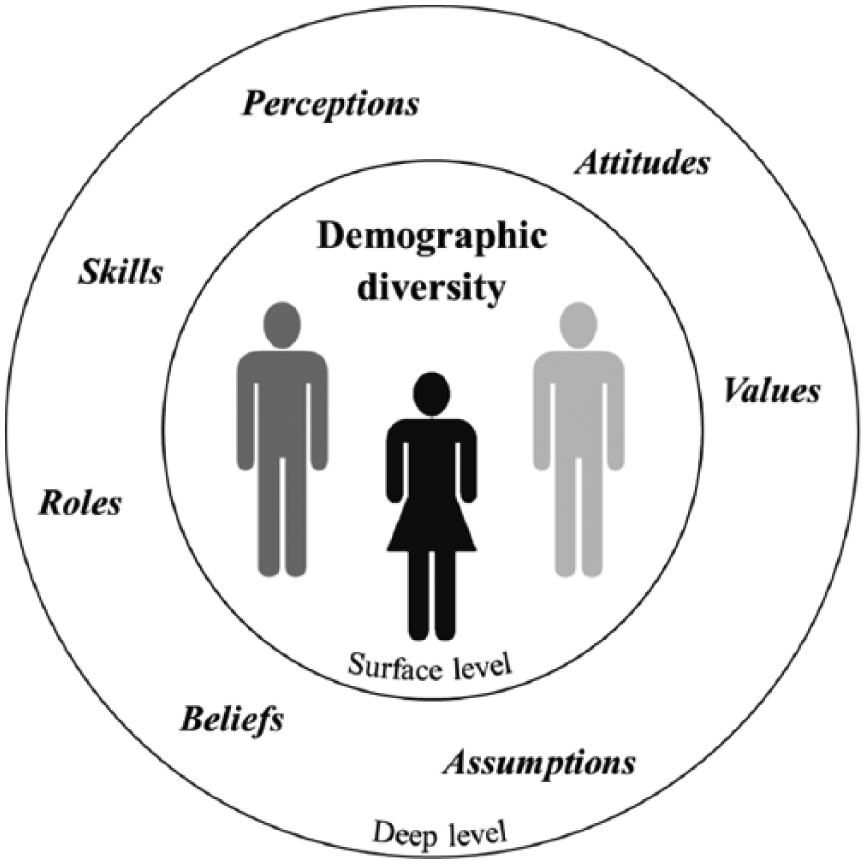
Surface- versus deep-level diversity.
In conclusion, it is neither theoretically nor empirically clear whether and how female representation on the board might affect board work. Investigating the different roles that women directors are perceived to act in, and exploring under which circumstances women directors are perceived in these roles, might add to our understanding of the link between female board representation and firm performance.
Context, method and data
Context
Our study is based on the German institutional context of a two-tier board structure with a management board on the one hand and a supervisory board on the other. All of our interviewees serve on supervisory boards, that is, it is their task to advise the management board and control its actions. Depending on firm size and industry, supervisory boards of German firms are co-determined, that is to say, there are shareholder representatives and employee representatives on the supervisory board. Our interviewees are from both sides of the board: some are shareholder representatives, some are employee representatives.
Sampling and respondents
Our analysis is based on 17 interviews. When we built our sample, we applied a mixed design to contact potential interviewees by ‘actively and deliberately develop[ing] and control[ling] the sample’s initiation, progress, and termination’ (Biernacki and Waldorf, 1981: 143). First, we directly contacted potential interview partners who served on supervisory boards of German listed firms between 2005 and 2015 (the names were retrieved from publicly available information, for example firms’ annual reports) via e-mail or via their individual profile webpages in job-related networks (such as www.xing.de or www.linkedin.de). Second, and referring to Kakabadse et al. (2015), we simultaneously applied the so-called snowballing technique as a sampling method. In so doing, we received recommendations from our interview partners on further board members who might also agree to be interviewed. Even though this sampling method is appropriate for the sensitive topic of our study (Biernacki and Waldorf, 1981), it also has disadvantages (Atkinson and Flint, 2001): for example, a sample selection bias that might limit the validity of the sample (Griffiths et al., 1993; Kaplan et al., 1987; Van Meter, 1990); a potential bias of interviewees who are linked to one another leading to a potential over-estimation of the cohesiveness of replies (Griffiths et al., 1993); the danger of missing isolated experts who are not members of the particular network (Griffiths et al., 1993); and the so-called gatekeeper bias of experts whose position or role in the supervisory board causes reticent or guarded answers (Groger et al., 1999).
While not being able to completely avoid these potential biases, we took great care to reduce these as far as possible. We did so by additionally directly approaching potential interviewees from publicly listed firms. Since we received most of the recommendations from within the construction industry, we further enhanced the balance of networks in our sample by additionally requesting experts from other industries such as finance and insurance, transportation and communication, retail and manufacturing. Furthermore, we made sure to not only interview experts from one gender or from one representative function, in order to avoid interviewing experts from only one network.
Table 1 gives information on our interview partners and the boards they refer to in the interview. Most of our interview partners serve on more than one board. At the beginning of the interview, we asked our interview partners to concentrate on one specific board. A total of 16 of our experts report from their experience on a board of a stock-listed firm, and one interviewee reports from his experience on the board of a family firm. With respect to the Standard Industry classification (SIC), our interviewees report on boards from a wide range of industries. Two of our interviewees report from the same board and served on this board at the same time.
The interviewees and the distribution of women on their boards.

I_no: interview number, f: female, m: male, ER: employee representative, SR: shareholder representative.
Source: Own compilation.
We coded the interviewees by indicating the interview number, the interviewee’s gender (female (f) or male (m)), and the representative function (employee representative (ER) or shareholder representative (SR)). For instance, expert I_1_f_ER is our first interview partner, she is a woman and an employee representative. Two interview partners are chairmen of the board; this information was added to the interviewees’ code (e.g. I_7_m_SR_Chairman).
Our sample consists of nine women and eight men directors. Eight of our respondents are employee representatives, the other nine experts are shareholder representatives – in each case almost equally distributed between the two genders. The experts’ tenure on the supervisory board on which they currently serve ranges from 8 months to 17 years. With respect to the number and distribution of women who serve on the interviewees’ boards, two experts (I_8_m_SR and I_10_m_ SR) are members of a supervisory board with only female employee representatives, and three interviewees (I_4_m_ER, I_6_m_ER, and I_12_m_SR_Chairman) serve on supervisory boards with only female shareholder representatives. The remaining 12 interviewees are members of supervisory boards with female employee as well as female shareholder representatives.
Interviews and material
Before each interview, the interviewees received information about the interview’s general topic (‘composition and collaboration in co-determined supervisory boards’) and they were informed that (according to the critical incident technique), within the interview, they would be asked to describe two typical work situations from their own personal supervisory board experience. We used structured interviews based on a detailed interview guideline – thus pre-defining the topics we aimed to cover and not simply following up on respondents’ answers (see Gläser and Laudel, 2010: 111).
The interview guidelines envisaged the following structure of the interviews: as a warm-up, interviewees were first asked to list characteristics they judged to be important for a person to successfully serve on a supervisory board. We then asked them to name characteristics they judged to be irrelevant. Next, we turned to the main element of our interview study and asked the interviewees to describe two typical work situations characteristic of their work on supervisory boards. This so-called ‘critical incident’ technique goes back to Flanagan (1954) and is widely used in labour psychology (for an overview, see Butterfield et al., 2005). Following the definition by Chell (1998: 56), ‘[…] the critical incident technique is a qualitative interview procedure which facilitates the investigation of significant occurrences (events, incidents, processes, or issues) as identified by the respondent, the way these are managed, and their outcomes in terms of perceived effects’. Letting interviewees recall and describe a typical work situation and then elaborate on the role that women played in that situation instead of abstractly asking them to generally elaborate on their perception of women directors’ roles or confronting them with a hypothetical situation, has several advantages: first, we give our interviewees the opportunity to give a detailed account of their own experience (Stauss and Weinlich, 1997) and to do so in their own words (Edvardsson, 1992). Second, our experts are free to determine which incidents to describe that might be of relevance in the overall research framework ‘composition and collaboration in co-determined supervisory boards’ (Gabbott and Hogg, 1996). Finally, by letting the interviewees themselves describe a typical work situation there is no distortion being caused by the interviewers that might otherwise bias the results (De Ruyter et al., 1995). By contrast, the content and context of the incidents are developed entirely from the interviewee’s perspective (Chell, 1998).
The interviews were conducted by two of the authors, in 13 cases as a team and in four cases there was only one interviewer. We interviewed 14 of our experts between February 2015 and June 2015, and three additional ones between July 2017 and September 2017. 1 A total of 13 interviews were conducted face-to-face, four interviews were conducted on the phone. All interviews were in German, and all interviewees (and the interviewers) were German native speakers. For the purpose of this article, quotes were translated into English. We decided against a professional translator, but rather translated the quotes ourselves to make sure that the interviewees’ intentions were correctly expressed (see Temple and Young, 2004).
At the beginning of the interview, the interviewees were asked whether they allowed us to tape-record the interviews. Only one interviewee (I_14_f_SR) did not give us her consent. In this one case, the interviewers noted the answers and read their notes aloud to the interviewee after each question; hence, for this interviewee no verbatim quotes are available. The remaining interviews were tape-recorded and transcribed. On average the tape-recorded interviews lasted 42 minutes, with a minimum of 15 minutes and a maximum of 80 minutes. In sum, our transcribed interview material is 584 minutes long.
The interview transcripts were coded using ATLAS.ti. For our data analysis, we applied a qualitative content analysis (Gläser and Laudel, 2010; Kuckartz, 2012; Mayring, 2010).
As a first step, four raters independently and deductively coded the material, followed by a discussion of the codes with all four raters in two open-ended meetings. The following codes were assigned: ‘women’ (148 interview passages), ‘men are different’ (14 interview passages), ‘men behave differently in the presence of women’ (27 interview passages), ‘more constructive discussions’ (18 interview passages), ‘change of atmosphere’ (24 interview passages), ‘new and different perspectives’ (9 interview passages), ‘women work differently’ (13 interview passages), ‘communication’ (70 interview passages), ‘women directors are (also) experts’ (15 interview passages), ‘decisions on board change due to female participation’ (9 interview passages), and ‘women mediate’ (6 interview passages). Further codes were ‘discrimination of women on board’ (26 interview passages) and ‘lacking integration of women on board’ (38 interview passages). Finally, we also differentiated between our interviewees’ own experiences (‘own perception’, 75 interview passages) and the experiences of others that our interview partners referred to (‘others’ perceptions’, 5 interview passages). Table 2 provides an overview of the deductive categories and codes of our content analysis, and indicates how much material the transcribed interviews for each code contain.
Deductive categories and codes of the qualitative content analysis.

Source: Own compilation.
In a second step, the categories were also derived inductively from the transcripts, and supplemented by codes which had been identified as recurring and of interest by the raters. Following Kuckartz (2012: 60ff.), this method is also described as inductive–deductive category formation and is already part of the interpretation of the material (see the section on women directors’ perceived roles later). Table 3 gives an overview of our inductive categories concerning the roles in which women directors are perceived, with short anchor examples. Overall 60 interview passages indicate that women are perceived as (unique) experts, 26 interview passages indicate women being perceived as objectifiers and 43 interview passages show that women are perceived as mediators. More details on the perceived roles of women directors are provided in the results section.
Inductive categories and codes of the qualitative content analysis.

Source: Own compilation.
Typical work situations
When asked for a typical work situation characteristic of their work on supervisory boards, the interviewees described different types of incidents in official boardroom meetings, in informal talks outside the meetings and in preparatory meetings among the subgroups of employee or shareholder representatives. Topics included the discussion of yearly reports, proposals for the appointment of new board members, and propositions to approve the management board.
While some of the critical incidents were described in a neutral and rather unemotional way, others had positive or negative connotations. In order to classify the critical incidents as ‘neutral’, ‘positive’ or ‘negative’, all four raters independently coded each of the interviewee’s situational descriptions, with high rates of convergence. Table 4 illustrates examples of neutral, positive and negative critical incidents.
Examples of critical incidents.

Source: Own compilation.
Interestingly, the majority of women described rather neutral work situations, while for the men we find more positive and negative descriptions of typical work situations, with male shareholder representatives more likely to describe positive situations and male employee representatives more likely to describe negative work situations.
Perceived roles of women directors
Asked about whether the situation described would have changed with more women directors on the board, most respondents (male and female) – at least at first – answered that gender in the boardroom does not matter. For example, one male employee representative (I_3_m_ER) states: To be honest, it is not important whether there is a woman or a man on the board. (I_3_m_ER)
Another male employee representative (I_4_m_ER) explains that he sees no difference between women directors and men directors because among women directors as well as among men directors there are different personalities: When I say ‘I do not see any difference’, of course, this is because I think women are different in their personalities, just as men are different. (I_4_m_ER)
Likewise, a male shareholder representative who is at the same time chairman of the board (I_12_m_SR_Chairman) also expresses that women directors and men directors do not differ in his perception. Specifically, and as interviewee I_4_m_ER notes, he emphasizes the variance within the two genders, and that he does not expect decisions to be different when there are (more) women directors on the board: Good women are just as good as good men, and bad women are just as bad as bad men. I think it is completely right that Germany finally pulls its socks up and wants to represent women to a greater extent in executive and supervisory boards. […], that’s an absolute necessity and smart. But to believe or to hope that this is now another company decision, different strategies, other business successes, I consider that, frankly, naïve, and also– I find ‘there is a very funny basic gender assumption in it under the heading “One or the other sex is” then just different!’. It’s funny, it’s funny. (I_12_m_SR_Chairman)
Similarly, two female shareholder representatives also state that – according to their perception – women directors are not different from men directors (I_17_f_SR) and that – in terms of the substance of the decisions taken – it does not really matter whether there are (more) women directors on the board than men directors (I_16_f_SR).
It is hard to tell where the difference is between men and women. There are great personalities on both sides. (I_17_f_SR) […] I think […] that would be very hard for me to tell that it would have really changed substantially, because the discussion, whether male or female, is often extremely driven by facts, isn’t it? […] I see great personalities there, gentlemen and ladies alike, who – where that does not really matter, whether there are men or women sitting there. (I_16_f_SR)
That is, as a surface-level characteristic, gender does not matter from the perception of the respondents. However, as we delved deeper into the subject, respondents did highlight specific roles that they perceive women directors to play on their boards: they perceive them as (a) (unique) experts, (b) objectifiers and (3) mediators. Hence, even despite being a surface-level characteristic, gender diversity apparently also translates into deep-level diversity where women directors are perceived by board members in specific and distinct roles that are associated with different behavioural norms and patterns. In what follows, we illustrate the different roles in which women directors are perceived by quoting from the expert interviews.
Women directors as (unique) experts
With respect to the women directors’ role as (unique) experts, our interviewees emphasize that they perceive women directors to be appointed not because of their gender but because of their expertise and competencies. One example is the following quote from a female shareholder representative (I_15_f_SR) who emphasizes during the interview that she perceives herself to have been selected because of her competencies and not because she is a woman: I do not have the impression that I am there as an alibi or quota woman, but I have, of course, taken care in my selection of board membership offerings, that I am on supervisory boards, which fit actually best according to competence matrix and competence criteria, according to specific priorities, know-how. […] so that gives a good mix for their supervisory boards, have put together. (I_15_f_SR)
Similarly, another female shareholder representative (I_14_f_SR – no verbatim quotes available) also expresses her perception that she was asked to join the board because of the specific expertise that she brings to the boardroom, and not as a ‘token’ woman.
However, when women directors describe themselves as unique experts who contribute to the board in a very specific way, this might hint at female board members trying to legitimize themselves in meritocratic terms (see Seierstad, 2016). However, and importantly, this self-perception of the women directors is also shared by the male interviewees – as the following two quotes highlight. For instance, a male shareholder representative (I_10_m_SR) describes the situation when a vacant shareholder representative position needed to be filled and the search was for a certain competence, not for a certain gender.
Uh, you have to actively look for supervisory board members. You have to look for good supervisory board members. And we were up, looking for a particular competence, […], image, and found a woman. […] (I_10_m_SR)
Likewise, the following quote from a male employee representative (I_2_m_ER) stresses the functional background and expertise that women directors bring to the board (on both sides: shareholder and employee representatives), and also that he does not perceive the women directors’ contributions to be gender-specific in any way: The women we have on the supervisory board, one on the shareholder side, one on the employee side, […], one is an engineer and the other one is in the commercial field […], their contributions to the discussion are in no way gender-specific. (I_2_m_ER)
However, several of our respondents also highlight that – in their perception – women directors not only bring a certain (e.g. functional) expertise to the boardroom, but their expertise is in fact different from the expertise of the male directors. That is, some of our interview partners perceive women directors not just as experts, but as unique experts to some extent.
For instance, one female shareholder representative (I_13_f_SR) is convinced that women directors contribute distinct experiences and different views as compared to men directors, without, however, clarifying to what extent women directors’ views or experiences are different from that of men directors: I would say that women contribute different points of view, different experiences …. Well, new points of view, new points of view, I guess. […] (I_13_f_SR)
While expert I_11_f_SR generally does not perceive women directors to be different from men directors (see above), she concedes during the interview that women might in fact see ‘different things’. In her quote below, she is also more precise in naming what it is – in her perception – that is different in the perspectives of men and women directors. Specifically, she thinks that women directors have a different perspective when it comes to HR topics, and she argues that women directors (e.g. because of their socialization) are on average more concerned with their fellow human beings and their social environment than men directors, and that this might lead women directors to see different things and also to see things differently. While she does not claim this ‘female view’ to be superior in any way, she expects positive effects from the female perspective being added to the male one, that is, from women and men directors ‘working together’: […] Well, of course, regarding human resource topics, […], well then it is always good if women and men work together, because women see different things. And, […] maybe also figure out different things such as the working atmosphere or things like that men probably might not find out. Because they [women] have always taken a bit more care of their fellow human beings and social things. (I_11_f_SR)
Thus, the view of expert I_11_f_SR ties in with the conjecture by Wegge et al. (2008) that the specific advantage of gender-diverse boards is the combination of female and male traits. Likewise, another male interviewee (I_8_m_SR) expresses a similar perception, namely that women directors’ expertise is different from that of men directors, and that the difference relates to social questions and topics. Similar to the above cited female shareholder representative (I_11_f_SR), he argues that women (e.g. because of their different socialization processes, their different experiences and different role models) differ from men with respect to what the expert calls ‘social insights’: And, but, what’s very important, is that of course a man has a completely different social, ah, insight than a woman […] (I_8_m_SR)
Another female expert, a female employee representative (I_f_9_ER), perceives a further potential difference between women and men directors. In the quote displayed below she highlights that she sees women directors’ differing perspective as being rooted in their more ‘practical orientation’: […] women have different perspectives. […] For instance, they communicate their gut instinct and are more practically oriented but do not want to ‘perform’ [in the sense of prove] themselves, yeah? Well, this means that they go deeper into practice, but also inquire so […] at the operational work. (I_9_f_ER)
In conclusion, our interviewees do perceive women directors as experts, and some of them even perceive them as unique experts (for a similar result see Duran and Pull, 2014). With their distinct and unique expertise, women directors have – at least in the perspective of some of our interviewees – the potential to enrich boardroom discussions and thus – following resource dependence theory (see Biggins, 1999; Hillman et al., 2007; Wegge et al., 2008) – contribute to better and potentially more balanced board decisions.
Women directors as objectifiers
Besides the role of the (unique) expert, women directors are also perceived by our interviewees in an objectifying and de-emotionalizing role.
For instance, a female employee representative (I_1_f_ER) states that she is convinced she brought more objectiveness to boardroom discussions. From her perspective, there seem to be two effects: on the one hand she feels that she herself contributed to more objectiveness in the boardroom, and on the other hand she has the impression that ‘due to her physical presence’ others (i.e. men directors) behave less emotionally: Indeed, I brought more objectiveness to the discussion, as I believe. Well, I guess that due to my physical presence as well as due to my nature I could make some discussions more objective. And this was even reinforced when Mrs. YZ [shareholder representative] came on board. Well, those discussions did not become too emotional but usually we are very objective. (I_1_f_ER)
Within the same interview, expert I_1_f_ER further elaborates on why – in her experience – the presence of women directors in general might de-emotionalize boardroom discussions and also render board work potentially more effective: […], I have had the experience of being in meetings, […], it is often the case that, […], that men tend a bit to, to repeat themselves. And that after discussing matters at hand, everyone has to say something once again and often things come up that have actually already been said. […], and then, I have also experienced, if more, the more women are present, […], the shorter, the shorter and succinct it is on average, yeah? That, I think, at some stage tips over. Thus, I think, a, a good mixture is always the right proportion. Thus, I don’t believe in saying ‘Let’s leave out the men altogether and put the women together,’ [laughs]. That is, I believe, not good either [laughs]. […], but if one has a, a good mixture, then I have asserted that it actually becomes shorter, more succinct, factual, […], all of it. And, like I said, I also think, the level, without wanting to offend our colleagues, the males, I also think that the level, […], doesn’t, doesn’t drift off as quickly, […], into somewhat unclear stories or, ah, to emotional things, […], that people rather restrain themselves. (I_1_f_ER)
However, it might well be argued that women directors describe themselves in a positive way (e.g. as objectifying boardroom discussions) to legitimize their presence in the boardroom (see Seierstad, 2016). Specifically, the question may arise as to how women directors themselves should know to what extent anything changed since they entered the boardroom. One of our female interviewees highlights this latter point when elaborating on another change that has frequently been associated with more women entering the boardroom: a change in atmosphere. As the following quote shows, women directors often gain their knowledge on whether and to what extent there were changes after they entered the boardroom from other board members: And what I only know from others, I mentioned it before, uh, the atmosphere is changing. And I have also experienced this in political committees, where I used to be the first woman in the local council in my home town, and was the only one for a long time. Here a colleague laughed, ‘When you are there, the atmosphere is different’. (I_5_f_ER)
Still, interviewee I_5_f_ER suggests: I think it would be better to ask a man what changes when women are present. […], because, as a woman I do not know the situation before, so that I can poorly describe what has changed. (I_5_f_ER)
Hence, it is important to also look at what male board members say in this respect.
Again, however, the perception of women as ‘objectifiers’ was not only expressed by female respondents. While expert I_7_m_SR_Chairman merely describes the female employee representative on his board as being ‘extremely constructive’ without exemplifying this further, expert I_8_m_SR is more explicit and hints at the different ways through which women directors might de-emotionalize and objectify boardroom discussions: they ask more questions, they ask for explanations, they want to know the details, and they accept neither sloppy answers nor rude behavior in the boardroom.
In, […], I would say supervisory boards, where there are only men, […], one speaks in, such categories ‘an ecological oriented person cannot be in favour of coal power’ for example. You never discuss that exactly with an ecological oriented person, you say, you simply say ‘Yeah, I know your opinion,’ you know? So, and that is, if a woman is present, much more detailed, which I like very much, I’d like to add. That is always – […] because then, of course, the men notice, […] so sloppy or so casual, like I used to push the others towards the side, does not work. And […], one has to honestly […], say, women, ah, dare to ask questions in this context, they ask. Thus, if someone attacks someone else bluntly, then she, ah, in 90% of the cases, which I have experienced, the woman says ‘Yes, Mr. so-and-so, why are you saying it like that?’ That is always very, very interesting, it must be said. That, that women are much more sensible in that respect, I would put it, to question things once again. That, that has always stood out. […]. Ah, also you notice too as well, that one makes mistakes and doesn’t always explain things directly. And of this, I have already been made aware of, by women too, that I have to be more explicit. (I_8_m_SR)
The perception of a more interrogative style of women directors is mirrored in the literature on gender differences (on the more questing style of women, see e.g. Apesteguia et al., 2012; Burgess and Tharenou, 2002; Burke, 1997) and is further reflected by the quote of another female expert (I_17_f_ER) who also describes her fellow women directors as asking more questions and being cautious not to let anything through on the nod: So, I notice that women ask more often than men do. […] so clear. And that works too, so on the employee side, I have to say, […] I find that very pleasant. We now have a colleague on the employee side, and that was now possible through the re-election, and we are doing very well. It is also a colleague who also says in the preliminary discussion then: ‘I’ve got another point, I’ve thought about it’, and the colleagues are then quite surprised and say: ‘We were actually already through. What? Do you have another point?’ (I_17_f_ER)
In a further quote, expert I_8_m_SR makes clear that – in his perception – it is already the mere presence of women directors that disciplines the men when it comes to the how of discussions. In so doing, the views of expert I_8_m_SR tie in with those of expert I_1_f_ER’s conviction (see above): women directors behave differently from male directors, and male directors change their behaviour in the presence of women: I always notice that … if a woman is in the room, the discussion becomes somewhat better than just among the men. Because […] no-one wants to embarrass himself, if he shouts abruptly, so to speak. That, that, was the most striking that when women were in the room, the whole thing happened in a slightly more humane way than before, or if only the men were among themselves. Because men always, tend to, […], address the thing directly like, like ‘Mr. so-and-so – completely wrong, and I know exactly, you have always done it like …’ That is so very, very personal too – that is not made as explicit if a woman is present, I’d like to add. […] (I_8_m_SR)
Similarly, expert I_6_m_SR also hints at men acting differently in the presence of women. In his perception, especially the older generation of men directors is disciplined by the presence of women directors. From the expert’s perception, the younger generation of men directors does not need the presence of women to behave in a non-annoying, and non-self-displaying way. For the (still dominating) older generation of men directors, however, he states: Company XY has a 26% quota of women in the organizational representative boar[d], […], in the works councils. […], we notice that where the women are, the […] atmosphere, the cooperation, is different. And, ah, it’s more productive. And it is, […], a large cooperation and also not only this, ah, men’s league or gruff male cooperation, but, ah, as soon as a woman is in the room, ah, there is another mood, another way of dealing with one another. And […], men are like hyenas among each other and no-one gives anyone a break or, ah, yeah. And that is why, this displaying oneself, […] among the men, this displaying oneself, ah, can get, ah, pretty annoying. Especially if one is of another generation or two generations younger than the, gentlemen, ah, that are also sitting in the room, ah, you can only shake your head. (I_6_m_ER)
In addition to the direct quotes, our interview material also contains indirect evidence of a potentially objectifying role of women directors. This indirect evidence concerns the fact that the female respondents more often than the male ones chose to describe a non-problematic and rather neutral situation on the board, whereas the male respondents described either problematic situations or positive situations. Arguably, our female interviewees took a more neutral and less emotionalized view of their board work than the male interviewees did, thus supporting our interviewees’ perceptions of female board members tending to objectify and de-emotionalize boardroom discussions.
Hence, our interviewees’ perception of women directors taking an objectifying and de-emotionalizing role is reflected in the way our female interviewees themselves perceive their board work. Apparently, even though being at surface-level, gender diversity translates into deep-level diversity where women directors are distinct from male ones in (a) how they perceive their board work and (b) how they are perceived in their role as directors.
Women directors as mediators
A third role in which women directors are perceived by our interviewees is a mediating one where women directors are perceived to strike a balance between different interests. For instance, one female employee representative states that her colleagues elected her as deputy chairman so that she can effectively mediate between the employee and the shareholder representatives in boardroom discussions: Yes, I was elected Deputy Chairman of the supervisory board. And that’s why I have, […] a leading role in the discussion, or the employee side also signals very clearly that they like me to say something. So, to say something more often on their behalf so that they can hold back a bit. […], so, I think that, yes, yes – so from my role, from the side I’m coming from, employee side, but it is now very much at eye level. So that we also treat each other very, […], equally. (I_17_f_ER)
Similarly, one male shareholder representative reports that in stand-off situations where no solution could be found, women directors in his perception often acted as ‘ice-breakers’ – making it possible for everyone to agree, even if that seemed out of reach before.
[…] and you realize or I often realized that female members of our supervisory board were the ice breakers, and that women often found a solution where others could not agree [before]. One, two, well three or four times I noticed this positively that we said ‘No, then we want an extraordinary meeting.’ And, […], then a woman could break the ice, this could be observed several times. (I_8_m_SR)
Also, expert I_6_m_ER mentions a potential ‘ice-breaking’ role of women. The fact that he explicitly refers to the two factional groups within co-determined boards, namely shareholder representatives and employee representatives, highlights that – in his perception – the presence of women directors on both sides might help to break the ice between the two factional groups and mediate between the (at least partly different) interests: The interesting thing is, that they, ah, in company XY, the shareholder board […], has nominated a woman. And at the moment, we are looking on the employee side, […], for appropriate female candidates as well, […], and to develop […], the works council panel further. […] I have always called it ‘men’s business’, but that is, ah, ‘men’s league’ sounds better, old men’s league. So, and that, […], in this way we can break the ice. I promise myself […] a more cooperative, an effective group, in which one cares less about oneself and more about the topic. (I_6_m_ER)
In addition to the direct quotes, the fact that the female respondents more often than the male ones chose to describe a non-problematic and rather neutral work situation on the board might be interpreted in the sense that – besides objectifying – they might also take a mediating role between the factional groups of shareholder representatives on the one hand and employee representatives on the other, since it is the male shareholder representatives who predominantly describe positive work situations and the male employee representatives who predominantly describe problematic work situations. Also, men on boards with women directors only on one side of the board (either the shareholders’ side or the employee’s side) report positive incidents less often than men who serve on boards with female representatives on both sides.
Being able to bridge a potential faultline between the two factional groups of shareholder and employee representatives might be a particularly important role of female board members in a co-determined supervisory board, especially against the background that – according to expert I_14_f_SR – there is hardly any communication between employee and shareholder representatives outside the board meeting. Thus, our results relating to women directors being perceived in a mediating role are directly linked to the faultline theory (Li and Hambrick, 2005), where a cross-cutting gender faultline might in fact attenuate the potential adverse effects of an existing functional faultline. Furthermore, our results again link to the literature on surface- and deep-level diversity in that gender diversity apparently translates into deep-level diversity where women directors are distinct from male ones in how they are perceived in their role as directors.
Discussion and conclusions
Whether and how women directors are related to firm performance is the subject of much debate. In our exploratory article, we try to shed light on this issue and investigate how board members perceive women directors’ roles on supervisory boards. Learning more about the roles that women directors are perceived in enhances our understanding of how women directors and firm performance are potentially related: if women directors are perceived in roles that contribute to the functionality of boardroom work, they can ultimately also be expected to positively affect firm performance.
In order to investigate women directors’ roles we used a qualitative study. To address potential problems of social acceptancy, we employed the critical incident technique asking respondents to first describe a typical situation on their board and then discuss their perception of women directors’ roles in that specific situation. Asked whether the situation described would have changed with an increasing presence of women on the board, most respondents – at least at first – answered that, in their perception, gender in the boardroom does not matter. However, when we followed up on this in more detail, respondents did highlight specific roles that they perceived women directors to play on their board: some quotes describe women directors being perceived as (unique) experts, others highlight that interviewees perceive women directors in an objectifying or mediating role. Clearly, all of these roles would be apt to enhance the functionality of board work and thus would positively contribute to firm performance: women directors as (unique) experts would add new perspectives and help find innovative solutions, as objectifiers they would help to de-emotionalize discussions and would thus render board work more efficient, and as mediators they would help to find compromises in deadlock situations.
Women directors’ perceived role as (unique) experts emphasizes that women directors are highly qualified and might bring additional expertise to the board – potentially enriching boardroom discussions and possibly leading to better solutions to a given problem and hence contributing to firm performance. Women directors’ perceived role as unique experts clearly relates to resource dependence theory (see Biggins, 1999; Hillman et al., 2007; Wegge et al., 2008), highlighting that diverse groups might profit from the different skills, expertise and connections that people with different backgrounds add to the group. Importantly, both male and female respondents perceive women directors to have a different perspective on certain topics and felt that this might help find better solutions, so women directors are seen as (unique) experts not only in their self-perception, but also from an outside perception. Interestingly, women directors are more often perceived to be (unique) experts by those board members who serve on a board with women directors on both sides (shareholder representatives and employee representatives). Thus, for women directors to be acknowledged as (unique) experts it might be important to be present not only on one ‘side’ of the board. When women directors are only present in the factional group of employee representatives (or, by the same argument, only in the factional group of shareholder representatives), the gender faultline coincides with the functional faultline (Li and Hambrick, 2005). However, when women directors are present on both ‘sides’ of the board (shareholder representatives and employee representatives), the gender faultline cuts across the functional faultline – apparently making it easier for the board members of the two factional groups to acknowledge the added value that a woman might bring to the board and to perceive them as (unique) experts.
Women directors’ perceived role as objectifiers refers to women directors potentially objectifying and de-emotionalizing discussions in the boardroom. Related to this, women directors’ perceived role as mediators concerns women directors as being helpful in mediating between different perspectives and opinions, enabling the board to find a solution which might not have been found otherwise. Besides the different quotes that highlight women directors’ role as objectifying and mediating, our interview material also offers indirect evidence that women potentially de-emotionalize boardroom discussion. This indirect evidence is derived from the critical incidents described at the beginning of the interviews: while male employee representatives predominantly tend to describe negative situations and male shareholder representatives tend to describe rather positive situations, women directors (from either side: employee or shareholder representatives) seem to be notably less emotional and describe rather neutral situations. While this objectifying and mediating role of women directors might be an important and highly relevant one, especially in the context of co-determined supervisory boards, it might also be of importance in a one-tier board structure with inside and outside directors. Interestingly, respondents seem to see women directors in these two related roles irrespective of whether respondents serve on boards with women directors only on one side or on both sides of the board (shareholder representatives and employee representatives). That is, for women directors to act as objectifiers or as mediators, it does not seem to be relevant whether the gender faultline (Lau and Murnighan, 1998) re-inforces the functional faultline or cuts across it (see Li and Hambrick, 2005).
With respect to the existing empirical literature on a link between women’s representation on corporate boards and firm performance, our results on women directors’ perceived roles hint at potential mechanisms through which women directors might positively affect boardroom discussions – arguably leading to a better firm performance (as has been found by e.g. Carter et al., 2003; Mahadeo et al., 2012; Smith et al., 2006). Women directors might positively affect boardroom discussions by adding expertise to the boardroom, by objectifying boardroom discussions and by mediating between different opinions. Interestingly, for women directors to be perceived in an objectifying and mediating role, it does not seem to be necessary that they are present in both factional subgroups, but for them to be perceived as (unique) experts, it seems to be helpful if they are.
Besides informing resource dependence and faultline theory, our results also speak to the literature on surface- and deep-level diversity. We started off by analysing surface-level diversity in terms of gender and ended up uncovering deep-level diversity in terms of women directors being perceived in specific and distinct roles. In the perception of our interviewees, women directors add (unique) expertise to the boardroom, they objectify boardroom discussions, and they mediate between different opinions. Figure 2 illustrates our findings in the context of the literature on surface- and deep-level diversity. Our results hint at the two levels being linked in that surface-level diversity might translate into deep-level diversity.

Gender diversity (surface level) and women directors’ perceived roles (deep level).
The present study is not without its limitations, which might indicate directions for future research. The first limitation of our analysis is that the database is relatively small. Hence, one needs to be cautious not to over-interpret our results and rather regard them as first and tentative evidence on supervisory board members’ perception of women directors’ roles. Future larger-scale studies are very welcome.
A second limitation of our study is that – given the tight time constraints of our specific clientele – we could only ask very few questions. Following the description of the critical incidents it would have been very interesting to also explore the perceived role of men directors in the situations described and/or to oppose the perceived roles of employee and shareholder representatives on co-determined boards. Unfortunately, this was beyond the scope of our study and future studies might address these points.
A third limitation is that our study is on board members’ perceptions of women directors’ roles on supervisory boards. Whether these perceptions mirror socially constructed behavioural expectations of women directors and thus reproduce gender stereotypes (see Mensi-Klarbach, 2014) or whether they are based on women directors’ traits and actual behaviour is hard to judge on the basis of our material. Hence, we cannot exclude the possibility that some quotes point to stereotypes and are not related to the board experiences of the interviewees. Furthermore, women interviewees might feel the need to legitimize themselves in meritocratic terms (Seierstad, 2016) and describe their role on supervisory boards in an overly positive way. Likewise, male interviewees might be struck by the so-called ‘women-are-wonderful effect’ (Eagly and Mladinic, 1994) and report on their experience with women directors in an overly positive manner. While the critical incidence technique aims to reduce these concerns, future studies will have to address these points more thoroughly.
Summing up, while our analysis does have limitations that should be addressed in future work, our study gives a first indication of the perceived roles of women directors on German supervisory boards and thus enhances our understanding of the link between women directors and firm performance: as unique experts, objectifiers and mediators, women directors might contribute to effective boardroom discussions and, in so doing, ultimately also contribute to firm performance. Even though our findings are generated in the context of (co-determined) supervisory boards in a two-tier system, they would also seem relevant in the context of one-tier systems. Whereas the perceived role of women directors as mediators might be especially relevant in co-determined boards, the perception of women directors as (unique) experts and objectifiers is clearly not bound to a specific type of governance system.
Footnotes
Acknowledgements
The authors gratefully acknowledge financial support from the Hans Böckler Foundation (project no. 2014-705-2) and thank the project advisory board for very helpful comments and suggestions. The Hans Böckler Foundation had no impact on study design, collection, analysis or interpretation of the data or the writing of the manuscript. We thank the associate editor and three anonymous referees. Kerstin Drachler, Michael Haylock, Carolin Lörsch, Julian Nüßle and Barbara Völkl provided excellent research assistance.