




Abstract
This article provides a first conceptual discussion of the usefulness of ethnography for International Human Resource Management. In line with its original anthropological meaning, ethnography is understood as a multi-paradigmatic mindset involving five interrelated strands, all of which have the potential to contribute to International Human Resource Management studies. Structural-functionalist ethnography enables deep comparison and can thus contribute, for instance, to meeting the structural and institutional integration challenges of International Human Resource Management. Interpretive ethnography sheds light onto the hidden realities of International Human Resource Management and can thus help, for example, to acknowledge the diversity of employee and stakeholder experiences. Critical, postmodern, and postcolonial ethnography reveal the power-inequalities associated with diverse frameworks, practices, and work experiences in a global context. They can thus help overcome the inherent power-inequalities of International Human Resource Management and might utilize previously marginalized knowledge for the development of alternative International Human Resource Management strategies and practices. Yet, leveraging the full potential of ethnography for International Human Resource Management studies requires International Human Resource Management scholars not to borrow pre-selected ethnographic approaches, such as interpretive ethnography, from related disciplines, such as International Business and Cross-Cultural Management, because these might not fit the specific needs of International Human Resource Management. For facilitating this goal, this article provides a first multi-paradigmatic discussion of the development and principles of ethnography in anthropology, and its present and potential contributions to International Human Resource Management studies. It is not a guide of how to do ethnography, but a roadmap enabling future International Human Resource Management researchers to choose their ethnographic research strategy consciously, reflexively, and as their research interest demands for.
Introduction
International Human Resource Management (IHRM) is an increasingly relevant field that, according to Pinnington and Harzing (2011), has evolved out of three streams of research, namely cross-cultural management (CCM), international management (IM) with a focus on headquarters–subsidiary relations, and comparative management (pp. 2–4). As an academic field and corporate practice, IHRM has thus come to be understood as involving three intersecting approaches: CCM in relation to people and organizations, IHRM in the multinational context, and comparative human resources (HR) and industrial relations (Dowling et al., 2017: 1).
IHRM is thus closely related to International Business (IB) and CCM studies. For instance, IHRM needs to consider cultural diversity (Romani, 2011), HR practices within multinational corporations (MNCs) need to meet different societal and national demands (Björkman and Lervik, 2007; Syed and Özbilgin, 2009), and HR strategies and practices are not easily comparable or transferable across national contexts (Brewster et al., 2018). All of these are relevant IHRM themes; they are connected to IB and CCM studies, and they are also linked to overarching challenges in a global context such as ethics, sustainability, and corporate social responsibility (Kramar and Syed, 2012).
In particular, the need to understand the cultural context of IHRM has increased in relevance over the past years (Dowling et al., 2013: viii). Yet, across various schools and orientations, it is heavily debated what culture involves and how it should be studied (Caprar et al., 2015; Mahadevan, in press; Romani, 2011; Romani et al., 2018). For instance, in IHRM, there is the question as to whether it is culture (understood as a value and meaning system shared only between a certain group of people) or institutions which create difference between people and organizations—a tension which IHRM needs to consider and manage (see overview and discussion in Romani, 2011).
Against this background, this article proposes to go back to the origins of the study of culture, to cultural and social anthropology, and to examine anthropology’s original signature method, namely ethnography, with regard to its usefulness for contemporary and future IHRM studies.
A main point here is the argument that IHRM studies should not simply take over the prominent understanding of ethnography, as it is already prevalent in wider management and organization studies, namely interpretive ethnography (culture as a meaning system). The reason is that interpretive ethnography might not fit the specific needs of more functionalist-oriented IHRM studies. Rather, I propose that IHRM needs to examine ethnography in all its varieties, and, for this, IHRM needs to turn back to the whole of ethnography as developed within cultural and social anthropology, wherein culture means much more than just meaning. This enables a specific discussion of the usefulness of ethnography that is related to the specific requirements of IHRM studies.
The contribution of this article thus lies in discussing the multiple ways from which ethnography—understood as a multi-paradigmatic “mindset” with five paradigmatic orientations underlying it—can be employed in IHRM. It thus provides a roadmap enabling future IHRM researchers to choose their ethnographic research strategy consciously, reflexively, and as their research interest demands for. It also highlights the specific usefulness of a structural-functionalist ethnography for IHRM studies.
For making this contribution, I first discuss the development and principles of ethnography in relation to IHRM. Next, I highlight the potential contributions which ethnography might make to IHRM studies, as differentiated into the five paradigmatic orientations underpinning ethnography. After highlighting the IHRM implications of this discussion, I summarize and conclude.
Ethnography and international human resource management
The present state of ethnography in international human resource management studies
At present, not many ethnographic studies have been published in major human resource management (HRM) journals (e.g. two articles in Human Resource Management, HRM, and three articles in Human Resource Management Journal, HRMJ), and none of them in this journal. Most of these ethnographies are in the subfield of IHRM (eight empirical ethnographic studies in the International Journal of Human Resource Management, IJHRM), which suggests that ethnography has had the most impact on—or might be the most relevant to—this HRM subfield. However, there has not yet been a conceptual discussion of ethnography in general in any of these journals, which suggests that there has not yet been a holistic engagement of IHRM studies with ethnography.
This seems a stark contrast to the considerable amount of empirical and conceptual ethnographic publications contributing to the development of wider management and organization studies (Watson, 2011). From there, ethnography has become part of the methodological toolbox in disciplines closely related to IHRM studies, such as CCM (Moore and Mahadevan, in press) and IB (Sharpe, 2005).
Paradigms in relation to ethnography and international human resource management studies
For understanding the impact ethnography could have on IHRM studies, one first needs to understand the underlying assumptions (paradigms) from which ethnography might be employed. Only then will it become clear whether ethnography can be useful for meeting a specific IHRM challenge or not.
Generally speaking, a paradigm is an assumption, rule, or principle about reality (ontology) and how it should be studied (epistemology) that people within a certain school or discipline accept as true, and the way in which researchers study their object of interest (methodology) is usually in line within these paradigms (Hatch and Cunliffe, 2006: 1–18). When I use the term “paradigm” in this article, I thus do not use it as a mere shift or transition in the assumption of the underlying goals of HRM studies and how to achieve them in practice, for example, “employee welfare” orientation (Kaufman) versus “strategic business partner model” (Ulrich), but in the overall ontological sense of Kuhn (1996), namely as the worldviews underpinning what should be researched upon, how this should be done, and why is it reasonable to do it this way in the first place (Alvesson, 2009).
Presently and historically, the majority of HRM studies and HR practice is rooted in the functionalist paradigm, that is, focused on how HR “works” (Alvesson, 2009; Delbridge and Keenoy, 2010; Heizmann and Fox, 2017). This means that HRM studies are concerned with the improvement of performance and HR’s contribution to potentially achieving this goal (Alvesson, 2009; Delbridge and Keenoy, 2010; Kramar and Syed, 2012). It is relevant to note that, in HRM studies, there is no major interpretive tradition, that is, a focus on “what things mean,” as there is, for instance, in organization studies (Hatch and Cunliffe, 2006). The interpretive paradigm, which is commonly understood as the counter-paradigm to functionalism (Burrell and Morgan, 1979), has also seeped into disciplines related to IHRM studies, such as IB (Doz, 2011) and CCM (Romani et al., 2018).
This interpretive tradition in other disciplines (which is not present in IHRM studies) constitutes a limitation in relation to ethnography, because the aforementioned disciplines have also adopted a specific type of doing ethnography, namely with a focus on meaning (interpretive ethnography, as based on Geertz, 1973). As a result, the learned understanding of ethnography in management and organization studies, as well as in CCM and IB, is the one of ethnography being a research approach that is exclusively interpretive (for CCM, see overview in Primecz et al., 2009; for IB, see Sharpe, 2005; Westney and Van Maanen, 2011; Yagi and Kleinberg, 2011).
This might also have contributed as to why ethnography—misperceived as a solely interpretive approach—has not yet found its way into IHRM studies. For instance, interpretive ethnography gives insufficient advice to an international HR practice that has to integrate a variety of institutional frameworks or that needs to consider the structural aspects of industrial relations in various countries. For such IHRM challenges, a more structural, functional, or technology-based understanding of culture would be required.
In contrast to the ways in which it has come to be understood in CCM and IB, and in wider management and organization studies, ethnography is not bound to a single paradigm (Harris, 2000; Sanday, 1979), and there is also a strong functionalist ethnographic tradition in anthropology (Moore and Mahadevan, in press), which, however, has not found its way into the aforementioned disciplines. Rather than borrowing a selected ethnographic approach from wider management and organization studies or IB and CCM, IHRM scholars thus need to go back to the origins of ethnography in anthropology. This way, they might identify specific contributions which an ethnographic mindset might make to IHRM studies.
Ethnography as a mindset, not a method, for international human resource management studies
The roots of ethnography lie in 19th-century European and early 20th-century North American anthropology (Bate, 1997; Eriksen, 2010; Kuper, 1999). It was at this point that anthropology, originally often based on the study of archives, developed into an empirical discipline.
Generally speaking, ethnography refers to how anthropologists study culture empirically, how they reflect upon this experience, and how they write about it empirically. Culture in the anthropological sense is “that complex whole” (Tylor, 1871: 1) which encompasses structure, knowledge, meaning, behavior, sensory experiences and material objects, and technology. It refers to the whole of the social and material/technological world and to the people, artifacts, structures, institutions, and so on, within it.
In its original anthropological sense, ethnography is therefore not only a “research method” within a certain paradigm, but rather a “mindset” (Bate, 1997; Czarniawska, 1998) that might bridge and cross several paradigms (see Moore and Mahadevan, in press). For instance, and in relation to IHRM studies, ethnographers might think of an international corporation as being a stable structure leaning toward an equilibrium of forces that “works well” (a functionalist viewpoint) or as a contested structure that is characterized by power-struggles, for example, between workers and management (a critical viewpoint). An ethnographer aiming at understanding how best-practice HRM should look like in this corporation might pursue both hypotheses when conducting their research (a multi-paradigmatic viewpoint), thus gaining a more “holistic” understanding (see Moore, 2011) of how HR in this organization “works.”
Out of this, we can see that ethnography, understood in its original anthropological sense as the multiple ways to grasp culture as “that complex whole,” is a highly adaptive mindset (Moore and Mahadevan, in press) which, since its inception, has employed multiple methods and has been constantly rejuvenated (Harris, 2000; Watson, 2011). It encompasses much more than, for instance, the macro-societal cultural dimensions in the tradition of Hofstede, which are normally considered by comparative HRM (Romani, 2011), or the meaning-centered approach to culture (Geertz, 1973; Van Maanen, 1988), which has become the prominent idea of ethnography in IB (Doz, 2011; Yagi and Kleinberg, 2011), in CCM (Romani et al., 2018), and in wider management and organization studies (Van Maanen, 2006, 2010).
When turning to ethnography from an IHRM perspective, it is thus important to note that the way in which ethnography is understood in wider management and organization studies or in IB and CCM (interpretive ethnography) is only a small part of the original anthropological tradition.
Ways of “doing” ethnography
The first major way of doing ethnography as developed by anthropology was participant observation. Participant observation was first put forward by Malinowski (1922). When World War I broke out, Malinowski, a citizen of what was then the Astro-Hungarian Empire, got stuck on the island of New Guinea, the southern part of which was annexed by Australia. He ended up staying on the Trobriand Islands in Melanesia for 2 years, and it is from this experience that he developed the method of participant observation (see Mahadevan, 2017).
Participant observation requires the researcher’s involvement with and the longitudinal immersion into the culture of those studied, the so-called “field” (Spradley, 1980). The researcher should, for example, learn the language of those studied, engage in their day-to-day activities, and participate in social events. Based on its original focus, participant observation should last at least 1 year, following the assumption that the anthropologist needs to experience a full year’s cycle (from harvest to harvest) in order to learn the culture of a traditional community (Bate, 1997).
Because the contemporary managerial and organizational context—of which IHRM challenges are a part—differs considerably from the traditional anthropological idea of a “field,” participant observation is no longer the sole method of how to do “fieldwork” in organizational anthropology (Bate, 1997; Handwerker, 2001; Van Maanen, 2006). Participant observation is thus one method—the “traditional” anthropological way—for conducting ethnographic research. Despite the term “ethnography” being sometimes used as equaling participant observation in management and organization studies (Bate, 1997), it is important to keep in mind that ethnography is much more, namely an underlying mindset of how to approach the social and material world, and that participant observation is but one of the many ways of implementing this mindset in practice (overview in Czarniawska, 1998; Van Maanen, 2006). Researcher role can take a variety of forms, including, for instance, shadowing (following people in their role; Samra-Fredericks, 2004), and ethnographic research accounts might even take the shape of literary fiction (Agar, 1995). Experiential approaches to ethnography also include visual ethnography, netnography (Ryan and Mulholland, 2014), or auto-ethnography (Learmonth and Humphreys, 2012).
The commonalities of ethnography
Based on the previous considerations, it is not the method but the underlying mindset which marks the contours of ethnography: In whatever shape, ethnography refers to a research process in which the researcher’s experiences in the double role of insider and outsider form the core of the collection and the analysis of the empirical material (Bate, 1997; Sanday, 1979). Becoming and being an insider means to engage with those studied. This engagement can take various forms. For instance, ethnographers might ask managers to write diaries or communicate with those studied in chat-rooms. Insidership thus does not only mean to establish a “presence” but to be involved “somehow.” However, there also needs to be detachment and infusion of theory (outsidership), meaning that researchers need to distance themselves from their own involvement in regular intervals, thereby alternating between insider and outsider status and bringing empirical material, reflection on own experiences, and theory together. The bottom line here is that ethnography is an inductive-deductive process that distills how the social and material world is experienced and interpreted—by those studied and by the researcher.
In whatever shape, the ethnographic process is explorative and “surprising” (in the sense that it starts from the experience and delivers unforeseen insights) (Cunliffe and Alcadipani, 2016; Van Maanen, 2006). It generates rich and deep empirical material and ensuing insights which could not be gained otherwise (Bate, 1997; Geertz, 1973; Van Maanen, 2006). Ethnography thus means following people or phenomena through a field and to show others how the researcher followed the people or phenomena studied. When doing so, the researcher can choose the intensity and mode of their involvement, based on what is required to understand a certain phenomenon. For instance, a researcher could try to map the contours of the whole of organizational culture in an MNC or just try to figure out how middle management would react toward a change in IHRM strategy. For shedding light onto the first question, longitudinal and full-time participant observation might be the minimum requirement; for the second question, selected ethnographic interviews (Spradley, 1980) might suffice. However, whatever path chosen, ethnography always requires the participative and reflexive involvement of the researcher as the main “tool” of their own research (Van Maanen, 1979, 2010; Watson, 2011).
In summary, we can thus define ethnography as resting on the interrelated pillars of researcher immersion as coupled with reflexivity (Cunliffe and Alcadipani, 2016; Van Maanen, 2006, 2010) and an inductive-deductive process of analysis that oscillates between empirical material and theory (Ybema et al., 2009). The specific ways in how to actually “do” ethnography depend on the research question to be answered, in particular in relation to how much and what kind of involvement is required and by whom.
The limitations and multi-paradigmatic potential of ethnography for international human resource management
The pillars—and thus the potential limitations—of the ethnographic mindset are the above-stated principles of deep immersion, researcher involvement and reflexivity, and the generation of “surprising” and complex data.
When it comes to paradigms, this rules out the original understanding of positivism as proposed by Comte (1907), that is, the ontological idea that the world exists objectively and should be studied with “scientific” methods by a detached researcher. Rather, the ethnographic mindset requires the researcher to be somehow involved in the research and to reflect upon this involvement. However, this does not rule out positivism as understood by French sociologist Emile Durkheim (see Swingewood, 1991) whose perspective then became prominent in anthropology. Durkheim focused on positivism as a method, understanding sociology as the logical continuation of the natural sciences, just with a different focus, namely on the social world. He argued that the social sciences can retain the same objectivity, rationalism, and approach to causality as the natural sciences, for instance, when analyzing the function which certain structures (e.g. kinship) or certain practices (e.g. marriage) have in society. This idea of positivism has later become understood as “structural-functionalism” in anthropology (Kuper, 1999) and as functionalism in management and organization studies (Burrell and Morgan, 1979). Functionalism also underpins the most of HRM theory and practice (Delbridge and Keenoy, 2010).
It is therefore important to note that positivism (understood as functionalism) and ethnography are not in opposition: Ethnographers might thus still focus on “how things work,” even though this is not commonly done by the interpretive ethnographies that have become prevalent in wider management and organization studies.
Another potential of ethnography lies in its ability to shed light onto the “hidden” aspects of management and organization, for example, the reactions or perceptions which the transfer of HRM strategies to another national context might entail (Moore, 2015). In this sense, ethnography provides IHRM with the “natives” point of view” (Bate, 1997).
Ethnography can also deliver deep insights into “how HRM works” (Watson, 2011). First, it reveals how a diverse workforce or employees from different national-cultural contexts experience and react to HR policy and practices. Second, ethnography is explorative: It sheds light onto those questions which IHRM might not have asked in the first place, for instance, because researchers and practitioners alike are unfamiliar with another national context (e.g. Shimoda, 2013) or because they are blinded by their own national and socio-cultural context when it comes to designing and implementing IHRM strategy (Mahadevan and Kilian-Yasin, 2017).
Ethnography can proceed further along this way than other, exclusively interpretive methods. This is due to the holistic idea of culture underlying it (Kuper, 1999), which also lends itself to functionalist analyses and which involves not only meaning but also, for example, objects, phenomena, and technology (see Mahadevan, 2017). Ethnography thus also contributes to IHRM’s double focus on people and technology (in anthropological terms: the social and the material world) in an international context by considering the role of objects and technology as non-human social actors. For example, Metiu (2006) identifies how insufficient knowledge transfer in distributed software engineering teams is linked to who “owns” the code.
Furthermore, ethnography is also useful for uncovering the diversity of interests, interpretations, frameworks, or structures that characterize IHRM theory and practice, in relation to all the aforementioned aspects of the social and material world. For instance, when studying diversity policies in an MNC, Moore (2015) identifies the roots of the assumption in a global automotive company that “production work is nothing for women” in how female bodies are perceived in this organization. Furthermore, she finds out that diversity managers in Germany and the United Kingdom do not give the same meaning to what “managing diversity” entails, and, hence, HR at headquarters fails to translate the goals of their diversity policy to other sites.
Ethnographic contributions to international human resource management studies
When viewed in relation to functionalist IHRM studies, ethnography is always critical in the sense that it wishes to dig deeper than what seems obvious and focuses on the lived experiences or underlying structures of a taken-for-granted social and/or material reality (Bate, 1997). Yet, this criticality does not imply an “anti-position”: Ethnography might well focus on how management functions in unexpected ways, and thus contribute to an improved practice (Harris, 2000; Sanday, 1979; Watson, 2011). The purpose of this section is thus to provide IHRM scholars and practitioners with a more differentiated understanding of the ethnographic options available.
When doing so, I consider the following underlying paradigmatic orientations of ethnography as existent in anthropology: structural-functionalism (Kuper, 1999), interpretivism (Eriksen, 2010), critical anthropology as informed by Critical Theory (Thomas, 1993), postmodern anthropology (Clifford and Marcus, 1986), and postcolonial anthropology (Manning, 2016).
As Figure 1 suggests, the five ethnographic orientations differ regarding their assumptions as to whether the social and material world is balanced, ordered, coherent, and stable (structural-functionalist and interpretive ethnography) or imbalanced, contested, fragmented, and fluid (postmodern, postcolonial, and critical ethnography). Two orientations focus on structure and function (structural-functionalist, critical), whereas two focus on meaning (interpretive, postmodern). One (postcolonial) straddles structure and meaning, and one, while predominantly rooted in structure, also leans toward meaning (structural-functionalist). For each, a key question and focus point can be identified, which are depicted in Figure 1. The following sections outline the historic developments and underlying assumptions of each of these positions, as well as their potential IHRM applications and contributions.
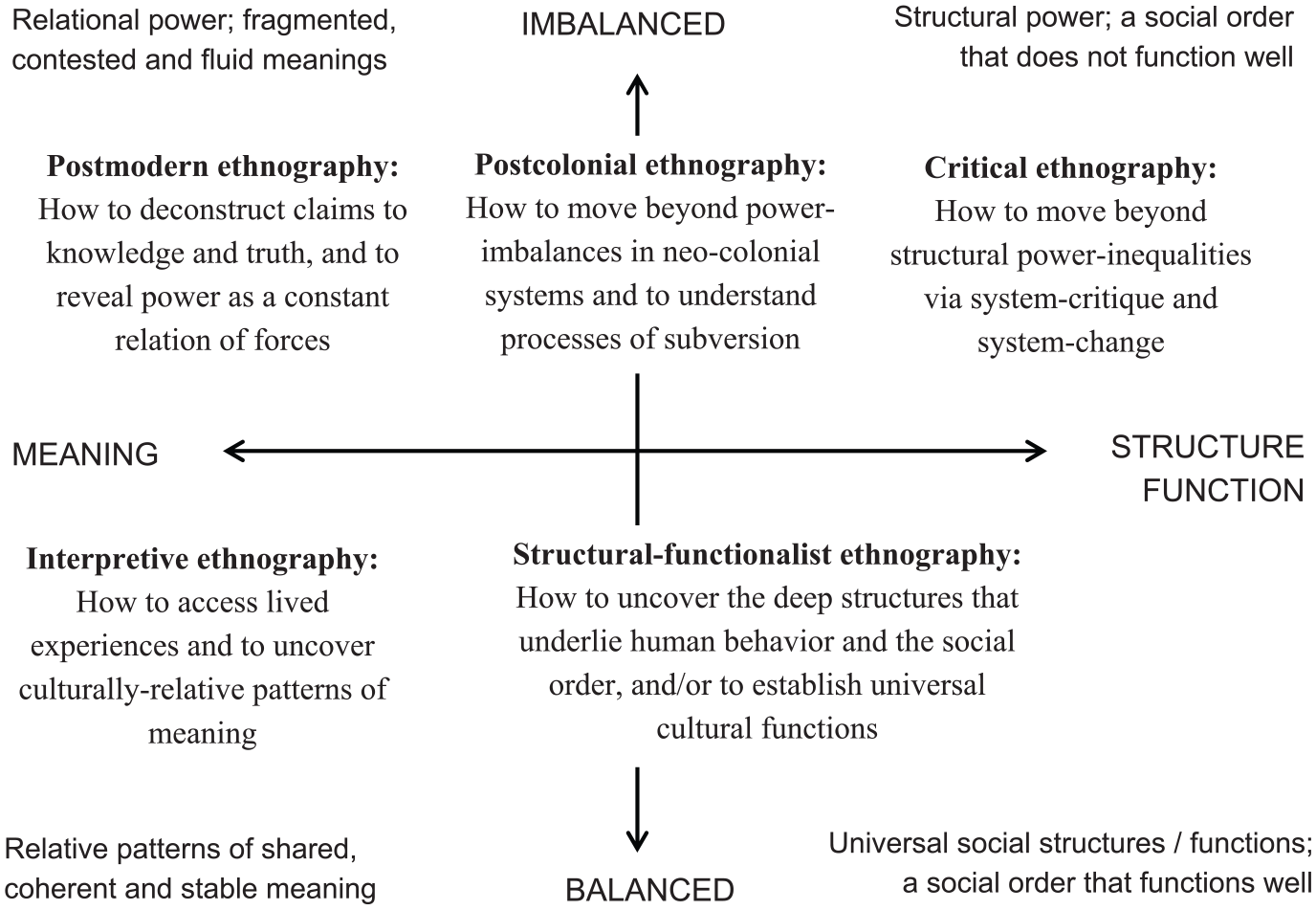
Five paradigmatic orientations of ethnography.
Structural-functionalist ethnography
Structural-functionalist ethnography assumes a balanced social order (power-inequalities are not a major focus point); it wishes to identify how the social order “functions,” often with a focus on identifying deep and universal structures underpinning human behavior.
There are two main historical roots to contemporary structural-functionalist ethnography (Kuper, 1999): The British school (Radcliffe-Brown, 1952) focused on the “functions” of social structure and their impact on human activities, for instance, as related to kinship systems (Tylor, 1889). The French school (based on Lévi-Strauss, 1963) wished to uncover the deep universal structures underpinning social phenomena, such as myths, social behavior, or the kinship systems studied by the British school (Eriksen, 2010).
In contemporary management, we see this orientation, for instance, in research on “native categories,” that is, the implicit assumptions by which disciplines or social groups structure reality (Buckley and Chapman, 1997). We find an IHRM application in Moore’s (2015) analysis of the divergent native categories underlying the meanings and purposes of “diversity management” practice in a German-UK cooperation.
Thus, structural-functionalist ethnography might shed light onto the tacit assumptions underpinning IHR strategy and practice, for example, in relation to outsourcing or offshoring. For instance, Houlihan (2002, HRMJ) investigates tensions in call center management strategies. The background to her study is the tension to achieve efficiency and provide a quality service to the customer which management strategies in call centers normally face. Out of this stems the “low discretion, high commitment” (LDHC) model by which high commitment (HC) in call centers is assumed to be achieved. However, Houlihan’s examination of how LDHC is really “done” and enacted reveals that most call centers, in fact, combine control-oriented HC management with a coercive approach to task implementation, thus rather “containing” than “enabling” their employees (Houlihan, 2002: 71).
In their ethnographic study of the introduction of Kaizen to General Motors Poland, which met local “resistance,” Dobosz-Bourne and Jankowicz (2006, IJHRM) suggest that it may be more useful to replace the terminology of “resistance to change” with the notion of “functional persistence.” They find that the reluctance of Polish employees to adopt certain practices such as organization, planning and self-discipline, despite being destructive and unreasonable from the outsider’s viewpoint, was a rational choice for them in protecting their sense of freedom and their need for creative expression. (p. 2031)
Rather than “fighting” such presumed “resistance,” they recommend that HR should ask which “function” this resistance might have and build change on values which are held by employees, such as, in this case, “creativity and freedom” (p. 2031). In such a way, ethnography can contribute to meeting the challenges of HRM in the context of multinational organizations.
By proposing unforeseen and unexpected “counter-meaning” and “counter-behavior,” both studies also involve interpretive and critical elements, as does every ethnographic study. Still, their contribution is focused on how IHRM “works” in unexpected ways, and this is why I classify them as structural-functionalist.
Structural-functionalist ethnography can lead to the development of alternative models. For instance, Charleston et al.’s (2018) study of expatriates sheds new light onto existing models of cross-cultural competence. Based on their ethnographic research, the authors find alternative requirements and propose an alternative model, which might enable HR practitioners to manage international assignments or host-country relations more effectively and efficiently.
Structural-functionalist ethnography is underpinned by the idea of cultural universality, that is, the assumption that one can identify socio-cultural elements, such as kinship, which exist in all socio-cultural contexts, and thus compare their specific orientations, such as specific kinship structures, across them (Schnegg, 2014). Thus, structural-functionalist ethnography enables deep comparisons (Moore and Brannen, 2018) and thus seems particularly suited to the challenges of comparative HRM (Brewster et al., 2018), such as integration or transferability challenges in MNCs (Björkman and Lervik, 2007).
Despite sharing parts of its name with “functionalist HRM,” structural-functionalist ethnography is thus positioned slightly differently: It is not solely rooted in positivism, and it also extends objective analyses toward the interpretive realm of “meaning,” for instance, by investigating and potentially comparing those “native categories” of which people and organizations might not be aware (see Figure 1). This is exemplified by the study of Samnani and Singh (2013), which shed light onto the contextual factors influencing HR, thereby challenging simplified models of “fit” in strategic IHRM studies.
Interpretive ethnography
Interpretive ethnography developed parallel to British and French structural-functionalism, mainly in the United States and Germany (Eriksen, 2010), and became particularly relevant in the 1970s with the work of Geertz (1972, 1973). It is the most influential strand of ethnography in management and organization studies (Bate, 1997; Weeks et al., 2017) and the major counter-paradigm in IHRM-related disciplines such as CCM (Romani et al., 2018) and IB (Doz, 2011).
Interpretive ethnography focuses on symbolic meaning (Geertz, 1973) to be uncovered and represented by the ethnographer via a “thick description” (Geertz, 1972). The underlying idea is that it is possible to identify shared patterns of meaning. An IHRM application is Styhre’s (2004) study of the different “meanings” of empowerment in an IHRM context.
In contrast to structural-functionalism, interpretive ethnography assumes that cultural meanings are culturally relative (Schnegg, 2014), that is, specific to a certain cultural context. For instance, concepts such as Yin-Yang or Caste originate from a specific cultural context (Greater China, South Asia) and might thus be specific of it (IHRM cannot compare the degree of Yin and Yang-ness of subsidiaries in Europe).
Interpretive ethnography rests on researcher immersion and assumes that cultural meaning can only be uncovered and approximated via deep research and the constant interplay between the empirical material and wider theory (Bate, 1997; Van Maanen, 2006). Interpretive ethnography thus stresses the value of participant observation the most and is highly skeptical toward alternative attempts at a “quick ethnography” (Handwerker, 2001).
Interpretive ethnography is useful for IHRM studies in multiple ways: When studying individuals, interpretive ethnography uncovers the everyday experiences of those working in multinational and international organizations (Weeks et al., 2017; Westney and Van Maanen, 2011; Ybema et al., 2009). For instance, both Moore (2006) and Shimoda (2013) describe how expatriates negotiate their position and the relation to host-nationals, thereby shedding new light onto critical IHRM challenges associated with expatriation or local-host tensions associated with staffing decisions. Both studies also deliver new insights related to specific national contexts, such as Japan and Indonesia (Shimoda, 2013), as well as new implications for headquarter–subsidiary relations in an MNC in general (Moore, 2006).
When focusing on organizations, interpretive ethnography uncovers organizational culture as “that complex whole” and beyond single locations, as, for example, Garsten’s (1994) ethnography of “Apple World” shows.
Recently, interpretive ethnography has also concerned itself with cultural “flows” beyond single organizations, applying Marcus’ (2008) idea of a “multi-sited ethnography.” For instance, Ho’s (2009) ethnography of Wall Street does not consider “Wall Street” as a physical location, but as a complex web of meaning. One could therefore think of applying this idea to the study of labor market relations across single national contexts or to the study of employment decisions made by global talents beyond single organizations.
Out of the “thick description” of these lived experiences, new insights for HR theory and practice can be inferred. For example, studying shift work in a rigid organization, Root and Wooten (2008) identify how fathers manage tensions between work and life and thus come to the conclusion that HR strategy and practice needs to pay more attention to fathers as stakeholders of work–life balance policies and practices. Similarly, Pritchard’s (2010) examination of the experiences of HR practitioners “becoming” strategic partners identifies previously unknown themes related to this shift, such as becoming strategic, becoming a partner, and remaining a generalist.
If these ideas are applied beyond single locations, such examinations can be highly relevant to HR in the context of an MNC. For instance, they can help HR managers to understand the underlying orientations of their diverse workforce, or they might provide insights into how differences in the wider HR context contribute to differences in employee experiences.
Critical ethnography
Critical ethnography, often rooted in Critical Theory (Thomas, 1993), focuses on the power-aspects immanent to structures, institutions, and practices (Burrell and Morgan, 1979). It is on the rise in management and organization studies (Kelemen and Rumens, 2008) and almost “mainstream” in contemporary anthropology (Eriksen, 2010).
Critical ethnography uncovers power-inequalities, as rooted in social or organizational structures, and challenges managerial and academic practices in light of how they might systematically or historically advantage some over others (Cooke, 2003; Klikauer, 2015: 200). Power is thus mainly analyzed on the macro-level of societies or wider frameworks, or on the meso-level of organizations and practices.
Generally speaking, power-inequalities, for example, as rooted in unequal labor market regulations, are more prominent in IHRM than in national or local HRM (e.g. Pinnington and Harzing, 2011), and this makes the critical ethnographic perspective highly relevant to IHRM studies. For example, the study by Liao et al. (2017, IJHRM) indicates that “the close tie between Taiwan and the West has resulted in an exploitative approach to the management of migrant workers with Islamic religious affiliations” (p. 1201). In such a way, critical ethnography enables HR researchers and practitioners to reflect upon inequalities, for example, as shaping negative perceptions of a specific group of employees, originating from the global context wherein IHRM takes place.
Critical ethnography furthermore has the potential to shed light onto the critical effects of IHRM in MNCs. Relevant studies investigate, for instance, the negative effects of global capitalism on factory workers in the non-West (Ong, 1987) or uncover hidden structural power-inequalities in MNCs (Nash, 1979). Vickers and Fox (2010) study HR as a community of practice that sheds light onto how middle-managers used a formal HRM practice to successfully counteract the official strategy of the firm, which was to close parts of a production site. The authors acknowledge the implications of objects and technology and also offer a practice-based critique of corporate strategy. In an IHRM context, such an analysis might uncover the unforeseen consequences which the implementation of strategy has in various locations. In addition, Vickers and Fox’ (2010) Foucauldian-inspired idea of power as emerging from micro-practices (agency, see Foucault, 1980) involves elements of postmodern ethnography, as described in the following.
Postmodern ethnography
In contrast to interpretivism, postmodern ethnography as rooted in the 1970s French school (Derrida, 1978; Lyotard, 1984) weighs the multiplicity, fluidity, and heterogeneity of individual perspectives over the assumption of a shared and fairly homogeneous culture. When viewed in light of critical ethnography, it is a specific way of looking at power, namely as emerging from individual acts of positioning, such as acts of domination and resistance (Foucault, 1980).
In the history of anthropology, postmodernism has developed as the counter-movement to interpretivism which by then (1970s) had replaced (structural-)functionalism as the major anthropological paradigm (Eriksen, 2010). A relevant idea is that no claim to “truth” or “knowledge” can ever be universally “true” but needs to be challenged as just one of many positions (Derrida, 1978; Lyotard, 1984). Reflexivity, explicating researcher positioning, is thus a key requirement of postmodern ethnography (Cunliffe and Alcadipani, 2016). An HRM application of these ideas is Pritchard and Fear’s (2015) study of HR as an epistemic community. They draw on identity work literature to examine an identity threat to, and subsequent response by, a training and development team. Through their analysis, they provide insights on the nature of HR practice and the construction of claims to expertise. Translated to an IHRM context, such an analysis helps to uncover the power of individuals and/or groups, for example, to resist and subvert a change in HR strategy. Postmodern ethnography also enables HRM scholars and practitioners to reflect upon the blind-spots of their own assumptions and to consider what seemed previously “unimaginable.”
Postmodernism aims at change via micro-emancipation, not via large structural critique (Alvesson and Willmott, 1992). This perspective can thus enable IHRM to work toward a more equal and fair practice, for example, in MNCs. For instance, in a comparative study, Sharpe (2006) highlights processes of micro-individual power and resistance in a Japanese MNC, thus helping us to understand how power emerges from the situation and multiple individual acts of control and resistance. This sheds light onto IHRM as a constant strategy as practice and enables HR practitioners to include perspectives which have been previously neglected in their own strategy-making processes. It also adds to knowledge-production in comparative HRM.
Postmodern ethnography can also contribute to a more inclusive workplace, for instance, when acknowledging the requirements of a diverse workforce. For example, Berger et al. (2017) investigate how “Whiteness” and “non-Whiteness” create inequalities for those individuals who are perceived as “non-White,” for example, the descendants of migrants or ethnic minority employees. They show that, due to inherent organizational and managerial blind-spots, the competencies of “non-White” employees are undervalued, and they provide a lens for how management and organizations could stop thinking of individuals in terms of “White” and “non-White” and could focus on objective talent rather than on subjective perceptions of certain personal traits. For IHRM theory and practice, which is concerned with ensuring fair conditions to all—despite their diversity—this is a crucial contribution.
Focusing on the individual ability to subvert unequal relations (agency, see Foucault, 1980), Essers and Benschop (2009) examine how female Muslim entrepreneurs negotiate the negative perceptions which are projected upon them by employers and organizations. They show that these women have developed highly successful counter-strategies to dominant practice from which management and organizations could benefit—if they were aware of the existence of these counter-strategies. The authors’ contribution to IHRM studies lies in showing how IHRM might profit from identifying and utilizing the skills and the knowledge-set of previously neglected, marginalized, or excluded individuals and groups.
Postcolonial ethnography
Postcolonial ethnography straddles postmodern and critical approaches; it is the most recent development of the discipline (Ashcroft et al., 2006) which has nonetheless taken roots quickly in wider management and organization studies (Moore and Mahadevan, in press). Postcolonial ethnography looks at present conditions in light of actual historical events, such as colonialism and imperialism, and asks the question of how these have contributed to current conditions. An example is Cooke’s (2003) analysis of how American slavery has been wrongfully excluded from management history.
Postcolonial ethnography requires us to question the implicit demarcation lines or cultural boundaries that underpin IHRM. For instance, there is the historically learned worldview that the “West” is inherently modern and that “the Muslim world” is not, with both of them being in opposition (Said, 1979). Similarly, in IHRM studies, we see the examination of a presumably traditional “Islamic HRM” as opposed to a presumably modern Western HRM (Mellahi and Budhwar, 2010). Also, as critical and postcolonial scholars have noted, there is the idea that “Western” management and organizational knowledge is not only superior but also universal, and that all other knowledge—often labeled “indigenous”—is only applicable to and relevant for the local context from which it emerges (Jackson, 2013).
Central to postcolonial approaches is the dichotomy between colonizers and colonized, also beyond the actual context of colonization, and how these might still manifest themselves today (Nandi, 1983). Postcolonialism thus draws the attention of IHRM to its history and to the IB conditions wherein it takes place. Enlarging the scope of IHRM studies beyond individual and organizational levels, and contextualizing IHRM in history, postcolonial ethnography thus helps us to understand how historical imbalances of power are perpetuated, for example, in managerial and organizational practice (Boussebaa and Morgan, 2014) or in academic knowledge-production (Tipton, 2008).
However, post-colonialism does not merely propose to critique historical dichotomies but to move beyond it and “imagine otherwise” (Nandi, 1983). In contrast to critical approaches in the Marxist sense which often take an “anti”-view toward established hierarchies, postcolonial approaches thus ask how those subjected to unequal power relations might challenge, subvert, and ultimately change unequal systems (Mahadevan, 2017: 101–126). This might happen in so-called “third spaces” wherein dominant meaning is first mimicked, and then translated, subverted, and changed by those ruled (Frenkel and Shenhav, 2006; based on Bhabha, 1994). Relevant IHRM applications of these ideas are, for instance, the study by Boussebaa et al. (2014) that shed light onto processes of “Englishization” in Indian call centers.
Another focus of postcolonial ethnography is the study of organizational “subalterns,” that is, those individuals who are structurally, systemically, and historically disadvantaged to such a degree that their “voices” are lost (Spivak, 1988). Relevant IHRM examples are ethnographies of Filipina maids in Hong Kong (Constable, 1997) or of Arab workers in the Israeli textile industry (Drori, 2000).
Because the demarcation lines between postcolonial, postmodern, and critical ethnography are fluid, most previous studies might also be characterized within one or both of the other power-sensitive ethnographic paradigms. For instance, Mahadevan and Kilian-Yasin (2017) investigate how HR in a German high-tech company wishes to integrate those whom they perceive as “Muslim migrants.” They show that the very label chosen (“Muslim”) and why it was chosen over alternative labels (such as “highly-skilled global talent”) is already problematic because it frames and, thus, limits HR’s idea of “who should be integrated” and “how this should be achieved.” This means that this study derives critical power-implications via the postmodern technique of challenging dominant identity labels, and, in such ways, ethnographers in IHRM can also mix their approaches, based on their specific research interest.
Implications: the multi-paradigmatic potential of ethnography for international human resource management studies
As the previous section shows, ethnography is inherently multi-paradigmatic and thus highly suitable to a complex field such as IHRM, which needs to take into account variances in structures and institutional frameworks, and diverse cultural meaning systems and employee experiences, and which also relies heavily on technology and technological infrastructures (for these characteristics of IHRM, see Pinnington and Harzing, 2011). All of these aspects fit the holistic idea of culture as “that complex whole” from which all strands of ethnography stem and to the understanding of which all of them contribute.
For instance, ethnography can ask how IHRM “works” (a structural-functionalist question) and shed light onto HR structures and practice (Buckley and Chapman, 1997; Watson, 2011), and it can also investigate what is “wrong about” a certain IHRM strategy or practice (a critical question; Liao et al., 2017). Ethnography can search for what IHRM strategy or practice “mean” to a certain group of people (an interpretive question; Root and Wooten, 2008), and it can also investigate the power-inequalities associated with a certain IHRM strategy or practice, for instance, with a focus on agency and subversion (a postmodern question; Alcadipani et al., 2015) or with a focus on the perpetuation of unequal histories (a postcolonial question; Mahadevan and Kilian-Yasin, 2017).
Finally, ethnography can combine several of these questions to gain even further insights (a multi-paradigmatic approach; Harris, 2000; Sanday, 1979). Many of the aforementioned studies, despite being classified by me as being rooted within a certain ethnographic orientation, retain elements of other orientations. For example, in their study of HR as a community of practice, Vickers and Fox (2010) bring together critical and postmodern perspectives on power. Similarly, structural-functionalist ethnography tends to include interpretive and power-sensitive (critical, postmodern and/or postcolonial) elements (Dobosz-Bourne and Jankowicz, 2006; Houlihan, 2002). These studies thus highlight the multi-paradigmatic potential of ethnography.
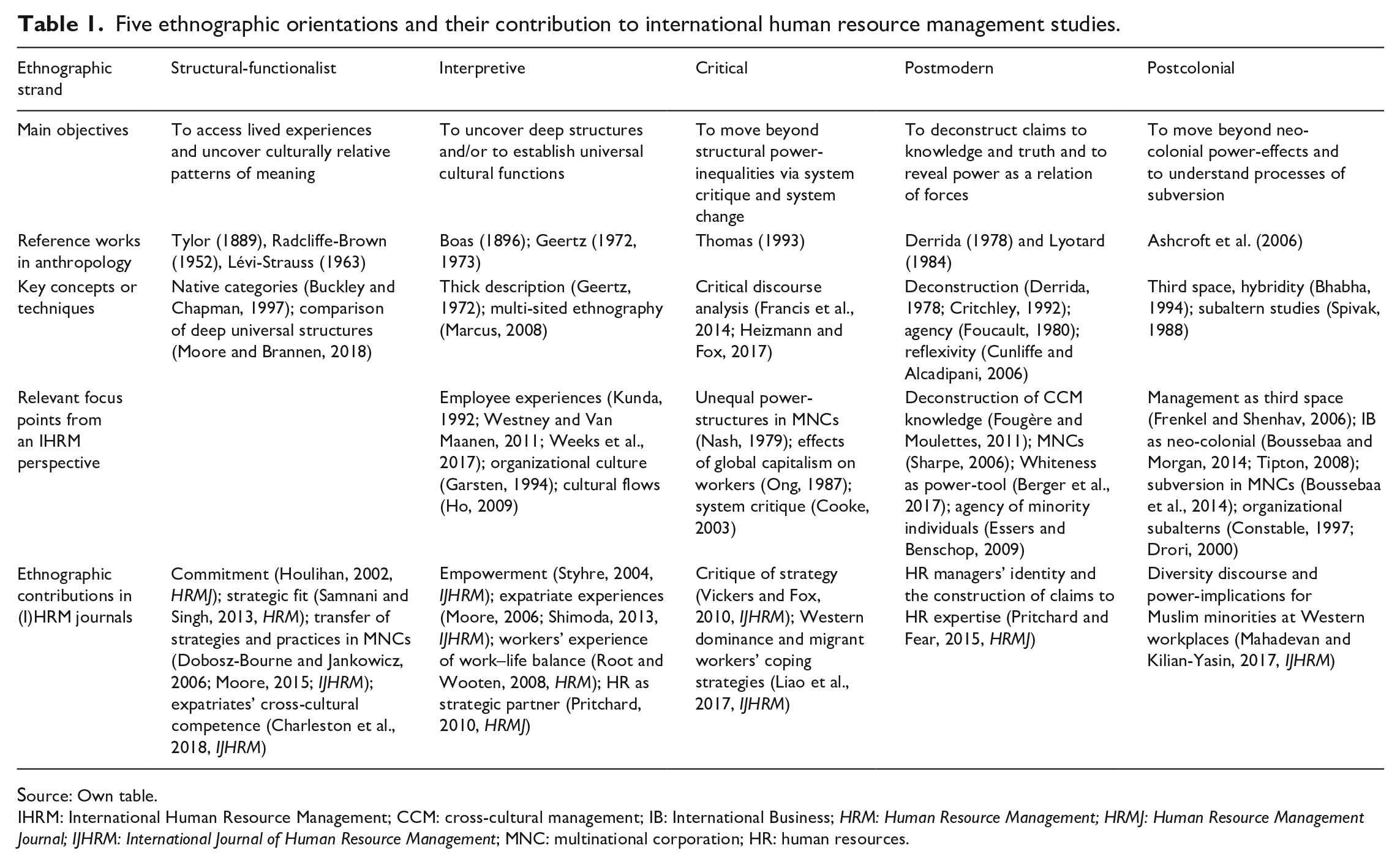
Table 1 summarizes the potential contributions of ethnography to IHRM studies. It also provides an overview on the five ethnographic orientations and their key aspects, as well as relevant reference texts.
Five ethnographic orientations and their contribution to international human resource management studies.
Source: Own table.
IHRM: International Human Resource Management; CCM: cross-cultural management; IB: International Business; HRM: Human Resource Management; HRMJ: Human Resource Management Journal; IJHRM: International Journal of Human Resource Management; MNC: multinational corporation; HR: human resources.
As Table 1 suggests, structural-functionalist ethnography is more visible within (I)HRM than in related disciplines, such as CCM or IB, or wider management and organization studies: Six of the 13 ethnographic studies in relevant (I)HRM journals proceed from this orientation. This again supports the argument that structural-functionalist ethnography seems particularly suited to the mainly functionalist field of IHRM and might make a unique contribution to it, which also differs from other managerial and organizational disciplines.
A major potential contribution of (structural-functionalist) ethnography lies in offering alternative interpretations of “how things work” in HR practice. This way, ethnography sheds a critical light onto HRM while still contributing to the underlying functionalist orientation of the field. This seems particularly relevant for IHRM which is characterized by high complexity, by numerous tensions, and by culturally and institutionally diverse frameworks and boundary conditions, and to which interpretive ethnography does not fully fit.
Still, IHRM scholars should not neglect the other ethnographic strands. For instance, interpretive ethnography can uncover hidden realities of IHRM across multiple contexts and encourage the incorporation of alternative viewpoints. Critical and postcolonial ethnography seem well-suited to challenge the “Westocentric” nature of IHRM theory and practice (Liao et al., 2017) or to question the presumed universality and global applicability of the theoretical concepts that underpin comparative HRM (Fougère and Moulettes, 2011). They might, for instance, shed light onto the hidden dimensions of workplace diversity (Essers and Benschop, 2009) or contribute to the study of international migrants (Liao et al., 2017; Mahadevan and Kilian-Yasin, 2017), both themes being pressing concerns of contemporary IHRM (Guo and Al Ariss, 2015; Syed, 2008). Postmodern ethnography can challenge and deconstruct the taken-for-granted knowledge and practices of IHRM, such as the idea that HR managers need to become “strategic partners” or achieve corporate legitimacy (Heizmann and Fox, 2017), situating the discipline in its social and historical context. It can also encourage the adoption of more reflexive research frameworks and help researchers to consider their role and the situatedness of their research, also in relation to its aims and outcomes.
Challenges and limitations to ethnography in international human resource management studies
The challenges to ethnography in IHRM studies are obviously its way of generating knowledge from an intersubjective interaction between researcher and field, which do not fit functionalist ideas of validity and rigor (Ybema et al., 2009). Also, ethnography, even in its structural-functionalist orientations, tends to value specific insights, small-scale comparisons, and historical context over large generalizations (Moore and Brannen, 2018).
Based on the previous considerations, the potential to be accepted as part of IHRM studies seems to be the highest for structural-functionalist ethnography (see Table 1). This would also be a new contribution because it is mainly interpretive and critical ethnography that have become prominent in management and organization studies, and in CCM and IB.
Directions for further ethnographic research in international human resource management studies
Based on the previous considerations, the first direction for further ethnographic research in IHRM is to consciously explore the potential of structural-functionalist ethnography. This way, ethnography might make a distinct contribution to the field.
Second, IHRM studies will need to explore ethnography more holistically, from or across the four other paradigms. This way, the discipline might develop their own ethnographic toolset, as it has already been put forward for wider management and organization studies (see, for instance, the inaugural issue of the Journal of Organizational Ethnography, 2012).
Summary and conclusion
For ethnography being able to reach its full potential, IHRM studies need to develop their own ethnographic tradition, a tradition that goes beyond and is different from the interpretive ethnographic approach already prevalent in CCM, IB, and wider management and organization studies. To this end, this article provided a first conceptual discussion of the usefulness of ethnography for IHRM theory and practice.
Offering a conceptual roadmap, it enables future IHRM researchers to choose their ethnographic research strategy consciously, reflexively, and as their research interest demands for. In particular, it sketches the contours of ethnography—in its diversity, but also in its commonalities—and as related to five paradigmatic orientations underlying ethnographic research (structural-functionalist, interpretive, critical, postmodern, and postcolonial).
Structural-functionalist ethnography has the potential to uncover hidden structures and meanings of “how things work.” Interpretive ethnography helps shedding light onto the hidden social and material realities of IHRM. Critical, postmodern, and postcolonial ethnography can deconstruct, challenge, and subvert dominant structures, practices, and work experiences.
Structural-functionalist ethnography in particular, while presently neglected by wider management and organization studies and in related disciplines such as CCM and IB, is highly useful for IHRM studies. The reason is that the IHRM context is characterized not only by differences in “meaning” but also by differences in structure and institutional frameworks, as well as technological challenges. The holistic approach to culture as “that complex whole” and the anthropological idea of ethnography as a multi-paradigmatic mindset, not a method, acknowledge this.
Ethnography can thus make a strong contribution to IHRM studies. However, this requires a more thorough and differentiated engagement with existing ethnographic strands, beyond the idea of ethnography being a solely interpretive science which is not suited to mainly functionalist IHRM.
IHRM scholars thus need to turn back toward anthropology, and not sideways to wider management and organization studies or related disciplines such as CCM or IB, which have already pre-selected interpretive ethnography for themselves. Out of this might stem a specific “IHRM way of doing ethnography,” and this article offered a first multi-paradigmatic roadmap for reaching this goal.
Footnotes
Acknowledgements
Many thanks go to Iuliana Ançuta Ilie for her insightful comments on this paper, to Fiona Moore for the inspiring exchange on ethnography, and to the editors of this special issue for recognizing the relevance of this topic for IHRM studies.
Funding
The author(s) received no financial support for the research, authorship, and/or publication of this article.
