



Abstract
The present study aimed to investigate the relationship of follower’s strengths-based leadership (FSBL) with follower work engagement. Additionally, this study also examined the mediational effect of employee strengths use and the moderating effect of core self-evaluation (CSE) on the relationship between FSBL and follower work engagement. Data were garnered at two points in time with a time lag of 2 months. Moderated-mediation path analysis with a total of 238 employees working in a research and design institute in Beijing was deployed to examine our hypotheses. As hypothesized, FSBL was a statistically significant predictor of work engagement, and strengths use acted as a mediator in the FSBL-work engagement relationship. In addition, we also found that CSE significantly and negatively moderates the direct effect of FSBL on strengths use and the indirect effect of FSBL on work engagement through strengths use. This study advances the FSBL theory and research and provides a new insight into the driving force of work engagement.
Keywords
Introduction
In recent two decades, strengths-based approach has increasingly garnered more attention from scholars in the domain of human resource and organizational behavior (van Woerkom et al., 2016b) in that it has been suggested to be closely correlated with sustainable performance (Bouskila-Yam and Kluger, 2011; Van Woerkom and De Bruijn, 2016; Van Woerkom and Meyers, 2015). Given the importance of leadership for facilitating performance of employees and organizations (Ceri-Booms et al., 2017), follower’s strengths-based leadership (FSBL) as a crucial construct of strengths-based approach has triggered scholars’ interest (Rath and Conchie, 2008).
FSBL refers to the behaviors that leaders execute to promote followers’ strengths identification, development, and deployment (Ding and Yu, 2020). Its basic assumption is that the greatest area of individual’s growth and development is the area of individual’s strengths (Van Woerkom et al., 2016b). Previous research has shown that FSBL can lead followers to experience higher levels of well-being or other positive outcomes such as innovative behavior, organizational citizenship behavior and task performance (Burkus, 2011; Ding and Yu, 2020; Rath and Conchie, 2008). Yet, we have limited knowledge on the relationship between FSBL and work engagement. As work engagement is of great importance to improvement in performance (Bakker and Bal, 2010; Carter et al., 2018), it is essential to investigate the FSBL-work engagement linkage. Therefore, the first purpose of this study is to test this relationship.
In essence, FSBL influences followers primarily by promoting followers’ strengths use (Ding et al., 2020b). FSBL differs from followers’ strengths use, the former obviously focuses on the use of strengths by the leader and the latter one on the use of strengths by the follower, specifically the initiative to use their strengths. FSBL has been found to relate positively to follower strengths use (Ding and Yu, 2021), and strengths use might be the proximal predictor of individuals’ outcomes such as work engagement (van Woerkom et al., 2016c). Accordingly, the present study introduces strengths use as a mediator in the FSBL and work engagement relation. As such, the second purpose of this study is to examine the mediating role of follower strengths use in the relationship between FSBL and work engagement.
In addition, core self-evaluation (CSE) as a higher-order personality trait was demonstrated to mitigate the positive effect of FSBL on employees’ outcome as CSE can substitute for FSBL in promoting positive outcome such as follower innovative behavior (Ding and Yu, 2020). In a similar vein, CSE might lessen the direct effect of FSBL on strengths use and the indirect effect of FSBL on work engagement through strengths use. Hence, the third purpose of the present study is to examine the moderating role of CSE in the relationship between FSBL, follower strengths use, and work engagement.
This study aims to make three aspects of contributions. First, this study provides a piece of robust evidence for the effect of FSBL and a new insight into the driving force of work engagement by examining the effect of FSBL on work engagement. To the best of our knowledge, this study is the first to investigate the FSBL-work engagement linkage. Second, by investigating the mediational role of strengths use in the FSBL-work engagement link, this study contributes to a better understanding of how FSBL promotes work engagement. Essentially, in terms of FSBL theory, stimulating follower to capitalize on his/her strengths at work is the primary pathway through which FSBL brings about various outcomes (Ding and Yu, 2020) such as work engagement, but this proposition has not received empirical support. Third, by testing the moderating effect of CSE, this study contributes to revealing that when FSBL has stronger effect on strengths use and when the mediational effect of strengths use on the FSBL and work engagement relation is stronger.
The proposed conceptual model was depicted in Figure 1.

The proposed conceptual model.
Theory and hypotheses
FSBL and work engagement
Work engagement has been defined “as a positive, fulfilling, work-related state of mind that is characterized by vigor, dedication, and absorption” (Schaufeli et al., 2002). Employees who have a high level of work engagement tend to experience higher levels of energy, enthusiasm, significance, and mental resilience, are more likely to persist when they face difficulties, can be fully involved in one’s work, always have the feeling of time passing quickly, and fail to detach themselves from work (Seppälä et al., 2009). A large majority of research has found that work engagement plays an important role in boosting commitment to organization (Yalabik et al., 2015), employees’ life satisfaction (Meynhardt et al., 2020), innovation (Bhatnagar, 2012), proactive behavior (Salanova and Schaufeli, 2008), and performance (Bakker and Bal, 2010). Given the great importance of work engagement to employees’ positive outcomes, it becomes quite important to investigate the antecedents to work engagement.
Particularly, leadership style as one of crucial driving forces of work engagement has received considerable attention (Xu and Cooper Thomas, 2011). Previous research has suggested that authentic leadership (Hsieh and Wang, 2015), charismatic leadership (Babcock-Roberson and Strickland, 2010), servant leadership (De Clercq et al., 2014), and empowering leadership (Tuckey et al., 2012) contributes to work engagement. However, the association of FSBL, a relatively new and critical leadership construct, with work engagement has yet to receive due appreciation.
The present study assumes FSBL to lead to an improvement in work engagement. From theoretical perspective, three aspects of reasons can be utilized to shed light on this phenomenon. First, when leaders provide opportunity to identify and develop strengths for followers and encourage followers to use their own strengths at work, followers will experience higher levels of support from leader, which in turn leads to an increase in work engagement (Swanberg et al., 2011). This notion is consistent with supervisor support theory suggesting the positive correlation of supervisor support with work engagement (Biggs et al., 2014). Second, employees who follow leaders appreciating their strengths are more likely to have higher levels of psychological capital, creativity (Wang et al., 2018), and proactivity (Chen et al., 2018). Such positive experiences induced by FSBL contribute to enhanced work engagement (Choi et al., 2015; Dikkers et al., 2010; Paek et al., 2015). Third, prior research has indicated that FSBL is positively related to employee well-being (Ding and Yu, 2020) and work engagement is an important component of employee well-being (Narainsamy and Van der Westhuizen, 2013). As such, it is feasible to believe that FSBL can predict work engagement. From practical perspective, Rath and Conchie (2008) also pointed out that FSBL can bring about an improvement in employees’ work engagement. Collectively, the following hypothesis was formulated:
Hypothesis 1: FSBL has a positive influence on work engagement.
The mediating effect of strengths use
Strengths use as the core construct of strengths theory was defined as “the initiative that employees may take to use their strengths at work” (Van Woerkom et al., 2016b: 962). When employees deploy their strengths at work, they are more confident in successfully accomplishing work tasks (van Woerkom et al., 2016c) and are more likely to achieve greater work performance (Dubreuil et al., 2014). Additionally, employees high in strengths use can experience higher levels of satisfaction, are more willing to help colleagues (Lavy and Littman-Ovadia, 2017), tend to craft their job (Ding et al., 2020a), and can experience lower levels of stress and negative affect (Wood et al., 2011).
Strengths use differs from strengths knowledge (Govindji and Linley, 2007). More specifically, possessing strengths is a prerequisite of strengths use, whereas strengths use is the direct way to achieve positive outcomes (Zhang and Chen, 2018). That is, if employee’s strengths cannot be used in work settings, it is difficult to yield the due effect. For example, when an individual has strong curiosity, but never applies to this strength, he/she is unlikely to benefit more from the curiosity strength in terms of work-related positive outcomes. Conversely, when the individual makes the most of this curiosity strength, he/she is likely to show more innovative behaviors, thereby gaining more benefits. Although previous empirical studies have demonstrated that both strengths knowledge and strengths use are significantly and positively related to individual well-being, they have a clear difference in predicting well-being.
A great deal of research has demonstrated the positive effect of strengths use on work engagement. In a weekly diary study conducted by van Woerkom et al. (2016c), they found that weekly strengths use could promote weekly work engagement through the mediating mechanism of weekly self-efficacy. In a cross-sectional research design, Stander et al. (2014) revealed the positive association of strengths use with work engagement. In addition, Botha and Mostert (2014) also found that strengths use positively relates to work engagement by structural equation modeling analysis. This positive relationship between strengths use and work engagement can be explained by job demands-resources theory (Botha and Mostert, 2014; Stander et al., 2014; Van Woerkom et al., 2016c). Specifically, strengths use which can be regarded as personal resource offers employees necessary condition for exhibiting higher levels of work engagement (Bakker and Van Woerkom, 2018).
To optimize the function of strengths use, scholars have attempted to investigate how to facilitate employees to leverage their strengths at work. For example, CSE has been found to predict strengths use through its influence on emotion (Ding and Lin, 2020). Kong and Ho (2016) demonstrated that supervisor’s autonomy support and independent self-construal of employee have significant positive effect on strengths use. In addition, organizational support for strengths use is also a crucial precursor of strengths use (Van Woerkom et al., 2016c).
From the FSBL theory’s perspective, FSBL will positively affect employees’ outcomes through its impact on strengths use. According to the definition of FSBL, leaders focusing followers’ strengths can promote followers’ positive subjective experience by helping them identify, develop, and use their strengths at work (Ding and Yu, 2020). Since strengths use is the ultimate purpose of strengths intervention compared to strengths identification and development, it will be the core path through which FSBL influences employees’ outcomes. The argument can be explicated by the fact that when leaders provide support for followers’ strengths identification, development, and deployment, followers are more likely to execute higher levels of strengths use (Van Woerkom et al., 2016c), which in turn will lead to an increase in work engagement by triggering followers’ motivation process (Bakker and Demerouti, 2017). Thus, based on the above outlined rationale and empirical findings, we formulated the following hypothesis:
Hypothesis 2: Strengths use mediates the effect of FSBL on work engagement.
The moderating effect of CSE
CSE refers to “the fundamental appraisals individuals make about their self-worth and capabilities” (Chang et al., 2012), it is a higher-order construct composed of four dimensions, namely, self-esteem, generalized self-efficacy, neuroticism, and locus of control (Bono and Judge, 2003). A vast majority of studies have indicated that CSE can result in a wide variety of outcomes including work success (Judge, 2009), stronger task motivation (Erez and Judge, 2001), higher levels of job and life satisfaction (Judge et al., 2005), positive voice behavior (Aryee et al., 2017), higher salary attainment (Cheung et al., 2016), decreased job burnout (Peng et al., 2016), lower levels of turnover intentions (Vîrga et al., 2017), emotional exhaustion (Anand and Mishra, 2021), and counterproductive work behavior (Debusscher et al., 2016).
In addition to research on the effects of CSE, investigating the moderating effect of CSE has increasingly received scholarly attention. For example, Hu et al. (2021) found that CSE positively moderates the relationship between mentorship quality and personal skill development. More importantly, CSE have been confirmed to act as a vital substitute for leadership (Nübold et al., 2013). According to substitute for leadership theory, subordinates’ characteristics such as ability, experience, and knowledge can substitute for relationship- or task-oriented leadership (Kerr and Jermier, 1978). A considerable body of research have provided support for this notion (Den Hartog and Belschak, 2012; Howell et al., 1990; Podsakoff et al., 1996). For example, followers’ CSE can decrease the influence of transformational leadership on followers’ performance, that is, the positive relationship between transformational leadership and followers’ performance is more positive when followers’ CSE is low rather than high (Nübold et al., 2013).
In the present study, we anticipate that CSE will lessen the impact FSBL has in terms of improved strengths use. This prediction is consistent with substitute for leadership theory (Kerr and Jermier, 1978). Specifically, when employees have a high level of CSE, they tend to express lower levels of sensitivity to FSBL behaviors; on the contrary, employees scoring low on CSE will be more sensitive to FSBL (Ding and Yu, 2020). CSE has been revealed to positively predict strengths use (Ding and Lin, 2019, 2020), which will lead followers to benefit less from FSBL in terms of enhanced strengths use. A recent empirical study of Ding and Yu (2020) confirmed the substitute of CSE for FSBL in improving psychological well-being. In sum, based on the above arguments, it is reasonable to expect that CSE will mitigate the positive effect of FSBL on strengths use. Therefore, the following hypothesis was obtained:
Hypothesis 3: CSE moderates the effect of FSBL on strengths use in such a way that the relationship is more positive for employees with low CSE than for employees with higher CSE.
The previous claims represented an integrative framework in which strengths use mediates the linkage between FSBL and work engagement and the positive effect of FSBL on strengths use is contingent on CSE. Building on this, we proposed the moderated mediation model, namely, CSE also moderates the mediational effect of strengths use on the influence of FSBL on work engagement. Thus, we postulated:
Hypothesis 4. CSE moderates the indirect effect of FSBL on work engagement via strengths use such that the indirect effect is more positive when CSE is low than high.
Methods
Sample and data collection
The current study is part of a large project regarding research on the effects of FSBL on employee work-related outcomes. A convenience sample of 423 employees working in a research and design institute in Beijing was recruited for the current study. Self-administrated questionnaires were used to gather data at two points in time, spaced by a 2-month interval. After obtained consent from participants and this organization, we asked participants to complete online questionnaires and promised that all information obtained would be treated as strictly confidential. At Time 1, we asked participants to complete questionnaire involving demographic variables, FSBL scale, CSE scale and strengths use scale. About 336 participants responded to the questionnaire (79.43% response rate). After 2 months, the 336 participants were asked to complete work engagement scale (Time 2). About 254 participants responded to the second phase survey (75.60% response rate). Ultimately, 238 valid paired sample data were received. Of the 238 samples, 54.20% were male, 96.20% had a bachelor’s degree or above, and 68.90% had been employed for >7 years. Besides, the average age was 35.76 years (SD = 7.11).
Measures
All focal variables were evaluated on a five-point Likert scale (from 1 = strongly disagree to 5 = strongly agree).
FSBL
FSBL was measured with Ding and Yu’s (2020) five-item FSBL scale. An example item was “My leader provides me with the opportunity to let me know what I am good at.” Cronbach’s α of this scale was 0.92.
CSE
CSE was rated using Judge et al.’s (2003) 12-item scale. An example item was “When I try, I generally succeed.” Cronbach’s α of this scale was 0.83.
Strengths use
We adopted five items of Strengths Use and Deficit Correction (SUDCO) questionnaire developed by van Woerkom et al. (2016b) to evaluate strengths use. An example item was “In my job, I try to apply my talents as much as possible.” Cronbach’s α of this scale was 0.93.
Work engagement
We measured work engagement using nine-item version of Utrecht Work Engagement Scale (UWES) developed by Schaufeli et al. (2006). An example item was “I am enthusiastic about my job.” Cronbach’s α of UWES was 0.96.
Control variables
In line with previous research (Inceoglu and Warr, 2011), age, gender, and education level were regarded as control variables. Participants were asked to indicate their age in years. Gender was coded as 1 = male and 2 = female. Education level was coded as 1 = College Graduated, 2 = bachelor’s degree, 3 = master’s degree, and 4 = doctor’s degree. We examined the proposed research model both with and without these control variables (Becker, 2005), which showed that control variables do not alter results of the current study. To offer a conservative estimate of our results (Koopman et al., 2019), control variables were retained in our research model.
Discriminant validity
To examine the discriminant validity between FSBL, CSE, strengths use, and work engagement, confirmatory factor analysis was performed. Four-factor measurement model was viewed as baseline model. Since item parcels could make models become more parsimonious, enable parameter estimates to be more efficient, and effectively control for inflated measurement errors originated from multiple items for the latent variable (Nasser-Abu Alhija and Wisenbaker, 2006; Schmitt et al., 2016), we used item parcels to define the constructs of work engagement and core self-evaluation. Consistent with work of Leroy et al. (2013), we created three item parcels for work engagement according to its three dimensions, namely, vigor, dedication, and absorption. In line with work of Yan et al. (2018), we created three item parcels for core self-evaluation. Analytical results showed that four-factor measurement model exhibits the best fit to the data compared to alternative models. Table 1 presented the results of comparison of measurement model.
Results of CFAs: comparison of measurement models.

FSBL: follower’s strengths-based leadership; CSE: core self-evaluation.
FSBL and strengths use combined into one factor.
FSBL, CSE, and strengths use combined into one factor.
All combined into one factor.
p < 0.001.
Common method variance (CMV) testing
Although the current study adopted two-wave research design to gather data, self-report survey might result in serious CMV. A single unmeasured latent method factor method was employed to test the degree of CMV of the current research data (Podsakoff et al., 2003). The common method factor was loaded on all indices of four-factor measurement model. Results indicated that the measurement model including the common method factor (χ2 = 162.87, df = 97, χ2/df = 1.68, RMSEA = 0.05, CFI = 0.98, TLI = 0.97, IFI = 0.98) reported a better fit to the data than four-factor measurement model. However, only 21.72% of variance were interpreted by the common method factor, <25.00% (Williams et al., 1989). Thus, in the current study, there does not exist serious CMV.
Results
Descriptive analysis results
The means, standard deviations, and Pearson correlations between research variables were reported in Table 2. As can be seen in Table 2, FSBL is positively related to CSE (r = 0.37, p < 0.01), strengths use (r = 0.63, p < 0.01), and work engagement (r = 0.45, p < 0.01). Strengths use is positively related to work engagement (r = 0.43, p < 0.01). Results of correlational analysis provided preliminary evidence for our hypotheses.
Means, standard deviations, and correlations.

FSBL: follower’s strengths-based leadership; CSE: core self-evaluation.
p < 0.01, two-tailed.
Hypotheses testing results
Moderated-mediation path model based on Hayes’ Process Model 7 was carried out in AMOS 23.0 to test our hypotheses. Indirect effects were evaluated using bootstrapping analysis with 95% bias-corrected confidence intervals (CI) based on 2000 iterations. Figure 2 displayed the standardized paths coefficients. The proposed path model showed a good fit to the data (χ2 = 38.73, df = 16, χ2/df = 2.42, RMSEA = 0.08, CFI = 0.93, IFI = 0.93), interpreting 26.30% of variance in work engagement and 48.70% of variance in strengths use. As predicted, FSBL had a positive effect on work engagement (β = 0.33, p < 0.001), Hypothesis 1 received support. The standardized indirect effect of FSBL on work engagement via strengths use was 0.10, CI [0.02, 0.20], which was supportive of Hypothesis 2.
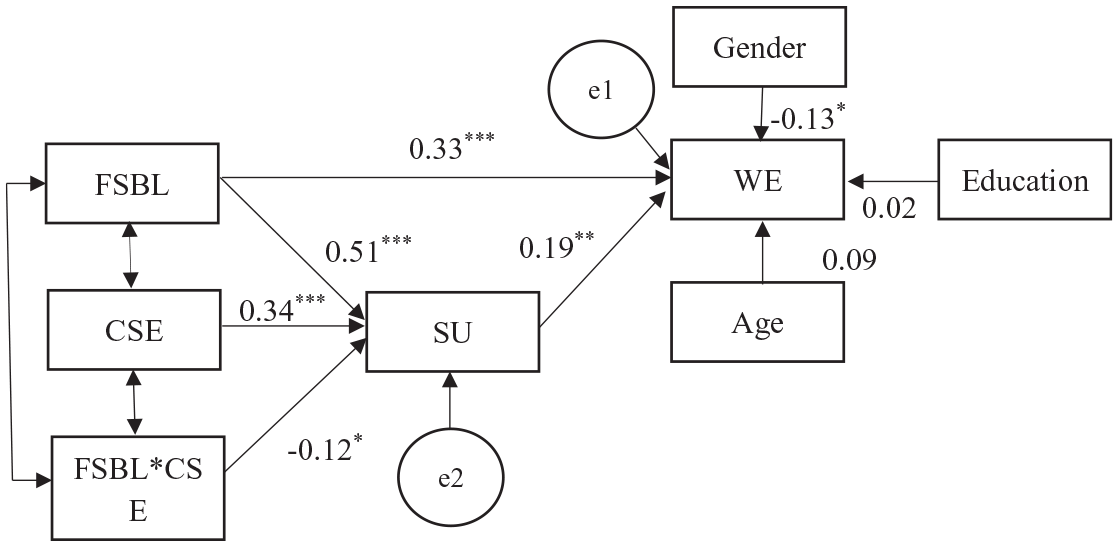
Results of the moderated mediation path model analysis.
Hypothesis 3 postulated that CSE moderates the effect of FSBL on strengths use. Consistent with this hypothesis, the standardized coefficient of the interaction for FSBL and CSE was −0.12, p < 0.05. To further explain the significant interaction effect, the impact of FSBL on strengths use at high and low levels of CSE was depicted in Figure 3. The effect of FSBL on strengths use was 0.29 (p < 0.01, CI [0.11, 0.47]) at a low level of CSE; the effect of FSBL on strengths use was 0.16 (p > 0.05, CI [−0.04, 0.38]) at a high level of CSE. Accordingly, Hypothesis 3 was supported. Hypothesis 4 assumed that CSE moderates the indirect effect of FSBL on work engagement through strengths use. The moderated mediation effect was −0.02, p < 0.05, 95% CI [−0.04, −0.001]. Further, the indirect effect of FSBL on work engagement via strengths use was .09 (p < 0.05, CI [0.04, 0.16]) at a low level of CSE; the indirect effect of FSBL on work engagement via strengths use was 0.05 (p > 0.05, CI [−0.01, 0.13]) at a high level of CSE. Therefore, Hypothesis 4 received support.
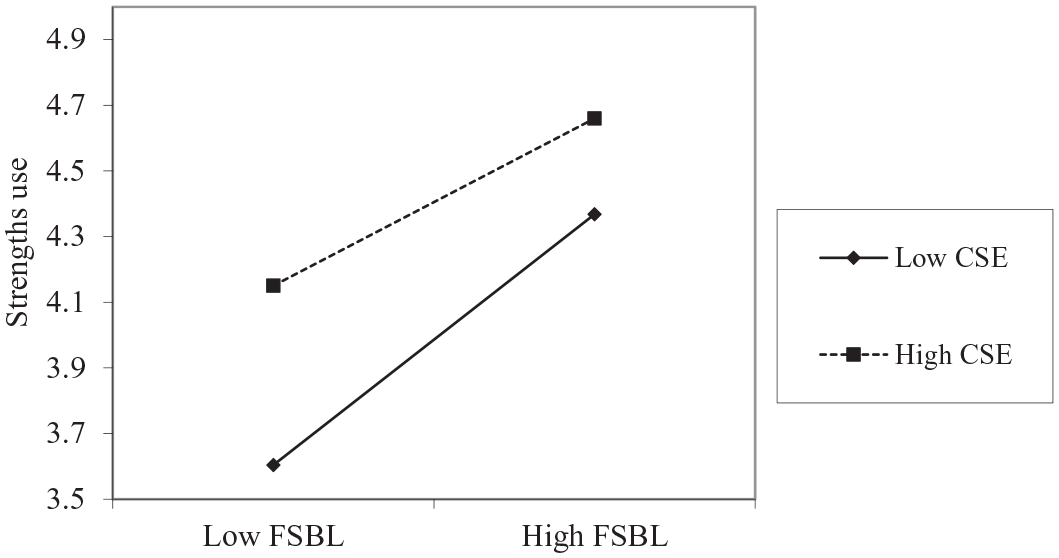
The interaction plot of FSBL and CSE on strengths use.
Discussion
This study of 238 Chinese employees working in various enterprises investigated the relationship between FSBL and work engagement and the mediating role of strengths use and the moderating role of CSE in the relationship. As predicted, all hypotheses received support in anticipated directions. First, our findings showed a positive effect of FSBL on work engagement. The result is similar to previous research suggesting that perceived organizational support for strengths use (POSSU) is positively related to work engagement (Meyers et al., 2020; van Woerkom et al., 2016c) in that FSBL and POSSU are important job resources of employees (Ding and Yu, 2020; van Woerkom et al., 2016a). The phenomenon can be elucidated by JD-R theory demonstrating that job resources can ignite motivational process of employees, thereby leading to an increase in work engagement (Bakker and Demerouti, 2017). Given that FSBL is a relatively new leadership construct, to date, little is known about whether FSBL can positively boost employees’ work engagement. Therefore, the present study not only extends our knowledge on the effect of FSBL, but also provides a new insight into antecedents to work engagement.
Second, the present study found the significant mediating effect of strengths use on the relationship between FSBL and work engagement. This finding is consistent with FSBL theory suggesting that leaders focusing on followers’ strengths facilitate followers’ positive outcomes mainly through the mediational mechanism of strengths use (Ding and Yu, 2020). In addition, this finding is also line with previous research indicating that when employees receive higher levels of support for strengths use, the level of their strengths use will be enhanced, which in turn results in an improvement in work engagement (Van Woerkom et al., 2016c). Similarly, JD-R theory provides a crucial theoretical foundation for the result (Bakker and Demerouti, 2017). Specifically, when leaders promote followers to identify, develop, and capitalize on their strengths use, followers will experience a high level of resources support for strengths use, which in turn will motivate followers to use their strengths at work. Such enhanced strengths use will further lead to higher work engagement. Therefore, the present study contributes to better understanding of how FSBL predicts work engagement by investigating the mediational effect of strengths use. Besides, this study also provides a piece of empirical evidence for FSBL theory.
Third, our results suggested that followers can benefit more from FSBL in terms of increased strengths use when CSE is low rather than high. This finding dovetails with study of Ding and Yu (2020) revealing the negative moderating role of CSE in the relationship between FSBL and psychological well-being. Substitute for leadership theory can be applied to shed light on the argument (Kerr and Jermier, 1978). When follower’s CSE is high, they have a low level of sensitivity to FSBL (Ding and Yu, 2020). As a result, the positive influence of FSBL on strengths use will be lowered. In other words, CSE as a vital personal personality trait substitutes FSBL in boosting strengths use. More importantly, our study also revealed that CSE negatively moderates the mediational effect of strengths use on the FSBL and work engagement relation. In a similar vein, this finding can be understood in the light of substitute for leadership theory. Taken together, the present study contributes to our understanding of the boundary condition under which FSBL affects work engagement via strengths use.
Managerial suggestions
Practical implications of the present study are threefold. First, since FSBL has a significant positive effect on followers’ work engagement, the employer organizations should promote employees with higher levels of characteristics of FSBL to the leadership positions. To this end, the employer organizations can assess the candidates of leadership positions by FSBL scale used in the present study. Second, this study revealed the mediational effect of strengths use on the FSBL-work engagement linkage. That means that improving deployment of strengths of employees is also an important pathway to motivate employees to engage in work. In addition to FSBL, organizational support for strengths use has been demonstrated to positively relate to strengths use (Meyers et al., 2020; Van Woerkom et al., 2016c). Therefore, the employer organizations can develop and implement strengths-based human resource management practices to cultivate employees’ perception of organizational support for strengths use (van Woerkom and Meyers, 2015), thereby improving employees’ strengths use. Third, the present study found that CSE can lessen the positive effect of FSBL on work engagement via strengths use. That implicitly means that leaders should treat employees low in CSE with more strengths intervention rather than employees high in CSE, because employees with a low level of CSE are more sensitive to FSBL and tend to benefit more from FSBL, whereas employees with a high level of CSE have lower levels of sensitivity to FSBL.
Limitations and directions for future research
The present study is not without its limitations. First, this study utilized self-report questionnaires to collect data. Although test of CMV showed that there was no serious CMV in the current study, it is essential to collect research data from different sources to improve the robustness of our results in the future research. Second, a cross-sectional research design was applied in the current study, which inhibits causal inferences of the current study. Future research should adopt experimental design or cross-lagged research design to further test our results. Third, the present study examined the proposed hypotheses using a sample of Chinese employees, which limits the cross-cultural applicability of our findings in that employees working in different culture might have different perceptions of leadership (Ding and Lin, 2020). Therefore, future research should conduct this study in different culture to replicate our findings. Fourth, according to substitute for leadership theory (Kerr and Jermier, 1978), characteristics of followers, tasks, and organizations are believed to substitute for leadership in promoting positive outcomes. However, the present study only investigated the moderating role of CSE in the effects of FSBL. As such, from the perspective of substitute for leadership, future research should expand research on the effects of FSBL by exploring the moderating role of characteristics of tasks and organizations in the effects of FSBL. For instance, strengths-based psychological climate (Van Woerkom and Meyers, 2015) might mitigate the effects of FSBL, primarily because strengths-based psychological climate and FSBL has similar role in facilitating follower positive attitudes and behaviors such as well-being and strengths use. According to substitute for leadership, when strengths-based psychological climate is high, the positive effects of FSBL might be lowered. Finally, prior research has pointed out that FSBL is similar to other positive leadership constructs such as transformational leadership, humble leadership, and authentic leadership (Ding et al., 2020b). However, this study did not control these leadership constructs. As such, future research should view these positive leadership constructs as control variables to test the incremental predictive validity of FSBL.
Conclusion
With the development of positive psychology, strengths-based approach has increasingly received considerable attention from researchers in the domain of organizational psychology. From the perspective of FSBL, this study investigated the driving force of work engagement. Findings of this study indicated that FSBL has a positive influence on work engagement, and strengths use acts as a mediator in the relationship between FSBL and work engagement. In addition, CSE was found to negatively moderate the direct effect of FSBL on strengths use and the indirect effect of FSBL on work engagement via strengths use. The present study advances the FSBL theory and research and provides a new insight into the driving force of work engagement. Future research should further investigate other mechanisms of the relationship between FSBL and work engagement.
Supplemental Material
sj-sav-1-gjh-10.1177_23970022211053284 – Supplemental material for How and when does follower strengths-based leadership contribute to follower work engagement? The roles of strengths use and core self-evaluation
Supplemental material, sj-sav-1-gjh-10.1177_23970022211053284 for How and when does follower strengths-based leadership contribute to follower work engagement? The roles of strengths use and core self-evaluation by He Ding and Enhai Yu in German Journal of Human Resource Management: Zeitschrift für Personalforschung
Footnotes
Acknowledgements
The authors are grateful to the employees who participated in this study.
Funding
The author(s) disclosed receipt of the following financial support for the research, authorship, and/or publication of this article: This study was supported by “the Fundamental Research Funds for the Central Universities (2020MS046).”
Data availability statement
The data that support the findings of this study are available from HD (
Ethical approval
All procedures performed in studies involving human participants were in accordance with the ethical standards of the North China Electric Power University and with the 1964 Helsinki declaration and its later amendments or comparable ethical standards.
Informed consent
Informed consent was obtained from all individual participants included in the study.

References
Supplementary Material
Please find the following supplemental material available below.
For Open Access articles published under a Creative Commons License, all supplemental material carries the same license as the article it is associated with.
For non-Open Access articles published, all supplemental material carries a non-exclusive license, and permission requests for re-use of supplemental material or any part of supplemental material shall be sent directly to the copyright owner as specified in the copyright notice associated with the article.
