




Abstract
Blurred work–home boundaries can hamper teleworkers’ recovery from job demands. In this study, we investigate teleworkers’ temporal, physical, communicative, and technological boundary tactics as predictors of recovery experiences (i.e. psychological detachment and control during leisure time) and recovery outcomes (i.e. exhaustion). We hypothesized that individuals’ work–home segmentation preference as a personal factor and availability demands as a situational factor should moderate the relations between boundary tactics and recovery. Using a web-based survey, we collected data from 274 individuals who mainly worked from home in a lockdown period during the COVID-19 pandemic. Results of hierarchical regression analyses revealed that the use of temporal boundary tactics was positively associated with psychological detachment, control, and lower exhaustion. The use of technological boundary tactics was related to higher psychological detachment. Our moderator hypotheses were partly confirmed: Segmentation preference and availability demands strengthened the relationships between several boundary tactics and psychological detachment, control, and exhaustion. In sum, our study contributes to a better understanding of teleworkers’ recovery processes and provides actionable knowledge for teleworkers on how to enable and sustain their recovery.
Over the last years, advances in information communication technologies have enabled an increase in the number of employees who work—at least some of their typical work hours—from home. During the COVID-19 pandemic, in many parts of the world, the proportion of people working from home drastically increased because working from home was widely used as a means of physical distancing to flatten the epidemiological curve of infections (Eurofound, 2020) As many employees and employers wish to continue working from home even after the end of the pandemic, the number of (part-time) teleworkers is expected to remain at a higher level than before (Eurofound, 2020).
While many employees enjoy saving commuting time when working from home, blurred work–home boundaries are frequently reported as a disadvantage (DAK-Gesundheit, 2020). A lack of clear boundaries between work and private life poses a risk for impaired recovery (Kinnunen et al., 2016; Wepfer et al., 2018). Recovery from job stress is essential to sustaining employee health and well-being (Sonnentag et al., 2017; Steed et al., 2021). Previous research supports the notion that segmenting work and private life domains is associated with better recovery (Kinnunen et al., 2016; Wepfer et al., 2018). However, little is known about which practical tactics teleworkers can use to sustain successful recovery from job stress despite blurred work–home boundaries. Initial research on the use of specific boundary tactics in employees with regular work arrangements provided first evidence for the benefits of these tactics for recovery and well-being outcomes (Binnewies et al., 2020; Park et al., 2020). However, it is unclear which specific tactics are most beneficial in a telework setting and under which conditions and for whom they are particularly useful. Knowledge about how to sustain recovery and well-being is particularly crucial in times of pandemics, given that workers are confronted with unprecedented challenges in multiple life domains (Kniffin et al., 2021; Rudolph et al., 2021).
Building on previous qualitative research that identified and described (tele)workers’ boundary tactics (Basile and Beauregard, 2016; Fonner and Stache, 2012; Kreiner et al., 2009), the aim of this study is to investigate the relationships of four categories of boundary tactics (temporal, physical, communicative, and technological boundary tactics) with indicators of successful recovery (i.e. psychological detachment, control during leisure time, and low levels of exhaustion). In the boundary literature (Allen et al., 2014; Ammons, 2013; Kossek and Lautsch, 2012; Kreiner et al., 2009), it is distinguished between three aspects of boundary management: (1) desired boundaries (i.e. individual boundary preferences), (2) actual boundaries and how people manage them (i.e. individual boundary enactments), and (3) environmental conditions, workplace policies, and practices which are relevant for individuals’ boundary management (i.e. environmental boundary influences). Accordingly, scholars study the effects of fit or congruence of these components on workers’ work-family outcomes and well-being (Allen et al., 2014; Ammons, 2013; Kossek and Lautsch, 2012; Kreiner et al., 2009). Drawing on this research, we examine the interplay of teleworkers’ boundary tactics (i.e. their individual boundary enactments) with (a) their segmentation preference (i.e. individual boundary preference) on the one hand and (b) with availability demands (i.e. environmental boundary influences) on the other hand. As we examine individual (segmentation preference) and contextual boundary factors (availability demands) as moderators, we investigate whether boundary tactics are particularly beneficial in situations when they are particularly wanted because of teleworkers’ personal segmentation preferences or needed because of blurred work–home boundaries due to high availability demands.
This study makes several contributions to the literature. First, we contribute to telework literature as we examine teleworkers’ recovery processes that have been largely neglected in the telework literature so far despite their importance for employee health and well-being (Sonnentag et al., 2017; Steed et al., 2021). Second, by considering specific boundary tactics and by examining their differential relationships with recovery indicators, we offer a finer-grained perspective on individuals’ boundary management. We help to refine the predictions of boundary theories by investigating individual and contextual moderators of the effectiveness of boundary tactics. Third, we contribute to the recovery literature by investigating recovery in the special context of working from home. As most studies on recovery were conducted with participants who worked in traditional work arrangements, little is known about employees’ recovery processes under more flexible work arrangements including work from home practices (Sonnentag et al., 2017). Given that prototypical recovery times and places may be different for employees’ working in flexible work arrangements, knowledge about this special context is needed to cater for the specific needs of this group. Finally, our study has important practical implications. Given that the number of teleworkers currently is as high as never before, evidence-based best practices for sustaining recovery, health, and well-being when working from home are particularly relevant. The findings of our study can help individuals to sustain successful recovery processes when working from home during the COVID-19 pandemic and beyond.
Recovery from job stress
Recovery from job stress is essential to sustaining employee health, engagement, and performance (Koch et al., 2013). Recovery from work-related stress refers to the process of unwinding and resource replenishment that eliminates strain reactions caused by job stressors (Sonnentag et al., 2017). It has been conceptualized both as process and as outcome (Sonnentag and Geurts, 2009). Recovery as process refers to specific activities (e.g. sports) or experiences (e.g. psychological detachment) that facilitate the undoing of stress effects (Sonnentag and Geurts, 2009) whereas recovery as an outcome refers to the result of the recovery process (e.g. feelings of being refreshed and energetic). A recent meta-analysis showed that recovery experiences and recovery outcomes exhibit differential relations with both antecedents (e.g. demands, contextual, and personal resources) and well-being outcomes (e.g. psychosomatic and physiological well-being), thereby underscoring the add-on value of studying both conceptualizations of recovery (Steed et al., 2021).
In this paper we focus on psychological detachment and control during leisure time as recovery experiences and on exhaustion as recovery outcome indicating insufficient recovery processes. Sonnentag and Fritz (2007) distinguished between four distinct recovery experiences: psychological detachment, mastery, relaxation, and control. In line with previous research that examined different aspects of blurred work-home boundaries and recovery (Dettmers et al., 2016a, 2016b), we focus on psychological detachment and control as these recovery experiences seem to be particularly affected by blurred work-home boundaries (Kinnunen et al., 2016), which is a common experience among teleworkers (Golden, 2021).
Psychological detachment refers to an “individual’s sense of being away from the work situation” (Etzion et al., 1998: 579). It implies refraining from work-related activities and work-related thoughts during leisure time. When employees “switch off” from work, they get a break from the job demands and distance themselves from their work (Sonnentag and Bayer, 2005; Sonnentag and Fritz, 2007). Control refers to self-determination during leisure time. It implies being able to decide what, when, and how to do certain activities in one’s leisure time (Sonnentag and Fritz, 2007). Exhaustion refers to the experience of “being overextended and depleted of one’s emotional and physical resources” (Maslach et al., 2001: 399). It is defined as a consequence of intensive physical, affective, or cognitive job demands (Demerouti et al., 2001) and indicates the result of insufficient recovery processes (Fritz et al., 2010).
The effort-recovery model (Meijman and Mulder, 1998) has been used as one of the predominant frameworks to study recovery from job stress. This model holds that effort expenditure at work leads to physiological and psychological load reactions that are usually reversible. If an individual stops working, the load reactions are reversed as the psychophysiological systems that were activated return to their baseline levels. Accordingly, recovery can occur when employees are no longer confronted with job stressors (Meijman and Mulder, 1998).
Teleworkers’ work–home boundaries
The COVID-19 pandemic has spurred the adoption of telework practices and numbers of individuals working from home have drastically increased (Eurofound, 2020). Telework (also known as telecommuting, remote work, flexplace) refers to “a work practice that involves members of an organization substituting a portion of their typical work hours (ranging from a few hours per week to nearly full-time) to work away from a central workplace—typically principally from home—using technology to interact with others as needed to conduct work tasks” (Allen et al., 2015: 44). In this study, we focus particularly on home-based telework, that is, on the situation when employees perform their work-related duties from home. According to a recent European survey, almost half of the teleworkers during the COVID-19 pandemic are new teleworkers without previous experience with working from home (Eurofound, 2020). Given that they did not voluntarily chose to work from home, but were forced into this teleworking arrangement (Kniffin et al., 2021; Waizenegger et al., 2020), it might be particularly stressful for them (Lapierre et al., 2016). As employees work from home, boundaries between work and home become blurred (Golden, 2021)—even more so if employees need to attend to various non-work demands during normal work hours (e.g. assisting their children’s home-schooling).
Boundary theories posit that individuals create, maintain, or change boundaries around their life domains in order to simplify the environment and manage multiple life roles more efficiently (Ashforth et al., 2000; Clark, 2000). Boundaries serve to structure and demarcate the various roles individuals have in their different life domains. Work–home boundaries may take three forms: physical, temporal, and psychological (Clark, 2000). Physical boundaries determine where role-domain behavior occurs (e.g. work in the office, at home). Temporal borders define when role-specific work is done and when not (e.g. work from nine to five; no work after dinner). Psychological boundaries are rules created by individuals regarding when thinking patterns, behavior patterns, and emotions are appropriate for one domain but not for the other (Clark, 2000). Boundaries between life domains can range from strong to weak (Allen et al., 2014). Strong boundaries imply that work and home domains are kept separate whereas weak boundaries mean a blending or integration of work and home domains. For example, strong physical boundaries might imply that employees only work in their office and never at home. Weak temporal boundaries might imply that employees flexibly adapt their working times as response to demands that arise from their work and family domains. When psychological boundaries are weak, employees may continue to think about work-related issues during leisure time.
When people work from home, physical, temporal, and psychological work–home boundaries become blurred more easily (Beauregard et al., 2019; Golden, 2021). Most obviously, when individuals work from home, physical work–home boundaries become blurred as both work and home lives are taking place in the same location (Kossek et al., 2006). However, temporal and psychological work–home boundaries may also become blurred. Working at home can create structural conditions—such as visible reminders of incomplete tasks and the ready accessibility of the work space and tools—that might tempt teleworkers to work more hours than they would when working on their organization’s premises (Ammons and Markham, 2004; Felstead and Henseke, 2017; Kelliher and Anderson, 2010). Further, teleworkers may feel pressured to remain in the work role whenever they are at home because their workplace is always available (Eddleston and Mulki, 2017), thus blurring psychological boundaries between work and home.
Boundary tactics and recovery
Individuals differ in their preference for having strong or weak boundaries around their life domains (Ashforth et al., 2000; Clark, 2000; Kreiner, 2006). “Segmenters” try to erect strong and impermeable boundaries around their life domains while “integrators” have only weak and permeable boundaries. In other words, individuals with a preference for work–home segmentation prefer to keep work at work while individuals with a preference for integration tend to blend work and home domains (Kreiner, 2006). At the same time, workplaces differ in their degrees to which they allow employees to integrate or segment work-home boundaries as they wish (e.g. Kreiner, 2006). For example, the requirement to work from home constitutes such a work-related boundary influence that limits employees’ possibilities to physically segment work and home.
In order to achieve the degree of work–home segmentation they prefer, individuals use boundary tactics (Kreiner et al., 2009). By using boundary tactics employees protect their boundaries between work and home and prevent or reduce undesired intrusions from one domain into the other. Based on the results of a qualitative study, Kreiner et al. (2009) distinguished four broad categories of boundary tactics: (a) temporal tactics, (b) physical tactics, (c) communicative tactics, and (d) behavioral tactics. Temporal tactics refer to efforts to deliberately allocate certain times to work and other times to private life to separate these life domains. Physical tactics include behaviors to create and adapt physical distance between the work and home domain. Using physical tactics might imply only to work in one’s office or in a designated work area (e.g. working corner) in the context of working from home. Communicative tactics comprise setting expectations, that is, telling work-related people about one’s specific work times to prevent unwanted intrusions. Behavioral tactics include leveraging technology to separate work and home domains. Such technological tactics can include using “caller IDs” to screen work-related calls during their family time (Kreiner et al., 2009) or choosing to deactivate work email notifications on their mobile phones outside their official work hours (Park et al., 2020). Using a qualitative research approach, Basile and Beauregard (2016) and Fonner and Stache (2012) confirmed that teleworkers used these tactics to manage their work–home boundaries.
We propose that the use of temporal, physical, communicative, and technological boundary tactics when working from home is associated with better recovery, that is, higher psychological detachment, higher control, and lower exhaustion. According to the effort–recovery model (Meijman and Mulder, 1998), employees need time and opportunities to get a break from job demands and engage in behaviors that enable them to replenish their drained resources. We argue that using boundary tactics to separate work and home domains allows individuals to get a break from their job demands as the use of these tactics ensures that work demands do not intrude into individuals’ leisure time and thus do not hamper recovery times and opportunities.
As psychological detachment is impaired when workers are exposed to high levels of job stress (Sonnentag, 2018; Sonnentag and Fritz, 2015), it is crucial that job demands are no longer present during leisure time and do not encroach upon employees’ home lives. When people adopt temporal boundary tactics to deliberately set time aside and plan for leisure time periods, they ensure that they have sufficient recovery opportunities and time to engage in recovery activities. Pursuing recovery activities (e.g. sports, meeting friends) is associated with higher levels of psychological detachment (Steed et al., 2021; Ten Brummelhuis and Bakker, 2012). When individuals use physical boundary tactics such as working only in a designated working corner in their home, they make sure that they do not stumble over work-related paperwork or utensils during their leisure time that remind them of their (unfinished) work and may thus stimulate work-related thinking. When individuals use communicative tactics, they let work contacts know when they are available for work issues and when not. Thus, they can reduce the risk for unwanted intrusions (e.g. phone calls from co-workers) that disrupt their leisure time and prevent full detachment. Finally, technological tactics also help to prevent work-related intrusions during leisure time, for instance, by disabling or pausing work-related communication (Kreiner et al., 2009; Park et al., 2020).
Empirical research from non-telework settings supports the notion that segmenting work and home life domains aids employees’ psychological detachment from work. For example, using profile analyses, Kinnunen et al. (2016) found that the group of “separators” who erected strong boundaries between work and home lives showed higher psychological detachment than other groups with weaker boundaries. Binnewies et al. (2020) found temporal and physical tactics to be positively associated with better psychological detachment; Sonnentag et al. (2010) found physical boundary tactics among pastors (i.e. having an office outside their home) to be related to better psychological detachment. Thus, we propose the following hypothesis:
Hypothesis 1: (a) Temporal, (b) physical, (c) communicative, and (d) technological boundary tactics are positively associated with psychological detachment from work.
Individuals experience control during leisure time when they can decide which activity to pursue, as well as when and how to pursue this activity (Sonnentag and Fritz, 2007). The experience of control during off-job time is hampered when employees are exposed to high job demands (Steed et al., 2021). Hence, we argue that erecting strong boundaries between work and home helps employees to get a break of those job demands that reduce their feelings of control during leisure time. Utilizing temporal and physical boundary tactics ensures that there are reliable times and places to enjoy leisure time according to individuals’ needs and preferences. For example, when teleworkers deliberately set and keep nonwork times, it should be more likely that they establish routines and engage in nonwork activities with fixed dates (e.g. regular appointments or classes) that help them recover from job stress (Sonnentag and Jelden, 2009). Similarly, if teleworkers physically separate work and non-work spaces in their homes, they avoid being exposed to certain work-related cues (i.e. work materials) that remind them of their job demands (Golden, 2021). Being in a non-work space signals them that they are now in “their” place where they can fully decide on how to spend their time. Further, as work-related intrusions (e.g. phone calls from clients, instant messages from colleagues) might undermine employees’ experience of control, boundary tactics which prevent such intrusions should increase feelings of control. For example, when teleworkers use communicative boundary tactics and inform work-related people about their own boundaries, they make sure that they are not disturbed in their chosen leisure time activities. Similarly, when using technological tactics (e.g. switching off email notifications; activating the mailbox) they can reduce unwanted intrusions that otherwise could prevent them from pursuing the activities that they had planned to do or remind them of their job demands.
Regarding empirical evidence from non-teleworkers, a study by Kinnunen et al. (2016) evidenced that employees with stronger work–home boundaries experienced more control than employees with weaker boundaries. Further, Binnewies et al. (2020) found temporal boundary tactics to be positively associated with control during leisure time.
Hypothesis 2: (a) Temporal, (b) physical, (c) communicative, and (d) technological boundary tactics are positively associated with control during leisure time.
Finally, we propose that using boundary tactics should reduce exhaustion as they ensure that resource-draining job demands are no longer present and recovery processes (i.e. the replenishment of lost resources) can occur. Strong work–home boundaries help teleworkers get the time and opportunity to unwind from job stress and replenish their resources which becomes apparent in reduced exhaustion levels. For recovery to occur, workers need to be mentally and physically away from the work situation (Meijman and Mulder, 1998; Sonnentag and Fritz, 2007, 2015). Temporal boundary tactics such as setting work times and planning for leisure time help employees to get a break from work-related issues and to engage in recovery activities that support resource replenishment (Steed et al., 2021; Ten Brummelhuis and Bakker, 2012). Using physical boundary tactics within the home when working at home helps employees to make the transition from the work to home domain (e.g. by closing the door of the office room) and thus help teleworkers to gain distance from job demands draining their resources (Basile and Beauregard, 2016; Fonner and Stache, 2012). Using communicative and technological boundary tactics additionally protects teleworkers’ recovery times from intrusions that may stimulate them engage in further work-related activities (e.g. to deal with a request by colleague) that interrupt the recovery process and further drain teleworkers’ resources (Fonner and Stache, 2012; Kreiner et al., 2009).
Findings from Wepfer et al. (2018) support the notion that a lack of segmentation between work and home is associated with increased exhaustion. In addition, Binnewies et al. (2020) found the use of temporal boundary tactics to be negatively related to exhaustion.
Hypothesis 3: (a) Temporal, (b) physical, (c) communicative, and (d) technological boundary tactics are negatively associated with exhaustion.
The moderating roles of individual and situational factors
While we argue that using boundary tactics when working from home is generally beneficial to teleworkers’ recovery, we further propose that for some persons and under certain circumstances the use of boundary tactics when working from home may be particularly useful. Drawing on the notion of boundary fit or congruence (Ammons, 2013; Kossek and Lautsch, 2012; Kreiner, 2006; Kreiner et al., 2009), we examine the interplay between teleworkers’ boundary tactics (i.e. their boundary enactment), their segmentation preference (i.e. their boundary preference), and their perceived availability demands (i.e. a highly relevant environmental boundary influence) when predicting recovery experiences and exhaustion.
Segmentation preference
As mentioned above, individuals differ in their preference for work–home segmentation (Allen et al., 2014; Kreiner, 2006). While some individuals prefer to keep work and home apart as separate worlds, others prefer to have rather weak or permeable boundaries and thus integrate work into their nonwork lives and vice versa. Research showed that a preference for work–home segmentation is associated with increased psychological detachment (Hahn and Dormann, 2013; Park et al., 2011), most probably because individuals’ preferences lead to segmentation behaviors (Palm et al., 2020).
Adopting a person-environment fit perspective (e.g. Caplan and Harrison, 1993), prior research showed that if individuals get the degree of segmentation they prefer, they experience better well-being (Edwards and Rothbard, 1999; Kreiner, 2006). Building on this research, we argue that individuals who prefer to segment work and home should particularly benefit from using boundary tactics as they ensure that they get the high segmentation they value (cf. Ammons, 2013). In contrast, individuals who do not mind integrating work and home may find work-related intrusions less stressful and thus their recovery processes may be less affected. Thus, using boundary tactics to prevent work-related-intrusions may not be as beneficial for those with low segmentation preferences.
Hypothesis 4: Segmentation preference moderates the positive relationships between (a) temporal, (b) physical, (c) communicative, and (d) technological boundary tactics and psychological detachment. When segmentation preference is high, the relationships are stronger.
Hypothesis 5: Segmentation preference moderates the positive relationships between (a) temporal, (b) physical, (c) communicative, and (d) technological boundary tactics and control during leisure time. When segmentation preference is high, the relationships are stronger.
Hypothesis 6: Segmentation preference moderates the negative relationships between (a) temporal, (b) physical, (c) communicative, and (d) technological boundary tactics and exhaustion. When segmentation preference is high, the relationships are stronger.
Availability demands
Building on the notion that resources are most useful when needed (Hobfoll, 2001), we argue that the use of boundary tactics should be most beneficial when needed, that is, in situations when work–home boundaries are blurred and when work frequently intrudes into employees’ private life (e.g. by being contacted outside one’s official work hours). Working from home already blurs the physical boundaries between work and home. Extended availability for work requirements additionally blurs the temporal work–home boundaries. Extended availability for work refers to “the condition during one’s off-job time during which employees have leisure time but are nevertheless accessible to their supervisors, coworkers, or customers and are explicitly or implicitly required to respond to work requests” (Dettmers, 2017). In other words, employees perceive that they are expected to be available for work demands during their leisure time regardless of formal regulations. Particularly teleworkers feel that they need to be constantly available (Kelliher and Anderson, 2010)
Extended availability has been shown to be associated with impaired recovery and well-being (Dettmers, 2017; Dettmers et al., 2016a, 2016b). As extended availability increases the permeability of the home domain and leads to role blurring, recovery processes may be hampered. Moreover, extended availability implies a permanent uncertainty regarding whether work will arise and how the demand the task will be, which leads to permanent activation (Dettmers, 2017). Even when extended availability does not lead to actual work, it may produce anticipatory stress effects (Dettmers, 2017).
We propose that teleworkers should particularly benefit from the use of boundary tactics when availability demands are high. Using boundary tactics should be particularly effective in situations when boundaries are weak and permeable, which is the case when teleworkers feel the requirement to be available for work (Dettmers et al., 2016a). When individuals are expected to be available, they experience a lack of boundary control (Dettmers, 2017). Using boundary tactics should re-establish control as individuals can adapt the strength and permeability of their boundaries according to their needs and preferences.
Hypothesis 7: Availability demands moderate the positive relationships between (a) temporal, (b) physical, (c) communicative, and (d) technological boundary tactics and psychological detachment. When availability demands are high, the relationships are stronger.
Hypothesis 8: Availability demands moderate the positive relationships between (a) temporal, (b) physical, (c) communicative, and (d) technological boundary tactics and control during leisure time. When availability demands are high, the relationships are stronger.
Hypothesis 9: Availability demands moderate the negative relationships between (a) temporal, (b) physical, (c) communicative, and (d) technological boundary tactics and exhaustion. When availability demands are high, the relationships are stronger.
Method
Sample and procedure
We collected data with a web-based survey between May and June 2020 in Germany, that is, during a period when social distancing orders were in place to flatten the pandemic curve of COVID-19. Participants were recruited using different strategies, such as personal contacts, the snowballing technique, and social media postings (e.g. Facebook, LinkedIn). Individuals were eligible when they worked at least 1 hour/week from home. No monetary compensation was offered for participation.
Overall, 286 individuals completed the survey. However, 14 individuals had to be excluded as they either indicated that they did not fill in the survey conscientiously or they did not fulfill the inclusion criteria of working 1 hour or more from home per week. The final sample consisted of 274 participants (61% females) with a mean age of 34.4 years (SD = 13.8). Most participants (52.6%) lived with a partner, or with a partner and children, while 19.7% lived alone, with the original family (12.4%), or with friends (10.9%). In terms of educational background, more than three quarters of participants (75.9%) had a university degree. Participants worked in diverse organizations and occupations (e.g. lawyer, teacher, consultant, administrator) with an average of 35.4 hours/week (SD = 12.3), of which they worked on average 31.1 hours (SD = 13.8) from home. Seventy-six percent of participants reported that they had worked significantly more from home during the last 4 weeks than they normally do.
Measures
All items were in German and if not otherwise reported, items had to be answered on a five-point Likert scale ranging from “1 = not true at all” to “5 = totally true.” Participants were instructed to refer to their experiences during the last 4 weeks when completing the surveys. Both Cronbach’s alphas and composite reliabilities are reported in Table 1.
Means, Standard Deviations, and Correlations Between Study Variables (N = 274).
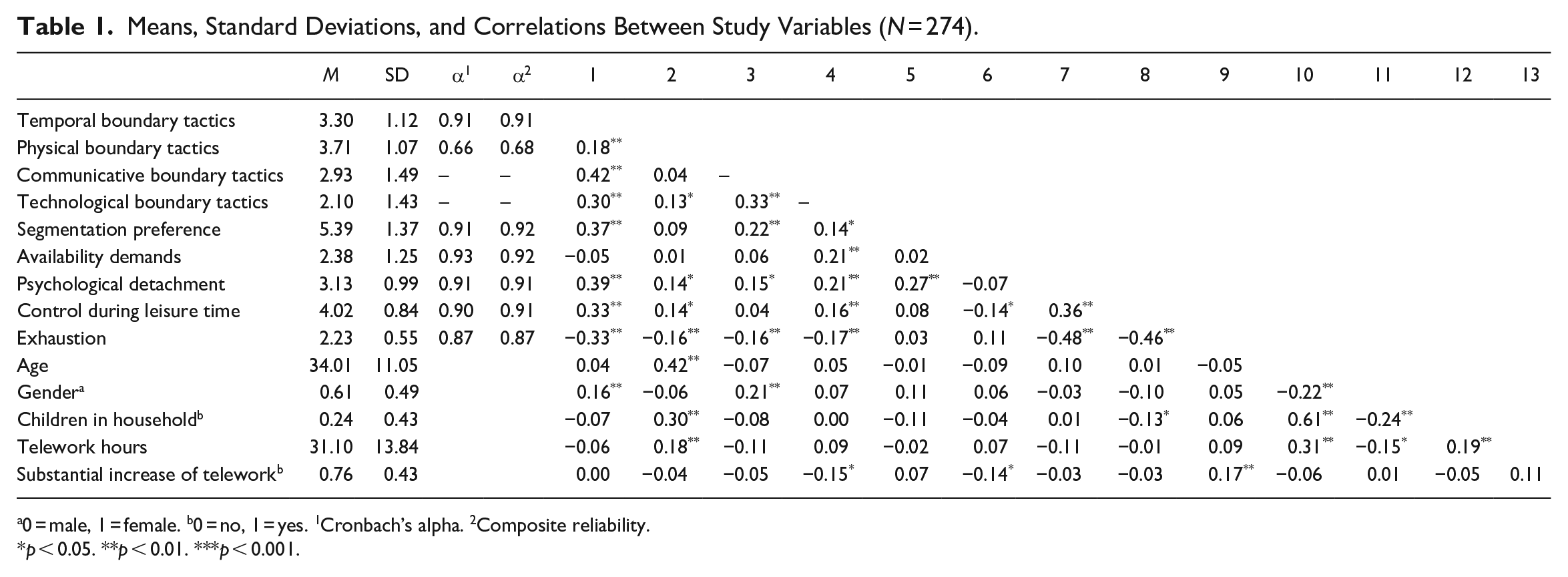
0 = male, 1 = female. b0 = no, 1 = yes. 1Cronbach’s alpha. 2Composite reliability.
Boundary tactics
We assessed boundary tactics with items from the scales validated by Binnewies and colleagues (Binnewies et al., 2012, 2020). We adapted the items to refer to the context of working from home. Temporal boundary tactics and physical boundary tactics were measured with three items, respectively. Communicative and technological boundary tactics were measured with single items. All boundary tactics items are displayed in Table 2.
Boundary management items and factor loadings.

p < 0.001.
To test whether the four boundary tactics represent distinct constructs, we performed confirmatory factor analyses using Mplus 7.3 (Muthén and Muthén, 1998). Results showed that the four-factor model had a good fit (χ2 = 37.56, df = 16, p = 0.002, CFI = 0.97, TLI = 0.95, RMSEA = 0.07, SRMR = 0.034) and a better fit than the one-factor model (Δχ2 = 138.53, Δdf = 4, p < 0.001). The fit of four-factor model was also better than the best fitting three-factor-model (Δχ2 = 16.24, Δdf = 2, p < 0.001) and the best fitting two-factor model (Δχ2 = 17.23, Δdf = 1, p < 0.001).
Recovery experiences
We measured psychological detachment from work during leisure time and control during leisure time with the respective four-item subscales of the Recovery Experience Questionnaire by Sonnentag and Fritz (2007). A sample item for psychological detachment is “During leisure time, I distanced myself from my work.” A sample item for control is “During leisure time, I determined for myself how I will spend my time.”
Exhaustion
We measured exhaustion with eight items from the Oldenburg Burnout Inventory on the four-point Likert scale ranging from 1 (totally disagree) to 4 (totally agree) (Demerouti and Nachreiner, 1998; Demerouti et al., 2001). A sample item is “After work, I tend to need more time than in the past in order to relax and feel better.”
Segmentation preference
We measured work–home segmentation preference with Kreiner’s (2006) four-item scale ranging from 1 (strongly disagree) to 7 (strongly agree). A sample item is “I don’t like work issues creeping into my home life.”
Availability demands
We assessed availability demands with four items from Dettmers et al. (2016a). A sample item is “My colleagues and subordinates expect me to be available for work outside regular working hours.”
Control variables
We controlled for age, gender, children in the household, weekly telework hours, and substantial increase in telework. To assess substantial increase in telework, we asked participants to indicate whether they currently worked significantly more from home than before on a Likert-scale ranging from 1 (significantly less work from home) to 5 (significantly more work from home). We dummy-coded substantial increase in telework with 1 if participants indicated significantly more work from home (5) and with 0 if participants indicated any other answer from significantly less work from home (1) to some more work from home (4).
Construct validity
To examine if the multi-item measures assessed represent distinct constructs, we specified a nine-factor model (temporal, physical, communicative, and technological boundary tactics, segmentation preference, availability demands, psychological detachment, control, and exhaustion) with all items loading on their respective factors. This model showed an acceptable fit (χ2 = 810.05, df = 430, p < 0.001, CFI = 0.93, TLI = 0.92, RMSEA = 0.06, SRMR = 0.05) and a better fit than a one-factor model (Δχ2 = 3312.72, Δdf = 34, p < 0.001) or six-factor model with all boundary items loading onto one factor (Δχ2 = 173.74, Δdf = 19, p < 0.001).
Results
Table 1 shows means, standard deviations, reliabilities, and intercorrelations between all study variables.
Test of hypotheses
To test our hypotheses, we ran three sets of hierarchical regression analyses with psychological detachment, control during leisure time, and exhaustion as outcomes. In Step 1, we entered age, gender, children in the household, weekly telework hours, and substantial telework increase as control variables, in Step 2, we entered the four boundary tactics, in Step 3, we entered segmentation preference and availability demands, and in Step 4a, we entered the interactions between boundary tactics and segmentation preference, and in Step 4b, we entered interactions between boundary tactics and availability demands. All results are presented in Tables 3 to 5. In cases of significant interaction terms, we illustrated the interaction pattern in Figures and examined the pattern of all interaction effects with simple slope tests (Aiken and West, 1991).
Hierarchical multiple linear regression analyses predicting psychological detachment (N = 274).
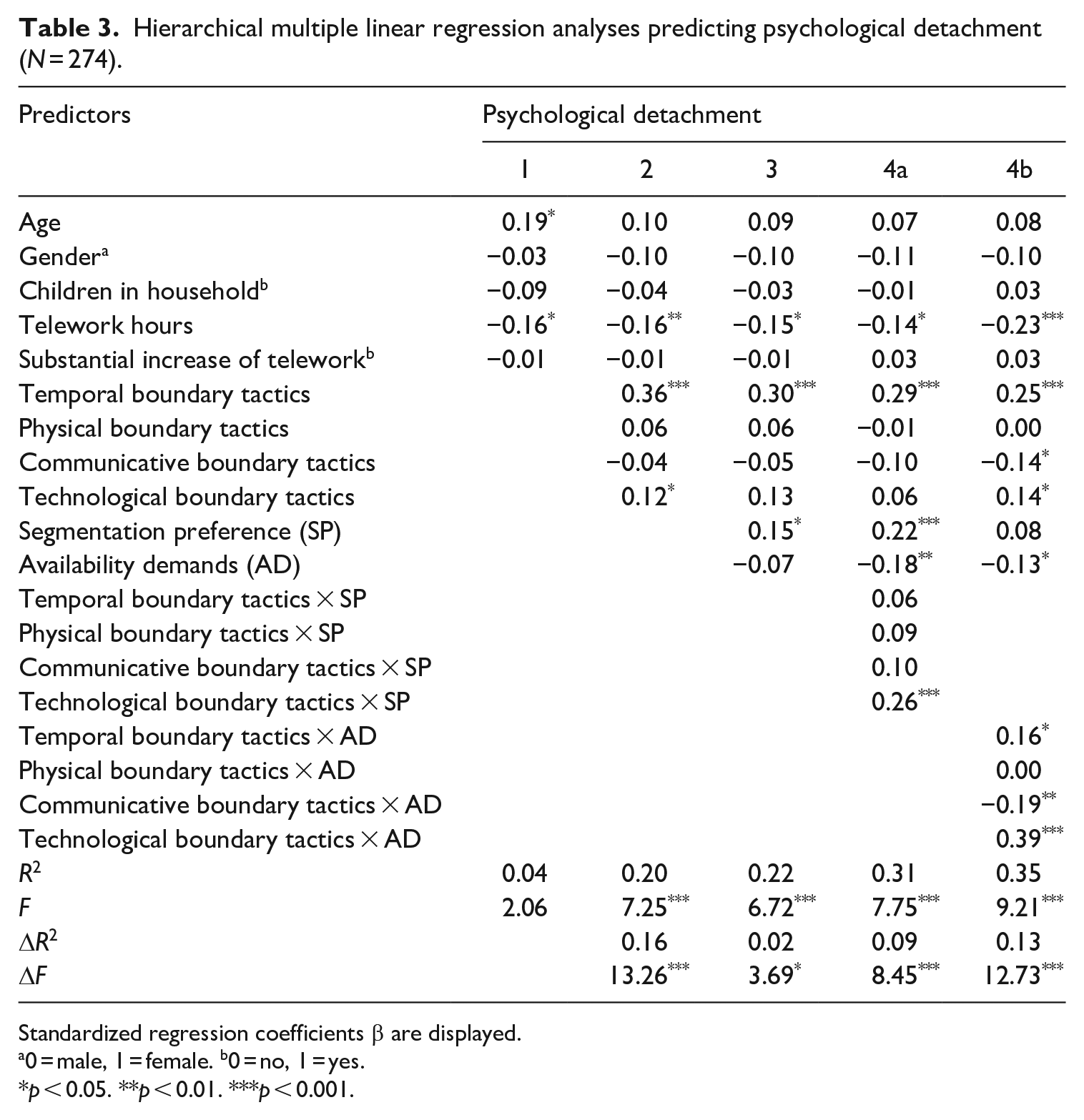
Standardized regression coefficients β are displayed.
0 = male, 1 = female. b0 = no, 1 = yes.
For psychological detachment as outcome (see Table 3), results showed that temporal and technological boundary tactics were significant positive predictors. Hence, Hypothesis 1 was supported for temporal tactics (H1a) and technological tactics (H1d), but not for physical and communicative tactics (H1b-c). Hypothesis 4 stated that segmentation preference strengthened the relations between boundary tactics and psychological detachment. Results showed that only the interaction term of segmentation preference and technological tactics was significant (see Figure 1). At low levels (one SD below the mean) of segmentation preference, technological boundary tactics were negatively related to psychological detachment (gradient of slope = −0.15, t = −2.277, p = 0.024) whereas at high levels (1 SD above the mean) of segmentation preference, technological boundary tactics were positively related to psychological detachment (gradient of slope = 0.23, t = 3.934, p < 0.001). In sum, only Hypothesis 4d received support, while Hypotheses 4a, 4b, and 4c were not supported. Hypothesis 7 stated that availability demands exacerbate the relationship between boundary tactics and psychological detachment. We found that the interaction terms between availability demands and (1) temporal, (2) communicative, and (3) technological tactics were significant predictors of psychological detachment. These interactions are illustrated in Figures 2 to 4. At high levels of availability demands, temporal and technological boundary tactics were positively associated with psychological detachment (temporal tactics: gradient of slope = 0.35, t = 3.652, p < 0.001; technological tactics: gradient of slope = 0.32, t = 4.684, p < 0.001) while at low levels of availability demands, temporal tactics were unrelated (gradient of slope = 0.09, t = 1.234, p = 0.218) and technological tactics negatively related (gradient of slope = −0.13, t = −2.599, p = 0.010) to psychological detachment. Communicative tactics were unrelated to psychological detachment (gradient of slope = 0.03, t = 0.526, p = 0.599) when availability demands were low, but negatively related to psychological detachment (gradient of slope = −0.21, t = −3.236, p = 0.001) when availability demands were high. As this interaction pattern is not consistent with our prediction, Hypothesis 7c was not supported. In sum, Hypotheses 7a and 7d were supported while Hypotheses 7b and 7c received no support.

Interaction effect between technological boundary tactics and segmentation preference on psychological detachment.
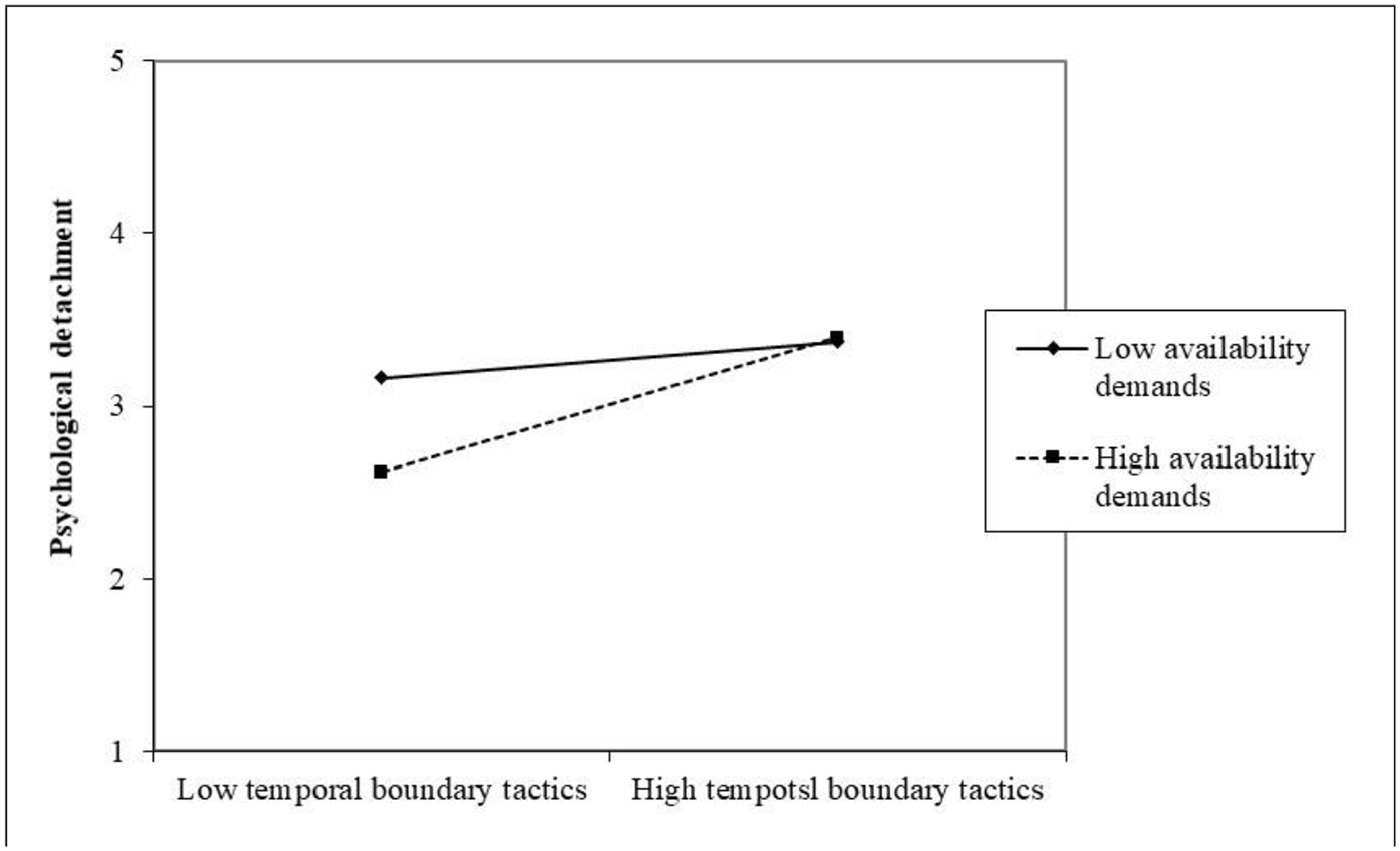
Interaction effect between temporal boundary tactics and availability demands on psychological detachment.
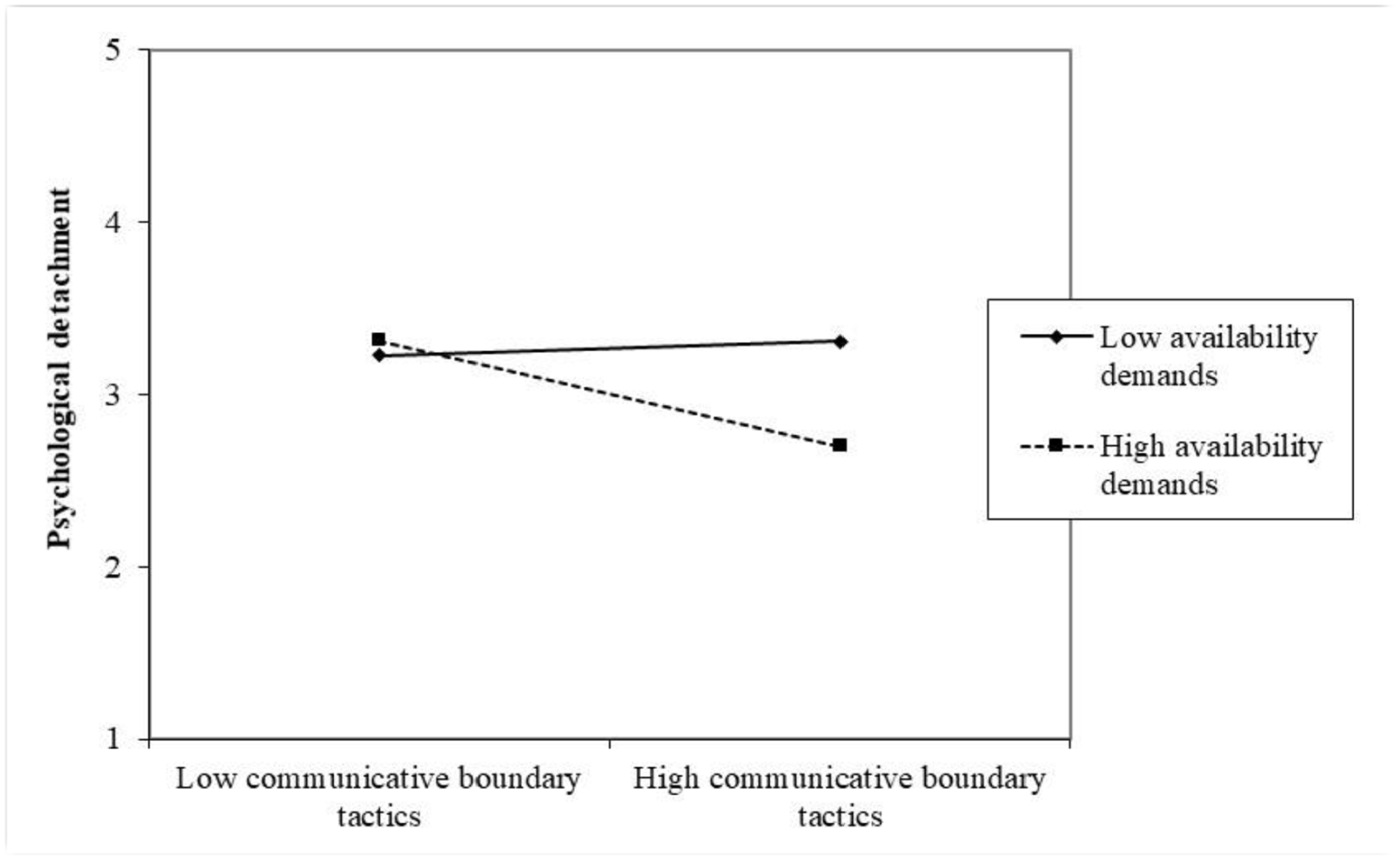
Interaction effect between communicative boundary tactics and availability demands on psychological detachment.
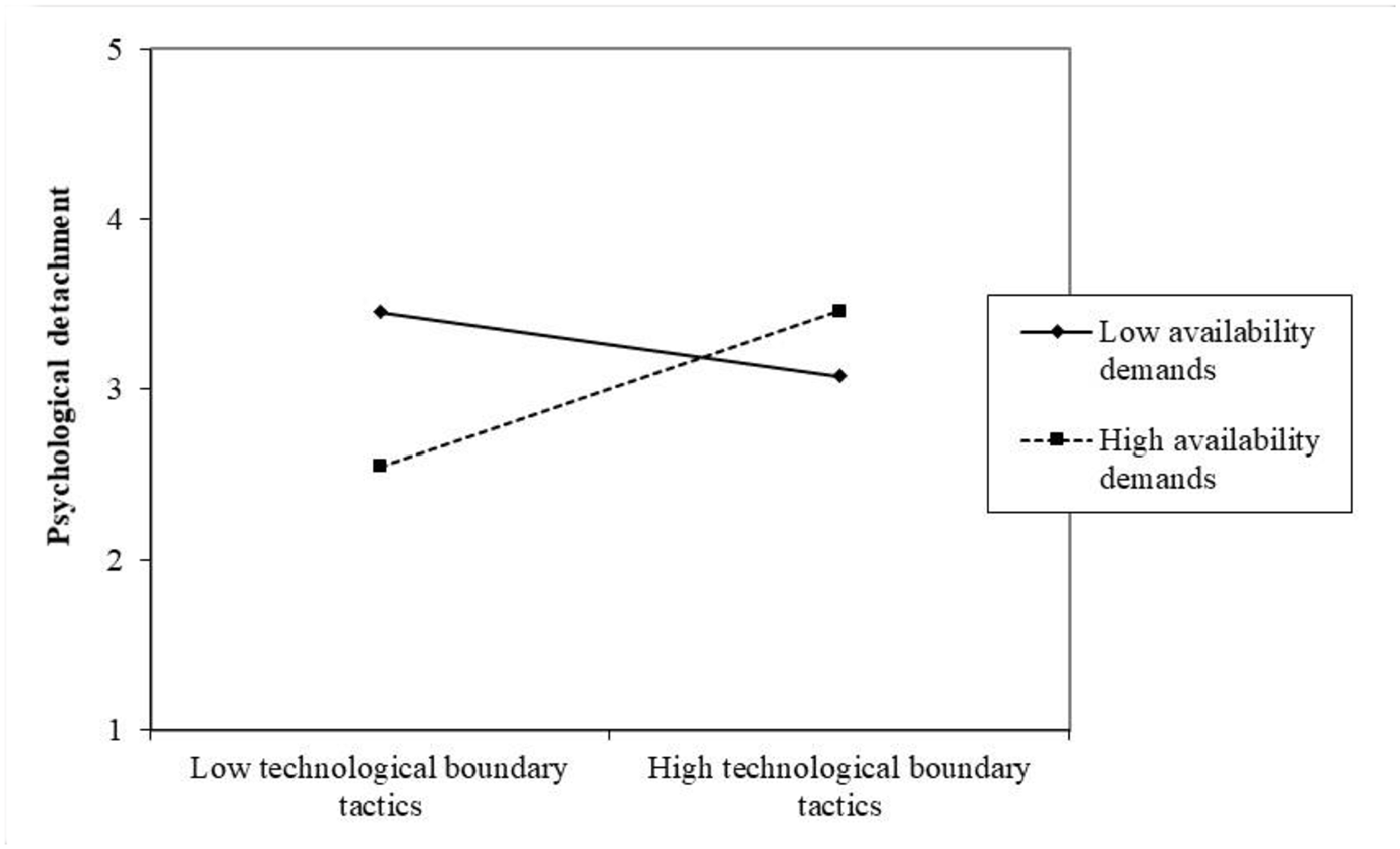
Interaction effect between technological boundary tactics and availability demands on psychological detachment.
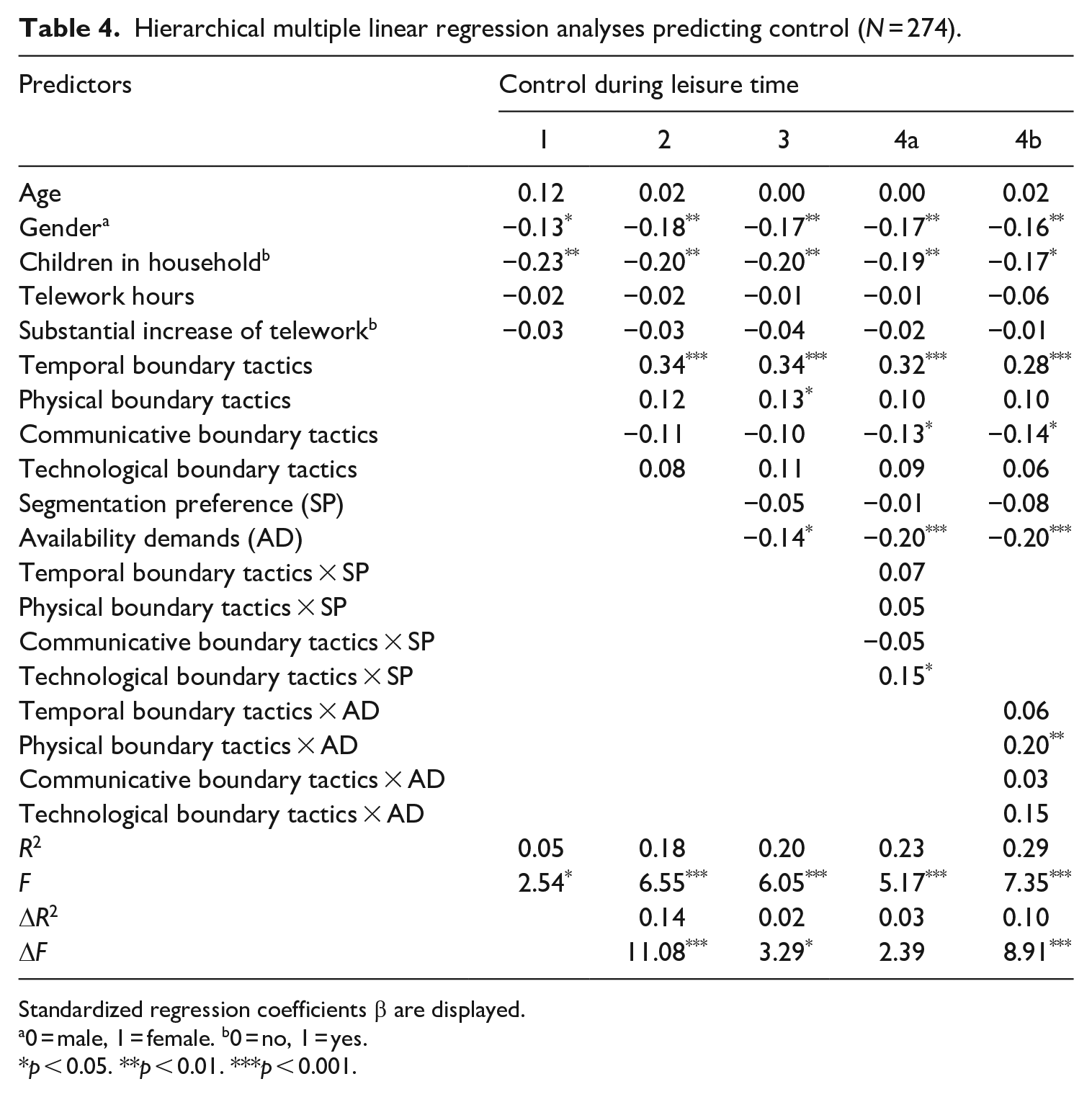
For control during leisure time as outcome (see Table 4), we found that only temporal tactics were a positive predictor supporting Hypothesis 2a. Hypotheses 2b, 2c, and 2d were not supported as physical, communicative, and technological tactics were not related to control. Regarding interaction effects, we only found the interaction between segmentation preference and technological tactics to be a significant predictor of control. The interaction pattern is displayed in Figure 5. When segmentation preference was low, technological tactics were unrelated to control (gradient of slope = −0.04, t = −0.651, p = 0.516) while they were positively associated with control when segmentation preference was high (gradient of slope = 0.15, t = 2.810, p = 0.005). Hence, Hypothesis 5d was supported while Hypotheses 5a, 5b, and 5c did not receive support.
Hierarchical multiple linear regression analyses predicting control (N = 274).
Standardized regression coefficients β are displayed.
0 = male, 1 = female. b0 = no, 1 = yes.

Interaction effect between technological boundary tactics and segmentation preference on control during leisure time.
When availability demands were high, physical boundary tactics were positively associated with control during leisure time (gradient of slope = −0.24, t = 3.388, p = 0.001) while they were not associated with control when availability demands were low (gradient of slope = −0.09, t = −1.317, p = 0.189), supporting Hypothesis 8b. The interaction pattern is displayed in Figure 6. Availability demands did not moderate the relations between the other boundary tactics and control. Hence, Hypotheses 8a, 8c, and 8d did not receive support.
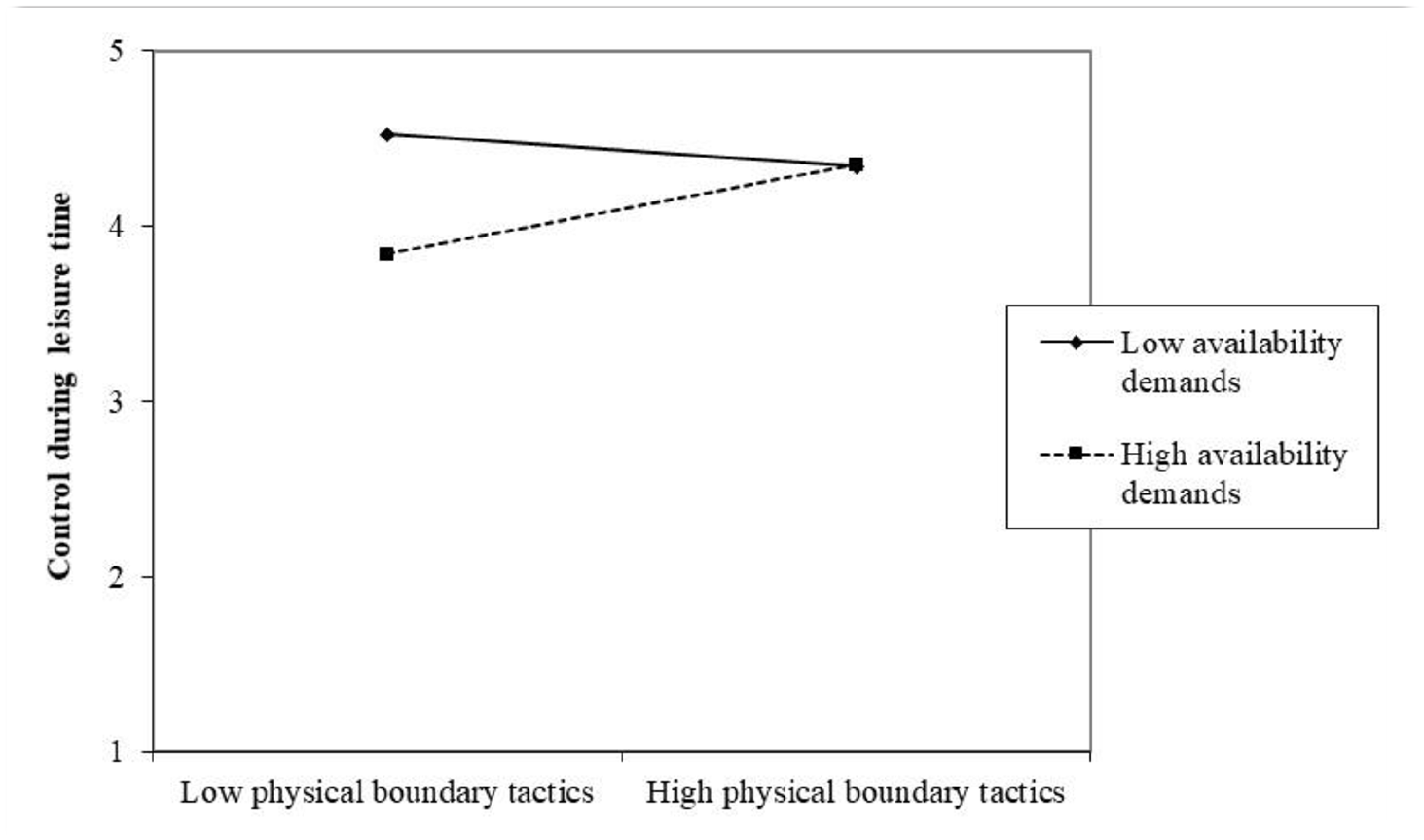
Interaction effect between physical boundary tactics and availability demands on control during leisure time.
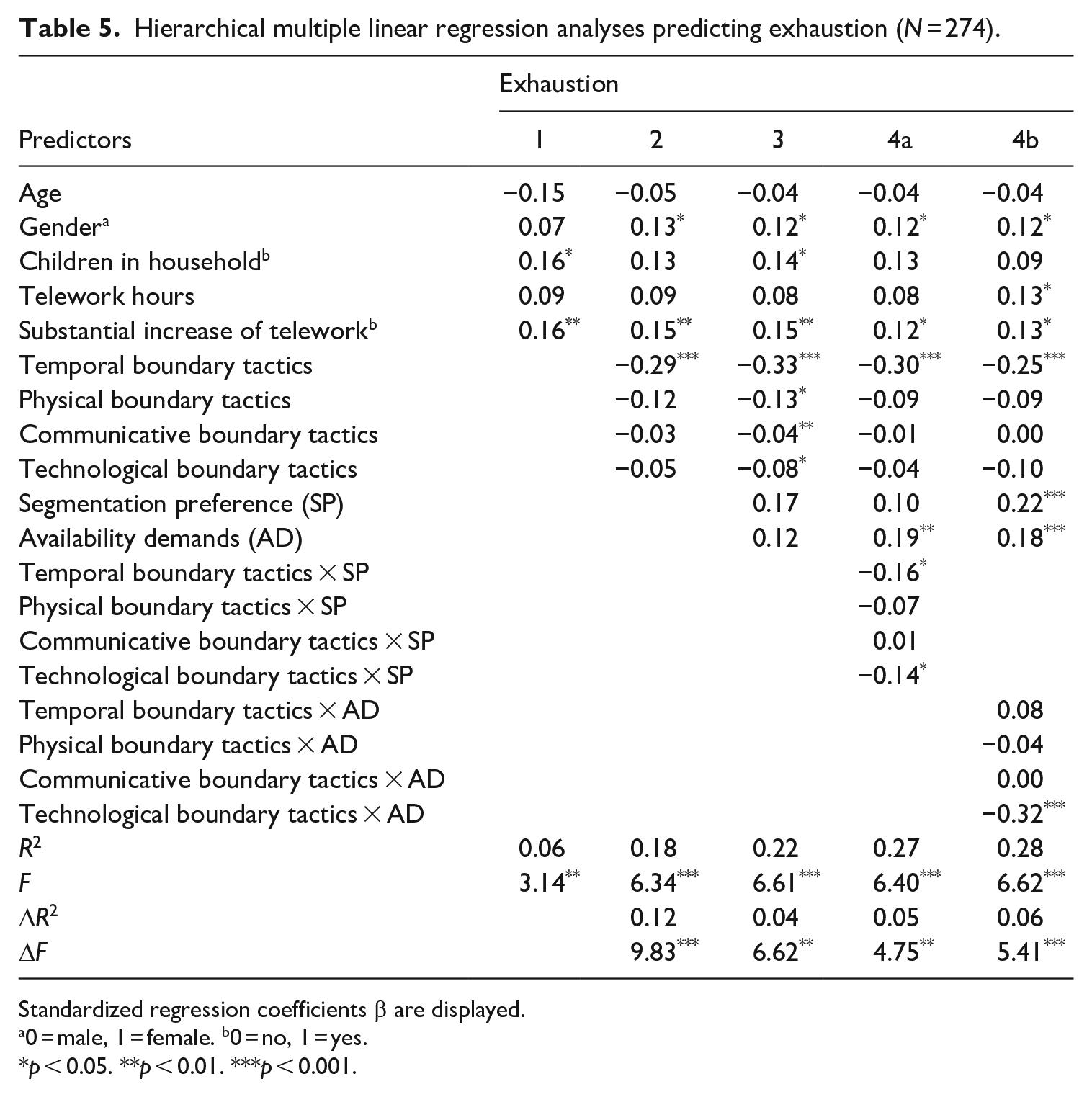
For exhaustion as outcome (see Table 5), results showed only a significant negative relation between temporal boundary tactics and exhaustion supporting Hypothesis 3a. Hypotheses 3b, 3c, and 3d were not supported. Hypotheses 6 and 9 stated that segmentation preference and availability demands strengthen the relations between boundary tactics and exhaustion. Results showed that the interaction terms of segmentation preference and (1) temporal tactics and (2) technological tactics, as well as between availability demands and technological tactics were significant predictors of psychological detachment.
Hierarchical multiple linear regression analyses predicting exhaustion (N = 274).
Standardized regression coefficients β are displayed.
0 = male, 1 = female. b0 = no, 1 = yes.
Temporal tactics were negatively associated with exhaustion when segmentation preference was high (gradient of slope = −0.23, t = −10.050, p < 0.001). Temporal tactics were also negatively associated with exhaustion when segmentation preference was low (gradient of slope = −0.07, t = −2.069, p = 0.040), but the association was weaker, providing support for Hypothesis 6a. At low levels of segmentation preference, technological boundary tactics were unrelated to exhaustion (gradient of slope = 0.04, t = 1.043, p = 0.298) whereas at high levels of segmentation preference, technological boundary tactics were negatively related to exhaustion (gradient of slope = −0.07, t = −2.181, p 0.030), supporting Hypothesis 6d. Figures 7 and 8 illustrate the interaction patterns. When availability demands were low, technological boundary tactics were positively related to exhaustion (gradient of slope = 0.06, t = 2.045, p = 0.042) while they were negatively related when availability demands were high (gradient of slope = −0.141, t = −3.430, p = 0.001), supporting Hypothesis 9d. This interaction pattern is displayed in Figure 9. Hypotheses 9a–c received no support.

Interaction effect between temporal boundary tactics and segmentation preference on exhaustion.
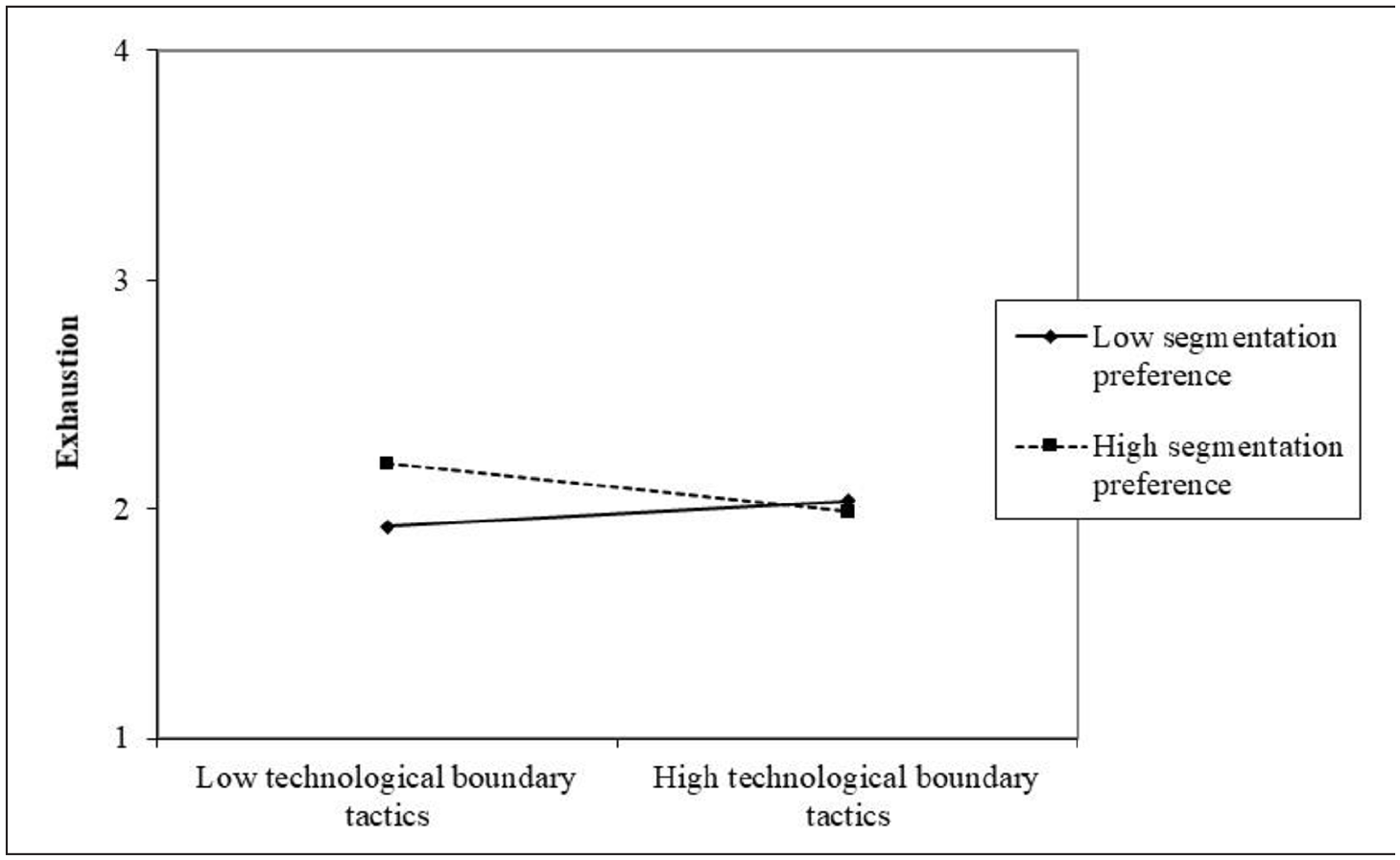
Interaction effect between technological boundary tactics and segmentation preference on exhaustion.

Interaction effect between technological boundary tactics and availability demands on exhaustion.
Discussion
This study examined the role of work-home boundary management in teleworkers’ recovery. Specifically, we investigated the interplay of teleworkers’ boundary enactments (i.e. their boundary tactics), their segmentations preference, and availability demands as environmental boundary influences. We found that temporal boundary tactics were associated with increased psychological detachment and control, and with reduced exhaustion and technological boundary tactics were associated with increased psychological detachment. Teleworkers’ segmentation preference and availability demands moderated some of the relations between boundary tactics and recovery indicators. Generally, the relations were stronger when employees preferred strong boundaries and when they experienced high availability demands.
Theoretical implications
By bringing telework and recovery literatures together, we enrich both literatures. In telework research, recovery processes have not been considered despite their importance for employee health and well-being (Sonnentag et al., 2017; Steed et al., 2021). Similarly, knowledge about recovery processes in the non-standard work arrangements such as telework is limited (Sonnentag et al., 2017). Consistent with predictions derived from the effort-recovery model (Meijman and Mulder, 1998), we found that teleworkers’ temporal boundary tactics were positively associated with recovery experiences and negatively associated with exhaustion. As recovery can occur only when employees are no longer confronted with job demands (Meijman and Mulder, 1998), using boundary tactics ensures that job demands are no longer present and do not intrude employees’ home lives—thereby allowing recovery to occur. Our findings are in line with previous empirical research with non-teleworking samples that supported the notion that work–home segmentation aids recovery (e.g. Hahn and Dormann, 2013; Kinnunen et al., 2016; Park et al., 2011; Wepfer et al., 2018).
We also contribute to boundary literature as we differentiate between specific boundary tactics. Previous research either only used general segmenting behaviors and did not conceptually and/or empirically distinguish between different tactics (Hecht and Allen, 2009; Wepfer et al., 2018) or focused on one or two tactics (Park et al., 2011, 2020; Sonnentag et al., 2010), which does not allow to comprehensively assess and compare the relevance of different boundary management tactics. However, understanding which tactics are most important is necessary for individuals to make informed choices about how to create boundaries between work and home life most effectively. Building on the qualitative work of Kreiner et al. (2009) and the initial quantitative findings of Binnewies et al. (2020), we examined boundary tactics in the special context of telework (cf. Allen et al., 2021; Basile and Beauregard, 2016; Fonner and Stache, 2012; Golden, 2021) and found differential relations between boundary tactics and recovery indicators. Temporal tactics were consistently the strongest predictor of recovery experiences and exhaustion. Setting times for leisure and planning for off-job activities ensures that employees do have enough time and opportunities for recovery.
Technological boundary tactics were positively associated with psychological detachment and this association was stronger under conditions of either high availability demands or high segmentation preference. For control and reduced exhaustion there was only a positive association with technological boundary tactics when segmentation preference was high. Additionally, technological boundary tactics were positively associated with reduced exhaustion when availability demands were high, whereas this association was negative when availability demands were low. Contrary to our expectations, physical and communicative tactics were mostly unrelated to recovery experiences and exhaustion when testing all boundary tactics together in one model. However, the bivariate correlations between physical and communicative tactics on the one hand and recovery experiences and exhaustion were mostly significant. Using physical and communicative tactics requires individuals to have temporal boundaries. For example, people need to have their work and non-work times clear in order to communicate them to other people or to know when to put away their work-related utensils. Thus, controlling for temporal boundary tactics might have rendered the associations between physical and communicative tactics and recovery indicators insignificant.
Interestingly, in our sample, technological and communicative tactics were used to a lesser extent than temporal and physical tactics. This pattern mirrors findings from Fonner and Stache (2012) and Allen et al. (2021) who found that communicative tactics were the least used type of tactics in their sample of teleworkers before and during the COVID-19 pandemic. This pattern might also point to the possibility that employees predominantly use temporal and physical boundary tactics and only reluctantly recur to communicative tactics when they begin to suffer from frequent work–home boundary violations (cf. Golden, 2021).
Moreover, our study contributes to boundary management literature by identifying boundary conditions of effective use of differential boundary tactics. Our findings help to add precision to boundary theory. The moderating roles of segmentation preference and availability demands for the relationships between boundary tactics and recovery were partly supported. The general pattern supports the notion that using boundary tactics is particularly beneficial when strong boundaries are either needed or wanted. Specifically, our moderator analyses suggest that technological boundary tactics were particularly beneficial to employees’ psychological detachment and only beneficial to control and exhaustion when employees had strong segmentation preferences or experienced high availability demands. This might imply that technological tactics unfold their beneficial effects for employees’ recovery when strong boundaries are either needed (e.g. because availability demands blur boundaries) or wanted (e.g. because it corresponds to individuals’ preferences).
Unexpectedly, when teleworkers’ availability demands were low, the use of technological boundary tactics was associated with reduced psychological detachment and with increased exhaustion. Similarly, when teleworkers’ segmentation preference was low, using technological boundary tactics was associated with reduced psychological detachment. These results suggest that using technologies to erect work–home boundaries might hurt teleworkers’ recovery when strong boundaries are not needed (i.e. when availability demands are low) or wanted (i.e. when segmentation preference is low). The use of technological strategies may require some effort (e.g. disenabling emails messages, logging off certain software applications, changing set-ups, etc.) and hence put additional demands on teleworkers. This should be particularly true for new teleworkers who may yet have to adapt to new routines and procedures (Waizenegger et al., 2020). When teleworkers become more routinized in using technological boundary tactics, their negative effects on recovery might disappear. However, the causal direction could be reversed here. People with low availability demands or a low segmentation preference who have no difficulty switching off from work or do not feel exhausted, might not see the necessity to use technological tactics—in addition to other boundary tactics. Consequently, they would only recur to using technological boundary tactics when they are unable to detach from work or already feel exhausted. Future research is needed to establish causal directions and investigate potential changes over time when teleworkers become more routinized.
Moreover, we found that when availability demands were high, communicative tactics were negatively associated with psychological detachment. This finding corresponds to findings of Binnewies et al. (2020) who found communicative tactics to be a positive predictor of exhaustion. These authors speculated that this finding may indicate that employees start using communicative tactics only when they are exhausted. Accordingly, in our study, employees may only start to talk to other people about their boundaries when they feel that their boundaries are frequently violated, that is when availability demands are high. In this case, communicative boundary tactics could be the emotionally-charged results of social conflicts—and thus be a stressor themselves.
Limitations and implications for future research
The cross-sectional nature of our study prevents us from drawing definite causal conclusions. As mentioned earlier, it might be the case that recovery influences one’s boundary tactics under some circumstances. Although longitudinal and (quasi)experimental intervention research support the notion that segmenting work and home leads to better recovery experiences and outcomes (Binnewies et al., 2020; Kinnunen et al., 2017; Rexroth et al., 2016), there might be cases when the causal direction is reversed. Thus, we encourage researchers to use longitudinal and experimental research designs to establish the causal directions between boundary tactics and recovery experiences and outcomes under different circumstances (e.g. high vs low availability demands).
As we relied exclusively on self-report measures, common method variance might have inflated associations, although common method variance is less of a problem in models using many independent variables, especially when these variables are not highly correlated as this was the case in our study, and when testing interaction effects (Siemsen et al., 2010).
Nevertheless, future research could use reports of partners and co-workers to evaluate employees’ recovery and boundary tactics (cf. Sonnentag et al., 2010), time-separated measurements of predictors and outcomes or apply statistical techniques such as the instrumental variable approach to alleviate concerns about common method variance (Podsakoff et al., 2012). Further, as we assessed communicative and technological tactics with single items, future research should also include multiple-item scales to tap communicative and technological boundary tactics more comprehensively.
In our study, we focused on the effects of various boundary tactics independently using a variable-centered approach, neglecting the possibility that the simultaneous and complementary use of several tactics or specific combinations of tactics may be most effective (Golden, 2021). Future research may use a person-centered approach to evaluate whether employees apply combinations of boundary tactics in order to gain insight into the existence of specific boundary management profiles (Wang and Hanges, 2011).
Finally, our data collection took place in a lockdown period during the COVID-19 pandemic. This situation differs from traditional telework arrangements in various aspects (Carillo et al., 2021; Kniffin et al., 2021; Waizenegger et al., 2020): Employees were forced to telework, were not well-equipped for working from home due to the abrupt change. Accordingly, this new work situation was stressful per se and accompanied by heightened home demands (e.g. taking care of young children while teleworking) and reduced recovery opportunities (e.g. due to stay-home orders), which all might have influenced employees’ recovery. As such, the generalizability of our results may be limited, and our findings should be replicated under post-pandemic conditions. Further, due to the special pandemic situation, our sample mainly consisted of new teleworkers or workers with only limited previous telework experience who did not voluntarily chose to telework and who were all confronted with new work-from-home demands (Waizenegger et al., 2020). Thus, the conclusions of our study best apply to people who are new to the challenges of teleworking and may have not freely chosen to telework (e.g. due to an organizational policy change; Lapierre et al., 2016). Because teleworkers might develop and adapt their boundary tactics over time (Golden, 2021), future research should use longitudinal designs to track changes in the use of boundary tactics over time. Moreover, future studies should check whether involuntary teleworkers and teleworkers by choice differ in the adoption of boundary tactics.
Practical implications
As our results highlight the importance of temporal boundary tactics for teleworkers’ recovery, teleworkers should be encouraged to deliberately plan and set their work and leisure times. Moreover, particularly teleworkers with high segmentation preferences and availability demands should be encouraged to use technological boundary tactics and set up a designated work area when working from home. Given that not all teleworkers can turn a spare room into a separated office room to be able to close the door behind when leaving work, teleworkers nevertheless should make sure to put work-related utensils away or behind a curtain to get work “out of sight, out of mind.” The use of technological tactics might involve making sure to “log-off” after work hours and closing software that signals that they are available to others (Golden, 2021).
Employers should support teleworkers in developing and using boundary tactics. Following our results, this might especially be meaningful if workers are confronted with new work-from-home demands because this implies that boundaries must be defined or at least reviewed, so that they can be effectively defended if required. Employers may educate employees about the effective use of boundary tactics and offer interventions. Such interventions may be offered as part of broader training programs preparing employees for the challenges of telework or may be included in broader recovery and stress management interventions (e.g. Hahn et al., 2011; Karabinski et al., 2021) as part of occupational health-promotion programs. Previous research evidenced that both face-to-face and self-taught (online) interventions were able to increase participants’ boundary management, recovery, and well-being outcomes (Binnewies et al., 2020; Karabinski et al., 2021; Michel et al., 2014; Rexroth et al., 2016, 2017).
Moreover, supervisors should discuss the use of boundary tactics with their teleworking subordinates and encourage them to use these boundary tactics. Given that supervisors are role models for employees’ boundary management (Koch and Binnewies, 2015), they should be encouraged and trained to use boundary tactics themselves and thereby lead by example. Relatedly, as work group norms regarding boundary management influence employees’ work–home segmentation (Palm et al., 2020), team members might be encouraged to share their best practices regarding the effective use of boundary tactics.
Educating teleworkers about the use of boundary tactics might be particularly necessary for new teleworkers, especially if they are forced into teleworking as it happened during COVID-19 in order to adhere to social distancing orders. As such a forced telework does not necessarily fit people’s segmentation preferences, learning how to use boundary tactics should be particularly beneficial. Similarly, for teleworkers working in jobs with high availability demands, participating in boundary management interventions might be particularly effective in line with organizations’ goal that employees be sustainably productive while working from home.
