



Abstract
In the case of China, creativity as a new type of cultural capital was the product of Chinese society’s acceptance of the western influence on the concept of culture. The motivating power of its formation was closely related to the construction of new identities of social groups. The equalization effect and distinction effect of creativity show the groups’ different opinions from internal and external perspectives; the proposition of equality in culture should be understood as a true but local role. In addition, case studies about creativity present another kind of formation of cultural capital contents and another way of accessing cultural capital: all kinds of social forces jointly participate in the construction of cultural capital in the process of interaction, identifying the capital value and occupying the capital through diverse interpretations.
Introduction
This study attempts to understand the relationship between the equalization effect and the distinction effect of culture from the angle of the formation of cultural capital. The exploration of this issue is based on the criticism and extension of the cultural capital theory proposed by Pierre Bourdieu. Bourdieu pointed out that the dominant class passes on its standards of cultural values to other classes as a way of assigning and determining social privileges and assuring that society continues to recognize the legitimacy of its authority to do so (Bourdieu, 1984, 2003; Bourdieu & Passeron, 2002). Therefore, culture is a form of capital that can help people gain and embody social status. In the process, particular types of personality, ability, and mental temperament reflecting the ideology of the dominant class may be internalized by members of society in a process that promotes even further the consecutive reproduction of the unequal class structure (Bourdieu, 2003; Bourdieu & Passeron, 2002). But it seems to me that many cultural forms, such as writing, art, and education, are more likely to advocate egalitarianism. What then is the relationship between the idea of equality that these forms emphasize and the reproduction of the hierarchical structure as a form of capital? Bourdieu regarded concepts such as equality and freedom, which are claimed by the cultural form itself, as false non-utilitarianism and superficial pureness that hide the fact that culture is a form of capital in itself (Bourdieu, 2003). The pure aesthetic standards based on Kant’s aesthetics have characterized nonutilitarian arts as a sacred and pure field. This is an artistic mechanism generated by a certain historic and social context that separates elegant culture from pop culture and provides a basis for the social hierarchical structure on which the elites stand opposed to the common public (Bourdieu, 1984). Consequently, the pureness is not detached from utilitarianism as it has alleged to have been while it covertly performs its social-division function.
This article makes a counter argument against Bourdieu’s above statement. Nonutilitarianism in a culture may seem to be false and specious, but many studies have shown that transitions in culture play an important role in changing social structures. Moreover, modernization has made the entire social-class structure more equal and more democratic (Darnton, 2012; Delanty & Isin, 2009; Habermas, 1999; Tocqueville, 2012). If we consider only the enhancement of culture by the social hierarchy but neglect the impact of culture on that hierarchy, we cannot fully understand the relationship between culture and society. In addition, ignoring cultural content is not conducive to promoting social equality and democracy. The notion that the idea of cultural content itself is belittled in this theory not only originated from the basic perspectives of social domination and unequal order explored by Bourdieu, but also from a problem analyzed by many scholars (Hall & Neitz, 2002; Lamont, 1992; Smith, 2008; Zhu, 2006). The problem of Bourdieu’s analysis of culture is that it was based on a relatively stable class structure, and he therefore emphasizes the reproduction of a hierarchical system with a strong sense of determinism. However, analysis of changes in the content of cultural capital and cultural propositions of equality in social changes are not entirely appropriate. When the elite and non-elite classes are in conflict or the entire class structure encounters major changes, how is the content of a new type of cultural capital formed, and what is the relationship between equalization and distinction?
Bourdieu stressed the function of the elite class and their dominating power in the formation of cultural capital. He believed that the elite group determines which type of culture has value and which type does not. Therefore, high culture constitutes the primary part of cultural capital, and by defining the content of cultural capital, the elite group can maintain the value of its knowledge and abilities to ensure their lasting authority (Bourdieu, 1984). Thus in the transmission of cultural capital, the habits of the ruling class, will influence the individual habits and behaviors of members in all social classes by means of media such as educational institutions, and as a consequence the unequal social structure will be further reproduced (Bourdieu & Passeron, 2002).
However, the content of cultural capital changes with time and space, and high culture does not always represent the nature of capital. For instance, Michele Lamont noted the differences between American and French cultural capital. The latter is often associated with high-level art forms. However, advanced culture in American society is not viewed as favorably because people tend to gain identity and form valuable interpersonal contacts and social bonds through participation in sports or popular culture (Lamont, 1992). Halle’s research also shows that in American society a clear correlation cannot be found between a preference for art or high culture and entry into or continual membership in the ruling class (Crane, 2006; Halle, 1989). Y. G. Chen (1995) noted that reading books and studying culture have different meanings in different historical periods of China and that these variations over time cannot be explained solely by changes in the ruling class. This means that Bourdieu’s theoretical model focusing on elite strength is too simple in that it interprets cultural capital as the result of one-way dissemination by the elite class. However, as claimed in cultural acceptance theory (Smith, 2008), there are no completely passive receivers. The non-elite class will demonstrate its volition and initiative, and the dissemination of culture should be understood as an interactive process.
This study examines how a new type of cultural object is constructed and given value that, in the social transition, leads to the acquisition of social capital. Attention will be given to the manner in which capital value is obtained from the cultural object through recognition and consensus so as to explain the relationship between the equality principle of the cultural object and the different effects of cultural capital. DiMaggio’s cultural mobility theory states that lower-class children can gain cultural capital and achieve upward mobility (DiMaggio, 1982) and points out that cultural capital may allow this movement within social structures. In contrast, this article will focus on equality asserted by culture itself and the coexisting effects of hierarchy via the process of capitalization.
David Swartz (2006) stated that Bourdieu used the word capital to indicate that culture can become a source of power. In this article, however, we use the term capitalization to mean a process by which cultural content can be exchanged with other symbolic meanings and social resources so as to realize differentiation and hierarchicalization among different owners. When we see cultural capital as a product of cultural communications and social interactions rather than as the consequence of one-way decisions of the dominant class, we find that obtaining common social recognition as a valuable object is a prerequisite for the capitalization of new cultural content. To understand the process of capitalization, this study focuses on the means by which a cultural value becomes widely recognized across social classes and whether it is determined by the elite class, as Bourdieu claimed.
The rise of creativity in modern Chinese society
The case adopted for this article is the rise of creativity in China in the first half of the 20th century. Its basic meaning includes creative spirit and creative ability. Creativity is one of the embodiment contents of cultural capital listed by Bourdieu (1984) and is used as a representative case for two reasons. First, creativity is one of the elements of cultural capital that arose during the process of modernization in Chinese society. The meaning of creativity in ancient China was similar to the meaning in modern society, but it was not commonly used. Little attention was paid to this value in traditional Chinese culture and ideology (Z. L. Liu, 2001). In the first half of the 20th century, a series of western ideologies, including the thought of creativity, were introduced to China where the concept of creativity was highly valued and praised during the New Culture Movement (Gao, 1999). Furthermore, creative ability has become an important goal and standard of competition in politics, economics, and education. Because creativity in China is a part of the cultural capital formed during modernization, it provides an instructive case that helps in studying the emergence and variation of cultural capital content.
In the meantime, creativity has connotations that are obviously different from the distinction function of hierarchy. The concept of creativity changed in the West with the goal of removing the cultural gap between the classes and with the idea that creativity is not simply the privilege of the aristocracy and that everyone can become creators of culture and create it equally in the culture evolution process (Z. L. Liu, 2001; Williams, 2005). In China, the concept of creativity upheld by thinkers and reformers also concentrated on equality and the elimination of class barriers when the western view of creativity was introduced (C. Liu, 2011a, 2012). However, the concept of eliminating class differences conflicted with the reproduction of social order as a means of creating cultural capital. How was this contradiction formed in the discussion and propagation of mass media in the public space? The discourse on the value of creativity can provide a typical case for us to understand its development from a cultural object to cultural capital.
Previous scholars who studied the rise of creativity considered it to be one of the factors of individual liberation. They treated creativity as a concept that echoes other modern ideas, such as freedom and democracy, and believed that it provides the motivation and basis for individuals to get rid of the constraints of Chinese traditional ethical relationships (Gao, 2006; Wu, 2009). In addition, other studies have demonstrated that the cultural elites of China introduced western thoughts and proposed the importance of creativity in individual liberation with the intention of forming organizations in Chinese society and constituting an alliance between modern intellectuals and the common people (C. Liu, 2011a, 2011b). These studies mainly discussed the ideas and proposals of cultural elites in the New Culture Movement of the 1910s and 1920s. From the perspective of the formation of cultural capital, they presented the idea of creativity as a cultural object and did not show its development as a form of social capital with widespread social recognition as well as the ability to change and enhance other resources, and enhance one’s position in the social hierarchy. Consequently, this article tries to reveal the understanding and application of the word and its meaning in public discourse, and to disclose the generative capitalization process of creativity in modern Chinese society.
Statistics and classification of text data
Discussions of creativity in Chinese newspapers and journals in the first half of the 20th century were examined to study the formation of capital value in public space. The analytical methodology applied is holistic-content reading of the narrative analysis, focusing on the content of narration and the induction of main points and themes (Lieblich, Tuval-Mashiach, & Zilber, 2008). The analysis will observe how the term creativity is used, identify the basis of its value, and examine the means by which it has gained general recognition.
The texts examined in this study were taken mainly from the Dacheng Old Journal Full-text Database. 1 A total of 545 articles published from 1900 to 1949 were retrieved through a search for the term Chuang Zao in the titles. This Chinese term encompasses the meaning of creativity, creative, create and creation in English, and its use in the titles of articles increased gradually after 1919. Specifically, 10 to 20 articles per year employed the term during the 1930s, compared to 20 to 30 pieces per year during the 1940s, and 75 articles in 1949. This increase indicates that the concept of creativity gradually became widely used and recognized during the first half of the 20th century.
To understand the content of all 545 articles, 74 articles that discuss creativity directly were selected as targets of observation. These articles represented the connotations of creativity more clearly than the other articles and thus can be regarded as constituting the core discourse on the value construction of creativity. The remaining articles, while mentioning the concept of creativity, say little about its cultural value and were therefore eliminated from the analysis. 2
The 74 core articles can be broken up into three categories: those that advocated for individual creativity, those that evaluated the creative ability of Chinese culture, and those that promoted a political stand through the advocacy of creativity (Table 1). To avoid problems caused by the limitations of this database, the author also investigated and gathered preliminary statistics in the same manner from other newspapers and periodicals in the Republic of China. Although the number of articles differed, the overall trends of development and content composition were basically the same as those described in the 74 core articles. This increases the confidence with which to say that these core articles constitute a valid source of discourse on the way the value of creativity was constructed.
Content of articles advocating for creativity from 1919 to 1949 (N = 74).
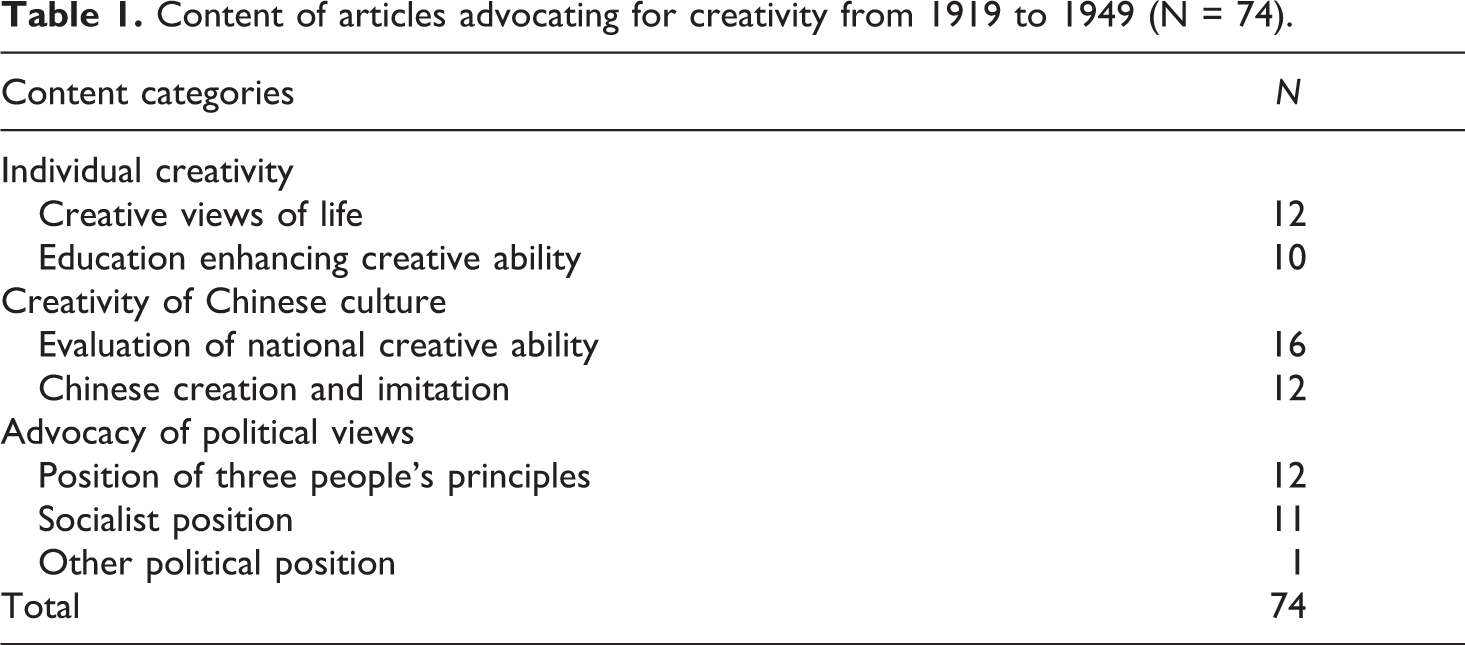
Individual creativity
Articles advocating for individual creativity appeared during the 1910s and the 1940s. As discussed below, they mainly espoused a creative view of life and the cultivation of creative ability.
Creative view of life
Many of the articles about creativity and life values argued that the content and value of life lies in creativity. They made this argument on the basis of Bergson’s theory of creative evolution (Bergson, 2013) and Russell’s theory of creative impulse (Russell, 1959). The former held that people cannot adapt to environmental changes without creation and evolution. “The only method to improve the social situation is that everyone lives a struggling and creative life” (Zong, 1919, p. 1). Therefore, “the value of life depends on creative ability” and “the most noble of humans are the ones who have the best creative ability and who consequently are the human beings who are most suited for survival” (Zhong, 1935, p. 126). Authors of the articles in this category claimed that a life devoid of creativity will be eliminated by nature and cannot exist in the world. As J. X. Li (1947) noted, “If not to create, you will become a captive of the reality. If everybody does so, the whole nation will lag behind; if every country does so, humans will experience no evolvement” (p. 2). The creativity to which these articles referred was the action of humans in social situations and stressed individual initiative in the environment. Creativity was viewed as a condition for survival and development, which indicated worries about international competition.
The articles based on Russell’s theory of social transformation encouraged the expression of creative impulses and the inhibition of possessive impulses. Therefore, creativity was regarded as a personal desire to develop one’s inner potential. Meanwhile, the satisfaction of being creative gave an individual great happiness and contributed to the development of society. The articles claimed that this benefits not only the creator but the whole society as well; being creative helps individuals identify with others. Thus promoting the will to create was considered by the authors as the best means of alleviating conflict between the individual and the group. In addition, these articles also emphasized the beneficial impact of creative impulses on social solidarity. Just as the will to create can replace rivalry and jealousy, so too can a creative spirit reduce competition and conflict in the individual’s life (Qing, 1947). Therefore, the fate of a nation can depend on “the youth’s fundamental attitude to life,” and “the purpose of life is to promote human life” (Ping, 1940, p. 10). Consequently, the creative philosophy of life was expressed as both selfish and altruistic – as a search for social welfare while at the same time developing the individual. Creativity was highly praised for its contributions to the nation and society.
The advocacy for individual creativity in the articles mentioned above centered on the progress and integration of the community. Creativity was regarded as a view of life in which both public and private interests were taken into account, and it aimed to promote close ties between the individual and the modern state.
Education enhancing creative ability
These articles called for creativity education that would improve the capacity of individuals to be creative. Creativity in these articles referred to transforming the environment to produce new things, and they made clear that creativity education is significant for national development. These articles stated that China’s future depends on the presence of creative ability, and thus the task of education is to develop national creative ability. “The particularly important question today is how to train the creative ability of our people to engage in a variety of businesses and enlighten the spirit which hasn’t been used in 2000 years to become the motive force for constructing a new country” (“Play – People’s Ability to Create,” 1933, p. 209). These articles advocated for the cultivation of creativity as a way of developing the nation. They therefore expected that creativity education would replace traditional education and bring individual abilities into full play.
Equality and democracy were considered to be the linchpins of creativity education. The articles asserted that everyone has creative talent and that creativity education liberates creativity within individuals (Tao, 1944a, 1944b), thereby realizing the goal of tolerance and educational equality between different classes. Furthermore, these articles explored methods of developing creative ability, such as identifying problems, creating plans, collecting materials, and so on (P. Y. Li, 1937). The authors believed that everyone could develop creativity with the program while at the same time stressing commitment and equality in the community. Moreover, creativity was regarded as a personal capability and a right and duty possessed by all citizens of a country. Accordingly, no palpable meanings of hierarchicalization or distinction were expressed in these explanations.
As seen from the above articles regarding the creative spirit and creativity education, the value of individual creativity was considered to be in the interests of the community, especially for the development of a modern nation. The advocacy for creativity focused on the noncompetitive enterprising spirit, emphasizing unity and equality. It aimed at shaping a new type of “individual in the group” in modern Chinese society so as to meet the requirements of national development. Therefore, creativity should be understood as a kind of individual virtue that, from the perspective of the modern community, emphasizes a commitment to one’s community rather than the simple need to realize individual freedom and liberation.
Constructing the value of creativity in the cultural field
Articles about creativity in the cultural field focused on two themes. One deals with the evaluation of creativity in the Chinese culture. The second focuses on the means by which Chinese culture was created.
Evaluating creativity in the Chinese culture
The articles on this topic in the 1930s criticized the lack of creativity among the Chinese and sought to analyze the cause. The authors believed that this lack of creativity led to poverty, social chaos, and individual indolence. At the individual level, it was caused by laziness and a conservative outlook (Gu, 1937) as well as by a lack of motivation and training (“Play – people’s ability to create,” 1933). At the social level, the lack of creative spirit was, according to the articles, rooted in the great importance that traditional Chinese society placed on conforming to rules, which resulted in a fear of being different from others. Therefore, individuals could not think independently (Pearl, 1934; Lan, 1937), and innovation in Chinese history was obliterated by authoritarian political ideas and narrow thinking (Zhou, 1931). This opinion held that culture creation is a requisite for a free and equal social environment. Efforts to promote the creation of Chinese culture, according to the authors, must emphasize subjectivity, initiative, respect for others, and an inclusive attitude to diversity (Tang, 1936). These articles stated that poor creative ability among the Chinese led to national failure or backwardness in contrast to the West. Furthermore, they criticized traditional Chinese social values and political systems and sought a change in social relations. These articles showed that as a new foreign standard, creativity represented a point of comparison and reference to the West in the face of the impact of western modernization.
In contrast, however, articles published after the 1940s confirmed the creative ability of Chinese culture and called for cultural identity through creativity. They stated that “our national creative ability isn’t worse than any other nations” (Lu, 1943, p. 42), called for a “restored confidence in our creativity” (Guo, 1940, p. 2), and opposed blind acceptance of the modern western system. Moreover, many articles emphasized the uniqueness of China and argued that the undeveloped nation had a unique advantage in that it was still learning and therefore had the potential to develop a national understanding of creativity that will be unique to China (Lin, 1946) and grounded in “the national form and scientific content” (Hu, 1943, p. 8). These articles attempted to restore confidence in the creative ability of Chinese culture rather than criticize its backward creative ability. Analysis of the articles shows that creativity changed from an external standard based on western cultural progress to an internal standard of examination and reconstruction that is based in the Chinese cultural tradition.
The relationship between creation and imitation
One question about creativity discusses whether imitation is necessary for creation. Many of the articles advocated creation by imitation and learning. They stated that imitation is not necessarily copying but, rather, the basis for creation (Cao, 1939) and that creation and imitation are not contradictory. To make the argument clear, these articles used the example of Japan to show that imitation and learning can be used as a preparation for creation, and they stated that the Chinese rarely created because they viewed imitation negatively without doubt and study (YTS, 1922). The authors of these articles thought it impossible for China to create without imitation and argued that the refusal to imitate was a sign of China’s quintessential conservative consciousness (Xin, 1932). Therefore, they believed that China should imitate first and then create, abandoning “the old spirit of China with the help of western culture” (H. G. Chen, 1934, p. 2) and then trying to form creativity and “cultivate the new spirit of Chinese independence” (C. Y. Shen, 1935, p. 9). Most of these articles were published in the 1920s and 1930s. The target of imitation and learning was western culture, and creativity was referred to as a unique aspect of Chinese culture attained by learning western culture.
Another opinion held that creation is quite different from imitation and that those who would be creative must abandon imitation. These articles stated that creation is completely the opposite of imitation, that creation should be held in higher esteem than imitation, and that improvement of the creative spirit is needed to change the “mimic disease” (Gu, 1937, p. 14). What’s more, they insisted that a critical attitude should be maintained towards western culture, because from politics to food, clothing, and living, “blind imitation would lead to slavishness” (Zhang, 1935, p. 4). They believed that copying modern education after the imperial examinations deprived China of its confidence. They advocated that the future of China should lie in national creation and encouraged Chinese youth to “abandon the shameful plagiarism” and “use creative spirit to create a new China” (Qu, 1940, p. 3). Arguing that “imitating both the ancients and foreign people is intolerable” (Ren, 1943, p. 297), they advocated the creation of a Chinese style according to the actual situation of Chinese society.
Most of these articles were published after the articles that advocated for the necessity of imitation. The target of imitation was western culture while the target of creation was “the Chinese style.” Thus these two views on creation and imitation both attempted to build a modern Chinese culture that is neither completely assimilated by western culture nor constrained by Chinese traditional culture.
The change in the assessment of Chinese cultural creativity and the alteration in the views of creation and imitation occurred around the same time. They reflect changing attitudes toward tradition and western culture in Chinese society from the 1920s to the 1940s and the consequent acceptance of the value of creativity. In the earlier stage, creativity was a foreign concept that represented a criticism of traditional Chinese culture from the perspective of western ideology. Afterwards, national characteristics were confirmed according to the new explanation of creativity, which strengthened the features of Chinese culture and society as the core content. This not only met the need of constructing a modern nation for China and deepened the recognition of traditional Chinese culture, but also acknowledged the historical roots of creativity in Chinese society and the capability of this society to possess this symbolic resource. In Chinese society, the acceptance of the capital value of creativity was realized by giving new explication to creativity. In addition, the recognition and possession of this value happened simultaneously. At the same time, the value of creativity in cultural fields still lay in the developmental needs of the modern Chinese nation because creativity referred to the independence and progress of Chinese society and the search for a unique path to Chinese modernization.
The construction of creativity in the political field
After the 1940s, creativity carried with it a strong political nature. Articles in this category include those that follow the propositions of the Kuomintang (KMT) government. Other articles followed the socialist political line.
Three People’s Principles and creativity
Some articles published during this time advocated creativity as a mobilizing social force following Chiang Kai-shek’s government policies. These articles promoted and praised Chiang Kai-shek’s proposition that “the purpose of life is to improve the general life of humanity and the meaning of life is to create and sustain subsequent lives in the universe” (Duan, 1941, p. 17). In addition, creation is to “start from none,” moving in “small increments to get abundance,” and “if we want to be revolutionary fighters, we have to adopt creation as the objective” (E. D. Z., 1940). These articles used creation as a slogan to call for the national labor force to work hard and make progress. They also introduced Chiang Kai-shek’s outlook on life, advocated that it would improve social welfare conditions, and called on everyone to develop creativity as a way of serving the society. These articles show that creative subjects were the citizens of the nation, and the KMT drew on this perspective about the value of creativity to call for the people’s commitment to and identification with the KMT’s political dominance.
Creativity was also used to summarize the political purpose of the Three People’s Principles. Writers used the creative view of society to sum up the essence of the cultural movement advocated by these principles. The articles advocated that the creativity of these principles was grounded in “the criticism of the feudal culture, the discarding of capitalist culture, the disavowal of Proletarian culture” (Yan, 1934, p. 10). The important KMT official Chen Lifu also maintained that “the essence of the Three People’s Principles lies in the spirit of creation,” as can be seen in his admonishment, “don’t copy, but create everything by yourself” (L. F. Chen, 1946, p. 4). He proposed that creation and development are the greatest purposes of enterprises (L. F. Chen, 1946). In addition, the articles stressed the legitimacy of the political line held by the Three People’s Principles on the basis of individual creativity, insisting that “creativity is the embodiment of the great ability of life” and that only the Three People’s Principles can help the nation break free from foreign oppression and allow individuals to exercise their creativity (Z. Shen, 1943).
In these articles, the construction of the value of creativity and the promotion of the Three People’s Principles were combined. However, the glorification and explanation of creativity was used to enhance the people’s identification with the KMT regime and to express the autonomy and advancement of its political line.
Socialism and creativity
In the articles that used creativity to support socialist political propaganda, the creative subject changed. These articles claimed that creative power is made by creative people – the working class. This view criticized feudal and capitalist cultures while advocating the creation of a socialist culture with people as the pioneering force (Zhang, 1935). Meanwhile, the authors claimed that the history of human society is the history of working people. “The creators of the world are laborers, who are the masters of human society” (Yu, 1949a, p. 14); therefore, “the laborers are the noblest people” (Yu, 1949b, p. 13). Furthermore, these articles praised the October Revolution’s reliance on the firm alliance constituted between workers and peasants. For example, one article observed that “It’s the creativity of the masses in their tens of millions that drive the bourgeoisie landlords away” (“People Create History,” 1934, p. 15). In the past, the creative subjects were “human beings,” “the Chinese people,” and “citizens” or “youths,” but the socialist articles took the underclass, especially workers and peasants, as the creative subjects. Before and after the victory of the socialist revolution in 1949, the number of articles with the word creation in their title increased dramatically. The articles clearly claimed that people create history, and “create people’s culture” (Xu, 1949, p. 14). They also argued that the prerequisite for creativity was the success of the socialist revolution and the construction of the political system with workers and peasants as the core. These articles not only expressed an understanding of history and culture but emphasized that the laborer was in the dominant position of social and political life.
The laborers’ voices in this period as depicted in the articles presented the same proposition. “Siyun” was a worker, who argued that the purpose of life is to create and who expressed that the group is the main force for social progress (“what pushes the era ship forward is our strong force”) and the political will of social transformation (“we will…create a more reasonable society and a more robust system”) (Si, 1942, p. 87). In a transcript from a speech to the students of Northeast Workers Political University, the worker representatives argued that the world had been created by workers whose talents and contributions had been exploited and concealed in the past. “The old society cheated on us” they said, claiming that the world is created by workers’ power, not by the capitalists, God, or heroes (Northeast Workers Political University, 1949, p. 21). Therefore, in the discourse of the socialist standpoint, creativity expressed the political role of workers and peasants as well as their political sense of mission. The role of creator embodied the definition of the political status of the laborer.
In addition, creativity was also used to explain the socialist political line. Articles advocated that the socialist road was “creating socialist culture,” a process that involved “on one hand, a struggle against the old feudal culture; on the other hand, a struggle against the whole western capitalist culture which is declining, and advocacy for the new Chinese culture creation of socialism” (Zhang, 1935, p. 5). The socialist discourse showed that socialism was different from other political directions, such as western capitalism and traditional Chinese feudalism, and that creativity demonstrated the advanced nature of the proletarian revolution as well as the uniqueness and autonomy involved in choosing the socialist political path. Given the significance of creativity to the definition of political subjects and to political propaganda in socialist discourse, we can see that, as with the articles dealing with the Three People’s Principles, creativity became the key discursive strategy of the socialist political party for representing workers and peasants in their own words and on their own terms.
The description of the creative subject shows that creativity implies participation in political life and thus plays an important role. In addition to the Kuomintang propaganda and the socialist articles, other articles took a neutral position, arguing that those in the middle class were the subjects around which a new society should be created. Thus, the authors of these articles did not agree with either communism or capitalism; they claimed that the main force by which a new era would be created was the middle class rather than the bourgeoisie or the proletariat. They stated that the creation of a middle class “will make our world peaceful and happy” (Jiao, 1946, p. 7). We can see that creativity represents a political action and a political status. The definition and explanation of creativity involved a disagreement concerning which segment of society should be the leading political group among the political powers.
Creativity was also used to express the autonomy and progress of political programs. As mentioned above, both the Three People’s Principles and socialist discourse used the words creativity and creative to claim that their platform was different from existing political lines of all sorts. But creativity represented the independent and progressive exploration of the modern Chinese political path and was in line with China’s situation. Each social group was eager to assign to itself a leading role in progressive social development based on its own interpretation of creativity, and the value of the creativity claimed by each group became a common target for criticism. The connotation of hierarchicalization defining superiority or inferiority was obviously strengthened in the application of political discourse. Creativity was transformed into cultural capital that could be turned into a power resource depending on how it was interpreted.
Conclusions
Group identity and capitalization
Based on the analysis in this article, changing social structure, rather than stability or continuity, was the dominant mechanism that formed the new cultural capital facilitated by Chinese society in the first half of the 20th century. Creativity as a new type of cultural capital was the product of Chinese society’s acceptance of the western influence on this cultural concept. The motivating power behind its formation was closely related to the construction of new identities among social groups, especially within the modern Chinese nation.
The overall interests of the modern nation are the basic source of value. Given this basic power, the role of creativity includes equalization and hierarchicalization, which represent two aspects of the modern nation. Equalization seeks to promote national integration and emphasizes the connotations of universality and equality. It aims to arouse the national identity, unite all citizens, and mobilize social power. On the other hand, hierarchicalization of culture deals with international competition and emphasizes the connotations of uniqueness and progress. It aims at survival and development in the world system. In short, the former is an internal view and the latter is an external view of the modern nation.
The two perspectives of the community were further reflected in the domestic competition for political discourse. In the mobilization of the target groups, advocacy for creativity focused on equality and unity, and in the propaganda of various political stances, the explanation of creativity stressed differentiation and hierarchical meaning. Equalization and distinction are different internal and external views of the basic standpoint of community and are interconnected. As a new national identity emerged in the midst of international competition and internal political competition, egalitarianism and distinction played out a coordinated relationship. The proposition of equality in a culture represents some aspects of the community and plays a part in social change by contributing to equalization and solidarity. Therefore, equality is not hypocritical or specious, and it should be understood as a true but local role.
Common construction and diversification interpretation
It is also important to note that in terms of change in social structures, the value of creativity becomes cultural capital after obtaining wide recognition, though varying interpretations of how this capital is implemented and who has access to it have been put forward by multiple classes. Creativity can be used to describe the crisis of Chinese culture and can also represent confidence in the Chinese culture by means of different definitions. In the same manner, creativity in public discourse became a common target for domestic political powers representing various classes. However, it does not mean simple acceptance; many classes define creativity and propose explanations about the methods of obtaining creativity. For example, in the articles about culture and education, creativity was regarded as a set of personality characteristics and abilities to be gradually cultivated and accumulated after certain procedures. In turn, the creators were mostly intellectuals and “advanced persons.” The Kuomintang government explained that creativity was the essence of life and needed not only to be cultivated and trained but also awakened by a strong call to creative effort. Socialist discourse held that creativity came from labor. It weakened the conditional factors of long-term cultivation and training, holding the opinion that the classes of workers and peasants were the most important but most frequently neglected subjects in terms of creativity. Those advancing various definitions and explanations claimed that the social classes they represented exhibit the conditions or progressiveness of this cultural capital.
Thus, in contrast to Bourdieu’s view that the elite class decides the content and value of cultural capital, the concept of creativity was formed by a contest between elite and non-elite classes, and between mighty countries and disadvantaged countries. Creativity became capital for all of these social groups in the joint construction of the capital value. All kinds of social groups made their own interpretations of what this capital connotes and how access to this capital is gained, using these interpretations to claim their own subjectivity and social status. That is to say, through the common participation and diversity of meaning, the construction of cultural capital is the process by which groups obtain the capital.
Diversified interpretations of the same concept are understandable in light of the fact that China was influenced by the ideas of Bergson, Dewey, and Russell, who had different claims but valued the general individual subjectivity. When Chinese society discusses the uniqueness of creativity within Chinese traditional culture, and when various social groups discuss their own importance in exerting creativity, all of them express their nonsubordinate value and status by means of the basic connotations of general subjectivity. At the same time, the abstract and fuzzy features of the concept create openings for different interpretations, and allow relatively vulnerable groups to empower themselves through their own interpretation.
Bourdieu pointed out that cultural capital promoted the reproduction of rank order, because elites determine not only the content of cultural capital but also who has access to cultural capital itself. The intergenerational transfer of cultural capital achieved in the family environment during the early socialization process plays a decisive role (Bourdieu & Passeron, 2002). In this respect, DiMaggio (1982) showed that in the United States, apart from the influence of the family and parents, peer groups and mass media were influential in skills acquisition, as were the behaviors and learning attitudes of all those involved in this skills acquisition.
This article explored the relationship between cultural capital and social rank order from the perspective of the formation of capital value. Case studies about creativity illuminate another way the content of cultural capital is formed and yet another approach to accessing cultural capital: All kinds of social forces jointly participate in the construction of cultural capital in a process of interaction, identifying the value inherent in this social capital and drawing on diverse interpretations to assert which groups legitimately possess this capital and use it for the good of society. This process disrupts and allows us to escape from the rigid rank ordering of social classes, impeding the historical pattern of social class reproduction. Regardless of whether Chinese culture tries to break away from the modernization of western models, or whether classes of workers and peasants emphasize the social value of their own labor, creativity motivates marginalized groups to try to free themselves from their subordinate place in the traditional rank ordering of social classes and assert their independence. In addition, the new social groups represented by the modern state are forming their own identity and also encouraging and supporting the movement toward equality across classes through the integration of varying discourses and by emphasizing the internal unity of varying groups.
It should be noted that this article, focusing on the formation of cultural capital, relies solely on discourse construction and, because of a lack of historical material, fails to discuss the functions of creativity in daily life. Nonetheless, discourse within the texts studied in this analysis shows how social capital is constructed and how groups gain access to social capital. Because class mobility in contemporary China tends to be fixed, the content of cultural capital reflects an elitist trend. Family education and school education reinforce the notion that elite culture constitutes the main contents of cultural capital in the practice of everyday life. In addition, when exploring cultural capital, Chinese researchers have mainly used measurement indexes that emphasize aspects of elite culture such as reading books and visiting museums and art exhibitions. All strengthen the replication and enduring effect of cultural capital on class hierarchy. Correspondingly, in today’s Chinese society, creativity is mainly defined by cultural and political elites, and the modern Chinese state is still an important source of cultural capital; but the meaning of labor in creativity disappears with the aphasia of classes of workers and peasants. Based on the research summarized in this article, in order to inhibit the reproduction effect of cultural capital on hierarchy, it is advisable to let more social groups participate in the construction of cultural capital content, starting from the point of capital generation.
Footnotes
Declaration of conflicting interests
The author(s) declared no potential conflicts of interest with respect to the research, authorship, and/or publication of this article.
Funding
The author(s) received no financial support for the research, authorship, and/or publication of this article.