




Abstract
Using a large dataset from the China Educational Panel Survey (CEPS) of 2013–2014 (n=1,593), this paper identifies possible reasons that affect the academic achievement of students in grades 7 and 9 who come from migrant families, and explores whether schools with high teaching quality can remedy disadvantages of low socioeconomic backgrounds. Results of regression analyses show that, against common wisdom, we found that neither family finance nor father’s occupation significantly influence student academic performance. In addition, school type, either public or private (including special schools for children from migrant families), did not have significant influences on the achievement of those migrant children; only school ranking did. We conclude that public school resources cannot remedy the disadvantages of family background of migrant children, and migrant children do replicate the fate of their parents.
Background
Educating children from migrant families in China has increasingly become a serious problem. In recent years, researchers have found that more and more crimes are committed by migrant youth. One of the reasons is that those migrant youths often fail to complete the minimum nine years’ compulsory education, and have higher dropout rates. The deviant behavior of these youths directly threatens the stability of the whole society. This study examines the underlying causes of the higher rate of dropout.
Many of these migrants are farmer-workers who have migrated from rural areas to cities for employment. Although working in urban areas year after year, they still do not receive the basic benefits that urban citizens receive, such as medical care, life insurance, and schooling for their offspring (Lu, Liang, & Hou, 2015). The children who accompany their parents (farmer-workers) and move to cities are called migrant children (Lu et al., 2015). According to Chinese National Knowledge Infrastructure (CNKI), these children can be defined as those who live in a certain city for a significant period of time but cannot be identified as permanent residents of that city (Zhang, Gong, & Yao, 2011). A large number of farmer-workers are employed in China’s big cities: 274 million farmer-workers in 2014 with an additional 35.81 million children (Wei, Wang, Chen, & Wang, 2014). How to afford a normal education for these migrant children and how to foster their upward social mobility have become serious challenges.
A difficult policy issue faces destination-city governments: how to accommodate those migrant children. Public school systems try to meet this challenge, but these urban systems are already overcrowded, making it difficult for them to enroll the children of farmer-workers. One of the main problems is that they have no city residence status, which is a necessary requirement for schooling in cities. In addition, the use of textbooks that are unfamiliar to the migrant children has posed another barrier in schooling (Yang & Tao, 2007). As a consequence, the migrant children tend to go to public schools in the city outskirts, which are much easier for them to access. But long distances and heavy traffic make it difficult for them to attend school every day and on time (Yang & Tao, 2007).
The recent presence of private schools, as well as special schools for migrant children, may become a remedy for the situation described above. The special schools seem especially attractive to migrant children. They are similar to the schools that the children who are native to the cities attend, are less costly than private schools, and have minimal admissions criteria (Yang & Tao, 2007). Nevertheless, they also have some disadvantages, including poor working conditions for teachers, high attrition rates for both teachers and students, inferior teaching quality, and a lack of discipline (Xiong & Liu, 2014; Yang & Tao, 2007; Zhang et al., 2011). Because public schools and special schools for migrant children already enroll the majority of migrant students, only a small proportion of those migrant children enroll in private schools (Xiong & Liu, 2014).
However, migrant students are neither allowed to attend senior high school nor participate in college entrance examinations in the cities where they complete their nine years of compulsory education, simply because they are not registered residents. At the time when high school and civil college entrance examinations are given, they have to return to their hometowns to participate in the examinations (Xiong & Liu, 2014). But the opportunities those migrant students have to attend college are limited even if they have excellent academic records. And because the Chinese culture has a strong tendency to discriminate against women, the majority of those college dreamers are likely to be boys (Xiong, 2010).
In many cases, migrant students never get to the stage of college examinations. At the beginning, almost all migrant children try their best and struggle for good marks. But they eventually give up hope when they interact with their environment, which is characterized by discrimination, poor teaching quality and inadequate instructional materials (Xiong, 2010). These conditions prevent them from continuing on to higher education. As a result, most migrant students consider that the future is not promising, and this pessimistic view further blocks their interest in studies. Eventually, they opt to drop out and abandon their academic goals (Xiong, 2010). As a consequence, few children whose parents are farmer-workers choose to prepare for high school entrance examinations in their hometowns. Many of those junior middle school graduates who complete their nine years of compulsory education finally end up enrolling in trade or vocational schools. These are the options that are permitted by the cities to which farmer-workers have migrated. Others who do not enroll in vocational schools seek employment directly after graduating from junior middle school (Xiong, 2010). The rate of migrant children seeking employment after nine years of compulsory education (excluding dropouts) reaches almost 14%. Some of them cannot find other jobs and work with their parents as street peddlers. In other words, social stratification has been conducted when those children are in their teenage years. This early stratification has detrimental effects for some of the children over the course of their lives (Lin, 2014). To some degree, we find that migrant children do not realize their goals of upward social mobility but instead replicate the life of their parents.
Research on the educational attainment of migrant children mostly uses descriptive analyses (Lu et al., 2015; Xiong, 2010; Xiong & Liu, 2014), examines relevant policy reforms (Hai, Yu, & Liang, 2014; Shao, 2010; Tao, 2012; Yang & Tao, 2007), or studies the psychological development of these children (Xiong & Yang, 2012). Other studies pay attention to factors that influence the academic achievement of migrant students (Zhang et al., 2011). However, systematic explorations of the causes of lower academic achievement among migrant children have not yet been completed, especially in relation to how school conditions influence those disadvantaged children and further influence their social mobility. This research addresses those unanswered questions.
Theoretical framework
There is no doubt that family background, especially socioeconomic status, has an influence on children’s educational attainment (Davies & Aurini, 2013). Yet functionalism nonetheless holds that schools can replace or lessen some of the family’s negative effects on children’s achievement (Liu & Hu, 2012). Richard Breen (2010) of Yale University supports the view that the more developed a country is, the less influence the family exerts on children’s educational chances. And as individuals advance to higher stages of education, the influence exerted by the family on the decision to move on to the next stage decreases (Lu & Treiman, 2008; Mare, 1980). Schools that offer access to social capital are sorely needed by students whose families are from low socioeconomic backgrounds and are hard pressed to help their children earn promotions on the basis of ability. These schools (offering access to social capital for low socioeconomic backgrounds students) can shape children’s proper behavior and at the same time advance their academic performance (Hoffmann & Dufur, 2008). This was highlighted by research on migrant children conducted in 18 countries within the Organization for Economic Cooperation and Development (OECD). Focusing on teaching quality and educational resources in school settings, results of the OECD survey indicate that these school conditions can significantly advance children’s mathematics marks, even among students who had previously lagged far behind in their classes (Shapira, 2012).
In the western world, academic performance gaps between families with different socioeconomic (SES) backgrounds tend to be widened during non-school times, especially during the summer. That is because children share a similar educational environment while studying at school, where lessons are standardized and the performance of students does not deviate or vary significantly. But during the summer vacations, children are exposed to differing environments due to the varying educational resources and social capital families are able to provide. This increases the gap between students who initially had similar levels of achievement (Davies & Aurini, 2013).
Despite family SES impacts, enhanced school conditions could narrow the academic gap among students from different families and significantly increase educational equity. This is the theoretical framework and underlying assumption for the following discussion.
Research hypotheses
China now stands in the middle of a transition from an agricultural society to an information society. In traditional society, family backgrounds scarcely have a significant impact on children’s educational achievements, given the poor condition of the country as a whole and the relatively small degree of stratification across families. After the opening of China to the outside world and the acceleration of economic development, family capital began to play an important role in the educational attainment of children (C. Li, 2003; Y. Li, 2006; Liu, 2006). Farmer-workers in China struggled at the bottom of the society, and they further descended to their current status as a disadvantaged group on account of their limited cultural, social, and economic capital. Their status change, of course, will further influence the prospects of their children. There is an interaction between families and schools. When families impose a direct influence on students, schools affect students indirectly by way of the family raising its children (Zhou &Wu, 2008). Accordingly, this study tests hypotheses on (a) the relationship between family backgrounds and the academic achievement of migrant children and (b) the ways different types of schools influence these students.
Family background and the academic achievement of migrant children
Migrant children differ from other urban students largely because of family cultural capital (Shapira, 2012; Xiong, 2010). Farmer-workers move in groups from the same villages to nearby cities. Normally they are introduced to city life by others from their villages who have already migrated (Tao & Yang, 2007). Their straitened economic condition leaves them with few resources to share among themselves as well as their children. Most farmer-workers have only a rudimentary education and can provide their children with little help on homework beyond basic supervision. The parents’ limited education also contributes to the poor language skills of migrant students (Lu et al., 2015; Xiong, 2010). In addition, the parents are usually employed in low-paying jobs that demand a lot of their time. This reduces the time they can be with their children and thus limits the extent to which they help their children gain the information and knowledge that will help them in school (Davies & Aurini, 2013; Lu et al., 2015). They normally have high expectations for their children, but those expectations can change if their children do not perform well in school (Tao, 2012). Western research has found that parents’ expectations for the education of their children and the study habits that are required for success have little effect on the academic performance of their children if they are from low socioeconomic backgrounds (Borman, Benson, & Overman, 2005). This may be the case with migrant children in China.
Conceptually we have the first hypothesis: Variations in educational achievement of migrant children are in some cases significantly affected by family background. This hypothesis can be divided into two specific hypotheses: Hypothesis 1a: Parents’ education, occupation, and economic condition are not the key factors in enhancing the educational achievement deviation of migrant children. Hypothesis 1b: Parents’ expectations for the education of their children may not improve the achievement of migrant children.
Influence of different types of schools
Public schools and the special schools for migrant children have different learning cultures as well as differing approaches to discipline. Accordingly, student behavior in these two types of school settings differs. Facing the pressure to prepare students for entry into higher education, public schools put a premium on teaching quality and strict discipline while schools for migrant students emphasize safety (Xiong, 2010). But the inattentive learning atmosphere of special schools for migrant children, along with the stress these students experience as they face an uncertain future, causes many of them to mentally disengage from their studies at the junior middle school (Lu et al., 2015). In contrast to the migrant children who attend the special schools, those attending the public schools are motivated to go back to their hometowns to take the high school entrance examinations. However, students at the special schools for migrant children do not develop a passion for study. After completing the nine-year period of compulsory education, the employment rate of those in the special schools is much higher than that of those attending the public schools. This indicates the higher tendency of students in the special schools to leave formal education and participate in the workforce (Xiong, 2010). As for educational achievement, some scholars argue that if migrant children were provided the same support and learning environment, they could exhibit the same level of educational excellence as city students (Xiong, 2010).
The second conceptual hypothesis can be stated: High quality education resources can significantly advance the academic performance of migrant students. Again, this can be divided into two specific hypotheses: Hypothesis 2a: Migrant students in public schools will have higher levels of achievement than those in private schools (including special schools for migrant children). Hypothesis 2b: Migrant students can keep in step with other students in urban areas if given the opportunity to study under the same conditions.
Research method
Data source
The data used in this research are drawn from the China Education Panel Survey (CEPS). For the 2013–2014 academic year, the CEPS selected students from grades 7 and 9 for inclusion in the survey and adopted a random sampling method to survey 28 counties including a proportion of children who came from migrant farmer-workers. A total of 112 schools and 438 classes were selected. Content of the survey covered basic student information, residence and migrant status, education expectations, family education atmosphere and necessary school information. In other words, almost all factors related to the learning and development of migrant children are considered.
For the purposes of this paper, 1,593 migrant farmer-workers with children were selected from the whole sample. The entire data analysis is based solely on this subsample.
Variables
Because this article explores the effects of family background and school on the academic performance of migrant children, test scores are treated as the dependent variable. Total scores are calculated by the sum of the literature, mathematics, and English scores. All scores are standardized and moderated according to school and graded to a mean value 70 and a standard error 10 for comparison.
There are three sets of independent variables. The first comprises the basic information of migrant students, such as gender, migration type, and whether or not students boarded at their schools. The next set of variables consists of the family’s socioeconomic conditions, including the educational level of the parents (the highest educational attainment selected), occupation of father, family finance, and parents’ expectations for the education of their children (i.e. the highest level of education that parents expect their children to attain). The last set of variables focuses on the characteristics of the school, including school type (public or private), location, and school ranking in the county (based on the teaching qualify over the decades). Table 1 summarizes descriptive data for these variables. In order to explore the relationship between the dependent variables and independent variables, multivariate linear models were analyzed. The results are detailed below.
Variables and descriptive statistics.

Multivariate linear models
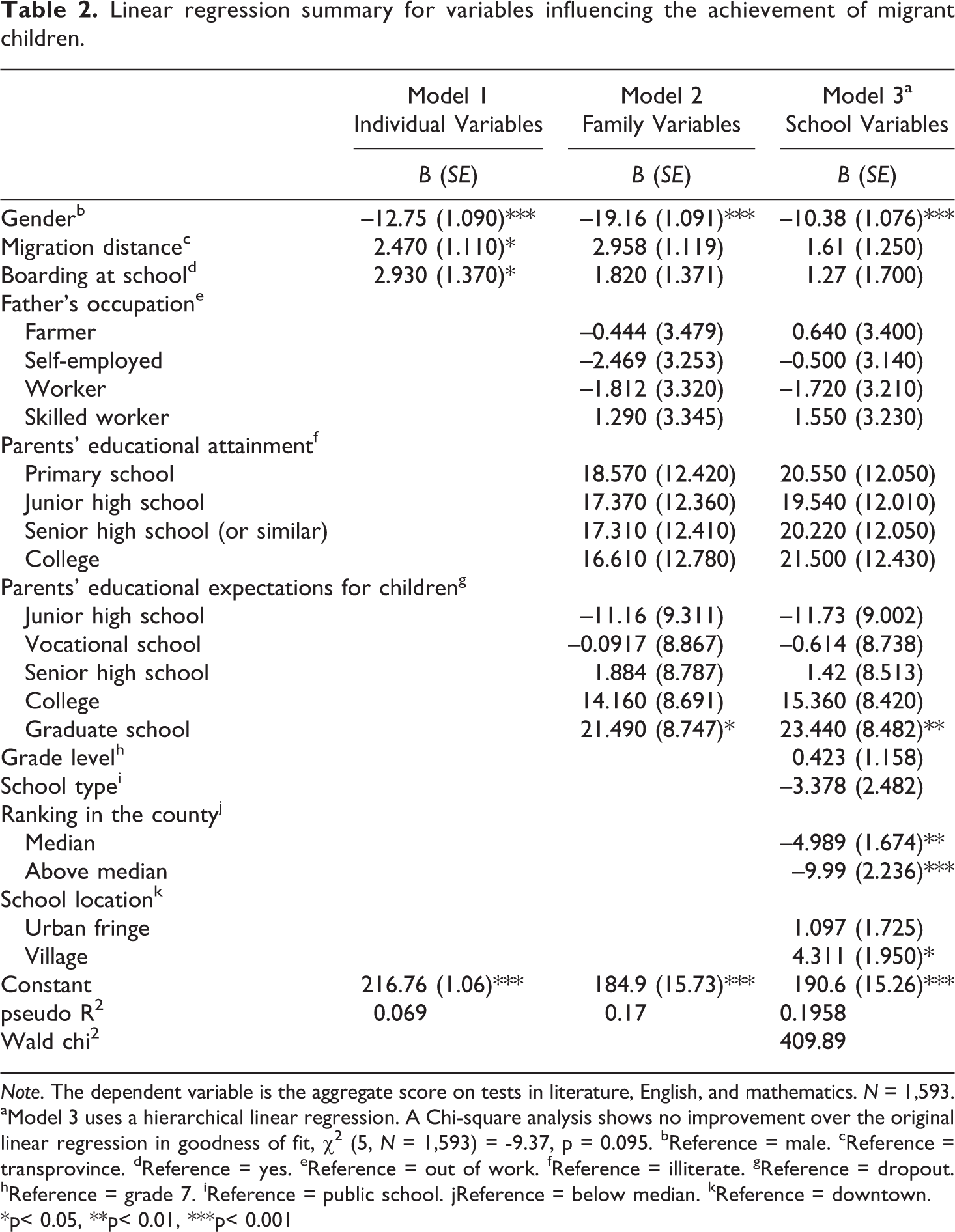
Test scores (the dependent variables) are standardized by school and grade, and because they are continuous variables, a linear regression model was used (Table 2). Three nested models were constructed.
Linear regression summary for variables influencing the achievement of migrant children.
Note. The dependent variable is the aggregate score on tests in literature, English, and mathematics. N = 1,593.
aModel 3 uses a hierarchical linear regression. A Chi-square analysis shows no improvement over the original linear regression in goodness of fit, χ2 (5, N = 1,593) = -9.37, p = 0.095. bReference = male. cReference = transprovince. dReference = yes. eReference = out of work. fReference = illiterate. gReference = dropout. hReference = grade 7. iReference = public school. jReference = below median. kReference = downtown.
*p< 0.05, **p< 0.01, ***p< 0.001
Model 1 only incorporates the first set of independent variables relating to the characteristics of the migrant children. Results show that gender is significant in explaining their academic achievement. On average, girls achieved higher scores than boys. This held true even when controlling for family background and school factors. Results also indicate that students who migrated outside the province scored significantly higher than those who migrated within the province. In addition, boarding at the school appears to significantly boost migrant students’ academic performance. Living at the school reduced the negative effect of poor family conditions.
Model 2 introduces family background factors and suggests that family background, including father’s occupation, family’s financial status and parental education attainment, has no significant impact on the educational achievement deviation of migrant children. Hypothesis 1a is supported. Parents’ educational expectations are significant only when the expectation is at master’s degree level. Migrant children whose parents expect them to gain the master’s degree have significantly higher scores than those whose parents do not expect attainment at the master’s degree. However, any educational expectations that are lower than graduate levels have no significant impact on academic achievement. Therefore, Hypothesis 1b is unsupported by the results.
Model 3 introduces school variables, including grade level, school type, ranking, and school location. Data analysis shows that school ranking was significantly correlated with the academic scores of migrant children, but the grade level served by the school was not. Findings also reveal that school type had no significant effect on these scores. Thus, hypothesis 2a is unsupported. This is likely because a high proportion (85.15%) of migrant students in this survey could enroll in public schools.
The most significant variable in improving migrant student achievement is school quality as measured by rankings (p < 0.001). Surprisingly, migrant students appear to perform most poorly in better schools (those with a ranking above the median), which is somewhat counterintuitive. Marks (i.e. test scores) are standardized according to school and grade, which implies that migrant children rank below the median in highly qualified schools, yet rank above the median in less-qualified schools. Similarly, migrant students in village schools score 4.3 points higher than those in urban schools. Thus, hypothesis 2b is also not supported. Up to now, hypothesis 2 as a whole is not supported.
Conclusion and discussion
Using three nested models and a multivariate linear regression, this article analyzes the effect of individual factors, family background, and school characteristics on migrant children’s academic achievement.
The results show that gender is a major indicator of educational performance. Girls did significantly better than boys, even after controlling for other variables. Distance of migration also affected migrant children’s scores. Children who migrated from outside their home provinces performed better than those who migrated within their home provinces. When students migrate to an unfamiliar place, it is hard for them to merge into the local society, and they may experience psychological stress and a low sense of their identity. Poor performance might therefore be expected. However, in reality, the direction of farmer-worker migration is from places with simple and rudimentary educational resources to large urban centers, such as Beijing, Shanghai, and Guangzhou, which have more highly developed educational systems. These educational environments give them advantages over children who remain in their home provinces.
Because the study subjects showed only small variations in terms of family finance, father’s occupation, and parental education, it is not surprising that their achievement scores exhibited only small variations as well. Among those variables, higher parental education expectations appeared to impel migrant children to outperform others, but only in the case of students whose parents expected their children to earn a master’s degree or higher. Parental educational attainment was also correlated with positive test scores, though only for the children of migrant-workers who had attained only a primary school education or for those whose parents had earned a college degree.
Data for the dependent variable (aggregate scores for tests in literature, English, and mathematics) were standardized. However, teaching skill levels, test designs, and strictness of scoring all varied from school to school. Therefore, the multivariate linear regressions could not precisely identify the true disparity in the academic achievement of the migrant children. It seems that school ranking has negative impact on migrant children. This again is against common wisdom. Although many obstacles must be overcome before sending their children to public schools, farmer-workers still fight to put their children in the best educational environment. This explains why 62.19% of migrant children are enrolled in schools that were above the median.
After controlling for family background and school characteristics, we found that migrant children appear to lag behind their local counterparts. This could be ascribed to the attitude of public schools in China toward migrant children. In Shanghai, for example, migrant children are placed in different classes from local students. Even if migrant children and local students study in one classroom when there are not enough students to justify creating separate classes for these two groups, they suffer under the intensive discrimination from local mainstream communities (Xiong & Yang, 2012). In addition, they are not allowed to take the examinations for advancing to upper education levels, which likely reduces their confidence and enthusiasm about learning.
At the bottom of the society, farmer-workers under poor family financial conditions are forced to focus on short-term practicality when making choices, particularly when their children perform poorly in school. Thus, it is easier to understand why 59.29% of farmer-workers hope their children enter a technical or vocational school, not the senior high schools. Around 14% of the migrant children choose to end their education after nine years of compulsory schooling. And even when some of those children enroll for three or more years in technical or vocational schools, they are still unable to find satisfactory jobs. Neither family finance nor father’s occupation significantly influenced student academic achievement. School type, either public or private (including special schools for children from migrant families), did not have significant influence on the lower achievement of the migrant children. The most important factor that was significantly related to improved academic achievement among the migrant children was whether or not their parents had high expectations for their educational achievement.
In brief, most migrant children, who encounter a series of significant barriers at different levels in Chinese society, have fundamentally repeated the fate of their parents. The problem of social mobility for migrant children in China calls for policy changes. To promote social mobility, it will be important to mix migrant students with local students. In addition, we need policies that help those migrant children move on to higher education in order to break the intergenerational circle.
Footnotes
Declaration of conflicting interests
The author(s) declared no potential conflicts of interest with respect to the research, authorship, and/or publication of this article.
Funding
The author(s) disclosed receipt of the following financial support for the research, authorship, and/or publication of this article: This paper is supported by the project “Effect of Family Background and School Characters on Academic Achievement of Migrant Children (Project Number: KJ1707184)”, and the project is funded by Educational Committee of Chongqing.