




Abstract
Following a series of recent devastating storms across England with large numbers of homes and businesses evacuated, and despite widespread consensus that further severe flooding is expected, a large section of the population continues to be excluded from developments in flood risk management. We argue that the absence of children and young people from assessments of both the effects of flooding and ways in which it can be mitigated, undermines the effectiveness and legitimacy of policy making. Drawing on in-depth participative research with two groups of flood-affected children and young people we show the range of ways in which they are affected by flooding, some ways they can be better supported, and then how their valuable experience can help shape positive change in policy and practice before, during and after floods. Children developed Flood Manifestos for Change in a direct challenge to their omission from flood governance. The Manifestos and the steps children took to advocate for them can be seen as acts of citizenship, highlighting the capacities of children and young people as flood actors, rather than flood victims.
Introduction
Ruth: It feels good. It feels like we finally have a voice. Sara: Yeah, like we can be heard now; like, they know how we feel.
Background
Over the last decade, more than 250 million people globally were affected by disasters each year – more than half were children (IFRC, 2010). In the UK, coastal and inland flooding tops the National Risk Register with more than five million properties (one in six) at risk in England alone (Cabinet Office, 2015) and there is widespread consensus that more severe flooding is expected over the coming years (IPCC, 2014; Messling et al., 2015). Disasters such as flooding not only affect children’s basic right to life, the right to the enjoyment of the highest attainable standard of health and the right to education, but there is an impact on children’s right to participate and for decisions to be made in their best interests (OHCHR, 1989).
As a large proportion of the affected population in any emergency, children should be at the heart of planning, response and recovery programming. Yet children are more likely to be seen as disaster victims than as environmental actors (Gibbs et al., 2013; James, 2011; Stephens, 1996) and even where government agencies express interest in involving them, in practice this is found to be superficial (Freeman and Aitken-Rose, 2005). Children in England and globally are missing, virtually invisible to flood and emergency planning policy and practice (Mellor et al., 2014; Rodriguez-Giralt et al., 2016). Where they are mentioned, children are generally positioned either as vulnerable or, paradoxically, as inherently resilient and likely to simply ‘bounce back’ (Fothergill and Peek, 2015). Both these perspectives risk ignoring the ways in which children experience and act in emergency situations. This in turn can lead to children’s insights being overlooked, in particular relating to how their communities can be supported to recover from and prepare for disasters.
Children are acutely affected during and after floods. Flood events and the long and protracted recovery period have a significant impact on children’s physical and emotional wellbeing (Walker et al., 2012; Whittle et al., 2010; 2012). We know from Butler et al.’s 2016 study of (adult) public and stakeholder perceptions of the UK’s 2013/4 floods that those residents who had been evacuated from their homes reported significantly poorer health and wellbeing, and many of those affected are families with children. Floods affect children’s day-to-day lives, and can result in many forms of displacement such as having to leave their homes, staying in unsuitable or damp housing, or being unable to attend their usual school. If they are displaced, they may lose friendship networks, school connections, and familiar surroundings. At the same time, they see adults under great strain and they can develop anxiety about future flooding. Children lose important material and spatial ‘goods’; they lose sleep and recreation, access to fresh food. They experience fear, anxiety, increased poverty, unfairness, destruction, uncertainty and the feeling of being ignored or misunderstood (Walker et al., 2010, 2011).
Within England, there remains a general lack of acknowledgement of children’s capacities to contribute to and support their local communities in emergencies, as seen in a range of key government documents (DCMS, 2006; EAC, 2016; HM Government, 2004). Current flood related and emergency planning policy (e.g. Public Health England, 2014) either ignores children or positions them as ‘vulnerable’, along with older people and pets, which has the effect of patronising and further disenfranchising children. Recently published guidance on flood resilience either makes no mention at all of children and young people or takes a step forward in acknowledging them and advocating their involvement ‘wherever possible’, but still under the category of ‘vulnerable’ (Cabinet Office, 2016: 4).
Most research into the social consequences of contemporary flooding has not included the perspectives of children. A notable exception is the landmark seven-year study with children following Hurricane Katrina (Fothergill and Peek, 2015). This ground breaking ethnographic work follows in great detail children’s recovery ‘trajectories’ (which are anything but linear) as they move through the vagaries of post flood life, heavily shaped by multiple forms of deprivation and by class, race and gender. Fothergill and Peek’s work also demonstrates the value of forms of participation to children’s recovery as this has the effect of reducing anxiety and enhancing a sense of control. Beyond flooding, participatory research with children who had experienced the Christchurch New Zealand 2010/11 earthquakes has shown that where space and time were given to enable the emotional processing of what had happened, children were able to show, illustrate and document the disaster. This work enabled the assembling of both the personal and community histories of the earthquakes, contributing to community recovery (Mutch and Gawith, 2014). Further, it is reported that when children became involved in environmental monitoring following the Chernobyl disaster this resulted in both improved clean-up rates and a lessening in the ‘psychic numbing’ which had been observed in the wake of the crisis (Zhirina in Stephens, 1996).
There is evidence that children can be agents of change within their communities and capable of actively participating in decision-making and emergency planning activities that help protect themselves, their families and communities. The Duke of Cornwall Community Safety Award, set up after the 2010 UK floods is open to ages 5–18 and more than 18,000 young people have completed this (Cornwall Council, 2012). International examples of children’s involvement in community recovery include El Salvador, where severe flooding in 2008 led to the deaths of 12 people. Following those floods, children became involved in the disaster preparedness process, leading to a drastically improved capacity to respond quickly and efficiently following similar flooding in 2009 (Back et al., 2009). Yet despite evidence of the benefits of children’s participation in disaster risk reduction and emergency planning, Rodriguez et al.’s (2016) scoping review of both practice and research shows that this remains disappointingly rare (see the European union Horizon 2020 CUIDAR project: Cultures of Disaster Resilience Among Children and Young People). Some recognition of the need to work with children has emerged in the UK, e.g. the Essex Resilience Forum ‘What if …?’ programme, which uses interactive games designed to help children think about what to do in emergency situations (Essex Civil Protection & Emergency Management, 2014), and the recently published Cumbria Flood Action Plan that includes an entry on working with flood-affected children (Environment Agency & Cumbria Partnership, 2016).
There is a strong argument for the value of post flood participatory research with affected groups. ‘Flood apprentices’ gained prominence for positive effects on community engagement and resilience building (Whatmore and Landstrom, 2011). Easthope’s ethnographic study of community participation in, and transformation of, national recovery and resilience guidance in flooded Toll Bar, South Yorkshire demonstrated the power of local actors to mobilise their experience (Easthope and Mort, 2014). The longitudinal ‘recovery diaries’ produced by 44 adults in Hull following the 2007 severe flooding demonstrated a ‘flood recovery gap’ in that for many people the recovery process is more gruelling than the flood ‘itself’ (Medd et al., 2015). This diary based research with families in Hull post 2007 revealed the marginalisation of children and led to the development of the Hull Children’s Flood Project (2009–11) which uncovered concerns about the effects of flooding on children’s longer-term physical and emotional health and wellbeing and led to calls for further work in this area (Walker et al., 2010, 2012). The project we report on here takes that call a step further to explore how children’s flood experiences, the actions they take and the advocacy they carry out can explicitly inform policy development.
Our research concerned children’s experiences of the UK winter 2013/14 floods and was carried out in collaboration with Save the Children. We employed creative participatory methods specifically to enable flood-affected children to articulate their experiences and shape a more productive relationship with relevant agencies and adults. We aimed to understand children’s experiences of the flooding, the impact on their lives, their resilience and the longer-term recovery process; to discover how children can best be supported in a flood and how to enhance their resilience to future emergencies; and to influence emergency policy and practice to better meet the needs and build the resilience of children.
The children who took part are located in geographically and socioeconomically contrasting English locations and experienced very different types of flooding: In rural South Ferriby – At approximately 7pm on 5th December 2013 a tidal surge breached the banks of the River Humber, damaging homes, businesses and farmland. The tidal surge travelled three kilometres inland and was the highest ever recorded in the Humber (Thorne, 2014). More than 100 families in the community were flooded and a third of the children attending the local primary school were affected. In urban Staines-upon-Thames – On the evening of 9th February 2014 seven severe flood warnings were put in place for the River Thames in north Surrey. Residents were evacuated and roads and schools were closed. Within days the Government declared a state of emergency with the army drafted in to assist the emergency services. Surrey experienced ‘coincident’ flooding i.e. clusters of events involving tidal, rainfall, river and groundwater sources, a hallmark of the winter 2013/14 floods. (Thorne, 2014)
Methodology
Our research approach was influenced by the work of disaster sociologist Kai Erikson who has argued that those who have experienced disaster develop a particular world view, where that world is less safe and secure. His work attends to issues of trust in authority and collective identity and is particularly concerned with the way disasters can both destroy and create community. Because of their experience and their altered world view, Erikson argues that people who experience disaster deserve to be listened to very carefully (Erikson, 1978, 1994, 2008). Erikson argues that chronic conditions, as well as acute events can induce trauma and especially when people are left out, abandoned from ‘the life around them’ (1978: 21). In the case of the Buffalo Creek flood and landslip disaster, Erikson refers to people ‘too old’ to take part; so we ask, what about those considered too young to take part? And if experience is integral to learning as argued by Lave and Wenger (1991) then those developing policy need to draw more directly on the acquired and embodied expertise of disaster survivors regardless of age.
There are significant ethical issues involved when working with children who have experienced major disruption. These include concerns about re-traumatisation and ongoing problems in a context of limited resources for support in school and within the community. There is also the need for a stringent ethical review process, which may help to explain the lack of studies seeking to understand children’s perspectives on disaster. We argue that ‘conventional’ and less participatory social research methods such as interviews and questionnaires, which might be used with adults, are less appropriate with disaster-affected children because such methods are less likely to create a familiar, comfortable and facilitative environment for meaningful inquiry. 4
Our methods were designed to allow the children to voice their experiences and facilitate the sharing of their thoughts in a safe environment and the project began nine months after the floods. We developed a creative, interactive programme for working with flood-affected children drawing on well-documented, sensory-based approaches, in particular practised by Bingley (2003; see Bingley and Milligan, 2007 for description and discussion of this arts-based methodology with children). We started by inviting the children to share their individual stories and then in groups moved towards the collective story, from which ways of recovering and building resilience as a community could be developed. Three all-day workshops held over the course of the school year in a familiar space near, but outside of the school environment, were key to enabling this process and building towards a public sharing of the project.
The workshops were framed with drama games and exercises, designed to establish a sense of trust among the group, as not all the children knew each other, to ‘warm up’ particular skills needed for the workshops and to open up a safe space in which to share stories. The children then walked with us around their local landscape affected by the flood, showing us places and features they felt were significant. Each was given a digital camera so they could record traces of the flood (Figure 1). Back at the workshop, the children shared their photographs in group ‘phototalk’ sessions. They were then invited to use arts-based techniques including sandplay, 3D modelling with art and found materials, and as they worked with these materials they told more of their stories, articulating experiences of the flood.
5
Theatre based methods used throughout the workshops aimed to build the children’s sense of themselves as flood ‘actors’ and develop their confidence to be able later to share their experiences and ideas with wider audiences, locally, regionally and nationally.
Walking and photographing the local landscape.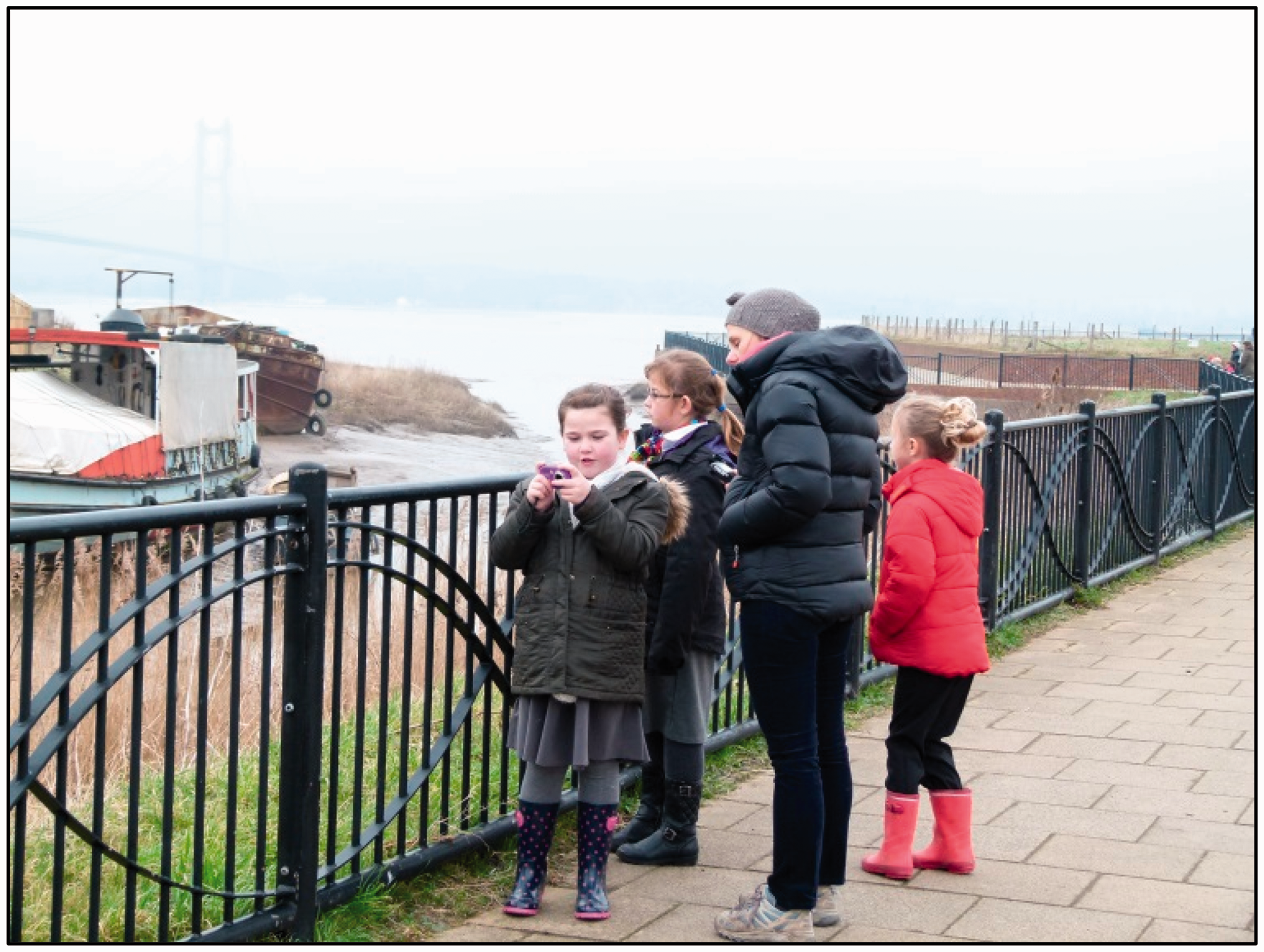
Data collected during workshops included: photographs; video and audio recordings of walking and phototalk sessions; group discussions during sandplay, 3D modelling and theatre activities and interview transcripts. Audio recordings were transcribed. This multi-media material was coded and categorised thematically in research team meetings and organised using Atlas.ti software. Emerging themes were taken back to the children for discussion and to support the development of their later presentations to stakeholders and creation of their Flood Manifestos for Change.
Six major themes
Children’s reactions to warnings and the need for greater flood awareness
Both groups of children indicated widespread confusion about flood warning systems. It appeared their families did not receive warnings about the flood or, if they did, then did not take action. As a result, when the flood happened people were unprepared. Families in South Ferriby were taken by surprise by the speed of the tidal surge and had to flee in the dark, which exacerbated distress for the children. Many described having to cut short routine evening activities, such as getting ready for bed. Amber, aged six years, said: ‘We was in the bath when it started … and I had to quickly get dried, slip some pyjamas on … and we went out the door’.
Amber also talked about driving out of the flood and about her younger sister: She wasn’t really scared because she couldn’t see … but I could, because I’m older and I could see. I could see over Mummy’s chair when she was driving. It was really scary. At first me and my brother thought it was quite fun … but then it kept on going up higher and higher and it started scaring us because we didn’t know what would happen next. Well … they didn’t give us a bad warning. They just said, ‘You need a flood plan in place. You shouldn’t flood, you’re not in the flood area’. So we thought we’ll just be prepared if anything does happen. We didn’t think it was gonna come in … We were just prepared that the roads would be closed. We stayed for a little bit, then it went up more, and then it went to the top step and Dad said, ‘We need to go now. When I say now, I mean now’. Louisa: It was only a yellow warning, wasn’t it? That means that it might not flood. John: Green means that it’s absolutely fine, nowt’s going to happen. Yellow means it might happen … and red means that it could be really bad … Louisa: But it was only a yellow warning.
Children’s perspectives on loss
In both locations, the issue of loss was strong in relation both to the experience of the flood and the long recovery process. Children’s articulation of loss included material possessions such as family photographs or the kitchen table, but also less tangible losses such as time, familiar space and social networks. Some children, like Louisa and her cousin Jane, aged nine and 10, talked about things that were saved: Louisa: We got all the pictures first … You can’t re-take them really, can you? Jane: Because there could be ones, like, of my granny, and my granny’s dead now …
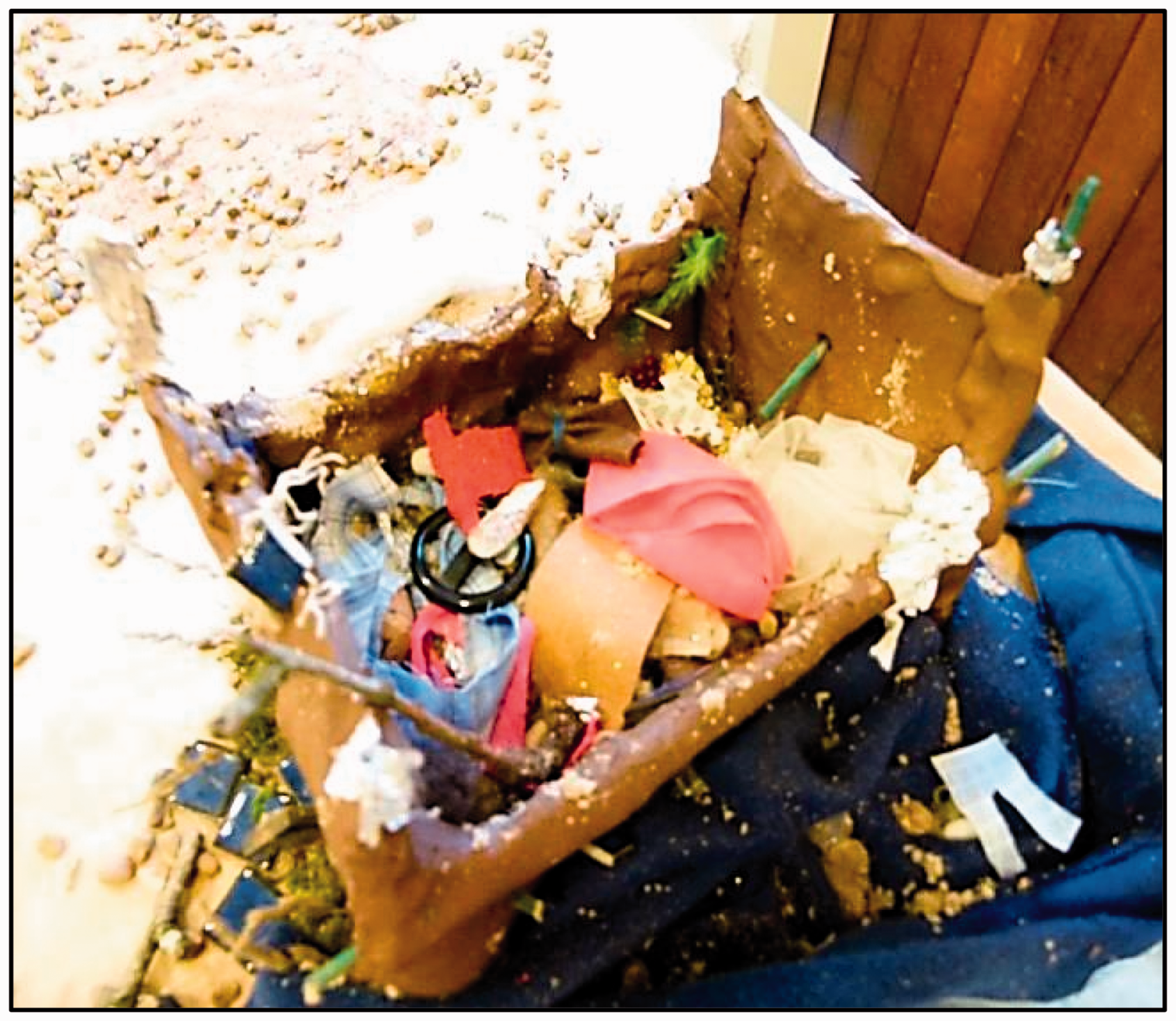
Roadside skips (Figure 2) were a recurring feature, particularly in Staines, and emerged in the workshops as a powerful talking point connected to loss, waste and value. They symbolised for many how treasured possessions became soiled and dumped, along with the memories that went with them. Jodi, aged 14, talked about how ‘the skip of memories’ that her group modelled (Figure 3) ‘shows the destruction the floods left … It shows all people’s memories and all their, like, precious things that got ruined’.
The skip: one of many photos taken by young people in Staines during a walk around the local flood-affected area. Group model of ‘the skip of memories’.
Aside from personal objects, there were stories of loss connected to the displacement experienced by the floods, including lost time. Many children and their families had to live in hotels, or were housed in other temporary accommodation, not only immediately following the flood but for long periods while their homes were being repaired. In Staines, Callum aged 12, described how his street, currently occupied only by builders, resembled a ‘ghost town’ that he found empty and scary, reflecting loss of familiar space. Ben, also aged 12, explained: When we moved I couldn’t go to the park or anything with my friends because they were all so far away … They kept on asking me but I couldn’t get back, because my mum wouldn’t let me cycle in the dark. It wasn’t great … It was just weird because you don’t make your own cereal or anything; they just give it to you. It’s like, you want to do those everyday things.
Children’s experiences of recovery
Coming to terms with loss was observed as an integral part of recovery. Many of the children talked about how long it can take to recover from a flood and the impact this has had on their lives, their families and the community. For some children, as Richard indicated (Figure 4) there was a desire to get ‘back to normal’. Evacuating their homes, moving in and out with other families, or into hotels and rented accommodation, sometimes seemed an endless process. Ben, moved into rented accommodation but the tenancy ended before the building refurbishment was complete on his home, so had to move again into another rental before eventually moving back home more than a year later.
Models showing life before and after flooding: ‘I made the people, so the happy ones are for before the flood, where everything’s working normally, then it’s sad people for after as they have to repair everything and it takes a long time to get everything working and back to normal’. Richard, aged 14, Staines.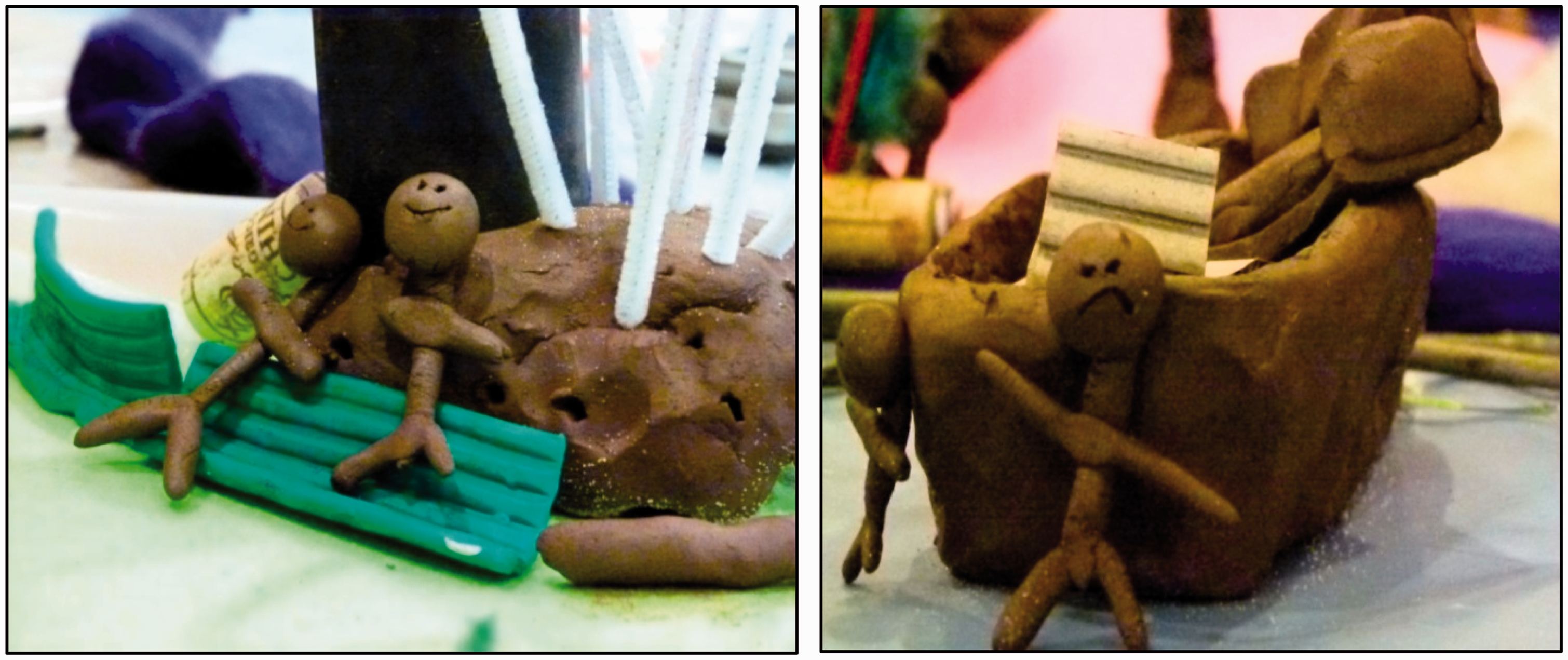
Daniel, aged 14, was away from his home for 12 months and said: ‘It felt like you’d lost a year of your life’. But he also talked about how living temporarily with his grandparents had brought the family closer together. Fortunately for Daniel, his grandparents’ home was spacious enough to accommodate the two families, whereas Callum told us how difficult it was getting to sleep at his grandparents’ home in a tiny room amongst all the packing cases and plastic bags stacked up to the ceiling full of his family’s belongings: I could barely move in my room. I couldn’t sort of get to sleep … I was so scared like [of it] falling down on me … all my stuff, Mum’s stuff, everything in the kitchen, all the stuff [from] all the rooms. Louisa: It was just like one big sleepover. Jane: Yes, but for a very long time. We got our drying certificate on Valentine’s Day … You had to get one … That means your house is completely dry and now you’re allowed to start working in it … Some people didn’t get their houses dry... They started putting their stuff in, then it got wet again, so they had to start all over again.
Having a skip (or not having one) is an example of how contradictions between the wider insurance industry and its supply chains may cause added stress to families and this exposed children to new levels of unfairness. Children talked about having to throw things out rather than restore them, and concerns about whether their insurance meant their homes would be made safer or more protected in the future. In this way, injustice became materialised for them.
Children’s awareness of isolation
Young people, predominantly in the Staines group, explained how in the months following the flood they began to feel isolated. Unlike the primary school group, in a large school community it was possible never to hear about others, especially in different year groups, who had been flooded at home. Added to this, the young people felt that the majority of the school staff were unaware which pupils were flood-affected and this seemed to have increased their sense of isolation. We return to this point below. However, in a large school which itself is not flooded, a sense of being alone and struggling to manage schoolwork can build up. An example of this was described by Andrew aged 15, who told us about the frustration of being unable to submit his GCSE options form because of the lack of access to computing and internet in the hotel where his family were housed: ‘… I couldn’t even fill out the form because it was online. I couldn’t print it out’.
Establishing who is affected, and the extent of the problems, is more complex than traditionally collected flood statistics suggest. The complexities of being directly and in-directly flood-affected are apparent from the children’s experiences outlined in our findings. Perhaps unsurprisingly, they reported a sense of isolation, with no-one to talk to who seemed to understand their situation; they had to manage the long-term effects of living in temporary accommodation, losing friendships if they had to re-locate to a different school because of home displacement, and had to cope with family tensions exacerbated by flood-related financial worries.
In these ways, children were seen to find the flood experience, from the day of the flood through the long recovery period, not only isolating but alienating – a feeling underlined when they found that friends, schools and local authorities failed to notice what they were going through, and consequently were unable to provide support.
A recurring theme among the young people in the Staines workshops was a sense of abandonment during the crisis by those they felt ought to be supporting them, as Ruth’s model (Figure 5) ‘SOS’ demonstrates. Ruth talked about how many local people were left to ‘fend for themselves’ by the authorities and she later described how: My experience left me with the feeling of being on our own and it felt like no one cared. It felt like we weren’t helped until it was too late.
Ruth’s model signals ‘SOS’. Everyone in here like understands what you went through, so you can talk to them and you know that they’re okay with listening, whereas outside they haven’t been through it. Because you sometimes feel like, if you’re talking it, you’re droning a bit and it’s boring them … whereas in here we kind of connect a bit more. Ruth: It feels good. It feels like we finally have a voice. Sara: Yeah, like we can be heard now; like, they know how we feel.
Children as active contributors in flood response and recovery
Given the general lack of acknowledgement in flood and emergency planning policies of children’s capacities to contribute to and support their local communities, we were interested to hear from the children about what they actually did during the floods. We learned that many had been actively engaged both in the immediate response during the flood events, and in the recovery process, supporting their families, friends and local communities in a range of ways. We heard accounts of how children checked in on neighbours, helped to move their own and other people’s furniture upstairs and joined in with the clean-up. They said this was generally a positive experience and they expressed satisfaction about the times they had been able to support others in difficulty. For example, Sara, aged 14, served tea and coffee to evacuated families and rescue teams at her local village hall: ‘I felt quite good at myself then. I could have been home just watching TV and I was actually constructive and helping people’. School friends Avril and Helena, aged nine and 10 gave up a riding lesson to help clean up their friend’s house: ‘No way would we have let our friend have to do it all herself … because we would be guilty. We didn’t even have to make a choice’.
In the course of the workshops, it also became apparent that children knew and understood more about what was happening than adults sometimes realised. Children described instances of seeing the pressure and strain in the adults around them, even when parents and teachers believed they were shielding the children from what was happening. Many of the children talked about the impact of the experience on their families and friends and demonstrated empathy and understanding for the reactions of others during the flood and the recovery process. As with the findings about the alienating effects of the floods, children are sometimes further excluded by the very fact of being children. But as 10-year-old Helena told the audience at the stakeholder event in her school: ‘Adults need to know that children become more scared and worried when they do not know what is happening … children have the right to know’.
Children’s understandings of flood adaptation and new normalities
In both locations, children talked about the likelihood of repeated flooding. To some extent this concern seemed to be related to a raised level of anxiety about the prospect of future flooding. As Jodi, aged 14, explained: I’m just kind of like worried it’s going to happen again this year … I suppose I’m going to worry every year though. Even if it doesn’t happen, we’re still going to worry.
Critically, while there was a desire for a return to ‘normal’ after the floods, many children demonstrated an understanding of the need for families and communities to adapt to a ‘new normal’ that ensured they were prepared. As Richard explains (see Figure 6): It’s a little raft and there’s a person sitting on it. They’re all prepared … They didn’t realise that it would have ever flooded but now they realise that it will more than likely flood again, so they’ve bought themselves a little raft that I made … Because it’s happened before, it can happen again. They’re adapting …
Richard’s model of a raft. We’ve sorted out next time. We’ve got a flood toilet … The floodwater can’t go inside it... And then we’re gonna turn all the lights off … and we’re gonna go upstairs. And then we’re gonna take our neighbours upstairs to my mum and dad’s room and then we’re gonna put some candles on … And we’re gonna get loads of food.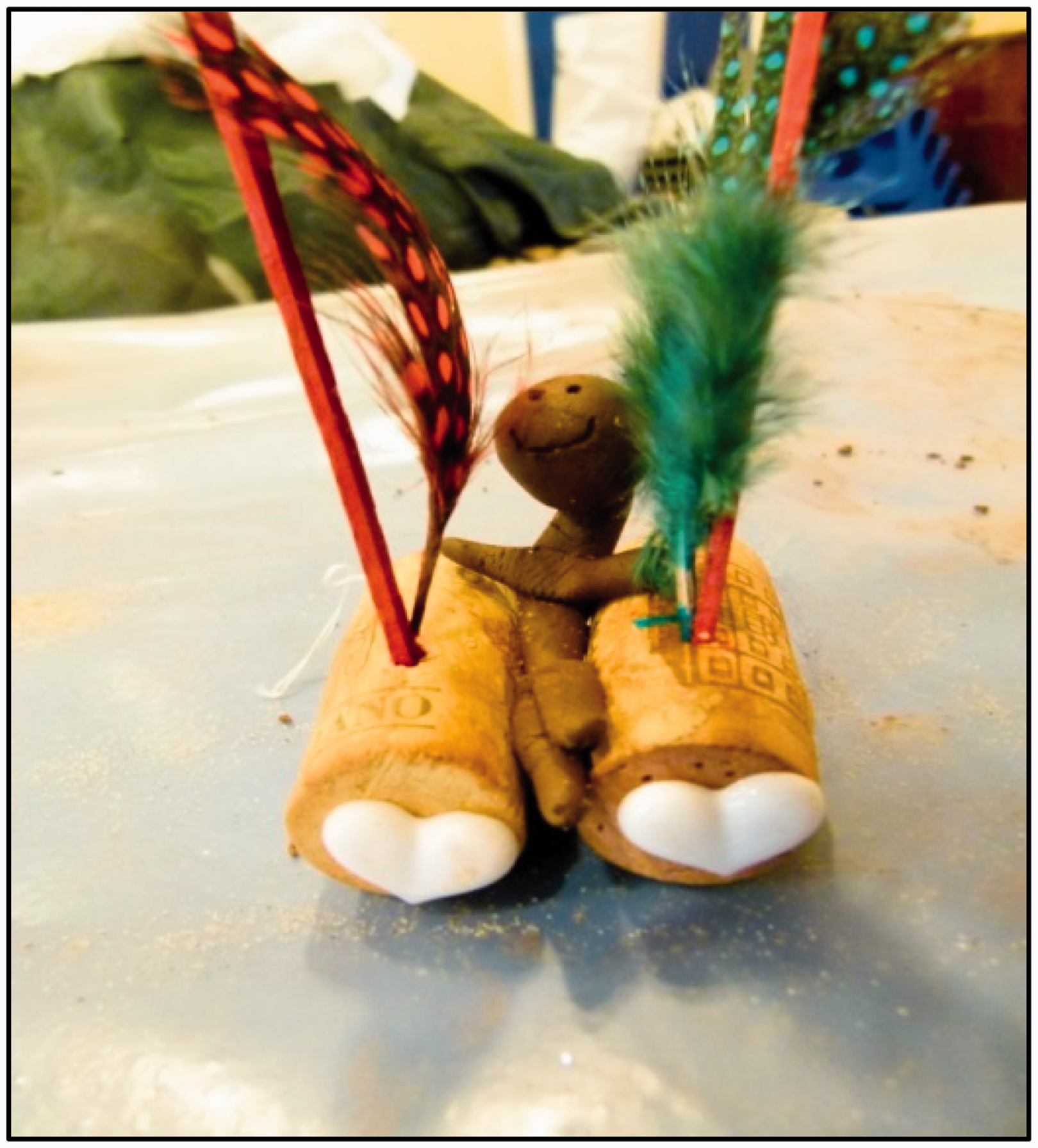
Children expressed an understanding that what counts as normal has in fact changed. They recognise that there is a ‘new normal’ which includes flooding and taking measures to prepare for and adapt to flood events.
Developing flood manifestos for change
At the third workshop, having identified many of the problems they experienced during and following the floods, the children developed Flood Manifestos, actions that they, their families, communities and government should take to be prepared and better manage future events. This was a major step from being affected to being effective, or as we might put it, from victims to actors.
As actors then, the children presented their ideas for change at performance-based events to audiences of parish and district councillors, and then with growing confidence to the insurance sector, emergency services, health and social care professionals, representatives from the Environment Agency, Defra and the Cabinet Office-Civil Contingencies Secretariat, teachers and parents. The interactive presentations were based around a game of ‘snakes and ladders’, drawing upon a range of material produced or provided by the children over the course of the project. The audience was taken through a ‘flood story’ to demonstrate how experiencing and recovering from floods are often arbitrary and never a linear process. Children gave out their Flood Manifestos and invited audience members to respond by writing a pledge about what action they would take as a consequence. A six-minute film captures the key points from this process and helps the Manifestos reach a wider audience.
Key points from the Manifestos.

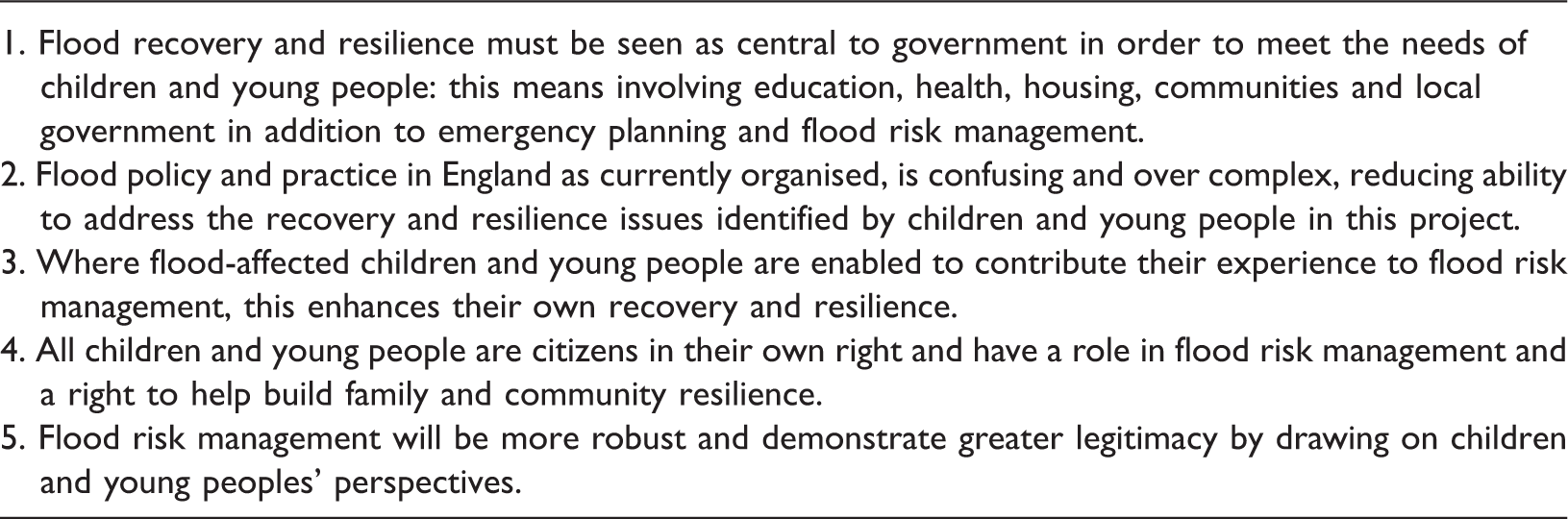
Policy implications derived from the children’s perspectives.
Discussion
Our research shows children play an important role in flood response and recovery, actively helping their families, neighbours and the wider community. Children recognise the risk of future flooding often more readily than adults, which prompts them to think about adaptation and the need for a ‘new normal’ (see Harms, 2015 for further discussion relating to the benefits of adopting a ‘new normal’). Flood-affected children in our study expressed interest in having a more explicit role in developing flood prevention and preparedness in their communities and families and our research highlights that having an active role in this helps with recovery. Their participation and responses to this research shows that children can be powerful advocates for change in flood risk management.
Recognising the value of children’s perspectives and capacities would clearly make flood policy more effective, enhance resilience and reduce the impact of future emergencies. Not to consult with children about resilience building is to fail to take advantage of their experience and particular perspectives. To recall just one example, Andrew told us about not being able to access his GCSE options form online because of being displaced by the flood. This was clearly something that the school authorities had not anticipated and it demonstrates the wider complex vulnerabilities of a society now so heavily dependent on the internet and on sources of electricity which can fail in a flood (Kemp, 2016). The frequently quoted UN Convention on the Rights of the Child states that children have the right to be heard and actively participate in decision-making that affects their lives. However, our research, along with that of James (2011) and Larkins (2014) shows an imperative to move beyond rehearsal of rights (useful though this is). Drawing on the work of Isin, Larkins goes on to make a distinction between ‘actions’, and ‘Acts’ of citizenship. In our study, actions would include helping flooded neighbours, while Acts would include creating and presenting the Flood Manifestos. Lack of recognition of children’s roles in disasters serves them badly, as Helena told the audience of stakeholders that came to her school: ‘Children have the right to know’. As a first step, this marginalisation could be addressed by actively involving children in disaster risk reduction activities and ensuring that children have equal access to meaningful information on flooding.
The children who took part in this project are flood experts from their own understanding and experience of what it means to be flood-affected. As their Flood Manifestos demonstrate, the negative effects of floods for children are exacerbated by inadequate flood risk management by adults; the organisational complexity brought about by recent flood policy changes undermines the ability to address this. The Flood Manifestos are a call to action, but we are concerned that flood policy in England (preparation, response, recovery, resilience) is currently too fragmented to enable children’s concerns to be fully addressed, as the multiple effects of flooding are the domains of different government departments or agencies. For example, the children asked to learn more about flooding in school with regard to safety and flood risk to their communities, but it is unclear which department has the mandate to address this need – whether it is the Department for Education, the Department for Communities and Local Government or the Department for Environment, Food & Rural Affairs. While some educational resources about flooding have been developed for children it is far from clear how these will or can be adopted (Twigger-Ross et al., 2015). Opportunities to respond to children’s actions and Acts of citizenship get lost in bureaucracy.
This paper adds to a growing body of work which attends to the multiple (social, technical and political) dimensions of flooding (Butler et al., 2016; Twigger-Ross et al., 2015; Walker et al., 2011), but in particular the marginalisation of children and young people who are affected, but largely excluded from being effective. Recent research recognises that floods are complex, heterogenous and have multiple effects; that they can be heavily localised, yet relate to distal, global phenomena. Floods are about rainfall, catchment, urbanisation, infrastructure, investment, climate change and they are about people – from issues of human-induced environmental change to trust in flood warnings; from Property Level Protection measures to social solidarity and cohesion.
Flood events in the UK bring all the above issues to the surface, and while there have been examples of supportive, tireless and innovative practice on the ground, we believe that the policy response to this increasing complexity over the last three major disasters (2007–2015/6) has been inadequate. Butler et al.’s research (2016) on public perceptions of the 2013/4 floods reports a ‘lack of clarity about institutional responsibilities’ (p. 3) and also that flood-affected people expect their government to protect them against flooding, to mitigate it and coordinate the response to it, while acknowledging they (the public) also have, and do, play a role (p. 23). But protection, mitigation, response (and the often neglected area of ‘recovery’) are all located in different organisational domains, between different agencies and government departments. This fragmentation is no more a naturally occurring phenomenon than is contemporary flooding, but is the outcome of a series of decisions in favour of ‘localising’ responsibilities under successive governments and which have been severely criticised (Begg et al., 2015).
Working with children underlines that it is time to find a way to reach across organisational boundaries and redirect resources to bring together flood response, recovery and resilience. An optimistic reading of recent events suggests that a more joined up approach to flood policy may be gaining ground: the 2016 National Flood Resilience Review drew from a multi-agency advisory committee (though it omits any role for children or young people) and the Environmental Audit Committee recently carried out an inquiry termed ‘Cooperation Across Government’ (2016). But the remits of both these inquiries were still heavily shaped around issues of infrastructure and investment, and entirely from an adult perspective. A reading of the children’s Flood Manifestos points to creative and imaginative ways to ‘join the dots’ in flood risk management linking three key policy domains: recovery, health and well-being; resilience; and preparedness and flood education. The children’s sustained work for this project was based on their hard won experience and ability to reflect and extract messages for policy; it demonstrates their determination to be seen as actors rather than passive victims.
Footnotes
Acknowledgements
We are very grateful to the two schools and their staff, and in particular to the children and young people who took part, without whom this study could never have taken place. The project also benefited from collaboration with Save the Children UK.
Declaration of conflicting interests
The author(s) declared no potential conflicts of interest with respect to the research, authorship, and/or publication of this article.
Funding
The author(s) disclosed receipt of the following financial support for the research, authorship, and/or publication of this article: The research was funded by the Economic and Social Research Council (Grant No. ES/M007367/1).