



Abstract
Taking the example of leisure in rural Scotland, this article makes a call for a renewed appreciation of a radical rural and a subsequent recognition of the potential for quiet politics. In doing so, it addresses the overlooked, yet potentially progressive, even radical, nature of ‘out-dwelling’ as a political endeavour. These ‘out-dwellings’ are twofold, encompassing the distinct yet complementary cultures of Huts and Bothies in rural Scotland. There is within these cultures a rising tide of discontent with contemporary society and a subsequent push for change. These political eruptions emphasise the spatial politics of everyday leisure and land where alterity to the imagined geography of a static, wild, romantic Scotland, driven by the landed estates, emerges as a key driver for change. This argument for a radical rural will be structured around four themes; political ‘out-dwelling’, transgressive mobility, conspicuous consumption and land ownership.
Introduction
Everyday life has, for some decades now, been understood as potently political. The radical turn to the everyday, driven by the Lefebvrian understanding of the seemingly ‘trivial’ as the ultimate space for resistance (2014) and re-enforced by De Certeau’s (1988) belief in the power of individual everyday actions, has highlighted that the everyday is not an ‘obscure background’ (De Certeau, 1988: xi). Rather it is a crucial stage for the remaking of social life. It is subsequently understood that the taken for granted everyday hides within it ‘political possibility’ (Gibson-Graham, 2003: 53) for envisaging the construction of not only different economic systems, but also social ones. When tied to the post 1989 move from the ‘big’ politics of the Cold War to the more grounded expressions of radicalism through the likes of Chatterton’s (2006) ‘uncommon ground’, we see that activism can exist in normative, practiced and overlooked acts. It is these acts that this paper is interested in.
Even the spaces termed rural, despite their often conservative portrayal, can be seen to express and even generate radical currents when we explore the everyday. Yet, rural geography remains, I would argue unfairly, regarded as quaint, charming, chocolate-box-esque. As Halfacree highlights, ‘the rural [it is assumed] reproduces stasis’ (2014: 515). While successful attempts to highlight the dynamism of the rural continue to be published, there remains an underlying discourse in many academic circles that rural geography is slow, static and altogether dull. The political fervour that Philo spoke of in his 1992 commentary on ‘Neglected Rural Geographies’ has seemingly slackened. Thus, while we do now consider the rural beyond his notion of ‘Mr Average’ (Philo, 1997), there is still, particularly in a British context, a sense of reticence around the notion of a political rural geography or a ‘radical rural’ (Halfacree, 2007).
Amidst conversations within this journal of refashioning a geographical engagement with politics and space, a reminder of the radical rural seems apt, timely even. In ‘Being Political’ (2002: x) Isin speaks of the lack of work which focuses upon ‘those moments of becoming political’ – it is these moments to which I attend in arguing that radical rurality has to begin and end with everyday life. The aim of this paper, then, is to explore the ways in which the rural offers people opportunities to enact and articulate changes towards more just forms of society. My argument concerns the space of (rural) politics as well as the politics of space, particularly around the control and use of land, and the related histories of dispossession and displacement. In doing so, this paper serves as a reminder of rural geography’s political potential and the benefits of cross-fertilisation, and encourages future conversations between political, social and rural geographies (and geographers).
Grounding the radical rural
Rural geography has come far since its inception, and particularly since the 1970s has addressed poverty, deprivation and social welfare in rural areas, rural governance and politics, social difference and experiences of rural life, and rural culture and media representations. Within this period, there has been a shift in focus away from a predominantly agricultural emphasis and towards the social, and subsequently towards both the cultural and the political. Of note in evidencing this shift are those works which emphasise that rurality is a social construct, largely centred around ideas of the idyll (Bunce, 1994, 2003; Cloke, 2003; Halfacree, 1996; Little and Austin, 1996; Mingay, 1989; Newby, 1979; Short, 1991; Shucksmith, 2016; Williams, 1973).
Work that charts the counter idyll and highlights its fractures upon social lines is perhaps more useful here in pushing rural geography forward. Halfacree (1993) was early to highlight that the rural idyll was the visioning of a hegemonic bourgeoisie and thus authors have since been at pains to emphasise the existence of ‘other rurals’ such as the Plotlanders of 1930s England. It is these ‘neglected rural geographies’ (Philo, 1997 emphasis added) that I turn attention to, focusing on their ability to move us beyond the rural of ‘Mr Averages’.
One strand of these emergent geographies pointed to a range of radical rurals. This work by authors such as Little (2015) and Halfacree (1997, 2007, 2008), has tackled issues including counter-urbanisation, mobility, the post-productivist countryside and ideas of critical modernism. Recognition of the radical potential of new rural practices is perhaps most integral to Halfacree’s (2007) work on ‘trial by space’ a paper which uses Lefevre’s model of space to analyse the ways in which the radical can be rural. Through this lens, Halfacree creates space for future studies to appreciate that ‘“radical ruralities” can [thus be seen] to take many forms’ (2007: 131), offering notions of difference which, in Lefebvre’s terms, aim to ‘shatter’ the ‘system’ (1991 [1974]: 372 in Halfacree, 2007: 131). All of this confirms Merriman’s conclusion that, ‘radical politics has to begin and end in everyday life’ (2002: 79 quoted in Halfacree, 2007: 138).
Leisure practices have often taken centre stage in studies of everyday life (Lefebvre, 2014) and thus appear key for exploring this radical potential of the rural, yet, in rural geography, leisure was until recently framed as distinct from more permanent migration and thus studies of leisure were resigned to rural consumption, rather than attributed to a radical rurality. However, Halfacree (2014) has recently argued that leisure must now, in the increasingly mobile world (Urry, 2007), be included in an ‘expanded counterurban imagination’ (Halfacree, 2014: 516) which acknowledges the temporary use of rural space.
David Sibley (2003) offers similar conclusions in acknowledging the ability of marginalised or ‘neglected’ others to enable researchers to understand rural divisions. Offering a psychogeographic stance on rural issues he posits that movement is troublesome because it differs from the dominant view of the rural as homogenous and bounded, encapsulating certain social and cultural qualities (Sibley, 2003: 219). Discussing the privileging of knowledge and subsequent discourse of ownership, Sibley (2003: 220) describes the issues surrounding an ‘imagined rural community’ where certain minority voices are disregarded and peoples displaced. Sibley (2003: 220) aptly argues that, Rhetoric is important when it resonates with the sentiments of powerful figures in a regime with authoritarian tendencies and, in order to understand conflicting representations of the rural, we need to try to understand this rhetoric. The rhetoric, in effect, produces threatening others who may then become targets for legislation. The bourgeoisie have for a long time signaled their anxieties about movements into their rural space by others who bring with them elements of disorder. The familiar coupling of disorder and dirt has been used in connection with recreational trips of the urban working class into the countryside in the 1920s and 1930s, for example, (Matless, 1998) …. These responses to Others in the countryside clearly required a vision of order and harmony produced by the work and stewardship of landowners and farmers and the erasure from rural social space of anything discrepant, like the shanty towns occupied by the migrant workers who built the railways, or plotland settlements in the 1920s. (Sibley, 2003: 224)
Researching ‘out-dwellings’
To substantiate this argument, I turn to the material and social worlds of the ‘out-dwelling’. ‘Out-dwellings’ are twofold – encompassing the distinct yet complementary cultures of Huts and Bothies (Figure 1). In this context, hutting refers to the small dwellings, simply made, designed for recreational use. Most are privately owned, but are sited on rented land. Hutting is a tradition that has existed in Scotland since the 1930s, but has blossomed again in recent years after a period of stagnation, reignited by Reforesting Scotland’s Thousand Huts Campaign. Bothies in contrast are predominantly ex-agricultural buildings with a significantly longer agrarian and cultural history than the huts I refer to. Bothies are thus positioned in remote land and now used for access to the outdoors. Predominantly maintained by the volunteer run charity, the Mountain Bothies Association (MBA), these buildings are basic and free to use, offering essential shelter to walkers and climbers who utilise the Scottish landscape for recreation.
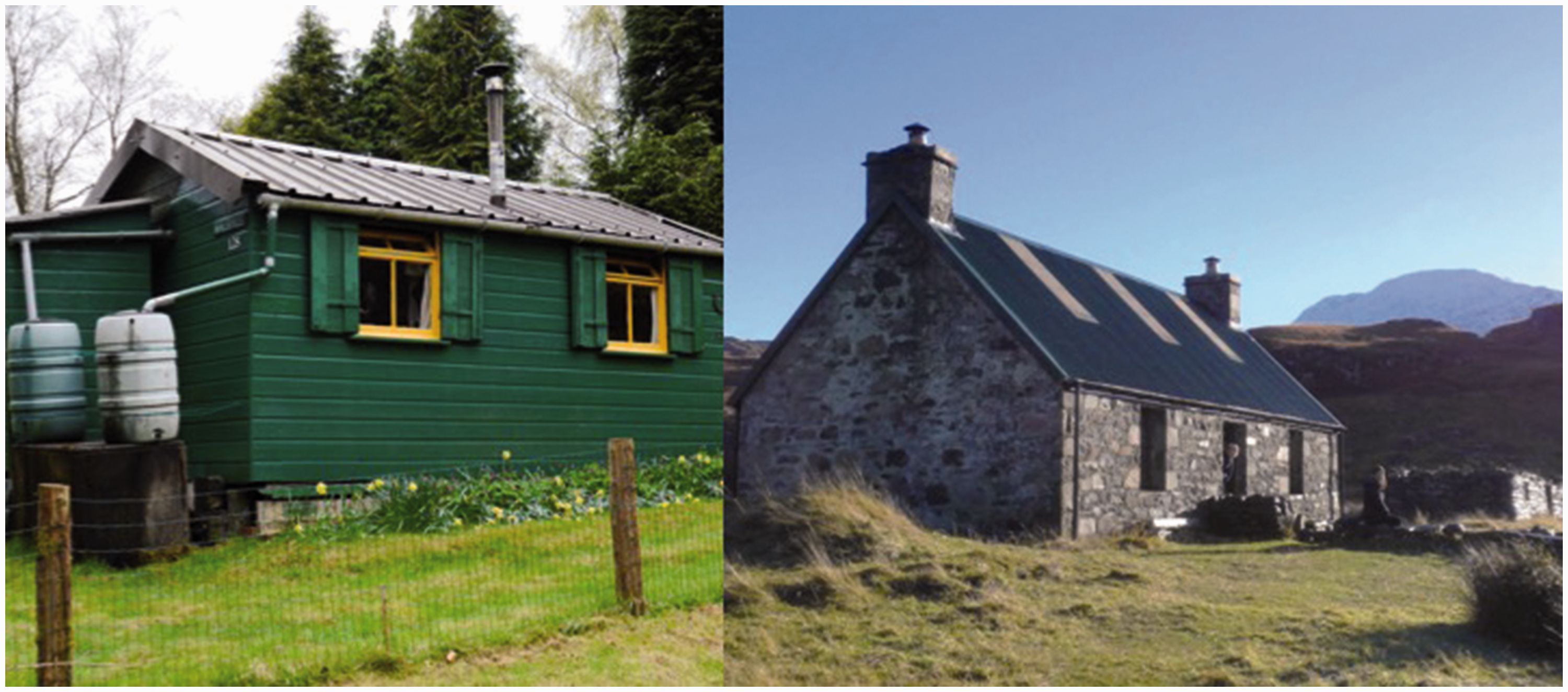
Left: example of hut at Carbeth outside Glasgow, right: Peanmeanach Bothy (author's own).
It is upon these two building types, 1 that I situate the notion of a quiet politics. This is a term that I propose to denote a politics which is active, present, but discreet in its operations. Not paraded, not publicised, but equally forceful in enacting change. It is a politics which allows for a radical rural machine. In this case it is the rural therefore that becomes ‘the space that enabled various strategies of becoming political’ (Mason, 2013: 281). These moments of becoming are, as Holloway (2002, 2010) would suggest, cracks in the system which often go unnoticed yet upon convergence have the potential for great change. The following arguments thus seek to address the less obvious, the overlooked and the more potentially progressive, even radical, nature of ‘out-dwelling’ as a political endeavour.
The data for this paper were gathered through analysis of the MBA archive currently housed at the A.K. Bell Library in Perth which charts the conception of the organisation through letters, meeting minutes, newsletters and handbooks. Information was also drawn from 32 interviews I conducted with ‘out-dwellers’ and members of their representative bodies. This amounted to days spent in the field, walking and talking as well as several more formal sit-down interview scenarios. Additional participant observation of ‘out-dwelling’ activities, as well the functioning role of the MBA and Thousand Huts Campaign enabled further insight. For further information on the project, see Hunt (2016, 2017). Exemplary moments are pulled from this data and reproduced here, reflecting snippets from the past and present of ‘out-dwelling’ culture in order to build the case for a quiet politics of everyday rural leisure.
What follows will be structured around the following four themes; conspicuous consumption, political concern, transgressive mobility, and land ownership. In doing so, the article draws together an argument concerning the use of rural land and the quiet politics of a particular, contemporary culture. As such it stands at the intersection of political, social and rural geography, offering one example of, and calling for further conversations in, the future of these sub-disciplines.
Conspicuous consumption of everyday leisure
The first focus of this paper concerns who has the right to be, and where. Here, I turn to questions over access to leisure, beginning with a comment from leading land rights activist and scholar Andy Wightman: The hunting estate remains the dominant landholding framework in the Highlands and Islands and, since its genesis, has resisted any attempt at reform bolstered by a political climate that has taken little interest in its affairs … Ownership of a Scottish hunting estate is the epitome of the hunting lifestyle, allowing for the enjoyment of exclusive hunting rights over large areas of country. This conspicuous consumption of leisure is thus intimately bound up with the ideology of landownership and the sanctity of property rights. Any challenge to the hegemony of the hunting estate attracts equally passionate defense. (Wightman, 2013: 223)
I wish, therefore, to posit the MBA as a radical movement in its very inception. Given the recent surge in popular interest in these rural shelters, documented in books, newspapers and on television it seems timely to highlight the importance of this organisation. As indicated earlier, it is the MBA who maintain ‘simple shelters in remote country for the use and benefit of all who love wild and lonely places’ (www.mountainbothies.org.uk). It is notable that from the inaugural meeting in December 1965, the members present were ‘unanimous that they will be open’, to maintain huts for ‘all’, to give access to the hills and valleys for leisure, for every person. It was 38 years before the Land Reform (Scotland) Act (2003) put political power behind this ideal. Such activism has often been unacknowledged in recent publicity. Moreover, the archival records of this organisation highlight their involvement in land issues, from personal battles for access to bothies, to relationships formed and lost with landowners, as well as records of threats of violence and minutes for meetings attended for the Wild Land Group amongst others. Today this organisation has negotiated access, maintained and protected around a hundred such buildings in Scotland. Arguably, this amounts to a track record of radicalism.
The MBA has, however, been criticised for being a little stiff, a little homogenous, in appearance, demographic and outlook upon the outdoors, perhaps seeming more like a home of reactionary rurality than anything more challenging. The MBA themselves are wary of their image and their future, noting in management meetings that the ‘user-ship’ has shifted over last 20 years. The same members who started this tradition are those involved in it today. There are fewer families and the average age of work parties (organised expeditions to conduct maintenance on these buildings) is rising all the time. This raises concerns for the future. As one committee member notes, there is no magic solution to a younger user-ship. One of the big challenges is galvanizing people, they are happy to use but not get involved … [and] lots of the Maintenance Officers are not good with social skills, good round the fire with a dram but they don’t advertise work parties to ‘strangers’, usually just them and their pal. (Maintenance Committee Meeting, 22 March 13)
In contrast to the under acknowledgement of the radical actions of the MBA, in recent years at least, the radical potential of hutting culture has been far more evident, profiled in the media and even finding its way onto the legislative agenda. The recent upsurge is largely due to the launch of the Thousand Huts Campaign by Reforesting Scotland in 2011. This group have acted, and continue to act, as a locus for hutting issues. It is through this group that a briefing paper drafted by Wightman and Planterose was presented to the Cabinet Secretary for Rural Affairs and the Environment in January 2013 which argued for ‘the creation of a planning and development regime for huts that provides a straightforward means by which huts can be constructed within the law’. This was a precursor to a motion in support of hutting voted in by 39 members of the Scottish Parliament in early 2013. This early action has seen real success with changes made to planning law through both the The Scottish Government (2014a) and the The Scottish Government (2014b). This was the first reference to hutting in national planning policy and saw acknowledgement that ‘the Scottish Government wishes to see rural areas playing an important role in supporting the quality of life of all, including through renewed interest in hutting and increased community ownership of rural assets’ (Stirling Local Development Plan Topic Paper: Stirling Council, 2015).
To many the original texts which host these changes will, admittedly, read as dry, technical and perhaps rather impenetrable. Indeed, such technocratic language is the bureaucrat’s greatest weapon. Many do not (or cannot) engage with this language, misunderstand it, avoid it, become bored by it and, as a result, fail to challenge it. Yet, this consultation nevertheless generated 787 consultation responses, demonstrating the level of popular interest in these simple builds and their potential to tackle the status-quo of land use.
Changes in hutting policy have since manifested in local planning documents (Stirling Council, 2015). Ideas are clearly shifting and hutting is now in the public eye and political lexicon. Both, it seems, harbour an appreciation that the time has come to bring this ‘outlaw’ culture into line with Scottish policy. ‘Hallelujah’ as Wightman writes: ‘for the first time ever in the history of land-use planning in Scotland there is a proposal that hutting should be encouraged, facilitated, and expanded’ (www.andywightman.com). The radicalism of this move is quiet perhaps but not gradual. It is transformative. Many of those interviewed were at pains to ensure that I would not publish the whereabouts of their hut but this was not the social elitism of early bothy culture, a fear of unknown others, undesirable elements. While there are issues of vandalism implicated in publication, anxieties over revealing a hut’s whereabouts more often concern officialdom, and the fear of retrospective reprisals on a building that should, by law, not have been built. Legal acceptance is therefore ground-breaking in hutting circles.
Similar gains are in the early stages with regards to building regulations (one of the two key points for which the aforementioned briefing paper sought to advise change). As the Thousand Huts publications attest, ‘[c]urrently, if you want to get permission to build a simple hut with sleeping accommodation you have to comply with the same building regulations as you would if you were building a house’ (Wightman and Planterose, 2013). Yet these buildings are patently not houses and most would not meet current building regulation standards. Those involved in this growing social movement are not blind to the implications of these changes, noting in discussions between the Thousand Huts Steering Group and the Napier University’s Centre for Offsite Construction and Innovative Structures that, ‘we’d be trailblazing in terms of this legislation’.
It is clear that these are revolutionary times. Quiet perhaps but forceful too. All of these agendas put Scottish people, and other citizens, more in touch with the land, a common resource which, over time, has been stripped away from the hands of the many and concentrated into the hands of the few. Monbiot (2013) talks of re-wilding people as well as lands and both cultures point this way, providing the means and impetus for people to engage with Scotland, beyond the urban, reclaiming ownership or at least access to land that for decades they have been denied. These cultures have made space in legislation, space in the imagination and, perhaps most importantly, space for better informed dialogue, for talking, growing and shaping ideas for a Scottish future.
The political as an active ‘out-dweller’ concern
In order to argue for ‘out-dwellings’ as demonstrative of a quiet politics, I next posit this culture as resistant to the current social condition. ‘Out-dwelling’ activities have thus far been neglected as a subject of academic concern and, therefore, fall within Philo’s (1992) suggested ‘neglected rural geographies’. Though practised by ‘ordinary people’ and through everyday activities, this is still a ‘counter culture’ (interviewee Giles), aligned with counter-urbanisation. ‘Out-dwelling’ culture adds an element of temporality to this phenomena of the counter-urban, since these are people who do not move permanently, they likely return to city (or town) lives. However, their ideals may remain comparable to those who move permanently to the countryside. And as Halfacree has more recently acknowledged, there is space for a ‘crucial rethink’ (2014: 516) of their current exclusion from the counter-urban imagination. It appears that ‘out-dwelling’ culture, figured in terms of users, practice and ideals, can readily speak to Halfacree’s (1997: 71) argument that ‘creative energies’ are where the radical edge of counter-urbanisation lies, and that such migration has ‘the potential to stir a radical ingredient into the emerging post-productivist countryside’.
Many from this counter culture saw ‘revolution’ (interviewee Hannah) as a descriptor of the radical potential of ‘out-dwelling’ to transform the relationship of people with land. Others interviewed were not shy about articulating the political potential of their endeavours: ‘I think the resurgence in hutting has been brewing for at least 10 years. People have a feeling of rejecting how society has gone’. These are the words of Karen Grant, Spokesperson for the Thousand Huts Campaign. Her campaign rhetoric, identifying a counter-modern edge to the ‘out-dwelling’ impetus, was reiterated in various settings, in talk of resisting the ‘clutter’ of everyday life (interviewee David), or the ‘speeding up’ (interviewee Grant) of society. There are echoes here of Pollan’s (2008: xi) conclusion that the hut is a place to ‘launch critiques on society’. While the draw of the wilds or the call of nature is often portrayed as therapeutic (Conradson, 2005) without thorough refection on the validity of that claim, there is also evidence to endorse Halfacree’s (1997: 75) conclusions that ‘abstract universal needs’ are both situated and date-stamped. Thus, ‘out-dwelling’ can be read within discussions of the postmodern condition of contemporary society which creates a reactionary rurality as individuals scramble to find meaningful identities in a society which no longer affords it. Rather than dismissing this as ‘a reactionary premodern nostalgic response’, Halfacree (1997: 81–83) argues for a ‘hidden subversiveness’ in these ideas, arguing that such practices could be read as ‘a form or dialectical synthesis between postmodernism and premodernism, refracted through the modernist concern for order’, or, in other words, an ability to see the benefit that traditional notions of order could have in finding understanding for contemporary life. At, The Bothy, the Hut and the Wild Wild Mind, a gathering of artists, authors and academics whose work focuses on the ‘Bothy’, it was noted that ‘a modern world has a different necessity for a hut’. These ‘out-dwellings’ have, therefore, established a new niche in contemporary society, one embracing both forward and backward glances to navigate the present. Rather than purely offering an escape from the modern, ‘out-dwelling’ can be seen as both a marker of existential concerns and a way to gain a sense of belonging in today’s world. It is here that counter-urbanisation has ‘the potential (whether or not realised) to feed into radical critiques of postmodern capitalist society’ (Halfacree, 2008: 485). I argue that this potential is being realised here, in relation to ‘out-dwellings’.
What I am drawing attention to is a small-scaled version of radicalism, quiet in its operations. It often goes largely unnoticed. Yet, it brings with it certain strength. Several users of ‘out-dwellings’ spoke of using these buildings to educate their children on a new way of life, a connection to land and older values with which to tackle future issues. Reduce, recycle, reuse here are set amidst ideas of thriftiness, a seeming integrity in making new from old. Huts in particular might not always have been seen to be progressive, not by all at least. One user spoke of being embarrassed to have a hut in his youth, the fashion then (and arguably now) was for holidays abroad. A hut spoke of poverty, not the well-publicised ascetic aesthetic which presently appeals. Today, however, interviewee James is aware of the potential of hutting, particularly as a result of recent events. I think it’s extremely political, yeah. I probably didnae always. I didn’t really find it much thought until recently, but the combination of the rent strike, the buyout process and what … Thousand Huts are doing, has highlighted to me just how political it is.
Nobody move: Mobility as transgressive
Issues of movement have also enabled ‘out-dwelling’ culture to trouble the imagined boundaries of a homogenous rural. Just as fractures in the imagined community of the idyll can impact upon the dominant view of the rural as cohesive, so too can this sort of ‘nomadism’ (Halfacree, 2007: 133) messy the urban rural divide. Examples of this exist within Halfacree’s (1996) research on ‘New Age’ Travellers and his more recent ‘critical response to the ‘non’ place of rural leisure within the counter-urban imagination’ (2014: 515) which highlight the contradictions in the intellectual positioning of rural mobility.
Within Scotland, although the ‘right to roam’ has been confirmed in law, this does not preclude the radical resonance of ‘out-dwelling’s inherent mobility. The mobility in question here pertains to the movement of persons to and from these ‘out-dwelling’ spaces, a movement afforded increased status due the temporary use of these buildings. ‘Out-dwellings’ are not places where people live, they are places that people visit and to visit requires one to arrive, and to leave. Here, I draw upon Sibley’s (2003) psychoanalytic analysis of movement within the rural environment which sees transience as troublesome, because it clashes with the dominant and sedentary view of rural life. Although formed in the unconscious, these anxieties evidence themselves in social, cultural and spatial practice as in Sibley’s (1997, 2003) historic examples of Navvies, Plotlanders and Gypsies, all people with transient lifestyles, and whose mobility is thus at odds with a perceived norm. While the ‘out-dwelling’ community is not defined by their mobility on an individual scale – members have permanent dwellings elsewhere – the practice of ‘out-dwelling’ culture as a whole is nonetheless troubled by this sanitising spatial impulse. For example, early communications between the MBA and landowners mirror this concern. As the following quote depicting the conversations involved in establishing an MBA bothy details, while a mobile usership was to be tolerated, an open door policy, with access for anyone, was not to be permitted. The project … on the Isle of Mull has fallen through … due to a change of heart within NTS [National Trust Scotland] hierarchy, when they realised that the MBA concept of an open bothy is literally that – open to all, at virtually any time without prior booking. We gather that the NTS were expecting the bothy to be open to all who had booked in advance and obtained the keys, and clearly as this was contrary to our aims we had to withdraw. (MBA Newsletter, 1982: 2)
Extending and complicating Sibley’s discussion of the imagined monolithic rural, is the way in which this exclusion of the poor is matched by an exclusion of those presumed to be wealthy. It is here that fears over rural second homes come to light. Wightman has often spoken of the problematic concentration of power and land in the hands of the wealthy, particularly the super-rich, but it is not at this level of wealth that anti-‘out-dwelling’ critiques are levied. Rather, there is a concern about re-appropriation of the rural by the urban, and worse still, the temporary rural dweller. Critique of this middle-class elitism permeates the language of many who critique these dwellings, but hut campaigners argue that their small, simple, temporary nature enables ‘out-dwellings’ to be ‘small homes there is no shame to own’ (interviewee James). Nevertheless, the assumption levied at Carbeth is that ‘it’s a middle class concern, hasn’t born out in reality… [it] isn’t all people who work for the BBC’ (interviewee Hannah). Likewise, the same interviewee Hannah whispered at the Carbeth Gala Day, ‘look around you, do these seem like the kind of people who have second homes?’, continuing; You know the Scottish index of multiple deprivation, we did an analysis based on postcode and over a third of hutters live in the top 15 percent of most deprived areas, and a significant number, 10 percent, live in the 5 most deprived areas.
Who owns Scotland?
Finally, in attempting to re-envisage the right to land I turn to address land ownership. Carving out political space for these activities does not automatically create physical space. Land ownership, rather than public access, public consciousness or physical mobility, is Scotland’s key problem. While figures vary, it has been argued that in 2010, 60% of rural Scottish land was owned by just 969 people (Wightman, 2013), the most concentrated pattern of land ownership in Europe (Sellar, 2006: 101). Again channelling Gramscian sentiments we come to what writer Gronemeyer calls ‘elegant power’, a power which ‘is characterized as generally unrecognisable, concealed and inconspicuous’ (Wightman, 2013: 3). As Lorimer (1997: 11) states, this vein of critical thought provides ‘a useful means to articulate these themes … [and explain] the tussle for control in the assembly of a new Highland order’. Unlike other European countries which experienced sharp revolutionary change in their modern histories, Britain’s political system acquiesced to critique, adapting at a glacial pace in order to suppress dissent and maintain (landed) power, under a veil of naturalised consent (Wightman, 2013); The institution of landownership in Scotland evolved gradually and it evolved under the political control of landowners and their agents in the legal establishment. This was the key to its survival and to the development of the current pattern of ownership. The role of the law has historically been to serve the interest of those in power. (Wightman, 2013: 2)
Within hutting circles some of those interviewed owned land and this, they admitted, was a ‘privilege’ (interviewee Douglas). But even these few were quick to emphasise that land ownership was a key issue in ‘out-dwelling’ provision. Without it users are continually at risk of eviction and their hut being destroyed. Without ownership hutters have no control over the future and less incentive to invest in ‘their place’. Emma, an artist who shares a hut on the west coast with her family, was one such person, at risk from eviction as her hut, while privately owned, was located on Forestry Commission land. Bought for just £500 her family had paid a ‘couple of hundred’ in annual rent in the 1970s rising to £800 by 2014. Insecurity was hence key to her experience, ‘so in a way we’ve been throwing away money every year because we didn’t own the land… [and] ‘if you don’t own the land … you can be asked to remove the house in a remote spot’. Historically, her family’s lease was renewed every ten years. It had been for decades. Yet at the last renewal the lease was given only four years, leaving Emma and her family in a state of uncertainty, precarious ownership resulting in ‘panic stations’ and a dread about the future which tainted those years. There is an important point to establish about long leases. If ‘out-dwellings’ are to increase the investment in people and place, soil and soul, then those providing land, must acknowledge that users need time and security, legalised in the provision of long-lease rents. This issue has been raised with the Scottish Parliament through a petition (PE014) submitted by the Carbeth Hutters Association in 2000. The case made little headway long term, although it led to a report by the Justice and Home Affairs Committee in 2000, which recommended ‘the introduction of an independent system of rent control and arbitration and new legal measures to give hutters greater security of tenure’ (in Wightman and Planterose, 2013), and was followed by the research paper ‘Huts and Hutters in Scotland’ (Scottish Executive Central Research Unit [2000] 2 ) and a consultation on the proposals to introduce legislation to ‘improve protections’. All of their activity ultimately resulted in no legislative action however, and so consequently insecurity remains the status quo.
Yet, for Emma, ownership was the ultimate goal. At the time of interview the Forestry Commission had agreed to sell the land for, what was at that time, an undecided price. This place, ‘Glennan the verb’ (interviewee Emma), was worth so much more than money, yet she could not invest, materially or emotionally in securing this site and her experiences, until ownership was obtained. One hutter circumvented this problem by buying her land by unusual means. Obtaining a half acre plot on which to site her hut through a ‘be a Scottish Laird’ scheme which aimed to sell small plots of land to those overseas, she capitalised on the commercialisation of North American nostalgia for the ‘motherland’. Notably these are still available on Amazon at a cost of £19.99 for one square foot. With regulations of 30 square feet currently set this would allow hutters to buy the necessary land for £600. A practical response to the chronic centralisation of landownership in Scotland.
As Halfacree and Boyle (1998: 8) note, ‘[t]he post-productivist opening-up of the countryside to new interests has promoted various dimensions of dispute and conflict’. Arguments such as this are all the more potent when opening is paired with ownership. Perhaps the most well-known example of a struggle over land regarding ‘out-dwelling’ arose from the rent strike at Carbeth and the subsequent buyout of the 90 acres for £1.75million by the Carbeth Community Company. During the years preceding the buyout the landowner, Mr Barns Graham, had sought to develop the land occupied by huts for more profitable ventures; leasing the land brought in £400 per hut in annual rent in 1997. Rents were thus raised, prohibitively so, by up to 47% for some huts (Justice and Home Affairs Committee 3rd Report, 2000) – ‘I think it was a psychological thing to get us off’ (interviewee Paul). In response hutters gathered together in an effort to stave off this financially driven form of eviction. A ‘Community Good’ fund was accumulated, gathering the withheld rent and using it, amongst other things, to pay legal fees for those facing eviction.
3
The landmark moment in this dispute came after a feasibility study, conducted by Fiona Jamieson in 2010 for Stirling Council, led to the huts gaining conservation status (Jamieson, 2000).
4
As Hannah explains, that was fantastic because it wasn’t just for the natural environment it was for the built environment as well, and it was kind of a vote of confidence that huts were part of [the], social history that ought to be conserved. And what it actually meant on a day to day basis was that unlike what had happened in other parts of the U.K, he [the landowner] couldn’t demolish the huts. a dream come true … we’re probably only just now [2014] starting to recover from the whole effort and energy and to start thinking what are the next steps and to start making a real difference in folks’ day to day lives. (interviewee Hannah)
Buyouts such as this should have been made easier since 2003, with the enactment of the Land Reform Scotland Bill and precedents set by communities in Assynt and Eigg. By 2011, around 425,000 acres of land across Scotland was owned by differing sorts of community-based arrangements (Wightman, 2013: 151). Land, it was supposed, would as a consequence be easier to come by. Bryden and Geisler (2005: 25) emphasise the connections between landownership and community, arguing that ‘the community’s right to buy is fundamentally a right “to be” and to secure a place-based arena of common identity and interests, protected by legal title’. Their argument thus suggests that community participation is somewhat ‘hollow’ if not supported by property rights, in their view ‘a key form of empowerment’ (Bryden and Geisler, 2005: 26). The benefit of ownership over access is certainly a challenge for future hutting development.
The discussion of community power is compounded by Mackenzie et al.’s (2004) appraisal of the role, creation and reworking of community in the new political spaces afforded by the ‘legal watershed’ (Bryden and Geisler, 2005: 28) of the 2003 Act and related legal changes regarding community ownership. Linking the debate to discourses of social justice and sustainability, Mackenzie et al., offer an exploration of the ways in which communities attempt to create a future in terms of land ownership that moves away from the dispossession of the past. Thus, they link conceptually to ideas of local resistance and the ways in which reclamation of that which was lost is key to a ‘culture of resistance’ (Said, 1994: 226 in Mackenzie et al., 2004: 160). Subsequently, the argument holds, rather than being acted upon as subjects in the increasingly globalised world, community ownership offers a means of remaking collective subject identities, changing ‘practices of the self’ (Foucault, 1985: 28) and contesting an ‘economy of sameness’ (Gibson-Graham, 2003: 54). Simply put, community ownership offers a means for greater social justice. Citing examples from before the Scottish Land Fund and Land Reform (Scotland) Bill (2003), Mackenzie et al. (2004: 178) claim that buyouts are not merely a reaction to policy change, but in fact cumulatively form a ‘quiet revolution’ slowly taking over Scotland. The Carbeth buyout falls within the province of this revolution and the growing evidence for a quiet politics.
Yet, this same buyout at Carbeth falls out with this legislation’s definition of community and questions broader ideas of how this term should be defined. As one interviewee Hannah explains, having become a community company, ‘frustratingly we weren’t going to be eligible under land reform legislation under the community reform buyout because we’re not residential, … it’s a technical thing’. As Bryden and Geisler (2005: 32) note, the issue with this ‘technical thing’ is that the 2003 Act has a limited definition of community which pays little consideration to the various interest groups implicated therein. This definitional deficit was raised in a 2010 ‘Post Legislative Scrutiny’ report of the 2003 Act (MacLeod et al., 2010), yet such a narrow classification of ‘community’ is continued in the current Land Reform Bill (Scotland) which, when introduced in June 2015, contained the following definition. A community – (a) is defined … by reference to a postcode unit or postcode units or a type of area as the Scottish Ministers may by regulations specify (or both such unit and type of area), and (b) comprises the persons from time to time – 20 (i) resident in that postcode unit or in one of those postcode units or in that specified type of area, and (ii) entitled to vote, at a local government election, in a polling district which includes that postcode unit or those postcode units or that specified type of area. (The Land Reform (Scotland) Bill, 2015)
Nonetheless, I want to be emphatic in stating that this issue of ownership is not a reductive polemic, figured around an oppositional ‘us’ and ‘them’ of out-dweller versus landowner. Many hutters recount good landowner relationships, citing the need for respect on both sides, and the preference for a code of conduct in terms of hutting practice. This relationship, they highlight, was key to a successful site. It is worth highlighting that this is different for those with individually owned huts on privately owned plots. The Thousand Huts too, are cautious of endorsing an all-out land grab, ‘especially in the modern day I think it’s important to make it appealing to landowners… ensure it’s a mutually beneficial relationship, [it] has to be sensitive and protective to the rights of both’ (The Thousand Huts Spokesperson Karen Grant). The issue of progressive landowner/user relationships is also particularly pertinent for bothies. Although the MBA do own one of the bothies they steward (bequeathed to their care) they do not otherwise own the land upon which these buildings sit. Since inception, the work of the MBA has relied on brokering and maintaining positive relationships between owner and user. Interviewees from this organisation were at pains to communicate that landowners were good, relationships were positive and the kindness of the owners was not to be taken for granted. This has not always been the case, with the archive telling stories of bothies boarded up, doors locked and threats made. Even now landowners threaten to reclaim bothies should the buildings or surroundings be abused, such is the case currently with ecological concerns over Peanmeanach Bothy, where live trees are often cut down for want of a warming flame (Figure 2).
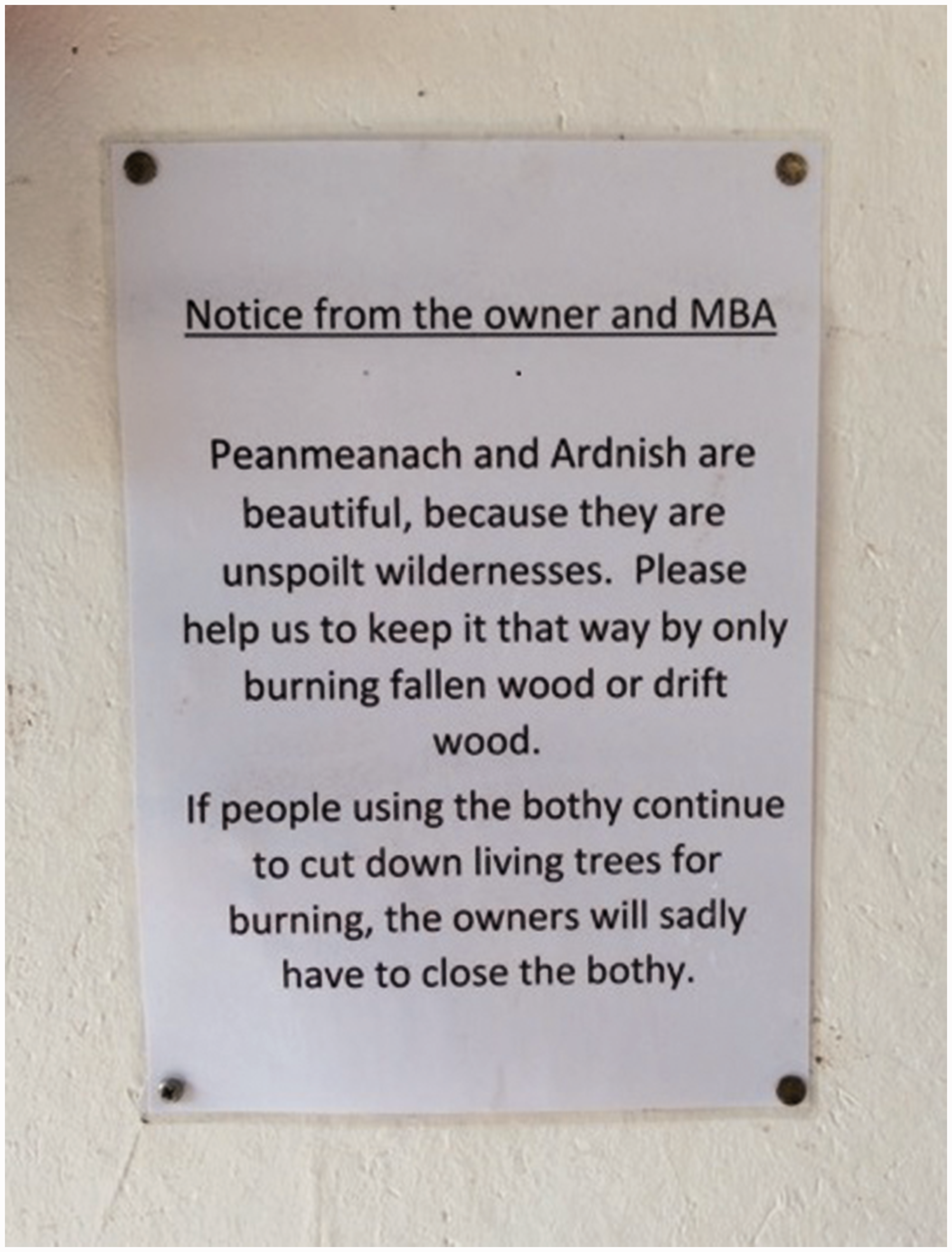
Notice from the owner and the MBA on the wall of Peanmeanach, August 2015 (author’s own).
While highlighting the dangers of a polemical attitude towards landowners and users, there remains room for a radicalism of landownership imbued in these cultures. It is the next bulwark to be challenged, the new frontier for this culture of quiet politics. The movement towards ownership marks a way to tackle these ideas of who owns Scotland, and a means of reconnecting people with land.
Conclusion
As the editors of this journal have recently noted, ‘a full view of the political must attend … to the politics of everyday, including questions of … marginalization’ (Daley et al., 2017: 4). I have followed that assertion in making the claim for increased recognition of a radical rural and calling for more work which emphasises the political nature of seemingly ‘provincial’ (Chakrabarty, 2000) sites of study. Of late it appears that rural geography, and particularly rural geography that attends to the radical potential of the rural, has been under-represented in academic conversations – especially those conversations which take place outside of the Journal of Rural Studies. Yet, as Mason (2013) states, ‘it’ is indeed ‘kicking off everywhere’ and this includes the radicalism of ‘out-dwelling’s quiet politics which offers a steady, seeping change, uncloaked in rurality and unnoticed yet powerful in its effects. While the larger political changes of the Arab Spring, Trumpism and Brexit might be more impactful and publicised, let us not overlook alternatives, not quash the attempts at change of cultures (like ‘out-dwelling’) for not offering a dramatic, and rapid enough shift. The same impetus abounds, a similar rising tide of discontent, of push for change, of response to the world in which people have found themselves. These ‘episodes of reaction’ (Mason, 2013: 262) emphasise the spatial politics of everyday leisure and land where alterity to the imagined geography of a static, wild, romantic, landed estate driven Scotland, emerges as a key driver for change. ‘Out-dwelling’ therefore stands as a process, a becoming and an example of the sense of a relational rural which can communicate, reinforce and generate radical expressions. It has the power to question who has the right to be, and where. This culture offers a resource for critiquing postmodern capitalist society, offering resistance through its very practice as an alternative to the hegemony presented. While no doubt facing a riposte from those who seek to defend their image of a selective and homogenised rural, ‘out-dwelling’ resists this stasis through bringing movement back into the Scottish rural scene. Add to this the politicised nature of land rights, access and ownership, and ‘out-dwelling’ is immediately embroiled within a wider context of radical transformations in the Scottish rural landscape. Thus while Wilbur is actually referring to the back-to-the-land movement, he argues with relevance to ‘out-dwelling’ that; The radicalism of …[‘out-dwelling’] is more akin to a lengthy experiment than a sudden revolution, but one that consciously seeks stable, replicable and enduring results. (2013: 157)
Footnotes
Acknowledgements
The authors would like to thank Gordon MacLeod, Clare Barnes, Douglas Mitchell, Christopher Philo, Hayden Lorimer and the two anonymous reviewers for their comments on various drafts of this work.
Declaration of conflicting interests
The author(s) declared no potential conflicts of interest with respect to the research, authorship, and/or publication of this article.
Funding
The author(s) disclosed receipt of the following financial support for the research, authorship, and/or publication of this article: The author was funded for this research by the College of Science and Engineering at the University of Glasgow.