




Abstract
Public protests in (un)democratic polities, reflective of discursive articulations of resistance and material expressions of struggle, seek to disrupt prevailing unjust societal, political and cultural practices. The insurrectionist purposes of protests are often in contravention of public order regimens, which seek to regulate enactments of public protests, minimise the disruptions inherent to protests and legitimise those defined as non-violent. This produces a non-violent–violent protest binary, which fails to account for the dynamic nature of protests. This study, critical of the non-violent–violent binary, assumed a multimodal analysis of unedited video footage of a selected authorised protest in the City of Cape Town, South Africa to understand the rapid discursive and kinaesthetic shifts that may occur within single protest events. The findings suggest that protests shift between moments of resistance and insurgency and moments of appeasement of official scripts. As such, protest enactments within a particular discursive space seem to be constitutive of resistance to power, insurgence and cooperation as well as actions defined either as legitimate or illegitimate by official discourse.
Public protests in (un)democratic polities, embodying discursive resistance and material modes of struggle, aim to interrupt exclusionary societal, political and cultural arrangements (della Porta and Diani, 2009; Duncan, 2016; Runciman et al., 2016). In these respects, protests are forms of opposition ‘in which bodies, symbols, identities, practices, and discourses’ are mobilised to either challenge entrenched relations of domination or oppose further exclusionary socio-political and economic manoeuvres (Taylor and Van Dyke, 2004: 268), representing the intertwining of extra-institutional and institutional politics (Oliver et al., 2003). In resonance with such conceptualisations, multidimensional analyses have examined the mechanisms and processes of protests (see Alexander, 2010; Paret et al., 2017) beyond a focus on causes and effects of protests (see Jain, 2010; Runciman et al., 2016). There is an increased concentration on protest events as units of analysis and on methodological pluralism that transcend the non-violence/violence, formal/informal and legal/illegal binaries evident in some studies of protests (see della Porta, 2014; Oliver et al., 2003).
The non-violent–violent1 protest binary may serve to vilify certain groups of protesters. For instance, in South Africa some media and official reports on public protests discursively situate protesters as irrational or irrelevant; demonise protest actions as threats to public safety; marginalise protests as unrepresentative of wider public opinion; and spotlight disruptive, violent and theatrical elements of the protests (see Duncan, 2016; Gitlin, 2003). Official scripts in South Africa tend to construct public protests as inherently violent despite the majority of protests occurring without incident (see Duncan, 2016; Jain, 2010). Runciman et al. (2016: 25) have therefore described the violent–non-violent protest dichotomy as ‘analytically obtuse’, and others suggest that it is evident of the oft-observed conflation of disruptive and violent protests (see Duncan, 2016; Paret, 2015). The binary and conflation obscures the actuality that disruptive repertoires, such as road barricading and tyre burning, in themselves do not result in injury to person or substantive damage to property. This either/or framework may thus entrench the notion of violence and non-violence as immutable, discrete categories and discount the hybrid and mutually constitutive elements of protests.
Not with standing the turn towards methodological and theoretical complexity that resists the non-violence–violence binary, studies on public protests have tended to exclusively rely on text-based data and methods. With the exception of research undertaken on the spatial dimensions of public protests (see Houssay-Holzschuch and Thébault, 2015; Iveson, 2017; Mitchell, 2015; Terzi and Tonnelat, 2017; Vigneswaran et al., 2017), that consider protests as an embodied spatial practice in public space, studies have generally neglected the multimodal elements and dynamic character of public protests (Doerr et al., 2013). Furthermore, research drawing from predominantly textual sources are inclined to overlook the interactional features, complex social actors, meanings and processes of protests and therefore typically do not offer depth understanding of the complex moment-by-moment unfolding of interactions that shape protest events (see Duncan, 2016; Zuev, 2016).
Observant of the analytical gaps and the turn towards multidimensional analyses, we undertake a multimodal study that examines the visual, aural, embodied and spatial aspects of a specific protest performance as well as the context of the protest performance. Our multimodal analysis of unedited video footage of a selected authorised labour protest in the City of Cape Town (CoCT), South Africa, approaches protests as complex enactments of organised dissent, and thereby resists the non-violent–violent binary (see Kress, 2009). As such, we focus specifically on the dynamic nature of the selected protest and the rapid discursive and kinaesthetic shifts that occur within the single protest event, with a view to furthering our understanding of the constitutive features of protests. We seek to illustrate how the selected protest, as a dynamic and complex phenomenon, incorporates, and shifts between resistance, insurgency and cooperation. Below, we briefly present the key conceptualisations within which we situate our multimodal analysis.
Protests as dynamic spatial practices
There are a range of spaces in which citizenship is practiced, encompassing invited spaces (which are spaces sanctioned by government and donors) and invented spaces (which are grassroot actions that fall outside sanctioned systems) (Miraftab, 2006). This conceptualisation locates social movements in social, historical and economic space, and draws attention to who can occupy, control, own and enact certain activities in that space (see Hammond, 2013; Mitchell, 2015). Space is thus (re)produced through struggle for resources, power and recognition (Vigneswaran et al., 2017). From this perspective, protest must necessarily be considered with reference to the contested and multiple in which citizens seek to (re)shape space, politics, economics and social spheres of being, thus extending beyond a mere ‘dualism between engagement and opposition’ (Oldfield and Stokke, 2007: 152).
Liberal, multiparty democratic systems expect citizens to express their socio-political and economic needs and aspirations through invited spaces, including the electoral system and associated mechanisms for democratic participation in public affairs. Ironically, invited spaces, meant to deepen democratic engagement, have been accompanied by a delegitimation of protest (Cornwall, 2008). When invited spaces restrict space for citizens to set their own agendas and meaningful modes of engagement (Cornwall, 2008), people may invent spaces for participation, through organised dissent (Miraftab, 2006), such as marches, pickets, blockades, strikes, sit-ins and occupations (Taylor and Van Dyke, 2004).
Protests, which occur outside of the regulatory framework of invited spaces, tend to be constructed by officialdom as a threat to the authority of the state, legitimacy of democratic dispensations, economic development aspirations and public safety (see Drury, 2002; Duncan, 2016; Gitlin, 2003; Robins, 2014). Such constructions, used by hegemonic systems to refute the social realities of marginalised, impoverished and displaced individuals and communities, underrate the systematic and structural violence resulting from unequal social structures and relations (Galtung, 1990), faced by many on a daily basis (Stewart, 2014). Even though a large number of linguistic and conceptual resources may be applied to discredit and delegitimise protests that are enacted outside of invited spaces (Drury, 2002), spaces for public participation in political and socio-economic processes are ambiguous and unpredictable (Cornwall, 2002). Cornwall (2004) argues that participatory processes are always in flux because power is a spatial practice. For the purposes of our analysis, we share Cornwall’s argument (2002: n.p.) that ‘“political space” is not only something taken up, assumed or filled, but something that can be created, opened or reshaped’ (also see Vigneswaran et al., 2017). This resonates with Lefebvre’s (1974/1991) recognition of space as both concrete and material, and socially and dialectically produced. Within this logic, participatory practices, including protests, constitute social arenas in which members of the public have the ability to influence development choices, and social policy and discourse, despite limited resources (Sinwell, 2009). Notwithstanding the regulation of protests, multiple publics may recreate spaces as social arenas and reappropriate these for something different to what was intended (Cornwall, 2002). Public protests as social arena are then modes of political participation through which communities can invent their own spaces to challenge the limitations imposed by formal channels and subvert them (see Mottiar and Bond, 2012).
Protests as organised dissent and struggle for socio-economic equity and political inclusion may take place on an invited–invented space continuum (see Miraftab, 2006). For example, many South African communities demanding meaningful participation in policy, governance and service delivery decision-making have moved away from sole reliance on the electoral process and other officially decreed pathways to public involvement. Increasingly, many communities are enacting public protests within invented and invited spaces as mechanisms to obtain effective service delivery, and socio-political and economic inclusion (Sinwell, 2009).
The point we underscore here is that public protests are dynamic and thus move rapidly between observing scripts imposed by regulatory regimens and insurrectionist practices shaped by social justice ideals. Public protests as spatial practices are adopted, subverted and reshaped by protesters to achieve social and political change (see Cornwall, 2004). In the ‘just insurgency, accommodation and precarity in resistance choreography’ section, we employ this conceptual framing to illustrate the fluid and complex dynamics of resistance, dissent and cooperation evident within the selected protest event, and the related struggle for socio-economic and political inclusion, as enacted on the invited–invented space continuum.
Method
Describing and locating the protest case
South Africa reports among the highest number of annual public protests on the African continent (Alexander, 2012; Joubert et al., 2015). Whereas public protests were fundamental to the anti-apartheid struggle (Petrus and Isaacs-Martin, 2011), in the post-1994 era they mostly signify opposition and resistance to neoliberal globalisation, manifest in rising levels of poverty, unemployment, inequality and unequal inclusion in socio-political and economic opportunities and decision-making (see Duncan, 2016; Paret et al., 2017; Stewart, 2014). The Regulation of Gatherings Act (RGA) protects the rights of all South Africans to engage in protests peacefully and unarmed, contingent on various conditions (Duncan, 2016). However, these legal and political frameworks may simultaneously echo apartheid era’s regulation of space and colonial dispossession (Iveson, 2017). The RGA can be used by authorities to sanitise public protest. Mitchell (2015) argues that space is made safe through these frameworks for capital and new urbanites. In South Africa, this continues to work across racial lines; most cities are still predominantly designed to privilege the white, middle class. Furthermore, through these legal regulations, authorities restrict protests to designated areas that relegate them to the perimeters of social, political and economic society (Mitchell, 2015).
We based our study on video footage of a municipal workers’ protest organised by the South African Municipal Workers’ Union (SAMWU), founded in 1987, which operates within the local government sector and has a membership of approximately 150,000 (SAMWU, n.d.). It has a ‘reputation for entrenched grassroots radicalism’ (Barchiesi, 2001: 385) and is affiliated with the Congress of South African Trade Unions (COSATU) and Public Services International (Barchiesi, 2001). The protest, supported by the Tripartite Alliance, as constituted by African National Congress (ANC) (the ruling party in the country), the COSATU and the South African Communist Party, took place in the CoCT, Western Cape, South Africa on 6 May 2015. The Western Cape is the only province in the country that the Democratic Alliance (DA) governed at the time of this study. The march was part of a larger SAMWU workers’ strike that began on 4 May 2015 and was broadly concerned with issues of discrimination and exploitation. Approximately 200 union members participated in the march, with march attendees being black, working class and predominantly male (S. Swingler, 2018, personal communication).
The RGA declared the march legal and required SAMWU to give the CoCT prior notice. The CoCT specified a route for the march that was to direct protesters from their site of assembly – Keizersgracht Street in the City Centre – to the Cape Town Civic Centre. The route provided by the CoCT circumvented the busier parts of the City Centre, including areas with a number of street vendor stalls. At the commencement of the march at Keizersgracht Street, the SAMWU marshals explained the approved route to the protesters. However, once the march started, the protesters deviated from the official route to the Civic Centre and instead chose a more direct route through the busier parts of the City Centre. The march ultimately ended as planned at the Civic Centre, at midday, where the SAMWU representatives delivered the memorandum of grievances to Mayor De Lille. There were some media reports of looting and disruption during the march (see Koyana, 2015; Phakathi, 2015). SAMWU (2015) released a press statement condemning the reported looting and suggesting that those responsible were a criminal element unaffiliated to SAMWU.
Data
We obtained footage of the SAMWU protest in the form of 25 video clips from a freelance journalist who works at a South African online daily newspaper, managed by a private media company with no political or religious affiliations. The newspaper has a strong focus on multimedia journalism, photo-essays and short videos. The video footage of the protest was ultimately edited into a short video published on the site. Since the journalist has covered several protests for various South African publications, we approached him to request access to some of his video footage. We accept that the journalist’s decisions on when, what and where to film may have influenced the shape and content of the video clips.
The 25 video clips varied in length from 6 seconds to 6 minutes and 14 seconds, and were 37 minutes and 32 seconds in length accumulatively. The journalist filmed the first video clip at 10 h 21, as the protesters gathered at the starting point of the march, and he filmed the last clip at 12 h 13, at the destination of the march. The journalist filmed almost continually, with an average of 3 minutes and 11 seconds of elapsed time between video clips. The longest break between video clips was 16 minutes 37 seconds and the shortest break between clips was 5 seconds, indicating the periods of the march not recorded by the journalist.
In our consultation with the journalist, undertaken upon initial contact and following our initial viewing of the protest footage, he offered background information on the march, including contextual details, such as protester profiles and the protest route, not altogether evident from the footage itself. He provided details on his physical position within the course of the march and his movements as the protest unfolded. It would have been apparent to march attendees and police that he was a journalist, as he was a white, middle-class male at an exclusively black, working-class march, bearing a handheld DSLR camera.
Multimodal analysis
Our analysis adapted Fairclough’s (2006) three-dimensional framework of discourse, consisting of text, discursive practice and social practice. Fairclough’s (2006) framework was adapted to semiotic resource (text), microsocial context (discursive practice) and macrosocial context (social practice). We represent the three-dimensional model diagrammatically in Figure 1. Fairclough’s (2006) model is orientated to language. In shifting from ‘text’ to ‘semiotic resource’, we acknowledge that discourse is constituted by language and through other semiotic modes (see Machin and Mayr, 2012; Wodak and Meyer, 2009). The semiotic text is the transcription of the video footage, explained in the data ‘Transcription’ section. The microsocial context relates to the broader discursive event, argued by Collins (1981) and Fine (1991), albeit with differing emphases, to render a meaningful frame for deciphering the macrosociology–microsociology nexus. This analysis then, while examining a microsociological moment, remains attentive to the macrosociological backdrop to the indicated protest. For this semiotic text, the microsocial context is the broader SAMWU protest within which the examined march was located, and as discussed above. The macrosocial context deals with discourse in relation to ideology and power, and situates power in relation to hegemony (Fairclough, 2006). As a counter-hegemonic representation, protest in South Africa remains inscribed within the enduring legacy of colonialism and apartheid, which persists in determining the coordinates of power in the contemporary context.
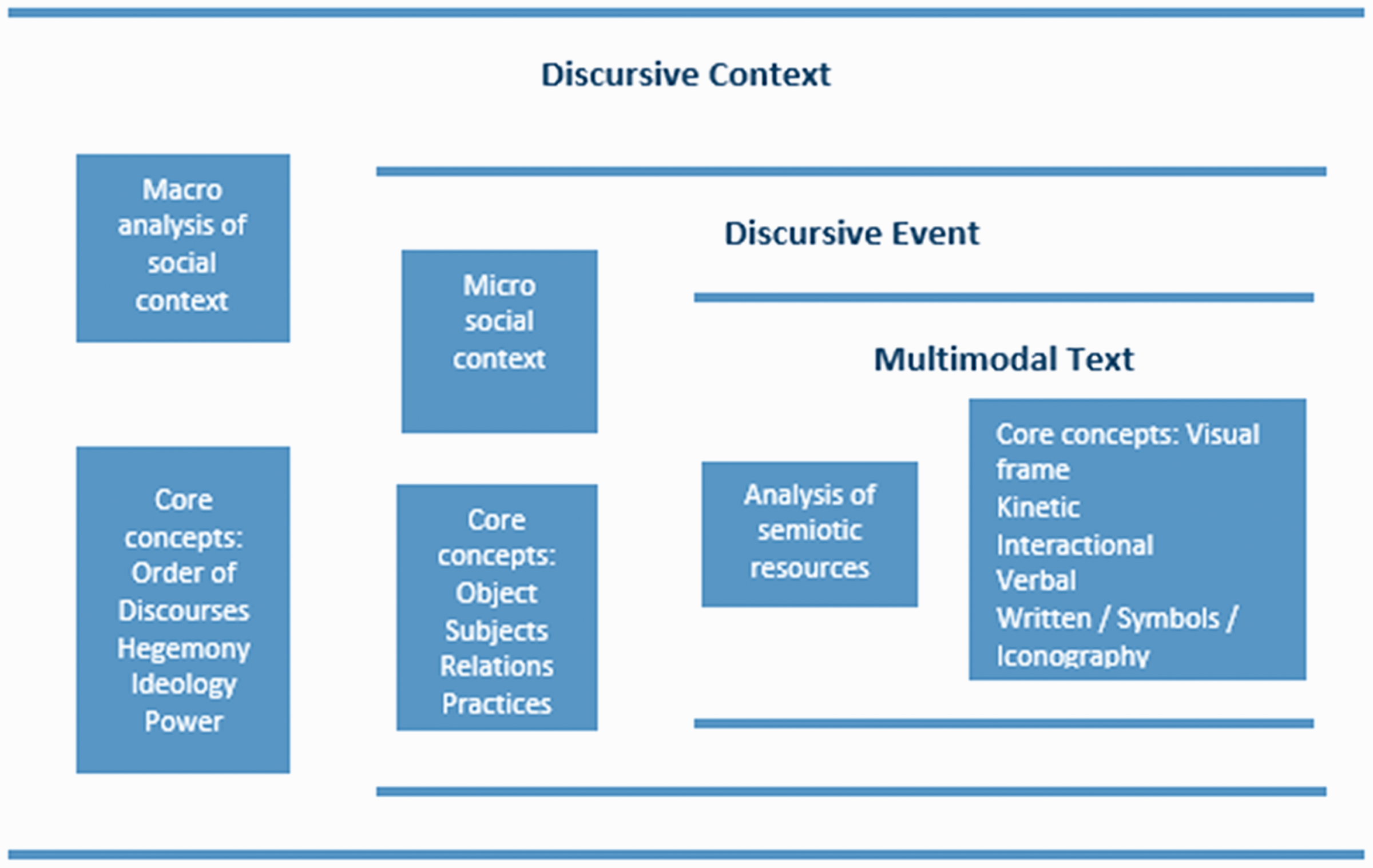
Model of multimodal analysis. Source: Adapted from Fairclough (2006).
We also drew on Willig’s (2008) six steps for Foucauldian Discourse Analysis. Accordingly, we (1) identified the discursive constructions of objects, (2) examined the differences between constructions and situated them within wider discourses, (3) located the discursive object within broader discursive contexts in which the differing constructions are employed, (4) considered subject positions that the discursive object offered, (5) examined the relationship between practice and discourse and (6) analysed the relation between discourse and subjectivity. This multimodal discourse analysis allowed us to review how protesters assumed subject positions and mimicked, adapted and/or resisted dominant discourses.
Transcription
Selecting an appropriate transcription method posed as a challenge given the lack of research on video data containing minimal verbal features. Resultantly, the method of transcription used in this study was adapted from the micro-analytical approach to transcription, aims to capture meaning-making processes and offers a fine-grained approach to examining the sequential unfolding of the protest (see Baldry and Thibault, 2006). We based our transcription method 2 on six horizontal plane levels, categorised as clip details, visual frame, kinetic, interactional, verbal and written/symbols/iconography. We transcribed a corresponding cluster of elements for each of these columns. For the first row, we specified and described the selected clip, and noted the duration of the clip. For the second row, we referenced a still from the protest video footage. In the third row, we referred to any salient behavioural or kinetic movements, such as walking, blocking a space or touching. For the fourth row, we examined the interactional functions and uptakes of the behaviours or kinetics of the protesters and other social actors. In the fourth and fifth rows, we referred, respectively, to the verbal features and written/symbolic/iconographic elements that we detected in the clip. Where indicated, we transcribed verbatim the video in isiXhosa, 3 then translated into English and back translated into isiXhosa. Our adapted transcription method involved selecting elements relevant to our research focus and context.
Just insurgency, accommodation and precarity in resistance choreography
Our analysis below suggests that the enactment of the selected protest shifted between discourses of insurgency and resistance and discourses of accommodation that resonated with the official scripts that sought to contain protest’s insurrectionist intent. The ambiguities and tensions that these contradictory discourses produced were evident in the spatiality and precarity of the protest performance.
Just insurgency and official regulatory scripting demands
Throughout the featured video clips, the protest, inclusive of struggle songs, rituals, placards, speeches and its underlying disruptive intent, was constructed as a legitimate means of expressing labour-related grievances and obtaining social justice. The protesters and SAMWU organisers, in particular, seemed to have invoked a discourse of just insurgency to legitimise the protest and the associated demands for redress directed to the CoCT’s administration. However, as we describe below, SAMWU officials punctuated this discourse of just insurgency with somewhat conflicting constructions that simultaneously appealed to protesters to observe and enact the protest march within the parameters legitimated by a democratic state and more specifically the CoCT.
Song and dance have a symbolic link to the anti-apartheid liberation struggle and act as discursive sites within which multiple publics are involved (Gunner, 2008). So, within a context in which the dancing body and song occupy an integral space in the discursive lives of trade unions in South Africa (Gunner, 2008), the protesters drew on a variety of liberation songs – resonant of the anti-apartheid struggle – throughout the featured protest. These included, Umzabalazo uyasivumela [The struggle is in our favour], Siyaya nomakukubi [We are going no matter how bad it gets!] and uSAMWU lo, u SAMWU lo abamaziyo, abazange bambone, abazange bambone [This is SAMWU, they haven’t seen us]. These liberation songs, etched in collective social memory, may have acted as a means of resistance to unite municipal workers and others experiencing exclusionary or unresponsive authorities, as in the CoCT (see Gunner, 2008). Liberation era songs, often embedded in masculine constructions of militarism and nationalism, not only invoke the memories of the liberation struggle, but in contemporary protests are also expressive of public anger and disgruntlement about the exclusionary prohibiting practices and policies of administrations in a democratic dispensation (see Gunner, 2008). Similarly, the protesters’ dance, or toyi-toyi, 4 was evocative of apartheid-era expressions of resistance to oppression. Before the introduction of democracy in 1994, toyi-toyi acted to unite and mobilise people in insurrectionary and liberatory struggle to overthrow the apartheid state (Cronin, 1988; Twala and Koetaan, 2006; von Holdt, 2018). Post-1994, toyi-toyi continues to have salience in South Africa despite the changed political context (von Holdt, 2018). In the contemporary context, the dance draws on the symbolism of warfare and violence to challenge state authority to highlight injustices (von Holdt, 2018). Research has constructed toyi-toyi as a socio-political ‘weapon’ for change in South Africa (see Twala and Koetaan, 2006). In the SAMWU march, toyi-toyi acts to rally the municipal workers against the unresponsive CoCT.
That SAMWU enacted this march in a city governed by the DA, the national opposition, which the Tripartite Alliance continues to regard as a white, capitalist-dominated party, may have conferred particular salience to the discourse of just insurgency. We suggest that in this context then, the dancing body and the liberation songs called forth an ideal of social being through the reclamation of voice, sound and body in a public space. Song and dance, according to Gunner (2008: 30), ‘become a means of empowerment and a means by which one inhabits or re-inhabits a tainted social space’. It would appear that the songs and dance acted to illuminate the continuities of the anti-apartheid struggle and demonstrate the resilience of the protesters in the face of long-standing worker struggles for socio-economic justice. The message of the songs, which situated the struggle as just, was supported by the various placards present at the protest, including ‘The Mayor. If you are the mother of the city, why do you treat SAMWU members as step-children?’ and ‘PHASI NGOBANDULULO KWISIXEKO SEKAPA’ [DOWN WITH DISCRIMINATION IN CITY OF CAPE TOWN]. Through the songs and placards, the CoCT was positioned as unresponsive and unjust while the protesters’ struggle was positioned as just.
Extract 1, clip 13, lines 19–26, 11:07 am: Speeches prior to the march.
The rituals on which the marshals drew on, which had a call and answer structure, invited the audience to participate. This call and answer structure, that is characteristic of protest in South Africa, is inspired by both musical forms and Christian modes of participation (Coplan, 2007; Tönsing, 2017). Its geneses are bound to collective forms of expression and ownership (Coplan, 2007). Hammond (2013) suggests that this structure provides a powerful listening platform for the historically silenced voices of black, working-class South Africans. This ritual is part of the vernacular of the everyday and is recognised as part of the protesters’ social language (Gunner, 2008). For instance, the imagery of ‘young lions’ drew on Oliver Tambo’s
5
reference to students and youth who defied the apartheid state and faced imprisonment, torture and murder as the ‘young lions of the struggle’. This situated the protesters within broader discourses of militancy and masculinity, while simultaneously positioning this march and the broader SAMWU protest as just.
Extract 2, clip 11, lines 5–11, 10:53 am: Speeches prior to the march.
Extract 3, clip 13, lines 49–53, 11:07 am: Speeches prior to the march.
Such songs and the marshals’ speeches worked together to create the sense of a just insurgency. The liberation songs, call-and-response salute, the raised fist and toyi-toyi act as an embodied public performance that remains at the centre of popular struggle (von Holdt, 2018). However, the marshals also situated this protest as a last resort within the continuum of broader negotiation strategies and in an extended timeline (see Extract 2, lines 10–11, ‘Grievances that weren’t addressed between one and two and four years’; and Extract 3, lines 51–53, ‘We’re not looking for anything new from the City. It’s what they took away from us is what they should restore’). This counters broader discourses that position protests as spontaneous and irrational (Drury, 2002; Duncan, 2016; Robins, 2014). In addition to locating the protest within a continuum of engagement and after invoking insurgent type subject positions, the marshals appealed to the protesters to ‘march according to the route that the conveners have negotiated’ (Extract 1, lines 25–26). This demonstrates a tension between just insurgency discourse and the overall intentions of a protest, and the official script of a city government that regulates how and where public protests are to be enacted. The tensions and ambiguities that arose between just insurgency and official regulatory scripting demands were not only limited to talk, but were manifest in spatialised processes, through which protesters accommodated and subverted power and domination. These accommodations and resistances were not linear, as we discuss below.
Spatiality and precarity in performance
The city centre has a dominant kinaesthetic field, which dictates the normative way of moving. Accordingly, the RGA, CoCT and protest marshals created a dominant kinaesthetic field to regulate how the protest march was to move within the city centre. Instead, the protesters navigated in a way that was external to the dominant kinaesthetic space, by assuming an illegal route, running and shouting, destroying property and looting, thereby producing a resisting choreography (see Parviainen, 2010). By choosing the illegal route to march, the protesters refused to proceed in accordance with both the rules of the city and the requests of the Union’s marshals. However, the performance of this resisting choreography in the featured protest was not linear and cohesive, with various social agents shifting between the dominant and multiple resisting choreographies. These resisting choreographies shifted between moments of non-violence and moments where the possibility of violence appeared palpable. The analysis below, spatialised in representation, describes the shifts between non-violence and violence that occurred from the beginning of the march to the point at which the protesters reconvened at the Civic Centre.
Research on the spatial repertoires of protest reports that in Cape Town marchers prefer routes that map the spatial layout of its colonial history (Houssay-Holzschuch and Thébault, 2015). At the start of the footage of the actual march, protesters are located on Darling Street and are moving in the direction of the Castle of Good Hope, the Grand Parade and Cape Town City Hall. These buildings were designed for colonial control and power (Houssay-Holzschuch and Thébault, 2015). The Castle of Good Hope is the oldest colonial building in South Africa and historically the centre of colonial control and dispossession. It was built in the 17th century by slaves, Khoikhoi, 6 Dutch Farmers and company workers. This is the first site of slavery passed by the protest, juxtaposing the protesters’ grievances against colonial violence and dispossession. The route then passes the Grand Parade, which is the main public square. Historically, a Dutch fort, and currently organised as a market space, the Grand Parade has been a site for political rallies over the years. It is where slaves were sold and disciplined, and the precinct where Nelson Mandela addressed the nation in 1990, after his release from prison, and in 1994, after his election as President. The Grand Parade is thus symbolic of both colonial violence and South Africa’s liberatory ideals. By selecting the illegal route, the protesters inserted themselves in public space that is associated with the country’s dual political narratives; this simultaneously forces dominant society to confront its exclusions, both contemporary and historical (Mitchell, 2015).
Although the protest started out following the illegal route and disrupted the dominant kinaesthetic field of the city and the RGA, at the beginning stage of the protest the resisting choreography produced by the protesters was non-violent and largely cohesive. An integral part of that resisting choreography was the singing of liberation songs and toyi-toyi. During that initial stage of the march, the protesters sang Umzabalazo uyasivumela [the struggle favours us]. In contrast, the marshals and police, through their requests for the march to turn around, produced a choreography that aligned with the dominant kinaesthetic field. The marshals drew on various interactional features (such as forming a marshal line, facing towards the protesters, walking towards the group and using physical touch to turn protesters around) to contain the march. The police assumed facilitator roles and did not use physical force to turn the group around, consistent with what della Porta (1998) has described as a more cooperative policing style that tends, in certain moments, towards collaboration with protesters. Instead, they moved with the group, requested the group to re-navigate with the use of a loudspeaker and used police vehicles to form a motorcade. Initially, neither the police nor the marshals treated this alternative resisting choreography as demonstrating the potential for violence.
The structured resisting choreography demonstrated in Darling Street, as described above, was not sustained throughout the march. The breakdown in the cohesive structure of the march occurred as the protesters moved from Darling Street into Adderley Street, the latter being one of South Africa’s most historical streets, situated in the central business district. The street is associated with both historical and contemporary protest. Along the route is the Slave Lodge, which is the second oldest colonial building in South Africa, initially used by the Dutch East-India Company for housing slaves, and later turned into government offices by the British. The building is now a museum that recognises the role of slaves in the building of the CoCT. As a symbol of colonial violence, this building garners a certain salience in the analysed protest by bringing to the fore the continued silencing and erasure of black, working-class voices.
There was a rapid kinaesthetic shift to a less cohesive choreography, which was characterised by a more volatile state. As the protest march turned at the corner, a group of protesters are seen running, with the marshals appearing to be unable to contain the forward movement. At this point in the protest, the singing was replaced by protesters’ chants and whistles. In that moment, while there was a breakdown in the structure of the resisting choreography, violence was still absent from the protest.
Extract 4, clip 21, page 4, 11:45 am: Protesters on illegal route and protest structure has broken down.
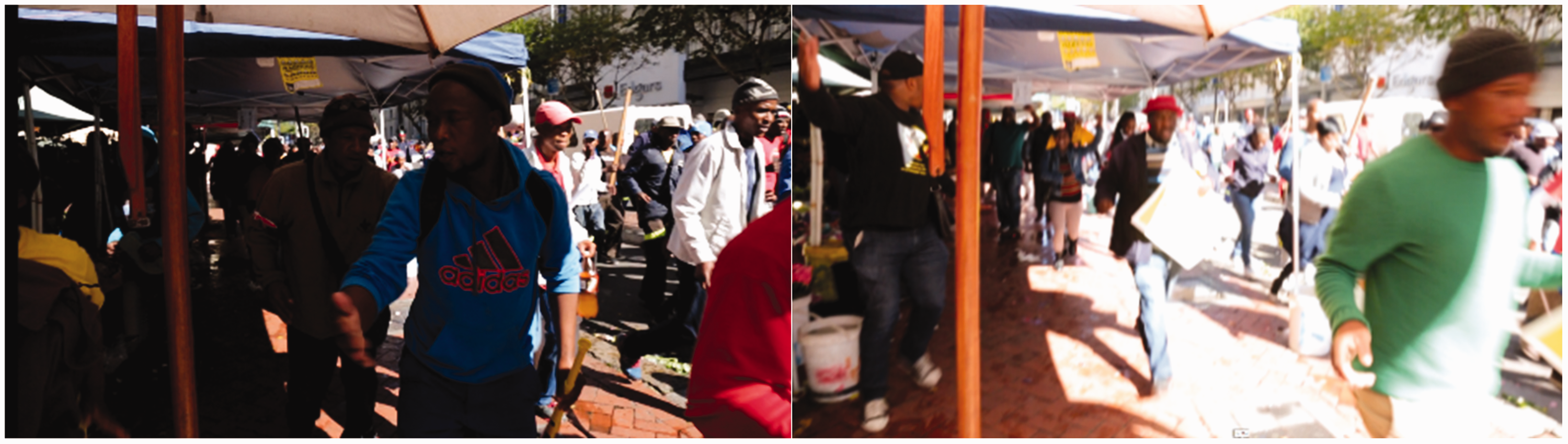
A moment later, as is illustrated by Extract 4, two marshals ushered a protester away from the vendor stalls at the side of the road while running with the group. The street vendors’ stalls in this location, on Adderley Street, predominantly sell food, cigarettes and electronics to commuters and city employees, and are owned primarily by South Africans. This marked the progression in disruption, which involved looting of stalls and damage to city property. However, other protesters continued with the resisting choreography. While this represented a moment of intimidation by the protesters, their efforts to disrupt the stalls were transient as they quickly moved away at the gestures of the marshals. The marshals aligned with the dominant kinaesthetic field of the city, and protected the street vendors’ stalls from the passing protesters. One marshal used quick hand movements with verbal cues to keep the protesters away from the stalls; however, this marshal did not stop moving forward. Even in this moment of disruption, the marshals seemed almost insouciant to the possibility of direct physical violence arising in this alternative choreography, that is the precariousness of the protest’s structure was not explicitly acknowledged by the marshals.
Extract 5, clip 22, page 3, 11:50 am: Protesters on illegal route and protest structure has broken down.
The precarity of the resisting choreography became evident in the moment that followed. This moment takes place on Adderley Street, approaching a traffic circle with a large fountain. Just beyond the fountain is the Van Riebeeck Statue, donated by Cecil John Rhodes and erected in 1899, and yet another symbol of colonialism. In Green Market Square, where the protest is approaching, many street vendors, often African Nationals, sell their wares – predominantly African curios – to tourists. Traders here appear to be in economic competition to those on Grand Parade or by the train station (Morange, 2015), highlighting the spatialisation of neoliberalism. As per Extract 5, some protesters temporarily drew on violent, xenophobic practices; the protest itself was not categorised as xenophobic. One of the protesters was heard asking, ‘Aphi amakwere-kwere?’ [Where are the foreigners?]. Amakwere-kwere is a derogatory term for foreign nationals. In this clip, we are able to observe the silhouette of a stick-wielding man, asking ‘Aphi amakwere-kwere?’ [Where are the foreigners?] in a threatening tone as a few protesters approached some street vendors’ stalls. This threatening act positioned the street vendors as foreign nationals who faced a real risk of violent victimisation.
This moment is entrenched in a systemic xenophobic sentiment in South African society, which has complex contemporary and historical political, social, economic and cultural dimensions (Dodson, 2013). Brought to the fore in this moment are the economic or material aspects of xenophobia and economic scarcity. Here, the competitive entrepreneurial paradigm of free market capitalism is enacted between South African and African foreign national traders (see Morange, 2015). In the context of a labour march to register unemployment, low wages and job scarcity, it would seem that the experience of structural violence as a result of capitalist competition is displaced onto the African foreign national, who is perceived to run a profitable business (see Morange, 2015).
Extract 6, clip 22, page 6, 11:51 am: Protesters on illegal route and protest structure has broken down.
Through a close viewing of this clip (Extract 6), we noted that this moment was the beginning of the harassment of street vendors, which happens on the corner of Adderley Street near Green Market Square. A subgroup within the protest march moved to rob the vendors of their wares. In Extract 6, a protester approached a vendor’s newspaper pile and removed the string around the pile while a few other protesters attempted to loot vendors’ stalls. At that moment, a marshal and a police officer, perhaps discerning the disruptive threat to the otherwise cohesive resisting choreography, moved towards the stalls to hasten away the protester and avert potential direct violence. The police officer moved to stand in front of the pile of newspapers and usher the protester away from the stall (‘Ag, voertsek’ [Oh, go away]). Through the use of this South African colloquialism, ‘Ag, voertsek’, the police officer seemed to have regarded the protester as a nuisance rather than a violence-inclined social actor within the protest march. However, it is worth noting that the intimidation and disruption of the vendors’ everyday life, livelihood and business may have been experienced by the vendors themselves as violence. Notwithstanding, here we observe a less collaborative policing style as the tactical repertoires employed by the protesters begin to shift and the disruption appears to intensify. Policing style is then never monolithically enacted, nor is it monocausal, but mirrors the mutability of protest dynamics (discussed in detail in a forthcoming article on police–protester interactions).
In the subsequent moments, the kinetic field shifted very rapidly as the police moved towards adopting overt militarised measures to contain what they may have perceived as unacceptable features of the multidimensional resisting choreography.
Extract 7, clip 22, page 6, 11:51 am: Protesters on illegal route and protest structure has broken down.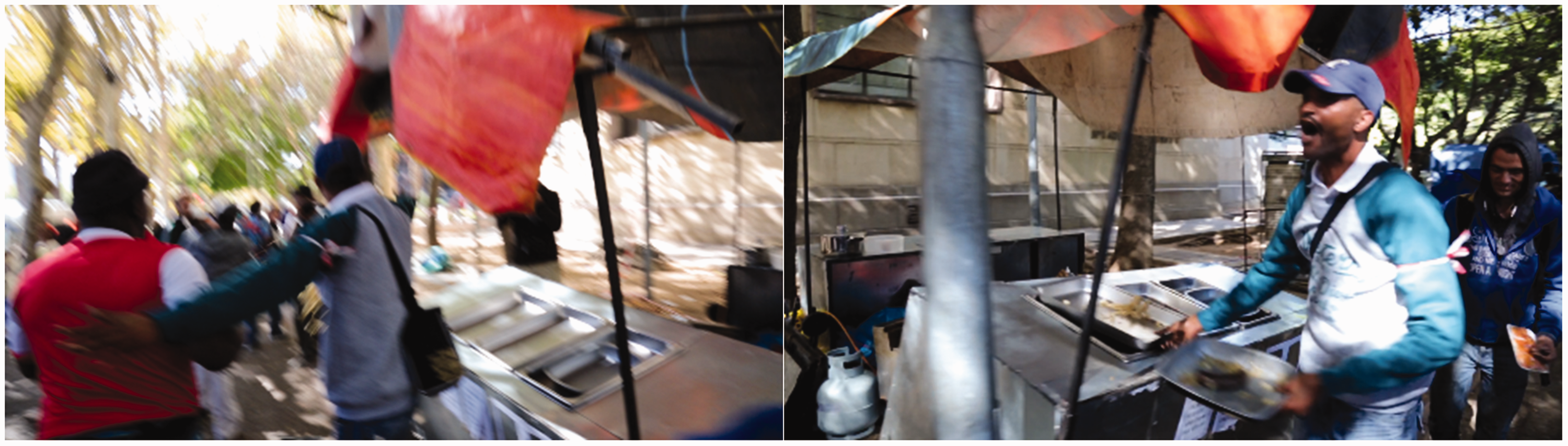
Through the resisting choreography, the protesters ignored the territorial boundaries established by the RGA route assignment, and subverted and evaded the controls of the authorities (the police and CoCT) and the marshals. Nassauer (2015) has suggested that such spatial incursion of assigned route boundaries may tend to be viewed as an escalation by the police who may then position the protesters as untrustworthy, irrational and potentially violent. The resisting choreography in its multiple manifestations may thus render protesters vulnerable to coercive and militarised police responses. Although by no means unique to South Africa, the South African Police Service is reported to show signs of increasing militarisation (McMichael, 2014). In the case of the SAMWU protest march, for the most part the police did not seem to appraise the incursion of territorial boundaries in itself as warranting a coercive or militarised response. The police also seemed to have ignored the protesters destroying city property, including bins, chevrons and other street signage. However, there are two moments when the police use threatening and militarised means to control the movement of the protest and the protesters. The first was the use of teargas around the same time that a few of the protesters began to loot vendors’ stalls, and the second was when the police used riot shields to barricade the Civic Centre, the seat of the City government.
Extract 7 reveals a subgroup of protesters trying to loot a street vendor’s stall. In that moment, we observed distinct differences in the responses of the SAMWU marshals and the police. A marshal in grey and green used his body to form a barrier between the stalls and the protesters, and adopted physical touch to encourage protesters to move along and to pass the vendors stalls. The marshal, who was also seen picking up fallen food trays from a street vendor’s stall, reminded the protesters to desist from practices that may undermine the non-destructive resisting choreography and overall legitimacy of the protest (Extract 7, line 1, ‘We are not going to break form!’). However, and in contrast, the police, 30 seconds later, fired six canisters of teargas to disperse the group. This was the first time that the police used coercive force during the march. While we cannot say with certainty that this is directly linked to the harassment of street vendors, since the precipitant to the use of teargas is off-camera, it does not appear to be coincidental that teargas is used shortly after the vendors are harassed. In that momentary space, the police assumed the subject position of armed protectors of the public and the City’s seat of government, as legitimised by the state. In was in that moment that the police shifted from treating the protesters’ spatial incursions as annoying or tolerable to an antagonistic stance that regarded the incursions as unacceptable and thus subject to direct coercive actions.
Extract 8, clip 22, page 9–10, 11:51 am to 11:53 am: Protesters on illegal route and protest structure has broken down.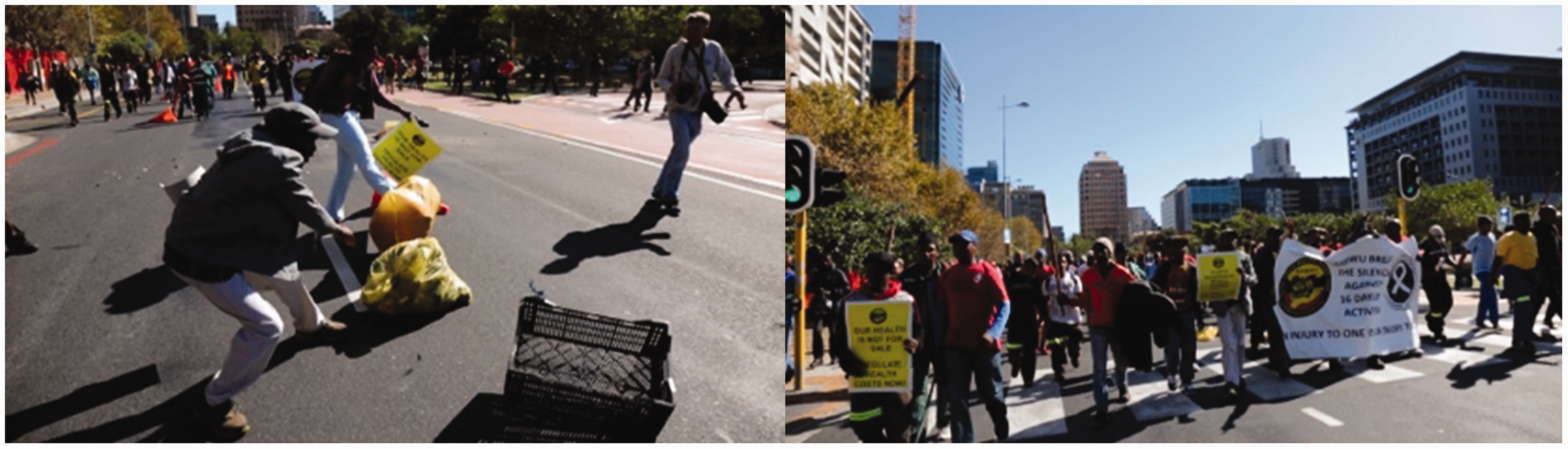
Then, as the protest march turned the final corner towards the Civic Centre, there was a further kinetic shift when the protesters reconvened and the protest itself seemed to assume a relatively more organised and cohesive structure once more. Even though subgroups of protesters continued to run ahead of the main march, scattered filled garbage bags around the streets, kicked crates and ran along quickly, many protesters returned to a walking pace. The kinetic shifts, together with the solidarity and struggle expressions (see Extract 8) and songs (uSAMWU lo, u SAMWU lo abamaziyo. Abazange bambone. Abazange bambone [This is SAMWU, they haven’t seen us!]), conferred a cohesive structure, somewhat similar to what was manifest earlier in the march. Despite the shifts towards greater cohesiveness in the last moments of the protest, the resisting choreography continued to be marked by multiple manifestations, with some subgroups not adhering to the organised structure, which simultaneously resisted and accommodated the City administration’s attempt at containing insurrectionist intentions of the SAMWU protest.
Concluding thoughts
Understanding protests as dynamic and complex phenomena, the detailed multimodal analysis undertaken here allows us to contribute to critical conceptualisations of public protests, understand the materiality of public protest that is often neglected in text-based approaches to the study of protests (see Doerr et al., 2013) and throw into relief the rapid interactional shifts between violence and non-violence. Observant of the macrosociology–microsociology nexus, and its attendant temporal and spatial coordinates, our analysis foregrounds the continuities in structural violence and narratives of resistance that mark South Africa’s political, social and economic landscape, and citizen engagement.
Our multimodal analysis suggests that protests are material enactments that are rooted within particular and broader discursive practices, locations and subjectivities (see Parviainen, 2010), and supports theoretical claims that protests are enacted on a continuum of engagement practices within invited and invented spaces (see Cornwall, 2002; Miraftab, 2006). Just as claims for social justice may adopt diverse practices, traversing the invited–invented space continuum, our study adds an additional perspective: resistance, insurgence and cooperation, and ‘legitimate’ and ‘illegitimate’ actions may be performed within a very specific discursive space, namely a single protest event. The identified discourses, along with shifts in the visual, spatial and kinetic elements of the protest event, lead us to understand that a single protest structure may move between cohesiveness and precarity, which in turn seems to elicit differing policing responses. More work needs to be undertaken to better comprehend the intersections between protest structure and policing practices.
In this sense, our multimodal approach, that prioritised the visual, spatial, kinetic and aural elements of collective action, also empirically affirms work that goes beyond simplistic and binaristic understandings of violence, and problematises the conflation of damage to property and violence (see Duncan, 2016; Paret, 2015; Runciman et al., 2016). More specifically, our study – that approached a single protest as a detailed unit of analysis – illustrates that violence and non-violence are not mutually exclusive markers of the constituency of protests, but manifest as conflicting and plural enactments within a single protest event. The rapid kinaesthetic and discursive shifts in the single protest event that we analysed reiterate that protests cannot be conceptualised as entirely non-violent or violent. Instead, violence and non-violence may be more usefully understood as enactments that are interactionally negotiated by each of the many agents present within the kinaesthetic field of protest events.
Our study reinforces the call for social movement research to continue undertaking nuanced and complex studies on protests across multiple environments and as specific practices within the invited–invented space continuum.
Footnotes
Author’s Note
Mohamed Seedat is also affiliated to South African Medical Research Council – University of South Africa Violence, Injury and Peace Research Unit, South Africa.
Declaration of conflicting interests
The author(s) declared no potential conflicts of interest with respect to the research, authorship, and/or publication of this article.
Funding
The author(s) disclosed receipt of the following financial support for the research, authorship, and/or publication of this article: This project is supported by the South African Medical Research Council Intramural Research Fund [grant number 47541]; and Unisa Ukuphepha 2: Demonstrating Compassionate and Safe Communities in Africa [project code 822500].