




Abstract
What is a home/house? How can we bridge between the concepts of a house, as a physical structure, and a home, with its symbolic and human meanings? The paper suggests an outline for a theory of housing/dwelling that considers the multiple facets of homes/houses: a top-down manufactured object, an ideal representation of ontological security, and a site of everyday lives and complex social relations. Combining several philosophical backgrounds—phenomenological dwelling, actor-network theory, Foucault’s dispositive, and Illich’s vernacularity—the home/house is investigated along three layers: (1) housing regime, that is the home/house as part of a broader system of planning, economy, or national goals; (2) critical phenomenology, aimed at finding and describing the gaps between the ideal-home image characterizing a given society and the home/house’s actual behavior; and (3) active dwelling, which regarded this gap as an engine for home-making as a political and agentic process. The theoretical arguments are briefly demonstrated through the case study of Palestinian homes/houses in the Occupied Territories, as political sites of both vulnerability and agency.
Introduction
What is a home/house? What does it do? What does it intend to do? How can we bridge between the concepts of a house, as a physical structure, and a home, with its symbolic and human meanings? Can we create a theory of housing/dwelling that considers the multiple facets of homes/houses: a top-down manufactured object, an ideal representation of ontological security, and a site of everyday lives and complex social relations?
This article presents an outline of a critical theory of housing/dwelling that has three complementary layers: (1) “housing regime,” in which the home/house is a feature in a wide system of planning, political economies, and state policies; (2) “critical phenomenology,” which explores the gaps between the ideal type of the home/house in a given society and its concrete embodiments; and (3) “active dwelling,” which investigates how the gaps between ideals and reality serve as sources for active agency, and, at times, even manifest resistance.
Therefore, this article examines the home/house as a political site, challenging the separations between the private and public realms and between the physical and symbolic dimensions of the home/house. It outlines a critical and political theory of housing/dwelling, combining phenomenology, actor-network theory (ANT), Foucauldian dispositive, and Ivan Illich’s vernacularity. The theoretical arguments are then demonstrated within a specific case study: the Palestinian beit (home/house) in the Occupied Territories. Being an integral part of the occupation regime, with its restrictions, violence, and demolitions, the Palestinian beit is also a place of active home-making, agency, and resistance.
Why do we need a theory of houses/homes?
Home is a contested concept in the academic literature (Blunt and Dowling, 2006). Beyond the physical structure of the house, the home is considered to be a socio-spatial entity (Saunders and Williams, 1988), a psycho-spatial feature (Giuliani, 1991), a “warehouse of emotions” (Gurney, 2000), and a “place” (Easthope, 2004). Home is also tied to notions of security and identity (Porteous, 1976). It is a place of routinization, where both the self and the longue durée social institutions are born and maintained (Giddens, 1991).
At the same time, however, it is seen and analyzed as a site of domination (Somerville, 1989); of danger coming from the inside, that is of domestic violence (cf. Freeman, 1979; Meth, 2003) or from the outside (Brickell, 2012; Porteous and Smith, 2001). It is a place of alienation (Bartram, 2016) and porosity (Baxter and Brickell, 2014)- a place that fails to maintain the promised separation between the threatening outside and the safe inside (Blunt and Dowling, 2006; Massey, 1992). In a long feminist tradition, the home is studied concerning its relations with the body, in relation to domesticity, and to the fragile line between public and private spheres (Blumen et al., 2013; Friedan, 1963). On top of these, we should add the home’s vulnerability, first and foremost in its potential to be physically demolished. Porteous and Smith (2001) define domicide as “the deliberate destruction of home by human agency in the pursuit of specific goals, which causes suffering to the victims” (12).
It is hard to find theorizations that tie the different facets of the home/house together. One of the important reasons for this is the lingual gap, since “house and home are related but not conflated” (Mallett, 2004: 63). The research of homes and houses has been separated into different disciplines, limiting the analysis to particular dimensions of the researched object. Hatuka and Bar’s (2017) analysis of contemporary housing studies found three main points of view: (1) housing as part of a top-down mechanism, be it the state or the economic market; (2) housing as a socio-cultural process, seeing homes and houses as a representation of wider sociological and cultural phenomena; and (3) housing as a personal experience.
The first approach is policy oriented and quantitative; it enables undertaking comparative studies, yet is limited when it comes to understanding the human significance of homes. The second approach identifies the social contexts of the home/house—seeing the physical structure as reflecting cultural norms and values—while underestimating both the political economy of houses and the personal significance of homes. The third approach focuses on individuals and human experiences. However, it limits the scope of comparison or analysis, since if “every person is perceived as an individual, every house is perceived as particular” (Hatuka and Bar 2017, 8). The same object (home/house) is thus analyzed through different disciplines, languages, and research methodologies, bringing up a need for “unifying framework that can incorporate both use and meaning” (Clapham, 2011: 360).
Peter King (2009) calls for a shift in the research of housing. Criticizing the tendency of housing studies to investigate houses—namely the production, consumption, management, and preservation of housing units—rather than homes, King argues that there is a need for a theory of dwelling, as an act related to the environment and personal aspirations of the dweller, which produces the housing unit as a meaningful place. King (2009) seeks to redefine housing as a specific phenomenon, and “from this position of phenomenological reduction to determine what housing is and does” (48). Only then we may begin building a theory and “to create our own metaphors” (48).
Rather than abandoning houses in favor of homes (or housing in favor of dwelling), however, I attempt to include both in the same analysis. It is the inseparability of the object and its uses that is at the basis of the decision to use the terms home/house and dwelling/housing throughout this article. The backward slash is not an either/or slash, but rather a way of simultaneously showing the inseparability—yet the inability of conflating one with the other—of the two sides of the object (see Clapham, 2011).
Toward a critical theory of housing/dwelling: Philosophical backgrounds
What does it mean to follow King’s call to study homes/houses from within, to strip them of former social science theories and to create our own metaphors? I understand King’s call for a theory of housing as a way to overcome the priority given in each of the abovementioned approaches to things that lay beyond the home/house itself—things that are assumed to predate ontologically the home/house. In other words, instead of seeing houses/homes as a side effect of the state/market, or as a reflection of cultural values or of the self, we should try to develop a language and research methodology that starts from the studied phenomenon itself.
The suggested outline for a critical theory of housing/dwelling builds upon several philosophical backgrounds. It combines phenomenological dwelling as an active way of “being in the world” with the methodological sensitivity toward the significance of materiality and nonhumans, as suggested by ANT. At the same time, it seeks to go beyond mere description—detailed and rich as it might be—in order to understand the political, social, and cultural aspects of the home/house. To accomplish this, I build upon Michel Foucault’s concept of the dispositive and Ivan Illich’s understanding of metaphors and vernacularity.
Combining the four philosophical approaches would enable us to explore the urge to dwell (i.e. the difference between homes/houses and other material objects); the interconnections between humans and nonhumans (the home/house itself, but as we shall see later, also elements as walls, windows, doors, and roofs); the political and relational role of the home/house in certain regimes of power and knowledge; and lastly, the ways in which dwelling is a political action of world-making, which can never be fully reduced to existing institutions and rationales. As will be demonstrated later in the Palestinian case study, a research that does not include both human and institutional perspectives—or a research that does not take the materiality of the home/house seriously—would be too partial and thin to describe the full human experience in its political and sociological contexts and implications.
In his “Building, dwelling, thinking,” Martin Heidegger (1971) refers to the fact that not every physical building is also a home, that is a place of dwelling. Dwelling, for Heidegger, is a way of being in the world, which is not passive and pregiven, but rather an act of de-distancing (Entfernung) the Dasein from its environment. To build a home—rather than just a building—is an active place-making. For Heidegger, the home/house is thus always a combination of the material house, of the act of building, and of the Dasein’s wish to de-distance itself from the world, by creating a home in it. Since humans’ basic condition is that of homelessness, the best they can do is “try on their part […] to bring dwelling to the fullness of its nature” (Heidegger, 1971: 159). Homes are thus never complete, and humans are never fully in the world, making dwelling a never-ending movement.
By tying together houses, homes, and the act of building, Heidegger proposes a way to understand the human significance of home-making. Nevertheless, his ideas refer to a general state of being in the world rather than to specific homes/houses, making it a limited tool of analysis. Moreover, referring to dwelling as an abstract existential mode threatens to naturalize and depoliticize the question of housing/dwelling.
Unlike Heidegger, Tim Ingold (2006) refers to dwelling as inherently political. The main shift is made from the individual Dasein, and the general human existential condition, toward the fact that we always live among other people. Thus, “while we may acknowledge that dwelling is a way of being at home in the world, home is not necessarily comfortable or [a] pleasant place to be, nor are we alone there” (Ingold, 2005: 503). Humans make homes because they are dwellers (Heidegger, 1971: 146), but this dwelling is political as it is always embedded in power relations, materialities, and histories.
Houses/homes are always part of power structures. The Palestinian case study will later demonstrate how the nearly total denial of building permits for Palestinians in the West Bank—and the resulted constant threat of demolition hovering above tens of thousands of “illegally built” homes/houses—creates a state of instability of both the house as a physical structure and the home as a social and personal need. At the same time, the urge to make a home as a way of finding a place in the world exposes the everyday dwelling as an inherently political experience.
Ingold’s (2006) perspective “tak[es] the animal-in-its-environment rather than the self-contained individual as our point of departure” (186–187), understanding dwelling as a coconstituted ecosystem of humans, tools, and environment. In order to inquire into the ecosystem’s specificities and politics, I propose adopting three additional tools: ANT to develop more sensitivity to materials, tools, and their interrelations with human actors; Foucault’s dispositive, to see how these human and nonhuman complexities are part of larger political rationales; and Ivan Illich’s concept of vernacularity, as a way of connecting individuals and societies through everyday practices.
For our purpose, the main potential of ANT lies in its being a research methodology with great sensitivity to humans, nonhumans, actions, and connections. It provides a tool for taking the house/home seriously: as a material structure, in its specificities of bricks, mortar, and design, without assuming the elements to be a straightforward model of—or a model for—society (Yaneva, 2012). Thus, by asking “What does a building do?” (Verkaaik, 2016: 139), ANT allows us to see what homes/houses enable or restrict, and how they tie together humans, nonhumans, and societies. We shall see later how various particles of the home/house (windows, walls, doors, and roofs) serve as “actants” in the humans–nonhumans network.
One of the characteristics of (and a point for criticism concerning) ANT is its closed and self-referenced way of undertaking an ethnography of humans and nonhumans in a system that “has no other” (Lee and Brown, 1994: 774). In a direct relation to the study of homes/houses, Yaneva (2012) describes the role of the ANT researcher as one that must “[j]ust follow and describe, describe and draw, draw and map!” (45). The lack of “other” is an advantage and a disadvantage of both ANT and dwelling perspectives. On the one hand, their insistence on describing systems as closed and self-referenced—as a means of taking care to refrain from proposing grand theories and “isms” that coerce the world into ready-made categories—develops a great sensitivity to details, and positions the object of study as its analytical point of departure (King, 2009). On the other hand, however, it risks creating a barrier between “how does it work” and “what does it mean politically and theoretically.”
The critical theory of housing/dwelling proposed here adopts the object-oriented point of view, yet insists on not losing sight of political and social significance. Foucault’s dispositive offers an interesting way of relating to materialities politically. The dispositive is: [A] thoroughly heterogeneous ensemble consisting of discourses, institutions, architectural forms, regulatory decisions, laws, administrative measures, scientific statements, philosophical, moral and philanthropic propositions […] The dispositive itself is the system of relations that can be established between these elements […] formation which has as its major function at a given historical moment that of responding to an urgent need. The dispositive thus has a dominant strategic function. (Foucault, 1977: 194–195; italics in original)
The combination of dwelling perspective, ANT, and Foucauldian dispositive enables to explore the home/house in detail, without abandoning its human significance nor its function as a strategic node in wider systems (economic, political, historical, philosophical). Nevertheless, houses/homes are more than top-down products of institutional systems, social structures, or mere representations of an existential urge of dwelling. Homes/houses are done and undone by everyday practices (De Certeau, 1984) that are always more than representational. I would therefore wish to add a fourth and last component to the philosophical backgrounds: Ivan Illich’s discussion of vernacularity and metaphors.
Illich (1981) defined vernacular practices as activities that make communities autonomous from both the market and the state. Vernacular activities develop “subsistence,” a concept that “implies not only an autonomous relation to the means of material survival, but also a complex dialogue between the individual and the collective” (Snowdon, 2014: 405). It is composed of intuitive knowledge and everyday practical know-how, which are fundamentally related to the question of dwelling, as the word “vernacular” stems from the Latin vernaculam, meaning “homebred” or “homegrown,” something “homemade” (Merrifield, 2015).
Being embodied, heterogeneous, and particular (Illich, 1982), the vernacular is still not idiosyncratic. When humans dwell, they create their own homes/houses, which are nevertheless part of a collective system. A research of homes/houses that takes into consideration the vernacular dimension should thus be “disciplined, critical, well-documented,” yet its deep meaning “can be understood only by means of metaphors” (Illich, 1982: 62, 76). Recalling King’s (2009) suggestion to study housing by “creating our own metaphors” (48), I suggest that we should take seriously the tension between a disciplined research and the need to create and decipher metaphors, as will be developed in the next section.
An outline for a critical theory of housing/dwelling
The philosophical backgrounds sought to make a fourfold basis for the research of homes/houses. Together they open a set of ontological and epistemological questions for better understanding the studied phenomena: “why” (do people build houses and dwell in them), “how” (they are built and dwelled), and finally “what does it mean” (to build a house and to make a home). The intention was thus to lay the ground for a theory of housing that starts from the studied phenomena; overcomes the disciplinary split between homes and houses, dwelling and housing; and which has its own concepts and metaphors.
A theory that takes dwelling, ANT, and vernacularity as its point of departure cannot—and should not—seek to be an abstract, impartial, and objective “science.” That does not mean, however, that the wish to theorize should be abandoned altogether. Discussing the meaning of theory in the social sciences, Abend (2008) distinguishes between seven different uses of the concept. It appears that Abend’s third type of theory best suits our purpose. Like other types of theory, theory3 explores connections between several variables, but instead of looking for abstract and mechanistic explanations for a given phenomenon (P), it asks: “‘what does it mean that P?,’ ‘is it significant that P?,’ ‘what is P all about?,’ or ‘how can we make sense of or shed light on P?’” (Abend, 2008: 179).
For Abend, theory3 is a hermeneutical task, offering a way of “making sense” by suggesting interpretations, contexts, and relations between individual actions and social systems and significances. It is a relational theory, wishing to better explain, interpret, and describe the studied phenomena—in our case, homes/houses and the act of dwelling/housing. The relational nature of the theory also entails a coconstitution of theory and methodology (Sayes, 2014). The tools that we use define our language of analysis, making the research methodology of how to understand and describe homes/houses a part of the theorization of what is a home/house.
In studying the home/house as a node in a net of relations, as well as a structure with an inner logic and action in the world, I propose three interdependent and complementary aspects of the home/house: (1) housing regime, (2) critical phenomenology, and (3) active dwelling.
Housing regime: Planning, building, demolition
Houses/homes are dominant instruments of power mechanisms: state planning, social discipline, urban renewals, welfare plans, capital investments, patriarchal modes of regimentation, military actions, and more. Houses/homes are part of a power dispositive, built in certain form and material features, based upon theoretical and practical assumptions concerning good or bad, efficient or inefficient, desired or undesired. These interrelated characteristics influence the entire life chain of homes/houses: their dispersion, design, and availability, as well as their human experience of dwelling.
Talking about homes without accounting for “how many houses were built?,” “where?,” and “how they are shaped and designed?” is as problematic as counting houses without seeing their human significance. Housing regimes thus suggest a double de-fetishization of the house/home. First, by exposing the production chain and the social life of the house as a component in a power/knowledge dispositive. Second, it is a de-fetishizing of the home as a psycho-symbolic place that allegedly has no materiality.
In ANT’s vocabulary, this is an act of punctualization (or “black-boxing”). The home/house is simultaneously a complex, multifaceted, and rich network in itself, and a “simple” actor in other systems. Instead of concentrating on one point of view (conceptualizing houses as being connected to issues of public policy and economics, or undertaking a phenomenological analysis of dwelling in homes), we may rather see their interscalar interdependency. Analyzing housing regimes necessitates a deep understanding of the dispositives of power in which the homes/houses are a critical component.
The need to understand different homes/houses, to study them beyond their physical building or demolition, and to expose the agency involved in the act of dwelling lead us to the next sections of the proposed outline. Providing a basis for a nuanced and contextualized thinking about the house/home’s doing and undoing, it acknowledges the fact that there is a full range between the pole of “the ideal home” and that of full homelessness. The home/house is a product as well as a process. It is done and undone in various ways, blurring the very notions of personal and political, inside and outside, private and public. For this purpose, I move on to critical phenomenology.
Critical phenomenology: The gap between the alleged and the concrete
In her account of the genealogy of the modern home, Kaika (2004) notes that it: became constructed not only as a line separating the inside from the outside (a house), but also as the epitome, the spatial inscription of the idea of individual freedom, a place liberated from fear and anxiety, a place supposedly untouched by social, political and natural processes, a place enjoying an autonomous and independent existence: a home. (266)
Dwelling is an ongoing effort to find a place in the world that is never fully achieved (Heidegger, 1971; Ingold, 2006). What a critical study needs to do is to understand dwelling in its contexts and specificities, between concrete images of the home/house (Easthope, 2004) and its vulnerabilities (Bartram, 2016). The first step is to map and describe the images of the home/house in the case studied, asking people what is an ideal home for them. The second move would then be to reveal the home/house actual function in the world, namely what it really does and how it acts. The critical characteristic of the study lays in the emphasis put on the gap between the alleged and the actual functions.
Critical phenomenology necessitates mixed methodologies, varying from qualitative interviews that describe what people think and say about concrete homes/houses and their ideal types, to a methodology that explores the materiality of the home/house and its cofunctionality with the human inhabitants and the general housing regime. Going back to the philosophical backgrounds, my suggestion is to combine ANT’s methodologies of mapping networks between humans and nonhumans with Illich’s use of metaphors as a method in the research of vernacularity.
My suggestion is to see the home/house itself, and its various material and functional features, as objects that have two bodies: first, as material actants in a given network; and second, as metaphors for dwelling in the world (see also Jacobs and Gabriel, 2013). We may think here of several such metaphors/instruments, such as roof, walls, windows, door, and the house/home itself (but also the neighborhood, the city, or even the state as a homeland). Each of these features is a material artifact displaying some kind of actual, observable “behavior,” while also simultaneously being a metaphor, representing an imagined relation with an abstract or generalized idea of dwelling and the meaning of home/house.
Hunt (2009), for example, develops the notions of “vulnerability” and “indefensibility” in order to define architectural infrastructures, such as open lobbies, dark corridors, elevators, or laundry rooms that do not allow one to keep building as safe and separated from the outside as their inhabitants might have wished (see also Bartram, 2016).
There is a clear interdependency between critical phenomenology and the contexts of the housing regime discussed above. A certain feature is not “vulnerable” or a “failure” in and of itself. Its vulnerability or indefensibility is derived from the larger dispositive in which these exist. Therefore, an elevator might be safe or unsafe, while the front door might succeed or fail in serving as a defense line, separating dweller from guest. Burrell (2014) shows how in a working-class Leicester neighborhood, the external windows and doors are a vulnerable feature, leading tenants to define their space differently by choosing to sleep in inner rooms, or by redefining the internal connecting door between the front and back rooms as “the threshold separating ‘out there’ and ‘in here’” (Burrell, 2014: 155). It is the wider context of the home/house and its surroundings that give each of its features their human and political significance.
The research of gaps between the alleged purpose of a feature and its concrete function opens an understanding of its deep human and more-than-human significance: what it allows or forbids, but also what it means for the people living in the home/house. What does it mean to live in a place in which the windows are a source of danger, rather than a place of air, light, and communication? How can we understand an unstable home/house, for example in a neoliberal rent market, when the physical house does not supply the alleged stability of dwelling? What does it mean to lose one’s home, beyond the physical shelter? What we need to stress, however, is that the gaps are productive and agentic by themselves, as they create what I would like to term active dwelling.
Active dwelling: Building as a verb
The idea of building as a verb (see also Turner, 1972) and of active dwelling arises from the assumption that the gap between the alleged home (as a safe haven) and the concrete one (which might be porous and vulnerable) is an active element. Ontological security is never given, but rather made and remade, a fact that makes the home/house a central feature in the political realm. It is a site of repetitive, performative acts taking place in and through the home/house. Humans make homes, and by that very act also produce and reproduce their selves and identities.
This is what Heidegger (1971) referred to, when noting the existential homelessness of humans and arguing that “building is not merely a means and a way toward dwelling – to build is in itself already to dwell” (143). Thus, instead of seeing homes as a given source of ontological security, it is the gap that will be considered responsible for the home-making and self-securing urges. Active home-making and dwelling is a performative act intended to reconstruct the damaged, imperfect home into a safe place it should have been. As a result, homes/houses are not closed objects, but rather ongoing processes (Kotef, 2010). It is not “home” but rather “homing” that we should be exploring, as an asymptote that never reaches the line, but is done and redone by the effort itself.
By building one’s home—or even by making one’s own room—the self is made and maintained. It creates a relationship between individual and society, in a language which is concrete and metaphorical at the same time. That is why building (as a verb) is deeply political: not only because homes/houses are built by the state or the market, in unequal and power-laden ways, but also because building is itself an act of world-making. Here Illich’s vernacularity is of special importance, as a set of bodily experiences and practical know-hows, intended to “make space” in the sense of creating subsistence and independence. It is “making room” in the sense of Virginia Woolf’s A Room of One’s Own: a place of independence, at times even resistance.
Theory that is better performed: The Palestinian beit in the Occupied Territories
The suggested threefold outline allows us to study homes/houses within their economic and state contexts as gaps between imagination and concreteness and as a productive site of identity-making. However, as noted regarding the ANT, sometimes a theory is “best understood as something that is performed rather than something that is summarized” (Cressman, 2009: 1; italics in original). The next section thus presents the case of the Palestinian beit (Arabic for home/house) 1 in the Occupied Territories as an example of analyzing specific housing regimes, critical phenomenology of ideal and concrete homes, and active dwelling as a way of “making room” for subsistence and resistance.
Housing regime: Nonplanning, criminalization, and demolition
Israel controls the West Bank and the Gaza Strip since the 1967 war. During the five-decade occupation, Israeli military rule has a major impact on nearly every aspect of Palestinian lives. While extensively developing the Jewish settlements (Allegra et al., 2017), Israel sets limits to Palestinian development and building. Aside of very few exceptions during the first five years of the occupation (Gordon, 2008), Israel does not initiate or operate any type of positive housing policy for the Palestinians in the Occupied Territories. The policy is one of nonplanning and nondevelopment (Bimkom – Planners for Planning rights, 2002; Braverman, 2008), which means, among other things, an almost total freezing of building permits. Furthermore, since the early days of the occupation, restrictions were imposed on Palestinian expansion by seizing large areas for military purposes, imposing unusual building limitations next to main roads, and prohibiting residence next to settlements and military installations. Many areas were declared nature reserves and various restrictions on building and agricultural activities were imposed there (B’tselem, 2002).
The Oslo Accords, signed in the mid-1990s, created a new regional division in the West Bank, separating the land into Areas A (under Palestinian responsibility), B (under Palestinian civil responsibility and Israeli military control), and C (under full Israeli control). While creating limited development opportunities in Areas A and B, the building authority in Area C (constituting 60% of the West Bank’s territory) remained entirely in Israel’s hands. For the most part, Palestinian requests for building permits on their private lands have been rejected by the Civil Administration. A UN report (OCHA, 2009) shows that between 2000 and 2007, 94% of Palestinian requests for building permits in Area C were rejected. Between 2000 and 2004 only three to six permits were given annually. In the years 2014–2016, only 53 out of 1253 applications were approved by the civil administration. At the same time, more than 2000 demolition orders were issued (Berger, 2016).
The significance of not issuing building permits is that tens of thousands of houses built in the past five decades have been deliberately criminalized, and the threat of demolition hangs over the heads of the residents without any real possibility for decriminalization and living a safe life in a stable home.
To the housing regime one must add the vast demolition of homes/houses since 1967. There are three types of demolitions: demolition of illegal structures; punitive demolitions by order of an army officer, often after a hearing and legal revision; and demolition as part of a combat-operational action, sometimes in the midst of battle and sometimes as part of a planned operation dubbed “exposure” in military jargon, referring to the opening of pathways for movement and observation and the removal of possible hiding places. Between the years of 2014–2016 alone, 2000 demolition orders were issued and 983 of them have already been executed. Overall, according to data of the Israeli Committee against House Demolitions (ICAHD.org), between 1967 and 2017, 48,743 houses were demolished in the Occupied Palestinian Territories.
The Palestinian beit is therefore part of a top-down housing regime, whose rationale is of nonplanning, de-development, and demolishment. It positions the beit as vulnerable to institutional laws and practices. However, this constitutes only the first layer in understanding the system in which these homes/houses exist and act.
Critical phenomenology: Between safety and vulnerability
Christopher Harker (2009) notes that the main sense of beit for his Palestinian interlocutors was connected to family, as well as a feeling of security arising from being situated in space. Akesson’s (2014a) findings are similar, with qualitative research in which Palestinians define home as a site of family practices, a center of identity, and a place of protection (see also Jamal, 2009). Nevertheless, in the face of the occupation’s apparatuses of violence, surveillance, and control, the home/house also serves as a “cage” (Akesson, 2014a) and as a site of danger in and of itself (Akesson, 2014b).
The critical phenomenology sought to map and describe the home/house’s components while emphasizing the gaps between alleged and actual functions. Each of these components, however, creates a set of social relations, political definitions, and lingual metaphors related to common divisions such as inside/outside, private/public, safe/dangerous, welcomed/unwelcomed. Home is imagined as a castle; walls are built to separate the inside from the outside and prevent the entry of undesirable elements; windows are used to observe the outside and to enable sunlight and air to enter; the door’s main function is to separate the inside from the outside, the private from the public, and residents from guests or invaders; and a roof that keeps the weather out and serves as a symbol of stability.
Close examination, however, shows that these components may fail in fulfilling their alleged purposes. Following the actants/metaphors is thus a tool for investigating the phenomenology of everyday dwelling in houses/homes.
Roof
When travelling in the West Bank, one may encounter “illegal houses,” lacking a roof—possessing instead just a canvas that protects from rain—in order to prevent its demolition by Israel. The rationale is a common belief that as long as the structure is roofless it is not considered a house and therefore will not be destroyed. In another case, a family from East Jerusalem was ordered by an Israeli court to remove tin plates from their home’s roof—20 years after their laying—or else they would be forcibly evacuated. Removing the tin plates from the roof exposed the entire house to rain, sun, and wind, but the risk of evacuation was yet more threatening (Akesson, 2014a).
These cases seem to represent a perverse inversion of the “tower and stockade” Jewish settlements, built overnight in British Mandate Palestine during the 1930s in order to create faits accomplis (Rotbard, 2003). British colonial legislation also stated that the moment a structure has a roof it is defined as a house, except that in that case the definition provided protection. In British legislation, the moment a structure was defined as a house, it was impossible to destroy it, whereas in Israeli military legislation the moment a structure is defined as a house, it is open to destruction. In other words, the roof, instead of providing double protection from the weather and immediate destruction, renders the house destructible.
Another function of the roof, as revealed in air attacks on the Gaza Strip since 2009, is to serve as a type of door. This practice, known by its military nickname of “roof knocking,” means that in order to announce the upcoming bombing of a home from the air, a “small missile” is fired at the edge of the roof. The message is “Get out. In a few minutes, a large missile will be shot at the middle of the building.” This is a message that the inhabitants are supposed to understand in the middle of a noisy war in a dense city or a refugee camp (see Joronen, 2016). The roof, which initially served as protection, became an instrument of communication that paves the way for the house/home’s destruction.
Walls
Walls are supposed to separate the outside from the inside as they constitute a passive defense from outdoor hazards and unwanted guests. Eyal Weizman (2007) has described at length the “inverted geography,” in which soldiers refrained from using roads, alleys, and yards, advancing instead by creating holes in walls, ceilings, and floors. In this way, they turned the inside into the outside: private homes became public roads, while roads, which are militarily inferior in such warfare, became “out of bounds” (see also Abujidi, 2014). Speaking with Weizman (2007), the military commander described the principles of penetrating the refugee camps: This space that you look at, this room that you look at, is nothing but your interpretation … The question, is how do you interpret the alley? … as a place… to walk through or … as a place forbidden to walk through? We interpreted the alley as a place forbidden to walk through, and the door as a place forbidden to pass through, and the window as a place forbidden to look through … This is because the enemy interprets space in a traditional, classic manner, and I do not want to obey this interpretation and fall into his traps, I want to surprise him. … (198) ‘Get inside’, he ordered in hysterical broken English. ‘Inside! – I am already inside!’ It took me a few seconds to understand that this young soldier was redefining inside to mean anything that is not visible, to him at least. My being ‘outside’ within his ‘inside’ was bothering him. (quoted in Weizman, 2007: 73)
Windows
Windows are made to be used mainly for looking outside and for allowing air and sunlight to enter. Opening a window to the world is a metaphor of connection and openness, just as we may speak of windows of opportunity as a potential for new things to appear. It is thus an instrument of de-distancing the inside and the outside. During times of intense warfare, however, windows might be a source of danger. Several testimonies of ex-soldiers have described a regular procedure, though not put into writing, of shooting to kill anyone who is defined by the commander of the force as lookouts, which are people […] preferably holding binoculars, but if they aren’t – no big deal […] Someone who appears to you as though he’s observing some tank, standing and looking at a tank, it could be at a window or on a roof, or so, you shoot to kill. (Breaking the Silence, 2012: 137)
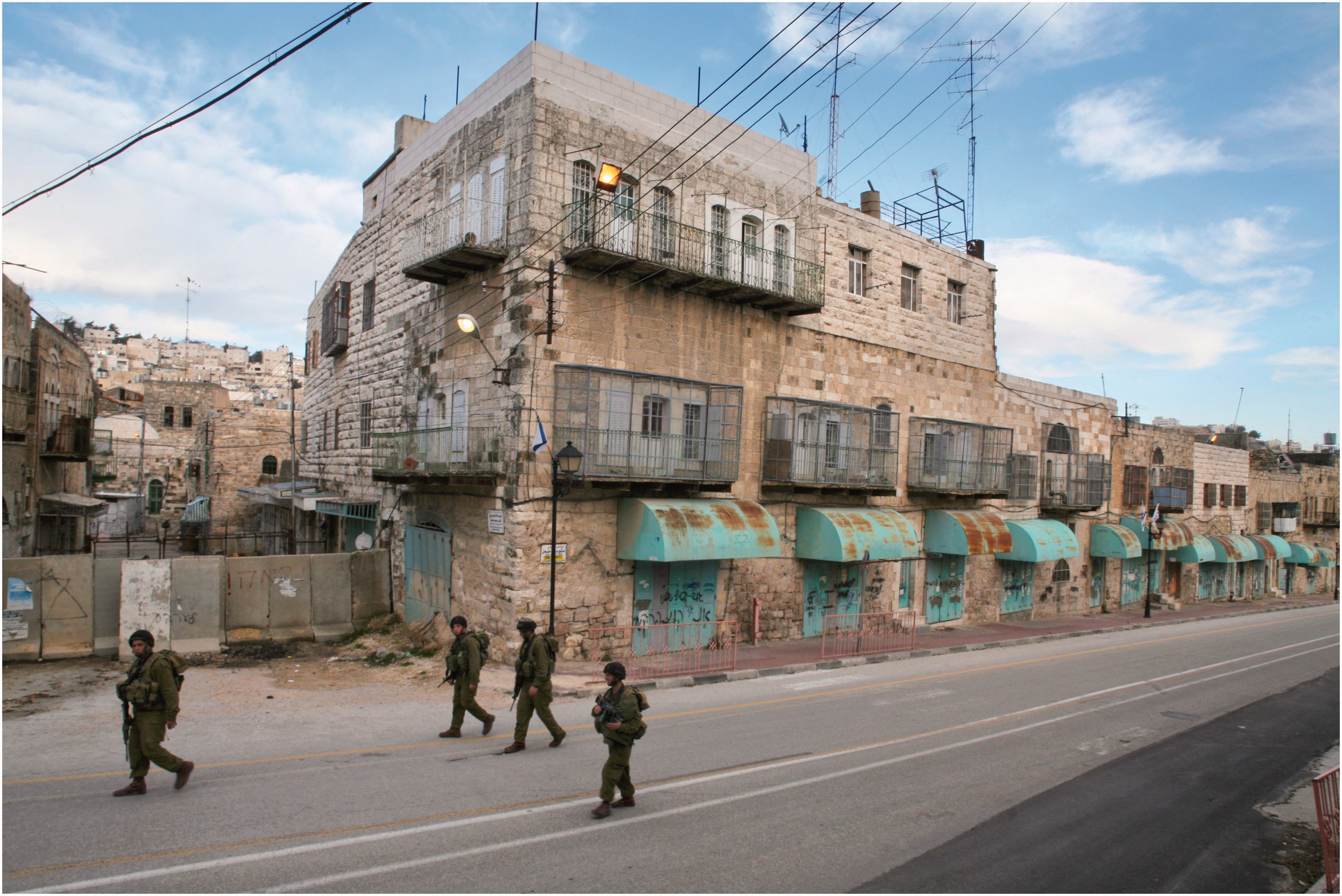
Shuhada Street in the old city of Hebron. Main doors are sealed by military order, windows facing the street are caged due to fear of settler’s violence, roofs turn into military bases, and walls serve as canvas for racist graffiti against Palestinians. Source: photograph: Keren Manor, Activestills.
Doors
Doors become the objects that can be blocked (e.g. Shuhada Street—once Hebron’s main street—where all the doors have been blocked, either by the army or due to fear of the settlers, with the residents going in and out of their homes/houses through back windows); something that is knocked upon or broken down in the middle of the night during searches; something that no longer serves as a symbol of the autonomous choice that distinguishes between resident, guest, and invader, but rather turns into a symbol of lack of choice. If the army chooses a certain house as a temporary or permanent guard post, it takes over most of the space, including the main entrances and exits, and relegates the inhabitants of the house to specific rooms and back exits, in coordination with the army forces. The threshold between “inside” and “outside” moves to internal doors, which, again, do not signify choice, but rather the lack of.
The Palestinian beit should thus be understood through the gap between its image as a safe place, site of family practices, and identity (Harker, 2009)—and its experience as closed and overcrowded place in which one has no privacy and feels like a prisoner (Akesson, 2014a). The criminalization of homes/houses due to lack of permits, as discussed in the previous section, exposes the Palestinian house to a permanent risk of demolition. Physical demolition of the house creates a broader harm due to the destruction of its emotional and social aspects, namely the home (Harker, 2009). However, the inherent scarcity of permits breaks the home/homelessness dichotomy, as it creates intermediate conditions in which housing is insecure and unstable; cases in which there are walls and a roof but the house lacks the alleged stability of a home (Heywood, 2005). The embedded instability may give rise to situations in which home demolition occurs even though the (physical) house still stands.
However, as argued above, it is exactly this gap between the alleged and the concrete—that is between the image of the home/house as a safe place and the reality of it being at times temporal and fragile—that creates the active dwelling as means of subsistence (Illich, 1981) and resistance.
Active dwelling: Building a home/house as a means of resistance
While the five-decade old occupation has clear effect on every aspect of people’s lives, reducing the Palestinian’s essence into a mere passive product of the control apparatuses would be factually, as well as politically, wrong. Moreover, one cannot think of the occupation without taking into account the active resistance and the insistence on living, despite the hardships.
Building and dwelling in the Palestinian context can be understood as acts of subsistence and resistance. Sumud is the Arabic word for “adhering” or “stubbornly standing” (Abujidi, 2014; Hammami, 2004; Shehadeh, 1982). This is an old Palestinian practice manifested in cultivating the land despite the uncertainty and the frequently threatened possibility of expropriation, in refusing to emigrate despite the difficulties of the occupation—and in building beits without permission, despite the constant threat of demolition.
The insistence upon building despite the risk of demolition, and especially the rebuilding of demolished houses/homes, has been considered throughout the years as one of the core features of sumud, and one can draw a straight line between this practice and the memories of the ruined villages and of becoming refugees during and after the 1948 war. For Jamal (2009) the Palestinian home is existentially a “homeless home,” and its building and rebuilding are thus political acts of seeking stability and making a place in the world for the Palestinian people (see also Fenster, 2014, 2018). Abdel Fatah Abu Srour, director of the cultural NGO al-Ruwwad in ‘Aida refugee camp, stated: Sumud is continuing living in Palestine, laughing, enjoying life, falling in love, getting married, having children […] Building a house, a beautiful one and thinking that we are here to stay, even when the Israelis are demolishing this house, and then build a new and even more beautiful one than before – that is also sumud. (quoted in Rijke and van Teeffelen, 2014: 90)
Moreover, the house’s features are used sometimes as direct means of resistance. One example can be brought from the city of Gaza. As part of the need for a juridical backup for bombing houses from the air, the Israeli army started warning Palestinians in 2006 with a recorded message delivered by phone, stating that that their houses will be bombed soon and that they must leave it immediately. On one occasion, soon after such a warning was received at a Hamas member’s home, the message was disseminated quickly through the loudspeakers of the neighborhood’s mosques. As a result, several hundreds of Palestinians gathered on the house’s roof and in its yard, forcing the Israeli aerial force to withdraw from its bombing intentions, thereby saving the house from demolition (Alhelou, 2006). The roof, by virtue of its visibility, served to create an inverted “roof knocking.” The quick and joint action of the neighborhood helped saving the house, but was also a significant political act of resistance and of gaining power in its Arendtian sense of people acting in concert (Arendt, 1958; see also Azoulay, 2013).
We should not restrict the agency involved here, however, to building new beits or to a direct resistance. We can—and should— also refer in that way to everyday dwelling as an active form of home-making (Easthope, 2014). Different studies show how everyday practices of home modification and beautification enable people to establish a sense of home, as well as constructing a clear sense of self and agency (Heywood, 2005; Neumark, 2013; Tanner et al., 2008). Parsell (2012) explains that “control over a space is important to people’s understanding of what it means to be at home, because this control over a space also means the ability to exercise a degree of autonomy over their lives” (160).
Walaa, a young Palestinian mother from a neighborhood located in East Jerusalem, in an area which is beyond the Separation Wall
2
describes the following: When I’m at home, and I rarely leave the home, I sometimes don’t remember […], because the home is clean and beautiful, and we invested a lot in it [… the thing that I don’t remember is] that this place is a devilish invention, the closest thing to hell. (quoted in Baram, 2016: 97)
Conclusion
This article presented an outline for a critical theory of housing/dwelling, which considered both the physical structure and the socio-symbolic significance attached to it. The outline included three layers to the investigation of the home/house: (1) the housing regime, that is the home/house as part of a broader system of planning, economy, national goals, and so on; (2) critical phenomenology, aimed at finding and describing the gaps between the ideal-home image and its actual “behavior” in the world; and (3) active dwelling, which regarded this gap as an engine for home-making as a political and agentic process.
Following King’s (2009) call for a theory of housing, the current paper has attempted to think the home/house from within. That is, instead of taking the home/house as a component in larger economic, sociological, or symbolic structures, the paper’s contention was to focus on the object itself, giving it a rich interpretation and analysis. Combining phenomenological dwelling, ANT, Foucauldian dispositive, and Illich’s vernacularity, the paper sought to describe homes/houses as a coconstituted network of material objects, cultural imaginations, and human actions. It takes seriously both humans (as dwellers and actants) and nonhumans (doors, walls, windows, and roof, as both material objects and metaphors), while exposing their deep agency and politics. The theory was demonstrated through a case study: the Palestinian beit in the Occupied Territories. It described the home/house’s exposure to restrictions and risks, on the one hand, and as a source of agency and resistance, on the other.
Every home/house is embedded in nets of politics, power dispositives, and subsistence. They are a product of an intersection of humans, nonhumans, cultures, and know-hows and their research thus demands mixed methodologies and careful description of both material functions and metaphorical significance.
The critical theory of housing/dwelling opens an opportunity to study and analyze with the same tools a variety of homes/houses around the globe: from Pakistan, where most US drone strikes attack homes/houses (Ross and Serle, 2014), through the unstable occupancy of renters in the UK (Burrell, 2014) and slum dwellers in India under permanent risk of eviction (Appadurai, 2013), to the insistence on home-making in refugee camps and temporary dwellings. The home/house is always in a state of becoming and of home-making (Kotef, 2010), and it is through those repetitive actions that we need to understand concrete houses, homes, their making and unmaking.
Footnotes
Acknowledgements
The paper is part of an ongoing research on political concepts undertaken in the Lexicon for Political Theory at the Minerva Humanities Center, Tel Aviv University. I am grateful to Hagar Kotef and Christopher Harker, as well as to the two anonymous referees, for their just and critical comments on earlier versions of the text.
Declaration of conflicting interests
The author(s) declared no potential conflicts of interest with respect to the research, authorship, and/or publication of this article.
Funding
The author(s) received no financial support for the research, authorship, and/or publication of this article.