




Abstract
Neoliberal governance spurs the contradictory drives of securitization and austerity in the US carceral system. Correctional and parole offices cut costs by relocating care, relying upon the work of Black women, their families, and communities to provide myriad services to their incarcerated and paroled loved ones. Yet while their labor is vital to the reproduction and growth of this system, these same neoliberal processes work systematically to erase it. In doing so, they allow new kinds of unwarranted state surveillance through the private space of the home. In this article, I critically analyze the austerity measures implemented by Pennsylvania’s Department of Corrections, an institution that has undergone extensive reforms since 2012. To do so, I bridge feminist political and economic geographies, examining state processes via an analysis of unpaid reproductive labor, everyday practices, and emotion. Through a three-year ethnographic study with the loved ones of incarcerated people, I show how the state externalizes the cost of supervision onto prisoners’ support networks, relying in varied ways on families for the care and surveillance of prisoners. I show that this covert strategy enables the state to claim reductions in prison populations while, in fact, maintaining containment of formerly incarcerated people. These findings urge increased attention to the state’s dependence on incarcerated people’s support networks, demonstrating the vital insights a feminist geographic perspective offers in this age of austerity.
Introduction: Austerity and the shifting geographies of “containment”
For 40 years, the US drug war fueled racially disparate, exponential growth of the US prison population (Clear, 2009; Prison Policy Initiative, 2017a; The Sentencing Project, 2011). Yet by 2008, this growth began to level off and even decrease in many places. This leveling reflected shifts under the Obama administration, the decriminalization of some drug use, and a “smart on crime” rhetoric replacing the “tough on crime” tenor of the previous period. Upon first consideration, these moves suggest progress towards a more just criminal justice system. However, closer examination reveals that while prison populations are stabilizing, those under “correctional supervision, 1 ” in the form of probation and parole programs, are growing rapidly. With few exceptions, the state-level rates of individuals supervised on parole have steadily increased since 2009. In other words, the leveling off and decrease in the prison population are in fact subsumed by its dramatic expansion by other means (Bureau of Justice Statistics, 2016). This new, national trend is perhaps most clearly evident at the state level in Pennsylvania, which underwent sustained and wide-reaching policy shifts regarding correctional supervision beginning in 2012. Responding both to federal shifts and concern from voters over the costs of imprisonment, state officials began to implement a range of laws and policy changes to decrease public spending on imprisonment. As a result, the Department of Corrections began to steadily reduce its prison population for the first time in decades. Both progressive prison reformers and conservatives calling for fiscal austerity celebrated this reform. However, and mirroring those nationwide patterns described above, while the policy decreased the number of inmates in correctional facilities, it increased the number of people under state-level “correctional supervision.” Projections for the next five years show that this pattern will continue (see Table 1).
Populations supervised by the PABPP, incarcerated by the PADOC, and the combined total by year.
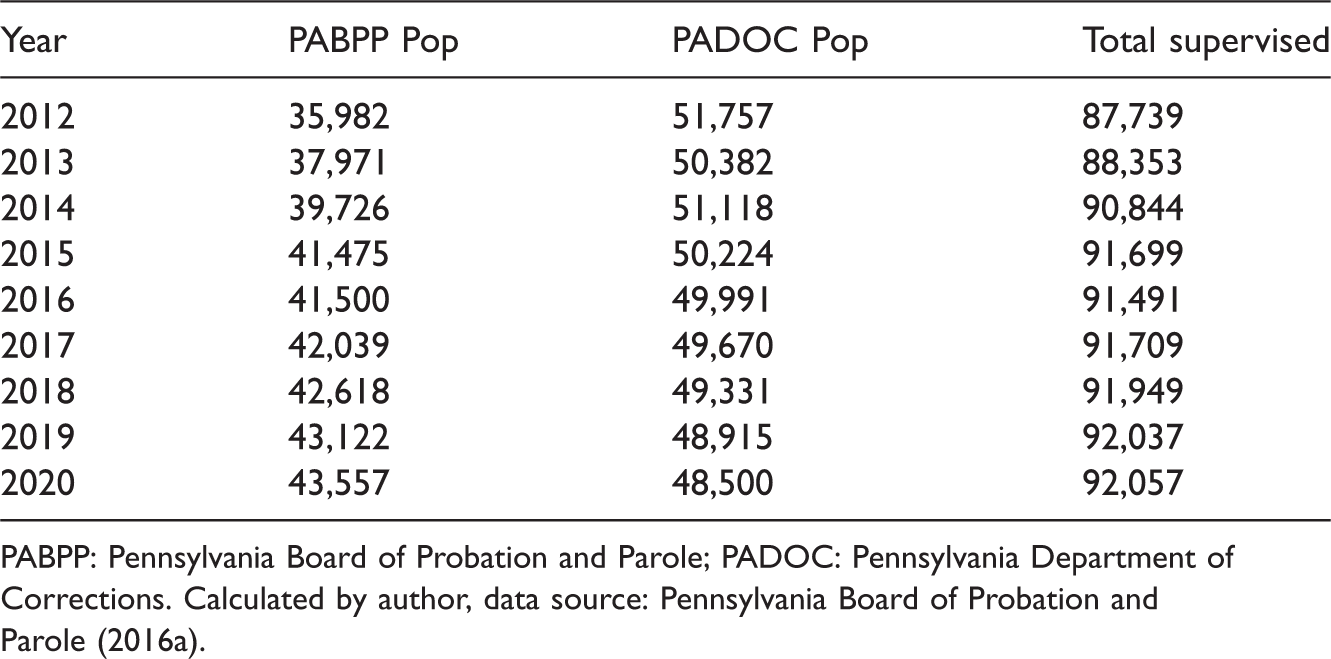
PABPP: Pennsylvania Board of Probation and Parole; PADOC: Pennsylvania Department of Corrections. Calculated by author, data source: Pennsylvania Board of Probation and Parole (2016a).
These shifting carceral practices are emblematic of the simultaneous pressures governments face to (1) contain and warehouse “surplus populations” who do not fit into the new manifestations of capitalist consumption (Loyd et al., 2012) and (2) reduce, shrink, and ultimately privatize government services (Brown, 2013). Closer attention casts a sinister shadow on any real reduction in the prison population (Schept, 2015). Reductions in the number of people housed in prisons continue to be offset by a growing population under probation and parole, both forms of correctional supervision. Utilizing a feminist geographic analytic attentive to the shifting burdens of social reproduction, this article builds on more recent critiques of prison reforms in carceral studies to demonstrate how these shifting carceral practices are in fact a deeply spatial cost shift from the state to the networks of care that support incarcerated people. Moreover, through correctional supervision, the spaces of incarceration become expansive and geographically porous. Further, through women’s care work, the burden of social reproduction and, at times, state surveillance becomes the responsibility of family and communities outside of the prison. While taking on the social reproduction of caring for parolees in the home may be a respite from having a loved one incarcerated, it raises a number of concerns regarding an emergent carceral state (Alexander, 2018). In what follows, I trace the machinations of these new practices. To develop this argument, this article draws on my wider body of research on the drug economy and incarceration in Grays Ferry, Philadelphia from 2011 to 2013, courtroom observations in 2014, and interviews and focus groups with people 2 supporting incarcerated loved ones in 2016. In this article, I juxtapose the neighborhood experiences of care reflected in this qualitative work with a textual analysis of the policies of the Pennsylvania Board of Probation and Parole (PABPP). Through this juxtaposition, I demonstrate how the shift from prison warehousing to correctional supervision operates as a strategy for prison privatization, bringing financial and emotional costs to those families and communities it most directly targets (Herbert and Brown, 2006; Mitchelson, 2012; Story, 2016). In an era of so-called decarceration, a feminist lens elucidates the complexity of these reforms by centering analysis on the social reproductive work of those who care for incarcerated people and those under correctional supervision.
I begin with an analysis of the claim by the Pennsylvania Department of Corrections (PADOC) and the Department of Probation and Parole that the prison population is decreasing. I argue that this claim of a reduction in population must be read as a displacement. A feminist lens reveals the reduction of a prison population through an increased reliance on probation and parole is, in actuality, a relocation of social reproduction. Through parole, the state transfers responsibility for the emotion and material care that inmates require to women and communities. To show this cooptive shift, I turn to where and how this care work is conducted. Focusing on the intimate and every day, I examine spaces of care outside of the prison. I show how the state spatially relocates the costs of fiscal austerity—resurfacing in the form of social reproduction undertaken in the homes and communities of inmates and, increasingly, parolees. Here, I draw on accounts from women caring for incarcerated loved ones to show how this relocated labor is manifested, bringing to light the financial and emotional costs for families supporting formerly incarcerated people. Lastly, I contrast state and community narratives of social reproduction, showing how the Pennsylvania correctional system renders invisible the very labor that makes parolee success possible. This enables the state to boast a dramatically reduced prison population, despite its dramatic expansion, albeit in new or relocated spaces and under the care of new nonstate subjects. The erasures performed by the Pennsylvania policy rhetoric render care and surveillance invisible. This invisibility, I conclude, requires a feminist geographic understanding of carceral policy as embodied, every day and extending well beyond the prison walls, to a more extensive geography of containment. In making this argument, I also extend the reaches of feminist political geography to inform critical carceral studies, thereby offering new insights on emergent practices of state austerity, and, in particular, the shifting, not fading, prison industrial complex.
A feminist curiosity for corrections and containment
Reflecting national trends, Pennsylvania took a tough on crime approach to “contain” inner-city drug use beginning in the 1970s, and its prison population burgeoned accordingly. In 1978, the total population in Pennsylvania state prisons and jails was approximately 8000. By the time the growth began to level off in 2008, the PA state prison population was nearly 50,000. While the prison population skyrocketed, increasing by about 540%, the state’s population increased just 7.4% in the same period. If the county jail population is added to that number, approximately 100,000 people are now behind bars in Pennsylvania (Prison Policy Initiative, 2017b). More recently, this rapid increase prompted some conservatives to second-guess the decades-long trend toward harsher sentencing guidelines and tough-on-crime campaigning (Wereschagin, 2012). This marked policy shift towards austerity in the state’s criminal justice system began with Republican Governor Corbett in 2011 and the state legislature passed the Justice Reinvestment Reform Initiative bill in 2012. This bill implements a variety of cost-saving measures and technological improvements to the parole review system to reduce the prison population. Reporting and policy documentation beginning in 2012 and spanning Democratic Governor Wolf’s current tenure reports a reduction in the state’s prison population as a beneficial cost-savings measure (Gilliland, 2011a, 2011b, 2012; NA, 2016b; Pennsylvania Board of Probation and Parole, 2016a).
Government reports after the Justice Reinvestment Reform Initiative bill passed overwhelmingly emphasize modest measures to promote cost savings. The 2016 Annual Report of the Pennsylvania Department of Probation and Parole, published in the second full year of Governor Wolf’s tenure, is rife with celebratory emphasis on cost savings. Two snippets from the 2016 Annual Report exemplify this tone: Figure 1 notes the $3500 a year of parole costs per inmate in contrast to $41,515 to incarcerate that same inmate in a state correctional facility. The report joyfully exclaims, “Recidivism is decreasing while the parole population is increasing!” (Pennsylvania Board of Probation and Parole, 2016a). This report lacks a reflective critique of imprisonment or the new and uneven burdens on communities as a result of recent reforms. Considering these burdens through a feminist lens reveals a relocation of social reproduction—i.e. the financial and emotional burdens to feed, clothe, or rehabilitate paroled inmates—away from the state to families and communities through the very process of parole.

This image taken from the Pennsylvania Board of Probation and Parole’s 2016 annual report exemplifies the celebratory emphasis on cost savings.
Prisons and detention have little to do with public safety; they are fundamentally a solution to political economic crises and contradictions (Beckett and Western, 2001; Bonds, 2012; Gilmore, 2007). The prison presents its own contradictions, and new imbrications of neoliberal austerity have created a new crisis for the costly, state-run prison infrastructure. My feminist tracing of social reproduction illuminates how so-called progressive reforms maintain and extend criminality and create new geographies of confinement. A consideration of social reproduction illuminates the state’s complex role in material practices of care. It also, as I demonstrate, illuminates the ways in which this burden is displaced onto the loved ones of those who are incarcerated through parole. This question—who is ultimately responsible, then, for everyday practices of care and survival in (and of) the prison industrial complex—is posited only through the framework established by feminist geographers attentive to the important role social reproduction plays in maintaining social systems. Moreover, attention to social reproduction reveals the systemic reliance on the labor and care of marginal people—especially women.
Critical carceral studies have rightly demonstrated the broad reverberations of a racially disparate system of mass imprisonment throughout the prison and far beyond (Beckett and Western, 2001; Brown, 2014; Clear, 2009; Crenshaw, 2012; Davis, 2003; Gilmore, 2007; Stanley, 2011). Mass imprisonment is complexly intertwined with housing segregation, as scholars such as Rashad Shabazz (2015) demonstrate the logics of confinement are in no way limited to the prison. Instead, mass imprisonment is a new manifestation of a broader culture of surveillance, confinement, and Jim Crow in the United States (Alexander, 2010; McKittrick, 2011; Sudbury, 2005). Collectively, this body of work makes clear the porous nature of the prison (Garland, 2002; Sudbury, 2005) and the capitalistic impulses and neoliberalizing logics that drive its ever-growing expansion to a wider swath of the population (Brown, 2014; Martin and Mitchelson, 2009; Schept, 2015). The drive for austerity will transform the prison, but will it eliminate it? I contend here that explicit attention to social reproduction through a feminist geographic analytic can help further explain the newest imbrications of mass incarceration by offering a framework from which to better understand the geographies of a new prison without a prison that correctional supervision creates.
Feminist geographers expose the everyday inter-workings of power by attending to the messy business of social reproduction. Katz (2001) defines this as “the material social practices through which people reproduce themselves on a daily and generational basis” (709). Social reproduction recognizes the emotional and material care work communities do for one another—counseling loved ones or feeding and clothing dependents, as having generative (i.e. reproductive) value. This value is economic and reproduces the economic body. Social reproduction is something oft ignored by policy makers and critical scholars alike, with everyday care practices relegated to the private and deemed inconsequential (Bakker and Gill, 2003; Bezanson et al., 2015; Marston, 2000). And yet, as Braedley and Luxton (2015) argue, capitalist economies depend for their existence on the unpaid and/or undervalued care work that most women – and to a lesser extent, men – do. Feminist scholars have shown that this work acts as a subsidy for the private profit making essential to capitalism. (vii)
Scholars exploring the impacts of the carceral state on women have overwhelmingly focused on women prisoners. This, however, is only one piece of the broader reverberations of expansive mass incarceration. My attention to social production reveals how the prison industrial complex entraps people who are not prisoners but connected to them. I seek to build here on the scholars who have shown expansion of imprisonment to also include Black women as mothers (Gilmore, 2007) and as “the raw material that fuels its expansion and profitability” (Sudbury, 2005: 162). Feminist geography can help to signal that this happens even when women are not becoming inmates. Instead, a feminist geographic lens that focuses on social reproduction and everyday practice shows how this can happen as Black women’s homes, care work, and participation in social reproduction are coopted through probation and parole policies. I analyze social reproduction to better trace how women and communities are enveloped through these new policies into a carceral society not as targets per se, but rather as those who care and support the targets in a way that offsets the financial tax burden of a “public” prison system.
In this vein, some recent work on migrant detention has been particularly useful for my consideration of the care networks maintaining incarcerated people (Hiemstra and Conlon, 2017b). The tracing of social reproduction through intimate economies applied to migrant detention reveals the concealed world of immigrant detention and consequently offers a frame in which to consider the micro-practices of probation and parole that oppose and trouble the macro-processes of prison population reduction. This is a new imbrication of the overlaps between imprisonment and detention outlined by Martin and Mitchelson (2009). They argue understanding both in tandem helps to reveal how “the violence of imprisonment reverberates throughout the families and communities that lose people to prison” (471). Most pertinently, the analysis of migrant detention through this lens reveals the way in which the system depends on the care networks of the most marginal in order to maintain itself.
Combining this work with other feminist scholars who have elucidated the labor of mothers and caregivers to support public institutions, such as Enloe’s (2010) attention to the work of mothering to support the US Department of Veterans Affairs, provides my frame to consider the cost savings measured heralded by the State of Pennsylvania. In my analysis, I deploy this frame to critique the state’s claims of cost savings and decarceration. This critique illuminates social reproduction in such a way as to extend critical carceral studies beyond the prison and inmate to the entire web of care networks that are exploited by this system. A feminist lens of social reproduction illuminates social reproductive labor at varied sites such as the military (Enloe, 2010), tourism (Dowler, 2001), homelessness (Staeheli, 2013), and, in my analysis, the prison industrial complex. It also offers an angle from which to query austerity that complements carceral studies more broadly.
Relocating/shifting the burden of inmate care: The families of Grays Ferry
The residents of Grays Ferry, a largely Black community in South Philadelphia, consider it common sense that families—especially Black women—are committed to the emotional and material care of their incarcerated loved ones. Thus, austerity in prison policy drives communities to play a socially reproductive role even during incarceration. This is a result of how ubiquitous imprisonment and subsequent parole have become for some places. Care represents the strength and resilience of Black communities in the face of mass incarceration, and it begins with support for loved ones while they are incarcerated and continues with their release. I describe such social reproductive care work in this section. I then demonstrate how care work is appropriated and rendered invisible by the state institutions that increasingly rely on it.
The systemic reliance on the social reproductive work of loved ones is not only applicable to the expansion of parole. This reliance has a longer history of supporting the prison industrial complex. I observed complex networks of loved ones supporting people both in prison and upon release. While they are in prison, community members offer emotional and financial resources: they pool funds for bail and commissary accounts, pay for phone time, and carpool for visits. Families and community members eventually welcome most of their loved one’s home offering welcome home parties, places to live, informal loans, clothing, rides and bus fare, and a great deal of rehabilitative and emotional support. 3 Families, friends, and neighbors work communally to care for their incarcerated loved ones through the entire process of incarceration, to parole, to finishing a sentence, constantly making up for the gaps in state services. So even before release, families and communities are essential to a prisoner’s survival. That is to say, this care work ultimately provides for social reproduction of and within the prison complex.
This continues through probation and parole. Once loved ones return from prison, ubiquitous in our interviews were examples of complicated care work provided by families. Their accounts highlight the everyday, embedded nature of inmate care for residents of Grays Ferry. I saw their experiences as exposing the highly gendered structures of this system. Overwhelmingly, it is Black men who are incarcerated in Grays Ferry (Pennsylvania has one of the highest Black disparity ratios in the country) and it is Black women—as their partners, daughters, mothers, sisters, grandmothers, etc.—who support them. This issue can be very difficult to get at, because the people doing this labor and ultimately bearing the costs of supervision are not fully cognizant of the externalization that shapes their lives. Nevertheless, the daily practices of social reproduction are clearly laid out by the women we spoke with.
In 2016, interviewees discussed in detail the extensive burden on families from the moment of arrest: they’ll go to every court date, they’ll put money on their books, make sure they’re eating, write them letters, send them pictures, go visit them if they’re in a prison that’s close. (Interviewee 5) I would say if you’re putting money on their books and visiting, that alone would be…probably a month $300 maybe almost $400, if you’re putting you know enough. And then as far as like the writing and stuff, you know, you gotta write it, get it stamped, mail it, that…it’s a lot. (Interviewee 5) Um, it probably would've been like $200 a month, because I would’ve been getting paid every two weeks so that may have been maybe $100 a week, I mean… $100 every two weeks so it would have been like $200 a month. (Interviewee 2)
In addition to this hefty financial burden, taking responsibility for incarcerated people has a substantial personal and emotional cost, extending throughout a family. One interviewee whose partner was incarcerated reflected on the financial loss of a breadwinner as well as the overwhelming emotional toll on her household: It was just a sit and wait thing and then I worked all the time so, it just kept me busy and it kept my mind off of it so when I come home I’m so frickin tired, I don’t even have time to cry, I would go home, get in the shower and I’m in the bed asleep getting up the next day to go to work. You know, and that’s basically it, wasn’t no, not a lot of crying. Maybe once out of a month I might shed some tears […] but my son had gotten real close to him so by him being locked up, my son really had nobody that he can really talk to, know what I mean and then my son started drinking a lot […] it was like my son was abandoned, which he wasn’t but it was like he was abandoned. (Interviewee 2) It’s hard. I think it’s hard taking care of another human being period. When I had my first son, I really didn’t know hard because I had my mom…Then the second one, it was like you know it got harder so it’s like it’s harder taking care of babies. And so, to take care of a grown adult, it’s even harder. (Interview 5)
This continues when these loved ones are released into private facilities or their actual homes. In 2016, 19,824 people were released from the Pennsylvania’s Correctional Facilities. Of this nearly 20,000 people, 16,664 were paroled. Moreover, nearly 20% of those people (3776) were released to Philadelphia (DOC Planning, Research and Statistics, 2017). As the state celebrates the reduction in the number of people housed in correctional facilities, tracing the loved ones provide to those released demonstrates reducing prisoners through parole is actually a displacement of cost. Families offer the aforementioned support while their loved ones are in state facilities—their work continues and even expands upon their loved ones’ releases. In fact, as I discuss below, the state anticipates and relies on it.
Families undertake care for released prisoners housed by, primarily for-profit, firms. One-third of released prisoners, mostly men, are placed in 1 of 53 statewide supervised living, community correction facilities. The PADOC operates only 15 of these centers. The other 38 are operated by private entities contracted through the state (Schweigert, 2010). These facilities, like every other node in PA’s carceral system, rely heavily on family members to support inmates and provide their basic necessities. When prisoners are released to these halfway houses, they are required to gather vital documents (birth certificates, social security card, and photo identification) and then register for food stamps, cash assistance, or disability benefits. In many cases, people on parole are required to search for jobs with forms that potential employers sign, verifying they filled out an application. In order to meet these varied demands, paroled people rely on their loved ones for transportation, clothing, groceries (food is not always provided), and even, in some cases, rent. The burden of making phone calls, buying groceries, finding transportation, and even paying to obtain vital documents often falls to loved ones. At minimum, it is necessary for family members to provide the emotional support necessary to navigate these frustrating bureaucracies.
Interviewees also welcome formerly incarcerated people who are released directly into their homes. One described the various forms of emotional and financial support she provided to her husband. She explained that her husband had “maxed out,” so he was not on probation or parole when he returned home, “I’m not gonna say your record is clean but he is free from all the other stuff that you have to go through” (Interviewee 2). Even though he was not on parole, he required help to acclimate to society. His wife describes a considerable amount of work required to help her husband connect to services which would help him find a job and avoid recidivism. It’s an ongoing struggle in their household: I think the hardest part for him is finding a job, you know, it’s hard because who wants to hire a felon.… [there]’s supposed to be [a lot of support for him], which I haven’t found…they do jobs for second chances so I’ve been going online trying to find out where that is so I can find him a steady job. He works at the stadium, but that’s only when they have concerts…so within that time you have nothing…no work. So that’s the only part, him finding a job. (Interviewee 6)
Another interviewee spoke in depth about the burden her late mother took on to care for her father and brother both while they were incarcerated and when they returned. This kind of responsibility was fairly commonplace in her immediate family so members of her extended family had similar experiences when cousins and uncles were released. You gotta just get used to being around them, I guess. That’s if they’ve been gone for a long time…like I had a cousin that was umm locked up for some years and then coming back, like my aunt, them coming back around like her house, it was like everybody just had to adjust to him or get used to him being there. Like you know…and then there was one of my cousins it was her dad so it was like…he’d tell her to do something and it was just like “huh?” like she’d look at him like, ‘who are you to tell me?’ But then it’s like well that is your dad, and before he went you were listening. But now that you’re older, you’re thinking that’s [not your dad] because you’ve been gone for so long. (Interviewee 5)
For those mothers and loved ones struggling and eager to have their loved ones back home, legislative efforts to reduce the burgeoning prison population beginning in 2012 were a welcome respite. However, concern for the impacts of imprisonment on these communities had little to do with these policy changes. The bipartisan Justice Reinvestment reform package mentioned above and signed by Governor Corbett and passed in both branches of the state legislature unanimously was so popular because it was would save the state money ($9.5 million in the first year). That savings would be reinvested at the local level for “smarter policing, probation improvement, victim services and performance grants” (Gilliland, 2014). The accounts of these interviewees demonstrate reduced costs for tax payers, do not disappear; instead, families pay them. It is worth noting the reinvestment fund does not earmark any funds for the families and communities providing reentry support. Why would it? Rather, these institutions systematically fail to recognize much of the socially necessary labor provided by these communities to make the parole system so cost effective.
Decarceration, recarceration, and the erasure of care
The Justice Reinvestment Reform Initiative of 2012 represents Pennsylvania’s push for austerity and reduced government spending in the prison system as a whole. While this savings was championed by legislators, it was not complemented by a progressive reevaluation of drug users or criminals. Instead, the narratives of drug war era containment lingered. For example, the uptick in local judges sentencing people to prison, which spurred rising prison costs and an increased prison population in 2013 despite projections of decreases after the 2012 reforms, demonstrates a wide-spread absence of change in ethos across the state justice system. The bi-partisan political will to reduce the number of prisoners was primarily financial; the voters who ousted Governor Corbett in 2014 were concerned about his budget choices, but did not take issue with racialized mass imprisonment in and of itself (Gilliland, 2011b, 2014). Governor Wolf, therefore, was elected into office in 2014 with a clear mandate to cut costs and redirect funds into public schools in a climate in which narratives of containment emphasizing being tough on crime and keeping communities safe still constituted highly effective “dog whistle” politics in the Pennsylvania suburbs (Bacon, 2016). The accounts of people we interviewed in Grays Ferry and the reality that the parole population in the state is increasing demonstrate that reducing the prison population cannot be understood as decarceration. Rather, the reduction in the prison population, through a feminist attention to social reproduction, is best understood as a spatialized shift in responsibility. Insidiously, this shift solidifies the justice system’s reliance on the care work of those quoted above and embroils these families in a new, less visible, and increasingly digital network of state surveillance.
Thus, the care described above makes possible state claims both of the decarceration of prison populations and dramatic cost savings. Yet this dependency is regularly neglected, elided, or rendered invisible by policy makers. Doing so provides a more politically and socially acceptable solution to cost cutting, one that both burdens and then neglects those new providers of care. In a closer examination of PABPP policy documentation, a dependency on the care outlined by women in Grays Ferry is both easily assumed and never fully credited.
In 2015, while there were 49,858 people in state prisons—a decrease from years prior, Pennsylvania had the highest per capita number of parolees in the country with 1109 per 100,000 (Pennsylvania Board of Probation and Parole, 2016a). According to the National Institute of Corrections (2016) at the end of 2015, Pennsylvania had 112,351 people on parole and another 183,868 on probation. The state was therefore home to 296,219 people who were not imprisoned, but were under some form of correctional supervision. This displacement of care from the prison to probation and parole occurs in two main ways.
First is the shift to reliance on the aforementioned private community correctional facilities, or halfway houses. Paroling people to these centers is effectively a back-door privatization of supervision that increasing the parole population makes possible. The state quells criticism by emphasizing that all prisons in PA are state-owned facilities, but fails to mention that this is not true of the now growing community corrections facilities across the state (Wereschagin, 2012). There is not enough data to make a meaningful claim on this, but as the state closes state-owned facilities and expands parole, this is clearly an increased privatization of the correctional system as a whole. There should be more discussion and investigations of the rising reliance on private community correction centers to house parolees (i.e. inmates) and the broader privatization and profit opportunities inherent in their supervision (see Mitchelson, 2014). The aforementioned narratives demonstrate that even when people do not parole directly to homes, women and families still provide a great deal of social reproductive work and this surely contributes to the profitability of these private facilities.
The second is the increased reliance and, indeed, demands upon the families of inmates when they are paroled. Parole is a spatial fix that simultaneously maintains legal imprisonment and displaces the state’s burden of social reproduction. This displacement is shockingly normalized in the parole guidebooks that set a clear expectation for this burden to be absorbed by families. In spite of the PABPP’s dependency on family units being clear and openly discussed in parole guidelines, it is often systematically erased in public explanations of parolee success, left unacknowledged, and never expressly supported. Instead, families are simultaneously expected to serve as extensions of the state supervision apparatus and are also placed under surveillance. The State Department of Corrections, then, is certainly saving money, but formerly incarcerated people, who are often destitute upon release, need to be sheltered, fed, and clothed—ultimately families are left to assume that burden. The Department of Correction’s cost savings is displaced onto them.
Families are given little credit, support, or recognition for this labor. Instead, this labor is erased in even the most mundane accounts of parole. Influenced by neoliberal cultural tropes, the PABPP regularly deploys individualized accounts of parolees’ successes without ever acknowledging the complex network of care undergirding said success. Take for example, a case from the Meet the Person Behind the Parole Number story series originally published on the PABPP Facebook page. The series, comprising of about 10 parolee accounts, seeks to humanize parolees and celebrate their reentry successes, and the stories celebrate to the broader community the value and potential of ex-offenders. When reading with an eye toward the process of social reproduction, however, the series also offers a window into the family support that many of those featured must rely. One of these narratives, the account of Donte (see Figure 2) exemplifies the importance of family while also exemplifying the fact that this is not expressly acknowledged by the state parole board. The reader is only told that Donte was raised by a single mother and that he was destitute upon release. Donte’s destitution is highlighted in the final paragraph of his story:
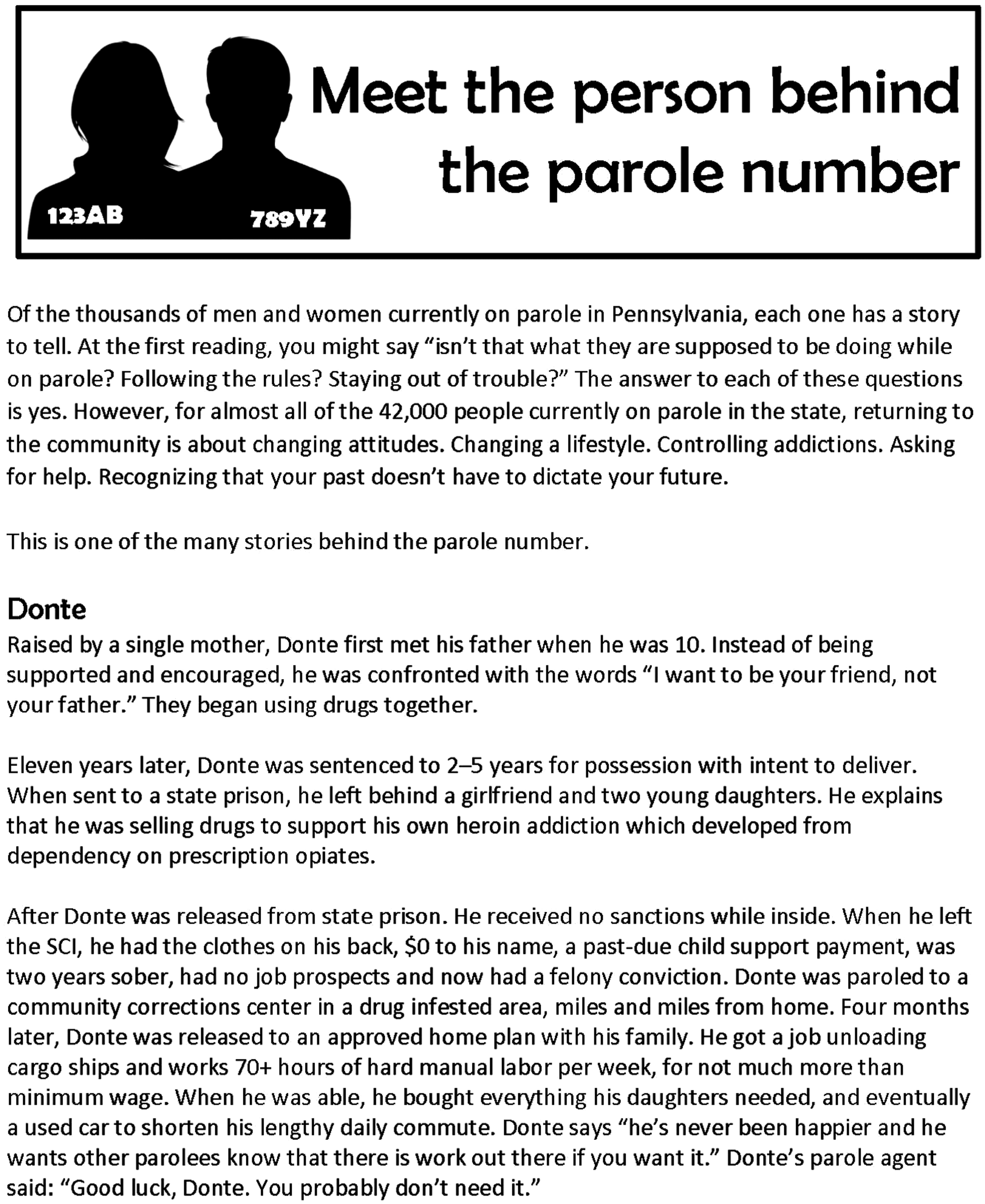
An example narrative from the “Meet the person behind the parole number” series published on the Pennsylvania Board of Probation and Parole’s Facebook page (Donte’s Story, 2017).
When he left the SCI, he had the clothes on his back, $0 to his name, a past-due child support payment, was two years sober, had no job prospects and now had a felony conviction. Donte was paroled to a community corrections center in a drug infested area, miles and miles from home. Four months later, Donte was released to an approved home plan with his family. He got a job unloading cargo ships and works 70+ hours of hard manual labor per week, for not much more than minimum wage. When he was able, he bought everything his daughters needed, and eventually a used car to shorten his lengthy daily commute. (Donte’s Story, 2017)
The narrative reflects PABPP’s general, neoliberal rhetorical approach focused squarely on the individual. This moralistic, individualized focus obfuscates networks of care upon which the parolee, and by extension the parole board, rely. It erases the family support and labor that underlies Donte’s success. The $35,000 required to incarcerate Donte has been offset and transformed into new opportunities to generate revenue through the dismayingly high charges he will pay for his supervision. Parolees pay for their own ankle monitors, their drug screenings, their therapy (often through Medicaid), and all of these services are highly privatized in Pennsylvania. As Hiemstra and Conlon (2017a) note regarding migrant detainees, while detained their bodies are dispossessed to allow for the accumulation of capital through commissary accounts. This is also the case for prisoners in Pennsylvania and their destitution rendering them profitable continues into release, leaving families to assume the burden. Again, this role the family plays in Donte’s case mirrors the role families and nongovernmental organizations play in supporting migrant detainees who are dropped at bus depots in the US by the border patrol with only the clothes on their backs (Williams and Vanessa, 2017). In Donte’s story, we see little mention of the emotional work and financial support that his mother likely provided—it is buried deeply between the lines. However, the fundamental duty of motherhood valued in Grays Ferry and ubiquitously referenced amongst interviewees, as they talked about the care they offer their sons and the care they saw their mothers offering, is an ethic upon which the department of parole relies. Only through this emotional network of obligation can the parole board extend the reach of the Department of Corrections while offsetting costs. It is this network that helps supervise “Donte” and ensures his success. People housing “inmates” are not paid or compensated in any way for their services, in spite of the wide range of responsibilities and impositions placed upon them.
This shift in the burden of care is achieved while still maintaining confinement—just through a reliance on families. Families are both shouldered with the basic responsibilities and costs of social reproduction, and their homes also become surveilled as an extension of the prison. Through shifting care, the state can contract with companies to surveil in new, more technologically sophisticated ways that are not as visible as the prison walls but insidious nonetheless (Alexander, 2018). Through her study of juvenile justice reforms, Brown (2014) argues this creates a carceral society as carceral power moves into the community. Parole supervision in Pennsylvania has parallel effects.
When families offer their homes to parolees, their homes become spaces of surveillance and confinement—e.g. functional prison cells. Through maintaining the legal status of “inmate,” the racialized logic of containment is maintained and the state is able to offset the costs of social reproduction which imprisonment requires via correctional supervision. For example, in prison, bunks can also be searched without a warrant or probable cause. Regulations from the parole handbook (Figures 3 and 4) make it clear that, during parole supervision, a private home also becomes liable to warrantless searches because, from the perspective of the State of Pennsylvania, there is an “inmate” housed there.

Excerpt from the Pennsylvania Board of Probation and parole handbook explaining home plans (Pennsylvania Board of Probation and Parole, 2016b).
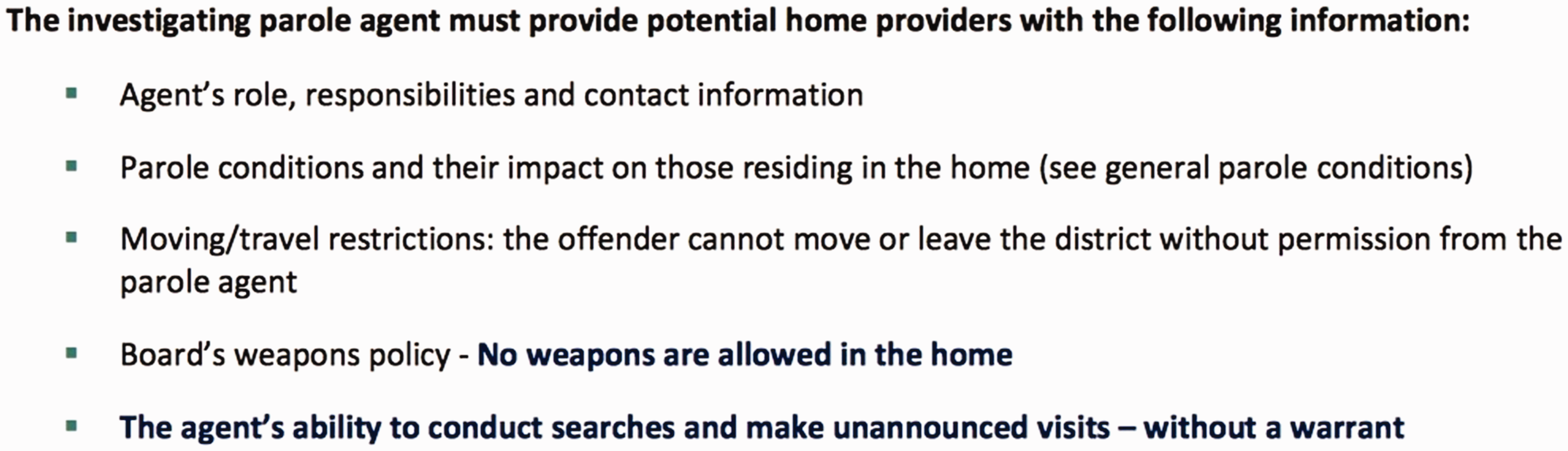
Excerpt from the Pennsylvania Board of Probation and parole handbook explaining the rights to enter the home where a parolee is housed (Pennsylvania Board of Probation and Parole, 2016b).
Supervision of this sort represents a new conversion of public and private, and thus, an emergent intersection with state violence (Crenshaw, 2012). Most conspicuously, the family is expected to provide housing, which requires the family to open their home to correctional supervision. The instructional materials supplied by the PABPP directly to families explicitly position the family as a central institution in supervising the reentry of incarcerated people (Figure 5). The role of families is positioned as central and the work they will have to do is clearly laid out, but this shifting burden is not readily acknowledged in policies or publications to the wider community (Pennsylvania Board of Probation and Parole, 2016c, 2017).
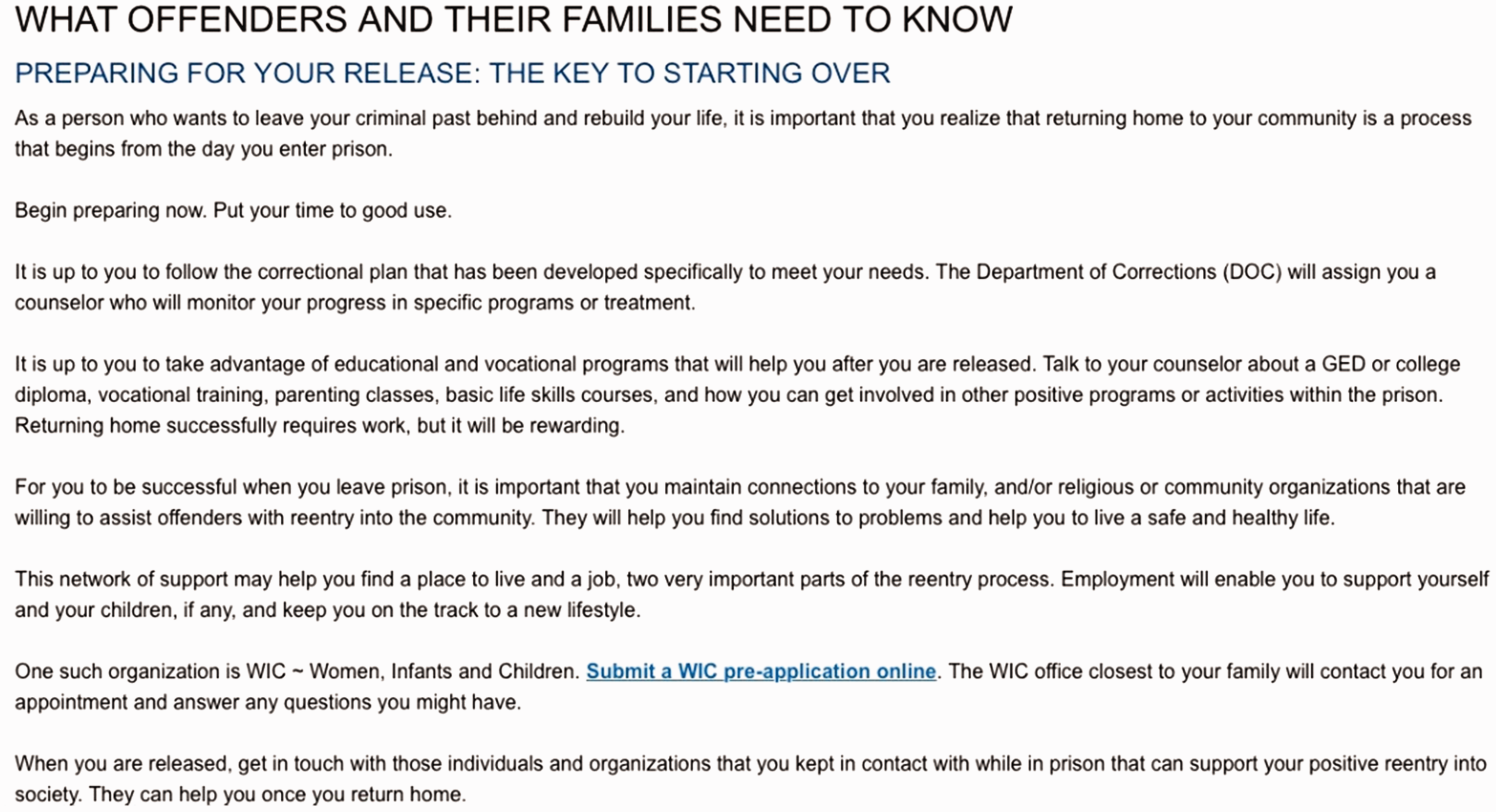
Instructions from the PABPP Parolee’s and Families page (Pennsylvania Board of Probation and Parole, 2017).
Additionally, the family unit is expected to provide reentry and supervision services in a number of ways beyond what the guidebook explicitly reveals. I learned during my ethnographic work in Philadelphia that loved ones providing a “home plan” are required to have a land-line phone to support the electronic monitoring devices used by PABPP. A base attached to a landline tracks the ankle monitor to determine whether the person is within a proximity of 20 feet of their residence. If not, the base calls the parole office (or a contracted 24-hour call center). Monitors are generally used to enforce curfews, but they effectively transform the house into a prison. Explicit in the handbook and the requirements for parole, an agreement signed by the person providing a home and the parole officer who approves the home plan, is the families’ obligation to provide ongoing emotional support. The PABPP Handbook states: Home plan investigations are conducted in accordance with the Board’s dual mandate to protect the safety of the public and aid in the rehabilitation of the offender…The board investigates a home plan to consider staff and public safety as well as victim issues….The home plan should provide a stable environment that will provide support and assistance to the offender while searching for a job, attending counseling, seeking medical care, striving for financial stability and locating transportation. The offender will have conditions of parole that must be followed and family members can help the offender to follow them. This can be a stressful time that can cause an offender to relapse – but a strong family support system, the help of clergy and friends and mentors can help this not to happen. (Pennsylvania Board of Probation and Parole, 2016b)
More notably the home plan directly shifts the responsibility for social reproduction onto the family unit. This process begins, as my interviews testify, within the prison as families share the cost of food, basic supplies, and phone calls. By moving an inmate into a contained in-home surveillance environment, this burden is shifted more squarely onto the family. Through reliance of families for informal counseling services, housing, basic needs, etc. the prison is able to extend its reach and cut its costs. Yet, time and time again, we can see the ways in which the social reproduction families provide is erased and ignored. Examples like Donte’s story should come as no surprise, nor are they contradictory with the parole handbook literature. The two texts, Donte’s story and the handbook, work in tandem to better incorporate the labor and care of families as a cost-saving measure while never recognizing it as such.
Feminist attention to these texts begs the question of what labor is necessary to maintain the prison, and, in turn, what labor is necessary to displace imprisonment? If we reread the aforementioned Donte’s story (the story of a man released with “just the clothes on his back”) through this lens, it becomes necessary to consider who precisely is helping and paying for Donte’s care as a parolee? While home is overwhelmingly considered preferable to the alternatives, there is little discussion in the policy documents of the PABPP of these families and the burdens they carry both financially and emotionally. In contrast, the everyday costs, complexities, and challenges of reentry are mentioned early and often in interviews, as I describe above. This reflects Enloe’s illumination of the labor of women and the everyday practices of social reproduction necessary to wage war (Enloe, 2010). It is necessary to raise similar questions for the maintenance of the prison industrial complex. This obligation families are made to feel and responsibilities they must take up in the light of austerity-driven withdrawal of state responsibility makes it quite seemless for the PABPP to shift the burden of care more squarely onto families in lieu of true decarceartion.
Conclusion
Applying a social reproduction lens to the reduction of the state prison population first shows how austerity happens through a displacement of social reproduction. The shift from imprisonment to parole reveals a shifting of the cost of social reproduction away from the state and onto the communities most negatively impacted by the forces of austerity, neoliberalism, and incarceration. Further, this also means these communities are the ones upon whom these forces most depend to be tenable. Similar to the cases of migrant detention’s intimate economies, certain precarious and racialized communities—already positioned as disposable—are actually connected and central to working on contemporary neoliberal–racial capitalism. This tracing speaks to understanding much wider operations of power and the utility of feminist geographic attention to trace them. Contemporary austerity can only maintain the security state through a blatant dependency on marginal families and communities.
Second, feminist geography plays a pivotal role in tracing and explaining the displacement of social reproduction austerity requires. This also reveals a great deal about new imbrications of the prison industrial complex. By interweaving discourse analysis of policy documents that trace the recent reductions of the prison population and the cost-saving measures implemented by the State of Pennsylvania with narratives from people in Grays Ferry, these dependencies come into clearer view. My interviews reveal the tremendous amount of care and support that families and communities provide to support the prison system. The policy move away from imprisonment and to a more expansive parole system is an extension of the state dependency on this social reproductive work.
Finally, this shows the need to carefully scrutinize any claim of a reduction of the prison population. Part of the power of these shifts is how easily this care work is rendered invisible. This article calls for a need to continue to study the role of families and care networks in the criminal justice system more broadly. The progressive changes Pennsylvania has implemented since 2012 have latent consequences that warrant further investigation, reflection, and adjustment. If the progressive goal of both critical scholars and criminal justice systems alike is to reduce the number of people in prison, better understanding care networks and challenging their erasures is an integral piece of ensuring policies are just, progressive and sustainable.
Footnotes
Acknowledgements
I would like to thank all of the people in Philadelphia who have taken the time to generously and patiently share their stories and experiences with me. I am grateful to Patricha Williams and Maddie Galvez for their help conducting some of the interviews. I am especially indebted to Caroline Faria and Jill Williams for their help and keen insights as I wrote the first draft. Thank you also to the anonymous reviewers for their discerning feedback.
Declaration of conflicting interests
The author(s) declared no potential conflicts of interest with respect to the research, authorship, and/or publication of this article.
Funding
The author(s) disclosed receipt of the following financial support for the research, authorship, and/or publication of this article: Initial research that informed this paper was funded through the National Science Foundation [grant number 1333176], Penn State's Africana Research Center and the Association of American Geographers. Additional funding was provided through a series of internal grants provided by Bucknell's Digital Scholarship and Pedagogy Mellon Grants, the Bucknell Institute for Public Policy, and the Bucknell Center for the Study of Race, Ethnicity, and Gender.
Notes
Vanessa A Massaro is an assistant professor of Geography at Bucknell University. Her research draws on mixed quantitative and ethnographic methods to explore the way spatially segregated racial minorities, particularly African Americans, navigate the intersection of racism with broader forces of economic injustice. Her work has been published in Gender, Place, and Culture, Geopolitics, Geography Compass, and Territory, Politics, Governance.