



Abstract
How differing social economy traditions within the global South can combine with state and market sectors to provide alternative development paths has increasingly become a focus of political and policy debate. This paper uses an institutional logics perspective to analyse the interaction between indigenous collective traditions and other institutional logics in Ecuador’s social economy. Results demonstrate how indigenous practice has interacted with other social economy elements to produce novel organizational and institutional forms. Findings from original primary research identify processes of co-existence, accommodation and conflict in the interaction of differing institutional civil society, state and market logics and the institutionalization of the social economy. Critically, processes of conflict generated by contradictory logics have over time helped close down many of the new political spaces, limiting the ongoing inclusion of indigenous institutions and the ability to construct an alternative, pluralistic path to development.
Introduction
The social economy’s role in economic development paths alternative to mainstream development orthodoxy has been increasingly recognized by practitioners, policy-makers and academics, especially in the aftermath of the global financial crisis (Amin, 2013; Dacheux and Goujon, 2011; Harcourt, 2014; Utting, 2015). Despite varying conceptions of the social economy, a broadly held view is that it comprises that part of the economy, neither private nor public, that consists of a plurality of organization forms not aiming for a return on capital, created by and for groups with common needs, and accountable to those they are meant to serve (Southcott, 2015). Yet even accepting this broad definition, the role diverse social economy organizations play in constituting economic development paths across spatial contexts remains strongly debated. Whereas market-based approaches place social enterprises centre-stage (Chell, 2007; Defourny and Nyssens, 2010), those advocating alternatives to neo-liberal capitalism emphasize the role of social solidarity organizations, including cooperatives, mutual benefit societies, foundations and local community and grassroots associations and organizations, which foster social solidarity through shared values of cooperation and reciprocity (Dacheux and Goujon, 2011; Utting, 2015).
Current conceptualizations of social economy organizations and the wider social economy they constitute continue to be dominated by the histories, economies and politics of the global North (Kerlin, 2009, 2010; Monroe-White et al., 2015; Moulaert and Ailenei, 2005; Salomon and Sokolowski, 2004). This is despite increasing recognition of varied social economy organizations and alternative development paths globally (Amin, 2013: Gibson-Graham and Cameron, 2007). In this respect, the social economy institutions of indigenous people in the global South – for instance, Minga in Latin America (Giovannini, 2014; Vásquez-Léon et al., 2017) and Ubuntu in Africa (Littlewood and Holt, 2015; Sarra and Berman, 2017) – are central to understanding the development of the contemporary social economy across the global South (Barth et al., 2015; Maguirre et al., 2017; Spencer et al., 2016). How these particular indigenous social economy traditions combine and interact with other elements of the social economy as well as wider market and state logics to produce alternative development paths remains largely unexplored.
Recent research into the heterogeneity and hybridity that characterize social economy activity has engaged with the institutional logics perspective (ILP) (Friedland and Alford, 1991; Thornton et al., 2012), particularly as a source of insight into the nature of organizational change within the sector in the global North (Skelcher and Smith, 2015; Vickers et al., 2017). Here, we extend the ILP approach to the global South context, to analyse the interaction between the norms, values and collective practices of indigenous communities with other institutional logics and the consequences of this for the wider incorporation of the social economy into the development process.
The paper therefore scrutinizes the institutionalization of the social economy in Ecuador. The case of Ecuador has attracted interest globally among development activists and practitioners (e.g. Restakis, 2014). From 2007, successive governments recognized a central role for a ‘popular and solidarity economy’ (PSE) sector, including indigenous collective social economy traditions, alongside state and private sector activities (Ruiz Rivera and Lemaître, 2017; Scarlato, 2013). The politicized process which produced this situation in Ecuador presents a unique opportunity to analyse an attempt to establish an alternative development path where social economy and indigenous collective traditions are placed centre-stage. We seek to answer three related questions. How have varying social economy traditions interacted to produce a distinctive social economy within Ecuador that includes the social economy institutions of indigenous peoples? In what ways have competing and contradictory institutional logics of civil society, state and market interacted to shape the novel institutionalization of the social economy and its attendant politics? Within these processes, to what extent can the collective mobilization of less powerful social economy actors, such as indigenous peoples, draw upon the presence of multiple logics to mobilize political support to create alternative development paths?
The paper’s first section sets out a theoretical framing sensitive to the production of plural conceptions of the social economy through the presence and interaction of differing institutional logics including those rooted within local indigenous cultures. The second describes our methodology and the third analyses the interaction between dominant social economy traditions within Ecuadorean civil society and the resulting political institutionalization of the social economy sector. The fourth section presents results from qualitative research with key institutional actors and social economy organizations to identify the nature of the co-existence, accommodations and conflicts between the state, civil society and market institutional logics in Ecuador. The paper concludes with consideration of the political implications of these results for the development of alternative spatially constituted, social economy development paths.
Institutional logics, the social economy and indigenous peoples
Analysis seeking to understand the plurality of organizational forms in the social economy has routinely sought to consider these in relation to the varied institutional logics of public, private and civil society sectors in the global North (Doherty et al., 2014; Mintzberg, 2015; Tracey et al., 2011). Conceptualizing the interaction between differing and competing rationalities and logics in the development of the social economy, and understanding the implications of this for political action, has become a growing focus for debate within the social economy literature. Research into the developing social economy has identified how practice is shaped by multiple goals apparent across a heterogeneous mix of civil society, public and private organizations that characterize this sector (Amin, 2013; Moulaert and Ailenei, 2005). Analysis of organizational change within the social economy has focused upon the development of social enterprises as a key institutional form (Borzaga and Defourny, 2004; Laville et al., 2015; Spear, 2006). Drawing upon theories of social entrepreneurship, studies of the emergence of hybrid social economy organizations (Battilana and Lee, 2014; Doherty et al., 2014; Tracey et al., 2011) have revealed the political tensions evident between public, private and civil society actors, especially within neo-liberal market based environments where market logics compromise social ends (Eikenberry and Kluver, 2004; Jones, 2007; Murtagh and McFerran, 2015).
To better understand the heterogeneity and hybridity that characterizes much social economy practice, some authors have rooted their analysis in an ILP (Skelcher and Smith, 2015; Vickers et al., 2017). This approach was developed to better understand interaction between normative societal structures, organizational forms and individual behaviour within institutional theory (Friedland and Alford, 1991; Greenwood et al., 2010; Thornton and Ocasio, 2008; Thornton et al., 2012; Yu, 2015). It identifies institutional logics as: ‘socially constructed, historical patterns of cultural symbols and material practices, assumptions, values and beliefs by which individuals produce and reproduce their material subsistence, organize time and space, and provide meaning to their daily activity’ (Thornton et al., 2012: 51).
Society here is conceived of as an inter-institutional system constituted through theoretically distinct normative structures, comprising market, state, community, family, religion, profession and corporation (Thornton et al., 2012). Each has its own rationality or logic – comprising both material and symbolic elements – working to enable and constrain situated agency. Critically, this approach recognizes how the contradictions between these different logics provide space for actors and organizations to use and reinterpret the varied available material and cultural resources in their agency (Greenwood et al., 2010; Thornton and Ocasio, 2008). Furthermore, which logics predominate and how they interact to shape organizations and individual agency are recognized to be historically and spatially contingent (Friedland and Alford, 1991).
The ILP has stimulated much research into the development of hybrid organizational forms (Jay, 2013; Pache and Santos, 2013) which has been extended into the study of the social economy (Skelcher and Smith, 2015; Smith et al., 2013; Vickers et al., 2017). These studies demonstrate how the combination of plural logics creates enduring tensions, compatibilities and compromises which not only constrain organizational action but also in certain contexts can positively encourage innovation (Vickers et al., 2017). The ILP therefore provides a framework for examining heterogeneity and hybridity within the social economy through investigating the interplay of different logics and how this shapes practice across the levels of individual agents, organizations and its wider institutionalization.
Adopting an institutional logics framework to the study of the social economy however presents several challenges which this study seeks to address. First, the strong focus within the existing literature upon change within social economy organizations has meant there has been far less consideration of how these relate to the wider institutionalization of the social economy and its attendant politics. A number of social economy studies have begun to develop analysis of the political institutionalization of the sector (Hazenberg et al., 2016; Nicholls and Teasdale, 2017; Sinclair et al., 2018) but to date these have been restricted to experiences in the global North and not adopted an ILP analytical framework. Second, despite recognizing collective mobilization as a mechanism for endogenous change in institutional logics (Thornton et al., 2012), there has been little study of how in practice less powerful social actors, such as indigenous communities, draw upon multiple logics to mobilize political support and prevent the dominance of neo-liberal market solutions in contexts such as the global South (Yu, 2015). Finally, despite the recognition of temporal and spatial contingency, existing research has focused largely on global North contexts rather than the very different contexts of the global South in the constitution of social economy practice within civil society, state and market logics.
Renewed recognition of the collective social economy traditions of indigenous communities and their value to the development process has formed part of the wider emergence of what is often referred to as new forms of ‘post-neoliberal’ collective action (Radcliffe, 2012). Here, social movements have sought to promote ‘alternatives to development’ that recognize the importance of autonomy in the production and dissemination of knowledge from across the global South (Gonzales and González, 2015). The result has been the creation of diverse social programmes that incorporate solidarity principles, diversity and the role of community economies (Amin, 2013; Gibson-Graham and Cameron, 2007), including those that recognize and revive native indigenous people’s traditions and values (Escobar, 2010). One of the most important of these has been the indigenous ethical paradigm of Buen Vivir, translatable as ‘Living Well’ (Acosta, 2013; Gudynas, 2011a; Radcliffe, 2012).
Buen Vivir has its origins among the heterogeneous Latin American indigenous populations and comprises a collective approach to well-being that engenders principles of reciprocity, solidarity and complementarity, and promotes collective rights and a localized, community-based model of production (Gudynas, 2011a, 2011b). It also highlights the role that the natural environment and cultural resources can play in reinforcing indigenous identity and culture, bringing back the voices of people who have historically been marginalized (Giovannini, 2014; Huanacuni, 2010). In relation to existing conceptualizations of the social economy, Buen Vivir provides a distinctive spatially based development model rooted within indigenous cultures which draws upon principles of social organization, such as communality, holism and harmony with the environment (Walsh, 2012).
The Buen Vivir notion has directly influenced recent institutional transformations in Latin America. Several states have recognized the popular politics of sustainability – encompassing land rights, indigenous rights and self-determination – rooted in the fostering of indigenous territories, pachamama (mother earth) and a ‘plural’ economy incorporating new social actors (Caruana and Srnec, 2013; Villalba, 2013). Indeed the notion of Buen Vivir was incorporated into Ecuador and Bolivia’s national constitutions in 2008 and 2009, respectively (Radcliffe, 2012; Villalba, 2013). However, there remains little understanding of the processes through which indigenous traditions have interacted with other civil society social economy traditions as well as with state and market logics, and the consequences of this for producing alternative development models. This context provides the basis for exploring the stated research questions across the remainder of this paper.
Research method
The social economy’s political institutionalization in Ecuador has been key to a political strategy to provide an alternative development model (Ruiz Rivera and Lemaître, 2017). This case therefore provided an opportunity to investigate the presence and interaction of indigenous collective social economy traditions with differing institutional logics to answer our research questions.
The research methodology adopted comprised two elements. First, in order to gain the necessary contextual understanding required by an institutional logics approach, the institutional ecology of the relationships between indigenous collective social economy institutions and other civil society social economy traditions and organizational forms was established, and its role in the wider Ecuadorian political process institutionalizing the social economy analysed. This was pursued through a critical literature review related to the social economy in Ecuador and the wider Latin America context, together with policy related documents. This was complemented by insights from the primary data gathered from semi-structured interviews with key institutional stakeholders.
Second, to understand the interaction between the competing and contradictory institutional logics of civil society, state and market and the extent to which indigenous communities were included in this political process, in-depth interviews were undertaken with key institutional actors and social economy organizations. These data were obtained through a series of repeat semi-structured interviews with 20 different institutional actors including leaders and staff members of social economy organizations (indigenous and non-indigenous), indigenous and activist groups, government officials and policy-makers and academics (see Table 1). Fieldwork was conducted in two periods between January 2013 and February 2016. Returning to interview respondents over this three-year period enabled the research to capture how processes and relationships evolved over time.
Data collection from semi-structured interviews.
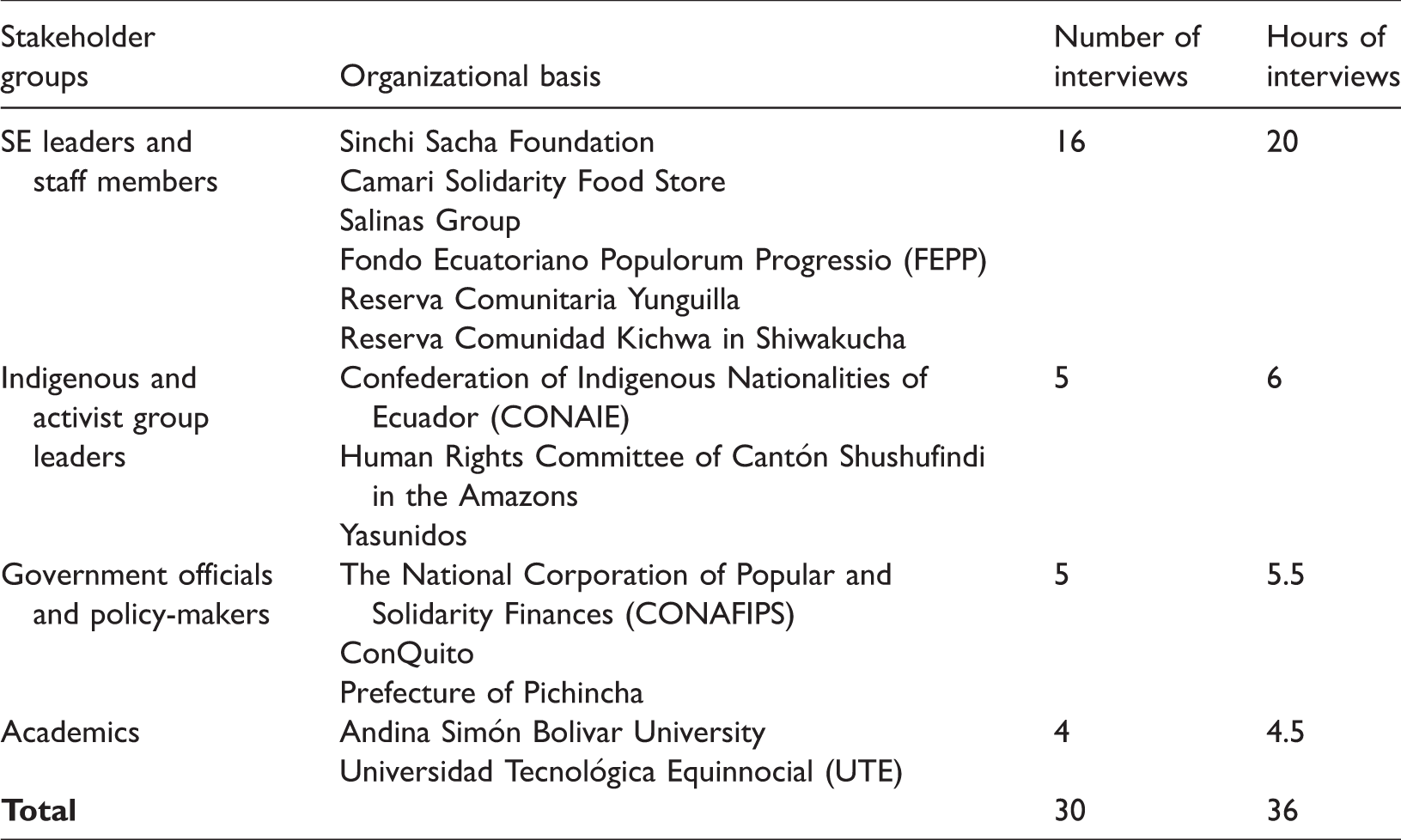
The use of semi-structured interviews ensured basic consistency in questions asked but allowed for new and unanticipated issues to emerge and be pursued by the interviewer (Myers, 2008). Each interview was conducted in Spanish and lasted between 45 and 90 minutes. Interviews were tape-recorded and transcribed verbatim. Interviews explored in detail the experience of stakeholders in the development of social economy activities in Ecuador and collected data on the activities, resources and capabilities of indigenous and non-indigenous social economy organizations and the attendant evolving relationships.
The study was grounded in existing research into institutional logics and the social economy which identified the key institutional logics of state, private sector and civil society. This provided an informing analytical framework with which to examine the intersection of these different logics. Detailed analysis proceeded through an initial phase of open coding (Strauss and Corbin, 1998) concerning the nature of the relationships between actors within and between different institutional logics, to develop a coding guide to facilitate cross-case thematic analysis. A second step integrated these codes by identifying themes via an iterative process of comparison and juxtaposition into a smaller number of higher order categories. In terms of characterizing the relationships within and between different institutional logics, three key themes of co-existence, accommodation and conflict were identified. These consolidated core themes were then examined in relation to indigenous and non-indigenous groups and used to analyse core elements of the social economy institutionalization process. An emergent issue here was the evolving power relations underlying these relationships between plural logics and how these shaped the evolution of this political process and the role of indigenous communities within this.
The institutionalization of Ecuador’s social economy
The ecology of Ecuador’s social economy
The resurgence of grassroots indigenous social movements across Ecuador from the 1980s onwards was a response to the negative consequences of successive governments’ neo-liberal economic policies and provided a new dynamic for the development of the social economy (Disney and Williams, 2014). Prior to the 1980s, successive Ecuadoran governments had looked to the global North for a development model characterized by a reduced role for the state and the opening of markets to foreign investors. However, recurrent periods of political instability and international emigration, particularly after the economic crisis in 1999, undermined the utility of this development model (Erazo, 2010; Uquillas and Larreamendy, 2006). In a situation of heightened social tensions, persistent poverty and successive government changes, civil society-based social movements opposed the foreign imposition of market policies and campaigned for a central role for the national state in controlling natural resources and redistributing revenues (Scarlato, 2013).
The development of these various social movements marked the coming together of a number of distinctive social economy traditions within civil society, rooted within indigenous collective organizations, social solidarity organizations, community and faith based social movements and fair trade based social enterprises. Such diverse social economy traditions are evident across Latin America, albeit with important regional differences in their respective influence upon how the social economy is institutionalized politically (Veltmeyer, 2017).
Indigenous social economy traditions in Ecuador are rooted within the indigenous communities that are estimated to comprise 7% of its population and form part of a patchwork of ethnic, regional and racial identities (INEC, 2010). In the pre-Columbian period (9000BC–1420), varied indigenous societies (e.g. los Pastos, Cañari, Las Vegas, Jíbaros and Atacames) had complex and diverse socio-economic and cultural systems (Lippi, 1996; Uquillas and Larreamendy, 2006). However, organizational activities were all based on principles of collective control and shared responsibility between individuals and communities (Acosta, 2013). Reciprocity, redistribution and exchange were a basis for social organization, with activity directed towards the well-being of the entire community (Gustafson, 2016; Peredo and McLean, 2006). Indigenous group leaders (caciques) created solidarity links between different communities, aiming to maintain their communities’ efficiency, safety and satisfaction (Lippi, 1996). This community system of production underwent change following the Inca invasion in the 15th century, with the introduction of a greater emphasis upon collective modes of production, for example in the forms of minga, ayni and mita, 1 and a relative decline in exchange activities (Lanas, 2013).
In the post-colonial period (from 1820), a distinct tradition of social solidarity emerged driven by European immigrants and their experiences of mutualism and trade unionism rooted within European utopian and socialist traditions (Williams, 2007). This was embodied in the growth of cooperative organizations. 2 These spread, predominantly across the rural economy, as a means to defend access and legal title to indigenous land, as colonists from the highlands increasingly moved into the Amazon region in the 1940s and 1950s (Erazo, 2010), as well as to improve productivity through savings and credit cooperatives (Da Ros, 2007; Miño, 2013). Following the land reforms in 1964 and 1973, the number of cooperatives in Ecuador increased rapidly, as peasant unions regrouped in cooperatives to access land (Bretón Solo de Zaldivar, 2008; Coque, 2002).
This cooperative tradition was increasingly adopted and developed by community and faith based social movements following the second National Cooperatives Act in 1966. The involvement of the Catholic Church and national and international NGOs and development agencies, in the creation and management of production, consumer, housing, service, savings and credit cooperatives (Da Ros, 2007), made it one of the most significant promoters of the social economy across the 1970s. This was particularly apparent in rural areas, where volunteer priests supported peasants and indigenous communities in the formation of cooperatives and associations, often taking a crucial leadership role in their development. In particular, there is the case of Grupo Salinas, founded in 1978 by the priest Antonio Polo, which has become one of the most high-profile social economy organizations in Ecuador (Calvo and Morales, 2017). In contrast, in the coastal region the Church was less influential as here the trade unions played a more central role in the cooperative sector’s development (Da Ros, 2007).
The intertwining of these social economy traditions led to the emergence of a number of important national organizations. These included the Confederación de Nacionalidades Indígenas del Ecuador (CONAIE) in 1986 and the Pachakutik Plurinational Unity Movement in 1996, which led the demand for recognition of Ecuador’s diverse ethnic groups and associated collective action (Scarlato, 2013). The Ecuadorian financial crisis in 1999 and resulting dollarization and mass emigration generated further social economy mobilization, including a new wave of credit and savings cooperatives (Ruiz Rivera and Lemaître, 2017). There was also a convergence between indigenous leaders interested in promoting collective endeavours and NGOs conducting community-based development projects designed to promote income-generating activities (Erazo, 2010). This led to the creation of a number of social economy fair trade initiatives (e.g. the Sinchi Sacha Foundation and Camari Solidarity Food Stores), as well as network bodies and second-tier organizations to represent and support grassroots organizations (e.g. Red Mar, the Ecuadorian Coordination of Fair Trade and the Solidarity Economy and Food Sovereignty Network). International NGOs also played a significant role, providing financial and capacity-building support in the social economy sector’s development (Ruiz Rivera and Lemaître, 2017).
Institutionalizing the social economy
The institutionalization of the social economy was intimately linked to the development of this strong emergent civil society logic combined with a renewed role for the state. In 2006, the Ecuadorian Movement of Social and Solidarity Economy (MESSE) was established to bring together diverse SE initiatives, including informal organic producers, artisans, promoters of popular education, artisan fishermen, community tourism initiatives, housing cooperatives, consumers and support entities, such as national and international NGOs (Esteves, 2014). MESSE formed Solidarity Economic Circuits to articulate the interests of actors from different territories and organize fairs and events. By 2013, Ecuador had an estimated 2500 grassroots indigenous organizations (communes, centres and cooperatives) at community level (Scarlato, 2013).
Following his election as President in 2007, Rafael Correa, leader of the centre-left, social democratic Alianza Pais political party which won a landslide victory in the national Constituent Assembly elections later that year, became a vocal critic of neo-liberal approaches and an eloquent advocate of the social economy and Buen Vivir (Utting, 2015). The new constituent assembly rewrote Ecuador’s constitution and the resulting 2008 Constitution recognized a plurinational and intercultural state (Nelms, 2015; Ruiz Rivera and Lemaître, 2017). This was built upon citizen participation in the decision-making process and a role for private and public forms of economic organization alongside what was termed the ‘popular and solidarity economy’ sector (Article 283). Significantly, PSE comprised both organizations characterized by collective solidarity practices (cooperatives, associations and the community sector) and those of the ‘popular’ economy (informal businesses such as street markets, craft workshops, the self-employed and family businesses). Defined in this manner, the PSE represented around 64% of Ecuador’s GDP (Scarlato, 2013).
In 2009, the Ecuadorian Government commenced the first of two consecutive Buen Vivir National Plans (2009–2013 and 2013–2017), to promote indigenous culture and the strengthening of indigenous rights and to develop strategies to enhance popular and solidarity practices. After three years of debate between government representatives, policy-makers, public authorities and social movements (including MESSE), the Popular and Solidarity Economy Act was promulgated in 2011 (Ruiz Rivera and Lemaître, 2017). This supported PSE practices across diverse activities (production, exchange, consumption of goods and services, and finance) operating in a range of organizational forms: cooperatives, associations, community organizations, popular economic units (Unidades de Economia Popular Solidaria), integrative bodies (e.g. federations) and support structures (e.g. foundations). This process encouraged the formation and development of plural organizational forms promoted, supported and controlled via the development of a range of state institutions (Nelms, 2015).
The highly politicized process of institutionalizing the social economy reflects the particularities of a civil society logic embedded within the histories of diverse, interlinked and sometimes conflicting social economy organizations and institutions. It is also fundamentally embedded within the interaction between distinct and often contradictory institutional logics of market, state and civil society rooted in distinct ideologies, beliefs and traditions. The next section examines the nature of this interaction in greater depth by identifying the various processes through which these plural logics have interacted and the power relations that underpin them.
Interacting plural logics: Co-existence, accommodation and conflict
Analysis of interview data identified three processes of co-existence, accommodation and conflict through which interactions were realized between distinct state, civil society and market logics and different social economy traditions within civil society. Co-existence related to situations where different civil society based social economy organizations and institutions continued with their distinctive characteristics but with only limited interaction with state or market logics or other social economy organizations. Accommodation was where a degree of compromise was evident between different logics and social economy institutions, extending across accommodations which sought to realize mutual benefits, through to those characterized by degrees of required compliance where power relations were unequal. Conflict was evident where contradictory tendencies resulted in active hostility and the pursuit of opposing actions. The three institutionalization processes identified demonstrate a degree of correspondence with the five different types of organizational hybridity identified by Skelcher and Smith (2015) in relation to non-profit organizations, namely segmented and segregated (co-existence), assimilated and blended (accommodation), and blocked (conflict).
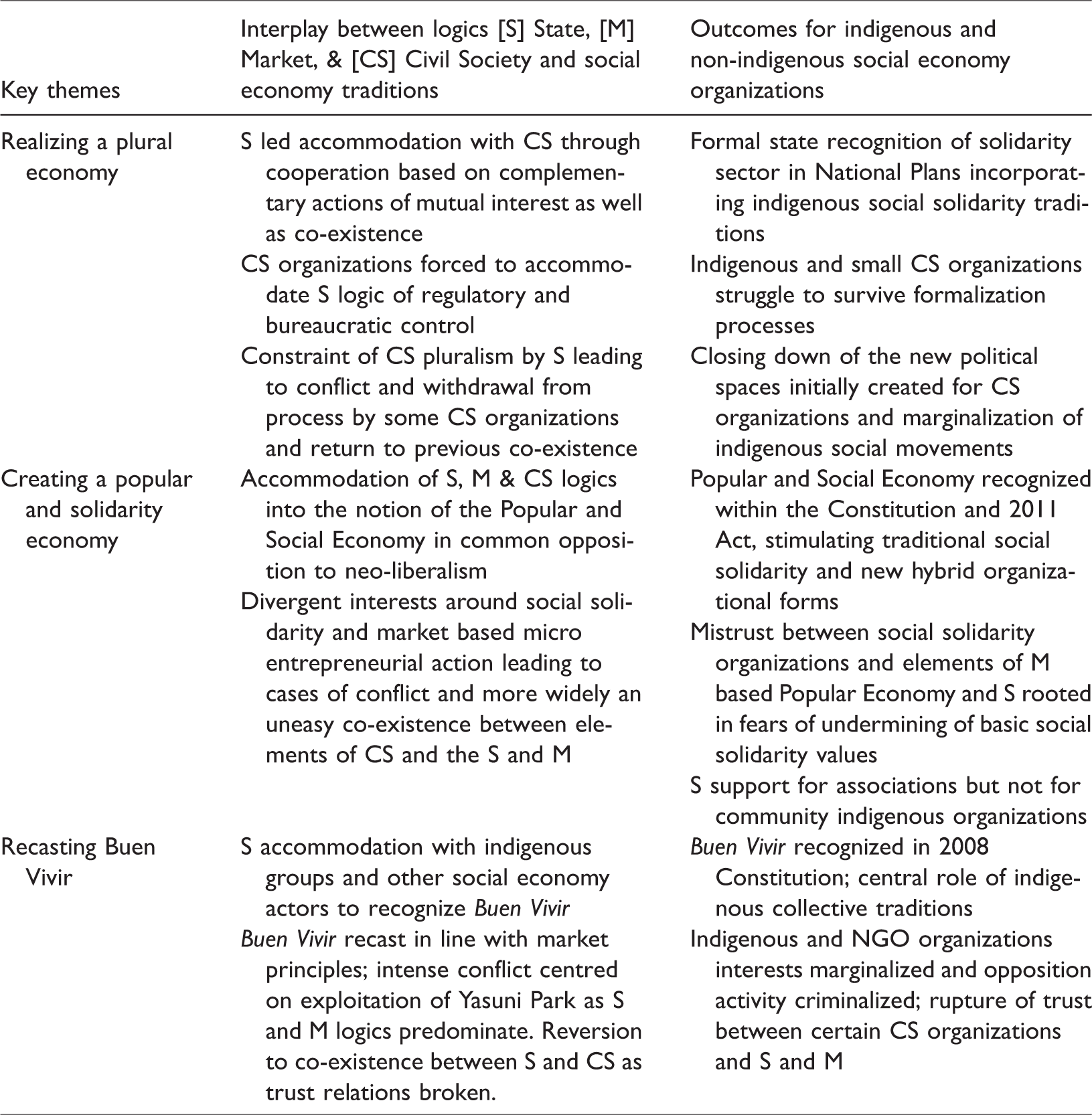
To understand how these different processes played out in the political institutionalization of the social economy, they are analysed here in relation to three of its central elements: the creation of a plurinational and intercultural state, the central role for the PSE and the notion of Buen Vivir. The analysis illustrates how the interplay of co-existing logics of state, market and civil society and different social economy traditions produced diverse outcomes (see Table 2).
Interplay between logics in the institutionalization of the social economy.
Realizing a plural economy
In response to the mobilization of diverse civil society interests, the government set out to create a new kind of state, characterized by citizen participation, a range of economic organizational forms and sensitivity to different cultures including those of indigenous peoples. This created a context in which different public, private and PSE organizational forms could co-exist and seek accommodation through cooperation based within complementary actions of mutual interest.
Government’s role in supporting and promoting a plural economy was widely supported across social economy actors and stakeholders. As the leader of one social economy organization stated; ‘The fact that the government has recognised a plural economy that incorporates the private, public and solidarity sector is really positive for the sector.’ Also, this resulted in SE initiatives and organizations attaining a greater level of visibility: ‘Well, it is the first time that the state has recognised the role of the solidarity economy in the country. This part of the economy was invisible before.’
The new and distinctive participatory process that the state adopted created a sustained degree of involvement in this start-up phase: We have been involved in the decision-making process of laws and regulations, it took us two and a half years to put our ideas together, it was an interesting process where different actors participated, policy makers, academics, practitioners within the solidarity economy, we all came together. (Social economy organization leader)
However, the state-led initiative was from the outset, characterized by inherent contradictions between a top-down process in which the state exercised a powerful position in relation to communities and social economy organizations, and divergent institutional logics operating across the social and popular economies. Tensions emerged rooted in a state logic of regulation and bureaucratization and the very different rationalities and interests of diverse social economy stakeholders and actors. State requirements regarding the formalization of organizations created regulatory difficulties, particularly for smaller, informal economic actors, which felt compelled to comply for fear of being closed down. A leader of an indigenous community-based organization stated: We don’t have much choice, but to formalise our organization, we didn’t want to do it, this is new for us, we have been working for many years that way and now the government is putting a lot of pressure on us. Well, I recently visited an association based 40/50 km away from Guayaquil city and the members told me that the Superintendent visited and informed them that if they don’t prepare what is required [paperwork] they will have to close down. This is a small association that has operated for more than 15 years, well they didn’t know about this new regulation, nobody informed them about that. The government has invested only 40% of the money within the SE sector, the rest has been used to employ people to work with the government. There are so many people that were supporting the SE in different ways at a grassroots level that left their jobs to work for the government. Definitely, this has created a huge gap for the SE sector ….the government has changed the way the sector was operating and the civil society has been affected as they don’t have those leaders anymore supporting them. (Leader of social economy organization)
Creating the PSE
The manner in which the PSE was defined within the Constitution brought together two distinct institutional logics: a social solidarity economy based on more formalized organizational types and a popular economy comprising a large, predominantly informal, market based system of exchange. The latter was characterized by self-employment and microenterprise activity providing low incomes to individuals and households living in, or on the verge of, poverty. Initially these logics co-existed albeit uneasily, through a common political opposition to neo-liberalism, globalization and a desire to create an alternative development path oriented to the needs of the population and rooted in local institutions and practice. Yet the contradictions between these two distinct rationalities became increasingly apparent, with divergent views regarding what, and who, the social economy sector was for. As a manager of a large social economy organization in Quito stated: We don’t agree with the fact that we are all included together, there are people in the popular sector who are using this as an economic opportunity but they are not interested in solidarity and collective values, we have been doing this for years, well, it is unfair to put us together.
This was most evident politically in relation to the cooperative tradition, particularly the larger formal cooperatives, where workers enjoyed a comparatively good economic position. Here the cooperative sector’s objectives meant a focus upon promoting social solidarity and better paid and regulated jobs and to directly contest ideologies of informality and individualism. In contrast, smaller informal popular economy actors were strongly aligned with the Government’s popular discourse promoting the PSE as an instrument to support ‘the poor’. Those individuals and organizations with a fundamental belief in social solidarity were often upset by the lack of knowledge and commitment to cooperative values by those forming and running cooperatives for the first time. For them, these actors often lacked trust in the sector, for example in relation to developing inter-cooperation between cooperative organizations, as well as a broader cooperative identity.
Second, the apparent lack of wider commitment to social solidarity within the PSE sector generated mistrust about actors’ motives. The results of an audit of cooperatives in Ecuador led to an official reduction in numbers from 5500 to 3300, as many were not actively functioning and existed only in name, and worries about why cooperatives were being formed: We were concerned that a huge number of cooperatives were more interested in the profit aspect and didn’t have any social element. For example, a transport cooperative decided to become a cooperative to pay less taxes and receive extra benefits such as $30,000 to buy a car. (Regional policy-maker)
One consequence of this uneven institutional treatment was that some actors who traditionally operated as community organizations, moved to establish separate organizations, creating fragmentation in the local community. There are a lot of examples of people moving from community based organizations to associations. A typical example is a group of 8-10 people that were previously working with an indigenous community-based organization in the Amazon, who have created a tourism association to improve their situation, leaving their community related activities and creating conflict with their local community as they now no longer think about the whole group but only their own benefit. (Academic stakeholder)
Recasting Buen Vivir: Sumak Kawsay and the rights of nature
The notion of Buen Vivir appears in the 2008 Constitution’s prologue in the context of the country wanting to create ‘a new form of citizen coexistence, in diversity and harmony with nature, to achieve ‘living well’, Sumak Kawsay.
3
The significance of incorporating Buen Vivir into the Constitution and subsequent development plans for Ecuador was widely acknowledged by indigenous community groups: For the first time in history, we have recognised the rights of nature in the Constitution as well as the importance of indigenous values and traditions, it is unique and we have to celebrate this, we hope other countries will follow us. (Indigenous stakeholder)
The compromising and undermining of the Buen Vivir notion were accompanied by examples of open disregard for its principles by dominant market and state logics. As indigenous and non-indigenous respondents noted, despite the Government’s claimed respect for ecological balance, it progressively moved to engage in extractive activities in line with traditional, state-led neo-developmentalist approaches. Political conflict on this issued became centred around the Government’s reversal of its position regarding oil extraction in the Yasuní Park. A commitment made in the 2007–2010 National Development Plan to conserve the natural resources of the Ishpingo-Tambococha-Tiputini area of the Yasuni Park was dropped in 2013. The reasoning for this was set out in a speech by the then President, Rafael Correa: We decided in 2006 not to extract oil from the Yasuní; however we have had to change this as we have not received the international support that we expected to sustain our natural reserve area… Since then, we have lost a lot of support from organizations and indigenous leaders; they don’t understand we are doing this for the benefits of our country. This has been one of the toughest decisions, if not the most, of my entire administration, but people have to understand I have to bring food for the Ecuadorian people, this is the only way we can reduce poverty. (15 August 2013, TV speech Canal 1) The government has decided to exploit the Yasuní, but they have not asked indigenous communities. In there, there are Achuar, Kichwa, Shuar and other ones, it is their land and they have the rights to decide what they want to do with their territory, there have been a lot of demonstrations but they have not been listened to.
The government response was to criminalize social protest, further polarizing positions and greatly reducing the scope for accommodation and compromise between indigenous groups and other social economy actors. For NGOs, government actions to regulate their work and exclude and limit the influence of organizations that set out ‘opposing views’ over the socio-cultural and economic development of the country led to widespread opposition. Government concerns over the role of international NGOs ‘supporting the interests of other countries and governments outside Ecuador’ resulted in the introduction on 4 June 2013 of Decree N.16, which gave the state the power to dissolve organizations that might ‘disrupt public peace’. This directly affected international NGOs supporting social economy initiatives and organizations. For example Fundación Pachamama, an NGO founded in the United States which had campaigned on behalf of indigenous communities since 1995, was forced to close in 2013. Such closures led to national protests, supported by such international organizations as Human Rights Watch, campaigning for the rights of NGOs to retain an independent voice in the country.
The state’s inability to maintain a participative process that engaged with the alternative development path of Buen Vivir fundamentally damaged the credibility of its commitment to a plural economy. It also closed down the political spaces operating between institutional logics that had previously been created, reversing previous processes of accommodation between civil society organizations and the state to one of co-existence. The Government’s most recent Development Plan (2017–2021) no longer contains Buen Vivir in its title, although following his election in February 2017, the new President, Lenin Moreno, has sought to deescalate this conflict. This has enabled NGOs to return to work in Ecuador and a referendum held in 2018 led to limitations being put in place on the extent of oil extraction in the Yasuní National Park. Nonetheless, a number of NGOs have not returned to Ecuador as they retain doubts over whether they will be permitted to operate independently, and indigenous communities’ trust in the state has been severely damaged.
Discussion and conclusions
This paper has demonstrated how indigenous collective social economy traditions came together with other societal elements to produce a distinctive, conflicted and politically institutionalized social economy sector in Ecuador. The Ecuadorean case shows how indigenous institutions can influence the development of distinctive national political actions, seeking to pursue alternative development paths that recognize a central role for the social economy. However, to understand the political scope and sustainability of such an alternative development path requires sensitivity to the contextually rooted interrelationships between diverse social economy traditions and distinct institutional logics, and the unequal power relations that underpin them.
The analysis presented illustrated how competing and contradictory institutional logics of civil society, state and market interacted to shape the political institutionalization of Ecuador’s social economy. Initially, this harnessed processes of accommodation in the interaction between civil society, state and market logics around a shared commitment to produce new political spaces. These interactions were characterized by a dedication to greater plurality and participation through the realization of heterogeneous and hybrid social economy activities and their associated organizational forms. However, as this institutionalization process progressed, fundamental contradictions both between these logics and within different elements of civil society, generated processes of conflict and a reversion to co-existence between social economy organizations and actors, which acted to close many of these novel political spaces.
By focussing analysis at the level of the wider institutionalization of the social economy, our findings extend existing studies of social economy organizations from an ILP. The processes of co-existence, accommodation and conflict identified here in the interaction of plural logics within the institutionalization processes demonstrate a degree of correspondence with the manner in which different logics are combined within hybrid organizations themselves (Skelcher and Smith, 2015). These results indicate the importance of investigating more closely this interrelationship between the wider institutional environment and individual social economy organizations and actors, which has remained underexplored within existing research. The combination of institutional logics and resulting ‘rules of the game’ within the wider institutional context for the social economy is associated with the distribution of political resources and evolve through moments of turbulence which create the conditions for the re-combination of institutional logics. These fundamentally shape the strategies of diverse social economy organizations and actors. A theoretical focus on the interaction between individual social economy organizations and the wider institutional environment has the capacity to provide deeper insights into not only how social economy organizations and actors respond and adapt in a manner that retains (or not) their credibility and legitimacy, but also how the strategies of hybrid organizations (Skelcher and Smith, 2015; Vickers et al., 2017) can be used to understand the wider institutionalization of the social economy and the political strategies needed to retain and realize the benefits of plurality.
Central to understanding how social actors and social economy organizations negotiated the contradictions and tensions arising from competing logics of state, market and civil society, was the uneven sources of political power through which they operated. The government-led state logic, which initially embraced and promoted the notion of a plural, intercultural state and the popular and social economy as a means of creating broad based popular support against neo-liberal agendas, shifted to assume a more traditional and dominant role. As the state sought to generate revenues and maintain electoral support in response to market needs and the interests of foreign-based capital during a turbulent economic period, the adoption of a state-led development model marginalized the interests of many social solidarity organizations, including those rooted in indigenous communities, and reduced plurality. State actions decreased the capacity of elements of the social economy sector, undermined notions of Buen Vivir, ignored indigenous land rights and challenged the independence of indigenous groups and NGOs. This shrunk the political spaces for accommodation and compromise between state and civil society logics, to generate direct political conflict and the withdrawal of certain civil society actors and institutions.
Ecuador’s development model recognized a key role for the social economy and indigenous thinking and demonstrates the political possibilities for developing distinctive strategies rooted within local knowledge. The incorporation of indigenous knowledge relating to collective solidarity and community based economic models and a holistic, ecological approach provided a powerful alternative to existing economy models. However, this model’s subsequent evolution amply demonstrates the formidable political and economic constraints involved in realizing and maintaining alternative development models.
Recognizing contradictory logics and their differential sources of social power focuses attention on the nature of their interaction, the extent of contradictions and the possibilities for accommodating contradictions and reconciling a plurality of visions to achieve positive development outcomes. Politically, the limited power of the social economy sector generally, and indigenous populations specifically, critically influenced the manner in which the institutionalization of the social economy progressed. The dangers of indigenous knowledge, as represented by the Sumak Kawsay/Buen Vivir worldview, being co-opted and diluted by dominant state and market interests in the pursuit of their own interests, are readily apparent and raise basic questions as to whether Buen Vivir can provide an approach ‘within or beyond’ development (Radcliffe, 2012, 2018).
The case demonstrates that any commitment to a plural economy needs to be underwritten by a radically restructured state role that guarantees the rights and equality of individuals and organizations across racial and ethnic groups, and enables inclusive partnership working across diverse civil society actors. Top-down, state-led processes are routinely insensitive to the needs of diverse, locally based indigenous social economy organizations. They are intolerant of those who oppose government action. In consequence, to establish a sustainable plural economy, diverse social economy organizations and institutions must be enabled to develop the resources and capacities that ensure they can retain an autonomous role; one that allows them to pursue their interests and challenge and resist any imposition of dominant state and market logics.
Footnotes
Acknowledgements
We would like to thank the anonymous referees, César Marcillo and Richard Croucher for their comments on earlier versions of this paper.
Author note
Sara Calvo is now affiliated with Universidad Internacional de la Rioja, Spain.
Declaration of conflicting interests
The author(s) declared no potential conflicts of interest with respect to the research, authorship, and/or publication of this article.
Funding
The author(s) received no financial support for the research, authorship, and/or publication of this article.