




Abstract
Popular culture – in this case military-themed videogames – has been argued to mould and shape popular understandings of the geopolitics of the ‘war on terror’. To date, most attention has been focused on the geopolitical representations of a ‘final’ popular cultural text or object. Less attention has been paid to how popular understandings of geopolitics and military violence have been constructed and commodified prior to, and ‘beyond the screen’. Empirically, the paper examines the marketing campaign of Call of Duty: Modern Warfare 3. Through the use of experiential marketing, I show how the game’s launch night incorporated spectacular displays, performances and consumer interactions to sell the pleasures of virtual war by drawing on geopolitical fears of terrorism and military violence within major Western cities. Firstly, I demonstrate how marketing engaged with and transformed urban spaces extending the popular geopolitics of virtual war. Secondly, the paper reveals how experiential marketing targeted and encouraged connections with and between attendees’ bodies. Thirdly, I demonstrate how such events promote geopolitical encounters which extend beyond the temporal and the spatial confines of the marketing event itself. Ultimately, the paper reveals how urban fears surrounding the global ‘war on terror’ were employed to sell the pleasures and geopolitics of virtual war.
Keywords
Introduction
On a cold November evening in central London, a green plume of smoke spewed from the rooftop of the Game Store on Oxford Street. Spotlights revealed two military-clad figures cautiously peering over. Manoeuvring over the edge of the roof they proceeded to abseil skilfully down the façade of the multi-storey building. Hundreds of people joyfully watched-on, camera phones in hand, applauding and encouraging the descending figures. As they reached the ground they were greeted by other military-clad actors – a package was handed over as one of the actors bellowed “Operation is Go! Go! Go!”. Assuming a tactical formation the group cautiously entered the building, their replica guns seeking out potential threats, all to the excitement of the massed crowd. A bewildered passer-by – clearly alarmed – approached me to ask what was going on. After informing him this was part of the promotional launch of the popular military-themed videogame Call of Duty: Modern Warfare 3, his apprehension quickly subsided: “Ah, just for fun!”.
This paper centres on the marketing campaign of the popular commercial videogame Call of Duty: Modern Warfare 3 (MW3 herein). It examines the processes through which fear and anxiety surrounding the ‘war on terror’ were drawn upon to sell virtual war. The game itself sees major western cities, such as London, as sites of terrorist activity and militarised violence. As the opening vignette demonstrates, the city of London was transformed and animated into an imitation of the virtual militarised worlds as part of the promotional launch of the game. In doing so, it is reflective of how urban spaces are discursively and materially constructed as scary, fearful and anxiety-ridden, particularly in a post 9/11 context (England and Simon, 2010; Farish, 2004; Graham, 2011). In an era of the global ‘war on terror’, this sense of insecurity has encouraged forms of securitisation that are reliant upon militarised presence and control within urban spaces (Glaeser and Shapiro, 2002; Graham, 2004, 2009; Katz, 2006). While scholarly investigation has emphasised the role of formal actors such as the state, I highlight the importance of popular culture industries in both reflecting and shaping public imaginaries of the geopolitics of the ‘war on terror’. These imaginaries extend ‘beyond the screen’ and are implicated in a wider cultural production of geopolitics and pose questions concerning the character and geographies of contemporary consumer culture.
In considering the marketing campaign and the launch night itself, the paper makes three broad contributions. Firstly, the paper develops existing literature in popular geopolitics to consider how the commercial videogame industry contributes to shaping geographical imaginaries of the ‘war on terror’ (Schulzke, 2013). Whilst other popular mediations have frequently depicted violence as geographically distant from their targeted Western audiences (see Dalby, 2008; Dodds, 2008), MW3 – and the resultant marketing campaign – alter popular geographical imaginations of danger and security by placing terrorism and militarised violence in Western European cities. Secondly, while current scholarship elevates screen culture as the dominant means by which such representations of global fear, war and terrorism circulate (Giroux, 2016), I reveal the ways popular geopolitical cultures extend and are made meaningful ‘beyond the screen’. By drawing attention to the marketing of MW3, I show how the city of London was staged and animated to sell virtual war. Such insights demonstrate the wider geographies that are inherent in the cultural production, consumption and commodification of popular geopolitical and militarised sensibilities. Thirdly, by drawing attention to the launch night, I highlight the ways experiential marketing (Smilansky, 2009) is used to encourage affective and emotional consumer relations with the MW3 game. Commercial entertainment industries are using spectacular, experiential and event-based performances to reach wider audiences and encourage popular geopolitical consumerism.
Methodologically, the paper draws on participant observation undertaken at the MW3 launch night in London to explore how everyday situated happenings and practices resonate and connect to larger trends of militarism and geopolitics (Allen, 2009). The mode of data collection involved: unstructured interviews with attendees; participating and observing events; maintaining a has been argued to visual research diary (Emmel and Clark, 2011); and engaging with media, fan and official promotional materials. I begin the paper by acknowledging current debates concerning the relationship between the ‘war on terror’, geopolitics and popular culture. I argue that scholarship needs to extend analytical focus beyond the ‘final product’ that appears on the screen. Taking this forward, I posit that practices of marketing are an integral means by which geopolitical meaning is negotiated before a ‘final’ text. I explore this empirically through an analysis of the marketing techniques employed for MW3. By drawing attention to the MW3 launch night, I demonstrate how the marketing transformed, animated and commercialised the wider cityscape of London. Following this, I outline the techniques aimed at connecting bodies to the militarised game world, in ways which extended beyond the launch night itself.
Popular geopolitics, videogames and going ‘beyond the screen’
Popular culture has been an important cultural vehicle in promoting everyday sensibilities concerning the geographies of the ‘war on terror’. The interdisciplinary field of popular geopolitics has opened up a critical discussion into the ways popular cultural texts and objects such as films, comic books, toys, and literature have become implicated into the contemporary spatialisation of militarised violence (Dittmer, 2011; Dodds, 2008; Woodward and Jenkings, 2018; Woodyer and Carter, 2020). Such popular geopolitical texts have been argued to propagate imaginative geographies that are both reflective and constitutive of the spatialization of contemporary fear and militarised violence post 9/11.
Despite their popularity, and the geopolitical ideas they propagate, military-themed videogames have received less scholarly scrutiny. Yet, much like film (see Dodds, 2008), the dominant narratives of commercial military-themed videogames such as Medal of Honor, Call of Duty, and Battlefield, have increasingly drawn inspiration from the ‘war on terror’ as exemplified by the tendency of said videogames to “define terrorism, identify threats, characterize terrorists, and imagine the consequences of potential attacks” (Schulzke, 2013: 586). Nascent research by geographers has begun to draw attention to the cultural politics of videogames within the context of the ‘war on terror’, in particular, their geopolitical framing; the portrayal of places, people and landscapes; and the overall scripting of games which glorify and prioritize cultures of military violence (Power, 2007; Salter, 2011; Shaw, 2010).
As geographers have shown, discourses of fear in the era of the ‘war on terror’ have been drawn upon, manufactured and reproduced within political and cultural spheres (Pain, 2009, 2010), often centring on urban space and life (Graham, 2009). Military-themed videogames have been argued to present opportunities to attend to the anxieties of “uncertain times” while simultaneously allowing players to participate in dramatic scenarios which centre on “getting back control” and “overcoming fear” (Power, 2007: 284). As Huntemann (2009: 233) argues, playing virtual war can “provide emotional management tools for real-world fears about terrorism […]”. Interaction and play have thus become essential in recalibrating the civic experience and understandings of war, terrorism and the geographies of military violence.
A key question posed has been what is at stake considering the blurring lines between entertainment and war. Stahl (2010) shows, from a US perspective, how popular imaginaries of military violence have become increasingly commodified within consumer capitalism and the transnational entertainment industries. This convergence has encouraged what Stahl (2010: 6) defines as militainment: “state violence translated into an object of pleasurable consumption” presenting a palatable and virtuous reproduction of unproblematised military violence within the public domain (Der Derian, 2009). Moreover, rather than adopting a more passive role as spectators, citizen consumers have become immersed in militarised dramas through interactive forms of consumerism generating ‘virtual citizen-soldiers’ whereby “pleasures are felt at the expense of the capacity for critical engagement in matters of military power” (Stahl, 2010: 111). On the other hand, this does reduce players as passive and uncritical in their practice and understanding of playing war. Instead, Shaw (2010: 791) outlines how such military-themed videogames offer transitional spaces that involves a “co-mingling between self and world” in which players bring their subjectivities and fantasies to play within “political spaces fizzing with military agendas” (Shaw, 2010: 798). However, such work has often overlooked the everyday geographies in which engagements with such politicised transitional spaces occur, and are often focused on the videogame itself.
To date, studies have been limited to a study of ‘videogame-as-text’. As such there remains a tendency to treat and analyse popular geopolitical objects and texts as “finished” products (Coulter, 2013; Glynn and Cupples, 2015) which are often mediated and only become understandable via the screen. In this respect, popular geopolitical analysis has considered “texts as coherent, self-contained systems” and therefore “lack[ing] in attention to the theoretical complexities therein” (Sharp and Lukinbeal, 2015: 25). As media geographers have noted, the spatial politics of media does not exclusively reside within the text. Rather, it must be considered as “a larger field of struggle for social power” that emerges from the wider social contexts in which media is produced, circulated and consumed (Rosati, 2007a: 996). There has been a growing interest in exploring how players are not passive consumers of geopolitical texts (Bos, 2018a), acknowledging the situated embodied encounters and practices of playing with geopolitics (Woodyer and Carter, 2020), and a need to attend the “everyday experiences of space and geopolitics that are neither scripted nor found embedded in celluloid or print” (Dittmer and Gray, 2010: 1667). Taking Rosati’s (2007a: 1000 emphasis in the original) claims that such texts and visual images need to “be understood not simply as an object but as a process as well – as power in circulation”, it is incumbent to consider how such geopolitical and militarised representations are circulated and made meaningful beyond and prior to an audience and scholarly encounters with a ‘final’ text.
This paper bridges such a lacuna by considering the broader geopolitics of cultural production, exploring the processes such as funding, marketing and distributive practices that are often overlooked yet remain important to the ways popular geopolitical sensibilities are commodified and are presented within wider (western) society. While Dittmer (2011) and Carter (2008) argue for a holistic ‘cultural economy’ approach which considers the broader interplay between audience, text and production, the marketing of popular geopolitics remains largely overlooked. By incorporating consideration of social and material conditions, infrastructures, divisions of labour, circulation of capital and marketing techniques, new insights can be drawn regarding what has been termed the ‘industrial production of culture’ (Rosati, 2007b). Coulter’s work (2011, 2013) speaks directly to the geopolitical implications of this. In drawing attention to the role of film, Coulter (2011) outlines how forms of distribution and funding of production are shown to be premised on ‘territorial appeals’ whereby particular national identities are used to acquire funding and to appeal to national and international audiences. Such broader cultural political-economic processes and practices are not superfluous. Rather, they are centrally important to matters of capital accumulation, founding the cultural authority of brands, and to the establishment of geopolitical meaning-making before the release of a cultural product.
Experiential marketing and the city
Consumer expectations of popular cultural phenomena are commonly shaped through mediated encounters before a ‘finished’ text. However, promotional material and texts are often dismissed entirely. Where they have received scholarly attention, the focus has been on questions of their commercial effectiveness which downplays their wider cultural and political significance (see Davis, 2013). Cultural theorist Jonathan Gray (2008, 2010), drawing on literary theorist Gerald Genette (1991), considers the role of paratexts which are defined as the assortment of additional textual material that surrounds and complements the main cultural text. Significantly, Gray (2010) emphasizes the important role promotional material plays in framing the meaning of popular cultural texts. “[T]hey tell us about the media worlds around us, prepare us for that world, and guide us between structures, but they also fill it with meaning […] and give us resources with which we will both interpret and discuss that world” (Gray, 2010: 1).
According to Lenoir and Caldwell (2018: 27) videogames are one of “the most intensely marketed commodities of digital technology”. To compete in an increasingly competitive global market, to both maintain and expand potential audiences, the industry has become increasingly reliant on marketing and it has emerged as a key arena where the experiences and geopolitics of virtual war are carefully constructed. Due to the risks associated in an extremely competitive industry – where it is estimated only 3% of games ever turn a profit (Kerr, 2006 cited in Payne, 2012: 310), the practice, techniques and subsequent narratives used in marketing are vital to their commercial success. While the increase in marketing expenditure has been considered through the broader political-economic structures (see Johns, 2006), there has been less attention given towards the wider spatial contexts in which virtual war is sold and the subsequent geopolitical meanings conveyed.
Marketing campaigns have grown more sophisticated. They move beyond simply drawing attention to the products’ functions or beneficial value, but instead are using a range of creative and technological practices. The aim is to build brand loyalty and to captivate potential consumers via emotive and sensory registers. What has been termed the ‘experience economy’ by Pine and Gilmore (2011) has seen the increasing desire of companies to strengthen consumer attachment to their brands and products. This reflects the purposeful efforts of brands to foster deeper connections with consumers in the global market place to generate a competitive advantage. The ‘experience’ is created when companies strategically market their products and services which “engage individual customers in a way that creates a memorable event” (Pine and Gilmore, 2011: 98). Here, the value of the experience emerges not just through interaction with the game, but through the promotional events and activities in which the experience of playing war is cultivated before consumers’ actual encounter the game itself.
The practices of marketing, advertising and promotion articulate imaginaries of place, identity and landscapes, thus making them germane research for the study of popular geopolitics. Moreover, marketing practices and materials are situated and are made meaningful in particular geographical contexts (Jackson and Taylor, 1996; Law, 1997). Cities, in particular, have long been sites of interest for the examination of the impact marketing and advertising have in terms of their occupation of public spaces; the effects they have on the patterns and rhythms of everyday urban life; and the quantity and the varied forms in which advertising transforms outdoor urban environments (Cronin, 2010; Iveson, 2012). Moreover, scholars have contended that cities have become increasingly central to the ‘experiential economy’. It is argued that such events have become a key vehicle in which urban spaces are transformed for leisure, political and commercial purposes. They shape both individuals’ relations with commercial products and marketing events as well as with the wider city itself (Lorentzen, 2009; Ernwein and Matthey, 2019). As Smith (2017) has argued, such events move consideration of the city as a stage to the city as staged, which sees the (re)making of the city and generating new meanings, performances and experiences of the urban environment across space and time. As the discussion will demonstrate, London (as well as other cities involved in the European launch) were deliberately selected and staged due to their appearance in the MW3 game. By bringing and extending the game world to the city, the experiential and emotional appeal ultimately “increase[d] the value of the product” (Lorentzen, 2009: 835) and the brand itself. In the following section, I go on to provide further context of the marketing campaign of MW3.
Marketing the geopolitics of Modern Warfare 3
MW3 was billed as “the most anticipated game in history” (Good, 2011: online). At the time of its release in November 2011, MW3 broke entertainment sale records. It sold more than 6.5 million units in North America and the UK in its first 24 hours of release subsequently making it one of the biggest entertainment launches ever. This process of brand establishment was based on an extensive, carefully designed and heavily funded global marketing campaign. For context, the previous Call of Duty: Modern Warfare 2 marketing and distribution budget was around $200million; a total which was far more than the cost of developing the game at $50million (Funk, 2009: online). Notably, however, the marketing campaign of MW3 portrayed a broader geopolitical narrative by focusing on the wider geographies in which the game saw conflict entering iconic North American and European cities.
In MW3 the overarching plot of the game sees a Russian Ultranationalist group orchestrate a series of terrorist attacks involving chemical bombs in major European cities as an attempt to foil a planned peace treaty that addressed the ongoing conflict between the USA and Russia. Whilst previous iterations of the game – and other military-themed titles for that matter – often drew attention to geographically distant, often unspecified or fictionalised virtual landscapes in the Middle East and Central Asia which were often presented as fearful, barbaric and ‘other’ (Bos, 2018b; Graham, 2011; Shaw, 2010) – MW3 was different. The game’s campaign mode and marketing strategies scripted major cities in North America and Western Europe including Paris, London and Berlin, as central locations to the geopolitical drama.
The release of MW3 saw the introduction and commodification of the wider fears, anxieties, and insecurities surrounding conflict and terrorism in major Western cities. As such, MW3 departed from the first game in the series. Call of Duty: Modern Warfare and its marketing campaign which shielded consumers from making comparisons with the impact of the ‘war on terror’ at ‘home’. Rather Call of Duty: Modern Warfare (2007) was carefully marketed as taking place ‘elsewhere’. As such, promotional material was generative of: “particular textual readings over others with the goal of insulating Call of Duty’s war play from interpretations and criticisms that might link the violent play on-screen to the worldly violence unfolding in Iraq and Afghanistan” (Payne, 2012: 306)
Indeed, the content of these advertisements encouraged comparisons with contemporary terrorist attacks in major Western cities. One trailer showed a London Underground train derail and explode, with the UK media drawing linkages with the terrorist attack in London that took place July 2005 killing 56 people (Daily Mail, 2011). Other aspects of the marketing campaign provoked criticism as it purported to “trivialize combat and sanitizes war” (Brown, 2011: online), and an advert was banned from daytime TV in the UK due to the depiction of scenes of violence. Defending the game at the launch night of MW3, the executive producer Mark Rubin argued that the game should be assessed purely for its entertainment value. In this instance the game legitimised through an emphasis on its resonances with cinematic conventions and, as such, it was argued that it should be exempt from wider (geo) political associations, criticisms and analysis: “You have to see the game in its context so I think any statements outside of that context and you are kind of losing your points. The other thing is the game takes place in todayish times, for a period, but it's in a totally fictional world you know. In our world there is no 9/11; there was is no Iraq war; no Afghan wars … none of that exists it’s a totally fictional world so those kind of points of trying to connect them to things that happen don't really work and everything we do, we do from a purely cinematic standpoint …” (Game On, 2011: online).
Second, the marketing of MW3 employed the use of social media. Social media, in this instance, illustrates the interplay between consumers and producers in which brands can build and augment emotional connections, but also respond to audience communities and ‘feedback’ (see Dittmer and Larsen, 2007; Rosati, 2007b). Nine months before the official release of MW3, leaked information and details of the game made its way online. In response to the leak, publishers decided to push forward the marketing campaign which took the form of four short ‘teaser trailers’ being hastily released via YouTube. The brief trailers focused on key game locales; Germany, America, France and England, revealing iconic national landscapes and architecture under attack. Acknowledging the global information networks which leave entertainment industries increasingly prone to hacking and the leaking of information, 1 publishers used social media as a means to directly communicate with audiences, and utilise the emergent hype of the leak by officially revealing the game’s geopolitical narrative, and creating desire directed at national consumer audiences.
Finally, promotional campaigns have utilized experiential marketing strategies whereby the focus is placed on providing embodied, event-based activities. This has included several Call of Duty XP (2011, 2016) events based in Los Angeles, USA, where paying guests were afforded unique and exclusive experiences including a ‘first-glimpse’ of the yet-to-be-released games. Also, there were opportunities for select attendees to experience the game world ‘beyond the screen’. They were able to try out a military-style zip line and to partake in a jeep course thus enabling them to “navigate obstacles inspired by the epic storytelling of the Call of Duty franchise” (Call of Duty XP 2011, online). The marketing campaign invited fans “to live, breathe and feel the brand through interactive sensory connections and activities” (Smilansky, 2009: 3), which enable embodied interactions and experiences beyond the gameplay itself.
The apex of these marketing and promotional strategies was most pronounced during the official game launch nights. The goal of the launch night was twofold. First the ‘launch night’ is an attempt to generate mass consumer exposure, and second to cultivate more personal and embodied experiences with the brand and, in this case, the geopolitical and militarised content. The material, symbolic and ideological significance of such urban event-based activities are not necessarily constrained by their temporality and the spatial contexts in which they take place (Smith, 2017). Other official 2 launch nights occurred in Berlin and Paris confirming the game’s focus on major Western capitals as sites of terrorism and militarised conflict. In what follows, I show how the launch night served to transform and animate the city of London and generated experiences which turned practices of military violence into pleasurable consumption.
Displaying Modern Warfare in the city
One central element of the marketing techniques of the European launch nights in London, Berlin, and Paris focused on blurring the ‘real’ and the imaginary. Drawing attention to the role of military simulations, Graham (2011: 220) argues such practices are not merely attempting to produce a copy of the ‘real’ world but are “hyperreal constructions – simulations of things that don’t exist – through which war and violence are constructed, legitimized, and performed”. Leading up to the European launch of MW3, one of the game’s designers Michael Condrey suggested: “[I]n Modern Warfare 3 we are going to take you around the world to some amazing set pieces. Paris is in the game in a big way … some really amazing gameplay and some unique experiences happen right in the heart of Paris, and to be there on launch night, to see the virtual world in reality and vice versa … it’s pretty special to me” (MW3 Launch Video, 2011: online)
To achieve this, a range of visual strategies were employed during the launch night. Lighting has long been utilised as a tool to alter the urban environment in ways that both project and reinforce commercial and state power (Edensor, 2012; Koeck and Warnaby, 2014; Kong and Yeoh, 1997). Lighting was used to temporarily transform not only the official launch venue itself but also the wider urban environment so that it reflected the geopolitical dynamics that defined the script of MW3.
Despite the evening’s main event being housed in a specific venue near the River Thames, in proximity to iconic landmarks such as Tower Bridge, the Tower of London and City Hall, lighting illuminated the wider city environment thus expanding its presence and visibility. Contrasting with the night sky, the launch night venue and surrounding area were bathed in a green hue. The colour drew on militarized night-vision optics – a technology that was integral to the gameplay as the player undertook the role of a specialist military operative, deployed in covert scenarios and often under the cover of night. Importantly this green hue became an evocative metonymy for the MW3 game and was used extensively throughout the marketing campaign. Unlike more orthodox forms of advertising, these visual practices and performances not only increased the potential spaces in which MW3’s brand of virtual war occupied and became visualised but it also worked to connect the game world to the city of London.
The wider projections of light and images of the game onto the wider cityscape of London is demonstrable of how the specific architectural contexts in which marketing takes place and works to “actualize their power” (Rosati, 2007a: 1010) and the communicative process.
Modern Warfare 3 imagery projected on to HMS Belfast, London (Source: Author).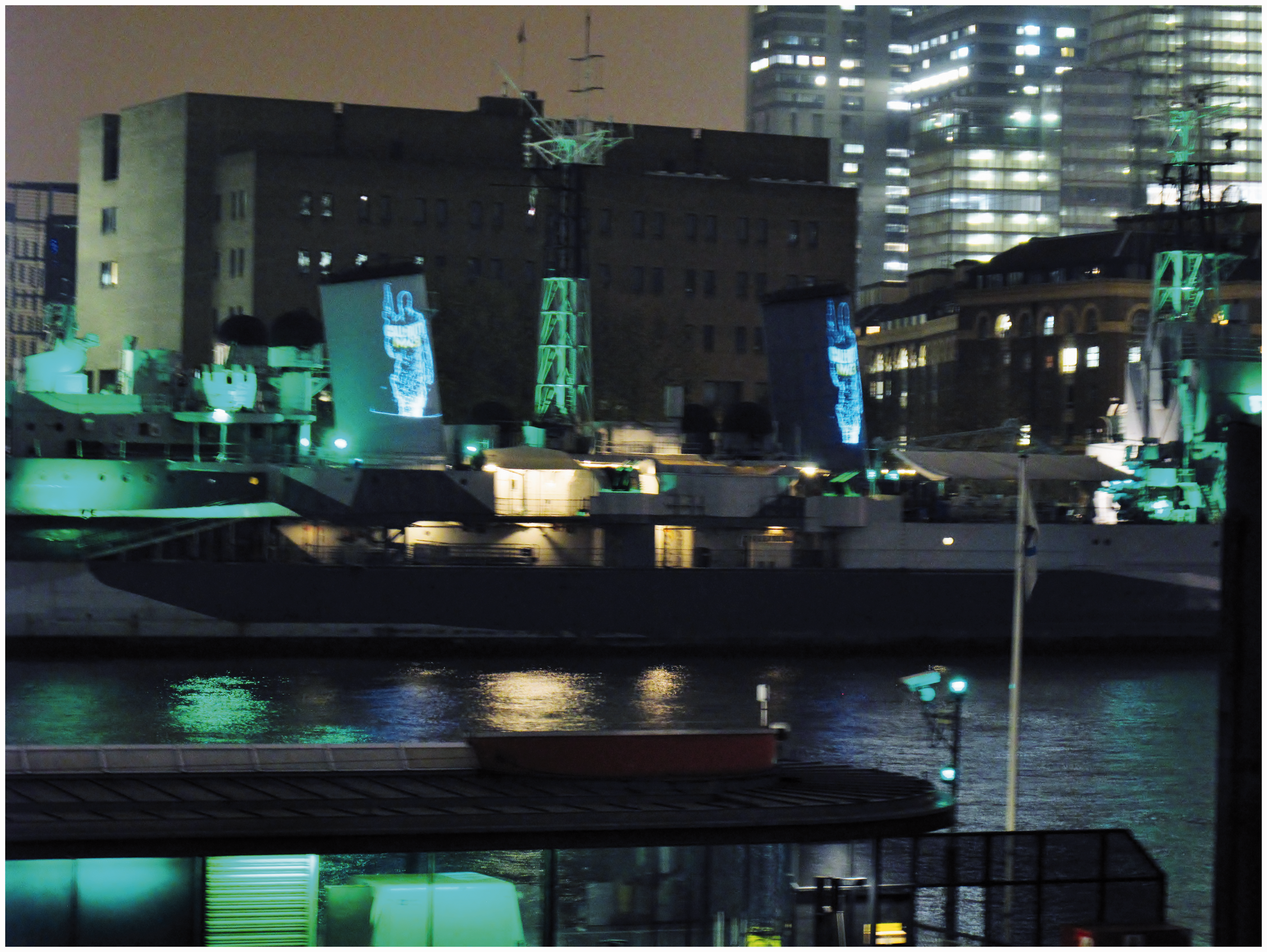
The incorporation of the city’s architectural surroundings became opportunities to expand the display of the game’s geopolitical and militaristic content. This was evident when a short animation was projected on to the façade of the launch night venue which served as the basis of conveying the geopolitical scripting of the game. Keeping with the dominant colour of the game, green lines buzzed, flickered and zipped around the stone frontage, mirroring the dominant imagery from the game. A cartographic animation of the globe emerged centring on Europe with a red arrow emanating from North America, moving to the UK, France, Germany and Russia. As the arrow moved red circles rippled from each area emphasising the connections within the game and the red vividly standing out connoting a sense of unspecified threat to these locations. As Figure 2 shows this sense of impending danger was connected to iconic sites of western countries. Political landmarks, such as the Houses of Parliament acted as an important synecdoche (Koch, 2018) and facilitated the translation of a sense of territorial identity between the London cityscape and its virtual depiction within MW3.

The outside façade of the launch night venue lit in a green glow and with images of the game (Source: Author).
The use of lighting techniques and accompanying 3D projections is illustrative of the ways urban spaces become staged. Such events and spectacles are not passively received but require active participation, “establish[ing] emotional and associative links between people, place and a ‘product experience’” (Koeck and Warnaby, 2014: 1417). The associative links created were not exclusively visual. Rather the launch night was augmented by the introduction of music that was synchronised with the projection. The character of the music further exuded a sense of urgency and threat. It cultivated an immersive atmosphere in which “affects, emotions, sensations and meanings are inextricably mingled” (Edensor, 2015: 334). This melodramatic music fused with the animation, fluctuating and climaxing, generating an affective relation which connected the city, the game’s geopolitical narrative, and the gathering bodies who were, pointing excitedly to others and recording with mobile phone devices.
Key to the animation, the wider strategy of the launch night, and the game itself, was its ability to draw on the emotional linkages and ties to the Western ‘war on/of terror’ (Pain, 2009, 2010). The centrepiece of the venue, a large circular table – reminiscent of the ‘war room’ as depicted in Dr Strangelove (1964) – enabled attendees to play the MW3 game which overlooked the table-top cartographic display presenting Western powers as mired in conflict. Here, connections between the fear of World War III and the game itself were displayed labelling; ‘Am3erica is under siege’, ‘G3rmany in chaos’, ‘Battle for Franc3’ and ‘Attack on 3ngland’. Continuing attempts are made to capitalise on popular culture and media tropes, connecting the game brand, and the fears of a global terror network culminating in World War III. Moreover, the transnational narrative of the game was not just to be overcome individually, but also through and with a global community of players.
This was demonstrated when a crowd had gathered in the venue to watch as a celebrity “battled for England” against celebrities at the other European launch nights via the game’s multiplayer platform. This notion of a worldwide conflict promoted an alternative perspective, as one attendee mentioned, the game prepared them by giving them a chance to “see conflict in a different way and to see what conflict does to the world”. Furthermore, this was tied in with a sense of believability concerning the game’s narrative and the fears of terrorism within Western cities, as one attendee mentioned: “It's good, it gives you a bit of an idea […] it gives you situations you can almost understand”. The focus on terrorist activity and militarised responses within a familiarised landscape became intelligible to players and was seen as, and anticipated as, “a situation that could happen”. While the emphasis has often been placed on the role of government in the utilising of staged simulations within cities to ‘play-out’ potential disaster scenarios (Anderson, 2010), the launch night shows the ways popular cultural industries draw upon similar logics in ways that construct fearful futures which can be temporarily experienced and overcome through purchasing and consuming the MW3. As attendees noted, the launch night and how MW3 was marketed, presented an “‘as if’ future to be made present” (Anderson, 2010: 233). These popularised mediations and performances of anticipatory logics have important consequences to the here and now – legitimating militarised presence, control and action as a defining feature of urban life.
Embodying and performing Modern Warfare
If the launch night served as an opportunity to transform and animate the (urban) environment, the process also targeted and encouraged connections with and between individual bodies. The launch night venue itself had been transformed into an environment of interactive militarised consumption. The layout had been carefully tailored presenting both banal and spectacular acts of interactivity and consumption both within the game world and with the Call of Duty brand more generally. Consumers were invited to play the game itself via a range of consoles organised around the venue. Moreover, the venue offered multiple and varied forms of the pleasurable consumption of MW3, with specially made alcoholic cocktails (mirroring the green colour scheme of the game); food boxes branded with the MW3 logo, and people wearing branded MW3 T-shirts. Musical performances were essential in evoking pleasurable consumption associations with the virtual war and to produce a memorable and positive ‘out-of-the-ordinary’ event (see Moor, 2003). In this case, the UK band Example encouraged attendees to raise their hands to show their appreciation of guns.
The launch night involved bodies as targets of and as sites for promoting the game (see Law, 1997). Awaiting attendees as they joined the green carpet were several actors dressed in full camouflaged military attire and armed with replica guns. While some wore camouflaged uniform half-a-dozen individuals were differentiated, wearing black attire, with smudged camo face paint and holding replica M4 replica guns (see Figure 3).
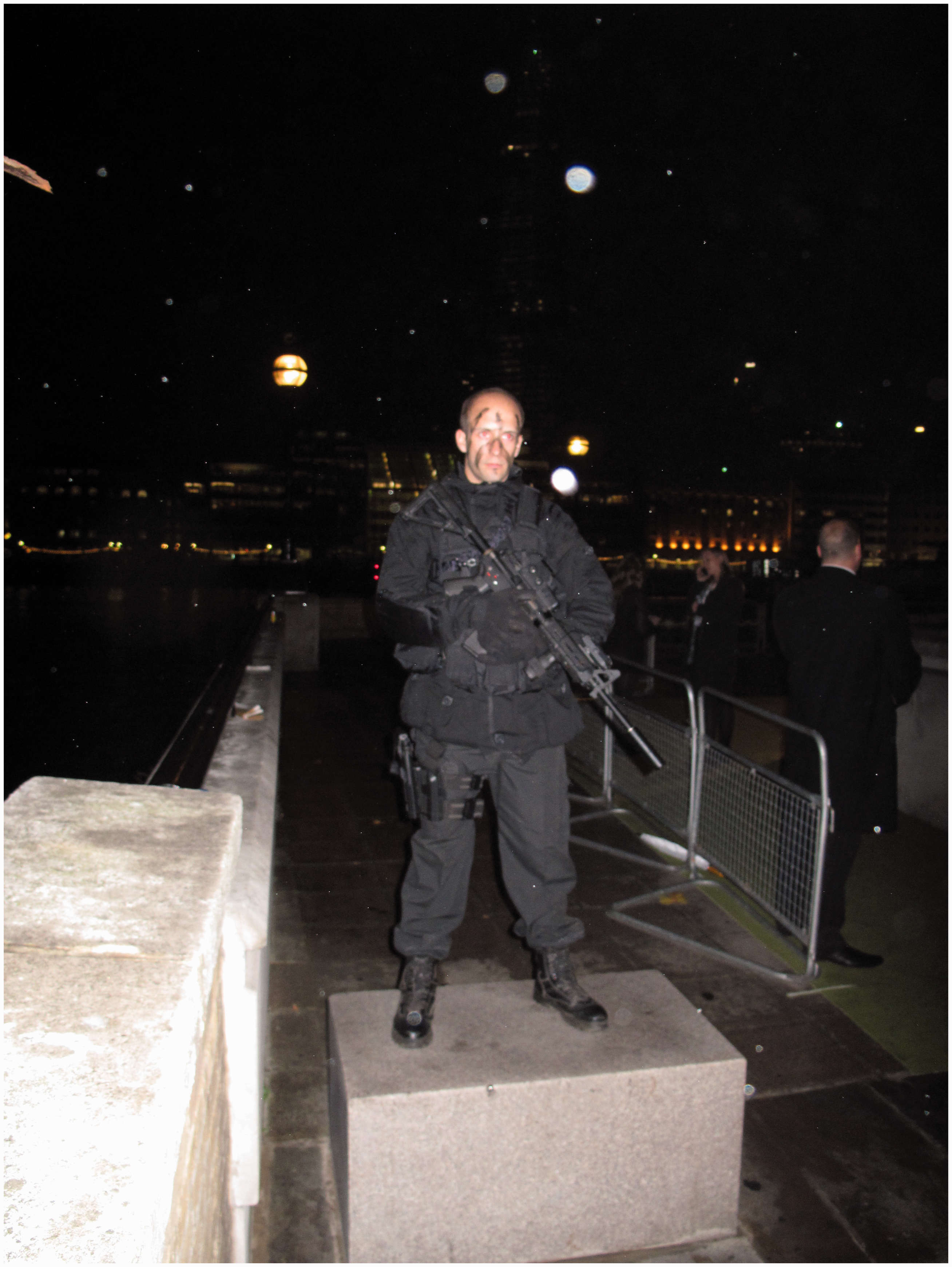
Actor dressed in military attire with replica M4 gun (Source: Author).
The details were not just in the presentation of the uniform but also through their embodied performance. These actors stayed fixed at particular positions, surveying the crowd while replicating and performing militaristic identities and characterised traits of discipline, preparedness and authority (Woodward and Jenkings, 2011). They were certainly less interactive than the virtual avatars they were signifying, standing stoically overlooking the gathered crowds.
Katz (2006) notes the increasing presence of the military in the US urban landscape – for example – promotes a form of banal terrorism which she defines as the “every day, routinized, barely noticed reminders of terror or threat of an always already presence of terrorism in our midst” (Katz, 2006: 350). As Katz (2006: 350–351) continues, such practices and ideals performed in urban spaces “produces a sense of terror and fear” that can be worked to naturalise security practices within the city – “hailed at moments of crisis to authorise such things as a suspension of civil liberties or an open-ended and clearly never-ending ‘War on Terrorism’”. Yet, as the launch night demonstrated, these militarized performances were purposefully adopted as a celebratory event in which attendees and the wider public could visualise and experience the virtual game world in place. Such fears as discussed by Katz (2006), are reduced to a negative sensation, whereas the activities of the launch night were designed to promote excitement, hype, and a sense of enjoyment, which was demonstrated in the enthusiastic public reception of the ensuing performances.
Attendees were not simply observers during the launch night but were enrolled into militarised performances which were intimately sensed and experienced through the body. Attendees, in this case, were “not simply watching the machine in motion but wiring oneself into a fantasy of a first-person, authorial kinetics of war” (Stahl, 2010: 42). The launch night shows how this notion of ‘interactive war’ does not just rest with the ‘final’ videogame itself. Rather it illustrates how the notion of interaction is mediated and encountered in ways in which the pleasures of virtual war become embodied. Indeed, there were several direct “invitation[s] [for attendees] to cross over and try on a soldier identity” (Stahl, 2010: 92) which encouraged ways of connecting attendees to the militarised game world experience. A laser tag event organised in the venue claimed to offer a ‘real-life’ Call of Duty experience. In recreating a mission entitled ‘catacomb’ in the basement of the venue, attendees could experience a ‘close-quarter combat’ scenario. This was a highly-charged, and affective experience in which, as an attendee, reflecting on the experience, stated: “[T]esterone began to fly as we were briefed then thrust through a shooting gallery, encouraged by the shouting of our counterparts to shoot “everything on sight”” (Keeble, 2011: online).
Attendees were also given the chance to ‘try-on’ and perform the militarized identities found in the game. At one particular attraction, attendees dressed in military attire and struck a pose, adorned in military uniform and clutching a replica M4 rifle, emulating the MW3 videogame cover (see Figure 4). Here, there were deliberate attempts in which “[consumers] bodies [were] transformed into militarized bodies” (Armitage, 2003: 3). As argued by Dalby (2008), the warrior figure has become a key popular geopolitical trope of the post 9/11 era – a figure who engages in violence in distant lands, “physically securing the West, and simultaneously securing its identity as the repository of virtue against barbaric threats to civilization” (Dalby, 2008: 440). Here, however, the marketing of MW3 placed the ‘warrior’ as key to the security of terrorist activity within the ‘homeland’. Moreover, the launch night offered the experience of attendees to engage with moments of cosplay offering new encounters where the attendee became part of the game world, and, as I go on to discuss, the marketing campaign itself.
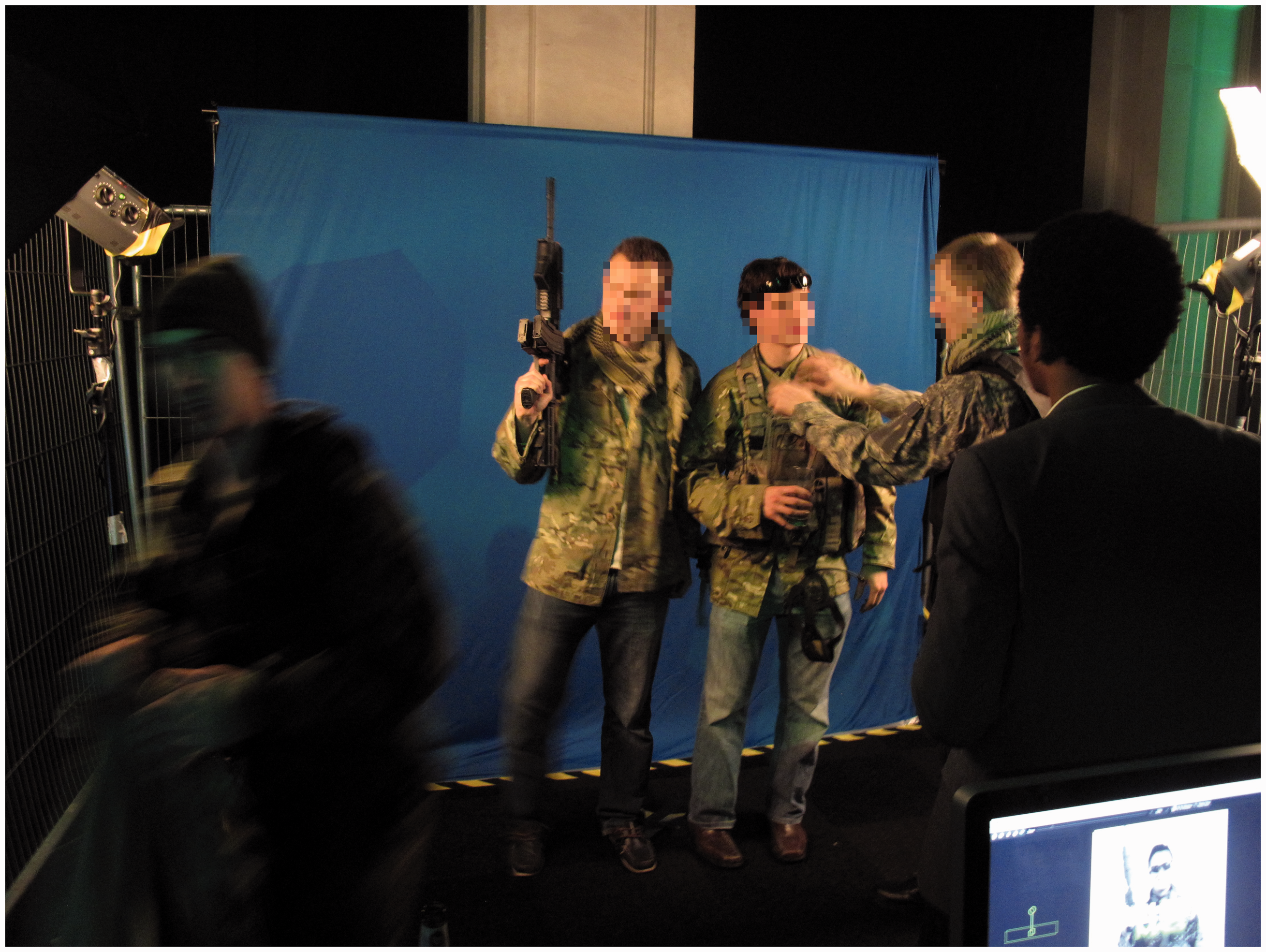
Participants dressing-up in military attire preparing to be photographed (Source: Author).
Modern Warfare beyond the launch night
Experiential modes of marketing are engineered towards producing memorable encounters which extend beyond the temporal and the spatial confines of the event itself. Such practices involve acts and methods that further connect the game to everyday life and to increasing the possibilities of durable affective connections with the attendee, as well as those who did not attend. As indicated earlier, social media was employed to generate hype through the use of the hashtag #MW3launch 5 which encouraged wider socialisation of the launch night itself, whilst the event was also live-streamed online. In a similar vein to film premieres, such events are purposefully intended to engender public and media attention. 6 A ‘green’ carpet enabled the media to interview celebrities and the game’s designers who offered a means of generating further publicity beyond the event itself through their association with MW3 and proclaimed fandom. A range of celebrities and athletes whose ‘star power’ was an important promotional strategy enabled a platform which legitimized the cultural significance of MW3, but also its broader popular geopolitical meaning (see Benwell et al., 2012). An interview finished by asking the celebrity if they had “anything to say to the troops in Afghanistan and Iraq [?]”. Despite the earlier comments from the executive producer, such interactions showed how conflations were made between the game world and the wider context of the global ‘war on terror’. Further comments from celebrities also framed who MW3 was for, as during an interview one guest suggested it is “not for girls” and, as another celebrity guest continued, MW3 was a means of “liv[ing] out innate masculine fantasies of violence”. Scholars have noted the gendered geopolitical relations promoted through popular cultural narratives concerning the ‘war on terror’ which promote masculinised values concerning security, foreign policy and military violence (Dodds, 2008; Salter, 2011). Indeed, the Call of Duty series promotes an intimate connection between masculinity and the military by “mark[ing] the military as a predominantly male space, where war is a contest primarily instigated, waged, and resolved by men” (Blackburn, 2018: 40). Such masculinised identities and performances are just not invoked in the gameplay but are embodied and consumed beyond the game itself (see Bos, 2018a). Celebrities at the launch night thus became an opportunity to further promote and establish the game’s popularity via the media, but also to generate and shape the game’s geopolitical and militaristic meaning before its release.
As the paper has outlined, the launch night and its associated activities brought a multiplicity of encounters with the geopolitics of MW3. Such modes of experiential marketing became an opportunity to extend the temporalities of the event and for attendees to “both have memories and to share them with others” (Moor, 2003: 50 italics in the original). Drawing attention to the role of objects and ‘stuff’ that become central to the practice of military recruitment, Rech (2019: 5–6) shows how material cultures “imply a folding of militarism into everyday habits and routines” and work in ways which “animate familiar geopolitical scripts”. In a similar vein, the launch night offered a range of MW3 branded objects which find their way on, or around bodies such as T-shirts, stickers, and posters which travelled and circulated beyond the immediacy of launch night and celebrated militarised cultures from the game itself. Such promotional objects, therefore, become an important means in which the figure of the ‘warrior’ became both enacted and personalised but also circulates beyond the launch night. The photo opportunity described earlier circulated, not only as a material object, but also in digital form as attendees were advised to upload it on to social media. The use of social media, (inter)national media coverage, global official and unofficial launch night events, and the mobility of material objects and paraphernalia are indicative of the afterlife of such events and how popular geopolitics sensibilities are made possible and interplay at multiple scales and within the geographies of everyday life.
Conclusion
This paper has outlined how popular geopolitical imaginations extend ‘beyond the screen’, and how they animate, transform and are made meaningful in place. By drawing attention to the marketing of MW3 in the city of London, I demonstrate how non-state actors – in this case, the entertainment and marketing industries – propagate spatial imaginaries and performances which consider Western cities as both targets and sites of terrorist attacks, and subsequent militarised forms of securitisation. This is not to deny the present risks and the forms of informal and formal violence that are increasingly centring on Western cities, but how the geographies of military violence is communicated via popular culture and the media, is integral to the legitimation of the securitisation and militarisation of urban life.
As I have shown, the case study provides nuance to and extends current scholarly investigation into the relationship between popular culture and geopolitics. First, rather than analysing discrete cultural object in the videogame itself, I have illustrated how the broader practices of marketing and promotional activities provide experiences in which the geopolitics of the videogame are displayed and embodied before, and beyond, interacting with the game itself. This points to the wider geopolitical assemblage of various actors, performances, economics, discourses and media engagements and entanglements which inform and rework popular geopolitical experience of and in place. As Mostafanezhad and Promburom (2018: 96) suggest this erodes simple dualisms between ‘audience’ and ‘text’, ‘off-screen’ and ‘on-screen’, and instead acknowledges the “series of cultural practices [and processes] that intersect at various nodes of experience and operates at interconnected and always shifting spatial scales, to create ‘place’ from ‘space’ as well as respatialize geopolitical imaginations”. Second, and developing on this point, the paper outlines the variegated spatial contexts in which popular geopolitical sensibilities are performed, displayed and emerge from place. Whilst the domestic setting has emerged as a key site of popular geopolitical consumerism (Woodyer and Carter, 2020), the spectacular event of the launch night reveals new ways and means in which advertising and marketing utilise and animate urban, public spaces, which are reflective and rooted within popular geopolitical ideas. As shown the various technologies, techniques, and spectacular performances, speak to politics of how urban space is continually (re)made, and in what image. Finally, the paper outlines how these geopolitical marketing practices are entangled within the everyday registers of emotion, affect and embodiment. As argued, geopolitical fears are manipulated and drawn upon for commercial and entertainment purposes and which intimately connect consumers to the pleasures of military violence, which could be enjoyed and overcome through consuming the virtual war offered in MW3.
With politicised forms of violence increasingly centring on urban spaces, such cultural performances are important in upholding the normalisation of militarised presence and logics within urban life. The paper, therefore, encourages future scholarship to consider the spatially “excessive nature of popular cultural phenomena” (Horton, 2008: 400) and ways such excesses become implicated into the cultural production of popular consumer understandings of geopolitics beyond the screen.
Footnotes
Acknowledgements
This research was undertaken as part of an ESRC + 3 PhD scholarship (ES/J500082/1). I would like to acknowledge and thank Marion Ernwein, Ian Klinke and Muireann Meehan Speed for their comments and suggestions on earlier iterations of the paper. I’m grateful for the editor and two anonymous reviewers for their thoughtful suggestions.
Declaration of conflicting interests
The author(s) declared no potential conflicts of interest with respect to the research, authorship, and/or publication of this article.
Funding
The research from this paper was funded by an ESRC +3 PhD scholarship (ES/J500082/1).