




Abstract
Recent scholarship on environmental justice highlights a concern about the relationship between the racial state and social movement strategy. This paper addresses the ingenuity of environmental justice organizing in the Proctor Creek and South River watersheds of Atlanta, Georgia, each home to predominantly Black communities and unjust flows of toxicants and sewage through urban creeks, streams, and rivers. We begin from critiques of the failure of institutionalized environmental justice and the state’s role in maintaining environmental racisms. To examine organizing responses to these circumstances, we analyze the improvisational politics of social movements in the context of the racial state, theoretically drawing from Charles Lee’s Ingenious Citizenship (2016). Empirically investigating the work of Atlanta community organizers, we emphasize pathways of strategic innovation among environmental justice organizers that improvise against the racial state even while negotiating with it. The article presents evidence of organizers challenging dominant modes of quantifying environmental injustice, appropriating and repurposing the language of environmental restoration, and improvising in the spaces of environmental governance. While state recognition has sought to contain or co-opt movements, we demonstrate the continuing vitality of mobilizations that simultaneously make demands of the state and rupture the governing forms of knowledge and practice that reinforce environmental racisms.
This paper examines forms of ingenious politics employed by activists in Atlanta, Georgia to address water borne racial inequities. Atlanta’s long history of segregation is entwined with water infrastructure. Shifting landscapes of urban exclusion in Atlanta have been articulated through and developed in concert with forms of infrastructural violence. Shaped by racialized investment and disinvestment, urban flows of water-borne waste map onto the racial geography of the city. This is particularly evident in the South River and Proctor Creek, which carry untreated sewage and toxicants through majority Black neighborhoods. Community organizers in these watersheds argue that government programs to remediate these environmental harms have been insufficient to unsettle the long-tethered relations between race and water infrastructure. Challenging the tokenism of reforms, Black environmental organizers have innovated forms of environmental justice activism.
In this paper, we draw upon scholarship addressing environmental justice and social movements to examine the ingenious politics of environmental organizing in predominantly Black Atlanta communities. We begin from emerging critiques of institutionalized environmental justice and its failure to meaningfully address ecological inequities. Marginalized communities face barriers to participating in environmental governance, processes which generally neglect the broader structures of racial capitalism that underlie environmental injustices (Ranganathan, 2016). To theorize organizing responses to these circumstances, we turn to social movement scholars, specifically placing Patricia Hill Collin’s classic text, Black Feminist Thought (1991), in conversation with Charles Lee’s recent book, Ingenious Citizenship (2016). While Collins (1991: 26) stressed that articulating a distinct “self-defined, collective standpoint is key to Black women’s survival,” Lee (2016: 9) highlights the need to address the “ingenious agency” of the marginalized, who continually invent “different ways of enacting oneself politically with limited tools and resources to generate change in one’s immediate surroundings and even the larger social sphere.” Applying these frames to organizing in majority Black watersheds, we examine how communities are responding to the failures of institutionalized environmental justice. In our analysis, we highlight two elements of ingenious politics at work in struggles against environmental racism in Atlanta: 1) an instrumental orientation to producing forms of counter-knowledge that force regulators to address systematic issues; and 2) a commitment to critically engage existing structures, challenging and subverting normative associations between race and waste. Focusing on movement responses to the limits of government recognition, we demonstrate how organizers’ ingenious and improvisational approach to politics unsettles the dominant order, opening new political horizons. Our analysis of the improvisational politics of community organizing complements scholarship on the delimitations of government recognition, showing how Atlanta organizers are continually reworking the terms of their relations with government authorities to address environmental injustice and make political change.
Empirically, this paper draws upon long-standing participatory research with two watershed groups: the West Atlanta Watershed Alliance (WAWA) and South River Watershed Alliance (SRWA). The third author is a scholar-activist who has worked for two decades with WAWA, an organization that she co-founded and still leads. The first author has conducted research in partnership with SRWA since 2012. The empirical foundation for our analysis includes participant-observation of hundreds of organizational meetings, public meetings, river outings, and monitoring events with these and several additional organizations, as well as 71 individual interviews. In the following, we first position our intervention in the literature, provide a brief history of the relationships between water infrastructure and race in Atlanta, then detail ingenious forms of organizing in the West Atlanta and South River watersheds (Figure 1).
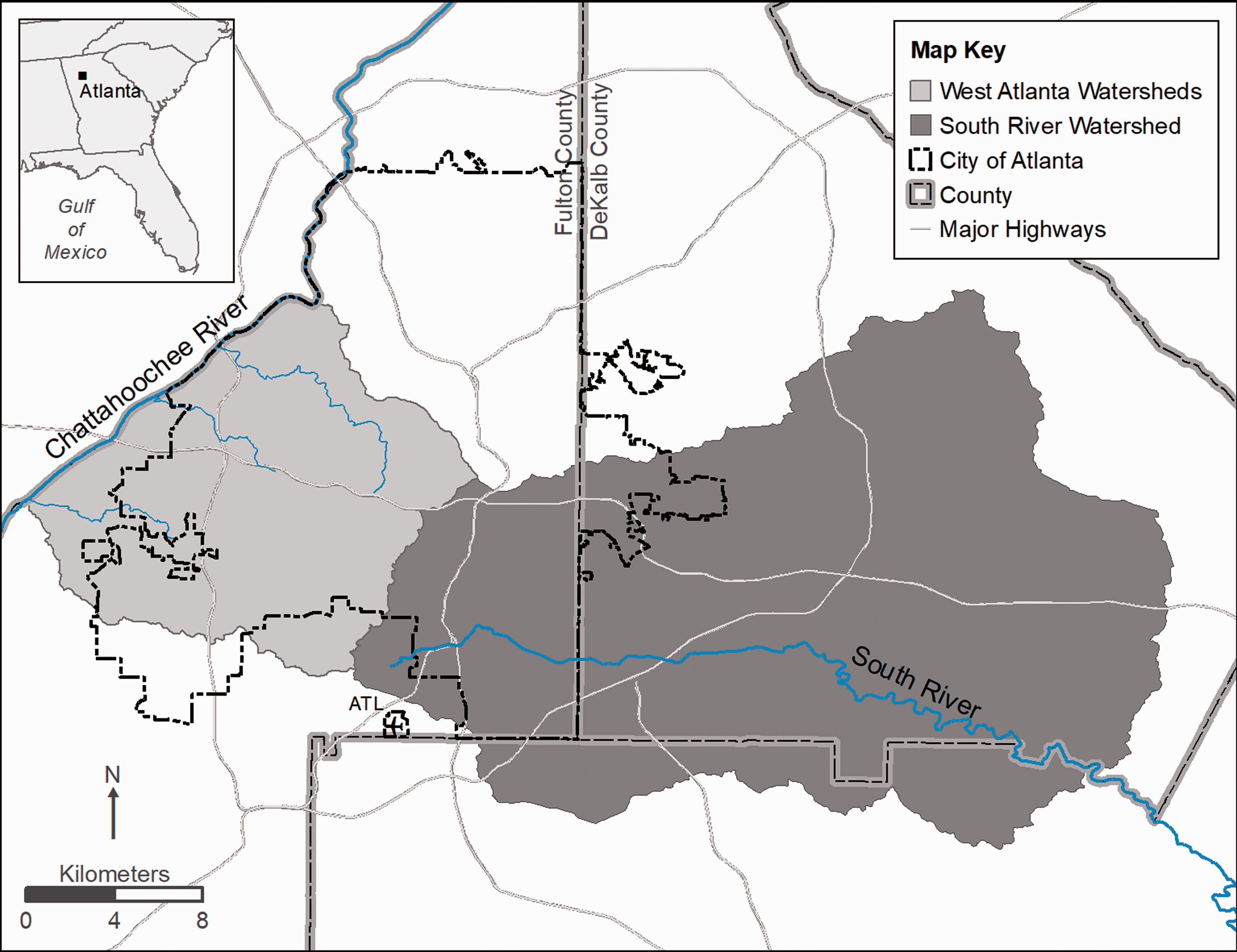
West Atlanta and South River Watersheds in Atlanta, GA, USA.
Ingenious potentials in the moments of environmental justice failure
Environmental justice (EJ) research has identified racially differentiated exposure to environmental hazards and emphasized disparities in who is included in environmental decision-making. The consistent underrepresentation of Black and other marginalized communities in environmental governance maintains racialized patterns of uneven development, directing environmental funding, research, and regulatory enforcement towards more privileged populations. EJ activism pushes against the enduring whiteness underpinning mainstream environmentalism and how it impairs engagement with the violent realities of our highly racialized socio-ecological relations (Gibson-Wood and Wakefield, 2013; Yusoff, 2018).
Campaigning for more inclusive environmental governance and demanding an end to the disproportionate exposure of racialized communities to environmental hazards, the movement has won wide-spread institutional recognitions at the national level (Sasser, 2014). However, the swell of success in the form of state recognition has been followed by a wave of critique of “environmental justice failure” (Pulido et al., 2016: 13). As state and federal agencies integrate processes to recognize environmental injustices, they also encourage a shift from radical demands for racial justice to administrative bureaucracy with limited impacts (Harrison, 2019; Holifield, 2004). These governmental processes have mired the EJ movement in interminable negotiations with state institutions that absorb and exhaust activist capacity while too often failing to meaningfully reduce environmental racism (Pulido, 2016; Pulido et al., 2016). Moreover, the EJ implementation strategies advanced and promoted by some portions of the EJ movement normalize problematic understandings of justice and policy effectiveness that continue to privatize responsibility for monitoring and controlling harmful environmental releases, and minimize the state’s regulatory responsibility to the public (Harrison, 2014; Ottinger, 2013). In order to resist such disempowering frames, critical EJ scholars have stressed the need to deepen analysis to address the racial state and structural anti-Blackness that normalize violence and injuries to Black bodies (Kurtz, 2009; Wright, 2021). In this paper, we build on such critiques, but pivot the argument. Rather than focusing on the failures of state recognition or limitations of certain activist approaches, we look to EJ organizers as important examples of what Lee (2016) describes as “ingenious” political activism.
Building upon critiques of the institutionalization of EJ within the political apparatuses of racial rule, we stress the need to attend to the agency, ingenuity, and vitality of Black community organizing. Collins (1991: 26) established Black communities’ need for a “self-defined, collective standpoint” to push back against dominant frameworks that normalize anti-Black violence. Standpoint theory faced criticism for an oversimplified binary of dominant-subaltern knowledge and the valorization of subjugated knowledge as truth (Hekman, 1997; Walby, 2001). Recent critiques of the state appropriation of EJ discourse highlight the traffic of ideas between movements and state authorities. Yet while marginalized communities are necessarily caught up in the very structures against which they struggle, their responses are not fully circumscribed by it. As Lee (2016) argues, despite the “inevitable complicity and contamination of any performance of resistance” (43), the ingenious agency of subaltern subjects enables them to rupture the disseminated script. Thus, we seek to build on critical scholarship on the problems of state recognition, bringing greater attention to inventive practices that organizations use to contest the state enframing of EJ.
We establish two points of dialogue between critiques of the institutionalization of EJ and theories of ingenious organizing. Emphasizing the inventive and disruptive elements of contemporary EJ mobilizations in Atlanta, we examine how Black organizations in Atlanta are: first, organizing to aggregate knowledge and collectively make environmental injustices visible; second, working to transform the imposed frames of environmental governance institutions to refuse the normative associations of race and waste.
Our first intervention addresses the production of knowledge about environmental injustice, demonstrating how organizers in Atlanta negotiate the knowledge politics delimiting modes of EJ recognition. Interrogating the technicalities of environmental governance processes, scholars have critiqued the power relations that privilege particular forms of knowledge and expertise. Dominant governmental frameworks for rectifying environmental injustice have continually delimited the extent of recognition and remedies for the hazards faced by marginalized communities (Corburn, 2002; Harrison, 2019; Pulido, 2016; Pulido et al., 2016). The instrumental orientation of government bureaucracies towards quantifying risks redirects discussions into technical debates about statistical reliability, often submerging community concerns and reestablishing the authority of experts, elevating particular research and regulatory questions, and eliding the systemic and complexly woven patterns of environmental injustices that are difficult to quantify and model (Davies, 2019; Ottinger, 2013; Wiebe, 2017). Although demands for EJ emerged from community activism, the instrumentalization of the practice of evaluating environmental injustice can restore hierarchies of expertise and authority that constrain and even undermine community assertions about environmental harms.
However, building community knowledge, as Collins (1991) describes, remains vital to political contestation. Despite government bureaucracies’ claims to authority over environmental truths, Kenis and Lievens (2014: 545) argue, “environmental questions … become the terrain of politicisation par excellence. Because everyone can appropriate these questions and give them a specific content, a genuinely political space of plurality can appear, where conflict, contingency, and power can become visible and contestable as such.” Negotiating such tensions, EJ organizers have emphasized the systemic gaps in expert knowledge and the state failure to adequately monitor environmental issues to ensure effective regulation. Building community knowledge, sometimes in collaboration with supportive experts, EJ communities have demonstrated the partiality and incompleteness of the expert knowledge used by state regulators (Checker, 2007; Corburn, 2007; Kinchy et al., 2016), often employing community-based monitoring to fill data gaps, reconsider dominant monitoring paradigms, and scrutinize industry and government activities (Anguelovski, 2015; Jalbert et al., 2014; Jelks et al., 2018; Kinchy et al., 2016). While issues regarding the incorporation of community-produced scientific data into regulatory mechanisms remain, our intervention demonstrates how the mobilization of such counter-knowledges creates political openings by demonstrating the gaps within official discourses that push emancipatory claims to the margins.
Our second intervention examines the particular strategies through which EJ activists are working to transform environmental governance institutions. Here, we build on critiques of the environmental politics of the racial state, showcasing the political sophistication of EJ organizing responses within these constrained political circumstances. Critiques of the institutionalization of EJ highlight the need to deepen theoretical engagements with the state. The racial liberalism underlying government recognition of environmental injustice has continuously hidden broader racialized structures of political and economic inequality, limiting the extent to which remedies can challenge the foundational structures of environmental racism (Holifield, 2004; Pulido, 2000; Ranganathan, 2016; McCreary and Milligan, 2021). Thus, the racialization of environmental harms is tied to the racialization of state apparatuses. EJ scholarship needs to attend to the state as an always already racialized formation that both delimits the possibilities for remedying environmental disparities but also plays a key role in the reproduction of them (Kurtz, 2009; Pellow, 2017). As Cheryl Harris (1993: 1777) argues, the prevailing regime of law and policy masks the inequitable distribution of benefits and harms, immunizing existing relations “from truly effective intervention, because the existing inequities are obscured and rendered nearly invisible.” Responding to these circumstances, recent critical interventions have called out the failure of governmental EJ recognition, arguing that litigation and regulatory engagement has locked communities in depoliticizing technical and legal negotiations (Pellow, 2017; Pulido, 2016; Pulido et al., 2016). However, communities have also criticized these processes and critical EJ scholarship requires a deeper relational understanding of EJ organizers’ engagements with the state.
Responding to the racial state, Black community organizers employ sophisticated strategies to make institutional change, both creating spaces for autonomous knowledge production and directly challenging structures of domination. Collins posits these as strategic poles of Black empowerment, respectively, sustaining spaces where Black women can maintain “an independent consciousness as a sphere of freedom” (143) and facilitate “efforts to change existing structures of oppression” (142). We follow Collins’ approach to chart complex movements between engagement with state institutions and collective consciousness-raising. As Lee (2016: 19) argues, “movements are always already lodged inside the liberal economy, and their hope for change may similarly hinge on their submitting to a complex process of instrumental negotiation within this economy.” While political and economic processes are skewed to serve dominant interests, the state is nonetheless a social relation that mediates between different social forces and offers opportunities for different groups (Bernauer, 2020). To support community participation, governance processes now offer communities funding opportunities. Although there remain definite constraints to these programs, they create opportunities for people to effectively remake their relationships with both experts and authorities (Ottinger and Cohen, 2012). They also offer resources for organizers to engage in projects within the community to build counter-knowledge that contests the normalization of Black suffering. Project funding can thus support community members to name environmental injustice in their neighborhoods. Describing this mode of engagement, Kate Derickson and Danny MacKinnon (2015) argue that politics of resourcefulness allows communities to strategically leverage state and academic supports to challenge distributional and procedural inequities in environmental governance.
Building from these two interventions, we examine the creativity of marginalized actors in disrupting existing relations and creating new configurations. Critical race scholars stress the need to address the ways that communities of color build subjectivities outside the dominant frames. Collins (1991: 105–106) emphasizes that these are not simply subjectivities forged “in opposition to others,” instead they reflect “the connectedness among individuals [that] provides … more meaningful self-definitions.” This struggle for self-determination is not static but improvisational. As Lee (2016: 19) describes, subaltern subjects articulate “clever and unordinary methods to remold and recraft the given ‘democratic terrain’ in manifold ways and thus generate more liveable spaces for all.”
We examine such ingenuities in the work of organizations in two majority Black watersheds of Atlanta. First, we explore how organizers in the Proctor Creek watershed have responded to dominant modes of quantifying environmental injustice that obscure neighborhood level dynamics, beginning to construct local community-based records of environmental contamination. Second, we examine how South River community organizers negotiate dominant constructions of the environment, refusing delimited frameworks of recognition and ingeniously appropriating and repurposing the language of environmental restoration. Such mobilizations have the potential to simultaneously make demands of the state and rupture the governing forms of knowledge and practice that reinforce environmental racisms. Through the paper, we examine this duality and advance a framework that both criticizes the structures of environmental injustice and respects community organizers’ efforts to negotiate survival and improvise against the racial state.
Waterscapes of exclusion and infrastructural violence
The confluence of race and water can be traced through the history of urban development in Atlanta. As in Laura Pulido’s (2000) analysis of the relationship between environmental racism and urban development in Los Angeles, Atlanta’s geographies of environmental racism are intricately coupled with the historic processes of urban development that produce segregation. These histories are obscured by governing discourses that naturalize the present metabolic configuration of the city. Thus, it is necessary to historicize the relationship between race and urban water infrastructure before examining how organizers confront the racialized violence that disproportionately exposes Black bodies and neigborhoods to environmental harm.
At the turn of the 20th century in Atlanta, Black residents living in “highly undesirable” low-lying areas were disproportionately impacted by waste (Russell, 1982: 478). Black households, while typically in close proximity to white homes, were “often on property lacking water and sewer service … ‘in the rear’ of other properties along with the outhouses” (Lands, 2011: 34). The 1908 Atlanta University Conference, headed by W.E.B. Du Bois, focused on the Black household and highlighted environmental factors underlying high rates of Black disease and premature death. Du Bois (1908: 58–59) estimated “twenty percent of the Negro homes in Atlanta” were in alleys described as “badly drained and dark hollows of the city,” where stagnant water with “masses of filthy sediment” collected as an effect of “the unfinished sewer system.” White authorities falsely blamed Black hygienic practices, rather than disproportionate impact of inadequate sewerage on downhill Black residences, for fostering epidemics (Borden, 2014), leading to an early racial segregation ordinance intended to “eradicate the breeding places of tuberculosis, smallpox, typhoid and other diseases” (The Atlanta Constitution 1913).
The consolidation of racial zoning from 1913 to 1931, overlapped with uneven processes of infrastructure expansion (Taylor, 2014). Even after the city began introducing sewage treatment plants in 1913 and 1914, pervasive problems with raw sewage discharge into streams endured (Troxler et al., 1983). By 1930, Black neighborhoods faced limited water services and concentrated exposure to sewage, with four out of five Black homes lacking running water (Bayor, 1996). Moreover, as sewer lines “went only as far as the end of white areas,” draining “into mainly black Atlantans' low-lying wells, streams, and properties,” infrastructural improvements in the segregated city intensified Black households exposure to flooding and infectious diseases (Bayor, 1996: 9). White city officials construed Black people as innately prone to disease, rationalizing the treatment of Black neighborhoods as waste “sinks rather than develop[ing] sewer networks that would have removed the waste to distant areas outside the city limits” (Elmore, 2010: 45).
In the 1930s, the Civil Works Administration identified Atlanta sewage improvement as a priority for New Deal spending, leading to large-scale expansion of a combined stormwater and sanitary sewer system, designed with a series of overflows to directly release wastewater into local streams when heavy rains overwhelmed capacity (Fleming, 1986). In the postwar housing boom, redlining and other discriminatory housing practices of the mid-20th century concentrated Black residence in combined sewer areas, as white suburbanization drove new development upstream of such hazards (Borden, 2014). Massive highway developments cutting through the urban core not only facilitated white flight, but their impermeable surfaces also increased stormwater volume, compounding the problems of combined sewage overflow (CSO) and urban flooding (Bullard et al., 2000). By the mid-1970s, half of Atlanta’s white population had moved outside the city limits to suburbs with upstream amenities along the Chattahoochee River (Kruse, 2007), while disinvestment in the majority Black city left insufficient revenue to address the growing CSO problem (Borden, 2014).
The legacy of this infrastructural discrimination continues to shape the contemporary relationship between race and wastewater in Black Atlanta. The Atlanta government has long resisted addressing the issue of CSOs, only taking initiative under intense state and federal pressure, and even then treating the issue as a technical one for engineering consultants to resolve without significant community involvement. The Georgia Environmental Protection Division (EPD) first notified the city that it needed to address raw sewage releases in 1972 (Troxler et al., 1983). The city began to construct water retention and diversion infrastructure to reduce the extent of the issue; however, larger interventions were required. Between 1988 and 1991, Atlanta CSOs overflowed 1,925 times (Borden, 2014: 90). In the early 1990s, the federal Environmental Protection Agency (EPA) began to enforce city compliance with water safety regulations. The city spent millions developing plans to gradually eliminate CSOs without community consultation, sparking intense public opposition to continued infrastructural discrimination in the proposed remedies.
In west Atlanta, a grassroots Black organization called the Environmental Trust led campaigns against the city’s waste infrastructure plans. They criticized the insufficiency of a small chlorine treatment plant to address the Utoy Creek CSO, in a majority Black neighborhood, and also challenged a plan to build an eight-mile sewage tunnel to transfer untreated waste from the predominantly white and wealthy northern neighborhoods to the predominantly Black southwest Atlanta community. Advancing competing plans developed through community-expert alliances, the Environmental Trust was able to stop the city, and subsequent lawsuits resulted in consent decrees forcing investments to mitigate the frequency and severity of sewage overflows (Jelks, 2008). Yet spill events still regularly occur; monitoring and enforcement remain ongoing issues in west Atlanta and community groups continue to struggle for recognition of EJ concerns.
The Proctor Creek watershed in west Atlanta remains one of the most impaired waterways in the metropolitan area, contributing to numerous social, economic, and health disparities for the residents of this watershed (US EPA, 2018). Ecologically, the Proctor Creek watershed has been impaired by decades of raw sewage releases, as well as illegal dumping, continued toxic effluent from manufacturing and industrial waste, and the leachate of legacy industrial wastes and pesticides (US EPA, 2017, 2018). Intensified urban development has increased the population density and impervious surface area in the watershed, increasing the volume of stormwater runoff and sewage, further exacerbating problems associated with the CSOs.
The poisonous legacy of ties between race and wastewater also continues to shape the majority Black communities in the South River watershed. Environmental monitoring of the South River indicates that it carries at least twelve regulated substances known to pose threats to human health (EPD, 1994). With headwaters buried in culverts beneath industrial brownfields just north of Hartsfield-Jackson International, the world’s busiest airport, the South River bears the trace of generations of environmental racism (McCreary and Milligan, 2021). Emerging from the culverts into daylight, the South River is a strikingly unnatural blue color. According to activists leading a tour of South River’s troubled headwaters in March of 2014, this milky blue color is a residual effect of flocculent from the buried debris of a century-old, retired cotton processing facility on the Tift Site, an adjacent brownfield. For more than a century, South River flood pulses have also carried large volumes of untreated wastewater from Atlanta’s CSOs (Borden, 2014). The South River has high levels of fecal coliform resulting from frequent sewage overflows in the city of Atlanta’s and DeKalb County’s wastewater systems. While the City of Atlanta has finally invested in infrastructure to decrease these spills, DeKalb County continues to struggle to meet terms of a consent decree issued for its continuing sewage spills. Because of these trenchant and longstanding degradations, the entire 60-mile course of South River is identified as unsafe for recreational contact. Thus, contaminants endanger the health and spoil the recreational space of Black Atlantans—stretching from low-income Black communities of the inner-city to expanding mixed-income Black suburbs south and east of Atlanta in DeKalb County.
Leveraging community knowledge
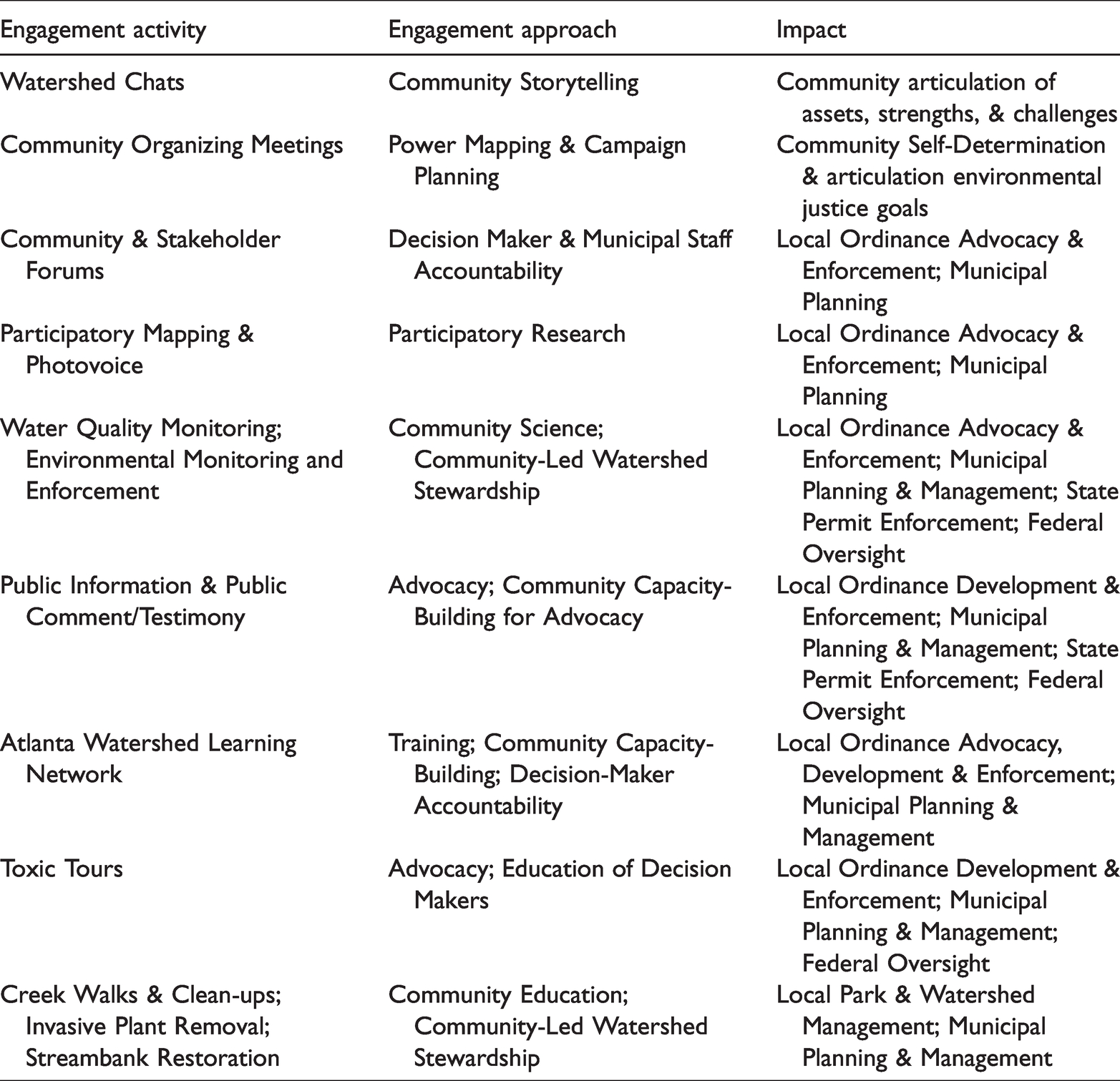
For more than two decades, the West Atlanta Watershed Alliance (WAWA), a Black-led, community-based, environmental organization, has worked to address pollution issues. Initially established to address discriminatory wastewater treatment practices, WAWA developed through coalitional community planning exercises, bringing awareness and action to long-marginalized concerns about unjust and harmful environmental conditions. Watershed residents have begun to fortify their local, community knowledge with visual, spatial, and biological evidence that bears witness to the toxic realities and inadequacies in wastewater and stormwater infrastructure that they experience. Beyond countering official knowledge, organizers have developed strategies to build collective knowledge and a shared political vision, strengthening muted voices with data that supports community stories, further pressuring multiple scales of government on the need to remediate contamination and take enforcement actions against polluters (Jelks et al., 2018; Jelks et al., 2020). In this section we highlight a diverse array of strategies for engagement WAWA uses to leverage the power of community knowledge (Table 1).
Strategies for engagement that develop and leverage community knowledge.
In 2010, residents began filling data gaps through participation in the Neighborhood Water Watch (NWW) Program, a collaborative, community-driven initiative of the Chattahoochee Riverkeeper (CRK), in which residents and other stakeholders living and working in tributaries to the Chattahoochee River assess water quality (CRK, 2018). As an initial NWW partner, WAWA staff have engaged in water quality monitoring and recruited and trained Proctor Creek Watershed residents to serve as Community Scientists. Data collected by Proctor Creek residents, WAWA, and CRK identified high levels of E. coli in parts of the watershed thought to no longer be impacted by combined sewage. While the City of Atlanta did not accept the community-generated data as sufficient to trigger regulatory action, it incited further evaluation by the Department of Watershed Management, revealing over 28 sewage pipes that were still carrying waste to Proctor Creek, and finally leading to infrastructural investments to reduce pollution levels in Proctor Creek (Leslie, 2014). These enduring problems would have never been identified without community data collection, which produced the political pressure necessary to finally achieve remedies.
Such successful work by community scientists established a model for collective knowledge production that underpins further research collaborations. For example, WAWA co-developed, with an academic partner, a mobile app to facilitate community collection of fine-grained, spatial neighborhood-level data on illegal dumping, areas that commonly flood, and locations with inadequate or failing stormwater infrastructure (Jelks et al., 2018), as well as developing a protocol to identify illicit discharges into Proctor Creek. These forms of counter-knowledge are built through community-engaged research methodologies that validate existing forms of community expertise through community education and storytelling practices, while also integrating innovative data collection processes (Sze, 2020). For example, a participatory photovoice research project in the Proctor Creek watershed linked urban policies to environmental and other neighborhood conditions that influence health and quality of life outcomes (Jelks et al., 2020). This project allowed residents to: define, for themselves, watershed-related environmental health challenges unaddressed by municipal officials; collect and analyze supporting photographic and textual evidence; and translate their findings into watershed restoration, community revitalization, remedial action, and policy solutions.
WAWA collaborated with Eco-Action and the Community Improvement Association to launch the Proctor Creek Stewardship Council (PCSC) to help residents of the watershed harness their collective power to advance community-centered solutions. Through its Community Monitoring and Enforcement Committee, members of the PCSC identified egregious dumping along Proctor Creek that, once brought to the attention of public environmental agencies, resulted the City of Atlanta cleaning-up an illegal tire dump. Community-engaged research including resident-led environmental monitoring resulted in identification of the tires (Eco-Action, 2014). Engagement activities such as toxic tours, convening forums with government stakeholders, and mobilizing participation in public comment and testimony, enable changes in local ordinances, compel better enforcement of existing policies, and hold government officials accountable to community concerns.
Through community organizing meetings, watershed residents build community voice, develop visions for the future, and articulate community-determined metrics of success. Engagement activities also transcend meetings; taking watershed residents “to the water” where they monitor water quality; collect data about other environmental conditions; and employ community-led watershed stewardship through creek walks, clean-up efforts, streambank restoration, and invasive species removal. Recent collaborations have also included an unlikely partnership between biologists at the U.S. Fish and Wildlife Service, Proctor Creek youth and community scientists, and local college students to conduct a wildlife assessment of the Proctor Creek Watershed–something usually conducted by agency scientists without the engagement of community residents. Through this community-initiated and engaged research partnership, agency scientists, Proctor Creek community scientists, and local college students collectively identified aquatic wildlife in Proctor Creek; proclaiming that “there is indeed life in Proctor Creek,” despite the immense challenges plaguing it (Taylor, 2017).
These examples highlight the complexity of engagements with environmental experts and government authorities, demonstrating how EJ organizers have continually problematized these institutions and demanded that their voice matters in environmental governance. Although there remain definite constraints and limitations, developing collective knowledge through environmental monitoring and planning processes offers opportunities for people to effectively remake their relationships with both experts and authorities (Ottinger and Cohen, 2012). Advancing the cause of justice, as Lee (2016: 12) argues, is not a question of simply accepting or eschewing an unjust political order, but ingeniously engaging and reorienting structures “to improvise and generate social change in potent and surprising ways.” Improvising beyond a dichotomy between reformist and radical change, organizers have grounded their work in the labor of environmental monitoring, community science, and collective knowledge production to both demand change and make another world possible. WAWA’s ingenious forms of engagement highlight the malleability of existing institutions and the possibility that governance processes and outcomes can be reconfigured to better acknowledge and remedy environmental injustice.
Interrupting structured silences
As documented above, WAWA has worked collaboratively with residents and a diverse set of non-profit, academic, and government partners to elevate the importance of community knowledge and participation in watershed governance. In the context of Proctor Creek, WAWA’s efforts have focused on highlighting both environmental inequities as well as opportunities for advancing community-driven solutions through a collaborative approach that values procedural justice on par with distributional environmental outcomes. Working in coalition with stakeholders from across the city, WAWA has co-led efforts to close one of two combined sewer overflow (CSO) facilities in the Proctor Creek Watershed. Beyond leveraging community knowledge to effect change, we argue that this work ingeniously restructures relations between the state and EJ communities. Following Lee (2016:18) we acknowledge hegemonic processes that structure silences around justice claims, but within these processes, “the hegemonic terrain is not wholly fixed” and there remain possibilities for marginalized actors to reshape politics “to assuage their abjection and create change (albeit with complicities and within limits)” (Lee, 2016: 18).
In its community mobilization efforts, WAWA has engaged community spaces and dialogues beyond the pro forma public participation so common to urban and environmental planning. As Robin Kelley (1994) emphasizes, Black community politics is often enacted in venues outside formal political processes, in spaces where community members share experiences, grievances, and aspirations, developing a Black consciousness critical of dominant political frames. For example, to engage and mobilize residents, WAWA has convened Watershed Chats, creating a space for residents to share community knowledge about Proctor Creek, engaging both youth and adults in placed-based, culturally-relevant environmental education. These initiatives have helped galvanize grassroots support to address pollution and other health and environmental hazards.
Alongside cultivating and revalorizing Black community knowledge, WAWA engages government authorities and cultivates partnerships to advance action for positive change. The grassroots PCSC, whose mission is to restore, revitalize, and protect the ecological health of the watershed and the quality of life of all its people, convenes monthly meetings of residents along with government, non-profits, and other stakeholders to ensure that residents have a voices in watershed restoration and revitalization planning. Establishing a critical forum for engagement, these meetings have transformed how authorities address Proctor Creek communities. Beyond simply countering structured silences with alternative community-generated knowledge claims and garnering a seat at the table, the production and deployment of collective knowledge has convened new tables that center communities and force government agents to engage with community leadership and address community-identified concerns.
For example, a community-led process identified neighborhoods overburdened by water quality problems that constitute environmental stressors and health hazards, contributing to the designation of the Proctor Creek Watershed as one of the EPA’s 19 Urban Waters Federal Partnership locations (US EPA, 2013). This partnership aims to “reconnect urban communities, particularly those that are overburdened or economically distressed, with their waterways by improving coordination among federal agencies and collaborating with community-led revitalization efforts to improve our Nation’s water systems and promote their economic, environmental, and social benefits.” Through this partnership, community leaders affirmed the need for authentic community engagement and collaborative action to restore Proctor Creek based on community-identified needs, and valuing community knowledge, assets, and history of watershed activism (WAWA, 2013). The Urban Waters Federal Partnership site designation has introduced new federal resources for restoration of the Proctor Creek watershed.
Geographer Kate Derickson’s work with WAWA and role in founding PCSC is a powerful example of an “interim politics of resourcefulness”: “an epistemological and political strategy for forging solidarities that seek to redress the everyday challenges historically marginalized communities face as they seek to articulate and realize alternative socionatural futures in the context of postpolitical environmental governance” (Derickson and MacKinnon, 2015: 306). Through collaborative partnerships with agencies and academics like Derickson, WAWA and PCSC harnessed resources to address longstanding environmental injustices in the watershed while also “cultivating resourcefulness as a normative ideal” to counter “governance that actively marginalizes or constrains antagonisms that would meaningfully transform or challenge the social and political order” (Derickson and MacKinnon, 2015: 311, 306). The community has also convened standing meetings centering community knowledge that are regularly attended by municipal, state, and federal agencies including the EPA and US Army Corps of Engineers. More than countering structures that previously silenced community voices, this reconfiguration has established regular channels for community members to voice concerns to authorities, who are seated in a position of active listening rather controlling agendas and selecting token moments for community input and public comment.
While some radical critiques of EJ failure have expressed concerns that instrumental negotiations with state agents risk falling into complicity with liberalism, we emphasize how such moments highlight how community members negotiate a “complex web of resistance” (Lee, 2016: 52). These negotiations are not trapped within the extant categories of the state but premised upon the formation of collective knowledge and standpoints for communities (Collins, 1991). Often activists do not simply and directly oppose the state, but instead improvise in the interstices. Lee (2016: 35, 55) reads such creative strategies for engagement as a “subtle and subversive … appropriat[ion of] the liberal citizenship script,” a furtive movement “under the surveilling eye of normative citizenship” (Lee, 2016: 35, 55). Here, activists repurpose and innovate on the tools they can access to make change, productively engaging and potentially interrupting the apparatuses of the state. Ingenuity and inventiveness have the potential to invert oppressive structures, interrupting structured silences in negotiations that are “intricately connected with, rather than radically detached from, the operations of the modern state and global capitalism” (Lee, 2016: 11).
Refusing the containment of institutionalized environmental justice
The South River Watershed Alliance (SRWA) is a community-based advocacy group that formed in the highly segregated, majority Black areas of southeast of Atlanta. It initially emerged from efforts by Black homeowners to confront sewage overflows that negatively impacted property values in their suburban neighborhoods in the late 1990s. While white flight to the suburbs north of Atlanta, upstream of the flow of urban wastes, enabled those families to accumulate family wealth through investments in property, the predominantly Black suburbs downstream in the South River watershed have been burdened by the weight of environmental degradations. This highlights the financial violence that interlinks with environmental racism, as working- and middle-class Black families in the suburbs south of the city are concentrated in neighborhoods where property values have been diminished by proximity to a river that has functioned more as hazard than amenity.
Initially, SRWA organizers framed their strategy in terms of EJ as they began to campaign against regulatory failures impacting South River water quality. In 2010, the introduction of a new multi-use trail along the river at Panola Shoals provided river access. The site became a popular swimming location until a local paper published photos of children playing in the polluted river, prompting the county to restrict access (Ffrench-Parker, 2010). Community concern about health risks for children inspired SRWA organizers to become more active in monitoring contaminant problems in the river.
In 2011, the SRWA intervened in a case brought forward by the federal EPA and the Georgia EPD to control sewage releases into the South River. A consent decree administered by a federal judge sought to bring DeKalb County into compliance with federal environmental law. As result of the case, the SRWA now represents the interests of local citizens, helping oversee the implementation of measures to eliminate sewage overflows. While this incorporated SRWA in the environmental governance process, token inclusion is not sufficient to rectify longstanding injustices.
Indeed, following a free public workshop on “Community-led Restoration of South River and the Pursuit of Environmental Justice” in June 2012, organizers began to rethink negotiating with government agencies in terms of EJ. The workshop included presentations by EJ geographer Sharon Moran, environmental lawyer David Deganian, and Johnny Waits, a community historian. While the workshop clearly identified South River as a site of profound environmental racism and injustice, framing strategy explicitly in terms of EJ seemed to promise little more than token representation of Black residents without meaningful decision-making authority over developments affecting their communities. “You can include Black folks all you want,” one organizer argued, but until there is an actual “legal mechanism” and “economic change,” Black people are going to get “the worst deal.” As expressed in another interview with a community environmental organizer: “The folks at the EPA just want to tie us up in conference calls, but it’s never going to amount to nothing.” Increasingly activists came to understand the EJ frame as a trap that locked organizers in meetings where other people set the agenda.
While negotiating in terms of increasingly institutionalized discourse of EJ locked organizers in interminable discussions, government resources were consistently directed towards other goals. Activists began to express concerns that meaningful conservation funding is often directed away from degraded rivers to protect “pristine” watersheds distant from contaminated Black communities. Instead of pursuing, for example, an EPA grant for EJ communities, organizers stated, “maybe we should be looking at this kind of in a different way … I mean we've talked it to death.” They felt that naming an issue as one of EJ did not promise to direct resources toward remedying historical injustices. Instead, it normalized the degradation of that environment, as government authorities, echoing the frames that originally rationalized channeling sewage to Black neighborhoods, continue to reinforce an association of Blackness with degraded environments. As an organizer explained in the midst of this innovative strategy reconfiguration, “the conversation about [EJ] should have changed since it ain't working, really…It hasn't evolved or progressed one bit.” Rather than directly assert the government should remedy racial injustices, SRWA organizers began to improvise alternative strategies to effect justice.
While cooptation, discursive narrowing, and redirection of radical EJ discourse is a prominent feature of institutional recognitions (Harrison, 2019), community organizing in this context demonstrates a subtle and subversive set of creative openings emerging from the gambit with the state. To better achieve justice, the community group has decided to drop the language of institutionalized EJ because it has been effectively enclosed and co-opted by the state. Indeed, in interviews SRWA organizers frequently articulated how the increasingly institutionalized language of EJ became part of the script that sustains the status quo, a form of recognition that normalizes an equation of Blackness with degraded environments even as it supposedly is meant to redress this correspondence. As Lee (2016: 5) argues, while radical democratic theorists often pose justice claims as directly oppositional to the structural conditions of injustice, marginalized subjects often improvise surprising, “nonlinear routes” to achieve social change.
Recreation as civil disobedience
Responding to the political foreclosure of EJ claims, SRWA has adopted a form of “ingenious agency” that shifts the focus away from making demands about injustice directly to government regulators. Instead, they asserted a right to nature. Despite recognition of environmental injustices occasioned by the flows of toxicants and human waste in South River, organizers working to diminish disproportionate exposures to contaminants began to employ discourses of renewal, redemption, and reconnection. When DeKalb County put up signs announcing that it was unsafe to use the river, they did not simply provide notice; rather the signs threatened community members with prosecution if they ventured into unsafe waters, reinforcing an equation of Blackness with not only contamination but also criminality. While purportedly working to protect residents, such practices of the racial state renders Blackness as a state of exception, suspending protections from environmental harm and criminalizing Black recreation (Pellow, 2017). SRWA activists sought to reverse the denigrating discourses that normalized an association between Blackness and contaminants. Organizers began to celebrate the rights of local residents to enjoy the ecology of the local watershed despite the impacts of sewage and other contaminants. Activists organized canoe outings as civil disobedience—transgressing the paternalistic ban on river use and asserting their right to use the water in order to force the county to stop spilling sewage. Ignoring threats of prosecution for recreating in polluted waters, organizers used recreation as a means to challenge the calculus that reproduces an identification of Blackness with degraded environments.
In middle- and working-class suburban Black communities, ecological appreciation was a more resonant frame than EJ. The residents of the suburban communities proximate to South River had often sought these suburbs as escape from compounded racial injustices in urban centers. South River organizers discerned that EJ discourse excited some community members but had little success in actually remedying issues in the watershed. Moreover, the discourse of EJ contributed to a sense of fatigue and diminished motivation of many residents to get involved or get to know the river and value it. “South River has been devalued,” explained one leader, and the “legacy of pollution still weighs heavily.” EJ talk especially alienated newcomers to the region who strongly preferred positive forms of identification and connection to the suburban landscape to which they had relocated. The EJ framework reflected the old story of racism and discrimination that many residents of the South River watershed in southeast Metro Atlanta—one of the fastest growing African-American suburban areas in the U.S. (Sullivan, 2011)—had been working, and indeed moving, to escape.
Community paddle trips on South River are structurally similar to events hosted throughout North America by environmental activists who employ recreation as a pathway to greater public engagement in conservation. However, SRWA’s organized paddles are quite compositionally distinct. Participants in the first trips of approximately thirty people were racially diverse, with Black community members composing half of the participants. Moreover, the type of people participating were quite different. Typically, recreation activism attracts keen naturalists, enthusiastic paddlers, and experienced watershed monitors familiar with riparian environmental events. SRWA solicited funding to help support first-time paddlers, and its events are unique in that they frequently attract a large number of novice paddlers. In spite of the unease of some of the participants, undoubtedly heightened by concerns about potential exposure to contaminated water, naturalists on the trips highlight the impressive ecological diversity and productivity of riparian environments, visibly resilient even in such a highly impacted watershed. While endless meetings in tedious governance proceedings contributed to activist burnout, getting people out on the river in kayaks and canoes empowered people with a sense of connection to the river. Moreover, where bureaucratic governmental processes were difficult to mobilize around and stalled movement pressure, people’s presence on the water increased organizers’ leverage to demand authorities stop sewage spills.
While government recognition of environmental injustice is always already circumscribed, SRWA has sought to broaden the horizon of political possibility by celebrating the ecological richness and beauty of the river that persist despite impacts. Moreover, organizers have recognized that mainstream environmental organizations get more resources to protect ‘pristine’ watersheds than EJ communities receive to redress hazards. The ‘pristine’ environments that receive more conservation funding are typically distant from Black-majority spaces and population centers. In light of this understanding, activists in the South River watershed adopted a form of ingenious agency by claiming a right to nature. Rather than focusing on direct demands through the constrained logic and mechanisms of government recognition, organizers indirectly challenged the structure of exclusions that environmental degradation effects. In order to realize freedom to enjoy nature, they have refused the foreclosure of watershed appreciation in Black neighborhoods. Embracing “the messy entanglement” of race and nature, SRWA has been able “to recover and generate a complex and contingent process of transformation” (Lee, 2016: 8). Their activism highlights how more justice, through innovation and improvisation, may be most effectively advanced through less explicitly oppositional forms of EJ organizing.
Conclusion
While Atlanta’s urban hydrology presents a landscape of racial disparity, organizers in the city have been working to reconfigure relationships between race, water, and waste. Examining the politics of environmental remediation and wastewater infrastructure in Atlanta, we have highlighted the ingenious tactics that organizers have used to challenge the normalization of environmental contaminants within Black communities. Drawing together the stories of organizers in two Atlanta watersheds, we have sought to highlight the inventiveness of Black engagements in urban environmental politics.
Community-based organizers in west Atlanta watersheds highlight the potentials of engaging creatively with existing governmental institutions in order to transform them by leveraging community knowledge. In doing so, organizers did not legitimate existing governance arrangements or the rule of experts but rather engaged specifically to institute changes in who governance processes engage. Alongside engagements with formal government institutions, organizers recognized the need to construct spaces to build community awareness, compile knowledge of environmental issues and strategies, and to form collective standpoints. Rather than approaching formal governance and community mobilization as mutually exclusive processes, organizers harnessed state resources to empower community consciousness-raising, environmental knowledge production efforts, and reconfigurations of relationships between the state and their communities.
In southeast Atlanta, organizers have sought to promote recreational use of the South River and develop an environmental appreciation of the distinct attributes of the watershed. While contamination disproportionately impacts the Black community, many activists found that government EJ initiatives only effected token inclusion in endless meetings that never address the structural issues that differentially expose Black bodies to premature death. Thus, activists have adopted a form of “ingenious agency,” eschewing formal recognition of environmental injustice and instead asserting a right to nature. Community activists organized canoe outings as a form of civil disobedience that ignored threats of prosecution for recreating in polluted waters. This highlights some of the hidden potentials that activists are discovering as they move away from a linear strategy of change—explicitly demanding an end to environmental racism—toward more improvisational approaches to engaging a state that does not assume the equality of Black lives.
These cases demonstrate both the ingenuity and variegation of emergent movement strategies, even amongst activists in the same city. Our intent here is not to privilege a singular approach to organizing but rather stress the dynamism and malleability of movement strategies. At times, the institutional opening that state recognition provides may offer important resources for mobilizing communities. Conversely, the constraints of pursuing institutional recognition of environmental injustices may in other moments inhibit organizing or result in co-optation. Ingeniousness and improvisation are necessary for an openness to opportunities in our diverse struggles for a more just future.
Footnotes
Acknowledgements
We were grateful for the opportunity to present an early draft of this paper at the 2018 American Anthropological Association meeting; thanks to Danya Fast and Andrea Lopez for organizing the session on “Necropolitics and the City in the Era of Trump.” We would like to especially thank Dean Hardy for assisting us with making the map for Figure 1, the anonymous reviewers for their very helpful comments, and all the activists in Atlanta who have taken time to speak with us for this research. All errors and omissions are our own.
Declaration of conflicting interests
The author(s) declared no potential conflicts of interest with respect to the research, authorship, and/or publication of this article.
Funding
The author(s) received no financial support for the research, authorship, and/or publication of this article.
