



Abstract
This article builds on the political geography of islands and emerging research on the relationship between island, border and sovereignty. Today, islands are recognised as crucial sites for the understanding of contemporary border controls. Military bases that were built during earlier colonial periods are increasingly used for transnational migrant detention practices. This article aims to offer another important insight to the politics of borders from an island perspective. Drawing from the case of Okinawa, the article shows how bases on islands themselves produce borders. Fences and lines that encircle the US bases on Okinawa Island cannot be reduced to conventional military off-limits boundaries. They are particular kinds of borders, which I would call ‘base borders’, that continue to divide the island into military and public spaces and demarcate two seemingly territorially bound sovereignties. Base borders are, however, more than the manifestation of extraterritoriality. While they regulate the mobility of local residents, base borders enable military servicemembers to enjoy extraterritorial rights, including the right to avoid being held responsible for a crime they committed outside the bases. In addition to this uneven mobility control, base borders have a function to control local resistance movements through the criminalisation of the base border crossing by protesters and the authorisation of the use of force by security guards. This article closely investigates how base borders function and are used in reality, and in doing so, it uncovers multiple ways in which base borders reproduce colonial relations between the US military (in coordination with Japan) and Okinawa.
Introduction
On a rather cloudy Saturday morning, we were walking on Airport Street [kūkō dōri] in Okinawa City. We walked a few hundred metres, passing through several shops and bars that are not yet open. The walk was part of a post-conference fieldtrip in which I participated. Eventually we reached the end of the street, marked by a yellow line painted on the ground across the street with letters saying, ‘Base Boundary’. Right behind the line, there was another sign, which read: ‘The sign marks the boundary [of] Kadena Air Base property [.] Unauthorized personnel keep out by order of the installation commander’ (Figure 1). As we were approaching this vividly drawn boundary, two young American officers in uniform began to walk towards us from the other side. Some of us were taking photographs of the site when the officers arrived at the line. They asked us to refrain from doing so, in a situation somewhat resembling a typical interaction at an airport passport control point. Beyond everything, they made sure that none of us would cross the line. Base boundary drawn across the street in front of Kadena Air Base Gate 2. Image taken in December 2019.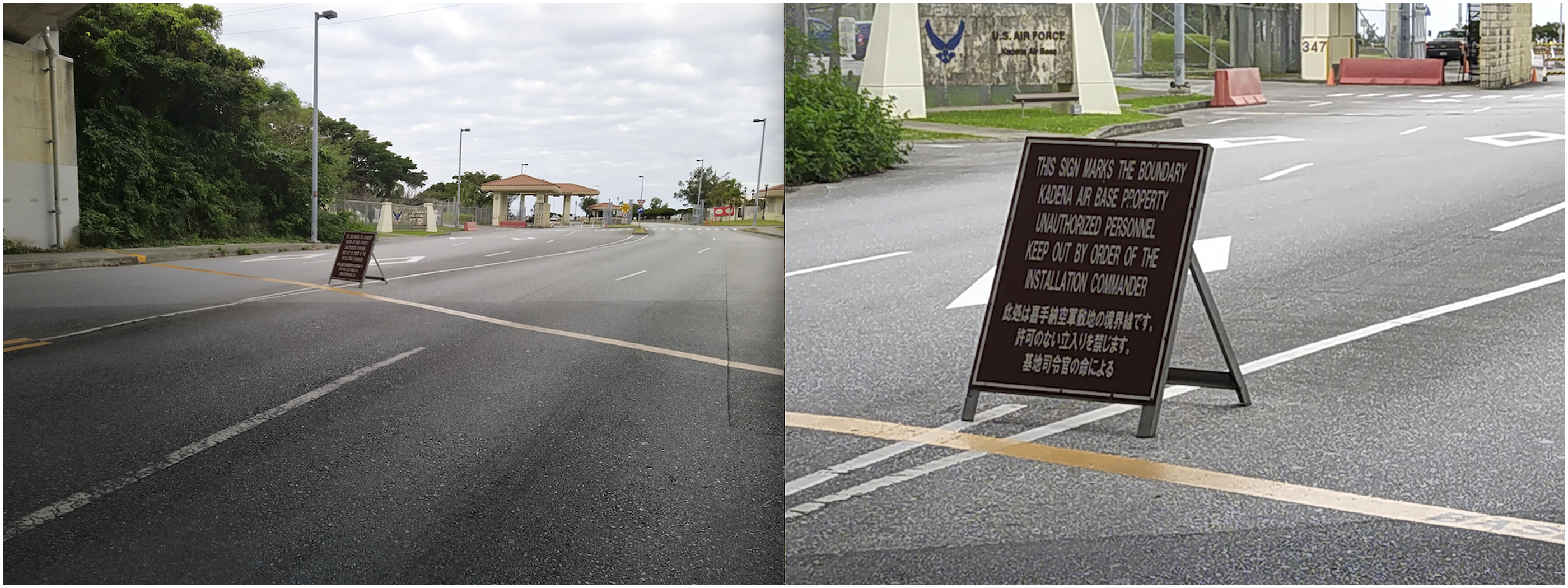
To this day, the United States continues to maintain hundreds of overseas bases, deploying hundreds of thousands of American troops across the world. A significant proportion of the bases are located on islands, many of which have a colonial history. From Diego Garcia in the Indian Ocean, Puerto Rico in the Caribbean, to Guåhan (or Guam), Hawai‘i and Okinawa in the Pacific, these islands were heavily militarised during earlier colonial periods and have historically supported US military operations as geostrategic sites (Enloe 2014; Davis, 2020; Gillem, 2007; Johnson, 2004; Lutz, 2009; Mountz, 2015; Vine, 2015). These bases have produced various spatial and political impacts on the geography of islands and the lives of islanders. Most obvious, perhaps, is the dispossession of land from islanders for building bases. As in the case of Pågat in Guam (Na‘puti and Bevacqua, 2015), this includes the dispossession of places that are sacred to native islanders. In the extreme case of Diego Garcia, the entire native population was displaced (Vine, 2009). Just as much as their physical and geographical impact, the high visibility of bases has a symbolic and psychological impact, promoting American values and security concerns to local residents (Alexander, 2016). The spatial impacts of bases also go beyond actual military areas, including the establishment of ‘America Town’ in their neighbourhood, changing the landscape of islands and the lives of islanders (Gillem, 2007).
This article explores spatial and political impacts that are produced by the boundaries of US bases on islands. Drawing on the empirical case of Okinawa, it suggests that the boundaries of the foreign bases should be understood as a particular kind of border and bordering process, which may be characterised as ‘base borders’. Albeit largely neglected in the conventional understanding of borders, base borders are a kind of border which continues to ‘b/order’ (Van Houtum et al., 2005) spaces and peoples on colonised islands, and thus, is both relevant and important for border studies. Base Borders are militarised borders, not in terms of the militarisation of contemporary migration controls widely discussed among geographers (for example, Graham, 2011; Jones, 2016), but in terms of borders that are produced through the militarisation of islands. Bases are typically surrounded by fences stretching for hundreds of metres or kilometres, which demarcate military and civilian spaces and delineate colonised spaces. Some parts of base boundaries are encircled just by a line painted on the street, which is nevertheless closely monitored by officers and security guards as described in the opening anecdote. The functions of base borders, however, go beyond and are more complex than mobility restrictions around the actual locations of bases. As will be explored in the article, the legal frameworks around base borders show that mobility restrictions are far from being mutual: base borders operate in a hierarchical, and imperialist way that local residents continue to suffer violence by military personnel who enjoy extraterritorial rights on the colonised island. Moreover, base borders do not only control base border crossing as if they are contrasting the two de facto separate territories but also criminalise local resistance movements. The borders are used to tame and control anti-base protesters whilst enabling military and security guards to use violence against them. From the initial dispossession of land to the criminalisation of resistance, this article argues that base borders are (post-)colonial bordering, 1 which marks continuing colonial relations between the United States (in cooperation with Japan) and Okinawa.
In the first section, the article revisits existing studies of borders, including the theorisation of borders as bordering and in terms of practice by which this study is conceptually informed. The section also looks at the emerging scholarship on islands in geography, which has brought the importance of islands to the forefront of debates around borders, sovereignty and territory and on which the article builds. The second section offers a brief history and geography of Okinawa to contextualise base borders on Okinawa Island and the current militarised situation of the island as a whole. The article then moves on to the analysis of the functions of base borders. The third section closely examines the US-Japan Status of Forces Agreement (also known as SOFA) to show how base borders operate in an imperialist manner. The fourth section explores the criminalisation of resistance by base borders through the analysis of two recent arrests of anti-base protesters. The concluding section discusses key implications and contributions that the analysis of base borders can offer to border studies, including issues with methodological nationalism, which has long been criticised but may still persist in contemporary border studies. The section also outlines a scope for alternative political and spatial imaginaries.
‘Invisible’ borders: From bordering to Islands
Border studies have bourgeoned in the past decade or two and the question of where borders are has been a major subject of debate. Conventionally, borders are understood as lines on maps. They are seen as territorially fixed and define the edges of state sovereignty. Contrary to this conventional understanding, geographers, as well as scholars from cognate disciplines including international relations, have argued that borders should be understood as practices, as bordering, which order, divide, and produce spaces and identities and which include some people while excluding others (Johnson et al., 2011; Newman, 2006; Paasi et al., 2019; Parker and Vaughan-Williams, 2014; Van Houtum et al., 2005; Wastl-Walter, 2011). As Newman (2006: 172) puts it, ‘borders are not confined to the realm of inter-state divisions, nor do they have to be physical and geographical constructs. Many of the borders which order our lives are invisible to the human eye but they nevertheless impact strongly on our daily life practices’. Borders exist both within a state and beyond its lines. On the one hand, borders exist within a given state territory as forms of monitoring immigrants. Immigration policing permeates society and foreign residents continue to be checked regularly after passing through immigration control at the airport (or at an equivalent site) (Coleman, 2007). On the other hand, border controls are also increasingly offshored. The international movement of migrants is increasingly regulated before they arrive in the country of destination. There are ‘extraterritorial’ border controls as in the case of the European Union’s practices of policing migrants at a distance in the Mediterranean (Guild and Bigo, 2010). Furthermore, human bodies themselves have become a site of border control by the introduction of biometrics for immigrant identification (Amoore, 2006). ‘Borders are everywhere’, as interdisciplinary scholarship in border studies has shown (Johnson et al., 2011).
More recently, Mountz, among others, has explored a remote site of border control further (Loyd and Mountz, 2018; Mountz, 2015, 2020). There is ‘a definitive geographical shift in border enforcement’, suggests Mountz (2020: xxi), in which the border has moved to islands not only in the Mediterranean but also across global oceans. ‘Islands are used as material sites of exclusion but also function as a spatial form mobilised everywhere to create legal exceptionalism and isolation’ (Mountz, 2020: xxiv-xxv). Military bases on islands, which were built during earlier colonial periods, ‘provided the practical and legal basis for building up today’s historically unprecedented detention, deportation, and border apparatus’ (Loyd and Mountz, 2018: 21). Islands are not just another site of migration controls but arguably an effective one. They enable the deportation of ‘unwanted’ migrants before they reach a destination country. In addition, because they are overseas, asylum seekers are often not protected by laws that are normally applied to people in a given sovereign territory (i.e. their claim for asylum in oversea islands does not always make them asylum seekers). These sites also largely remain hidden from view of media and human rights monitors (Mountz, 2011). One of the most well-known sites is a US naval base in Guantánamo Bay where the practice of detaining refugees has been exercised since the 1990s (Kaplan, 2005: 839). There are also other sites where migrants are controlled offshore, including the Mariana Islands, another site of US migration control, Nauru and Christmas Island where the Australian detention centres were built, and Italy’s Lampedusa which has come to light in the context of the so-called ‘European migrant crisis’ (Mountz, 2011). Bordering practices on islands that are not (fully) part of the sovereign territory of a destination country indicate that sovereignty goes beyond its conventional territorial framework, and thus, poses an important question concerning how and where sovereign power operates. Islands, in this regard, underscore the importance of relational geography, which unsettles static understandings of borders of land/sea, island/mainland, ‘static tropes of insularity, isolation, dependency and peripherality’ (Pugh, 2016: 1042–3). Blurring the relationship between onshore and offshore sites, the contemporary politics of borders ‘operate as relational geographies’ (Mountz, 2020: 75).
Islands prove to be important for understanding sovereignty and borders, not just because of border enforcement practices on islands, but also because of the political status of islands themselves. There are hundreds of US military bases across the world and a significant number of them are located on colonised islands. The United States built bases on islands – including Diego Garcia, Puerto Rico, to Guam, Hawai‘i, and Okinawa – by dispossessing land from islanders (Enloe 2014; Davis, 2020; Gillem, 2007; Johnson, 2004; Lutz, 2009; Mountz, 2015; Vine, 2015). The presence of the US military on islands and these islands’ de facto colonial status challenge the territorial understanding of sovereignty and show the fictitious characteristics of sovereignty (Davis, 2020: 5). As Davis (2020: 5) argues, the fictitious characteristics of sovereignty – conventionally understood in terms of supremacy, decisionism, infinity, absoluteness, completeness, and territorial jurisdiction – are revealed in metropolitan states’ control over colonised islands (see also Brown, 2010: 22). ‘A government’s control […] frequently does not end at its official borders’ (Davis, 2020: 12). The present situation of Okinawa is indicative of such fictitious characteristics of sovereignty. As will be explored in the next section, Okinawa, which had been a US military colony for nearly three decades since the end of the Second World War, is today formally under Japanese jurisdiction. However, the continuing presence of US bases on Okinawa Island, with the forms of extraterritoriality that the military enjoys, proves that neither territory nor sovereignty are as straightforward as the conventional, inter-state, understanding of borders suggests. Instead, there are forms of borders and bordering practices that were established by colonialism and continue to divide Okinawa and the lives of Okinawans even after the end of military occupation.
The colonial territorialisation of Okinawa
Okinawa is the southernmost prefecture of Japan, consisting of small islands lying between the East China Sea and the Pacific Ocean. According to a recent report by the Okinawa Prefectural Government (2019), there are 33 US military facilities across the prefecture, which together constitute 187 square kilometres. They make up about 8% of the total land area of Okinawa Prefecture and 15% of Okinawa Island (Okinawa hontō) (Figure 2). Among the major facilities are Kadena Air Base, Marine Corps Air Station Futenma (hereafter, Futenma Air Base), Camp Schwab, and Camp Hansen. Kadena Air Base is approximately 20 square kilometres, extending mainly across Kadena, Chatan, and Okinawa City. Adjacent to it is the Kadena Ammunition Storage Area, which constitutes about another 27 square kilometres. Futenma Air Base is relatively small, a five-square-kilometre facility, but located in the densely populated residential area in Ginowan City. It has been regarded as ‘the world’s most dangerous base’ as the former secretary of defence Donald Rumsfeld described when he saw the base from above in 2003 (Ginowan City, 2004). Due to its location, Futenma Air Base has been a centre of political discussion in the past few decades (Nishiyama, 2020). While Kadena and Futenma Air Bases are located in the central part of Okinawa Island, Camp Schwab and Camp Hansen are located in the northern part. Camp Schwab is primarily located in Nago and occupies 20 square kilometres. Camp Hansen is located in the south of Camp Schwab and extends nearly 49 square kilometres, spreading across various municipalities. In addition to these bases, there are also training sites including the Northern Training Area, the largest training site spreading over 36 square kilometres across Higashi and Kunigami villages (Okinawa Prefectural Government, 2019). US military bases and facilities in Okinawa Island.
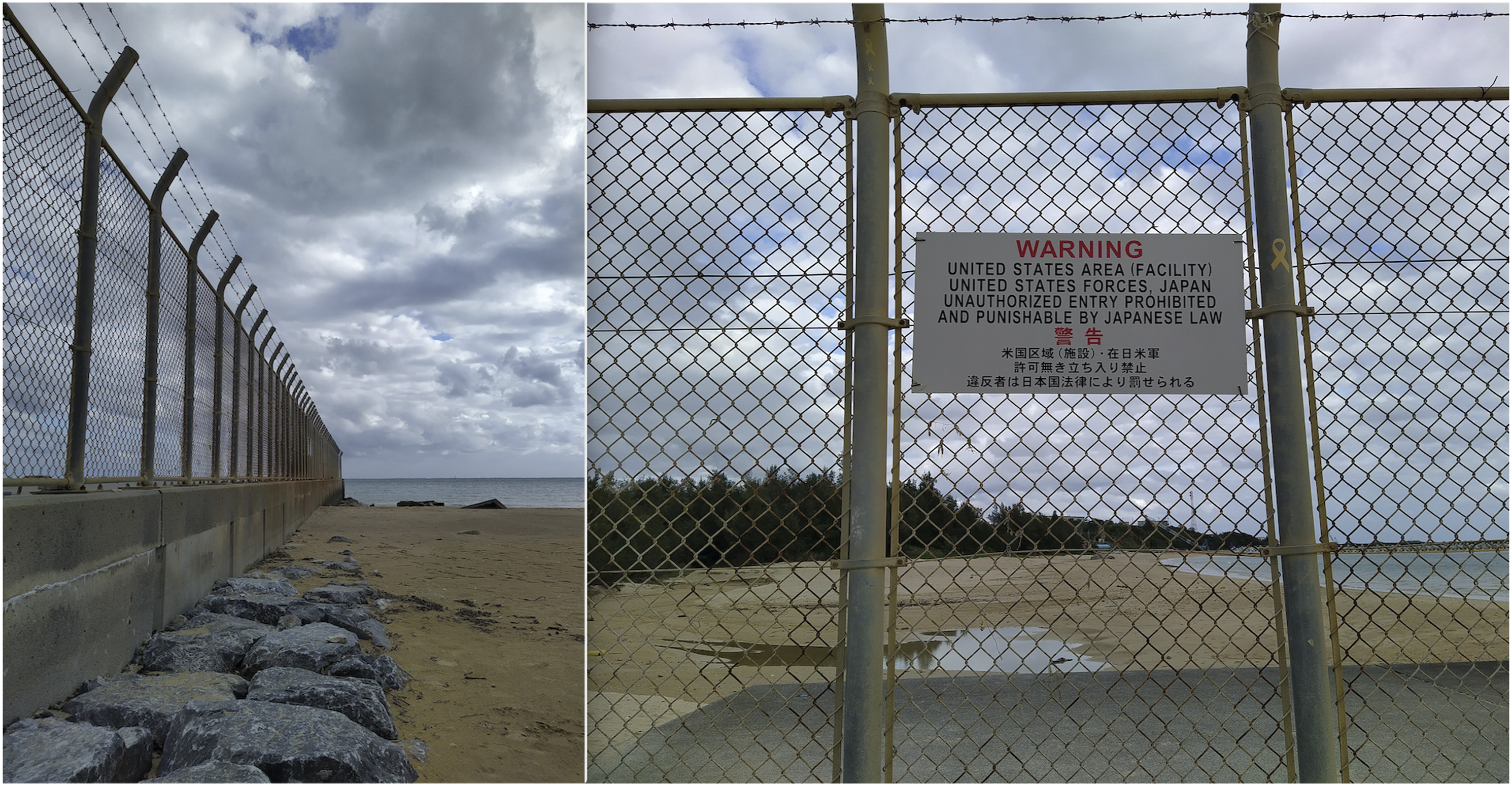
Like military facilities in general, US bases on Okinawa Island are typically encircled by fences, which divide military and public spaces. Around the entrances of bases, as in the aforementioned case of Airport Street in Okinawa City, painted lines are also used to mark boundaries. The boundaries of the US bases are placed in different sites across the island. Some of them are in the middle of local residential areas. Figure 3 is an image of the south-western part of Futenma Air Base that was taken from the rooftop of the Okinawa International University, which is located just about one hundred metres away from the base. The densely populated residential areas of Ginowan City can be seen on the left-hand side of the image, which shows a stark contrast to the military base on the right-hand side. The boundaries are also placed on the beach and extend offshore. Figure 4 is the fence built on the beach at the west-end of Camp Schwab in Oura Bay – sometimes known as ‘Henoko Beach’ (Henoko no hama) – which is currently the planned relocation site for Futenma Air Base. This plan has been highly contested both within Nago City and across Okinawa (Nishiyama 2019). The south-western part of Futenma Air Base in Ginowan City. Image taken in December 2019. Fence on the beach near the west-end of Camp Schwab. Image taken in December 2019.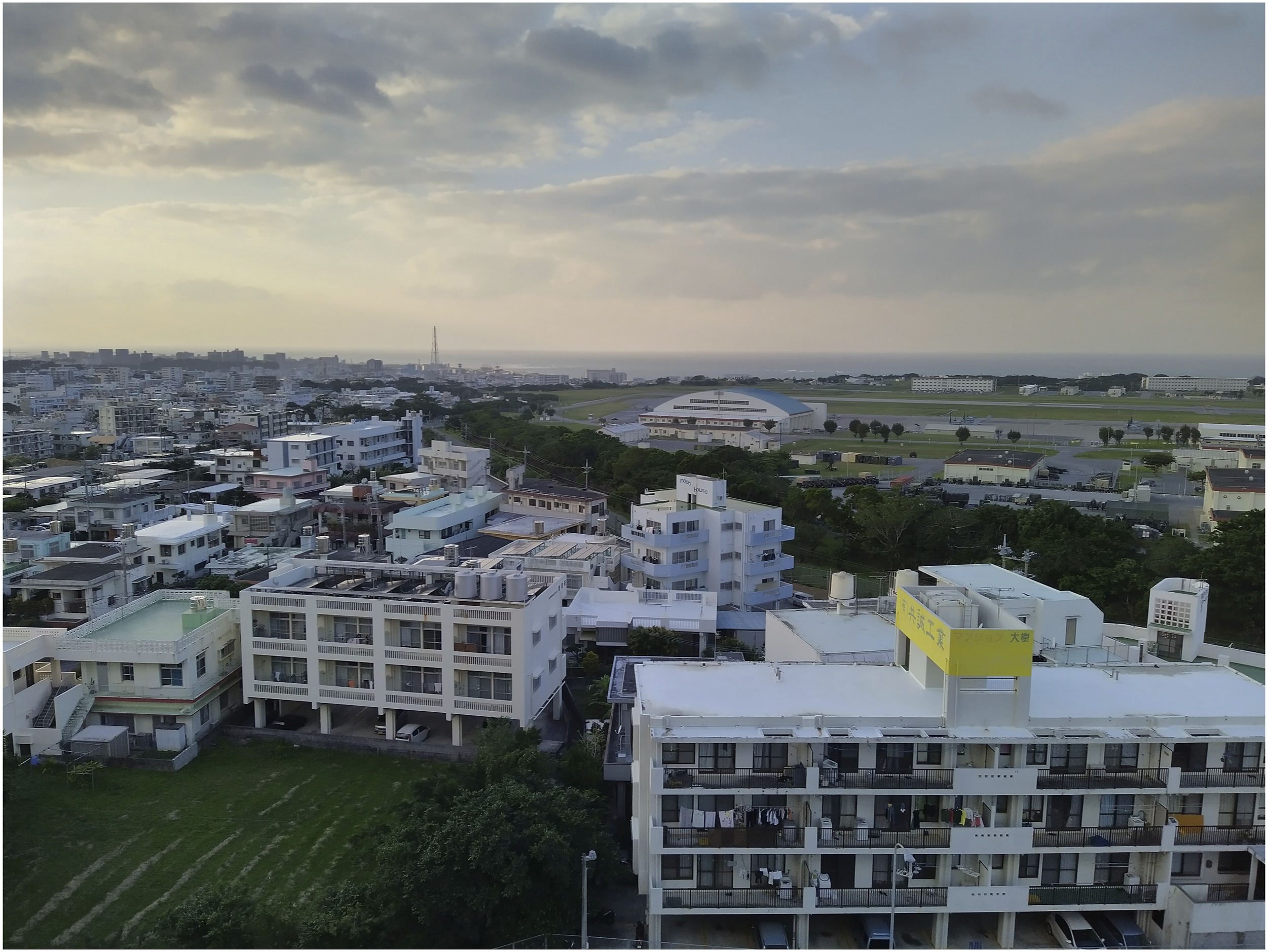
Unlike military restricted areas that were created inside their own national territory, these boundaries of bases in Okinawa should be understood as borders. Accordingly, Okinawa, and Okinawa Island in particular, should be understood as border (is)lands not simply because the islands are geographically located at the edge of the Japanese territory and historically have been a ‘frontier’ (Furuki, 2003). Nor is it just because Okinawans are the ‘boundaries’ of the Japanese: Okinawans were assimilated during the years of Japanese imperialism since the late 19th century and yet still excluded from the ‘Japanese proper’, which Oguma (2014) argues marks the ‘boundaries’ of the Japanese. Okinawa also consists of border (is)lands because of the presence of foreign military bases and their fences that continue to divide the everyday spaces of Okinawa and the lives of Okinawans. Traditionally, these military boundaries are not considered as borders. As Iwashita (in Furukawa and Iwashita, 2013: 5) notes, ‘fences surrounding bases in Okinawa are not borders (kokkyō)’ because ‘Okinawa is under Japanese sovereignty’. Iwashita, a pioneering figure in border studies in Japan, nevertheless underscores the importance of those fences for border studies because despite Japanese sovereignty, local residents cannot enter there (without appropriate permission). Or to draw from Agnew’s discussion on ‘formal sovereignty’ and ‘effective sovereignty’, the situation can be described as follows: despite its formal sovereignty, characterised by ‘official, internationally recognised rights to rule’, Japan does not have effective sovereignty, that is, ‘an actual ability to direct what is happening on the ground’ in Okinawa (Davis, 2020: 13; see also Agnew, 2018: 9). Instead of relying on the concept of borders narrowly, Iwashita suggests that border studies should focus on ‘shredded space’ (sundan-ka sareta kūkan), which, he argues, allows us to take a comparative approach to border studies. The idea of ‘shredded space’, according to him, enables us to compare the case of military fences in Okinawa with the issues in Palestine, Ireland and the Kuril Islands – where Japan has an ongoing territorial dispute with Russia (in Furukawa and Iwashita, 2013: 6). While Iwashita does not explore the concept of ‘shredded space’ in detail, his suggestion for the broader conceptualisation of borders appears to bear some resemblance to the critical understanding of borders as a process of b/ordering spaces and peoples discussed above, in that both focus on what they do (mobility restrictions, inclusion, exclusion, and so forth) rather than borders defined by existing (formal) sovereign territories. Following this understanding, military fences and lines on Okinawa Island can be understood as a particular kind of border, which may be characterised as ‘base borders’.
The understanding of borders beyond existing (formal) sovereign territories is also important for recognising the roles of colonialism and post-colonial policies that created, and reproduce, the very condition of base borders. Okinawa Island and other islands that constitute Okinawa Prefecture today have colonial histories. Prior to Japanese imperialism, the islands were unified as the Ryukyu Kingdom with its capital at Shuri Castle on Okinawa Island. 2 In the early 17th century, following the invasion by the Shimazu clan of Satsuma in 1609, the Ryukyu Kingdom was placed under the rule of Satsuma and effectively under the rule of Japan. The invasion did not abolish the kingdom or prohibit its vassal relationship with China, but it placed the kingdom politically and economically subordinate to Satsuma and Japan. In the early years of Japanese imperialism, the Ryukyu Kingdom was formally incorporated into Japan. The newly formed imperial government of Meiji was committed to transforming Japan into a modern state and one of the tasks was to rearrange the status of the Ryukyu Kingdom. The Kingdom’s dual tributary relationship with China and Japan was transformed by incorporating it fully into the Empire of Japan. The geopolitical incorporation coincided with the assimilation of the islanders into the Japanese culture whilst still being regarded as ‘inferior’ to the ‘Japanese proper’, thus, subject to be ‘civilised’ by the Japanese (Inoue, 2007: 3). By the end of the 1870s, the kingdom was abolished and annexed as Okinawa Prefecture and the islanders were ‘Japanised’.
The colonisation of Okinawa by Japan was followed by another colonisation by the United States in the mid-twentieth century. Following their initial landing in the Kerama Islands, a group of islands located about 40 km away from Naha, the US military invaded Okinawa Island and seized it by late June in 1945. After the war, the Ryukyu Islands including Okinawa Island came under the administration of the US military government as the former coloniser (Japan) and the new coloniser (the United States) signed the Treaty of San Francisco in 1951, whereby they agreed that the latter retain the right to exercise powers over Okinawa and Okinawans. Since the invasion and the subsequent years of occupation, the US military built new bases, or rebuilt and expanded existing facilities on Okinawa Island. Within 1 year after their arrival, over 160 square kilometres of Okinawa Island was taken by the US military as an act of war, and by 1955 almost half of the island’s population (approximately, 250,000 people) were displaced for the construction of US bases including those who were shipped to Bolivia (Gillem 2007: 37; see also Amemiya, 1999; Suzuki 2010: 29–34). The US military already initiated the construction of Futenma Air Base in Ginowan City by June 1945. Kadena Air Base was originally an airfield made by the Japanese imperial army, which was soon captured by the US military in the early days of their invasion and which they extended in the subsequent years. Some military facilities, such as Camp Schwab, were built in the 1950s. The US military continued to administer the Ryukyu Islands until 1972 when the islands were formally returned to Japan.
When the US military occupation of Okinawa finally ended in 1972, a new (or not so new) post-colonial form of territorialisation was introduced, which was empowered by the two former colonisers. Contrary to many Okinawans’ hope (see McCormack and Norimatsu, 2018: 7), the end of US military occupation did not translate into the demilitarisation of Okinawa. Japan did not make any significant change to alleviate the heavy US military presence in Okinawa. Instead of re-distributing the US military across the country, the Japanese government introduced a compensation monetary system, which is often referred to as the ‘sympathy budget’ (omoiyari yosan) (Gabe, 1999). Japan’s post-reversion subsidies were nominally designed to promote the development of Okinawa, but the payments were, in practice, designed to pacify Okinawans’ anger and maintain its relationship with the United States (Oguma, 2014: 344). The governmental subsidies such as rent for base land and wages for base workers contribute to maintaining a militarised, and colonised, Okinawa by subduing discontent among Okinawans (Oguma, 2014: 345). This also contributed to the creation of Okinawa’s base-dependent economy, which made people on the island, at least partially, dependent on the income generated by the Japanese government (Tanji, 2007: 108).
In short, the presence of US bases is the product of (post-)colonial bordering, which entails a series of colonial and post-colonial territorialisation by the two former colonisers. The failure to conceptualise the military issues in Okinawa in terms of borders and territorialisation is to comply with the existing international norms, which neglects the (ongoing) colonial constitution of Okinawa. With the contextualisation of the (post-)colonial history of Okinawa, the article now turns to a close analysis of the mechanisms of base borders and examines how they operate and what they do to spaces and peoples beyond the dispossession of land and mobility restrictions.
Crossing base borders 1: Base borders for whom?
Base borders are not just symbolic of military colonialism but physical and material, which have legal and political consequences for local residents. Perhaps the most obvious consequence is that they border lands, dividing cities, streets, forests and beaches across Okinawa Island. Crossing base borders by local residents without appropriate permission is a criminal act and subject to prosecution as shown in the sign hung on the fence in Figure 4. This seemingly logical – as in the conventional understanding of off-limits military areas – boundary making by the US military needs closer analysis for understanding how base borders actually operate.
Contemporary border studies have thoroughly investigated the question of borders for whom (for example, Paasi et al., 2019). They have shown asymmetrical and uneven structures of borders: for example, while border control heavily regulates unskilled migrant workers and refugees, it allows free flows of skilled workers and capital. A similar, yet distinct, asymmetry can be found in the operation of base borders. The spatial and political relations between the two territories that are marked by base borders are not reciprocal as the conventional understanding of sovereignty might suggest; instead, they are hierarchical and show a form of ‘organised hypocrisy’ that is inherent in the operation of sovereignty (Krasner, 1999). Stronger states constantly violate the sovereignty of weaker states and choose among different rules, picking the ones most convenient for accomplishing their objectives (Krasner, 1999: 6). The presence of US bases on foreign islands is the manifestation of such hypocrisy (Davis, 2020: 13), which also applies to the control of base border crossing. Base borders do not regulate everyone and all kinds of crossing in the same manner. Unlike Okinawans, crossing the yellow line is not a criminal act for US military personnel. Neither Okinawans nor the local police authority have the power to regulate the mobility of US servicemen in the same way as the base security guards do. There are asymmetrical and colonial relations in the ways base borders control mobility, which characterise base borders as (post-)colonial borders not only in their establishment and very existence, but also in their operation in the present.
Such asymmetry in the operation of base borders is not limited to actual base border crossing. The colonial mechanisms of base borders operate beyond their physical locations. Administrative and legal structures concerning the US military in Okinawa, and in Japan in general, are more complex than just prohibiting people from crossing base boundaries and the establishment of extraterritoriality inside the bases. Under the US-Japan Status of Forces Agreement (formally known as the Agreement under Article VI of the Treaty of Mutual Cooperation and Security Between Japan and the United States of America, Regarding Facilities and Areas and the Status of United Armed Forces in Japan, also known as its acronym, SOFA), there are different jurisdictions between the military areas and Japan and between the military personnel and Japanese citizens, including Okinawans. The existence of the two jurisdictions under the SOFA means, in theory, that the Japanese authorities can apprehend US servicemembers when they commit a crime outside the military areas. However, if a US servicemember was not captured off base, the US authorities are not obliged to transfer a suspected person to the Japanese authorities unless the person is officially indicted. This makes it difficult for the Japanese authorities to question suspected servicemembers, which is an important process for preparing an indictment in the country. This means, as Johnson (2003: 4) puts it, ‘that the Japanese police are hobbled in carrying out an investigation and that prosecutors may thus be reluctant to indict an American serviceman because of insufficient evidence’. Johnson (2003: 4–5), who served as a naval officer in Japan during the Korean War, further argues, ‘All servicemen in Okinawa know that if after committing a rape, a robbery, or an assault, they can make it back to the base before the police catch them, they will be free until indicted even though there is a Japanese arrest warrant out for their capture’. High-ranking military officers, according to Johnson (2004: 5), ‘enforce extraterritorial “status of forces agreements” on host governments to ensure that American troops are not held responsible for crimes they commit against local residents’.
In fact, this provision of the SOFA has been an obstacle in pursuing criminal justice in Okinawa. Until the high-profile case of the 1995 gang rape of a local girl by three US servicemen, the United States had never handed over a suspected serviceman to the Japanese authorities without indictment (Johnson, 2003: 5). Even the 1995 case, where the United States eventually turned over the suspected servicemen, conflicted with the SOFA. Shortly after the incident, the Japanese police requested the US Marines to hand over the three servicemen, who went back to Camp Hansen after kidnapping and raping a local schoolgirl in Kin. The request was denied by the US Marines who cited the SOFA for their decision (The New York Times, 1995). It took nearly 1 month before the three servicemen were handed over to the Japanese authorities and this happened only after indictment. Following the 1995 rape case, which fuelled anti-base sentiments across Okinawa and led to a large-scale protest, the United States and Japan held a meeting to discuss and reconsider the SOFA in which the former agreed to give ‘sympathetic consideration’ with regard to handing over suspected servicemembers in the future (Johnson, 2003: 6). The ‘sympathetic consideration’ did not make any significant changes, however. For example, in November 2002 when the Okinawa prefectural police issued an arrest warrant against Major Michael Brown for attempted rape of a Filipina base worker, the United States once again refused to hand him over to the Japanese authorities (Selden, 2004).
With their complex legal structures, base borders mark a kind of extraterritoriality that nevertheless goes beyond the established US military territory. Not only does the US military enjoy the extraterritoriality of their bases, but such extraterritoriality can also be exercised by military servicemembers outside the bases on foreign islands. From the (ongoing) dispossession of land to the asymmetrical mobility control and the extraterritorial rights outside the bases, territorial sovereignty and integrity are merely nominal, or indeed ‘fictitious’ (Davis, 2020: 5). Instead of the principle of reciprocity, the functions of base borders are embedded in, and reproduce, colonial and imperial power relations between the United States, Japan and Okinawa.
Base border crossing 2: The criminalisation of anti-base resistance
The uneven power relations that are embedded in base borders – be it the establishment of military territories on foreign islands itself or how base borders (un)regulate the movement of people – are indicative of the reality that US (effective) sovereignty operates beyond its conventional territorial framework (Davis, 2020; Mountz, 2020). Base borders do more than divide spaces and regulate the movement of people, however. They are also used to tame, control and criminalise local resistance movements against the bases.
Anti-base movements have long been prevalent in the history of Okinawa since the early years of US military occupation. Already in the 1950s, Okinawans organised a mass, island-wide, protest against the forcible land seizure and unfair land policies of the US military (Yamazaki, 2003). In 1970, the lack of a proper justice system concerning crimes committed by Americans led to an uprising in Koza City (present Okinawa City) where more than a thousand angry residents burned over 70 cars owned by Americans and a few buildings on the Kadena Air Base (Ueunten, 2010). Another significant protest took place in the aftermath of the 1995 gang rape, in which over 80,000 people joined a protest in Ginowan City (Angst, 2001). In recent years, anti-base movements have centred upon the planned relocation of Futenma Air Base to Henoko. The relocation entails a landfill in Oura Bay for building a new base, which is currently under way. Okinawans have been protesting the construction of a new base, and arguing that the relocation site should be outside Okinawa. Along with fences built around Camp Schwab, including one in Henoko Beach shown above, yellow lines have been painted on the street at the entrances of the base, marking base boundaries in a similar manner to the one on Airport Street in Okinawa City.
The newly painted yellow lines at Camp Schwab are used to control the anti-relocation protests that have grown since the mid-2010s not only by keeping protesters away from the base but also by enabling the use of force by security guards against protesters. On 22 February 2015, Hiroji Yamashiro, a 62-year-old native Okinawan and the chairman of the Okinawa Peace Movement Centre was arrested by security guards during a protest at Camp Schwab. He was accused of a violation of the Special Criminal Act (commonly known as keijitokubetsu-hō), which is a law concerning the security alliance between Japan and the United States and which specifically prohibits people from entering US military facilities. Yamashiro’s arrest can be seen in video footage from a surveillance camera, which was leaked by Robert Eldridge, a former academic and the Deputy Chief of Staff for Marine Corps Installations Pacific since 2009, and which was posted on a neo-nationalist YouTube channel (Mitchell, 2015). After the arrest, Yamashiro claimed that he did not cross the yellow line and that he was actually asking other protesters to stay behind the line, a claim that was also reproduced in local newspapers (for example, Okinawa Times, 2015). Eldridge leaked the footage to prove that Yamashiro indeed crossed the line and thus that the security guards’ actions were justified. Similarly, the YouTube channel also titled the video as ‘Okinawa media madness! The truth about the arrest of Hiroji Yamashiro’. At the beginning of the footage, Yamashiro, while speaking with a microphone towards the base, appears to have crossed the yellow line by about 1 m. Later, when security guards came to the site and clashed with protesters who were also about 1 m inside the yellow line, Yamashiro started asking other protesters to step back. The security guards made several attempts to apprehend Yamashiro while other protesters tried to protect him. Eventually, when other protesters stepped back following Yamashiro’s call, the security guards apprehended him, as he was now standing alone in front of other protesters. The security guards grabbed Yamashiro’s legs and dragged him upside down for several metres into the base. While the footage was leaked with the intention to prove Yamashiro’s ‘criminal’, or better criminalised, act, what it actually shows is that the mere painted lines on the street are not just symbolic but can enact violence and power over anti-base protesters.
A similar arrest took place at Futenma Air Base. On 6 April 2017, an 84-year-old man was arrested during an anti-base protest. According to the witnesses, he was standing on a yellow line and speaking with a microphone. When one of his feet stepped inside the line, he was locked up by the security guards and taken to the base (Okinawa Times, 2017). Speaking to Okinawa Times, a local lawyer criticised the excessive use of power by the security guards, which appears to target particularly, if not exclusively, anti-base protesters. He stated: ‘Is it really necessary to detain and arrest a person just because of crossing the line rather than a clear intrusion by going over a US military fence? Even if there is a warning sign, it is excessive to detain someone immediately’ (Okinawa Times, 2017).
The control and criminalisation of anti-base protesters shows not just another colonial dimension of the operation of base borders; it is a (post-)colonial form of oppression of native islanders. In addition to the territorialisation of parts of the island and the uneven mobility control, base borders have a function of repressing anti-base, and in effect anti-colonial, protesters, which in turn contributes to maintaining the ongoing occupation. The remote and extraterritorial sovereignty of the United States, in this sense, operates beyond the establishment of territory on foreign islands; it entails active practices of policing that are designed to deter native islanders from engaging in direct actions that would hinder their presence.
A missing point in border studies? Concluding remarks
The analysis of base borders offers a new empirical and geographical scope in border studies as well as a contribution to conceptual and theoretical debates in the field. Empirically, despite some suggestive notes by border studies scholars such as Iwashita discussed in the article, base borders have still been largely a neglected subject in border studies. This is, perhaps, due to methodological nationalism, which has been widely criticised in the fields of border studies and political geography more broadly, and yet which still appears to be persistent. Loyd and Mountz (2018: 16) have noted that there is methodological nationalism in border studies despite the border studies scholars’ commitment to go beyond state-centrism. For them, methodological nationalism – defined as ‘the territorialisation of social science imaginary and the reduction of the analytical focus to the boundaries of nation-states’ (Wimmer and Schiller, 2002: 307) – persists in studies of borders in their predominant geographical focus on national domestic space (Loyd and Mountz, 2018: 16). In doing so, border studies neglect extraterritorial forms of policing and confinement that are exercised on islands. Equally, the exclusive focus on migration in border studies – in which border controls become synonymous with migration controls – may also risk falling into methodological nationalism. Both migration and migrants are typically (with the exception of internal or domestic migration) defined by conventionally-understood international borders, which presume the static and singular existence of nation-states. There are bordering practices in operation beyond the control of transnational migration including base borders in Okinawa. Attention to base borders seems to be much needed as similar situations continue to exist on other islands such as Guam, Puerto Rico, Hawai‘i (despite being a US state), and Diego Garcia (although the native Chagossians were virtually all displaced) (Vine, 2009). These sites are not very visible from the conventional understanding of borders; however, they still b/order spaces and peoples and enact forms of violence (cf. Jones, 2016).
Bringing base borders into the field of border studies as a new geographical site of analysis is important because they have conceptual and theoretical implications and contributions to the field. Drawing from the case of Okinawa, the article identified that base borders were established by the colonial dispossession of land and continue to be maintained by the policies of the former colonisers. The (re)production of base borders is indicative of the problematics of the conventional understanding of sovereignty, territory and borders. Following Davis (2020: 12–3), the article showed that the strictly territorial understanding of sovereignty does not apply to US bases in Okinawa as Japan lacks effective sovereignty over the bases (even if Japan had effective sovereignty over the bases, there would remain an unanswered question concerning the Japanese colonisation of Okinawa). The recent interventions by Mountz, among others (Loyd and Mountz, 2018; Mountz, 2015, 2020), have shown that islands are increasingly becoming a new location of sovereign and bordering practices; a mainland state – be it the United States, Europe, or Australia – uses a remote island for its border enforcement and mobility management. The analysis of base borders offers another insight into the role of islands in border studies: islands themselves are a site of bordering practices in which (former) imperial states divide local spaces and the lives of islanders. It shows imperialist sovereign practices within islands.
The existence of extraterritoriality today is closely linked to the imperial expansion of the past, which applies not only to the case of Okinawa but also to others including Guantánamo Bay (Reid-Henry 2007). The role of colonialism is not limited to the establishment, and continuing presence, of bases. This article has shown that there is a clear hierarchical, and imperialist, structure in the functions of base borders: while the movement of local residents is restricted and criminalised, military officers enjoy extraterritorial rights including a right not to be responsible for crimes they committed against local residents (without indictment). In addition, the ongoing colonial bordering of Okinawa entails the criminalisation of resistance movements. By criminalising base border crossing, violence by military officers and security guards against anti-base protesters is justified and has indeed been used. Like in the case of Gutantánamo Bay, which Reid-Henry (2007) argues is far from being ‘exceptional’ and a sort of legal ‘black hole’, these functions of base borders are all carefully sanctioned by rather ‘normal’ laws and international agreements between the two former colonisers. In a nutshell, base borders are a form of (post-)colonial bordering which entail the (ongoing) dispossession of land, the reproduction of hierarchical political and spatial orders, and the control of resistance.
Lastly, but certainly not least, base borders are not only a site of colonial bordering practices but also ‘a site of generative struggles’ (Brambilla and Jones, 2020) where alternative political and spatial orders can be formed. Despite the criminalisation of resistance and the reinforcement of base officials’ power, Okinawans continue to engage in anti-base protests. Like the Chagossians’ movements (Vine, 2012: 854), anti-base protesters in Okinawa challenge the ‘loss of sovereignty and demand the restoration of democratic decision-making powers over occupied land’. For them, base borders are a site of struggle for reclaiming sovereignty. This is powerfully encapsulated in a placard that was held by a protester during one of countless anti-base protests in Okinawa. Figure 5 shows an act of mimicry (cf. Bhabha, 2004: 121–31) by a protester, ridiculing a boundary sign of the US military and disrupting their colonial discourse. The right-hand side of the image shows an official boundary sign at Kadena Air Base (the same sign as the one on Airport Street shown at the beginning of this article). On the left-hand side, a protester shows a sign, which reads as follows: ‘This sign marks the boundary of Okinawan land [.] Unauthorized personnel keep out by order of Okinawan citizens’. Protester reversing the logic of the territorial claim by the US military. Source: ‘Protests & Campaigns Against US Military Presence' by sidadepaz, licensed under CC BY-NC-ND 4.0.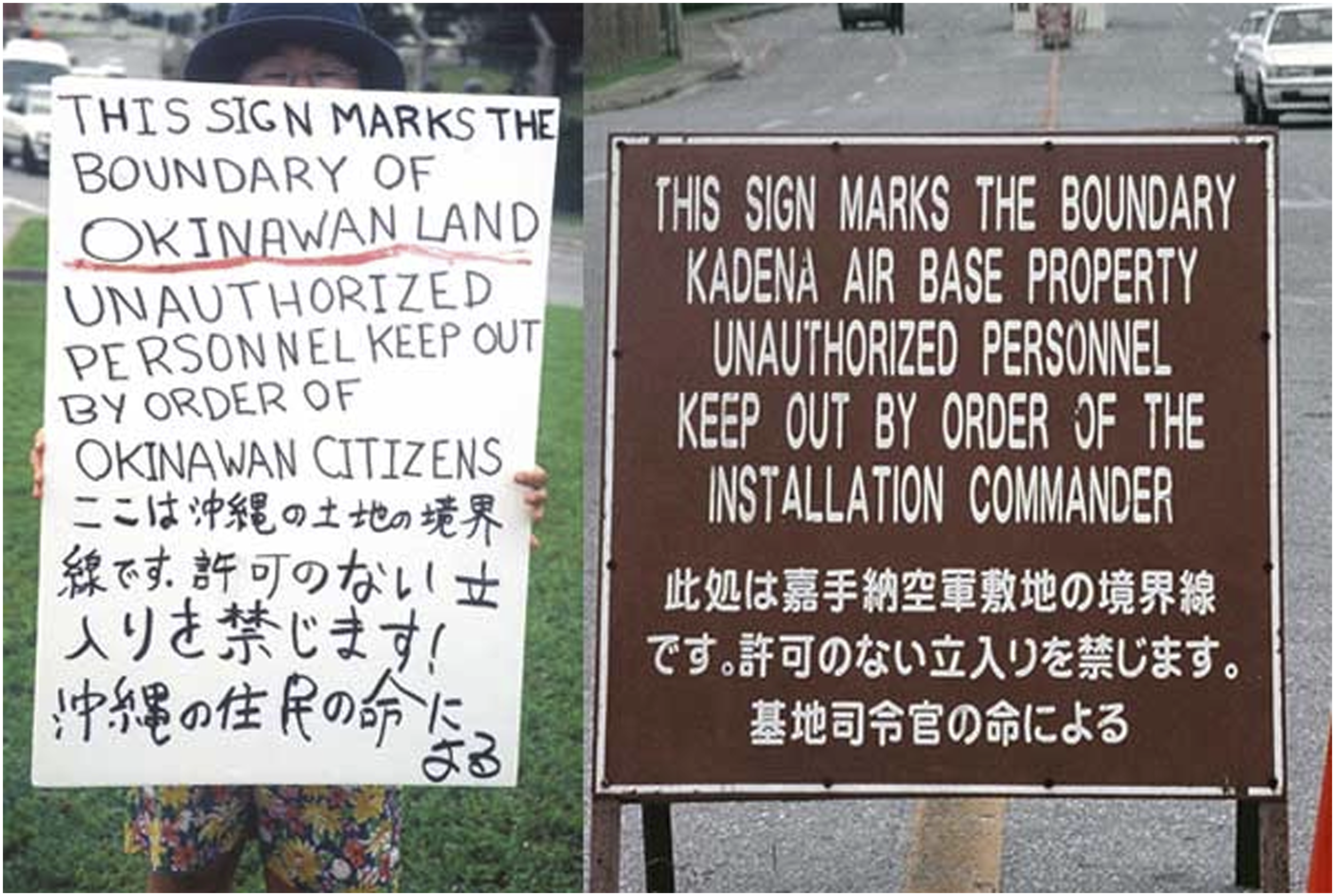
The protester’s sign, which is reproduced here from The International Women’s Network Against Militarism (sidadepaz, 2015), reminds that base borders are the manifestation of colonial and forcible territorialisation; it reminds that the places where the US bases are stationed are in a foreign, formerly independent, sovereign territory by using the same logic of territorial claim of the US military; it reminds that those who are crossing a boundary are not Okinawans, but the US military. With their attempt to undo the existing logic of base borders, Okinawans’ enduring resistance represents ‘a horizon of hope’, transforming base borders from a space for the politics of violence to a space for ‘the politics of hope’ (Brambilla and Jones, 2020). ‘The politics of hope’, Brambilla and Jones (2020: 298–9) argue, ‘means giving visibility back to stories of resistance and of autonomous movement, outside the purview of the sovereign power of the state. It means seeing from the view of […] people who live in the borderlands’. From this perspective, the introduction of base borders to border studies can develop constructive links between various resistance movements in different contexts that are equally generating alternative political and spatial imaginaries against forms of violence produced by different kinds of bordering.
Footnotes
Acknowledgements
An earlier draft of this paper was presented at the 4th Workshop on the Geopolitical Economy of East Asian Developmentalism in Osaka in November 2019. The paper was revised in light of comments and suggestions I received at the workshop. I am particularly grateful to Anssi Paasi and James D. Sidaway for their guidance and encouragement on this project. An anecdote at the beginning of the paper is from the post-workshop field trip to Okinawa in which I participated. I would like to thank the organiser Takashi Yamazaki who provided insightful information throughout the trip. I am also grateful to two anonymous reviewers for constructive comments which greatly improved this paper.
Declaration of conflicting interests
The author(s) declared no potential conflicts of interest with respect to the research, authorship, and/or publication of this article.
Funding
The author(s) disclosed receipt of the following financial support for the research, authorship, and/or publication of this article: This research was supported by the Academy of Finland (grant number 321755).
