




Abstract
In this paper, we argue the emotional life of corruption narratives underwrite the rise of the extreme Right in Brazil. Further, we argue that the talk of corruption is pervasive, polysemic, contested, racialized and emotional. It is deeply entwined with social struggles over the form, content and ends of political life. Drawing on this perspective, we analyze discourses of corruption in the wake of a seismic corruption scandal, Operation Lava Jato. We identify two competing narratives of corruption. The hegemonic form uses emotions to create political enemies, promote anti-Black punitivism and uphold social hierarchies. In contrast, a counternarrative of corruption rooted in Black feminist epistemology centers racialized spatial inequality as Brazil’s central challenge and offers pathways to reclaim political life from punitive neoliberalism. We contribute by specifying how the emotional life of corruption talk helps build support for Jair Bolsonaro’s cross-class project of revanchist populism. Ultimately, we argue that the Right has successfully mobilized corruption talk in the service of necropolitics.
Introduction
The 2014 anti-corruption campaign Operation Lava Jato remade Brazil’s political landscape. A price fixing cartel orchestrated a network of bribes, kickbacks and campaign contributions, funded by over-invoicing on state contracts. Investigators convicted hundreds of executives, public officials and politicians, members of a hitherto immune political elite. Lava Jato judge Sérgio Moro rose to prominence as an international anticorruption star. Yet the emotional life of corruption talk set the stage for the terrifying rise of extreme rightwing politician Jair Bolsonaro to the Presidency. The fallout of Operation Lava Jato led to Dilma Rousseff’s impeachment in a 2016 parliamentary coup, ending a 13-year period of Workers' Party governments and their bold, redistributive social programs. Two years later, alleging corruption, Moro’s court jailed the popular presidential candidate ex-President Lula da Silva, then leading by a wide margin in the polls. Moro barred Lula from running and even forbade press interviews, setting the stage for Bolsonaro’s win. This article interrogates the puzzle that the domain of anti-corruption works so well as a strategy of illiberal statecraft.
Revelations by investigative journalists at The Intercept and subsequent scandals detail collusion between Judge Moro and prosecutors designed to undermine the Workers’ Party (the PT, Partido dos Trabalhadores). Indeed, once Lava Jato had removed the PT from power, prosecutions slowed considerably (Rodrigues, 2020). This, and other abusive legal practices, have led researchers to argue that Lava Jato was a project of anti-left lawfare, that is, the selective use of law to attack political enemies (Jinkings et al., 2016; Proner et al., 2018; Valim, 2018). In contrast to this perspective, we argue that mainstream corruption narratives channel widely felt political emotions like fear and resentment into broad support for illiberal political forms, ultimately upholding inequality and anti-Blackness. In what follows, we explicitly theorize the talk of corruption as an analytic to study competing understandings of corruption. Political emotions amplify corruption talk’s capacity to resonate with diverse, even antagonistic publics. We argue the emotional life of corruption talk is an important relay between everyday life—marked by insecurity, precarity and exhaustion with politics as usual—and inequality and anti-Blackness. Furthermore, the Brazilian experience can speak to diverse contexts where the extreme Right mobilizes anti-corruption, like the United States, India and Indonesia.
On 14 March 2018, gunmen assassinated visionary city councilwoman Marielle Franco. Her tragic murder also testifies to the threat she posed to entrenched structures of power. As a queer Black woman from Maré, a tough Rio favela, Franco was a “repository of hope,” (Araújo, 2018: 208) especially for poor Brazilians of color, as she embodied the political power of the multiply marginalized. 1 The collective grief following Marielle’s death amplifies her voice beyond her precious mortality. Across Brazil and beyond, mourners called out, “Marielle, presente!” (Marielle is still here) and “Marielle é semente!” (Marielle is a seed). This article sows some of the epistemological seeds of Black feminist thought by bringing their key insights to our study of corruption. We amplify the political analysis of Brazilian Black feminists Marielle Franco, Joice Berth and Djamila Ribero who contest framing corruption as Brazil’s central social challenge, insisting instead on the corrosiveness of inequality and anti-Blackness. Their critique analyzes how racialized and spatialized imaginations of criminality justify punitivism toward the poor, Brazilians of color and leftists advocating redistribution. We extend this critique to show how discourses of corruption refract these racialized notions of guilt and innocence through collective, political emotions.
Our theoretical framework, discussed next, brings an emerging field of critical corruption studies into conversation with Brazilian psychoanalytic and sociological scholarship on emotion. We then contextualize the rise of the extreme Right. The following two empirical sections analyze the talk of corruption in this conjuncture: the hegemonic version and a counter-narrative grounded in Black feminist epistemology. We conclude with reflections on the stakes of these discussions.
Critical corruption studies
We argue that the talk of corruption is pervasive, polysemic, contested, racialized and emotional. It is deeply entwined with social struggles over the form, content and ends of political life. This section unpacks this framework.
In the wake of the post-Washington Consensus, a rising global anti-corruption industry promoted neoliberal governmental reforms by locating corruption in the public sector, imagining it as endemic to the global south, proposing legalistic and technical reforms, and avoiding confronting elite alliances of power, ultimately preparing ground for Western-driven market expansion (Hindess, 2005; Bukovansky, 2006). An emerging body of work evaluates the social lives of corruption, including as a contested analytic (Goldstein and Drybread, 2018), a “infrastructure” of political-economic action (Kim, 2020) and a repertoire of profiteering practices intertwined with capitalist social relations (Tucker, 2020). Corruption is ordinary, compiling the quotidian practices of actors throughout the field of power called the state (Gupta, 2012). In Brazil, the politics of anti-corruption has shifted based on economic conditions and the relation of elites to governing coalitions (Martuscelli, 2016); however, the normalization of elite illegalities (Drybread, 2018; Souza, 2021) and corruption as a “mode of rule” (Fogel, 2019: 153) have a long history.
Discourses of corruption express anger at perceptions of the misuse of power through a “slippery” (Doshi and Ranganathan, 2018: 3; see also: Prouse, 2021) symbolic register. These discourses can be put to varied ends. The category “corruption talk” draws from Teresa Caldeira’s (2001) work on “the talk of crime.” Both categories, we find, usefully capture the co-constitution of the discursive and symbolic with the material and structural. 2 This approach frames corruption as a contested field rather than a neutral concept identifying a stable external object. It highlights how corruption talk is a mutable resource in conflicts over who and what activities are identified as corruption.
Corruption talk is racialized. Racism is constitutive of capitalism and thus our argument here should not be surprising. 3 Anti-Blackness powerfully organizes Brazil, an ex-slaveholder society with entrenched racial hierarchies and the largest Black population outside of Nigeria. The country’s colonial history of mestizaje (race mixing) feeds a “myth of racial democracy” (Munanga, 2010: 169) where race is supposedly less salient than in old apartheid race regimes, in places like the US. Only a few authors have interrogated the relationships between race and corruption narratives (e.g. Ranganathan and Doshi, 2017). In a blog post written early in the Lava Jato scandal, Joice Berth (2016) argues that anti-corruption hides “a racist agenda.” As Souza (2021: 498) argues, a “racist affect” within anti-corruption campaigns associates honesty with elites and the largely white middle class. Indeed, light-skinned Brazilian elites interpret the desires for social mobility of dark-skinned, working-class Brazilians as corruption, even as they interpret their own “rapacious acquisitiveness as rights” (Drybread, 2018: 16). Whiteness, Goldstein (2018: 20) argues, protects Brazilian elites facing corruption charges by producing them as “already innocent.”
Brazilian Black feminists emphasize the socio-spatial imagination of criminality (Berth, 2020; Silva, 2009). Criminality is widely associated with marginalized, Black urban spaces and the criminal with young, Black male favela-dwellers (Ramos and Nunes, 2020). The favela signifies racialized difference, acting as a means to denigrate and target Blackness without speaking of race (Vargas, 2004). The consequences of these racialized spatial imaginaries can be deadly. Record numbers of police killings followed Bolsonaro’s election. In 2020, police killed 6416 people; 78.9% were young men of color living in marginalized neighborhoods (FBSP, 2021). Anti-Black state violence effectively renders these young men as killable (Alves, 2014), in what (Penglase, 2014: 13) describes as an “undeclared civil war.” As Berth (2020) underlines, “racism culminates in death for Black people.” Because of this, a growing chorus of Brazilian scholars use Mbembe’s (2019) frame of necropolitics in their work (Alves, 2014; Hilário, 2016). Necropolitics is a regime of power managing exposure to premature death through hierarchies of (de)valued lives and binaries of good against evil. We use necropolitics because it names how death-dealing constitutes an anti-poor, anti-Black agenda that manages poverty through state violence and punitive containment.
The talk of corruption is deeply emotional. We follow feminist scholarship on emotion as political, transpersonal and unbound, rather than individualized subjective experience (Ahmed, 2004; Bondi, 2005). 4 As Ahmed (2004: 90) argues, negative emotions “stick” to racialized bodies, and we add, to specific stigmatized places. Thus, for us, emotion infuses both material and discursive domains.
We amplify an emerging consensus among Brazilian social scientists that emotions are key to the conjuncture. In Operation Lava Jato, the mainstream media and the judiciary stoked emotions such as anger, hatred and resentment against the Brazilian Left and the PT (The Workers’ Party) (Gallego, 2019), an orientation called antipetismo (anti-PTism). Similar dynamics targeted other leftist governments in the region, expressly legitimizing authoritarianism (Merlin, 2019). Brazilian psychoanalysts identify resentment as foundational to authoritarianism. Kehl (Kehl, 2020: 16) argues resentment is a “constellation” of reactive emotions aimed at the perceived source of injury, accompanied by a sense of righteous superiority. Resentment bonds evangelical voters to Bolsonaro through a conservative morality of defending the family (Gracino Junior et al., 2021). Indeed, a resentful “emotional solidarity” sutures together alliances of the middle classes and the rich against the gains of the poor and working classes (Souza, 2019: 154). The hostile grammar of resentment sets upright citizens who give against those who only take (Dunker, 2015). We will argue that corruption talk’s resentful emotional appeals shape a hierarchy of valued bodies setting the morally superior anti-corruption supporter against racialized others and political enemies.
Our collaboration brings Thainara Granero de Melo, a Brazilian scholar of social psychology into conversation with Jennifer L Tucker, a US-based urban planning scholar. To analyze the political life of corruption talk in Operation Lava Jato, we tracked the keyword “corruption” through state documents, press reports, public speeches, pictures, videos and social media messages on YouTube, Twitter and Facebook. We drew from mainstream and alternative media sources. Our analysis begins with the launch of the Lava Jato scandal in 2014 and continues through 2021, the first 2 years of Bolsonaro’s presidential term. We also sought out interviews, social media posts and political writings by Marielle Franco, Joice Berth and Djamila Ribeiro.
In this archive of texts, we cataloged key moments, actors and institutions. We identified three conflictual moments in political contests over the nature, scope and impact of corruption: (1) the Get Out Dilma (Fora Dilma) agenda (2015–2016) during Dilma Rousseff’s second presidential term as anti-corruption movements consolidated; (2) the Great National Pact (2016–2018) organizing the parliamentary coup ousting Rousseff; and (3) the necropolitical agenda (2018–2022) of Jair Bolsonaro’s law and order politics. We also identified four main protagonists. First, the neoliberal/establishment Right includes elites in traditional rightwing/center-rightwing parties and economic elites. Secondly, the authoritarian Right includes far-right politicians, the military, conservatives Catholic and evangelical leaders, public security agents and rural elites, all with a strong nationalist bent. Thirdly, liberal reformers include moderate and right-wing groups of young and middle-class Brazilians, digital influencers, economists and journalists. This group emerged from mass protests in 2013 against bus fare hikes and mega sporting events but soon incorporated more conservative anti-corruption demands. Finally, the Left includes left and center-left parties, progressive groups, social movements, and academics defending the PT’s redistributive agenda. The discursive position of the Lava Jato team (judges and prosecutors) overlaps with both liberal reformers and religious leaders in the authoritarian Right.
Subsequently, we selected texts communicating divergent arguments about corruption. We analyzed texts that named emotions like outrage, love or hate as well as emotionally charged phrases, like “privileges for bandits.” We identified the discursive features of the dominant narrative of corruption and analyzed how Black feminists constructed a counternarrative. We argue the dominant narrative coalesces into a common sense, that is, “practical, everyday consciousness or popular thought” (Hall 1986, 20). Common sense is contradictory, contested and continually constructed—rather than imposed—out of available narrative frames, values and emotional registers (Gramsci, 1971).
Methodologically, we used Stuart Hall’s (1973) Gramscian encoding/decoding approach. Institutions like the media produce and curate (encode) messages aligned with dominant ideologies which audiences then interpret and reproduce (decode). While dominant institutions orchestrate messages to gain consent for their preferred reading—often making emotional appeals to sway audiences—audiences actively interpret messages through their own experiences and values. Encoding/decoding is thus a socially constructed and power-laden process through which people make meaning of reality. Our archive allows analysis of how different groups encode messages about corruption; however, discourse analysis can only gesture to the messy process of interpretation, negotiation, and redeployment of these narratives in everyday life.
Revanchist populism in Brazil
Bolsonarismo’s political alliance is cross-class, unstable and non-coherent. In 2018, middle- and upper-class Brazilians voted for Bolsonaro by wide margins. Yet a critical segment of dissatisfied poor and working-class Brazilians joined his alliance (Richmond, 2020) while more than a quarter of voters cast blank ballots. As president, Bolsonaro’s popularity quickly plummeted, but strong support from agribusiness, the military and evangelicals—the beef, bullet and bible caucus—suggest Bolsonarismo will remain a political force for some time. Corruption remains a top political issue (Atlas, 2021).
Rising insecurity amid the economic downturn set the stage for Jair Bolsonaro’s rise. The PT model of neodevelopmentalism faltered after the 2008 economic crisis, eventually undermining the Workers’ Party’s redistribution plans. Furthermore, while PT policies expanded the purchasing power of the popular classes, they did not invest in their social mobilization (Singer, 2018). Paradoxically, the success of redistribution created “difficult-to-manage frustration” as macro-economic condition worsened (Safatle, 2019), especially among newer, lower-middle classes. Socio-structural changes like the precaritization of labor markets, a decline in trade unionism, the rise of electorally-active Pentecostal movements and increasingly violent urban landscapes also led to disillusionment with the PT (Richmond and McKenna, 2023, this issue). Downward social mobility alongside rising insecurity activates resentment and other political emotions. Antipetismo (anti-PTism) mobilized this race/class resentment against the politics of social inclusion (Pinheiro-Machado, 2019).
Everyday violence and widespread insecurity also mark this conjuncture. The transition to democracy after US-backed authoritarianism coincided with a rise in urban violence and economic turbulence. Robbery, assault and even homicide are commonplace. Many use racialized narratives of criminality to explain these traumatic experiences (Caldeira, 2001: 32). The state’s response is violent, what Marielle Franco (2014) analyzed as an extended carceral state which contains the poor in favelas and prisons while meting out devastating numbers of racialized police killings. Amid this insecurity, the expansion of social inclusion pairs with popular skepticism for civil rights, including due process and legal protections for prisoners (Caldeira and Holston, 1999: 692).
This special issue frames the rise of Brazil’s extreme Right as revanchist populism. Drawing from Neil Smith (Smith, 1996 p. xviii), revanchism is a class project of “revengeful and reactionary viciousness” targeting both historically-marginalized groups and the Left. Revanchism emphasizes the war-like retaking of ground imagined as lost to an adversary, thereby framing the gains for poorer Brazilians as a key catalyst. Revanchist populism mobilizes “self-righteous hatred” (Centner and Nogueira, 2023, this issue) to craft an exclusionary polis, a “we” antagonistically set against an imagined enemy in an us/them logic characteristic of populism (Laclau, 2005). We argue that constructing a populist “we” requires material, discursive and emotional work. Without being a foregone conclusion, revanchist populism allows elite social groups to project their interests as the general social interest, largely because of their power over meaning-making institutions, like the media. We will argue that corruption talk plays a key role in the construction of consent to rightwing projects and that studying political emotions can invite questions about the making of coalitions invested in equality and racial justice.
In Brazil, we argue, revanchist populism constructs the enemy through two binaries: the moral Brazilian versus the bandit and the good citizen against “os corruptos” (the corrupt ones). Manichaean good versus evil thinking was prevalent both in the discourse of the Lava Jato team (De Sa e Silva, 2020) and of anti-corruption voters and protesters (Messenberg, 2017; Tatagiba, 2018). Bolsonaro mobilized the first binary by tapping into the fear of crime with a macho persona and a tough-on-crime discourse, deploring “the bad guy has more rights than the good citizen.” 5 Os corruptos is an expansive category including leftists, supporters of the PT, feminists and LGBT + people (Tatagiba, 2018). Os corruptos also includes Brazilians who claim rights but avoid duties, an assessment targeting welfare and affirmative action beneficiaries and “those who don’t work” (Kalil, 2018: 13). This marks a shift away from using corruption talk to decry elite misconduct while, in contrast, using the talk of crime in relation to poorer Brazilians. Os corruptos also codes advocates of redistribution, like the PT, as corrupt. Gallego (2019) argues that os corruptos is an empty signifier, a flexible category used to stigmatize social outcasts and political enemies. There is popular support for these imaginative binaries (Hita and Gledhill, 2019; Pinheiro-Machado and Scalco, 2020).
The Lava Jato campaign amplified these emotional atmospheres, which we discuss next. Here we emphasize that the Lava Jato discourse produced an illiberal repertoire of action by constructing corruption as an existential threat, thereby justifying judicial activism as the necessary, moral savior of the nation even while its advocates claimed to act outside of politics (De Sa e Silva, 2020; Pereira and Silva, 2021). Moro promoted a punitive model of justice involving pretrial detentions and plea bargains to pressure the accused to condemn others. As Silveira (Silveira, 2020: 226) argues, the Lava Jato team’s “rhetoric of technique” espoused transparency and the technical nature of law, masking their political project (see also Pereira and Silva, 2021). These claims to the neutral, technical application of the law depoliticized intensely political questions about the contours of public life and the distribution of social wealth.
Initially, Lava Jato judges and the prosecutorial team were lauded as national heroes and international anti-corruption stars. Judge Sérgio Moro won the Notre Dame Award and Time named him one of the world’s 100 most influential people. However, by 2019, reporting by The Intercept revealed that Lava Jato prosecutors colluded with Judge Moro to target the PT while Prosecutor Dallagnol sought to profit from his role, accepting speaking fees from firms under investigation, in effect, thinly-veiled kickbacks (Fishman et al., 2019). Two years later, in March 2021, the Brazilian Supreme Court exonerated Lula, declaring that Moro’s decisions were biased. The weaponization of Lava Jato leads many to describe it as anti-left lawfare—the use of the law to attack adversaries—either driven by US imperialism (Guardiola-Rivera, 2021) or the Brazilian elite (Proner et al., 2018). While capturing important dynamics, the lawfare perspective can miss the construction of consent for illiberal political projects through emotional appeals to ordinary Brazilians and reiterate the law as an adequate source of redress.
The Lava Jato campaign was a dramatic expression of a model promoted by the global anti-corruption industry. Transparency International and kindred groups promote a view of corruption grounded in neoclassical economics and oblivious to other social science research (Wedel, 2012). Their definition of corruption as the “abuse of public office for private gain” (The World Bank, 1997: 8) assumes that the public and private are separate, self-evident spheres. Its anti-state bias assumes that the market is fair and meritocratic, while the state is viewed as rife with private interests (Brown and Cloke, 2004). Furthermore, this liberal epistemology of corruption assumes the law is a neutral and fair arbiter, a stance that overlooks the anti-poor, anti-Black biases of law, and the ways that racial capitalism works through legalized forms of exploitation and dispossession (Tucker, 2020). Tellingly, the anti-corruption industry failed to foresee the anti-democratic impacts of their most lauded model.
This globally circulating anti-corruption discourse articulated with changes in Brazilian legal culture and institutional forms. In the 1990s, the new constitution promoted social rights. By the 2000s, however, an “anti-corruption catechism” (Engelmann, 2020: 6) promoted fixed responses to specifically-defined problems, applied with religious fervor. Rooted in punitive neoliberalism, this catechism relied on international models, located moral authority in US-based think tanks, and claimed scientific validity through country-based rankings of perceptions of corruption. Ultimately it undermined Constitutional social rights.
The modern Brazilian press amplifies corruption talk through elite control of media monopolies. 6 In the past two decades, the corporate media has portrayed the PT as an evil villain, while business groups financed a growing rightwing social media presence and backed groups circulating fake news (Davis and Straubhaar, 2020). These media narratives position the Workers’ Party as primarily responsible for corruption, belying the ubiquity and long history of dealmaking as a mode of politics.
The talk of corruption
In this section, we analyze the dominant discourse of corruption, what we call corruption talk. We argue corruption talk mobilizes the political emotions of resentment, outrage, love, and fear; key ingredients in constructing Bolsonaro’s populist “we.” We assess the emotional appeals and discursive effects of corruption talk, arguing the discourse constructs dehumanized political others and articulates anti-Black punitivism. While the following heuristic oversimplifies the complexity of emotions, which are not neatly separable, it brings into relief their political effects. We focus on the construction of these narratives, hoping to inspire further research into their uptake, negotiation, or transformation in everyday life.
Resentment
In 2015 and 2016, millions of Brazilians protested corruption, Lava Jato and Rousseff’s presidency under the Fora Dilma (Get Out Dilma) banner. Protesters waved Brazilian flags, sang the national anthem, and wore yellow and green, colors symbolizing patriotism. With the slogan “Our party is Brazil,” they claimed their anti-corruption discourse transcended party politics, promoting instead the “national will.” Most protesters were white. Black and brown Brazilians were present largely as workers—street vendors, maids or military police—not disaffected citizens (Costa Vargas, 2016). Adding to imagery of the PT as thieving criminals, some protesters communicated antipetismo (anti-PTism) with expressly racist imagery, like a protest sign showing Rousseff as the popular Black entertainer Mussum, smiling wide with the tagline, “you’re being screwed.” One white protester smiled as he mocked lynching another white protester in blackface. These anti-Black performances mobilized racist associations linking criminality with Blackness to criticize the PT.
In one emblematic photograph of the protests, a white couple walked a few paces ahead of a darker-skinned nanny pushing their child in a stroller. The nanny wears the traditional white clothing of today’s servants and yesterday’s slaves, symbolically marking her subordinated status and the long history of white entitlement to Black labor. The PT’s modest redistribution policies threatened these sorts of social relations, fueling revanchist feelings of resentment against challenges to racialized hierarchies.
In these events, the talk of corruption invoked an existential threat to the Brazilian nation. The Lava Jato team used phrases like “invisible mass murderer” 7 and “our enemy” 8 to refer to corruption, while Prosecutor Dallagnol repeatedly commented “corruption kills.” 9 During a talk at a Pentecostal megachurch, Dallagnol made emotional appeals to Brazil’s elites, saying “the upper-classes pay the price of corruption.” 10 He invoked Nehemiah, a biblical governor who rebuilt Jerusalem’s walls, saying “a city without walls is a city exposed to its enemies, which could be attacked or sacked at any time… today we live in a country without walls, exposed to corruption and impunity,” then comparing anti-corruption to the reconstruction of walls. Dallagnol’s image of a population under threat conveys anti-corruption as a moral, religious battle, enrolling his upper-class audience as self-righteous subjects under threat, a cocktail that cultivates resentment. Moreover, walls are powerful metaphors, evoking both physical barriers and symbolic forms of social distance that enact social hierarchies. Joice Berth (2020), for instance, argues the walls segregating rich from poor are “the expression of fear,” physical instantiations of political emotions.
Corruption means many things in the discourses of Dallagnol and Fora Dilma protesters, working through a “logic of equivalence” (Laclau and Mouffe, 1985: 130), discursive simplifications which confuse one thing for another in order to construct political enemies. The term corruption slips into criminal which itself is overloaded with significations, meaning both the PT and the racialized poor. The bandit and os corruptos are relays in this logic of equivalence, linking the Left and their welfare projects with criminality. Indeed, we found rightwing and moderate politicians vilified social welfare and PT-led governments with language like “handouts,” “fraud” and “swindling.” 11 Communicating hate, Jair Bolsonaro called the PT-led state a “rotten machine … living on corruption” and “sucking the state’s teats,” 12 conflating corruption with social spending.
Outrage at PT social programs affiliates with contempt for the poor. Anti-corruption protesters in the Fora Dilma rallies expressed feeling harmed by poor, Black and brown Brazilians occupying spaces of whiteness and argued PT welfare programs misused state funds (Saad-Filho and Boito, 2016). Indeed, corruption talk’s logic of equivalence implies that poor people’s desires for social mobility are a form of corruption. Thus, corruption talk equates the Left with criminality by coding social spending as privileges to the undeserving.
Corruption talk also promotes austerity. In 2016, Dilma’s successor Michel Temer passed a 20-year legislative freeze on social spending. Supporters explained that corruption necessitated austerity as a way to “reconstruct the broken nation.“ 13 Bolsonaro also used corruption talk to attack redistribution, commenting “privatization will not just fight corruption, it will be a hard takedown of Socialism’s parasitism.” 14 Brazilian economist Rodrigo Constantino, a key rightwing opinion leader, proposed that addressing corruption should primarily “reduce and decentralize state power and the resources passing through the public sector” 15 while Eduardo Bolsonaro—a legislator and the president’s son—claimed corruption “is a consequence of communism/socialism.” 16 This view on corruption thus underwrites neoliberal reforms.
Outrage/love
We argue that Lava Jato prosecutors used performative prosecutorial tactics to generate outrage. The team explicitly targeted public opinion, timing leaks and press conferences to maintain focus on the former president, 17 a strategy of “spectacularization” (Pereira and Silva, 2021: 2). Indeed, Moro had Lula arrested by armed Federal Police without first issuing a summons, a move that created the impression of guilt. In another episode, Judge Moro illegally disclosed unauthorized tapped calls between Dilma and Lula to a primetime news program in which Dilma suggested offering Lula a ministerial position to protect him from prosecution. 18 Both the arrest and the leak were strategic spectacles designed to generate outrage. Indeed, Dallagnol encouraged Brazilian society to “show its outrage” 19 in protests and at the ballot box.
In this storyline of good against evil, the media portrayed Moro and the Lava Jato prosecutors as the “Nation’s heroes” on a noble crusade. 20 A Brazilian action-drama series produced by Netflix, O Mecanismo (The Mechanism) captured the mainstream story: a neutral legal team fearlessly confronting a corrupt political underworld. The Lava Jato team portrayed their moral mission as a “war against corruption” 21 while describing any critique of their methods as “declaring an open war” 22 against their team. The metaphor of war mobilizes desires to annihilate an enemy, a dangerous other who cannot be engaged, only destroyed. Such violent desires are necessarily emotional.
Anti-corruption protestors amplified these emotional appeals. For instance, graffiti artist Leandro Spett depicted Dilma and Lula as dangerous devils (see Figure 1) and protesters used charged language like “terrorist”
23
and “disgrace.”
24
Another commented, “Dilma, it’s a shame [the army] didn’t hang you.”
25
These emotional appeals, we argue, help to craft the antagonisms central to what Mbembe (2019: 70) terms the “relation of enmity,” a necropolitical form of othering. In this discourse, the Left and its redistributive projects are enemies to be eliminated, not just challenged. Image credit: Ilton Rogério https://www.istockphoto.com/photo/popular-demonstration-against-corruption-day-march-13-2016-gm518091200-89822833.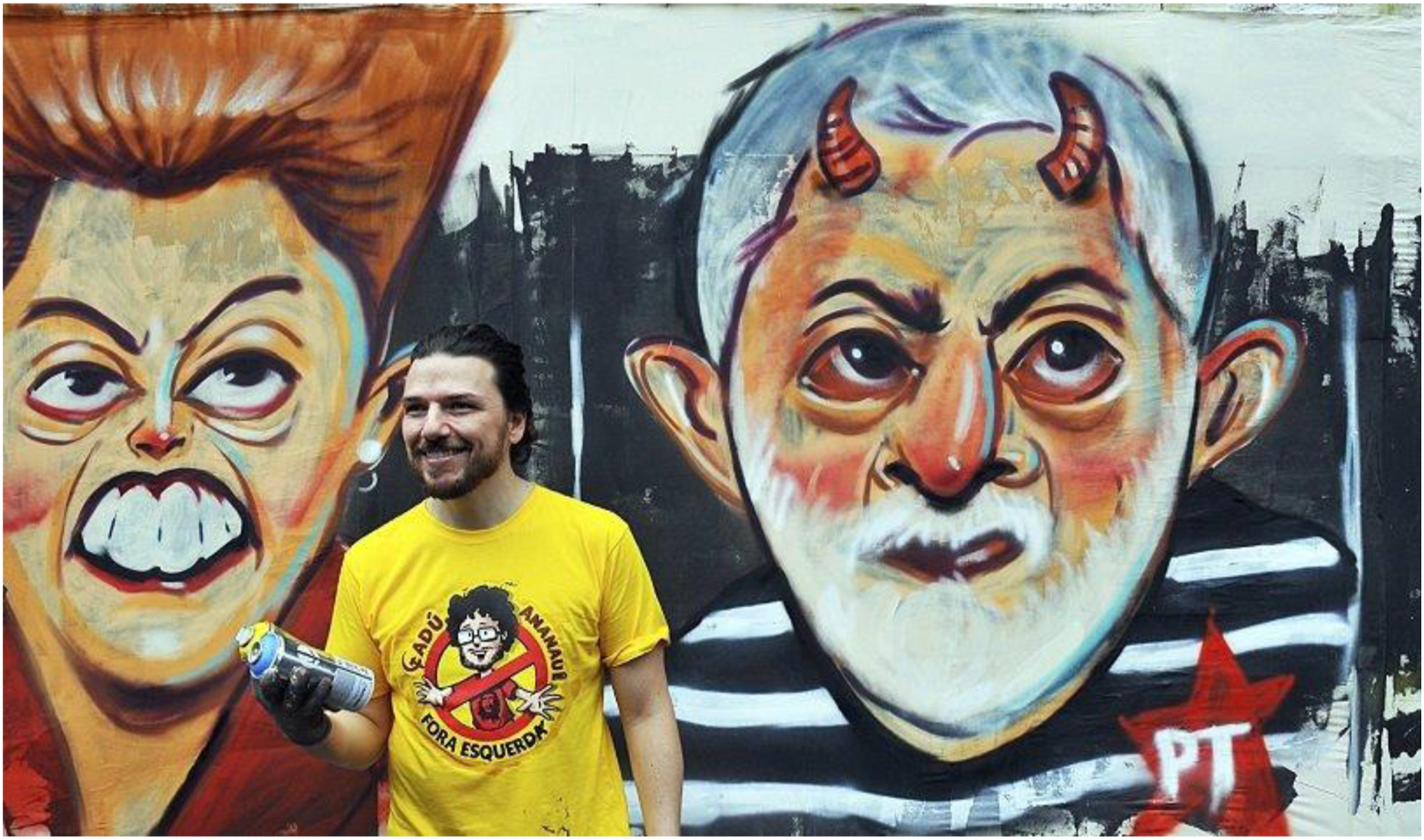
Amid all the hateful rhetoric, prosecutors expressed their motivations as nationalist love. In 2016, Dallagnol described his work as “a matter of brotherly love, of service to society,” 26 not of personal, financial interest. Lava Jato supporters also expressed love. Amid public outcry over the illegality of the Lava Jato team’s leaks, Sergio Moro’s supporters gathered to sing the popular song “Como é grande o meu amor por você” (How Great is My Love for You) in a YouTube tribute to Moro. 27 This brotherly love buttresses outrage at political enemies.
We suggest the relation of enmity relies on what intersectional feminist Patricia Hill Collins (2002) calls “oppositional dichotomous thinking,” powerful symbolic associations that valorize one side of the binary while denigrating the other. The litany of these binaries includes man/woman; white/Black; mind/body; culture/nature; citizen/criminal and, we suggest, moral citizen/os corruptos. These categories are imagined to be naturally given, hierarchically related, and easily distinguishable. The emotional charge of these binaries shores up a heroic sense of “us,” set against a dehumanized, dangerous “them.” Thus, Lava Jato constructed os corruptos as enemies of the state, a logic which later justified withholding legal protections from Lula da Silva (see: Valim, 2018).
Fear
The Lava Jato prosecutors also cultivated fear. Once elected, Bolsonaro appointed Moro to the new and powerful position of Minister of Justice and Public Security. In his inaugural address, Moro described crime and corruption as “related,” saying, “The priority mission of the esteemed president, Jair Bolsonaro is clear: ending impunity for large-scale corruption, the fight against organized crime and the reduction in violent crimes, all with respect to the Rule of Law, and to serve and protect the citizenry.” 28 Moro linked crime and corruption by naming them in the same sentence, both as presidential priorities, signaling the import of both domains to Bolsonarismo. Moro also invoked a singular, unified citizenry, obscuring the race/class hierarchies that have long organized social life and political rights.
In the early days of the anti-corruption crusade, the tough-on-crime rhetoric expanded to tough-on-corruption. The Lava Jato team said, “corruption is as violent as drug trafficking” and wanted a Brazil that treats “os corruptos and drug dealers equally.” 29 This tough talk suggested that corruption would be treated as harshly as narcotrafficking, connecting to popular desires for punitivism. Aggressive pretrial detentions and ratings-driven arrests—like arresting the PT Finance Minister Guido Mantega at the hospital bed of his dying wife—initially suggested the iron fist of the law would be applied to the political elite, not just to poor Brazilians.
Corruption talk mobilized the emotional resonances of punitivism. In 2019, Moro drafted the Anti-Crime Package, “simple and effective measures,” he said, claiming to address both elite illegalities and street crime in the same legislative proposal. 30 Rather than grounding the bill in research or best practices, Moro identified “popular support” as justification for the bill. 31 These measures included legalizing Moro’s controversial practices like negotiating sentences and imprisonment before appeals in higher courts. The anti-crime bill also toughened sentencing, loosened restrictions on gun ownership, and allowed detention before the completion of the appeals process. True to law-and-order thinking, Moro argued that punishment for legal trespass could address both corruption and violent crime.
The Anti-Crime Package also introduced qualified immunity, a proposal to shield officers from prosecution for using lethal force. Bolsonaro promoted these proposals with bombastic rhetoric celebrating violence, saying “The police can shoot first without any problem if the [criminal] element is potentially carrying a weapon.” 32 A former governor of Rio de Janeiro and key Bolsonaro ally celebrated this policy for “digging graves.” 33 Indeed, the Anti-Crime Package tapped into racialized imaginations of crime as a problem of the urban peripheries to justify increased policing, even as the police kill an average of 17 people a day, 80% of whom are young black men (G1, 2020).
Qualified immunity, although never enacted, reveals the political emotions behind the Anti-Crime package. The proposed license to kill is expressly emotional, activated if officers experience “fear, surprise or violent emotions.” 34 The law differentiates between defensive emotions which justify lethal force (fear, fright and disturbance) and aggressive emotions (anger or hatred). However, ambiguity in the legislation defines qualified immunity expansively and associates fear and hatred, legalizing state killing when officers feel hatred (Mello and Alban, 2019), a core emotion of the relation of enmity.
Moreover, we found the talk of corruption links everyday violence with social welfare expenditure, indexing the fear of crime. Lava Jato prosecutor Diogo Mattos attributed insecurity to excessive “benevolence” in PT crime policy. 35 Prosecutors also implied the Lava Jato campaign could address street crime, decrying that “the good citizens hide at home while criminals freely walk the streets […] the population must repel this new threat by supporting the investigations that wash this country from north to south.” 36 This discourse thus associates bandits and os corruptos. Indeed, the capaciousness of corruption talk allows it to work through systems of racialized meaning about both crime and corruption.
We argue that by slipping between the talk of corruption and crime, Bolsonaro and Moro can conjure the enemies inhabiting different binaries: the bandit and os corruptos. Thus, they can speak to multiple publics: those exhausted by crime, those outraged at elite illegalities, and the resentful classes desiring to take back social space after a period of multiracial inclusion and upward mobility. Talking of crime and corruption together relays these different political emotions. Both forms of talk elide racial capitalism’s inequalities as criminogenic, as the condition of possibility for both the economies of desperation behind crimes of poverty and the deep-seated elite sense of entitlement to loot. This slipperiness of corruption talk, we suggest, can therefore help hold together support for Bolsonarismo, even as these narratives are always open to negotiation and challenge.
Feminist counternarratives of corruption
On 13 May 2017, 129 years to the day after Brazil abolished slavery, Sérgio Moro headlined a debate about the role of the judiciary in Brazilian democracy. After Moro’s presentation, Djamila Ribeiro, a Brazilian philosopher and writer, questioned Moro’s defense of the law in the context of mass incarceration and state violence, what she called “penal populism.” 37 As she critiqued Moro, the audience interrupted her. “May I speak?” she continued, “How can we dialogue about this in Brazil when the judiciary is being represented as a great hero?” Later Ribeiro recalled, “the audience yelled in outrage when I said that judges were also enforcers of law during slavery.” 38 Ribeiro’s defiance marked a rare episode of public challenge to Moro, while also embodying a confrontation between hegemonic and oppositional narratives of corruption.
Feminists offer nascent counter-narratives of corruption. While this archive is slim, it contains potent ideas. These feminists center racialized inequality as the central challenge facing Brazil and propose pathways to reclaim political life from punitive neoliberalism. Unsurprisingly, these perspectives lack the apparatus of amplification backing corruption talk. More of concern, however, is its lack of traction within much of the Brazilian Left, along with the PT’s failure to prioritize anti-racism (Berth 2016). Indeed, until the 2018 elections, much of the Left supported the anti-corruption crusade.
Marielle Franco (2018: 138) critiqued “the hegemonic vision that Brazil’s principal problem is corruption, not inequalities,” a prominent discourse after Dilma’s ouster. Feminists like Franco agreed Lava Jato promoted antipetismo (anti-PTism), but went further, grounding their analysis in their own experiences of intersecting oppressions. Ribeiro (2017) translates feminist standpoint theory as “lugar de fala” [the place where one speaks], which Black feminists occupy as a site of knowledge production and a source of transformative politics (Loureiro, 2020). Franco (2016, cited in Loureiro (2020): 54) says, “One thing is to be born and live in the favela, another is to use this place of being a favela woman to make claims and to make politics in a different way.” Claiming their lugar de fala, these feminists directly contest the ways in which the talk of corruption naturalized racialized inequality and mobilized revanchist sentiments.
These feminist perspectives highlight racist punitivism. In her dissertation, Franco (2014: 123) analyzed how Brazil’s increasingly militarized security policy depoliticizes by displacing politics from the “central space.” For her part, Berth (2016) blogged that the cultural “exaltation of punishment” is inseparable from racialized notions of crime and innocence. Tough talk about punishment for os corruptos transmutes in practice and “hits the Black and the poor” (Berth, 2016) through the racialized criminal justice system. Indeed, punitivism looks different when aimed at white, elite illegalities. Reflecting on the favela equivalent of the plea bargains offered to Brazilian elites Franco posted, “For the favela resident, speaking up means getting beat up and shot. But the rich get rewarded if they tell the truth. For the poor, the plea bargain is called torture.” 39
Joice Berth (2016) also warned the Left about anti-corruption’s “racist agenda.” Berth (2016) highlights this in a pull quote from Ribeiro, “Absence is also an ideology,” arguing that the Left and Right converge in their support for punitivism and anti-corruption. Tough-on-crime policies, after all, continued through PT governments, even spectacular campaigns like deploying the military in peripheral neighborhoods in advance of the recent World Cup and Olympics. The absence of a robust theory of anti-Black racism in much left analysis meant it was ill-equipped to confront the racialized articulation of anti-corruption with punitivism.
A great irony of corruption talk is how the powerful are able to mobilize its discourses while protecting their own transgressions. Some of these dynamics are spatial. Legal transgressions built both favelas and penthouses, but elite spaces gain aesthetic legitimacy by looking legal and modern (see Roy, 2005). Feminist critique names these spatial politics. Berth (2016) describes the hardening of socio-spatial boundaries as an “urban apartheid” where walls materialize the fears and exclusionary desires of the middle and upper classes. Likewise, Marielle Franco challenged the spatial imaginary that stigmatized favelas as sites of criminality, tweeting that evidence of corruption is found rather in “the penthouses of Leblon [a wealthy Rio neighborhood, and] Brasília.” 40 And in Rio de Janeiro, militias bankrolled land deals behind an explosion of irregular, cheaply-constructed houses in favelas (Zaluar and Conceição, 2007). Senator Flávio Bolsonaro—another of Jair Bolsonaro’s sons—is under investigation for financing these deals with public money and assistance from the Crime Bureau, the militia suspected of orchestrating the assassination of Marielle Franco.
The racialization of corruption talk also likely shapes urban spatial politics. The furious social response to rolezinhos (cruising) as mostly Black youth assert their collective presence in shopping malls (Vargas, 2016) and the transgressive spatial politics of pixadores (graffiti artists) rejecting assimilation into the exclusionary city (Caldeira, 2014) may, in part, represent divergent responses to a semantic field that constructs aspirations to class mobility by poor and Black/brown Brazilians as corruption.
Corruption talk invites critics to engage within its language and logics, to counter that it is the entrenched, rightwing elite that are the corrupt ones. For instance, we might write that Flávio Bolsonaro bought a BR$6 million mansion in a luxury community, one of his 20 new properties, even while earning only BR$24,900 a month as a senator (Benites, 2021). Where does he get his (dirty) money? This is an important question, but misses corruption talk’s power, its taproot drawing on political emotions that “the wrong people are getting help.” The emotional register is not opposed to reason, as we learn from feminists, but it does not root its power in factual substantiation or empirically-grounded debate.
Along with socio-spatial critique, Black feminist approaches offer a pathway to reconstitute political life. Against the post-political claims of anti-corruption campaigners, Black feminists reassert the necessity of the political, especially urgent given how the talk of corruption fuels a growing rejection of politics. In two essays, Franco (2017, 2018) outlines this pathway. First, it requires centering the agency of poor and working-class Brazilians generally, and Black women and favela residents specifically. Emphasizing the necessary collective, solidaristic nature of life in spaces of exclusion, she writes, “While they bear the brunt of Brazil’s unequal social formation, they are also the ones who produce the means for transforming it” (Franco, 2018: 137). Thus, against the spatial imagination that reads favelas and informal settlements as sites of lack and criminality, Franco heralds their productivity, creativity and capacities to build lives and engage politics. This vision of the protagonists of history contests dominant scenarios of expert-driven change. Rather than the leadership of charismatic individuals—so necessary to PT politics—Franco insists transformation requires engaging “trajectories, encounters, perceptions of self and other, [political] opportunities and social issues” (Franco 2018: 138). Her references to social issues and the dynamics of self and other assert the centrality of race. This political philosophy highlights the challenge of simultaneously occupying power and transforming it.
Secondly, this reinvigoration of political life requires engaging the “collective imagination,” (Franco, 2018: 138). As Franco (2017) reminds us, political elites have rarely delivered for ordinary Brazilians. Feminists like the Congresswomen Talíria Petrone and Erica Malunguinho acknowledge this produces a justified outrage in many. Petrone says the experience of politics as “men in suits and corruptos,” 41 can turn this anger into a wholesale rejection of politics. To counter this, she promotes “a down to earth politics” that acknowledges the devastating precarities of everyday life and prioritizes meeting poor people’s basic needs. Seeking to transform anger at Marielle’s assassination into “something positive,” 42 Malunguinho’s political project “of love, affect and humanization” centers women and Black people, saying “our project doesn’t want war with anyone, we just want to live well.” 43 Instead of cultivating resentment, anger, fear or exclusionary love, these emotional appeals engage action from a different place, insisting on the value of Black lives and on the dignity of all. This feminist politics of emotions outlines possible pathways to contest the emotional resonance of corruption talk.
To counter the feeling that the necessary transformations are impossible, these feminists also write to spark hope. Franco (Franco, 2017: 94) penned her reflections on the political paths beyond authoritarian neoliberalism with the subtitle “When a flower breaks through concrete.” This metaphor of beautiful improbability is also an allegory of life’s creative, vital tenacity. Marielle called forth the unimaginable with the word “when,” insisting on racial equality and spatial justice as possible futures and sounding echoes of Angela Davis’s (2014) injunction, “You have to act as if it were possible to radically transform the world. And you have to do it all the time.” This enactment recalls what Silva and Lee (2021) identify as the “agentic time” of Marielle’s mourners and their practice of hope beyond linear notions of temporal progression and the pragmatics of electoral strategy. This mode of politics draws from wellsprings of action even in landscapes of ruination. Its determined nature defies the odds. In the election cycle following her assassination, Rio elected four women with ties to Marielle to local government. For us, this instantiates the praxis of possibility embodied by Black feminists like Marielle. Indeed they are the seeds sown by her, blossoming through concrete.
Marielle, presente!
Conclusion
The extreme Right in Brazil has successfully weaponized corruption talk to undermine projects of social uplift and redistribution. Yet more than just crass lawfare, we argue that the emotional life of corruption talk is constitutive of its political power. We have shown that the capaciousness of corruption talk helps it cultivate a range of political emotions which affiliate with racialized, anti-Black notions of crime and innocence. The emotional charge of baggy signifiers like bandit and os corruptos helps conjure political enemies and construct consent to punitive, illiberal versions of anti-corruption. For (Mbembe, 2019: 43), the enemy in necropolitics is a “terrifying object […] which desire must continually invent.” We argue that the emotional work of corruption talk continually invents the fantasy of the enemy—the Left and the racialized poor—against whom the good citizen must be defended, even with violence. Indeed, the assassination of Marielle Franco reveals the deadly consequences for those who embody an effective challenge to the hegemonic common sense about the who and where of corruption and crime. Demystifying the political emotions behind corruption talk, we suggest, offers resources to those invested in building feminist counterpublics aiming toward social equality and racial justice. Certainly, the global anti-corruption industry has been unable to discern the violent, racialized and class-based effects of their models even as corruption talk in different registers abets rightwing projects in diverse contexts: from Trumpian election conspiracies to the linking of anti-corruption and anti-crime in Duterte’s deadly campaign against Indonesian drug users to Modi’s dramatic demonetization scheme in India. Indeed, political life under late capitalism seems to invite the displacement of struggles over inequality onto the depoliticizing terrain of anti-corruption.
At the time of this writing, Lula is the newly elected president of Brazil, a seismic reorientation away from revanchist populism. Yet the challenges unleashed through the consolidation of corruption talk remain. In a context of deepening inequality, Lula’s detractors are mobilizing corruption talk to challenge his attempts to expand social programs, even as the discourse morphs into charges of fiscal irresponsibility. And while practices of corruption are built through elite illegalities, the hypocrisy of men like the Bolsonaros is beside the point because political emotions do not orient around assessing truth claims. Even further, punitivism is only obliquely concerned with legality, for if the law defends the “wrong people” (read: the racialized poor and the Left) then it can be suspended. Indeed, by mobilizing powerful racialized notions of criminality, corruption talk expresses anti-Black punitivism.
Can corruption talk be redeemed? Explicitly reclaiming anti-corruption as the terrain of the Left, Flávio Dino, former Governor of Maranhão and minister of Justice, argues “Nothing corrupts Brazil more than inequality, the concentration of income, power and knowledge in the hands of a few people…[anti-corruption] is ours, actually.” 44 Indeed, Black feminists offer an important counter-narrative of corruption, underscoring inequality, anti-Blackness and the persistent criminalization of the urban peripheries as the true challenges. We have shown how easily corruption talk affiliates with anti-Black racism, revanchism, and punitive populism, suggesting that attempts to rework corruption talk for more emancipatory ends proceed with great care.
Footnotes
Declaration of conflicting interests
The author(s) declared no potential conflicts of interest with respect to the research, authorship, and/or publication of this article.
Funding
The author(s) received no financial support for the research, authorship, and/or publication of this article.