



Abstract
The waterfront regeneration of Valparaiso in Chile has been the expression of significant institutional efforts aimed at reaching the so-called urban renaissance of the port-city, seeking to overcome the sustained symptoms of urban decay and economic underperformance. Over the years, a locally born idea became a controversial proposal led by the central government: A privately developed commercial project, named Puerto Baron (Baron Port). This article explores spatialized political struggles both underpinning and undermining this project, from institutional and elite interests pushing its realization to social actions triggering its end. In Valparaiso political and economic forces coalesced across different scales in their attempt to materialize a project that transfers globalized spatial imaginaries with tangled territorialized politics that exceed the limits of the city. Although state-led entrepreneurialism sets the waterfront regeneration agenda, interdependencies with networks of elites and local government were key to sustaining the project. In opposition, social movement strategies of scale jumping help to contest and influence the project’s delay. The case highlights the fragile nature of governing coalitions in Valparaiso as a shift in municipal power, which brought an alignment towards grassroots actors, ended the rather flawed regeneration project of Baron Port. The paper shows how unbounded spatial politics become highly permeated by interests at different scales, though still dependent on national centralized actions and definitions.
Introduction
Since the mid-1990s the Chilean state has realized several attempts to regenerate Valparaiso to overcome its sustained and long-term process of economic decline and social deprivation. In an approach mostly dominated by a market-led tourism agenda through the exploitation of heritage to attract private investment (Vergara-Constela and Casellas, 2016; Opillard, 2017), the waterfront regeneration was seen as the key strategic initiative able to trigger the still pending city renaissance (Caimanque, 2019), playing, as elsewhere, a key role in shifting places from production to consumption (Amore, 2020).
Attempts to diversify the economy of Valparaiso have roots in the decreasing importance of the port activity in terms of direct employment and its contribution to the port-city’s economic performance. In this scenario, elites and institutional efforts have been aimed at the port-city’s rebranding mostly linked to its urban heritage legacy, rich history, and bohemian imaginary (Espinoza, 2011). The designation of the port-city’s historic quarter as UNESCO’s World Heritage Site in 2003, as a “testimony to the early phase of globalisation in the late 19th century” (UNESCO, 2003: 121) during its port-city heyday was crucial in consolidating this new approach. Valparaiso symbolically gained a global value to be enhanced and protected by the state, that labelled the city as ‘Chile’s Cultural Capital City’.
Valparaiso started to rethink “its social bases of support, architecture of political intervention, and strategic priorities” (MacLeod, 2002: 604), through three different but intertwined strategic-like processes of urban regeneration, all led by the national government: (i) the Development Programme for Valparaiso or the ‘Reactivation Plan’ in 1995 (MSGG, 1995), (ii) the Presidential Advisory Committee for the Development of the City of Valparaiso or ‘Plan Valparaiso’ in 2002 (Ministerio del Interior, 2002) and; (iii) the Programme for the Regeneration and Urban Development of Valparaiso, or its acronym PRDUV (IDB, 2006) from 2006 to 2012. The trajectory of these plans consolidated a tourism agenda in which the waterfront regeneration would play a key strategic role. However, the initiative took an unexpected route, ending in a controversial, socially contested, and mainly unwanted commercial centre project called Puerto Baron. The project design driven by real estate interests foresaw the production of mainly semi-private urban spaces, and after many years of public – and legal – disputes was finally buried in 2019.
The idea and design of the Puerto Baron project, its failed process of materialization and, finally, sudden disappearance is the result of a tangled and contested process of coalition building at different spatial scales, which itself is related to the city’s flawed attempts of urban regeneration. In Valparaiso, urban governance is characterized by high concentration of power at the national government (Hidalgo and Zunino 2011), a marked dependency of private sector interest to invest, and limited municipal powers and budgets, affecting their capacities to govern (Amirtahmasebi and Licciardi, 2012).
Far from a straightforward approach linked to the practice of place-making aimed at solving urban problems (Roberts, 2000), urban regeneration is deeply related to processes of governance and decision-making (Ward, 1997; Davies, 2002; Jones and Evans, 2006; Kuyucu, 2018). In this regard, the waterfront of Valparaiso can be understood as a technique of governance (Cochrane, 2020), an object of political practices aimed at materializing the transfer of urban imaginaries, unevenly from north to south (Gonzalez, 2011), but still “in the context of wider forms of spatialized governance (beyond the local authority)” (Cochrane, 2020: 527).
Through the case of Valparaiso’s waterfront project, this article aims at contributing to the debates on spatialized urban politics, through the multiscalar analysis of coalition building processes in pursuing entrepreneurial agendas. It is highlighted that Valparaiso’s politics act in a relational way, whereby globalized spatial imaginaries of regeneration clash with territorialized politics in the institutional-political context of fragmented and contested governance. This work, then, seeks to understand the political factors that explain the rise and subsequent fall of the Puerto Baron waterfront project, and how interests interact beyond territorial administrative boundaries, pursuing their contradictory agendas.
It is argued that, although in Chile state-led entrepreneurialism is dominant (López-Morales et al., 2012), central government decisions inevitably coalesce temporarily with other interests to materialize urban regeneration plans: the port influences the waterfront; the conditions for private sector investments; supranational support; and the local government, with limited but strategic powers in urban planning. The contribution of this work accounts for a southern approach of multiscalar coalition building shaping urban governance in Valparaiso. In this endeavour, the research highlights the interconnected and tangled relationships of several forces and interests unfolding beyond the city boundaries to materialize the Puerto Baron project. The coalition identified proved to be fragile, as the social organization’s contestations were successful in questioning and delaying the project, and left-oriented municipal political changes became strategic in the project’s withdrawal after almost 15 years.
The article draws on the urban regime approach (Stone, 1989, 1993) as well as the politics of scale to analyse how actors interact and produce spatial politics in the city. The use of urban regimes literature is based on the substantial contributions to the characterization of urban governance (Tretter, 2008), in assessing governing processes through the interplay among institutional, private sector, and community players linked to urban development (MacLeod and Jones 2011; Shin et al., 2015). Debates on the politics of scale (Smith 1992, 1993; Brenner, 2001) are used to contribute to an understanding of Valparaiso’s local politics which are constantly rescaled to regional, national and supranational tiers. In the attempt to bridge spatial dimensions of networks and scales (Jessop, et al., 2008), the analysis in this paper uses a relational approach of politics (Allen and Cochrane, 2007; McCann and Ward, 2012) to understand how coalitions are temporarily produced across unbounded and fuzzy territorialities, as a spatialized approach to politics.
The article is based on qualitative methods to address the study. Fifty-four interviews with actors from decision-makers to grassroots organizations were conducted and analysed and used as primary sources of data to obtain a more in-depth approach of the case, which is the understanding of the social and political articulations among actors embedded in governance construction. Secondary sources such as official documents and analysis of strategic plans analysis, and a review of the media papers were used and triangulated to obtain more substantive evidence of the governance dynamics.
The first part of the article provides a theoretical debate on governance by linking the literatures of coalition building and the politics of scale, in which a relational approach of politics is applied to illustrate its spatialized nature. Then, the article moves onto a brief explanation of the development of Valparaiso’s waterfront framed by political economy and the aims of the port-city’s regeneration. The last two sections analyse the case study in-depth: The rise of Puerto Baron through state-entrepreneurial manoeuvres and the role of coalitions supporting the project, and the fall of Puerto Baron influenced by social movement contestations and the arrival of the new mayor in the city. Conclusions are drawn on the contested and fragile features of Valparaiso´s governance.
Rescaling spatial politics through networks and unbounded territories
The urban politics of regeneration imply understanding different forms of relationships among interested parts within governance (Jones and Evans, 2006; Kuyucu, 2018), which may vary from formal, bureaucratic and hierarchical ways such as in the UK (Davies, 2017), to non-hierarchical and more informal forms of relationships linked to the urban regimes literature in the US. Interests converge and diverge over certain territories and spatial scales, which in the context of globalization configure relational scenarios of governance that are more diffuse and territorially unbounded (Allen and Cochrane, 2007). This section proposes a framework that accounts for urban politics' spatialized and multiscalar features applied in a Latin American case. Therefore, elements from urban regime theory, the politics of scale, and relational thinking are drawn together, to emphasize dimensions of territory and networks that allow for assessing the entrepreneurial process of (failed) regeneration in Valparaíso.
Urban regimes have had great influence in networked politics linked to power and urban decision-making (Harding, 1996), focusing on informal arrangements between public institutions and private interests, and how they collaborate “in order to make and carry out governing decisions” (Stone, 1989: 6). In doing so, mutual interests are built in the form of coalitions, establishing common agendas (Ward, 1997), sharing resources to pursue them (Stone, 1993, 2005). One key goal is to produce governing capacity, in a period that goes beyond government cycles and whereby the regime´s stability is a key factor in its success (Stone, 1993).
Despite criticisms such as cross-national theoretical transfers issues (Wood, 2004; Pierre 2014), an agency bias over structural conditions that affect and shape urban politics (Davies, 2002) and being too municipally based (Boudreau, 2017), urban regimes remain relevant when used as a framework for analysis (Stoker, 1995). Contributions from Regulation Theory and Neo-Gramscian analysis (Jessop, 1997, Davies et al., 2020) helped to expand urban regimes scope, with research carried out at metropolitan (Keil, 2011) and regional (Oosterlynck and Swyngedouw, 2013) scales. The combination between urban regime/Gramscian approaches can help to explain the state’s and civil society’s construction of hegemonic urban visions, mediated through regulations that embed urban politics in regimes of accumulation and forms of social regulation beyond the local scale (Oosterlynck and Swyngedouw, 2013).
Significant contributions to the analysis of urban regimes and growth coalitions with attention to political economy and uneven space production have been made in linking scale theory with urban politics (McGuirk, 2003; McCann and Ward, 2010; Brenner, 2019). The notion of politics of scale (Smith 1992, 2010 [1984], Cox 1998; Herod, 2011; Brenner, 2019) expanded the political economy approach of scale production to the role of agents and their socio-political and cultural struggles (Herod, 2011), creating more explicit links to governance studies. The politics of scale look at the asymmetrical interplay among actors represented by the state, elites, and other capitalist forces, as well as insurgent actions by social actors (Conway, 2009) that produce differentiated scales for capital accumulation and/or state power, and spaces of political contestation (Smith, 1993; Jessop, 2009). The politics of scale have gained relevance in the understanding governance discourses and practices in cases such as mining and extractivism (Vela-Almeida et al., 2018) and environmental politics (Chung and Xu, 2016).
Actors’ interests and changing power relations become mediated through the politics of scale, in an incomplete, provisional, and unstable way (Jessop, 2005), unfolding both hierarchical and relational features (Allen, 2017) as a representational practice (Cox, 1998). Dominant temporal-spatial configurations can be contested, by social forces that strategically ‘jump’ to different scales (Smith, 1993; Jessop, 2009) in efforts to “challenge existing power relations” (Mahon and Keil, 2009: 19), making room for more emancipatory political strategies (Brenner, 2001). Scale jumping is an action of both upscaling and downscaling (Hoogesteger and Verzijl, 2015), and implies the production of contested scales instead of merely jumping to pregiven scales (Engels, 2015), hence, far from a bounded city (Davidson and Martin, 2014). Urban politics expand decision-making to new spaces of governance and more players, reinforcing the importance of networks (Cochrane, 2020) with forces operating beyond the urban scale (Macleod and Goodwin, 1999).
Relational and territorial spatial politics
Spatial politics as both relational and territorial become crucial (McCann and Ward, 2010) as the interplay between several networks of association that create and recreate spatial configurations (regional, urban, etc.) are not necessarily attached to territorial administrative boundaries (Allen and Cochrane, 2007). Contemporary urban governance under globalization generates policy transfers and urban imaginaries that move from place to place through different networks of interest aimed at similar urban outcomes, but deeply rooted (and adapted) to specific territories (McCann and Ward, 2010) and their specific constraints. Not only policymakers, but planners, consultants, communities, and activists play a key role in the territorialization of successful or failed urban policies (Temenos and Lauermann, 2020).
Through a relational approach to urban politics, cities are understood both as unbounded territories and differentiated activities beyond physical limits (Robinson, 2005; McCann and Ward, 2012), as the interests coalescing through networking transcend them. Urban politics open to different players at different spatial scales constitute temporary fixations “through processes of territorialisation (…) that take effect through their performance in place” (McGuirk, 2012: 263). This also includes social movement’s place-based cohesiveness processes and relational alliances for political action (Nicholls, 2008).
Thus, beyond economic development and urbanization, urban governance needs to pay attention to the relationship between the built environment and its social identities, practices, and struggles (McCann, 2017), which are interrelated with actor’s interests through transnational and local institutions, to deepen an understanding of heterogonous urban cases that are also imminently global (Ong, 2011). The purpose of this, following Roy (2009), is not to test how southern cases add to northern urban frameworks but to produce analyses of heterogeneous and cosmopolitan forms of urban studies (Robinson, 2005), expanding approaches to governance, coalition building, and urban entrepreneurialism.
Spatial politics in Latin America
Urban entrepreneurialism and growth regimes have different expressions outside the Anglo-American context (Lauermann, 2018). The recognition of how urban politics unfold among cities is important to avoid pre-given forms of growth coalitions in a specific entrepreneurial government (Hall and Hubbard, 1996). The conceptual flexibilization of urban regimes and coalition building through time, departing from their original conception (Davies, 2017), have provided new impulses and analytical frameworks for European (Davies et al., 2020; Davies and Blanco, 2017, Lambelet, 2019; Russo and Scarnato, 2018) as well as Asian cases (Shin et al., 2015). However, the urban regime approach is still underdeveloped in the Latin American context.
Governance in Latin America is characterized by state apparatuses that remain under processes of institutional development and strengthening (Lukas, 2019), particularly in countries dismantled by dictatorships (Bohoslavsky et al., 2021). Although contemporary democracies tend to be more open and robust, including through an empowered civil society, patronage, clientelism as well as technocratic approaches remain dominant in decision-making processes (Roy, 2009, in Lukas, 2019; Zunino, 2006). Poverty and inequalities are still at the centre of many countries’ challenges. Here, civil questioning of political and economic elites has increasingly emerged through social protest and activism, which reflect the exhaustion of a neoliberal model based on uneven development and deprivation. In a context configured by forms of governance “wherein categories such as ‘formal’ and ‘regulated’ are always shifting and unstable” (Caldeira, 2017: 7), the relational ways in which actors, knowledge, ideas, resources and practices unfold through space (McGuirk, 2012), tend to clash with centralized and sectoral frameworks (Barton, 2013), thereby giving room for socially contested expressions.
In Latin America, the state remains a major player in configuring urban environments (Ong, 2011), which in centralized countries like Chile translates into an approach of coalition building with private investors to control local development (Zunino, 2006). Urban governance is expressed through speculative state-led entrepreneurialism, in which the public sector absorbs political and economic costs to secure and benefit real estate interests (López-Morales et al., 2012). The path towards the “good governance” promoted by the World Bank in southern countries (Rhoades, 1996) ends related with normalized and depoliticized forms of urban entrepreneurialism (Peck, 2014), while interurban competition continues to increase structural unevenness.
Case studies of Latin American waterfronts show how state actors play a crucial role at different levels, articulating interests around urban policies and projects. This stands in contrast to cases from the global north, where private transnational influence appears more important (Jajamovich, 2016). Policy mobilities also operate, with different outcomes, within countries. The regeneration of Porto Maravilha in Rio de Janeiro was based both on global urban imaginaries and the institutional and operational experiences gained in Sao Paulo (Silvestre, 2022), while Puerto Madero in Buenos Aires failed to be replicated in Mendoza, Argentina (Jajamovich, 2016). These cases have in common public subsidies and facilities based on the relaxation of planning rules and rebranding, aimed at consolidate attractive areas in which social issues are not addressed (Cuenya and Corral, 2011).
While urban entrepreneurialism as a conventional ‘growth machine’ shows signs of exhaustion in the global north (McGuirk et al., 2021), moving to post-democratic, technocratic and financialized approaches to late-entrepreneurialism (Peck, 2017), regions such as Latin America indicate a different story. Any attempts to build a welfare state were structurally reduced to the minimum (Lukas, 2019) decades ago, reflected in the Chilean neoliberal experimental process of dispossession (Harvey, 2005). The high dependency on the private sector, institutional vertical and horizontal tensions, and social activism, shapes specific forms of political territorialization, which were expressed, in some cases, through controversial urban outcomes. Through the study of Valparaiso’s waterfront, coalescing interest shapes a fragile pro-growth agenda in which spatial politics unfold at multiple scales, and global urban imaginaries become territorialized in a contested way.
Valparaiso in context: State-led urban regeneration preparing the mall project
Valparaiso is in the coastal central area of Chile, at 110 kms from Santiago, the country’s capital. The comuna of Valparaiso is composed of three urban areas: The city of Valparaiso (study area) and two localities called Placilla-Curauma and Laguna Verde (Figure 1). The comuna’s population is 296,655 inhabitants, according to the 2017 census, which has been relatively stable since 1982 with a small increase in 2017. However, this increment is mainly located around the Placilla-Curauma area, therefore the historic city presents sustained symptoms of abandonment. Valparaiso figures in terms of unemployment and poverty, are usually above the national averages. In this regard, participants argue that the city has lacked effective employment opportunities since the decline and privatization of the port activity. Valparaiso along the neighbouring comuna of Viña del Mar, has a concentration of 15.5% of the country’s informal settlements (Techo and Fundación Vivienda, 2021). Valparaiso and the Metropolitan area.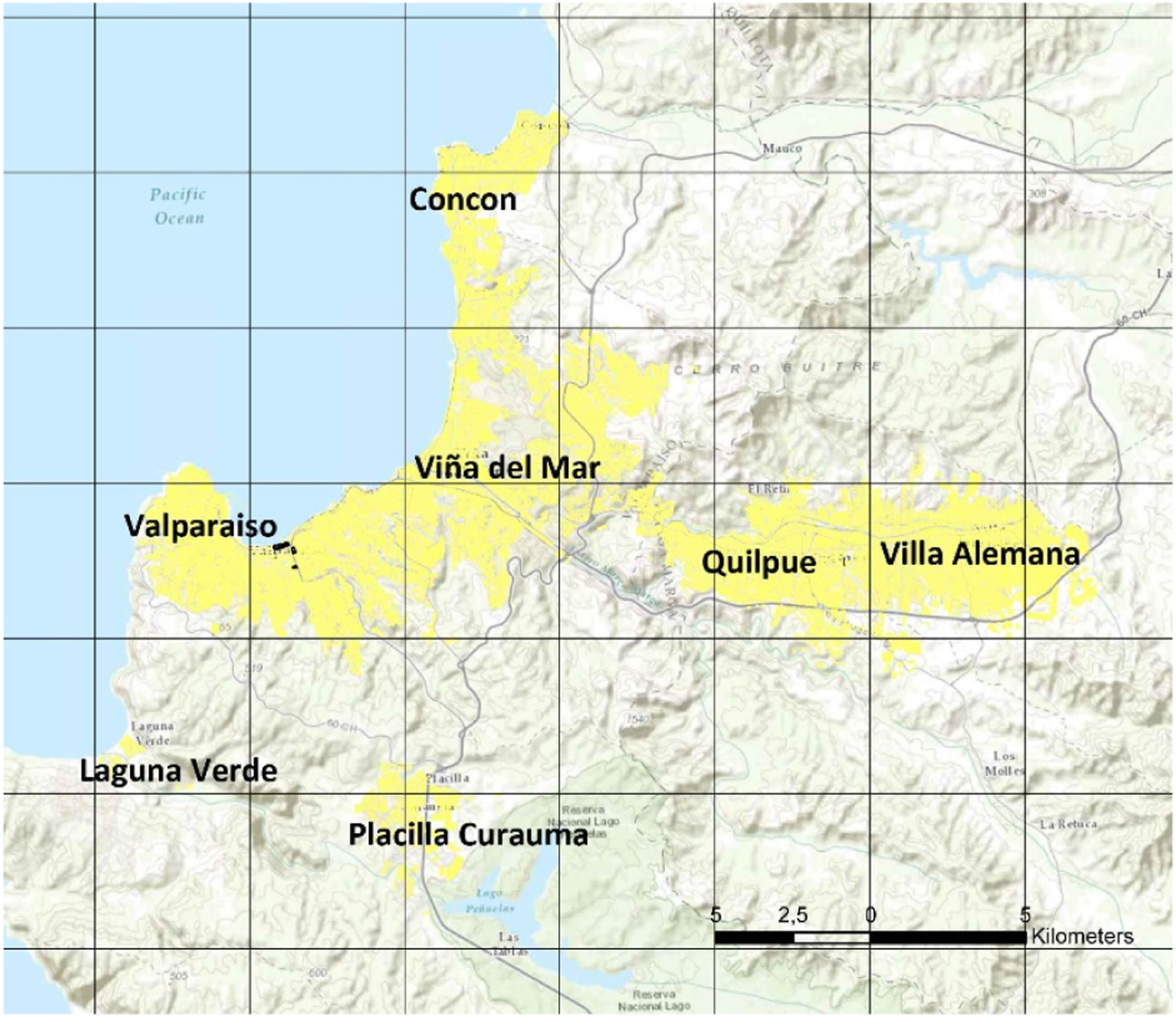
The state-led strategies of regeneration produced in Valparaiso between 1995 to 2012 were built under the Concertación de Partidos por la Democracia (1990-2010), which was the main centre-left political coalition in office after the dictatorship. The Concertación developed national politics in a context broadly marked by attempts to consolidate the regained democracy, promoting economic growth, and increasing social investments (Silva, 2009). Successful politics regarding diminishing poverty, employment and economic growth are widely recognized, but the country’s high dependency on capital movements, imposed a mode of governing according to the market behaviour (Ruiz, 2019), conditioning decision-making.
Presidents and Mayors of Valparaiso since 1990. Source: Own elaboration based on SERVEL.
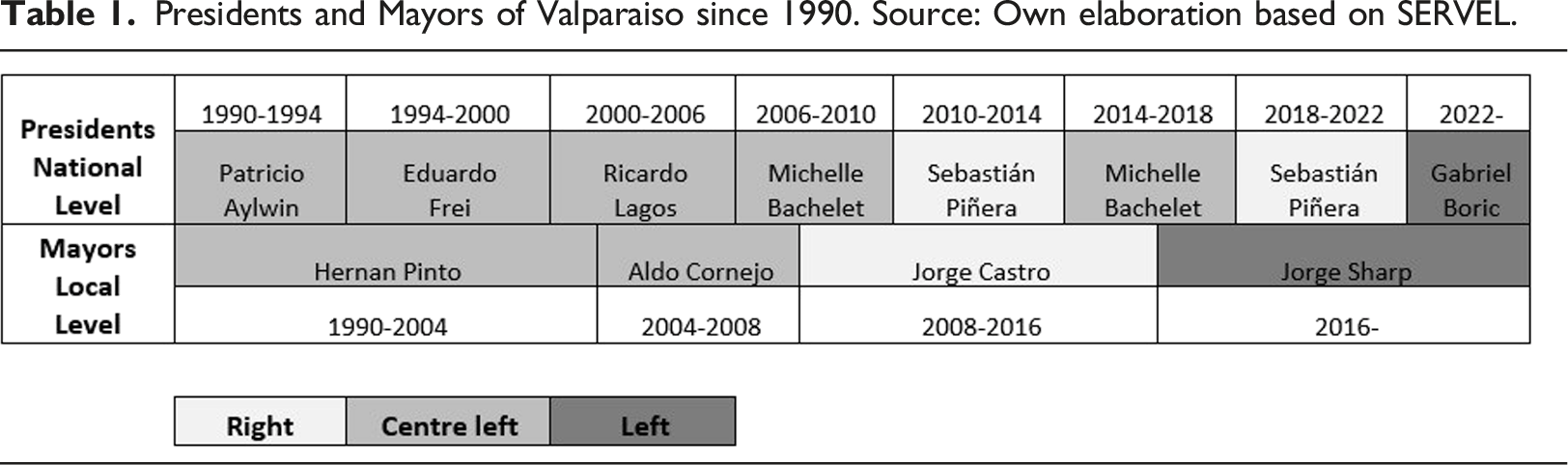
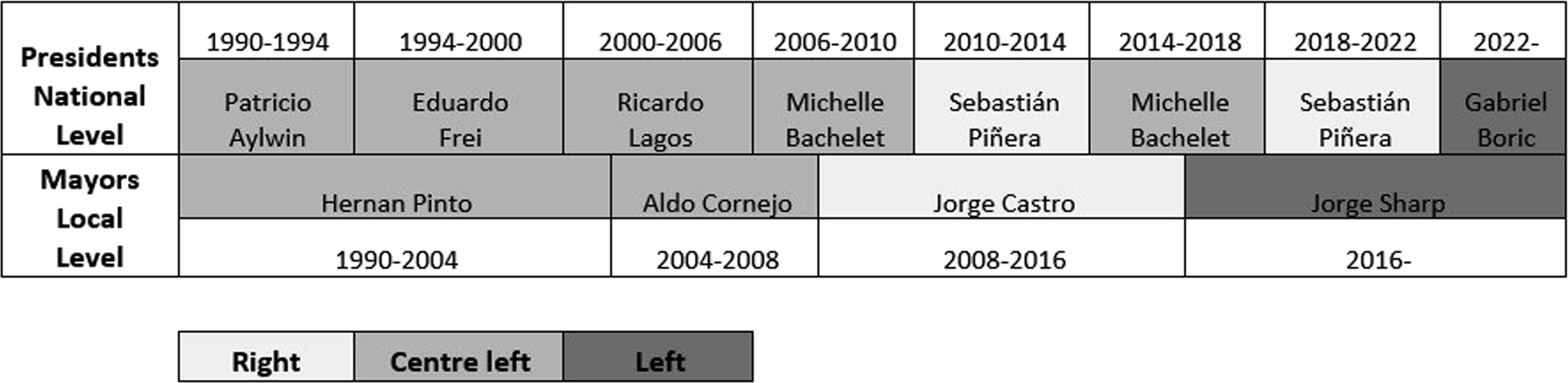
The waterfront idea was announced during the ‘Reactivation Plan’ at a national level in 1995, aligned with local elites arguing for port-city’s economic changes towards tourism through the media, and a Mayor Hernán Pinto promoting the megaproject. He used his political resources and influence at central government to gain the support of both President Frei and the Ministry of Housing and Urban Planning, MINVU. Moreover, the municipality played an important role, among other public and private companies, in transferring around 17.5% of municipal land in the current Baron area, to the port authority (El Mercurio de Valparaiso, 1999). This ensured the public Port Enterprise of Valparaiso (hereafter through its Spanish acronym, EPV) as the single owner of the land for the commercial and tourist project development.
A second stage was taken under ‘Plan Valparaiso’ investments in 2002. Here, the port investments made to improve its operation acquired greater importance for the waterfront project because this implied the removal of containers and trucks in the area defined by EPV’s Masterplan. As elsewhere the public sector took the risks (MacLeod, 2002) with investments made both to improve public space and increase the attractiveness of the area for the private sector’s arrival. The waterfront project would connect a ‘puzzle’ of projects already developed (Former officer at Plan Valparaiso): the construction of public promenades, the Portales Fishing Cove, the regeneration of Baron Pier, and the private-led new passenger terminal in part of the old Simon Bolivar warehouse (Figure 2). These investments acted as preconditions for a private-led model of regeneration, also linked to the neighbouring underdeveloped area called El Almendral, which is potentially attractive for future investments. Puerto Baron location and its investments. Source: Own elaboration.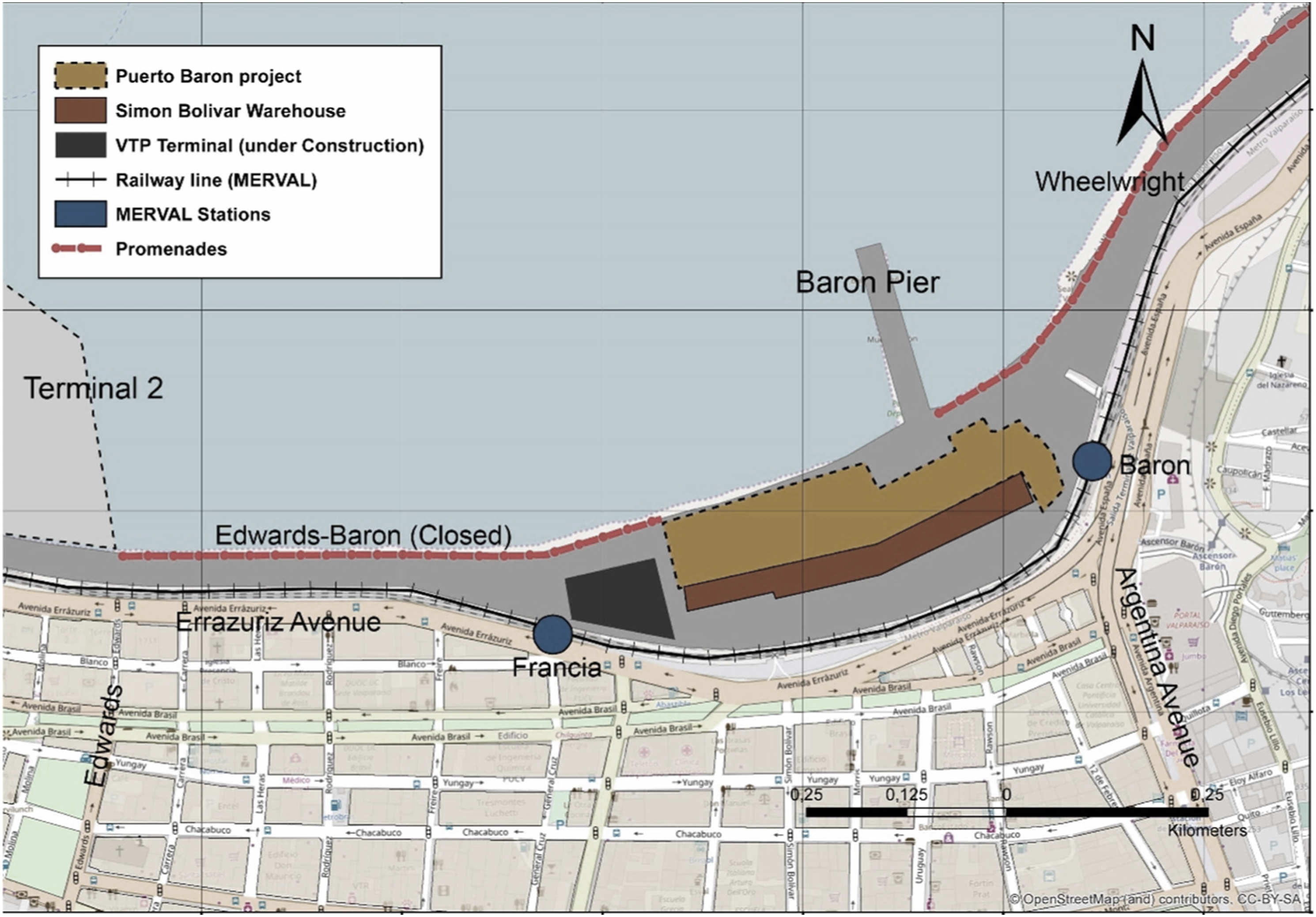
The definition of features of the waterfront project was influenced by important international consultancies and their studies. Here, the circulation of spatial imaginaries such as the ‘Barcelona Model’ in Latin America (Silvestre and Jajamovich, 2022), implied networks between Chilean state actors and Catalan international consultants, creating spatial proposals integrating public spaces, a museum, housing, and hotels. However, difficulties to materialize the original ideas of the project at that time, linked to land subdivision complexities, the port authority as owner of the land, and with lack of experiences in this kind of megaprojects, produced a rather different spatial and political territorialization. EPV´s leading initiative, the waterfront project named Bordemar was tendered in 2005, with one single proposal made by Plaza Group,
1
allowed to use the land under a concession of 30 years: So, in practice (…) those territories belong to someone: The Port Enterprise of Valparaiso. And EPV is dedicated to what its name says! ... it does not do real estate management. The problem is (…) who does it? (…) Ah! And all this [happened] in a pre-crisis Chile, in which capitalism reigned supremely, in which [projects] had to be done without subsidies (…). Then, in practice this ended up turning into a mall! (Former Executive Secretary at ‘Plan Valparaiso’).
At this point, public and private interests coalesced in several ways, from elite discursive approaches and political manoeuvres to convince the state to build a new waterfront for Valparaiso. Under a globalized spatial imaginary, coalitions were taken at a national scale to create attractive conditions, in which the interdependence between central government and the private sector were expressed in important works for the city, aiming to consolidate the core of the waterfront project.
The rise of Baron: Coalitions and scalar interests in a flawed project
The relatively stable scenario in which Chilean politics unfolded, particularly during the 2000s, sustained a model of city production in Valparaiso based on profit and consumption. Once Plaza Group became the single developer of the port-city’s most valuable piece of land, the condition to make the commercial project succeed was to expand the possibilities for further growth, supported by EPV regulations. Public space and housing speculation triggered a form of entrepreneurialism aimed at both compromising urban investment and institutionally intervening throughout the entire process to ensure the shopping mall materialization: [In this country] although per capita income today is over US$15,000, the taxes collected are so low that there cannot be quality of life improvements, and therefore we must necessarily resort to the private sector, so, through making good business opportunities, we can make improvements in the quality of life of the inhabitants, otherwise we’re finished! (Former EPV Board member).
State-entrepreneurialism operated once the project was awarded to reinforce the coalition, as EPV committed through a contract addendum, to give approximately US$21 million to the Plaza Group to build and maintain public use spaces (La Segunda, 2011). Instead of making the developer responsible for these spaces, EPV pushed the boundaries further, subsidising it. This manoeuvre also had links to other public interests such as the metropolitan Metro system of Valparaiso, MERVAL. The mall area would benefit from transport infrastructure with two station accesses through the projected public spaces. The informal interdependencies among the EPV, Plaza Group and MERVAL, reflects a project locally settled but aimed at the Valparaiso Metropolitan area, to capture high-standard consumers and ensure its economic feasibility, in a city with low consumption capacity (Neumann, 2019).
Regarding housing, the ‘Port Modernization’ Law of 1997 allowed EPV to offer, through a Presidential order, plots of land for sale outside the port area. A few months after the Plaza Group was awarded the tender, President Bachelet authorized EPV, through Decree 144 (MTT, 2006), to dispose of 30,000 m2 of land to be sold exclusively to the Plaza Group for housing purposes. With this, the private company could buy this land at any time within the concession. For the operation, the potential sale price was 2.25 UF/m2, 2 plus 10% of the selling price of each future housing unit (Revista Qué Pasa, 2013), while the land value for taxation on plots around the Baron area plots ranged from 7 to 28 UF/m2 3 (SII, 2021). On the one hand, with this agreement, the Plaza Group could benefit from buying land cheaper than its commercial price, ensuring potential housing developments next to Puerto Baron. On the other hand, EPV would obtain revenues for an operation estimated at US$ 240 million. Although EPV could not perform operations outside port activity, with this agreement they would indirectly act as a real estate player, receiving revenues through the concession, but leaving the Plaza Group to ‘formally’ develop the real estate action.
Politics of planning: Changing land use and regulations for profit
To ensure Puerto Baron’s profitability and feasibility, an urban growth coalition was produced between state public enterprises and the multinational retailer/developer, alongside municipal political support. As the municipality lacks the resources and power to make comprehensive plans, city planning regulations constitute an important tool to be part of the coalition. During the 2000s several planning modifications were made in favour of the commercial project. Before the tender, EPV submitted a proposal to change the land use of the Baron area, that originally allowed only port-linked activities. The Municipal Council approved the modification of the masterplan through a seccional, 4 allowing commercial or cultural uses, in exchange for protocols for the use of the space, as port land is not considered for free public use.
Far from a straightforward process, the informal growth coalition faced the emergence of oppositions to the project, particularly social movements contesting part of the planning modifications. Although the seccional was approved, social movements campaigns such as Que nadie nos tape la vista (Let no one block our views) were influential in banning the height increment proposal of 60 mts. For new buildings. The planning modifications took place between 2004 and 2005, near the elections for a new mayor. The Municipal Council approval was made 2 months before the Regional Council modifications at regional planning level, which is supposed to go first. It has been argued that a new mayor and a new council would produce uncertainties regarding the future of the project, unveiling the coalition’s permeability to possible political re-configurations. Nevertheless, the political balance almost did not change, and the approval was finally ratified in 2005, despite the irregular process. In this regard, as a former municipal councillor explained: ... [There is a] precarious relationship], because in the end, what has happened is that the municipality yields to the pressure of the state and sometimes to the pressure of private enterprises, and this gives rise to problems of corruption. So much of the silence […] of the political world has to do with the financing of electoral campaigns. ...I believe that this relationship is even clearer in a city that is poor, and in the end the people who participate in politics are extremely vulnerable to bribery.
As in any informal agreement between decision-makers, influences might be widely recognized among participants, but the ways in which it operates are hard to expose until the outcomes of a planning modification are completed. Once the Seccional was approved and the presidential decree for housing handed in, Plaza Group requested new modifications, arguing that the project was still unprofitable. Although the municipality initially rejected further changes in the context of social campaigns against the mall, establishing a period of uncertainty and negotiations from 2007 to 2009, the process ended with the approval of a new maximum height. Part of this change is explained by the role of political parties within the coalition, which were aligned with the project. In the Municipal Council session to define the planning modification, two councillors unexpectedly changed their votes, who were previously ‘committed’ to the grassroots movements to reject the amendment. An activist argues: … they gave arguments based on party orders, and that they had reviewed the project information once again. But finally, it was not that, because they had meetings with us, they knew the subject completely, advised by experts, so it was not a technical issue, it was a political decision.
The conjunction among state actors, multinational interest and the local government configured an informal multiscalar coalition aimed at materializing a commercial urban legacy for the city as driver for growth and profit. Puerto Baron is the expression of temporary coalitions - from those establishing the scenario for the regeneration project to those aimed at its profitable materialization-in which the boundaries between the public and the private become fuzzy, building a governance territorialized in Valparaiso but relationally build beyond that urban scale. This form of governance is both product and booster of the Chilean centralism, the lack of municipal autonomies to develop own initiatives, a financial capital/real estate/retail imbrication whose dominant elites are out of Valparaiso (Santiago), and the influential role of political parties intertwined in national and local politics.
The fall of Baron: Social contestation and the shifting of local politics
Between 2009 and 2013, Puerto Baron’s key stage was to obtain the building permit along with feasibility studies such as roads impact. The project was overtly controversial, marked by mobilizations and several judicial actions made both by grassroots and individual actors aimed to bog-down its materialization. This period also showed the political willingness to build the project at any cost, as a clear goal backed up at both local and national levels, regardless of the political party differences.
Institutionally speaking, Chilean technocracy poorly involves social actors, who remain dependent on the will of dominant groups (Collado, 2018). In turn, Valparaiso’s activism has been a vehicle for social movements to have a voice in urban debates, developing capabilities to effectively ‘jump’ to other scales for contestation. Groups with counter-cultural and counter-political features such as Ciudadanos por Valparaiso (Citizens for Valparaiso) (Rojas and Bustos, 2015), or wider associations at that time like the Comando en Defensa de la Ciudad Puerto (Command in Defence of the Port City) and later the Asamblea Ciudadana (Citizen Assembly), showed capabilities to become recognized as temporary actors within governance. The campaign No al Mall, Si al Puerto (No to the Mall, Yes to the Port) was able to join a heterogenous array of actors against Puerto Baron that included port and transport workers, politicians, the Chilean Navy, members of the private sector, local traders and the Architects Union, among others.
Whilst the building permit was granted in 2013 to start the works, grassroots actions gained more relevance, as they found irregularities linked to the permit. The grassroots strategy aimed at symbolically rescaling the project as a national matter. They denounced, both to the Local Court and the National Monuments Council unreported archaeological remains in the Baron area subsoil, which ended with legal orders to stop works and submit an Archaeological Management Plan. In response to this, EPV instead of Plaza Group developed an archaeological plan, although the latter was responsible for that task. This institutional behaviour reflects the entrepreneurial approach of the state, committed to resolving private developer matters to ensure a commercial investment, releasing them from their responsibility against other public institutions.
The municipal permit also neglected a key norm of the national planning instrument, OGUC, 5 which regulates that a large-scale project such as Puerto Baron must be settled next to an ‘Express’ or ‘Main’ road, or in other words, have a direct access to these typologies of roads. Puerto Baron did not accomplish the norm for being divided by a railway line. The state response was the OGUC modification itself, allowing large-scale projects to be separated to an express/main road at a maximum distance of 300m, connected through smaller roads. The transgression of national regulations to support a shopping centre, among other projects alike, represent spatial expressions of politics deeply intertwined with real estate and developers' interest aimed at profit. In 2015, under President Bachelet’s second government, this controversial measure was abolished, after several claims by planning experts and civil society actors. Within this debate, grassroots movements took new legal actions, reaching the Supreme Court in 2017, in an event that would be key for the future of Puerto Baron.
In parallel, four activists reached out to UNESCO through a letter signed by several organizations and citizens informing the negative impact of the projects developed on the coastline, including a port extension called Terminal 2. Social movements jumped to a supranational scale, turning the local project into a national matter, as UNESCO sent recommendations to the State to address the potential negative effects on the port-city’s World Heritage Site. The relational approach between grassroots and supranational actors reconfigured the territorialization of the WHS, expanding UNESCO’s fixed boundaries of the historic quarter to the entire coastline, and provoking the intervention of the national state and the municipal reaction: It is assumed that UNESCO has influence on the site and on the surrounding area that affects the site (…). When we are talking about Puerto Baron, we are taking about four kilometres away from the site. I don’t know how the Chilean state allowed, explicitly but completely informally, the expansion of UNESCO’s powers over an area that is not directly in question. (Former Municipal Officer).
In 2014, President Bachelet mandated to conform a ‘Conservation Committee of the Historic Quarter of the Seaport City of Valparaiso’, to address the requirements raised by UNESCO. This measure implied the formalization of the coalition – having ministerial authorities and the Provincial Governor at the core – as collaborative efforts were made by public and private actors within the committee sessions in response to grassroots claims and UNESCO’s observations (EPV Officer). In fact, although the state cannot force the Plaza Group to make changes to the project, they worked together including the municipality to finally redesign Puerto Baron along with 19 responses submitted to UNESCO by the State of Chile. Here it is expressed a centralization of powers that “enable the central government to reach in and act as a local player, while local actors are expected to work across a wider geography” (Cochrane, 2020: 531), reflected in the grassroot jumping of scale to UNESCO. Although social actors were invited to one session of the committee, decisions were made by powerful actors such as the Governor, EPV and Plaza Group. Nevertheless, the responses were reviewed in the 41st session of the World Heritage Committee in Krakow, Poland, in 2017, and the Grassroots ‘temporary victory’ implied an important involvement in decision-making through contestation.
Mayor Sharp and the strategic involvement against puerto baron
Despite all the pitfalls of Puerto Baron, its road to its construction seemed ready to be fulfilled. The National Monuments Council approved the EPV methodology of the Archaeological Management Plan, and UNESCO gave green light to the redesigned project arguing that “the State Party has responded in a positive and constructive manner to its recommendations” (UNESCO, 2017: 140). However, a turning point was the election of the left-wing mayor, Jorge Sharp in 2016. He was a former leader of the historic student national mobilizations in 2011, who against the polls obtained a wide majority in Valparaiso. 6 His political group, joined with other political and social organizations under the local political coalition called Valparaiso Ciudadano, 7 in a rearticulating process towards new forms of social and political construction (Ruiz, 2015). The ongoing local government has close ties to New Municipalism approaches (Thompson, 2021), which are aimed at strengthening the local government based on further participation and questioning ongoing state-entrepreneurial forms of urban governance.
Mayor Sharp’s overt opposition to Puerto Baron coincided with the social movements’ judicial action, regarding the building permit explained above. The more radical shifting of municipal politics illustrates the fragile nature of the coalition, as the new local government played a strategic role in the Puerto Baron falling. Paradoxically, the judicial claim was against the municipality, when the right-wing Mayor Jorge Castro, supporter of the project, was in office. During the judicial pleadings, The new local government did not defend the legality of the building permit, and the Court finally dictated its illegality (Poder Judicial, 2017) in a tight vote 3 to 2. It can be argued that the absence of an institutional defence of the permit might had political implications on the Court’s resolution. Mayor Sharp publicly announced the resolution and gave full recognition to the mobilized grassroots community against the development throughout the years.
Finally, in 2018, the Plaza Group withdraw the proposal granted 12 years before, using a contract’s ‘exit clause’ to end its participation with EPV. This triumph of social movements in Valparaiso, plus the citizen-led municipal approach opened room for new spatial politics and coalitions, more integrated to city residents, but still dependant on national definitions. In April 2021 begun the works of Paseo del Mar (Sea Promenade), a new waterfront led by MINVU, focused on green space areas and small-scale commerce. Paseo del Mar eliminates the mall, but the outcomes of this regeneration agenda are still to be seen, either as a balanced public space for residents and tourists, aligned to new municipal goals, or a trigger of land speculation around El Almendral, more aligned to previous coalitions and networks.
Conclusions
Valparaiso’s struggle to design and implement a coherent plan for the regeneration of the port-city’s waterfront shows the entangled, complex, and contested nature of the spatial politics in a global south case. Public and private interest from local to supranational scales develop informal coalitions that changed over time and spatial scales, sustaining a mode of urban governance and development seeking economic growth. Although centralization in Valparaiso’s decision-making is identified, this does not imply a simple assumption of ‘top down’ politics “restricted to the operation of the statehood and an associated political self” (Agnew, 2016: 265). Indeed, Valparaiso illustrates the direct involvement of players from and out of the local scale, deciding on local matters through the waterfront case. The trajectory of Valparaiso’s politics operated relationally through networks coalescing at different scales of decision-making, including state public enterprises, local elites, a multinational company, and an economically needed municipal government. They constituted a relatively stable form of entrepreneurial governance led by the different national governments, until the political break in the municipality that evidenced the fragility of coalitions supporting a rather flawed project.
Fundamental leverage for the waterfront project as a driver of the port-city’s urban renaissance were the state-led urban regeneration strategies, through institutional mechanisms and ideological approaches to produce a neoliberal urban space in the hands of private actors to exploit the land: (i) public expenditures aimed at attract private investment to build a space of consumption; (ii) a project-based form of urban planning, changing regulations to make the project profitable; (iii) subsidies to build and maintain public spaces and; (iv) facilities for real estate development and speculation out of the mall itself. These operations consolidated the growth coalition, oddly centralized in the Port Authority as owner of the land, that acted as a dominant player in Valparaiso’s city governance.
From the opposite side, the fall of Puerto Baron highlighted the role of grassroots movements and their different contestation strategies, from street mobilizations to judicialization of the conflict. Their scalar strategies to jump and reach UNESCO were also important, but strengthened the coalition capacities to sustain the project. Finally, in the path of judicial actions, the arrival of a new mayor opposing Puerto Baron unveiled that, despite the lack of institutional power of the municipality, in the end local politics mattered in the fate of the project. This also shows how all players must be relatively aligned in a regime, despite the low capacity to govern analysed in the case.
As argued by Stone (2015), governance is a rather diffuse concept. Applying a urban regime to Valparaiso required relational scalar politics to understand how political and economic elites coalesced to sustain a heritage/tourism agenda through the waterfront project. In this regard, the article sought to provide an account of spatial politics in a Latin American city, which configured a fragmented and contested form of governance, shaped by mix of state centralization highly dependent on urban private investments, a highly strategic local municipal power through planning, and an active civil society able to influence decision-making. These unbounded but also unstructured political relationships explain how regeneration policy transfers become territorialized in distinctive ways from the EU/US context. The relationships found in Valparaiso produced clear spatial differentiations expressed through radical socio-spatial changes in limited areas, while the rest of the city remains in stagnation (Caimanque, 2019). However, the same articulation of interests failed to fully materialize their key project aimed at growth and profit, leaving room for other alternatives of urban development.
Although the waterfront coalition maintained a degree of stability aligned to the regime literature, it lacked a clear leadership as it was permanently permeated by interests and forces supporting or opposing positions in and beyond the city, reshaping them. The waterfront case is the expression of a power-laden multiscalar pro-growth coalition, framed by a highly centralized, neoliberal, and authoritarian Chilean political economy, but one which in the end was not able to produce effective local governing capacity, especially after the shift of power correlations in the city. Further comparative studies become important to advance towards more robust understanding and theorization of spatial politics in Latin America. This appears crucial in the context of massive mobilizations for deeper political and economic changes in the region. Particularly in Chile, it opens a fruitful scenario for research in urban politics considering the social outbreak in 2019, that is unfolding even further beyond formal institutional and territorial boundaries.
Footnotes
Acknowledgements
I am grateful to Francisco Vergara-Perucich and Michael Lukas for their important insights and critical comments on this work.
Declaration of conflicting interests
The author(s) declared no potential conflicts of interest with respect to the research, authorship, and/or publication of this article.
Funding
The author(s) disclosed receipt of the following financial support for the research, authorship, and/or publication of this article: This work was supported by the Fondo Nacional de Desarrollo Científico y Tecnológico (3210089) and Comisión Nacional de Investigación Científica y Tecnológica (Conicyt Becas Chile /72140285).
