




Abstract
This paper examines the ‘local’ politics of mobile public policies through a comparative analysis of Business Improvement Districts (BIDs) in two left behind English market towns: Tamworth and Wellingborough. The representing of BIDs as a successful and transformative public policy elsewhere does not guarantee their smooth reproduction everywhere, of course. This paper argues that ‘local’ public policymaking is inherently contingent and indeterminate. Drawing on semi-structured interviews and documentary analysis, the paper makes three key contributions to the wider academic literature. First, it underscores the importance of explaining – rather than assuming – the means through which places ‘arrive at’ mobile policies and how they become embedded (or not), foregrounding the processual, power-laden and situated nature of public policymaking. Second, in revisiting the concept of institutional thickness/thinness, the paper calls for greater attention to meso-level analysis to unpack the conjunctural ‘local’ politics shaping the uneven making-up of mobile public policy. Third, the paper examines the afterlives of policy failure, arguing that ‘failure’ does not always constitute an absolute but rather might also be understood as merely a pause, a precursor to the emergence of a related policy. In doing so, the paper highlights the continued importance of the relational and territorial nature of the politics of public policymaking.
Keywords
Introduction
Ten years ago a property tax to pay for street wardens or machines to lift gum off the pavements would have been greeted with near revolution among landlords. Today they are almost demanding it. Not surprisingly, that came as something of a shock to [UK] Whitehall mandarins struggling to formulate yet another solution to declining town centres. (Lawson, 2001: 1)
This quote embodies a shift in urban public policymaking at the turn of the twenty-first century. As part of this wider current came the promoting of Business Improvement Districts (BIDs) as a response to town centre decline in England. BIDs are geographically bounded public-private partnerships in which local businesses and/or property owners, enabled by government legislation, vote to pay a mandatory levy ringfenced in order to finance supplementary place-based services. These include festival organising, graffiti removal, security provision and street cleaning. The quote at the top of the paper appeared in a consultancy report accompanying the UK government’s White Paper Our Towns and Cities: The Future – Delivering an Urban Renaissance (ODPM, 2000). Months later, Prime Minister Tony Blair launched the national BID programme, describing it as akin to “New York-style schemes” (ODPM, 2003: 1). Since then, nearly 330 BIDs have been established across the UK, spanning large cities, smaller towns, and industrial parks (Grail et al., 2020). Over the same period, BIDs have also appeared in a growing number of cities across Anglophone countries and parts of Europe (Silva et al., 2025; Stein et al., 2017; Valli et al., 2024). As such, BIDs – and the ideas they encapsulate – have been widely celebrated within global-urban policymaking circuits as paradigmatic ‘mobile’ urban policies, circulated and reconstituted through trans-local conferences, digital platforms and study tours. Through these informational infrastructures, they have been framed as best-practice solutions for revitalising city and town centres, downtowns and industrial areas (Cook, 2008; Ward, 2006). Yet this success narrative – defined narrowly as policy mobilisation and presence – often masks more uneven, context-dependent outcomes, especially in places marked by economic, institutional and social fragility.
In the aftermath of the 2008 Global Financial Crisis (GFC), many smaller post-industrial and coastal towns in the UK were characterised as ‘left behind’ (Houlden et al., 2024; Pike et al., 2024). Unlike English cities such as Birmingham, Bristol, Leeds, Manchester, Newcastle or Sheffield, these towns have remained largely untouched by the urban renaissance or recent ‘levelling-up’ initiatives (Martin et al., 2021; Raja and Larsson, 2025). They have “failed to rise to the challenge of maintaining competitiveness on a global scale” (Gansauer, 2025: 1223), experiencing prolonged economic decline, sustained disinvestment, and persistently poor socio-economic outcomes. Retail cores have been hollowed out, becoming peripheral within wider spatial divisions of consumption, losing flagship stores and increasingly populated by charity, discount and pound shops. Alongside long-standing retail suburbanisation and the fallout from the 2008 GFC, these towns have been particularly affected by Brexit and have struggled to adapt to the rise of e-commerce (Houlden et al., 2024; Jones and Livingstone, 2018). Within this context of successive ‘global’ crises, the COVID-19 pandemic further disrupted consumer behaviour and deepened uncertainty over their futures (Dolega et al., 2026). Research on such shrinking and peripheral towns, this paper argues, offers a critical vantage point for interrogating governance environments marked by thin institutional arrangements, fragmented coalitions, and constrained local capacity. These conditions render left behind towns more prone to policy non-arrival, failure, or stalled implementation.
Though “the story of the development of BIDs in the UK is generally one of success” (Grail et al., 2020: 84), this paper interrogates the limits of that narrative by examining the localised politics through which BIDs have been adopted, implemented, or stalled in more marginalised settings. BIDs, as centrally constructed solutions to town centre decline, have travelled widely as successful and transformative arrangements. Unsurprisingly, those governing many ‘left behind’ towns turned to the national BID programme as a solutionist (Montero, 2020) route to economic revival (Cook, 2008; Gansauer, 2025). This paper adopts a relational, processual, and socio-constructivist approach to public policymaking, attentive to the messy, conjunctural ‘local’ politics through which political moments of defeat, stalling, or non-adoption – what Lovell (2016: 327) describes as “fragments of assemblages that have broken down” – materialise within longer urban governance processes (Baker and McCann, 2020; Colven, 2020; Wells, 2020). From this perspective, it conceptualises public policymaking not as “decontextualised, discrete, and functionally inert” but shaped by “social, political, spatial, and temporal context” (Baker and McCann, 2020: 1193). Through the cases of Tamworth and Wellingborough, the paper examines the localised politics that complicate the assumed universality of mobile public policies, rendering visible the contingent, contradictory and friction-filled pathways through which such policies are sometimes reworked, resisted, or unassembled. This requires attention to “the unpredictable and varying ways … of non-arrival and non-adoption” (Jacobs, 2012: 418), particularly in contexts where ‘local’ mediation remains entangled with the nation-state’s role in urban public policymaking, such as in the UK (Lorne, 2024; Ward, 2006).
The next section outlines the paper’s conceptual contribution. It draws on the literature on mobile policies, highlighting the generative role of mid-level concepts in understanding how local territorial politics mediate policy arrival and adoption. In both Tamworth and Wellingborough, local public policymakers have cycled through numerous pro-growth strategies aimed at maximising ‘local’ value retention (Caffyn, 2004; Raja and Larsson, 2025). Among the most prominent has been the centrally prescribed BID programme. Particularly within the Anglophone policymaking world, BIDs have become a widely recognised response to struggling centres, downtowns and industrial parks, their movement from one location to another exemplifying the wider approach of policy mobilities (Cook, 2008; Ward, 2006). While this literature richly captures how policies travel globally (Silva and Ward, 2024; Temenos and McCann, 2013), its focus on relational flows has sometimes come at the expense of fully appreciating the territorial nature of public policymaking (Lane, 2022; Temenos, 2024; Temenos and McCann, 2012). Grounded in a 4-month research programme involving 52 semi-structured interviews and documentary analysis, this paper examines how mobile policies encounter friction, obduracy and resistance in the cases of Tamworth and Wellingborough. We argue that these towns stand in for a large subset of non-core cities worldwide (Bell and Jayne, 2009; Gansauer, 2025, whose experiences are often overlooked in policy mobilities research yet are essential to understanding why mobile policies fail, falter, or simply do not emerge, at all or as and when intended. The paper concludes by reiterating the importance of ‘local’ politics in the introduction of mobile public policies. Even in a world where public policymaking is marked by ongoing churning and searching (McCann and Ward, 2011), the local remains central. All ‘elsewheres’ are somewhere. This localised politics of public policymaking is partly constituted through proximate relations amongst locally dependent actors and longer-reaching connections involving those engaged in mobilising policies. This global-urban dialectic, as McCann and Ward (2010) suggest, is mediated by the number and nature of actors involved and the spatial-temporal specificity of their relations. The mid-level concept of institutional thickness/thinness (Amin and Thrift, 1994) offers a valuable lens for capturing this complexity. It mediates the friction that might slow – or stop – a mobile public policy, shape the terms of local discussion, and ultimately determine whether a policy is introduced, adapted or rejected. This is the relational politics of local public policymaking.
Mobile policies, institutional thickness and the rise of business improvement district ‘solutionism’
To situate the case studies of Tamworth and Wellingborough and the questions they pose for wider debates on public policymaking in an age of mobile policies, the paper draws on three strands of academic literature: the politics of mobile policies as public policy solutions, ‘local’ institutional thickness, and BIDs as entrepreneurial policy solutions.
Mobile policies as public policy solutions
Over the last two decades, a significant strand of work has advanced a processual, relational and socially constructed approach to public policymaking, emphasising how public policies are learned, mediated and reconstituted across space and time (Silva and Ward, 2024; Temenos and McCann, 2013). Central to this policy mobilities literature is the notion that policies “are produced in a global-relational context, are transferred and reproduced from place to place, and are negotiated politically in various locations” (McCann and Ward, 2010: 176). As such, policies are not static but assemblages of circulating models and grounded netherworlds, shaped by institutional heterogeneity, local frictions, and contingent, power-laden interests.
This scholarship has examined the uneven ways through which so-called ‘best policy practices’ are selected and mobilised in response to crises (McCann et al., 2013). This work foregrounds the politics embedded in informational infrastructures such as events, individuals, trans-local networks and technologies that facilitate policy circulation (Baker and McGuirk, 2019; González, 2010; McCann, 2008). Yet, this focus has often privileged ‘successful-cum-mobile’ cases, underplaying instances of absence, failure and immobility (Jacobs, 2012; Temenos and Lauermann, 2020). Responding to the charge that “policy mobilities has, up to now, looked at how successful policies have been mobilised … often reinforcing perceptions of the success of particular models” (Temenos, 2024: 526), recent work has explored ‘other’ instances: policies that failed to meet their goals (Chang, 2017; Wells, 2020), became ‘worst practices’ (Lovell, 2016; Mittal and Shah, 2021), or failed to be re-embedded elsewhere (Lauermann and Vogelpohl, 2019; Stein et al., 2017). Together, these studies show how both policy ‘demand’ and ‘supply’ are manufactured and mediated by multi-scalar governance and situated politics.
Here, contextual, positional and situational differences are central to understanding the local politics of policy mobilisation (Temenos, 2024; Temenos and McCann, 2012; Ward and Wood, 2021). Recent policy mobilities studies take a topological perspective on scale and space to conceptualise policymaking as inherently processual and power-laden (Lane, 2022; Prince, 2017). This approach aligns with Robinson’s (2015: 833) argument that “arriving at policies involves far more than assembling discrete materialised entities, ideas or objects which we can trace as they move”, requiring instead “topological spatial imaginations … to interpret the mixing and folding of here and ‘multiple elsewheres’”. This framework recognises that policies are not only ‘made-up’ locally but shaped by “local politics involving locally-embedded interests and conditions” (McCann et al., 2013: 584).
While still underexplored in parts of the literature, Temenos and McCann’s (2012: 1393) study of Whistler’s urban sustainability model illustrates how policy mobility scholarship can illuminate the contingent, often messy “relationship between policy mobilisation and local politics”. This approach reveals the socio-spatial processes through which public policies stall, fail to arrive, or become unassembled (Jacobs, 2012; Temenos and Lauermann, 2020). Scholars have documented how institutional fragility, political resistance, and shifting conjunctures shape the non-adoption of mobile policies. Müller (2014) shows how Vancouver’s sustainability model stalled in Sochi amid top-down governance, weak institutional oversight, and urgent Olympic deadlines. Lovell (2016) attributes Victoria’s failed smart metering rollout to political turnover and the disintegration of socio-technical assemblages. Similarly, Wells (2020) traces how Washington, D.C.’s right-to-shelter policy was reframed and derailed under fragile local institutional conditions. Colven (2020), writing on Jakarta, documents how the introduction of Dutch water expertise encountered political friction, competing priorities, and limited local capacity, stalling the proposed flood and land reclamation schemes. These studies suggest that ‘failure’ is not a fixed endpoint, but a relational product of localised politics. Indeed, as Ward and Wood (2021) argue, many non-core urban contexts are marked by institutional inertia, path-dependency, and stasis, which mediate how mobile policies are refracted, stalled, or left unassembled. This paper draws on that insight to analyse BIDs in England’s left behind towns within the context of what Fiorentino et al. (2024) argue consist of fragmented governance, short-term funding and eroded trust.
Institutional thickness/thinness and territorialising mobile public policies
Understanding the challenges facing the ‘local’ adoption of mobile policies deemed successful within global-urban policymaking demands a contextualised approach. We argue that a generative way to conceptualise policymaking is through meso-level concepts grounded in situated circumstances. This approach rejects a binary ‘global-local’ lens and instead foregrounds the mutual shaping of place-specific contexts and broader structural forces, moving between proximate and constitutive contexts (Davidson and Ward, 2024; McFarlane, 2025; Robinson, 2015).
One such meso-level concept is institutional thickness, a multi-layered concept which emerged from the ‘institutional turn’ in urban and regional economic development studies in the 1990s. Initially a prescriptive framework for economic development, institutional thickness has been widely critiqued and reworked. In its foundational formulation, it described territorially embedded conditions shaping uneven economic development across places. Amin and Thrift (1994) identified four components. First, the presence of a range of institutions, such as business organisations, chambers of commerce or local authorities. Second, the importance of inter-organisational cooperation and interaction. MacLeod (1997), for example, discussed how the creation of the Scottish Electronics and Oil and Gas Forums facilitated information exchange among interdependent actors. Third is the existence of coalition-building structures to minimise roguish interests. Fourth is mutual awareness, understood as a sense of shared sense of place and common agenda. As Raco (1998: 992) noted in urban regeneration programmes in Cardiff and Sheffield, institutional thickness remains a power-laden, situated process shaped by state restructuring processes and the “politically constructed formation of institutions and their [pluralist] responsibilities and powers” to legitimise local decision-making.
Three decades on, the concept continues to be debated (Barratt and Klarin, 2022; Zukauskaite et al., 2017). Much of the literature has focused on quantitatively cataloguing institutional presence, often overlooking the conjunctural processes underpinning it. As MacLeod (1997, 2001) warned, this can veer into deterministic form of soft institutionalism, overlooking the qualitative relations between institutions and how the absence of engagement, fragmented agendas or misaligned interests – captured through ‘institutional thinness’ – shape urban politics (Barratt and Klarin, 2022; Henry and Pinch, 2001; Phelps and Valler, 2018). Indeed, institutional presence alone does not guarantee shared agendas or functional coalitions (Clapp et al., 2016; Cox and Mair, 1988; Peck and Tickell, 1995). Rather, institutions are path-dependent, often operating in fundamentally different ways across place and time.
These critiques call for a more open-ended, relational and temporally sensitive conceptualisation of institutional thickness and thinness. What appears ‘thick’ today may become ‘thin’ tomorrow, and vice-versa. Antagonism, friction and path-dependency shape whether public policies implemented become institutionalised or eroded over time (Clapp et al., 2016; Colven, 2020; Zukauskaite et al., 2017). Institutions are not abstract structures; they are peopled, remade and refined through social actors, agendas and interactions (Landau, 2021; Phelps and Valler, 2018; Sotarauta, 2017). Moreover, scholars have urged reconsideration of institutional thickness’s scalar ontologies, particularly its focus on the local-urban scale, calling for greater attention to the inter-scalar processes through which institutional thickness and ‘local’ policies are mediated (Henry and Pinch, 2001; MacLeod, 2001).
Business improvement districts (BIDs) as an example of entrepreneurial urban solutionism
Over the last 25 years, the historical geographies of BIDs have been well-documented (Silva et al., 2025; Ward, 2006). First emerging in Canadian and US cities in the 1970s and 1980s, BIDs gained prominence in global-urban policymaking circuits in the 1990s through a range of informational infrastructures “tied closely to powerful definitions of truth about best cities and best practices that profoundly shape policy” (McCann, 2008: 14). BIDs – and the ideas behind them – have been constructed as solutions to challenges facing numerous city centre and downtown economies. In light of such plaudits, the UK Labour Government turned to the BID ‘model’ as part of its urban renaissance agenda, inspired by examples from New York, Philadelphia and Washington D.C. that rendered legitimate the US experience to English public policymakers (Cook, 2008; Ward, 2006). As Cook (2008: 771) observes, ‘being there’ produced a “portable and abstract definition of a BID” that shaped how the programme was discursively framed and materially re-embedded back home. Since their uptake, BIDs were cast as solutions to the declining economic fortunes faced by both large cities and left behind towns. BIDs have thus become emblematic of a centrally-prescribed policy solutionism (Montero, 2020), reflecting the enduring “role of the state and national spatial imaginaries on how policy moves, mutates and gets reworked” (Lorne, 2024: 243).
BIDs are public-private partnerships in which business and property owners within a defined area vote to pay a ring-fenced levy for place-making programmes to revitalise commercial districts. Competing with out-of-town and online retail, BIDs reflect how businesses, “property owners …, developers and builders, the local state, and those who hold the mortgage and public debt have much to gain from forging a local alliance to protect their interests” (Harvey, 1989: 149). Their spread reflects the rise of entrepreneurial statecraft through the selective incorporation of business agendas into policymaking (Peck and Tickell, 1995; Ward, 2006). While functions vary locally, slogans such as ‘clean, green and safe’ and ‘entertaining and fun’ are common in the day-to-day management of public space.
Although BID functions remain relatively consistent across sites of invention and emulation, their governance architecture differs across economic, socio-spatial and politico-institutional contexts (Silva et al., 2025; Stein et al., 2017; Valli et al., 2024). The centrally prescribed English BID programme, though modelled on New York-style schemes, underwent significant formal mutations (Cook, 2008; Ward, 2006). First, whereas US BIDs are funded by property owners, in England (except for London’s property-owner BIDs), all non-domestic ratepayers are legally required to contribute. Second, under the 2003 Local Government Act, BID formation and renewal require a centrally mandated double-majority vote: both by number of levy-payers and aggregate rateable value. This voting mechanism was introduced to mediate power-laden relations between independent and multi-site retailers (Cox and Mair, 1988). Once approved, BIDs typically operate for 5 years. Since their introduction in 2004, the UK BID programmes have been widely adopted, with only 104 unsuccessful referendums out of 1057 (less than 10%). These formal aspects highlight how national legislation and regulatory frameworks have embedded structured forms of centrally prescribed localism, shaping the conditions under which BIDs form across English towns and cities.
Considering this inter-scalar conditioning of ‘urban’ policymaking, the policy mobilities literature’s focus on the contextual, positional and situational is especially insightful in examining public legitimisation tools such as referenda. The requirement for a BID to be successfully or unsuccessfully formed underscores the persistent role of ‘local’ politics to unpack the “contextual black box of local policymaking” (Lane, 2022: 1355), complicating the relationship between ‘local’ politics and relational policy mobilities.
It is at the intersection of these three academic literatures that this paper makes its conceptual contribution. While each offers generative insights into public policymaking, their combination provides a more holistic framework (Figure 1). The notion of ‘institutional thickness’ acts as a mediating meso-level arrangement, combining elements of the global and the local, and the near and the far, shaping what happens when entrepreneurial mobile policies encounter ‘local’ politics. This speaks to the global localness of policy mobilities: how relationally constituted territorial points of fixity and motion shape policy journeys. Rather than seeing the local as either obstacle or facilitator, we highlight its multifaceted role – how the constitution and reconstitution of institutional thickness can decelerate, reshape or redirect a mobile policy (Colven, 2020; Sotarauta, 2017). Friction thus becomes an analytical lens to examine both the immediate constraints and longer-term pathways when mobile policies encounter complex ‘local’ politics. This nuanced approach informs our analysis of two English market towns that turned to the national BID programme, where we examine how the evolving constitution of institutional thickness/thinness has the capacity to slow or halt a mobile policy, shape its local make-up and mediate the conditions under which it is introduced, adapted, or stalled. It is to this relationship in Tamworth and Wellingborough that we now turn. Theorising the localised politics of mobile public policies: our framework.
Mobile policies meet friction, failure and obduracy in Tamworth and Wellingborough
The discussion that follows draws on a 4-month research programme examining repeated instances of mobile policy presence and absence, involving 52 semi-structured interviews (totalling 75 hours and 45 minutes) conducted across public, private and third sectors. This paper draws specifically on 22 interviews in Tamworth and Wellingborough, understood here as repeated instances of mobile policy absence. Interviewees included BID executives, public sector ‘middling’ technocrats and policy consultants, and non-executive BID members. The combination of elite and non-elite interviews centred on the ‘local’ context for the emergence and attempted rollout of the BID programme. Interviews focused on three interrelated themes: public-private relationships shaping town centre governance; comparative, learning and exchange practices mediating the making-up ‘local’” of BID programmes; and the contradictions, resistances and tensions that have shaped their discussion/introduction. Complementing interviews, the paper also draws on a range of documentary materials, including BID proposals and business plans, consultancy reports, regional and local press coverage, meeting minutes, policy briefs, presentations and organisational websites.
All interviews were recorded, transcribed and analysed using an iterative qualitative approach. Analysis combined deductive coding, informed by the policy mobilities and institutional thickness literatures, with inductive coding attentive to emergent themes arising from empirical material. This hybrid strategy enabled both theoretical sensitivity and openness to the situated particularities of each case. Documentary materials were analysed in parallel with the interview data to contextualise and corroborate interview accounts, enabling triangulation across sources. Taken together, these methods examine how mobile policies “find their expression and are given their meaning in particular, grounded, localized ways, how they are translated through practice, and how that translation, in turn, feeds back into further circulation” (Cochrane and Ward, 2012: 7).
Situating Tamworth and Wellingborough
I think the basic issue was the sense that Tamworth had become run down and neglected … The economic life of the place was slowing down. (#48, BID board member, Tamworth) The thing that killed our town centre is Rushden Lakes [shopping centre]. That’s why we closed our shop … We were like, “There’s no point because the shops in Rushden Lakes were competing with us and getting the same customers”. (#43, BID board member, Wellingborough)
These two quotes from Tamworth and Wellingborough encapsulate the lived experience of economic decline and intensifying inter-local competition (Figure 2). They reflect broader, yet spatially uneven, narratives of urban and regional decline, rendering peripheral cities and towns across the US and Western Europe through uneven flows of power and capital. These trajectories are rooted in well-documented processes of austerity, demographic shrinkage, employment restructuring, public and private retrenchment, the suburbanisation of residential and retail capital, and widening socio-economic inequalities (Hinkley and Weber, 2020; Wells, 2020; Wilson and Heil, 2022). Tamworth and Wellingborough are illustrative of what the 2008 GFC termed as ‘left-behind towns’ – less agglomerated and integrated places that have been excluded from, or unable to benefit from, broader urban-economic renaissances (Pike et al., 2024). This is evidenced by relative demographic and economic shrinkage, higher poverty and disadvantage, lower educational attainment and employment, sustained underinvestment, and political neglect (Houlden et al., 2024; Martin et al., 2021). Over the past five decades, both towns saw manufacturing employment fall from around 50% to just 12%, while gross disposable household income and net business growth have consistently remained below the national average. At the same time, local authority spending power declined by roughly one-third between 2010 and 2021, further limiting local capacity to coordinate and sustain town centre investment. These pressures have been accompanied by political discontent, with two-thirds in each town voting in favour of Brexit. Case studies: Tamworth and Wellingborough in context.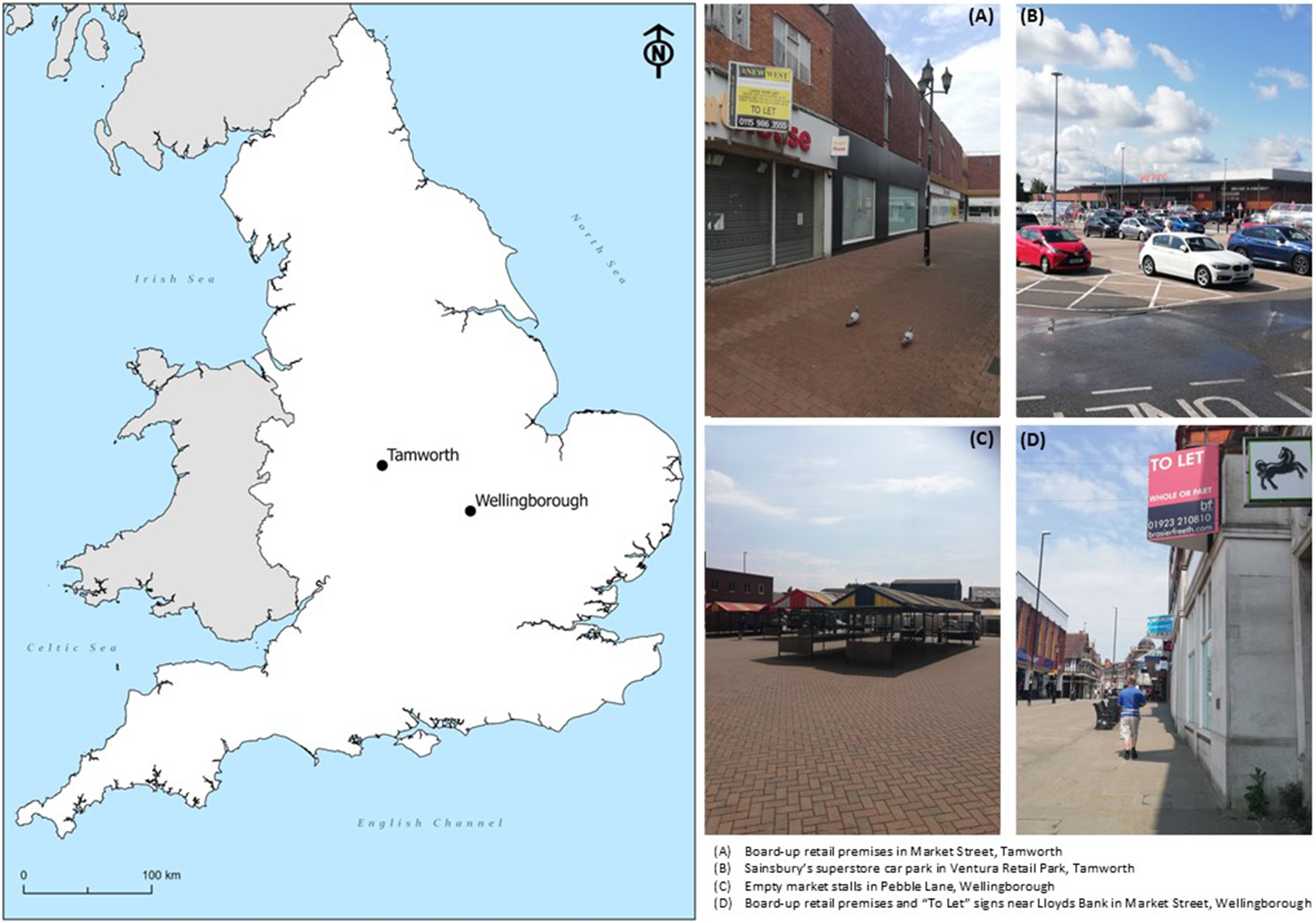
Designated medium-priority areas in the UK’s Town Deals for England, these towns are framed by central government as lacking “the right conditions to develop and sustain strong local economies” (NAO, 2020: 4). Yet they are not neutral settings into which public policies arrive. Rather, they are shaped by structural disadvantages, such as limited institutional capacity, weaker pro-growth coalitions, fragile governance, lower levels of local trust, and fewer private sector incentives, that make policy adoption and implementation more uncertain. As Fiorentino et al. (2024: 110) note, “numerous failed attempts at regeneration and economic restructuring have caused a lack of institutional trust, increasing feelings of discontent”. These are the conditions through which public policies must travel, adapt, or falter. Tamworth and Wellingborough exemplify a broader subset of left behind towns marked by what Ward and Wood (2021: 1473) describe as “the incrementalism, inertia, path dependency and stasis that can be seen to characterise much of the governance and … urban redevelopment”.
This wider context is far from new. Writing over twenty years ago, Phillips and Swaffin-Smith (2004: 557) described England’s market towns as “sleepy backwaters with little to offer”. While some experienced postwar demographic growth, their role in the spatial division of consumption soon declined under the pressures of “market forces”. This echoed earlier reports stating that around a quarter of English market towns had experienced a decline in vitality and viability (URBED, 1994). Alongside de-industrialisation and labour market restructuring since the 1970s, these “forces” contributed to growing reliance on out-of-town shopping environments, particularly for food and bulky goods (Bromley and Thomas, 1995; Dolega et al., 2026).
Tamworth and Wellingborough exemplify these broader trends (Roger Tym and Partners, 2011). By the early 2010s, Ventura retail parks in Tamworth accounted for 58% of local comparison goods spending, compared to 28% in the town centre (Tamworth Borough Council, 2016). Wellingborough similarly faced growing competition from neighbouring towns, such as Milton Keynes and Northampton, and especially after the opening of the Rushden Lakes shopping complex in 2017 (Wellingborough Borough Council, 2019). Predictably, these decentralising shifts delivered lasting blows to the vitality and viability of traditional high streets and towns.
Consequently, town centre footfall and yield values fell. Upmarket department stores, essential services and outdoor markets have closed, relocated or been reoriented toward lower-income consumers (Caffyn, 2004; Powe et al., 2009). Vacant shops, under-maintained public spaces, high vacancy rates and discount chains have positioned both town centres among the worst-performing in their regions (Roger Tym and Partners, 2011; Tamworth Borough Council, 2016; Wellingborough Borough Council, 2019). After-hours lifelessness and persistent forms of anti-social behaviour (Millie, 2008) have further deterred investment. The GFC accelerated these issues, prompting predictions of the ‘death of the high street’ (Hughes and Jackson, 2015). Independent and major retailers alike, including those in inner-city malls, have faced mounting operational costs, while public sector functions have been progressively hollowed out (Harvey, 1989; Wilson and Heil, 2022). More recently, the aftermath of COVID-19 further intensified these pressures, as rising e-commerce and reduced in-person services pushed vacancy rates even higher in many town centres (Dolega et al., 2026; Jones and Livingstone, 2018).
BID antecedents, funding, operations and board composition in Tamworth and Wellingborough.
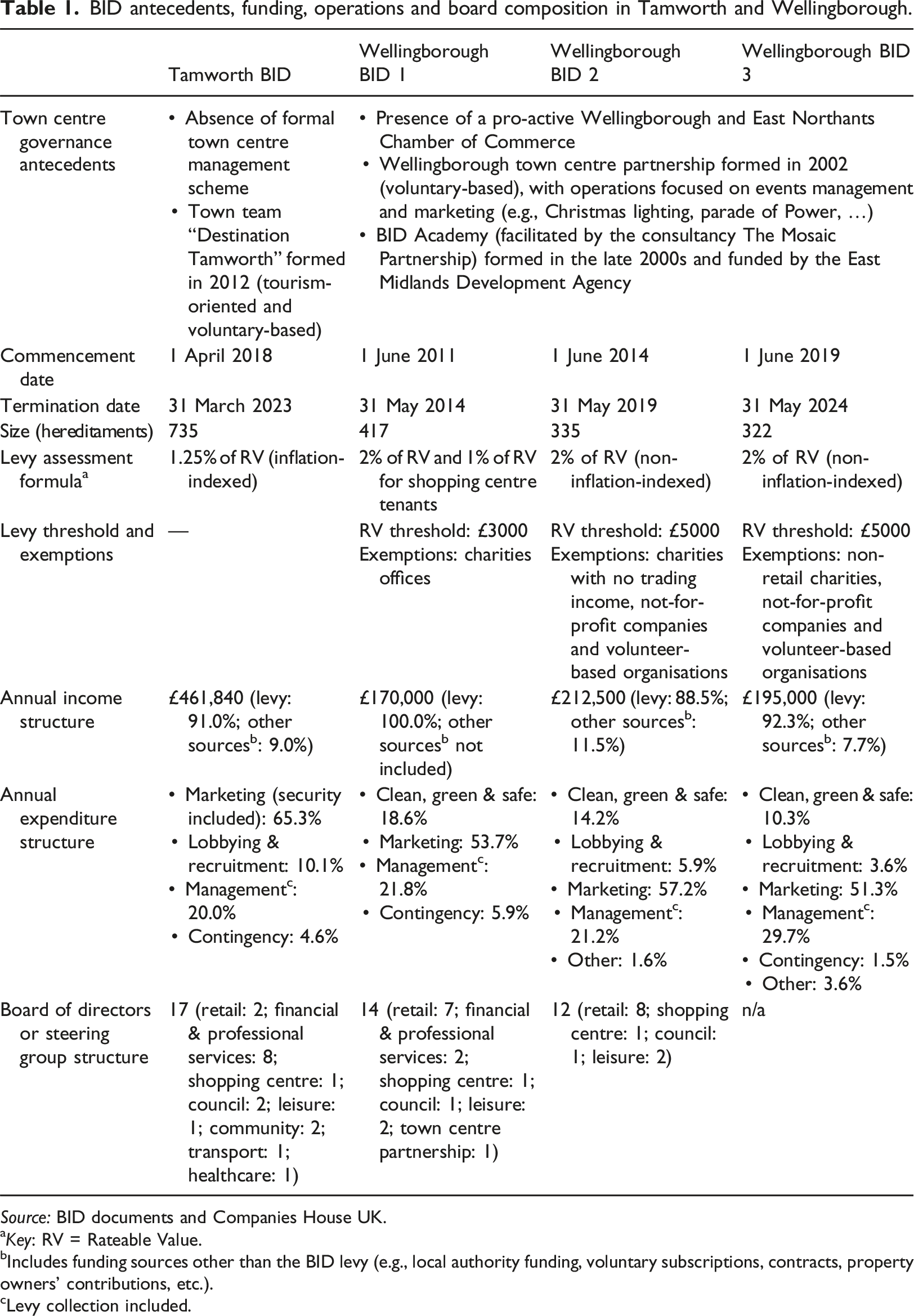
Source: BID documents and Companies House UK.
aKey: RV = Rateable Value.
bIncludes funding sources other than the BID levy (e.g., local authority funding, voluntary subscriptions, contracts, property owners’ contributions, etc.).
cLevy collection included.
The political economy of business improvement districts: Friction, failure and futures in Tamworth and Wellingborough
Where to start? Entrepreneurial public policy solutions, informational infrastructures and inter-town referencing
BID ballot results in Tamworth and Wellingborough.
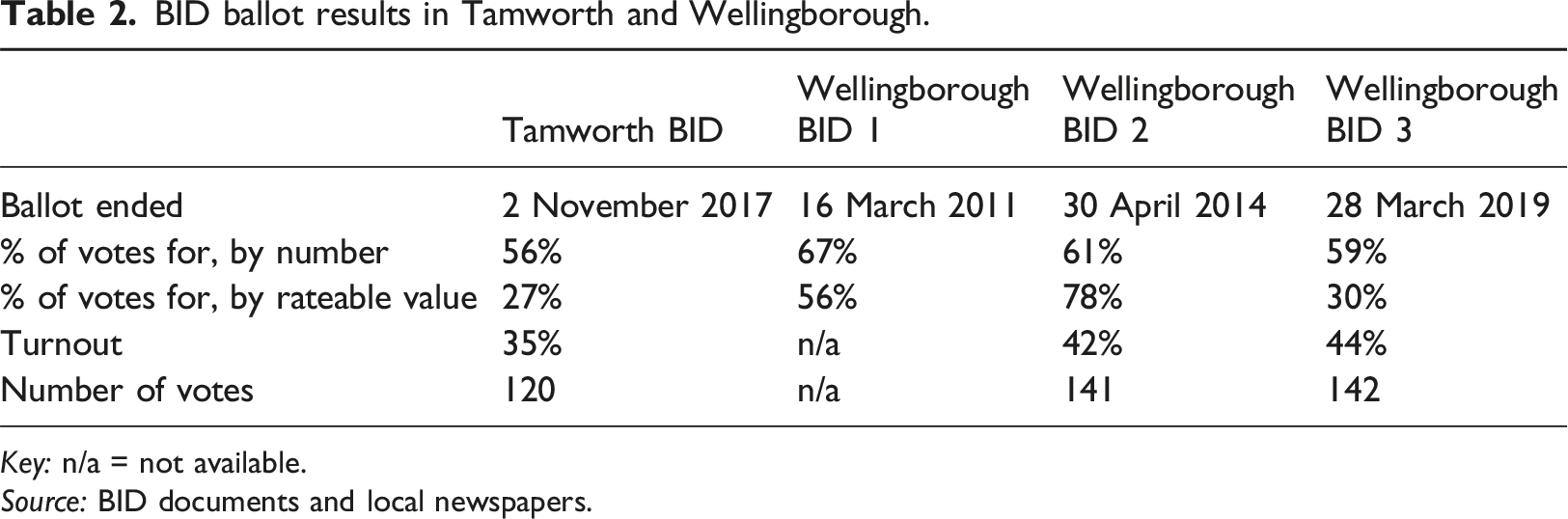
Key: n/a = not available.
Source: BID documents and local newspapers.
In the face of successive ‘global’ crises (Hinkley and Weber, 2020; Wilson and Heil, 2022), those involved in governing Tamworth and Wellingborough adopted market-oriented approaches to reposition their towns in competition with larger urban centres. This involved relational practices of comparison and referencing that shaped how they ‘arrived at’ their BID programmes (Lane, 2022; Robinson, 2015; Ward et al., 2025). The first was through the social labour of nationwide consultancies, professional networks and regulatory infrastructures assembled to “produce and disseminate knowledge, creating a shared discourse on a topic and establishing and reinforcing norms” (Rapoport and Hult, 2017: 1782). Here, in both towns, BID consultancies were hired to guide planning and make proposals ‘ballot-ready’. Wellingborough went further by joining the East Midlands Regional Development Agency-funded BID Academy, where selected towns received expert-led BID training.
The second practice operated through comparison with similar-sized towns, where BIDs emerged as ‘panaceas’” to economic downturn. While less overt in Tamworth, consultancy-organised study tours in Wellingborough brought local public and private actors into relational proximity with places where BIDs were framed as sources of pride and spectacle. These embodied experiences and accompanying materials constituted informational infrastructures through which “programmes that policy actors wish to understand and, potentially, emulate” (Baker and McGuirk, 2019: 562) were learned and mediated.
‘Arriving at’ public policies: ‘Local’ institutional infrastructures and precursors
To understand how places arrive at BIDs as ‘local’ public policies, however, we must move beyond comparative and extrospective practices, even which acknowledging their importance. This section argues that equally important are the pre-existing conditions that shape how such ideas were mediated, learned and embedded within “local politics involving locally-embedded interests and conditions” (McCann et al., 2013: 584). In Tamworth and Wellingborough, unpacking this contextual box behind the local making-up of BIDs involves conceptualising policymaking as a “historically path-dependent process that depends on both current and historical institutional factors” (Montero and Baiocchi, 2022: 1541). Revisiting earlier models of town centre governance, we argue, reveal crucial insights into the nature and scale of local coalition-building. These experiences are always important, of course, and in the case of these two towns it means public policymaking occurs in contexts marked by “thinned and stretched local governance struggles” (Fiorentino et al., 2024: 111).
Using public-private growth coalitions to boost local economies has long defined the entrepreneurial turn in town centre governance over recent decades (Harvey, 1989; McCann, 2017; Peck and Tickell, 1995). Particularly in England, this includes town centre management (TCM) schemes (Cook, 2008; Ward, 2006), described as engendering “more heterarchic governance modes characterised by collaboration and networks of stakeholders” (Hehir et al., 2023: 38). Following the mushrooming of out-of-town shopping, this principle guided the formation of a town centre partnership in Wellingborough in 2002, backed by business leaders, the Chamber of Commerce and the local authority, aiming “to maintain and improve the quality and viability of Wellingborough … for all users and bring benefits to business” (Wellingborough Town Centre Partnership, 2002: 2).
This move restructured the scale and nature of town centre governance, broadening collaboration among stakeholders whose interactions followed ‘governance-by-government’ approaches, widened stakeholder involvement and produced shared pro-growth agendas (Bjørgen et al., 2021; Healey, 1998, 2018). However, declining public funding and ad hoc private-sector contributions proved insufficient (Cook, 2008; Ward, 2006), prompting the scanning of alternative financial governance mechanisms: The [Wellingborough] TCP had no money. It had thousands of pounds, but it didn’t have tens of thousands or hundreds of thousands of pounds … other than turn the Christmas lights on. So, the TCP members had looked at BIDs and thought, “This is the logical bit to do”. (#31, BID executive director, Wellingborough)
Wellingborough is not alone in such comparative gestures. However, not all towns “have the institutional expertise to successfully instigate public-private partnerships with the potential to facilitate ‘spectacular’ developments or infrastructure improvements” (Jayne, 2006: 166). The precursors to the BID programme in Tamworth illustrate this. Here, agencies involved in town centre politics lacked formal politico-institutional infrastructures capable of convening public and private sectors around redevelopment strategies (Healey, 2018; Hehir et al., 2023). However, following the publishing of the UK Coalition Government-commissioned Portas Review, Tamworth formed an ad hoc TCM-like Town Team under the banner of Destination Tamworth – one of the few towns to act on the recommendation to get “town centres running like businesses” (Portas, 2011: 11). This bottom-up, community-led governance structure brought together tourism-oriented business owners, landlords, local authorities and residents to foster growth and “support the wide programme being delivered through Tamworth Borough Council” (Tamworth Borough Council, 2013: 25, emphasis added).
While certainly configuring a form of entrepreneurial governance through down-scaling (McCann, 2017), the former quote also reflected Tamworth’s entrenched ‘governance-by-government’ approach. Here, the prescriptive nature and scale of public-sector involvement in local politics came to the fore. As the literature suggests, this approach is both conductive of, and conducive to, lazy paternalism and business apathy, as “local government is the pre-eminent actor in local politics, with few non-statutory interactions between Council and business leaders” (Davies, 2002: 316). Put differently, the restructuring of state-market power geometries thus remained ‘thin’ and short-lived (Healey, 1998; Wang et al., 2024). These differing institutional precursors shaped how Wellingborough and Tamworth ‘arrived at’ the BID programme: It [BID] would’ve been a concept almost too far for some of them [businesses]. They all knew who the previous town centre manager was. He was solid, walked the BID [area] … I think it would have been a much, much harder job [to establish a BID] without that previous role. (#42, BID manager, Wellingborough) I think that the [Borough] Council is a partner in it, and it can bring some resources, but the businesses need to step up and take ownership. So, it [Town Centre Partnership] failed mostly because the Council was too dominant and prescriptive … Businesses weren't willing to take accountability. It was always, “What are you going to do about it?”. (#52, local authority officer and BID board member, Tamworth)
These contrasting quotes reveal how competing priorities, fragmented growth coalitions, and limited institutional capacity mediate the means through which mobile policies become fragile, contested, or unassembled in particular places (Colven, 2020; Pike et al., 2024). Some, like Wellingborough, were more formal and structured, with institutions ‘thicker’ and used to being “drawn into thinking about what it means to be a member of a political community, to have a public voice” (Healey, 2018: 66). Others were more prescriptive and ‘thinner’, marked by the absence of formal coalition-building mechanisms, low levels of trust, and a history of top-down governance in which local councils remained dominant while private and civic actors had limited political voice or capacity. In such settings, multi-scalar governance often reinforces institutional asymmetries rather than enabling local autonomy (Fiorentino et al., 2024; Müller, 2014; Phelps and Valler, 2018; Stein et al., 2017). Of course, these path-dependent institutional precursors certainly shaped how Tamworth and Wellingborough ‘arrived at’ BIDs and how they were implemented or contested. Attending to these uneven institutional geographies helps clarify why mobile policies like BIDs succeed in some places but stall or fail in others, despite formal procedural equivalence. In the next section, we examine how these uneven foundations translated into instances of contestation, friction, obduracy or resistance and ultimately policy fragility on the ground.
Friction and fragility: Contesting policy mobilities across time and place
The previous section showed how institutional legacies shaped the groundwork for BID proposals in Tamworth and Wellingborough. However, institutional thickness alone does not guarantee smooth policy uptake. Often in left behind towns, historically constituted patterns of disinvestment, fragmented governance and institutional thinness mean that mobile policies enter fragile and politically charged terrains. Here, we examine how mobile policies encounter friction and obduracy as they move from idea to implementation. Evolving local power geometries, weak growth coalitions, institutional misalignments and contested visions of place shaped, slowed and at times undermined the translation of the BID programme. In doing so, we show how such frictions are not merely obstructive but form part of the complex processes through which mobile policies are negotiated, reconfigured or resisted within specific local settings.
At the heart of Tamworth’s approach was a desire to use the BID as a lever for town centre regeneration. The Borough Council framed it as a means to enhance gateway development sites and foster interdependencies across the town centre, Ventura and railway station (Tamworth Borough Council, 2016). Yet a consultancy-based feasibility report assembled the social and political practices involved in the making-up local of the BID programme. The following illustrates what was seen as an absence of an institutional “framework which brings [town centre and Ventura] businesses together with any sense of common purpose” (pfbb UK, 2016: 16): They [Borough Council] felt there’s an interdependency between the [Ventura] retail park and the town centre to which they tried to force the square peg into a round hole. I don't think there was much interdependency. I think they thought that there’s an opportunity for the town centre to capitalise on Ventura’s visitors. (#44, BID consultant, Tamworth)
In Wellingborough, by contrast, we found considerable evidence of a shared sense of purpose among local businesses, particularly those with longstanding ties to the town. This cooperative spirit was apparently supported by the institutional legacy of the TCM scheme, which had helped foster consensus-building networks: If you are going into a town, there’s an element of caring and waiting to support the community. You know, a couple of brands here do that … However, most big brands don't these days because they have shareholders who… You know, it's hard to get a big chain into Wellingborough now. (#42, BID manager, Wellingborough)
In Tamworth, efforts to establish a BID failed due to tensions between independent businesses and national retail chains. Diverging interests, particularly over who stood to benefit, prevented a unified growth coalition from forming. As one interviewee expressed in relation to businesses located in Ventura: I think they look sinful and actually “Do you know what, I get no benefit from this, so why am I paying a levy?! I'm running a £40 million very successful business and doing well in Ventura! So, why do I want to be part of this thing called a BID that benefits a café on some street in Tamworth where I've never been?!” (#48, BID board member, Tamworth)
These quotes reflect the politics of dissonance over consensus, invoking long-standing arguments around the centrality of local dependence in the localised politics of public policymaking and their resonances in the material absence of BIDs (Cox and Mair, 1988). In Wellingborough, a small number of retail chains and strong local networks helped align business interests toward collective goals. In Tamworth, however, the presence of multi-locational chains embedded in corporate networks tied to ‘more-than-local elsewheres’ introduced frictions that ultimately stalled BID formation (Landau, 2021; Phelps and Valler, 2018). These conjunctural politics illustrate what Peck and Tickell (1995: 60) describe as the “distinction between capital in general and particular capitals” in local politics, unpacking what Jacobs (2012: 418) calls the “unpredictable and varying ways … of non-arrival and non-adoption” of policy programmes. Indeed, the material absence of a BID in Tamworth thus expresses deeper institutional misalignments and conflicting forms of local dependence.
This is not to suggest that BIDs are ‘all-or-nothing’ arrangements. Policy mobilities scholarship argues that the processes through which places (fail to) arrive at public policies are shaped by conjunctural politics and path-dependent temporalities (Baker and McCann, 2020; Wood, 2015). This challenges the assumption that presence-cum-success and absence-cum-failure are discrete categories (Colven, 2020; Temenos and Lauermann, 2020), instead foregrounding the relational spatio-temporal “contingency, contradiction, and unevenness in the processual co-production of policy outcomes” (Bok, 2020: 1220). Put differently, Tamworth’s unsuccessful ballot in one conjuncture does not foreclose future mobilisation. Rather, it highlights how structurally disadvantaged contexts such as left behind towns, where path-dependency and stasis render policy arrival, adoption, and implementation uncertain (Fiorentino et al., 2024; Ward and Wood, 2021).
The case of Wellingborough further illustrates this point. It requires approaching both institutional thickness and public policymaking as inherently indeterminate, processual and tension-filled, continuously constituted and reconstituted over time (Baker and McCann, 2020; Temenos, 2024; Wood, 2015; Zukauskaite et al., 2017). For instance, from its early stages, consultants and BID directors noted resistance from some councillors toward forming a BID within their political jurisdiction. In response, the East Midlands BID Academy organised policy tourism initiatives involving councillors and local authority officers. Of course, the selected sites were far from neutral. Delegations were taken to selectively experience places and narratives that legitimised particular policy decisions. This highlights the social and power-laden labour involved in curating “a set of pre-filtered policy options” (Baker and McGuirk, 2019: 564), the embodied experiences of ‘being there’ and their transformative afterlives back home: The Borough Council got a consultant who came and did a presentation. I don't think that we’re particularly supportive at first, partly because of double taxation … They [BID team and consultant] did an amount of work to look at setting up a BID. (#34, local authority councillor, Wellingborough) We did visits specific to things we wanted to showcase. For example, we took them to Bedford. That visit was really about the relationship with the local authority. There was a sort of excellent relationship with the local authority there. (#40, BID consultant, Wellingborough)
Eventually, this study tour produced a “sense of being ‘in tune’ with what is happening elsewhere” (González, 2010: 1412). It fostered conditions for trust-building and, more importantly, eased local authority obduracy around institutional backlash from empowering the private sector in town centre governance (Fiorentino et al., 2024; Hehir et al., 2023; Müller, 2014). These informational infrastructures ultimately contributed to the approval of Wellingborough BID for its first term, notably with the support of one of its largest levy payers: the local authority itself.
While certainly constituting a particular form of institutional thickness, we would caution against interpreting this as indicative of a stable or linear policymaking trajectory. Rather than viewing presence-cum-success and institutional thickness as fixed, we follow those who stress the indeterminate, messy and open-ended nature of ‘local’ politics. The case of Wellingborough shows how consensus can erode amid shifting interests, evolving power relations and changing institutional conditions. The fallout between BID executives and the local authority during the second term, and the BID’s failure to secure a third term, illustrates the path-dependent and contested nature of local politics and the limits of institutional thickness in changing conjunctures (Clapp et al., 2016; Lovell, 2016; Ward and Wood, 2021; Zukauskaite et al., 2017): When a small cabal used to push things their way through local government came up against the BID board, we listened and took notes but made it clear: “Don’t tell us what to do”. Maybe we should’ve been more conciliatory, but the unavoidable fact was the BID had to deliver on its voted plan … Earlier council representatives understood that – those who came later didn’t. (#32, BID executive director, Wellingborough) One councillor on the board wasn't a fan of the Medieval Festival … He thought BID funds should go to ‘hard’ things … For him, events were “fluffy” marketing and not structurally valuable. Most of the board wanted to get rid of him because of that. (#31, BID executive director, Wellingborough) [The second BID operations manager] didn't put the same effort into the BID and didn’t have the same rapport with the businesses. Also, when it came up for renewal, the marketing plan was poor … It had no innovation and no new bits. (#34, local authority councillor, Wellingborough) [The first BID operations manager] cared about the town and wanted it to thrive … But when the next one took over, they [BID] were like “Do this at this point of the year, this at this point, and this at this point”. They weren't looking at what actually suited the town or its people. (#36, independent retailer, Wellingborough)
These quotes capture the messy instances of friction and obduracy, highlighting the contestation and resistance of once present-cum-successful public policies. They foreground evolving agency within and between institutions and the power-laden mechanisms of social and political actors embedded in local politics (Colven, 2020; Landau, 2021; Phelps and Valler, 2018; Sotarauta, 2017; Wells, 2020). Interviewees described how micro-level forms of agency, shaped by distinct identities, interests and strategies, contributed to the reconstitution of ‘shared’ agendas and institutional interactions around local economic development. In this context, and echoing Müller (2014) and Wells (2020), local authorities at times acted as veto players, mobilising against mobile policies they perceived as politically threatening.
In some ways, this echoed the ‘governance-by-government’ approach found in Tamworth, where the local authority positioned the BID to advance its regeneration agenda. In Wellingborough, earlier policy tourism initiatives to Bedford, organised under the East Midlands BID Academy, appeared less transformative over time. The same anxieties over the form and functions of private sector involvement in local politics resurfaced, suggesting these tours may have only temporarily offered “reassurance, comfort and legitimacy for the kind of urban policies that policy-makers and politicians already employ or are likely to implement” (González, 2010: 1411). From the local authority’s perspective, less conciliatory BID executives, “not prepared to play their tune” (#42, BID manager, Wellingborough), took over, at which point the BID came to be perceived, and to perceive itself, as a rival power centre. These instances of friction and obduracy also surfaced in local media, especially around BID-organised events, including the relocation of the continental market under a revised local authority policy (Northamptonshire Telegraph, 14 March 2017) and the organisation of the beach event (Northamptonshire Telegraph, 21 March 2019).
Taken together, these empirical cases illustrate how policy failure, stalled implementation and non-adoption are mediated by the conjunctural ‘local’ politics of left behind places. Weaker institutional scaffolding, lower business trust and contested political relations form the terrain upon which mobile public policies are assembled or come undone.
Conclusion
In conclusion, we return to the paper’s central argument and make three wider points. First, the paper argues for a continued appreciation of the indeterminate, messy and open-ended nature of the territorial politics through which public policies ‘arrived at’ places. While such policies circulate widely through global-urban policymaking circuits, they do not necessarily become localised in the ‘multiple elsewheres’ they enter. Although the “current urban [policymaking] condition is one of which comparisons are omnipresent” (Ward et al., 2025: 16), this paper emphasises the contextual, conjunctural and situated interests and conditions shaping ‘local’ public policymaking (Lane, 2022; Temenos, 2024; Temenos and McCann, 2012; Ward and Wood, 2021). This requires understanding how the ‘multiple elsewheres’ and the ‘here’ – the ‘global-urban dialectic’ (McCann and Ward, 2010) – mutually constitute the ways particular places ultimately arrive at mobile public policies (Lane, 2022; Prince, 2017; Robinson, 2015). As the cases of Tamworth and Wellingborough – representatives of a wider sub-set of left behind places – demonstrate, it remains essential to explain, rather than assume, the processual, power-laden and situated nature of public policymaking in an age of mobile policies. Their experiences reveal “difference in repetition” (Jacobs, 2012: 419) and caution against viewing the making-up ‘local’ of policies as smooth, linear or guaranteed based on their represented presence-cum-success elsewhere.
Second, theorising policy mobilities – and its connective global-urban dialectic – would benefit from greater analytic, intellectual and methodological attention to the meso: the mid-level and mid-range theorising. This paper contributes to topological debates suggesting that the “mid-level position is often purported to potentially resolve not just a spatial tension between global and local, but the problem of explanation too” (McFarlane, 2025: 100; see also Montero and Baiocchi, 2022; Davidson and Ward, 2024). In particular, it revisits Amin and Thrift’s (1994) mid-level concept of ‘institutional thickness’ – and its relational counterpoint, ‘institutional thinness’ – to highlight the genetic-cum-explanatory value of such concepts for unpacking the messy politics of local-urban policymaking. Through this manoeuvre, the paper illuminates the unpredictable, power-laden social and institutional relations shaping the movement and making-up ‘local’ of public policies across different temporalities (Bok, 2020; Colven, 2020; Lauermann and Vogelpohl, 2019; Sotarauta, 2017). In Tamworth, the absence of formal institutional arrangements reflected a ‘governance-by-government’ approach (Hehir et al., 2023) and echoed long-standing arguments about local dependence (Cox and Mair, 1988), ultimately producing instances of institutional thinness. Wellingborough, by contrast, initially exhibited a contingent and temporary configuration of institutional thickness, supported by a town centre partnership and cohesive networks among locally dependent actors. In that conjuncture, these relations stabilised the initial mobilisation of the BID thought. However, as the later analysis showed, this configuration proved fragile and reversible. As the composition of actors shifted, institutional relations fractured, ultimately contributing to the BID’s failure to secure renewal. We argue that the evolving presence or absence of institutional thickness is a valuable mid-level concept for understanding how mobile policies are politically assembled, contested, reworked and, in some cases, undone in different places. These contrasting configurations did not determine outcomes but shaped the initial political conditions under which the BID programme was mediated and translated.
Third, combining these arguments and contributing to a future research agenda, this paper finds that the politics of territorial public policymaking are constructed within self-evolving, historical and relational trajectories (Baker and McCann, 2020; Wood, 2015). Building on this approach, the evidence presented here offers a couple of possible directions for policy mobilities scholarship. On the one hand, presence-cum-success and absence-cum-failure should not be approached as self-evident outcomes, but as relationally constituted across multiple conjunctures (Bok, 2020; Colven, 2020; Temenos, 2024). This is especially important at a time when fragility, friction and obduracy appear to characterise much of the contemporary public policymaking. The case of Wellingborough demonstrates how the presence of a policy at one point can set the conditions for its later absence. On the other hand, this paper ends not with policy endpoints but with the possibility of re-beginnings. While Tamworth and Wellingborough currently lack a BID, neither case suggests finality. Those we spoke to in both towns indicated that new conjunctures could yet generate renewed interest in the programme. In Tamworth: “If I could rewind the clock and do it differently, I would focus purely on ‘core town centre’ to get a BID established” (#48, BID board member, Tamworth). In Wellingborough: “We have to be prepared for maybe some things won’t work and, if they don’t work, how we rectify them to make it work” (#36, independent retailer, Wellingborough). These quotes frame failure not as closure, but as a generative moment, the implications of which may not reveal themselves immediately. Friction, then, may not end policy mobility, but lay the ground for its reinvention. This indeterminacy and openness underscore the continued importance of attending to the relational and territorial politics of public policymaking.
Footnotes
Acknowledgements
We would like to thank all those with whom we spoke during this research project. Our thanks also go to the participants of the 2024 Regional Studies Annual Conference session “Contemporary Issues in Place Management and Leadership III: Governance, Insights and Futures”. Special thanks to Jean-Paul Addie for his comments on an earlier draft of this paper. The usual disclaimers apply.
Ethical considerations
All participants provided written informed consent prior to enrolment in the study.
Funding
The authors disclosed receipt of the following financial support for the research, authorship, and/or publication of this article: this research was funded in whole or in part by the Fundação para a Ciência e a Tecnologia, I.P. (FCT, https://ror.org/00snfqn5816) under Grant 2020.06080.BD (https://doi.org/10.54499/2020.06080.BD) and UID/00295/2025 ( ).
).
Declaration of conflicting interests
The authors declared no potential conflicts of interest with respect to the research, authorship, and/or publication of this article.
Data Availability Statement
The data that support the findings of this study are available from the corresponding author upon reasonable request.