



Abstract
In today's developed world, the ability of a city to generate good experiences for its residents and visitors is a main aspect of its attractiveness. A good city is considered to be one in which people feel secure, relaxed, and happy. This article explores the factors that influence the subjective momentary experiences of individuals in the city, while focusing on the impact of spatial variables on these experiences; 91 students living in Jerusalem, Israel, were asked to repeatedly self-report four dimensions of episodic experience, namely, sense of security, happiness, annoyance, and sense of comfort. Reports were sent in real time using a smartphone application during an eight-month period. The results, based on over 5000 experience samples, indicate that subjective momentary experiences, particularly sense of comfort and sense of security, are highly influenced by situational variables and environmental characteristics including type of activity and environment, place characteristics, and company. Surprisingly, personality variables which are considered to be a main determinant of wellbeing and general life satisfaction were found to be non-significant in the multilevel models that were implemented. This finding further supports the notion that momentary experiences greatly differ from general evaluations of subjective wellbeing.
Keywords
Introduction
The emergence of post-materialist values, that emphasize self-expression, in late modern societies has increased the engagement of both the public and professionals with questions of subjectivity (Inglehart, 1990). These cultural changes also had an impact on the theorization of place and environment. Early humanistic geographers, for example, started to develop subjective, human-centered approaches toward places since the 1960s. This includes the introduction of concepts and research areas such as sense-of-place, place attachment, and placelessness (Relph, 1976; Tuan, 1975, 1977). More recently, urbanists began to point out that due to improved economic conditions in western societies, individuals’ assessments of the attractiveness of cities have become more reliant on subjective criteria (Glaeser et al., 2001; Morrison, 2011). The basic argument is that while in modern times a city was considered attractive if it managed to achieve a series of objective benchmarks that support wellbeing, such as advanced infrastructures, accessibility to amenities, and employment options, today a good city is one that can also support more subjective aspects of individuals’ wellbeing. It is a “happy city” that supplies opportunities to enjoy life and achieve self-actualization (Ballas, 2013; Florida and Mellander, 2010; Glaeser et al., 2014). It is a place where people feel secure and where positive experiences are generated (Ballas, 2013; Florida, 2002; Glaeser et al., 2001). Therefore, in their pursuit to create more attractive and livable cities, current stakeholders and urban planners now seek to create places that not only improve the objective living conditions, but also promote subjective wellbeing of city dwellers.
Subjective wellbeing is a well-established concept that encompasses both cognitive and affective dimensions (Diener et al., 1999; Eid and Diener, 2004). While typically employed to depict a general, static perception of individuals toward their life, more dynamic approaches that examine the day-to-day variation in subjective wellbeing are implemented as well, and especially in recent years. This is done using repeat measurements of subjective perceptions of wellbeing along the day (Ettema and Smajic, 2015; Huta and Ryan, 2009; MacKerron and Mourato, 2013; Schwanen and Wang, 2014). The current study is part of recent efforts that have been taking place to better understand the dynamic nature of subjective experiences and the environmental factors that influence them (Birenboim, 2016; Birenboim et al., 2015; Kim and Fesenmaier, 2014; MacKerron and Mourato, 2013; Quinlan Cutler et al., 2014). More particularly, the research focuses on subjective momentary experiences, which similarly to mood, are considered to display substantial variation within-person over time (Eid and Diener, 2004). The aim of the study is to improve our understanding as to the factors that influence our daily experiences in cities. To do so, the article dynamically explores the determinants of subjective wellbeing in cities.
In contrast to general wellbeing, that is strongly associated to personality traits (Diener and Lucas, 1999; Diener et al., 1999), it is assumed that in the case of momentary experiences, the influence of situational variables, including environmental and place characteristics, will also be substantial (Csikszentmihalyi and Hunter, 2003; Eid and Diener, 2004). The current study took a quantitative approach to the measurement of episodic experiences while implementing a repeat measurement technique, known as Experience Sampling Method (ESM), in which participants self-reported about their affective state in real time through a dedicated smartphone application.
The following theoretical sections discuss the approaches that are used to explore subjective momentary experiences and the factors that are hypothesized to have an impact on these experiences. The suggested factors are then examined in the empirical part of the article that was carried out in Jerusalem, Israel. The research examines four dimensions of experience: happiness, sense of security, sense of comfort, and annoyance. The article concludes with a discussion about the potential of the approach, its limitations and suggestions for future research.
Defining and measuring subjective momentary experiences
The concept of experience and even more so momentary experience is not commonly used in the literature and therefore it lacks a clear definition (Birenboim, 2016). This study adopts a generic definition of experience that is based on the one suggested by Chhetri, Arrowsmith, and Jackson: “experience covers a wide range of subjective meanings such as moods, emotions and feelings of individuals” (2004: 31). The definition of Chhetri, Arrowsmith, and Jackson implies that experiences are multidimensional in their nature covering a range of affective aspects. While most scholars are likely to agree with this assertion, we still find disagreements as to the nature of the relations between the dimensions that construct our experiences (Kim and Fesenmaier, 2014). One approach considers different emotional states and experiences to be interrelated to one another and to be constructed of few core affects or dimensions. This approach leads to a holistic perspective that is suitable for the measurement of affective perception in all situations. One of the most common models that are utilized to measure this holistic affective experience is Russell's Core Affect (Russell, 1980). This model makes use of two dimensions; a hedonic dimension (i.e. sad–happy) and activation dimension (i.e. passive–active) in order to identify the emotional state of people. High score on the hedonic scale in combination with low score on the activation scale, for example, will be categorized as a serenity or tranquility experience. Nevertheless, it is only recently that researchers started to adopt this instrument in daily experience studies (Pollak et al., 2011; Schwanen and Wang, 2014).
The second approach emphasizes the singularity of each dimension of experience. According to this perspective, there are several different types or dimensions of experience which are not related to one another. Hence, the type of experience that we measure should be dependent on the topic and goals of the research. Researchers who choose to implement this approach might be concerned about overlooking unique experiences or they might want to focus on specific emotional states (e.g. fear, satisfaction). We can find several examples of studies that chose to focus on unique momentary experiences. Csikszentmihalyi and Hunter (2003) repeatedly measured happiness levels among adolescence. Hull and Stewart (1995) measured several different aspects of experience including the satisfaction level of people while they were gazing at different views. Chhetri et al. (2004) analyzed the subjective experiences of hikers in the Grampians National Park to find that the subjective aspects most relevant during nature walking activity are the dimension of desirable, impelling, apprehensive, and social interaction.
In the current study, the second approach that asserts that experiences are constructed of independent set of affective states was adopted. This approach was preferred since it allows the exploration of unique dimensions of experiences that are commonly not represented in holistic approaches (e.g. sense of security). The dimensions of experience that were implemented in the study were chosen based on their prevalence in the literature and/or due to their expected relation to urban environments. In order to reduce burden from participants, the number of dimensions that were studied was restricted to four: sense of security, comfort, happiness, and annoyance.
Sense of security has become a notable research topic in recent years and especially in the context of urban environments (Brands et al., 2013). The relationship between the physical and social environment and residents' sense of security is evident in several past works including in the well-known broken window thesis (Wilson and Kelling, 1982) and the crime prevention through environmental design paradigm (e.g. Cozens et al., 2005).
Researchers also acknowledged the association between urban environments and psychological or subjective sense of comfort (Sarkar, 2003). Many of these researchers focused on the effect of urban stressors and climate conditions on this dimension of experience (Schnell et al., 2012; Stathopoulos et al., 2004). Therefore, urban environments are expected to have a significant impact on subjective experiences.
Happiness is one of the most common indicators for assessing quality of life and subjective wellbeing. In recent years, we are witnessing a growing interest in the research of life quality in urban environments and the development of new research areas such as “happy cities” (Ballas, 2013; Glaeser et al., 2014). However, studies in the field are by and large limited to general rather than momentary reports about happiness.
The last dimension of experience that was measured is annoyance. In this study, it is considered as a psychological state in which an individual is perturbed and to some extent even stressed. Quite a few studies have indicated that urban environments have a high annoyance potential (Lindvall and Radford, 1973; Ulrich et al., 1991). Many of these studies focused on the effect of urban stressors and especially noise (Paunović et al., 2009).
The study of subjective experiences is receiving more attention in recent years, and in particular, we find more studies that take place outside the lab where researchers are utilizing ecological sampling techniques (Birenboim et al., 2015; Ettema and Smajic, 2015; MacKerron and Mourato, 2013). The advancement of mobile location and communication technologies improves our ability to conduct such real time, ecological studies (Birenboim and Shoval, 2016; Lane et al., 2010). Nevertheless, there is a lack of an established theoretical foundation that supports the exploration of momentary experiences. In this regard, it is important to understand, what are the most salient determinants of episodic experiences.
Factors that influence momentary experiences
Our knowledge about general assessments of subjective wellbeing, life satisfaction and happiness is well-established and relies on half a century of continuous research (Diener et al., 1999). The case with momentary wellbeing, which is considered more affective in nature (Almeida et al., 2009), and to an even greater degree with momentary experiences is somewhat different. While the literature on emotions and affective psychological state is vast, studies are usually restricted to single measurements of participants' emotional state under lab conditions, leaving us with a relatively limited understanding about the day-to-day affective experiences. The factors that are hypothesized to influence momentary experiences in this section are based on our knowledge on general subjective wellbeing, lab studies about affective perception, and a few other factors that are yet to be grounded in theory.
Personality and socio-demographic factors
Personality traits such as extraversion and neuroticism are considered to be one of the most substantial predictors of subjective wellbeing and happiness. In fact, happiness is occasionally referred to as a personal quality or a trait. (Diener and Lucas, 1999; Diener et al., 1999). Therefore, we also expect to find that personal traits have a notable impact on momentary experiences. People who have a predisposition to feel happy will be happier regardless of the situation. This might also be the case with other dimension of subjective experiences. For example, people who generally feel secure will tend to report a higher level of sense of security on average. Nevertheless, the impact of personality traits on momentary experiences is expected to be much more moderate than in the case of general wellbeing (Eid and Diener, 2004).
Psychologists attribute relatively little significance to the effect of socio-demographic characteristics on individuals' subjective wellbeing (Diener et al., 1999) Variables that are positively correlated with wellbeing include: income, religion, marriage, education, health, and employment. Gender differences and age on the other hand do not seem to have a consistent effect on subjective wellbeing and happiness. Hence, it is assumed that socio-demographic variables will only have a moderate impact in the case of momentary experiences.
Situational factors
Csikszentmihalyi and Hunter (2003) used ESM to identify factors that affect everyday life happiness of youth. They found that happiness is affected by temporal determinants such as the day of the week and hour of the day as well as by the type of activity that is taking place and the company one is with. These findings led to the conclusion that happiness is dependent on situational variables or, as Csikszentmihalyi and Hunter refer to them, “state-like factors” and not only on personality and socio-demographic characteristics. Similarly, Eid and Diener (2004) showed that mood strongly correlates with situational variables or as they refer them as occasion specificity.
Environmental factors were also found to have an influence on affective as well as cognitive perception of people. The most notable and well-known example that supports this claim is found in studies that explored the positive influences of natural environments on individuals (see for example Ulrich et al., 1991). A recent study that implemented repeat measurements of happiness in real time (ESM study) found that momentary happiness of people is indeed greater in natural environments (MacKerron and Mourato, 2013).
It is not only the physical environment that affects our momentary experiences. Schwanen and Wang (2014) indicate that the social context, as reflected by socio-demographic variables, is at least as important as the physical one. Similarly to Csikszentmihalyi and Hunter (2003), they show that activities that are performed with other people and especially with acquaintances improve momentary happiness and activation.
Based on the literature that is cited above, it is hypothesized that people will report more positive experiences when on holiday and during weekends, when spending time with friends and acquaintances, in more affluent neighborhoods and in what they consider to be pleasant and aesthetic environments.
Daily mood effect
While, as mentioned above, there is a strong evidence that mood and affect have a distinct within-day variation (Clark et al., 1989; Csikszentmihalyi and Hunter, 2003; Kahneman et al., 2004), researchers have overlooked the impact of between-day variation on subjective experiences. People often indicate that they are having a good or a bad day, a more stressful or relaxing day (Sheldon et al., 1996). Our assumption is that the same person will evaluate the same experience differently, depending on his general daily mood. For example, people who are having a stressful day will tend to evaluate their momentary experiences more negatively.
Previous knowledge about a place
Our knowledge about a place has the potential of influencing our experiences in it. Walking through a neighborhood which is known for its bad reputation is likely to make people more anxious, and so does visiting an urban park in which we were bothered in the past by disorderly people. Hull and Stewart briefly consider the effect of past knowledge on the experience of repeat visitors to the White River National Forest in Colorado arguing that it may influence their affective perception (Hull and Stewart, 1995).
In conclusion, we find several potential variables that are hypothesized to influence our subjective momentary experiences. Personal traits are thought to have a significant influence on general subjective wellbeing. Hence, it is expected that they will also have a notable impact on momentary experiences. It is also assumed that experiences are less dependent on people's life condition, and hence that socio-demographic characteristics will only have a minor impact on the evaluation of episodic occurrences. In contrast, situational variables that only have a minor impact on general wellbeing are expected to have a more significant influence in the case of momentary experiences. Finally, there are other factors such as previous knowledge and daily effect that should be considered when explaining episodic experiences.
Method
The research took the form of a longitudinal study. Participants were asked to repeatedly self-report about their experiences in real time during their day-to-day activity. This sampling technique is known as the ESM or ecological momentary assessment (EMA) and it is acknowledged for its high ecological validity (Csikszentmihalyi and Larson, 1987). ESM studies give us the opportunity to examine real-life situation for a long period of time and thus enrich our perspective about human experiences beyond the more common lab-style experiments and questionnaires. Nevertheless, ecological sampling approaches suffer from low internal validity especially when compared to experimental methods (Bell et al., 2001).
Study area
The study took place in Jerusalem, the largest city in Israel with more than 800,000 inhabitants. Jerusalem comprised several different ethno-cultural groups. The majority of population (about 65%) is Jewish and it lives in the western part of the city. The Jewish population is commonly further divided into several sub-groups based on religious standpoints, and it includes several large ultra-orthodox communities that live in highly segregated neighborhoods. The Palestinian Arab minority group comprises 35% of the total population and it is concentrated in the eastern parts of the city. The city is at the heart of a religious, ethnic, and national conflict. Jerusalem is a multi-religious city, highly sacred for Judaism, Christianity and Islam and therefore makes a well-known spiritual and tourism destination (Shachar and Shoval, 1999). It serves as Israel's capital city, hosting the major political institutes and administration. Throughout the 2000s, Jerusalem witnessed a large number of terror incidents that included suicide bombs and shooting attacks. These incidents are assumed to have altered the perception of sense of security in the city during that period.
Procedure and data
The data collection procedure included two main parts. In the first one, participants were asked to self-complete a set of four online questionnaires that were sent to them on the day of recruitment. The questionnaires included:
A socio-demographic and personal details questionnaire. A spatial acquaintance questionnaire – In this questionnaire, participants were introduced with a map of Jerusalem that was divided into 26 zones based on the city neighborhoods. The number of zones was limited to 26 in an attempt to avoid a long questionnaire. Neighborhoods were grouped into zones based on their socio-demographic similarity and spatial proximity. For each of the zones, participants were asked to rate their expected sense of comfort and their familiarity level with the area on a one-to-five Likert scale. The trait part of Spielberger's state-trait anxiety inventory (STAI). A commonly used questionnaire that assesses the trait anxiety of individuals (Spielberger, 1983). A Hebrew version of the EPQR-A questionnaire (Katz and Francis, 2000) – a revised and abbreviated version of the Eysenck Personality questionnaire (Francis et al., 1992). This questionnaire assesses three personal traits: extraversion, neuroticism, psychoticism, and an additional lie scale. The first two traits are known to be correlated with general subjective wellbeing measurements (Diener et al., 1999).
In the second part, participants were asked to self-report about their subjective experiences through a dedicated smartphone application. Participants received up to four surveys a day in random times and/or in specific locations in the city based on the phone location. In the surveys, that included eight closed questions, they were asked to rate their current sense of security, comfort level, happiness, and annoyance level using one item for each of the dimensions (i.e. how secure/comfortable/happy/annoyed do you feel right now?). The rest of the survey consisted of multiple-choice questions about the characteristics of the situation, including items about the type of place, type of activity they were engaged in and their immediate social company (e.g. alone, with acquaintances). In the last item, participants were requested to define the characteristics of their immediate environment. This item included 10 adjectives that can be used to describe places, five of them were negative: unattractive, busy, disturbing, dirty, and repulsive. And the other five were positive: clean, comfortable, aesthetic, pleasant, and pretty. An index (PosNeg index) that subtracts the number of negative adjectives from the positive ones was used in the final models. Additional situational variables were calculated based on the time in which the survey was completed. These include, a binary variable of weekday–weekend, the time of day (the following four categories were used: daytime, evening, early-night, and late-night), three categories of ambient temperature – cold (≤7℃), hot (≥30℃), and moderate (>7℃ and <30℃), three categories of cloud cover – very heavy cloud cover (7/8 or more of the sky is covered with clouds), heavy cover (more than 5/8 and less than 7/8), and light to no cloud cover (<5/8). The neighborhood (one of the 26 zones that were defined in this study) in which the participant was located when completing the survey was extracted based on the GPS coordinates that were assigned to the survey.
An additional survey, the six-item short form of the Spielberger state anxiety scale (Marteau and Bekker, 1992) was sent to the participants toward the end of the day through the mobile application. This inventory includes items about stress level and relaxation. Due to the lack of an adequate short instrument that assesses daily mood, the Spielberger scale was used as a proxy for that purpose.
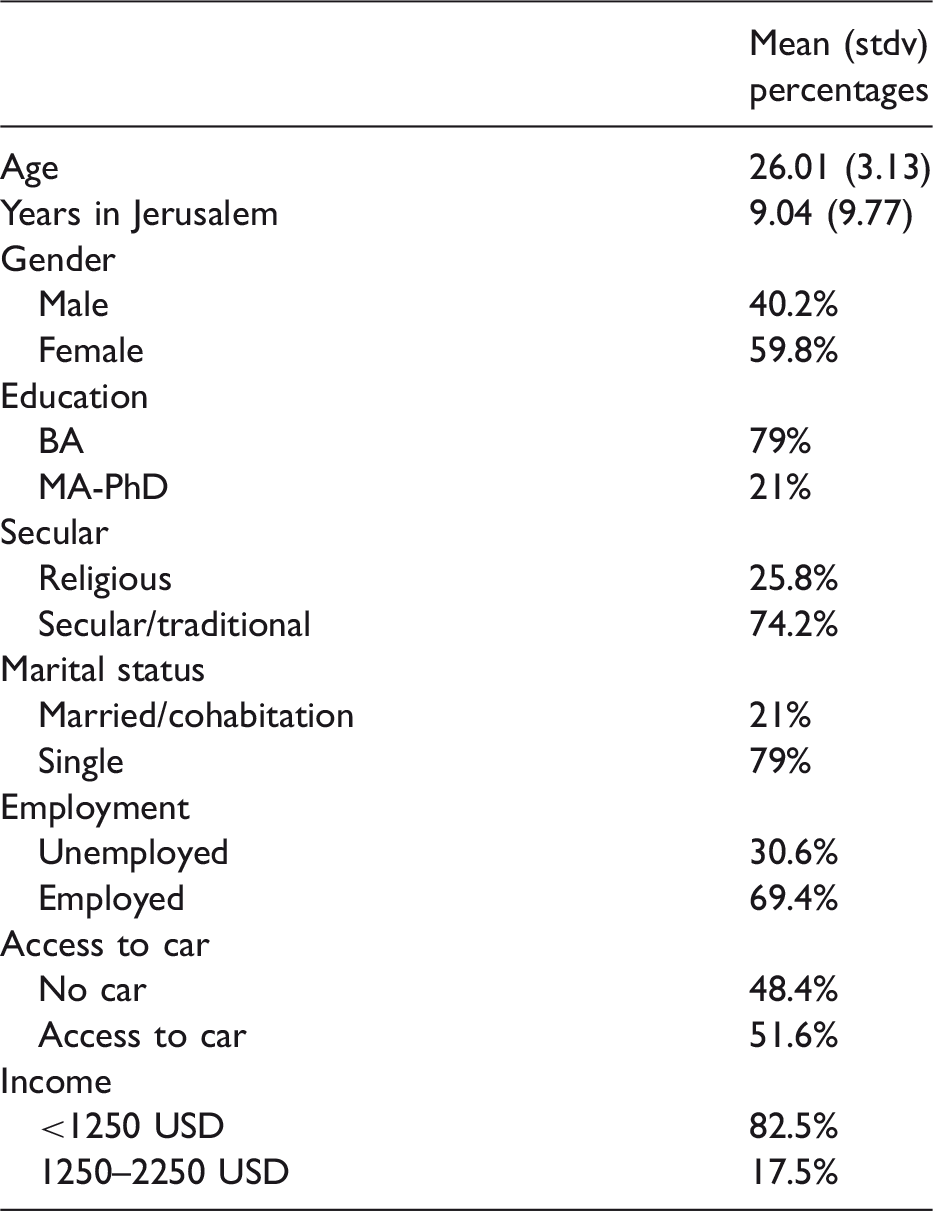
Participants
Socio-demographic characteristics of the participants.
Results
The data were analyzed using multilevel models, also known as mixed models. This statistical procedure is often implemented in ESM and other longitudinal studies that include repeat measurements of participants, since it accounts for the interrelationships of observations within subject (Shiffman et al., 2008). The analysis was conducted using JMP software. It should be noted that due to the unique coding of categorical effects in JMP, coefficients of nominal variables should be interpreted as the differences in the predicted response for that level from the average predicted response over all levels of the effect.
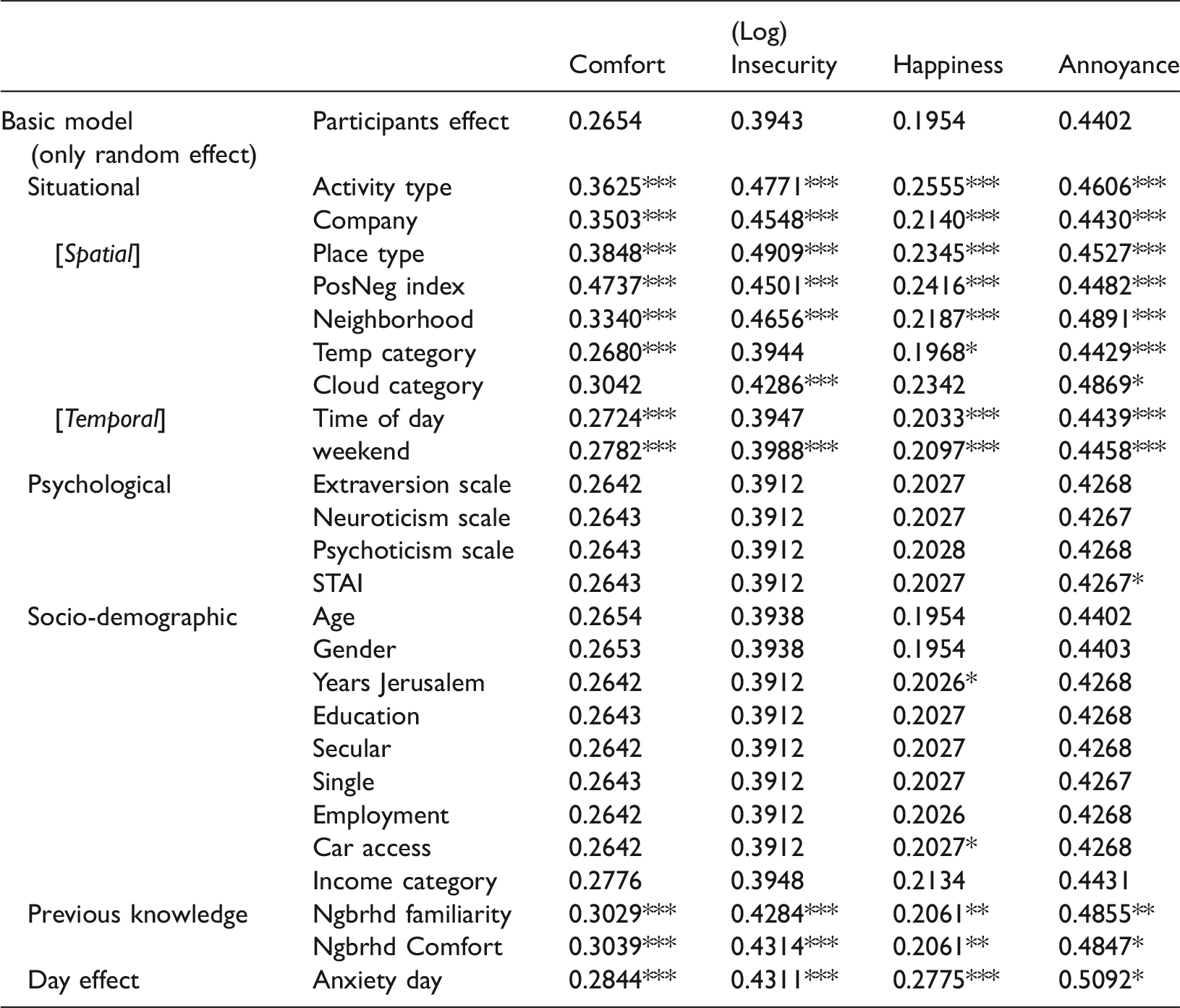
The contribution of each fixed effect to the coefficient of determination (R-squared adjusted) of each dimension of experience.
P < 0.05, **P < 0.01, ***P < 0.001.
Note: The numbers represent the adjusted R square values and the asterisk represents the significance level of each effect as determined by an F-test.
The effects in Table 2 are grouped by their type – the first nine variables include situational factors that are further divided into subgroups of spatial and temporal factors. The subsequent four variables are psychological in their nature and so on. The results indicate that psychological and socio-demographic factors, including gender, are not significant when it comes to explaining momentary experiences. All four dimensions of experience that were measured in the study were not affected by these types of variables. The temporal effects, part of day and weekend, showed a minor contribution compared to the basic model that only include the random effect of the participants. Both the previous knowledge of students about the neighborhood in which they were located and the daily anxiety level were found to have a significant influence on all four dimensions of experience. In the case of daily anxiety level, the impact on happiness and annoyance seems to be greater than on sense of comfort and safety.
The most prominent variables, however, were the situational factors and the sub-group of spatial factors which had the strongest influence on the coefficient of determination. Place type, neighborhood, activity type, and company had all demonstrated a good potential in explaining momentary experiences. The most surprising finding is that the characteristics of places as reflected in the PosNeg index seem to be one of the most substantial factors that are related to individuals' subjective momentary experiences. It is important to note that weather factors (temperature and cloud cover) had a very minor gross contribution, though in most cases statistically significant, on participants' experiences. This, however, might be related to the fact that during the field work, the weather was by and large comfortable. About 80% of the reports were received on clear days with moderate temperatures. It is expected that more extreme weather conditions will result in a more notable impact on momentary experiences.
Another important observation is that the dimensions of happiness and annoyance were less influenced by the situational variables compared to sense of comfort and security. This finding might be explained intuitively if we consider the nature of the experiences that were measured. Sense of security and comfort can change dramatically when moving from one place to another, e.g. when entering from a dark street to a familiar house. On the other hand, it might be the case that happiness and annoyance are less sensitive to the spatial setting and therefore more stable over time. One can be troubled for long periods of time regardless of his current situation.
Mixed model – Insecurity level (y = log(insecurity)).
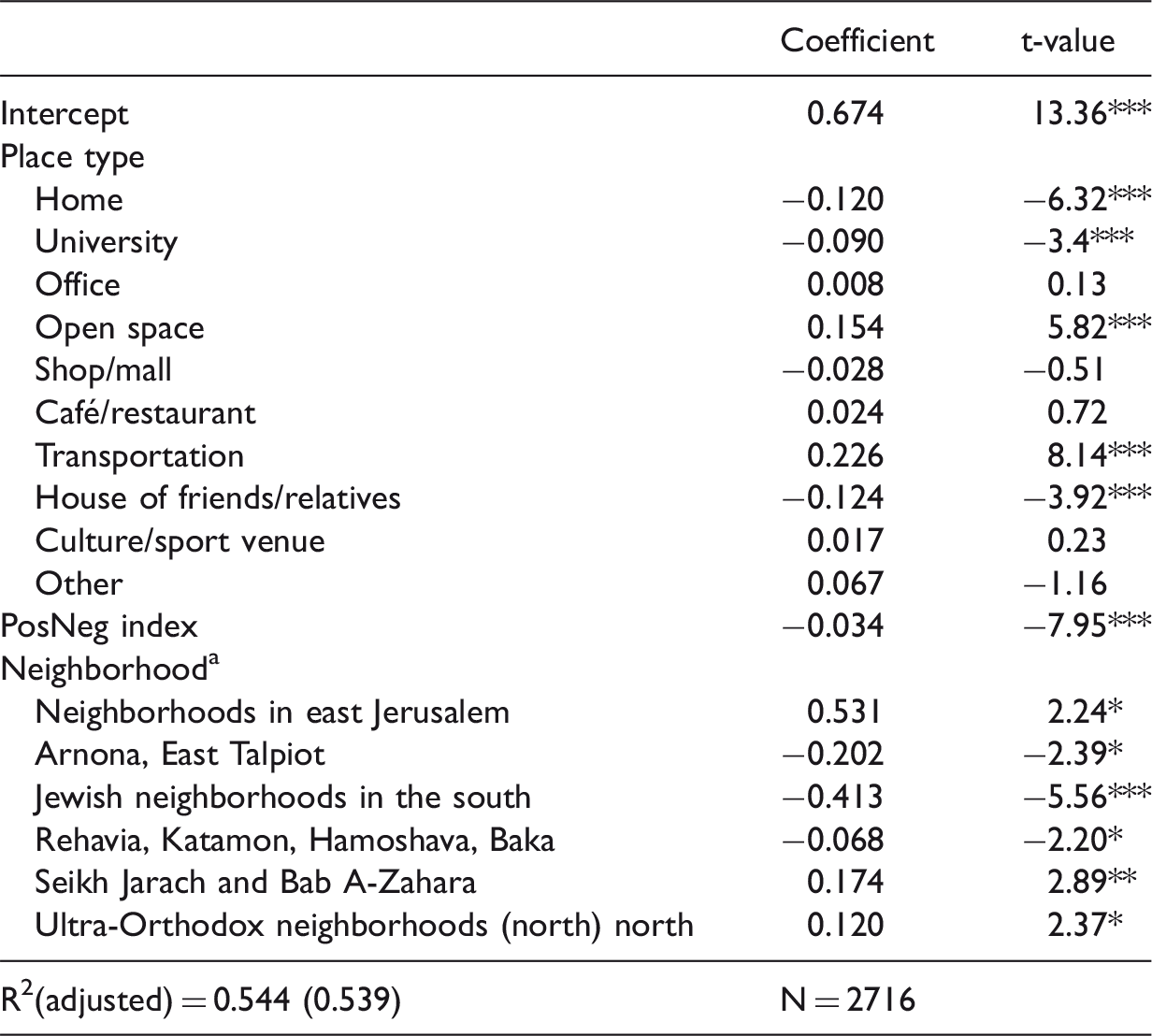
Note: Participants are a random effect in the model. Average insecurity level = 1.89, stdv = 1.15.
This effect includes 26 categories (neighborhoods). Only neighborhoods that were found significant are presented here.
P < 0.05, **P < 0.01, ***P < 0.001.
Mixed model – Sense of comfort.
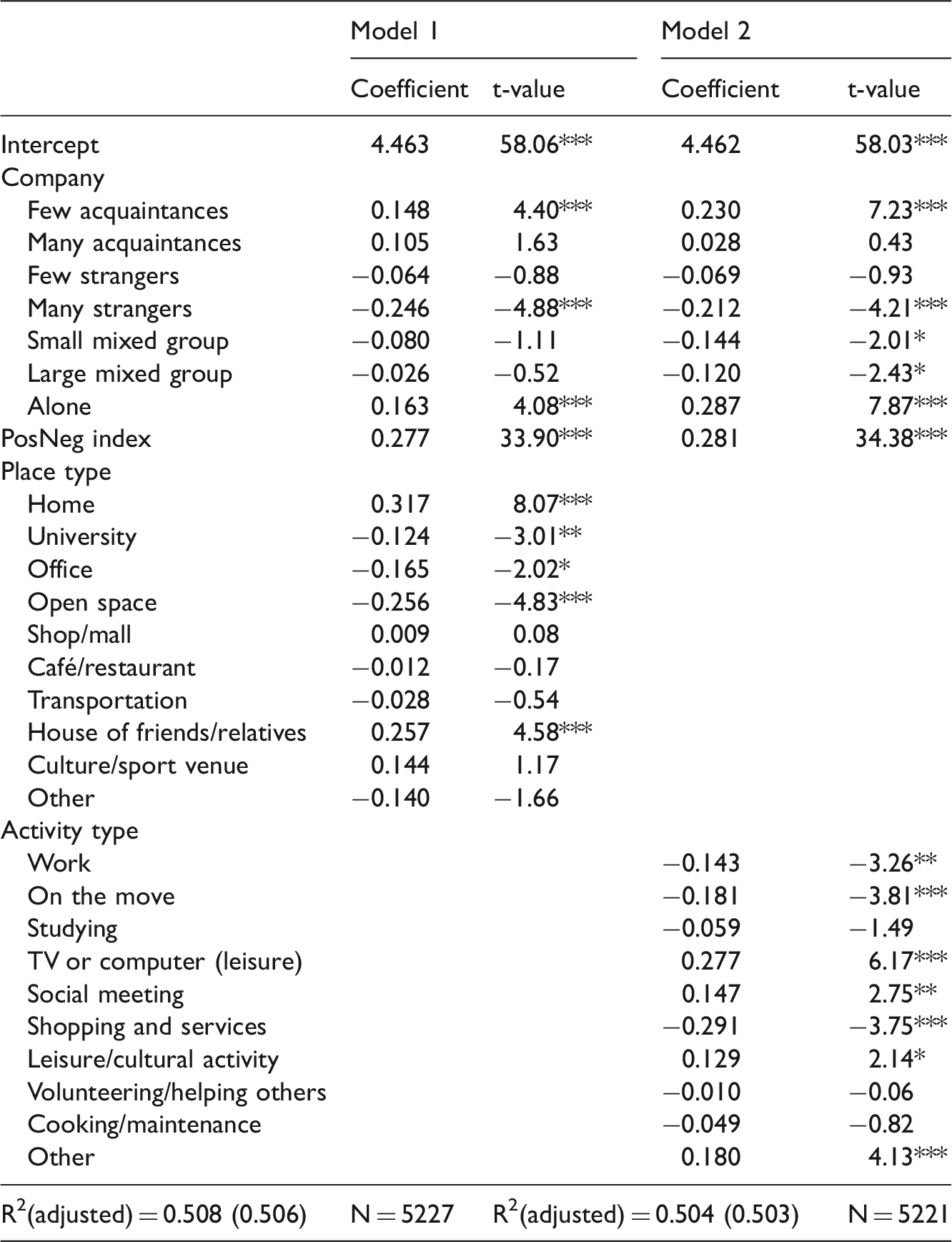
Note: Participants are a random effect in the model. Average comfort level = 5.12, stdv = 1.47.
P < 0.05, **P < 0.01, ***P < 0.001.
Mixed model – Annoyance.
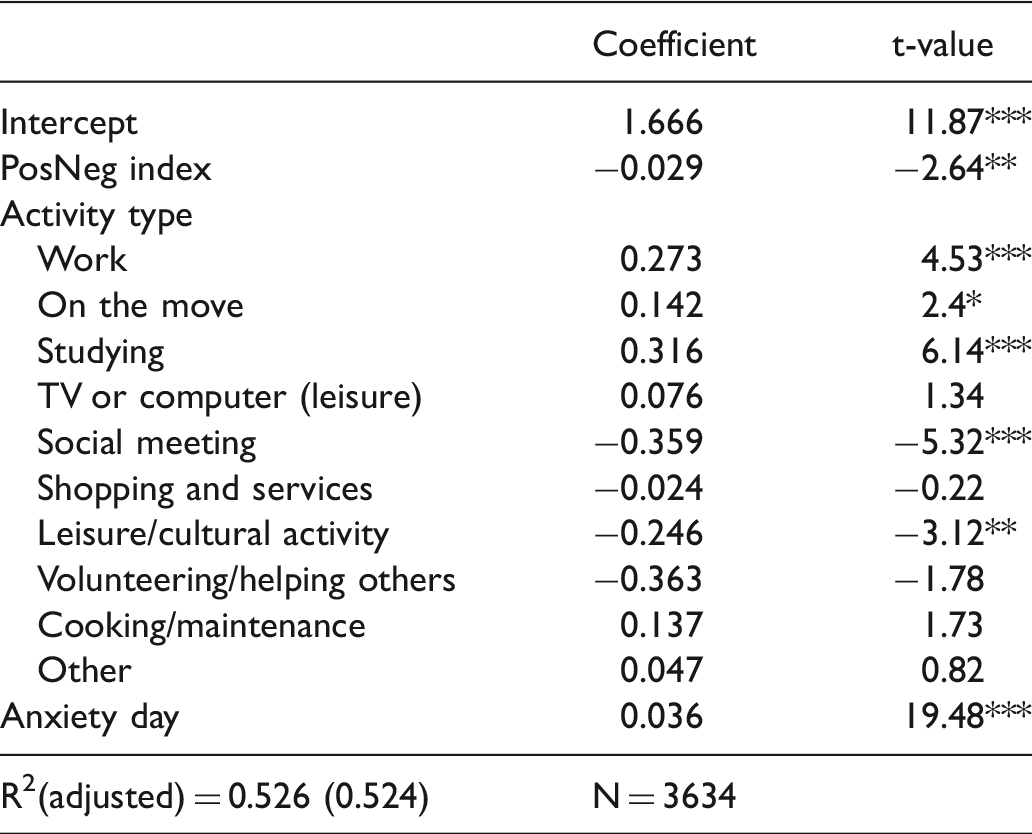
Note: Participants are a random effect in the model. Average annoyance level = 3.37, stdv = 1.69.
P < 0.05, **P < 0.01, ***P < 0.001.
Mixed model – Happiness.
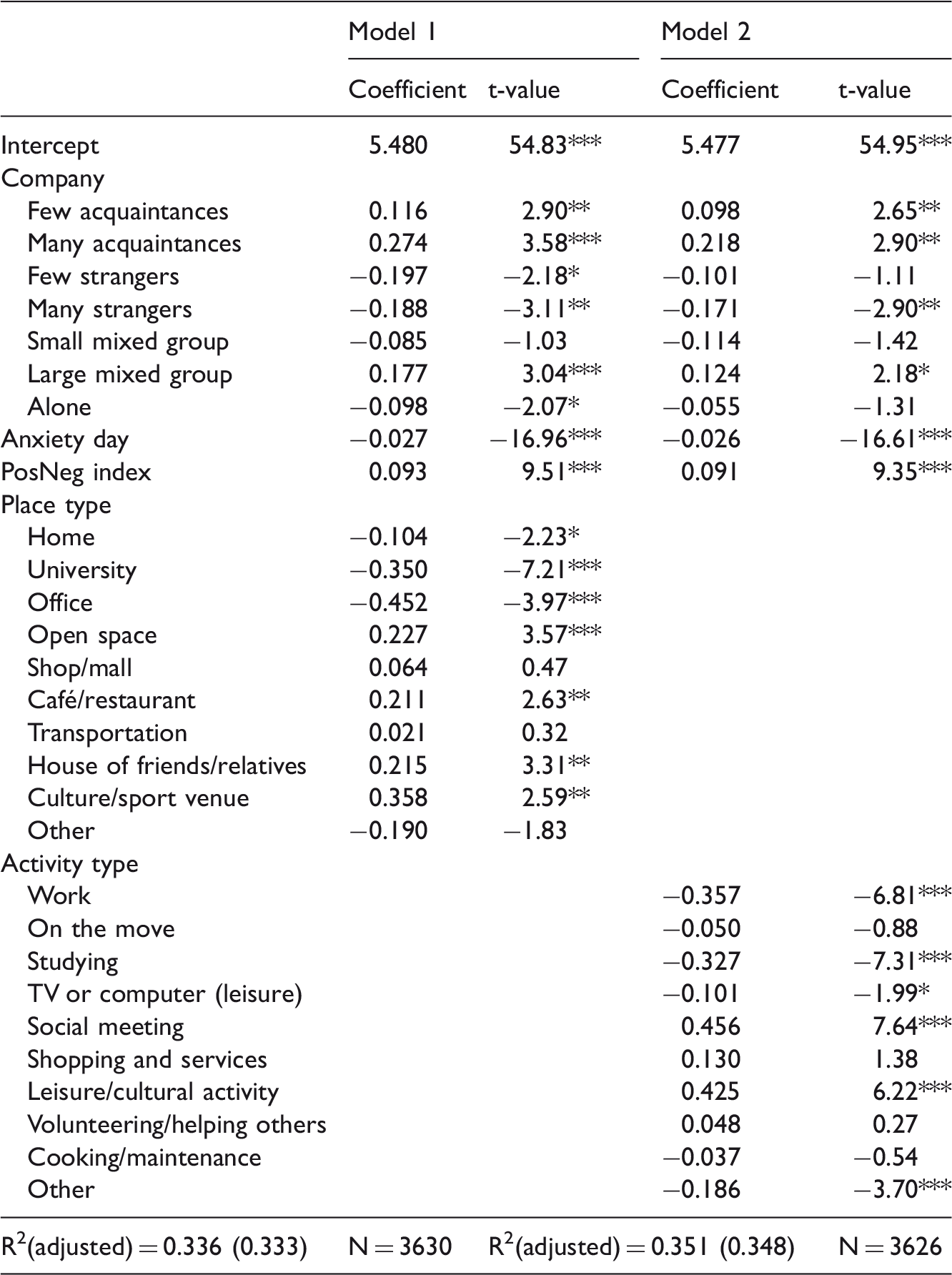
Note: Participants are a random effect in the model. Average happiness level = 4.45, stdv = 1.25.
P < 0.05, **P < 0.01, ***P < 0.001.
The last model (Table 6) analyzes the factors that are related to the experience of happiness. As is the case with comfort level (Table 4), two models are presented to avoid multicollinearity problems. Happiness seems to be strongly affected by our daily anxiety level. As with annoyance level, this might mean that daily mood has a stronger impact on happiness compared to other dimensions of momentary experiences. Students were found significantly happier during leisure and social activities and less cheerful while working and studying (Model 2). They were also happier when spending time with acquaintances (sometimes even when surrounded by additional unfamiliar people) and less so when with a large group of strangers. We can also observe few interesting findings regarding the effect of type of place (Model 1). While the results above imply that students feel less secure and less comfortable in open spaces and transportation vehicles, they do seem to be happier in these places. This means that people can be happy even in more stressing, less comfortable environments. On the other hand, while feeling more comfortable and secure, they do report lower levels of happiness at home. It is important to note that this does not mean that they are not happy at home, but rather that their happiness level is lower than average. It should also be noted that this model demonstrated the lowest R-squared (Model 1-0.336, Model 2-0.351).
Discussion
This article explored the affective perception of individuals in an urban setting while adopting a new concept of subjective momentary experiences. In order to dynamically measure these affective experiences, the study adopted the ESM procedure. The results presented here suggest that situational variables, including spatial ones, are important determinants of episodic experiences. A stronger association between spatial factors and momentary experience was found in the case of sense of security and sense of comfort. This might be a result of a higher sensitivity of these dimensions of experience to the immediate environment. A question remains as to how the unique research setting influences the results. While both the physical characteristics of Jerusalem and the socio-cultural and political context are very much likely to have a distinct effect, it is hypothesized that situational variables will be found significant determinants of momentary experience elsewhere. However, this should be further tested in other research settings in the future.
One of the interesting findings of this research is that place characteristics, as reflected in the PosNeg index, were found to be strong predictors of momentary experiences. The index was found significant in all four models that were introduced and it is by far the most prominent factor in the case of sense of comfort. However, the index should be further developed, tested, and standardize. Moreover, it is important to note that at the moment we cannot be certain about causality. It might be that people who are happy tend to report about positive characteristics and not that the positive characteristics of place make people happier.
Similarly to past studies (Clark et al., 1989; Csikszentmihalyi and Hunter, 2003; Eid and Diener, 2004; Hull and Stewart, 1995), it is evident from the results that the valence of experience varies both temporally and spatially. However, temporal effects such as time of day and weekend disappeared when type of place and activity were controlled in the models. This indicates that place acts as a mediating variable between time and experience. For example, students are happier and less annoyed in the evening mainly because they tend to stay in more desirable places during that time (e.g. at home) and not due to a real temporal effect, as might be suggested in previous studies.
Many studies have acknowledged the positive impact of natural environments and elements on humans (MacKerron and Mourato, 2013). In this study, students were found to be happier in open spaces regardless of whether they are natural or artificial. A similar finding was reported by Sugiyama et al. (2009). Future studies should explore the effect of open spaces on our momentary experience more thoroughly. It is important to note that while students were found to be happier in open spaces they also felt significantly less secure in these environments. This finding implies that momentary positive and negative dimensions of affect can be experienced simultaneously, as has been suggested elsewhere (Clark et al., 1989).
Limitations and suggestion for future research
Given the exploratory nature of the study, it was hard to avoid methodological and conceptual limitations. There is still a need to develop the theoretical and empirical foundations of the concept of momentary experiences and to further investigate how existing approaches correspond with it. Three interrelated psychological traditions should be considered in this regard: First, cognitive-perceptual factors should be taken into account. There is strong evidence that perceptual factors affect emotional reaction and vice-versa (Dolan, 2002). Cognitive-perceptual approaches might reveal valuable insights as to how the physical (urban) environment affects our experience. Closely related to that is the investigation of biological-neurological aspects of experience. A long tradition of studies in medical-related fields support the assertion that affective states are manifestations of biological-neurological states (Johnston and Olson, 2015). Biological markers, such as salivary cortisol (Almeida et al., 2009), heart rate (Gaggioli et al., 2011), and skin conductance (Kim and Fesenmaier, 2014) may serve as indicators of emotional arousal. Tools that measure these markers in real-life have become more available in recent years, making it an appealing research approach for investigating the effect of the environment on subjective experiences.
Second, while personal traits were not found significant in explaining momentary experiences in the current study, they still make a promising factor that should be further investigated. Additional personality traits should be considered in future studies. It should also be taken into account that a larger sample might be required in order to reveal the actual relation between personality traits and experiences.
Finally, more affective psychological approaches to the study of experience should be examined. Emotional control theories, for example, might supply valuable insights as to the motivation behind experience seeking (Carver and Scheier, 1990). A better understanding of how environmental elements affect emotional arousal should improve our ability to control affective-experiential aspects of the environment, and may generate practical insights for planners and architects.
From a methodological point of view, it is important to develop a standard instrument that can assess episodic experiences. This tool should be short enough to be practical for implementation in studies that utilize repeat measurement techniques for long periods. This is especially relevant when surveys are conducted using smartphones (Birenboim and Shoval, 2016).
In order to enhance future studies, larger, less homogeneous samples should be used. A more heterogeneous sample, might allow us detecting socio-demographic characteristics that are relevant in determining momentary experiences. It is also advisable to conduct cross-national and/or other cross-cultural comparative studies in order to examine this.
Transportation researchers, urban planners and architects who seek to generate livable, comfortable and in some cases emotionally remarkable landmarks and places are likely to benefit from the advancement of the field (Ettema et al., 2010; Hull and Stewart, 1995; Lynch, 1960). Momentary experiences and especially aspects of stress, anxiety, and comfort are also highly relevant to the disciplines of health and psychiatry that demonstrate a growing interest in the relation between environmental factors and daily experiences in recent years (Almeida et al., 2009).
Concluding remarks
In the fast-paced lifestyle of Western society, people are more mobile and tend to participate in many unique daily episodes (Rosa, 2003). They also tend to share their experiences and whereabouts through online social media platforms in real time. In order to capture episodic occurrences, we should adopt dynamic measurement tools such as geo-tagged social media information (Roick and Heuser, 2013), near real-time online surveys (Schwanen and Wang, 2014), and advanced telecommunication and tracking technologies that can be used to collect episodic information in an ecological manner (Birenboim and Shoval, 2016; Lane et al., 2010; MacKerron and Mourato, 2013). These methodologies and data sources make the investigation of momentary experiences more feasible than ever before. An example from the practical world for the implementation of such technologies can be found in Dubai that announced the implementation of a happiness index that will be evaluated on a daily basis (Gulf News, 2014). According to this initiative, residents and tourists will be able to report about their satisfaction using a dedicated mobile application. While it is still too early to say what will be the implications of these new technological changes, it does seem that we have a challenging mission of following all these rapid developments and adopting new research practices.
Footnotes
Declaration of conflicting interests
The author(s) declared no potential conflicts of interest with respect to the research, authorship, and/or publication of this article.
Funding
The author(s) disclosed receipt of the following financial support for the research, authorship, and/or publication of this article: This project was supported by the department for strategic planning of the Jerusalem municipality.