




Abstract
Trees provide many environmental benefits, but low-income communities of color tend to have fewer of them. New York City attempted to correct this disparity by planting a million trees via public–private partnership between 2007 and 2015. This paper examines MillionTreesNYC’s environmental justice goals and planting strategies via program documents and interviews with program partners, and assesses equity outcomes via regression analysis of new trees planted, existing tree canopy, park space, and sociodemographic characteristics measured at the level of the census block group. Ultimately, MillionTreesNYC did not prioritize low-income communities of color to a measurable degree, and planted more trees in areas with greater existing tree canopy. Despite public–private partnerships’ reputation for prioritizing profit over equity, the problem was not a lack of commitment to environmental justice. Instead, MillionTreesNYC’s focus on parks, which are themselves inequitably distributed, frustrated the city’s efforts to equalize the urban forest. This paper therefore exposes the deep historical roots of environmental injustice, which are difficult to eradicate without careful attention to both past and present socio-spatial inequities.
Introduction
From 2007 to 2015, the City of New York led a campaign to plant a million trees (City of New York, 2007: 129; MTNYC, 2014a). MillionTreesNYC (MTNYC) was one of the largest and most well-funded tree planting initiatives in the country (Layzer and Schulman, 2012). It specifically prioritized neighborhoods with few trees to improve local air quality and prevent respiratory illnesses (City of New York, 2007; MTNYC, 2014a). This goal was supported by city officials, donors, and community partners (Brown, 2015; Campbell, 2014; City of New York, 2007: 129; Desjardins, 2015; Duran-Mitchell, 2015; Fisher et al., 2015; Greenfeld, 2014; Katseff, 2014; MTNYC, 2014b; MTNYC employee, 2015; Newman, 2014; NYC Parks and USDA Forest Service, 2014: 37; Trotman, 2016; US Forest Service employee, 2015). One would therefore expect MTNYC to be a best-case scenario for how a city can promote environmental justice via urban forestry. Yet as this paper will show, MTNYC did not prioritize low-canopy neighborhoods to a measurable degree, due in large part to the unequal distribution of parks, where MTNYC planted most of its trees.
A substantial body of research evaluates the urban forest’s environmental benefits (Akbari, 2002; Eisenman, 2016; Konopacki and Akbari, 2002; Nowak et al., 2013, 2014; Pataki et al., 2011; Rosenthal et al., 2008; Tong et al., 2015; Whitlow et al., 2014a, 2014b). Researchers have also established that tree canopy is inequitably distributed with regards to poverty and race (Harlan et al., 2006; Heynen et al., 2006; Rosenthal et al., 2008, 2014; Schwarz et al., 2015; Wolch et al., 2005). However, there has been less attention to how urban forestry programs distribute new trees, or how such distributions are shaped by pre-existing environmental inequalities, particularly the lack of parks in low-income communities of color (Danford et al., 2014; Perkins et al., 2004). This paper therefore addresses the following questions, using a combination of spatial statistics, document analysis, and interviews with key program partners: (1) Was pre-MTNYC tree canopy distributed unequally with respect to poverty and race? (2) Were New York City’s parks distributed unequally with respect to poverty and race? (3) How were trees planted by MTNYC distributed with respect to poverty, race, and parks? The results demonstrate that past inequalities in park provision frustrated the city’s present-day efforts to equalize the urban forest. This case study therefore provides strong evidence that the lingering effects of historical disinvestment in low-income communities of color can thwart present-day efforts to advance environmental justice. Like a weed that keeps coming back despite the gardener’s best efforts to eradicate it, environmental injustice has deep roots.
MillionTreesNYC
A public–private partnership (PPP), MTNYC was supported by NYC Parks, the New York Restoration Project (NYRP), the U.S. Forest Service, the New York City Housing Authority (NYCHA), and private and corporate donors (MTNYC, 2014b). PPPs help cities pay for new amenities via an infusion of outside resources, yet they may be biased towards profitable investments (Bovaird, 2004; Daniels and Trebilcock, 1996; Klinenberg, 2002; Sagalyn, 2001, 2012; Stoker, 1998; Verkuil, 2007). For example, parks built via PPP in New York City tend to be sited where the private partners can expect a return on investment in the form of higher property values (Katseff, 2014). In addition, outsourcing public services to the private sector may render them less accessible to marginalized populations (Bovaird, 2004; Daniels and Trebilcock, 1996; Klinenberg, 2002; Sagalyn, 2001, 2012; Stoker, 1998; Verkuil, 2007). PPPs may therefore be poor tools for pursuing environmental justice.
Nevertheless, MTNYC was committed to environmental justice. According to planning documents and representatives of major partner organizations, the campaign specifically prioritized neighborhoods with the greatest need for more trees. MTNYC grew out of PlaNYC, New York’s sustainability plan for 2030, which committed the City to work with civil society and corporate partners to plant a million trees and prioritize “neighborhoods with few green spaces” (City of New York, 2007: 129). To identify such neighborhoods, NYC Parks commissioned a tree canopy assessment just before the start of MTNYC, and another mid-way through the program in 2010 (Grove et al., 2006; NYC Parks, 2010). MTNYC also prioritized “Trees for Public Health” neighborhoods with fewer than average street trees, higher than average juvenile asthma rates, and poor air quality (as illustrated in Figure 1) (NYC Parks and USDA Forest Service, 2014: 37). These commitments were publicized via the MTNYC website (MTNYC, 2014a). Moreover, when interviewed, representatives from MTNYC’s major partners – NYC Parks, NYRP, NYCHA, the mayor’s office, the U.S. Forest Service, and TD Bank – demonstrated a high degree of commitment to environmental justice (Brown, 2015; Campbell, 2014; Desjardins, 2015; Duran-Mitchell, 2015; Greenfeld, 2014; Katseff, 2014; MTNYC employee, 2015; Newman, 2014; Trotman, 2016; US Forest Service employee, 2015). All interviewees from these organizations referenced distributive equity when describing MTNYC’s goals; this ranged from simply acknowledging that some neighborhoods have fewer trees, to linking these disparities to long-standing structural inequalities based on class and race (Brown, 2015; Campbell, 2014; Desjardins, 2015; Duran-Mitchell, 2015; Greenfeld, 2014; Katseff, 2014; MTNYC employee, 2015; Newman, 2014; Trotman, 2016; US Forest Service employee, 2015).
MTNYC’s “Trees for Public Health” neighborhoods.
Several factors may have protected MTNYC from the typical pitfalls of PPPs. For instance, the City did not organize MTNYC as a PPP due to lack of public funds. At the very start, Mayor Michael Bloomberg allocated over $350 million, mostly from municipal capital bonds (Campbell, 2014; Layzer and Schulman, 2012; NYC Parks, 2015b). The City also allocated general funds, and received a $2 million grant from the U.S. Forest Service (Layzer and Schulman, 2012). Instead, the City’s primary motivation for partnership was to build grassroots support for MTNYC by tapping into the local knowledge and volunteer networks built by civil society organizations such as NYRP (Fisher et al., 2015).
In addition, MTNYC relied on civil society partners rather than private partners for implementation. NYRP was heavily involved in the day-to-day work of distributing and planting trees, and served jointly with NYC Parks as co-lead agencies. Civil society organizations such as NYRP lend themselves particularly well to collaborative governance, in which the roles of government and civil society intertwine (Ansell and Gash, 2008; Boyte, 2005; Fisher and Svendsen, 2013; Fisher et al., 2015; Sirianni, 2009). Such partnerships have implemented a variety of urban sustainability programs (Fisher and Svendsen, 2013; Fisher et al., 2015). Moreover, existing research has shown that collaborative governance expands the roles played by a diverse spectrum of citizens in public decision-making (Ansell and Gash, 2008; Boyte, 2005; Fisher and Svendsen, 2013; Fisher et al., 2015; Sirianni, 2009). Such partnerships therefore pose fewer obstacles to pursuing social equity than the literature on traditional PPPs might otherwise suggest. It is therefore unsurprising that MTNYC and its partners made such strong and public commitments to environmental justice.
Environmental justice, the urban forest, and urban parks
The urban planning literature defines environmental justice in terms of procedural fairness or distributive equity. Deviations from the first result when the planning process fails to address diverse stakeholder needs and incorporate local knowledge (Corburn, 2002, 2005; Pellow, 2000; Shrader-Frechette, 2002). Historically, predominantly white officials have used zoning and planning to concentrate noxious land uses and industries in poor and minority communities, a practice known as environmental racism (Bullard, 2000; Cole and Foster, 2001; Maantay, 2001). Distributive inequity derives from class- and race-based inequities, with environmental impacts and amenities unevenly distributed across both geographic space and socio-economic groups (Soja, 2010). Moreover, racial inequality has been found to persist even when controlling for socio-economic status (Ringquist, 2005). Overall, procedural and distributional inequities are linked because the former cements land-use patterns that concentrate environmental amenities and impacts unevenly across the social and spatial landscape.
This paper evaluates the equity of MTNYC’s tree planting efforts using the normative framework of distributive spatial justice (Fainstein, 2010; Rawls, 1999; Soja, 2010). This choice of framework is justified because MTNYC was explicitly founded with the goal of equalizing the distribution of the urban forest (City of New York, 2007: 129). Moreover, increasing procedural equity requires increasing community participation, which is no silver bullet. As described by Few et al. (2007), climate projections are technically complex, cover long time spans, and become increasingly uncertain when global models are downscaled to the local level. Climate adaptation is a public good vulnerable to both free-ridership and the discounting of long-term risks compared to short-term benefits (Few et al., 2007). Consequently, community members may have difficulty reaching a meaningful consensus on adaptation measures, such as mitigating the urban heat island via urban forestry (Few et al., 2007). Moreover, even when officials seek marginalized groups’ input, power inequalities restrict their voices and access to information, preventing full procedural equity (Fainstein, 2010; Flyvbjerg, 1998; Forester, 1989; Foucault, 1995). That is not to say that these groups’ input should not be sought, since they possess critical local knowledge that city officials often lack, particularly about local environmental impacts (Corburn, 2002, 2005). However, regardless of process, the equity of program outcomes should still be measured against a distributional yardstick. There is enough consensus among human beings on the meaning of justice to assume that a fair distribution of resources is one that does not advantage people who started out with more, or disadvantage those who started out with less (Fainstein, 2010; Rawls, 1999). Justice also has a spatial dimension. Geographically uneven development produces inequality by unevenly distributing advantages and disadvantages across space according to race and class (Soja, 2010). For instance, social and economic inequalities disproportionately concentrate pollution in low-income communities and among African-Americans and people of Hispanic or Latino origin (Ringquist, 2005). Recent research has begun to reveal the extent to which such neighborhoods also lack environmental amenities, such as trees and parks (Byrne and Wolch, 2009; Byrne et al., 2009; Dai, 2011; Jennings et al., 2012; Loukaitou-Sideris and Stieglitz, 2002; Wolch et al., 2005, 2014). Climate adaptation measures and infrastructure follow similar patterns, with low-income communities of color disproportionately impacted by climate change, including the health impacts of heat waves (Morello Frosch et al., 2009; Vale, 2014).
To the author’s best knowledge, this is the first evaluation of MTNYC’s distributional equity. While NYC Parks and the U.S. Forest Service collaborated on a progress report for MTNYC in 2011, they did not specifically evaluate distributional equity (NYC Parks and USDA Forest Service, 2014). MTNYC also organized a special issue of Cities and the Environment; however, none of the articles assessed MTNYC’s distributional equity as is done in this study (Strauss, 2010).
Trees provide many environmental benefits to urban neighborhoods, of which MTNYC specifically sought two: improved air quality and reduced incidence of respiratory illnesses (MTNYC, 2014a). The empirical evidence for these benefits, however, is mixed. While many studies found significant positive associations between trees and human health, the exact causal pathway remains unclear (Eisenman, 2016). Trees may trap enough airborne pollutants to improve public health significantly (Nowak et al., 2013, 2014). However, the methodology behind these findings, as well as their interpretation, are disputed (Pataki et al., 2011; Whitlow et al., 2014a, 2014b). Trees change local aerodynamics and may reduce air pollution dispersion and increase pollutant concentrations, depending on their location and planting configuration (Tong et al., 2015). In addition, trees may even contribute to poor air quality and respiratory illnesses by emitting pollen and volatile organic compounds (VOCs) (Pataki et al., 2011).
By cooling nearby buildings, however, trees reduce the need for air conditioning, and by extension, reduce air pollution from power plants, particularly during heat waves (Akbari, 2002; Konopacki and Akbari, 2002; Rosenthal et al., 2008). Since heat can aggravate respiratory illnesses, trees may reduce their incidence by cooling the air through shade and evapotranspiration (Akbari, 2002; Konopacki and Akbari, 2002; Lowry, 1967; McPherson et al., 2008; Peper et al., 2007; Pincetl et al., 2013). Yet trees’ effect on temperature is highly localized. Disparities in tree cover and impervious surfaces produce measurable differences in ambient temperatures and heat-related mortality between neighborhoods and even from one street to the next; therefore, trees planted in, for example, a park would primarily benefit the park’s immediate neighbors (Pincetl et al., 2013; Rosenthal et al., 2008, 2014). This is problematic for environmental justice because low-income minority neighborhoods generally have fewer trees and suffer higher rates of heat- and pollution-aggravated respiratory and cardiovascular illnesses (Harlan et al., 2006; Heynen et al., 2006; Klinenberg, 2002; Rosenthal et al., 2008, 2014; Schwarz et al., 2015; Wolch et al., 2014). Moreover, trees’ cooling effect will become even more critical as heat waves become more severe and frequent under climate change, as they are predicted to do in New York (City of New York, 2007).
Of course, trees alone are not enough to ensure a city is sustainable or equitable. Trees may grow alongside exploitative social and economic relations that undermine true social, economic, and environmental sustainability (Campbell, 1996; Fainstein, 2010). Moreover, residents of underserved neighborhoods may not welcome new trees, fearing they may catalyze gentrification and displacement (Curran and Hamilton, 2012; Wolch et al., 2014). Nevertheless, MTNYC enjoyed broad and diverse public support, as demonstrated by Fisher et al. (2015). For instance, MTNYC’s trees were planted and maintained not only by NYC Parks staff, but also by an extensive and diverse network of volunteer tree stewards: when controlling for educational attainment (a proxy for social class), racial minorities volunteered with MTNYC at higher rates than whites (Fisher et al., 2015: 53–54). Overall, it is reasonable to accept MTNYC’s premise that trees are an important environmental amenity, and to assume at least some consensus among New Yorkers that more trees are desirable.
New York has many public parks, a useful resource for an urban forestry program in need of spaces that it can easily plant with many trees at once. As this paper will show, parks were the focus of MTNYC’s planting strategy. Yet New York has a long history of parks inequity. As described by Gandy (2002), the design and siting of many of the city’s large, historic parks perpetuated the political and social dominance of the city’s elite over marginalized groups. For example, New York’s most iconic public greenspace, Central Park, was envisioned by its designer Frederick Law Olmsted as a park for the people (Gandy, 2002; Olmsted, 1977). Yet the park is deeply rooted in a history of environmental injustice. Its construction displaced an informal settlement inhabited by low-income immigrants and African-Americans, while generating profits for real estate speculators (Gandy, 2002). Since the park’s creation, local housing prices have been some of the highest in the city (Gandy, 2002). Given that trees’ environmental benefits are concentrated in their immediate surroundings, the parks’ trees would benefit only a select few New Yorkers (Pincetl et al., 2013; Rosenthal et al., 2008, 2014). Parks inequity has also been fueled by funding mechanisms that favor wealthy neighborhoods. For instance, donors give large sums to maintain historic landmarks such as Central Park, while less prestigious parks in less privileged neighborhoods fall into disrepair (Gandy, 2002; Katseff, 2014). In recent years, PPPs have become a popular mechanism for financing new parks, as exemplified by New York’s High Line; however, because such arrangements are closely linked to high-end real estate development, they generally lead to adding amenities to already desirable neighborhoods (Katseff, 2014). Because parks are long-term investments, such disparities remain engrained in the urban landscape for generations.
Methods
MTNYC’s commitment to environmental justice and its parks-focused planting strategy are assessed via analysis of program documents and in-depth interviews with program partners. The former includes official plans, websites, promotional materials, and media coverage. Interviews were conducted with a purposive sample of representatives from major program partners and donors: NYC Parks, NYRP, the mayor’s office, NYCHA, the U.S. Forest Service, and TD Bank. One or two key representatives were interviewed at each organization. These representatives worked directly with MTNYC and held positions such as program manager, community engagement manager, urban forestry director, environmental services manager, and policy advisor. Most worked closely with underserved communities, and some identified as members of those communities themselves. A total of ten interviews were conducted, each lasting one to two hours. All questions were open-ended to allow interviewees to reveal the factors they felt most influenced their work. Questions covered program goals, structure, funding, and planting strategies, as well as opportunities and obstacles encountered when planting trees in different areas and types of spaces. Responses were used to guide variable selection and contextualize the results of the quantitative and spatial analysis described below.
Summary of regression models.

MTNYC: MillionTreesNYC.
Pre-MTNYC tree canopy is measured as the percent of surface area covered by foliage, based on high-resolution aerial imagery (NYC Parks, 2010). The most spatially detailed data available are at the block group level, and are only available for 2010. Trees grow slowly, and by 2010, most trees planted since MTNYC’s start in 2007 would still have been small saplings. They would therefore have minimal impact on tree canopy measurements taken in 2010. The percent of surface area covered by parks is calculated based on the boundaries of city property managed solely or partially by NYC Parks (NYC OpenData, 2013b). These boundaries include only public parks, which, as public property, would have been readily accessible to a municipal program such as MTNYC. These boundaries are further refined by removing building footprints (NYC OpenData, 2013a). While it is possible to plant trees on roofs, balconies, and other structures, MTNYC did not count them towards the million-tree goal. Such spaces are therefore excluded from this analysis. The percent of households in poverty and the percent of residents who are non-white are drawn from the American Community Survey (U.S. Census Bureau, 2012).
Using MTNYC’s planting records, the number of trees planted is summed and normalized by area, measured in square miles (NYC Parks, 2015a). This analysis includes only those trees directly planted by MTNYC, whose specific locations were reliably recorded. For instance, records are not available for trees given to homeowners, making it impossible to know if or where these trees were planted. While MTNYC planted its millionth tree in an official ceremony in October 2015, NYC Parks shared MTNYC’s planting records with the author in April 2015. As of this writing, updated planting records have not been finalized and released. However, 992,726 of the total million trees (just over 99%) are included in the records used in this analysis, making them reasonably complete. Because MTNYC did not keep systematic records of tree survival, it is not possible to exclude trees that may have died. However, an extensive network of volunteer stewards cared for MTNYC’s trees (Fisher et al., 2015). Moreover, no interviewees reported significant levels of tree vandalism. It is therefore reasonable to assume that most new trees survived at least through the period covered by this analysis.
Results
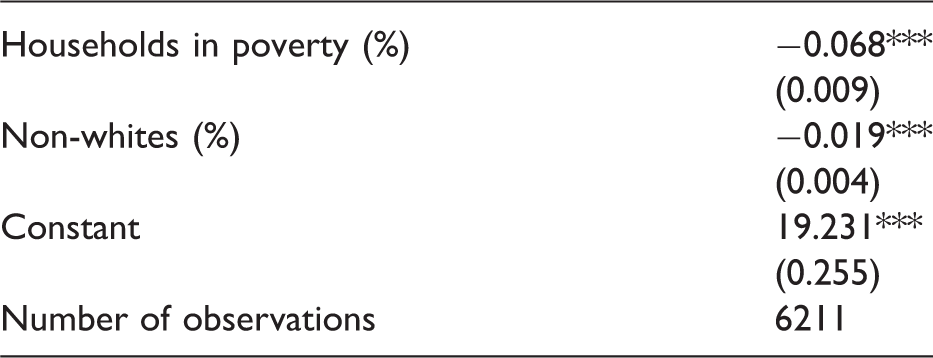
Coefficient estimates for regression of surface area covered by existing tree canopy (%) (by census block group).
Source: NYC Parks (2010); U.S. Census (2012).
Standard errors are reported in parentheses.
p < 0.01.
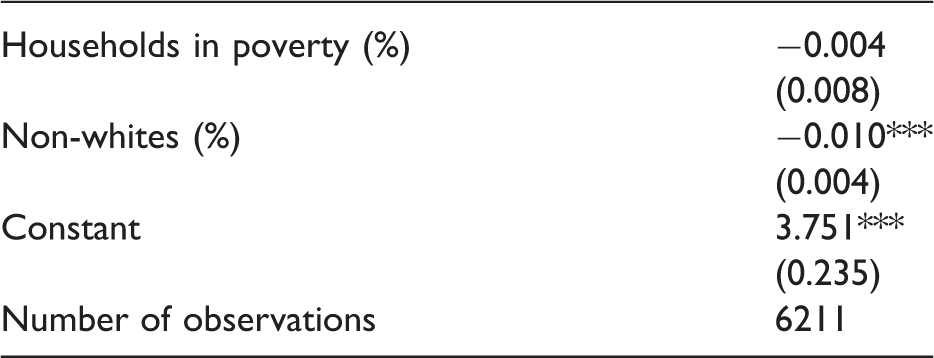
Coefficient estimates for regression of surface area covered by parks (%) (by census block group).
Standard errors are reported in parentheses.
p < 0.01.
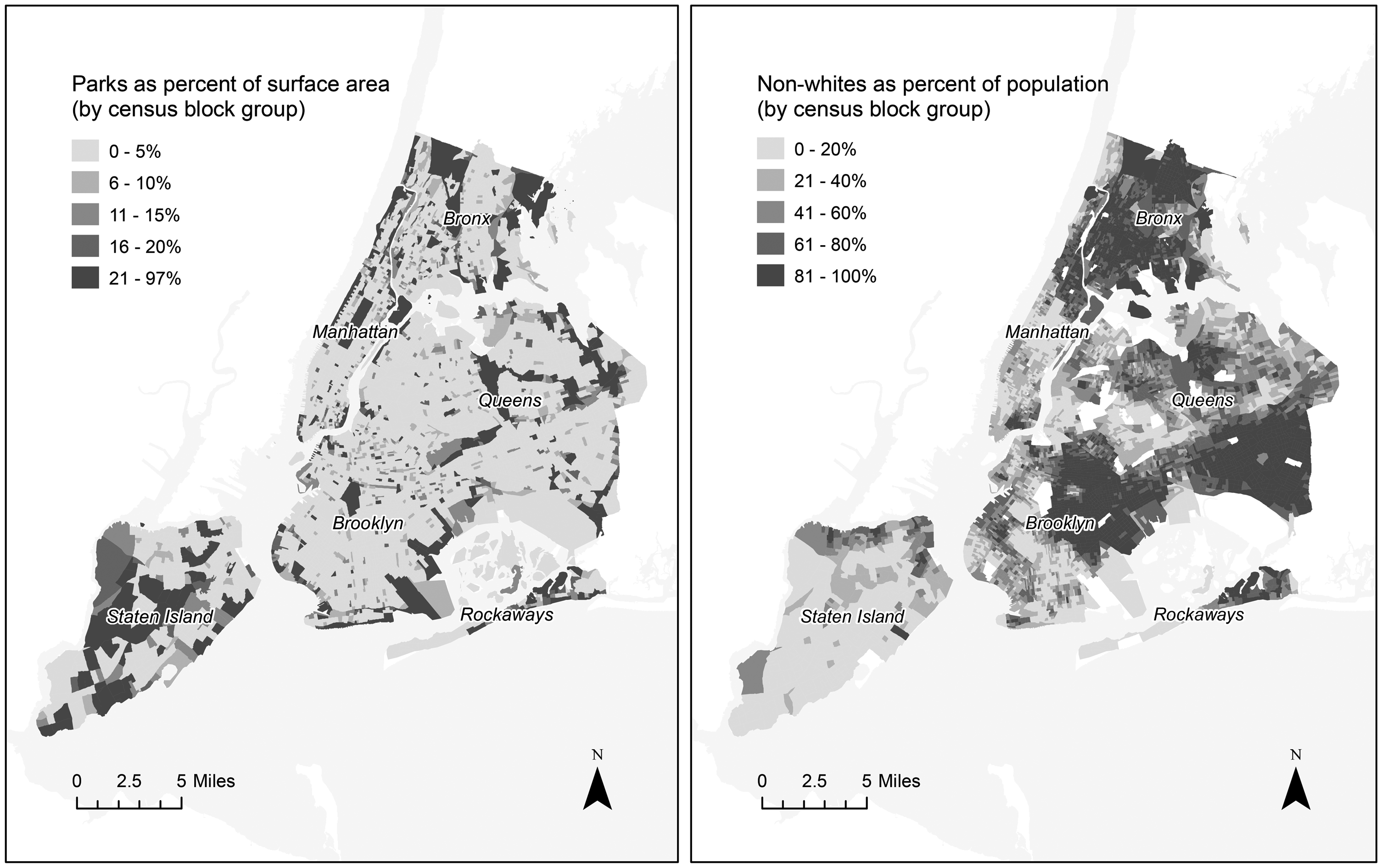
Parks vs. non-white residents.
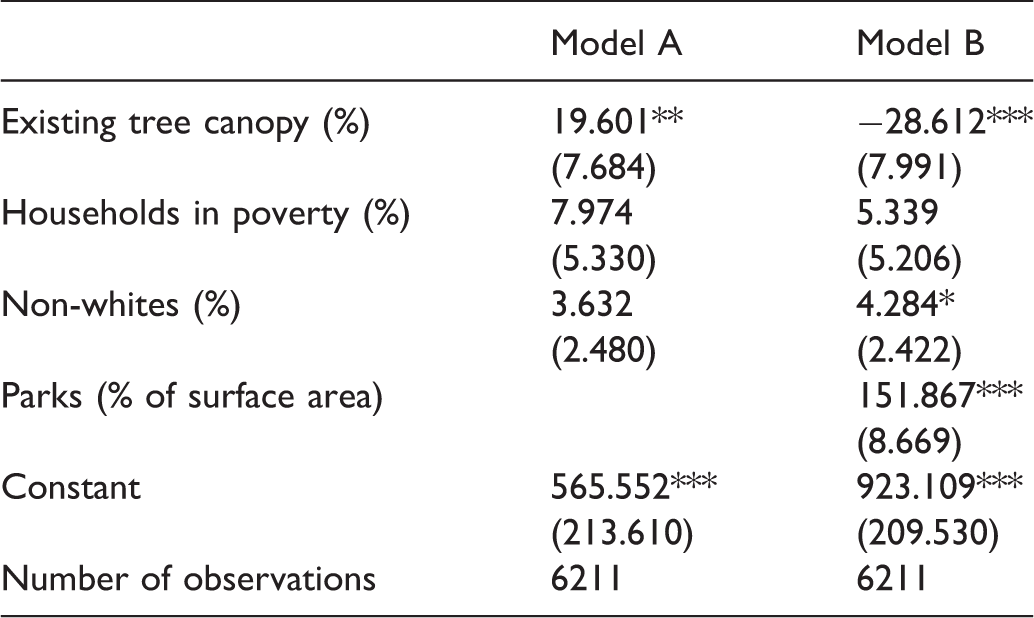
Coefficient estimates for regression of trees planted per square mile by MTNYC, 2007–2015 (by census block group).
Source: NYC OpenData (2013a, 2013b); NYC Parks (2010, 2015a); U.S. Census (2012).
MTNYC: MillionTreesNYC.
Standard errors are reported in parentheses.
p < 0.01.
p < 0.05.
p < 0.1.

Existing tree canopy vs. density of trees planted per square mile by MTNYC.
However, parks absorbed the bulk (83%) of trees planted by MTNYC (NYC Parks, 2015a). As demonstrated by Model B in Table 4, parks are significantly (at α = 0.01) and positively associated with the density of trees planted, and a one-unit increase in the percent of surface area covered by park space is associated with approximately 152 (99% CI: 129.530, 174.203) more new trees planted per square mile by MTNYC. Moreover, when park space is introduced as a control variable, the density of trees planted by MTNYC is significantly (at α = 0.01) and negatively associated with existing tree canopy, as well as significantly (at α = 0.10) and positively associated with the proportion of non-white residents. All else being equal, a one-unit increase in the percent of surface area covered by existing tree canopy is associated with approximately 29 fewer new trees planted per square mile by MTNYC (99% CI: −49.201, −8.023), while a one-unit increase in the percent of residents who are non-white is associated with approximately 4 more trees planted per square mile by MTNYC (90% CI: 0.300, 8.267). In other words, among areas with similar proportions of park space, MTNYC actually did prioritize areas with lower canopy and more non-whites (although poverty still stops short of statistical significance). These results provide strong evidence that the unequal distribution of parks was the critical factor impeding achievement of MTNYC’s environmental justice goals.
How parks inequity shaped MTNYC’s equity outcomes
Parks were the focus of MTNYC’s planting strategy for a variety of practical and philosophical reasons. As public property, parks are accessible to a municipal program such as MTNYC, providing large amounts of open space where it can plant many trees at a time. For example, in MTNYC’s first year, NYC Parks hosted “It’s My Park!” Day, in which approximately 6000 volunteers planted 10,000 trees in parks across the city (NYC Parks, 2007). As described by an MTNYC partner at the U.S. Forest Service, parks were vital to achieving the million-tree goal: There are large open areas that can be staged and prepped by a contractor from the Parks Department. Then you can have a big volunteer engagement day. And those got bigger and bigger throughout the campaign to the point where they were eventually planting 20,000 young trees in a single day. (Campbell, 2014)
The remaining 17% of MTNYC trees were planted in the public right-of-way, typically in sidewalk tree wells or street medians (NYC Parks, 2015a). But streets are more difficult and more expensive to plant than parks. Due to liability issues associated with working in crowded public areas, street trees typically had to be planted by licensed and insured contractors (Newman, 2014). The typical sidewalk well can accommodate only a single tree, and is often inadequate even for that (Duran-Mitchell, 2015; Katseff, 2014). As a representative from NYRP reported, “almost every street tree has to have concrete removed because even if you have an old street tree pit, most of them were not built to the current standard, so you would have to expand them in a lot of cases,” imposing additional costs (Duran-Mitchell, 2015).
In addition to these practical reasons for favoring parks over streets, MTNYC’s partners viewed parks as a special kind of democratizing greenspace with psychological and social benefits. Even though both parks and streets are the product of human design, interviewees often described the former as “natural” and the latter as “urban jungle” (Newman, 2014). According to this framing, parks are the most critical type of urban greenspace because they have a special ability to relieve the pressure of urban crowding: “with land becoming even more scarce, you need to make sure that the city has enough parks everywhere so that density is livable and New York is a great place to live” (Katseff, 2014). Caring for trees in areas spatially separated from the hustle and bustle of the city was viewed as a psychologically beneficial activity that would transform urbanites into better community members; in other words, volunteer stewards would gain a sense of community from working together in a shared space apart from ordinary urban life (Brown, 2015). Overall, MTNYC’s planting partners viewed public parks as inherently democratizing: “especially within the most underserved neighborhoods” where residents’ private resources are limited, “public green space helps bring everyone up to the same standard of living,” according to NYRP’s Director of Community Engagement (Brown, 2015).
These views echo Frederick Law Olmsted’s vision of egalitarian public parks. Olmsted believed large public parks would improve New Yorkers’ environmental health, one of the chief virtues of urban parks being their ability “to supply the lungs with air screened and purified by trees” (Olmsted, 1977: 316). In addition, public parks would serve as a safety valve for class conflict, bringing together New Yorkers from all walks of life and building a stronger and more egalitarian sense of community (Olmsted, 1977). It is therefore unsurprising that MTNYC’s lead agency, NYC Parks, has its headquarters in Central Park, Olmsted’s most famous design and the hallmark of the 19th-century urban parks movement (NYC Parks, 2017).
Conclusions
This paper makes the following key findings. Before MTNYC, areas with higher poverty and more non-whites had significantly less tree canopy, justifying MTNYC’s stated environmental justice goal of equalizing the urban forest. Parks were also distributed unequally, with areas with more non-white residents having significantly less park space, even when controlling for poverty. However, parks absorbed 83% of MTNYC’s new trees, creating a significant obstacle to environmental justice. Yet once park space is included as a control variable, MTNYC’s new trees are actually concentrated in areas with lower tree canopy, higher poverty, and more non-whites. These results demonstrate that MTNYC’s focus on parks made it harder to prioritize underserved communities, despite the program’s best intentions. In other words, a history of disinvestment in greenspace in low-income communities of color was already engrained in New York’s landscape long before MTNYC began. Without explicit attention to past inequalities in park provision, MTNYC was ultimately unable to address the historical roots of environmental injustice, frustrating its present-day efforts to equalize the urban forest.
Based on the results of this analysis, cities need to compensate for underserved communities’ lack of park space. Cities could prioritize these areas for street trees, even if such trees are more difficult to site and require more resources to plant, as discussed above. In short, cities need to make a trade-off between efficiency and equity. While more research is needed to evaluate the long-term equity outcomes of different planting strategies, slow and steady may be the most effective approach to ensuring that the environmental benefits of the urban forest are shared by all. Building more parks in underserved areas might also make it easier to plant trees. However, the level of investment required would be beyond the scope of most urban forestry programs. And while cities should keep equity in mind when siting future parks, they should also exercise caution: previous research suggests that large-scale parks may catalyze gentrification, driving up housing costs (Bovaird, 2004; Daniels and Trebilcock, 1996; Sagalyn, 2001, 2012; Stoker, 1998; Verkuil, 2007). Therefore, building more parks in underserved areas may simply displace vulnerable populations, neutralizing any potential gains for environmental justice. There is some evidence, however, that small-scale pocket parks and community gardens may not catalyze rent increases to the same degree (Curran and Hamilton, 2012; Wolch et al., 2014). Individual trees, such as those planted in sidewalk wells, may also have a relatively small impact on surrounding housing values (McPherson et al., 2008). More research is therefore needed to determine which factors moderate the relationship between greenspace and gentrification, shaping the long-term equity outcomes of different tree planting strategies.
Despite MTNYC’s inability to achieve its environmental justice goals fully, there is a silver lining: collaborative governance may yet prove to be an effective means of adapting the PPP model to the pursuit of social equity. Despite PPPs’ reputation for prioritizing profit over equity (Bovaird, 2004; Daniels and Trebilcock, 1996; Klinenberg, 2002; Sagalyn, 2001, 2012; Stoker, 1998; Verkuil, 2007), MTNYC’s public, private, and civil society partners were all strongly committed to environmental justice (Brown, 2015; Campbell, 2014; City of New York, 2007: 129; Desjardins, 2015; Duran-Mitchell, 2015; Fisher et al., 2015; Greenfeld, 2014; Katseff, 2014; MTNYC, 2014b; MTNYC employee, 2015; Newman, 2014; NYC Parks and USDA Forest Service, 2014: 37; Trotman, 2016; US Forest Service employee, 2015). And once parks are included as a control variable, MTNYC did in fact concentrate its trees in areas with lower existing tree canopy, higher poverty, and more non-white residents. One could therefore argue that all that stood between MTNYC and its equity goals was the need for greater historical awareness of the roots of environmental injustice. Future collaborative governance efforts may therefore prove more successful by learning from the past.
Footnotes
Declaration of conflicting interests
The author(s) declared no potential conflicts of interest with respect to the research, authorship, and/or publication of this article.
Funding
The author(s) received no financial support for the research, authorship, and/or publication of this article.