



Abstract
This research aimed to explain the co-presence patterns in public spaces, i.e. pedestrian movement rates, based on the analysis of spatial patterns established in street segments. Two dispersed residential neighbourhoods with different spatial characteristics – morphological configuration, land use and physical/visual permeability – were analysed in Santa Maria city. Generalized linear regression models were used to infer the relations among variables. The research question was: which spatial characteristics are related to co-presence in public spaces of dispersed residential neighbourhoods? The configurational morphological attributes had statistical significance for almost all regression models for neighbourhood 1. In neighbourhood 2, commercial activity was significant and positively related with all models. The results regarding physical and visual permeability were inconclusive for both study areas.
Introduction
This paper aims to understand co-presence patterns in public spaces of dispersed neighbourhoods based on the analysis of spatial patterns established in street segments. Co-presence, in this study, refers to a group of people who share a common space, not necessarily interacting with each other (Hillier, 2007) and its study tries to understand how urban space interferes with the way they move and meet other people (Holanda, 2002). For Zukin (1995), co-presence allows the experience of the ‘other’ in an everyday situation and the formation of public culture. Being co-present in public spaces brings the opportunity to acquire information about the living conditions of people, turning these public spaces into a place for a constant process of creating different solidarities and group identities. Grannis (1998) exemplifies that through the importance established by local streets for the potential of neighbourhood interaction. Not only between close neighbours but also among the more distant ones, from face-to-face interactions that occur on the streets and which allow the residents to recognize themselves by sight. Netto et al. (2012) reinforce that concept, considering co-presence as a social aspect that precedes the forms of sociability themselves, but subjugates them. Once co-presence is a social phenomenon that depends on the interaction of several variables, it is approached here from three sets of spatial characteristics: the morphological configurational, derived from space syntax theory; attractors or urban activities in private spaces; and the physical/visual permeability of buildings.
Space syntax was developed in the 1970s as a theory and set of methods for the investigation of relations between society and space. From a conceptual model based on the social content of spatial patterns and the spatial content of social behaviours, it focuses on the relationship between local and global morphological patterns in the configuration of buildings or urban settlement layouts (Hillier and Hanson, 1984). The urban form is one of the main spatial variables related to co-presence, since it establishes different proximity and distance rates among the inhabitants of a settlement through the barriers structure and space permeability, represented by the built blocks and the open spaces determined by them (Hillier and Hanson, 1984). In the configurational field of urban studies, in which space syntax is placed, each urban open space is studied in its relation with the others. Thus, the way these spaces are interconnected establishes different configurational spatial properties, which can be measured through the syntactic variables.
The parcel part of the pedestrian movement generated by the urban form itself is called natural movement, distinguished in 'to-movement' and 'through-movement' (Hillier et al., 1993). The first can be correlated to the syntactic variable ‘integration’ and measures the topological relative accessibility of one space to all others, i.e. measures closeness centrality. The second correlates with the syntactic variable ‘choice’, which evaluates the confluence rate of each space in the topological, metric or angular shortest paths, among all spaces of the system, i.e. measures betweenness centrality (Hillier and Vaughan, 2007). Therefore, it indicates the probability of movement through spaces, from the possible limitations of route choice. Both variables ‘integration’ and ‘choice’ can be measured at two levels: global (the whole city system and/or its conurbations) and local (the whole neighbourhood and/or its parts). Another important syntactic variable is called ‘connectivity’, which measures the number of direct connection links of a certain space, indicating its importance in promoting relative accessibility in the system.
Several works have shown consistent correlations between morphological configuration and co-presence (Braga, 2003; Hillier, 2007; Hillier and Hanson, 1984; Hillier et al., 1987, 1993; Maciel and Zampieri, 2018; Zampieri, 2012), establishing a new paradigm in the pedestrian movement studies. However, space syntax configurational models are often criticized for their simple mathematical formulation, which does not allow adjustments or calibrations. Krafta (2014), for instance, states that space syntax results assume a mechanical and definitive relationship with configuration, which does not always happen at satisfactory levels. Several works have tried to overcome this limitation developing mathematical models that include other spatial information besides syntactic measures. Zampieri (2012) developed models that consider the different attractiveness rates of urban activities in the origin and destination of the pedestrian movements, the physical permeability of buildings and the sidewalk characteristics. Berghauser Pont and Marcus (2015) addressed the issue with combined neighbourhood typology measures, like ‘accessible density’ and ‘attraction betweenness’. Netto et al. (2012) and Saboya et al. (2015) studied co-presence relations with both physical and visual permeability of buildings, discussing the role of constitutions (doors), garages and windows in the public–private transition interface.
According to Saboya et al. (2015), many classical urban studies rarely have their conclusions circumscribed to specific contexts, implying that they would be universally valid when in reality they may not be. Vaughan (2015) considers suburban space on its terms as a specific and complex field of social practice. In Brazil, co-presence studies mainly contemplated consolidated central urban areas (Braga, 2003; Netto et al, 2012; Zampieri, 2012), leaving a gap corresponding to peripheral areas. These have been little explored, especially in Brazilian medium-sized cities, those with a population between 100,000 and 500,000 inhabitants, which have the highest geometric growth rates in the country in recent years (IBGE, 2014), mainly due to the dispersion of their territory. Here, ‘medium-sized city’ is used to situate the analysed context in terms of the demographic size of its socio-spatial system, rather than in terms of the settlement function in the cities network.
Dispersion, in its turn, is the current characteristic of Brazilian urbanization, whose fundamental principle is the accented territorial growth, with discontinuities or voids (Catalão, 2015). The process tends to create spatial enclaves resulted from a weak local spatial structure that limits the overall articulation of each of them with the whole city system. So, they do not create a natural destination for pedestrian or vehicle movement (Hillier, 2007). Thus, it tends to decrease the contact among residents of different regions of the city.
So, the problem addressed here is: which spatial characteristics are related to co-presence in public spaces of dispersed residential neighbourhoods? Do their disperse configuration and spatial differentiation (by land use and physical/visual permeability) shape conditions to different levels and forms of co-presence in the public space? For this, it is proposed to study the empirical case of Santa Maria, a medium-sized city that shows dispersed residential settlements throughout its territory. Considering co-presence as an indicator of social appropriation of public spaces, the identification of its patterns could help infer potential social effects of the built environment in this specific context. Therefore, the contribution of this study is the reflection of urban design principles used for space production of contemporary cities, especially those resulting from dispersion.
Methodology
The methodology consists of the following steps: (i) selection of independent variables related to co-presence, (ii) segment analysis of the empirical object, (iii) data collection and tabulation, (iv) exploratory analysis and (v) multiple regression analysis. Three sets of independent variables were selected from the literature review: (i) the configurational morphological attributes, expressed by the syntactic angular measures; (ii) the attractors, expressed by the type of urban activity; and (iii) the physical and visual permeability, expressed by the number of constitutions (doors), garages and windows in street segments.
The street segment – a section of an axial line between two intersections – was adopted as the unit of analysis because the linear representation is more accurate than a two-dimensional one (isovists and convex spaces) for configurational studies of movement. This representation is endorsed by the cognitive strategies used by human beings when walking (Medeiros and Holanda, 2007) and segment analysis incorporates in its mathematical model the angular deviations of streets, which are important for pedestrians’ choice of routes (Turner, 2001). Currently, segment analysis has been more used than axial analysis in space syntax studies, also for the vast majority of suburban/dispersed neighbourhood’s papers compiled by Vaughan (2015). The exploratory analysis in this study, which comprised the test of correlations between co-presence and each independent variable, showed stronger results for segment syntactic measures rather than the axial ones.
The empirical object is Santa Maria, a medium-sized city located in the southern region of Brazil (Figure 1(a)) with 261,027 inhabitants in 2010 (most recent census). The study was carried out in the district of Camobi, which has the greatest territorial extension (2,035 ha or 16.7% of the urban area) and absolute population (21,822 inhabitants in 2010 or 8.86% of the urban population) (Agência de Desenvolvimento de Santa Maria, 2016; IBGE, 2016) conformed by urban dispersion in the city, adapting to the socio-spatial context of the research. Due to the short time available for data collection, the study was limited only to two neighbourhoods with different morphological characteristics (Figure 1(b)). Angular syntactic variables were obtained by processing the city’s 2017 segment map (elaborated by the authors) in the depthmapX 0.50 software (Varoudis, 2015). This map is a one-dimensional simplification of theurban space that covers the network of open spaces of a settlement.
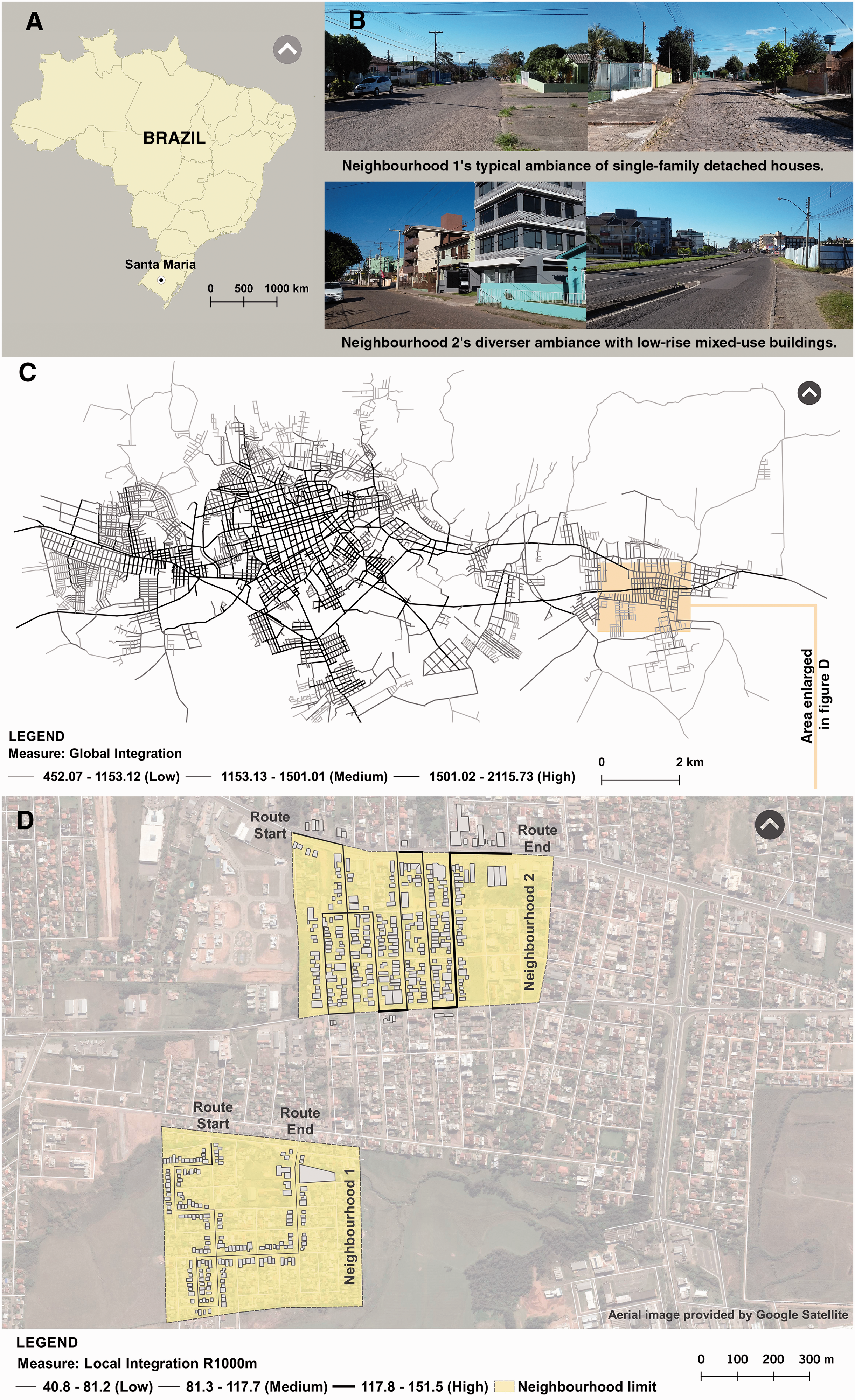
The study area: (a) the city’s location in southern Brazil, (b) the two neighbourhoods’ ambiance, (c) the city’s segment map with the ‘global integration’ measure, and (d) the counting routes overlaid on the segment map with the ‘local integration R1000m’ measure. Source: Authors.
The study neighbourhoods were selected with the measure ‘global integration’ (Figure 1(c)), after classifying all city segments with the Natural Breaks method, which reduces variation within the stipulated classes, in that case, three (low, medium and high global integration), and maximizes the variance between them. Two neighbourhoods with different levels of accessibility were chosen, one of low to medium global integration; and another, from medium to high global integration. The number of segments selected in each neighbourhood was based on the minimum standards of similar space syntax studies: 20 and 24 segments were randomly selected, encompassing 27% and 48% of the total segments of neighbourhoods 1 and 2, respectively. To guarantee morphological diversity also at a local scale, the selection covered the four classes of the variable ‘local integration’ R1000m (Figure 1(d)). The first neighbourhood (COHAB Fernando Ferrari) is essentially a single-family detached house area, while the second one (Vila Santos Dumont) presents a mixture of low-rise mixed-use buildings, but largely residential ones. Therefore, neighbourhood 1 had a smaller number of segments selected because it practically does not present any variation in its street characteristics. In general, spatial patterns are consistent within both neighbourhoods, so its co-presence patterns are likely similar in the remaining segments.
There are several techniques developed for counting of pedestrians, some more adequate than others, depending on the collection purpose (Vaughan and Grajewski, 2001). In this research, an adaptation of the ‘moving count’ (Hillier et al., 1993) was used, which allows the simultaneous counting of static and moving pedestrians. In this method, the researcher walks along a predefined route within each study area, at an average speed of approximately 1.5 m/s, counting the number of pedestrians passing by. Only the pedestrians in motion in the opposite direction to the displacement of the researcher and/or those that are static are counted. This distinction is made to differentiate appropriations from urban space in passing movement and stationary activities. Two counting routes were defined, only to establish a travel reference for the researcher, who must always count pedestrians in the same way, starting from the same origin segment to the final one.
In order to avoid distortions of co-presence levels, it is necessary to count at various timetables during the day and on different days of the week. Thus, averages of co-presence levels are obtained. The atypical days are Mondays and Fridays, whose movements are not normal and show great variation in relation to the other days of the week, as well as the same days in other periods of the year (Transportation Research Board, 2000). In this study, counts covered all periods of the day, in five time intervals of two hours each: from 8 a.m. to 6 p.m. Counts at each time interval were repeated on four typical weekdays and on four Sundays (atypical days), to ascertain possible similarities and/or differences in the two situations. Each route was accordingly observed 40 times. The attractors were collected in loco, being counted in units and aggregated considering the total units of all the building floors of both sides of the same segment and divided by the total length (in metres) of the segment. Thus, segments with length differences can be compared. The constitutions (doors), garages and windows of all floors were counted in units, on both sides of the same segment, along its entire length and only considered when located at the interface between public and private space. The total value of the permeability variables was later divided by the length of the segment as well.
Only the independent variables that showed stronger correlations and/or correlations with most of the co-presence categories were selected to the regression analysis (Table 1), to avoid compromising the model’s quality. Eight non-linear regression models were created, four for each neighbourhood, in software R (R Core Team, 2017). Generalized linear models were used because each category of co-presence was not in a normal distribution. Within the software, the stepwise method adds or eliminates variables, one at a time, from an initial model to final models that can represent the phenomenon better.
Behaviour of the explanatory variables of co-presence in routes 1 and 2.

Source: Authors.
R1: route 1; R2: route 2; SP: static pedestrians; MP: moving pedestrians; AD: atypical day; TD: typical day.
Results and discussion
Hereafter, the regression models are presented in the supplemental material and Table 1 shows the behaviour of the co-presence explanatory variables in routes 1 and 2. As the stepwise method does not use all the independent variables to compose the models, the discussion of the effects of each variable is restricted to the particular model. These effects cannot be simply compared to each other, precisely because they have shown different independent variables, which also have different units. Only one model did not input any configurational variable, but this was precisely the one with the lowest generalized coefficient of determination, i.e. the lowest potential for explaining the co-presence variability: less than 50%.
Regarding the ‘integration’ measure, it was always positively related to co-presence in route 1. Also, it was significant in its global version only for static pedestrians, and, in its local version, for all models. Both variables showed behaviours consistent with the syntactic theory: the greater the ‘integration’ of a segment, the higher its co-presence levels will generally be. However, in this specific case, the isolated variation of the ‘integration’ would not result in a substantial impact on the total co-presence. This is because the neighbourhood’s regular grid tends to distribute the ‘integration’ more homogeneously, not increasing the measure substantially from one segment to the other.
In route 2, except for the atypical day models, ‘integration’ was also significant; however with the difference that it would increase or decrease the total of moving/static pedestrians by its global and local version, respectively. On typical days, route 2 presents a greater pedestrian increment than in route 1 and receives more strangers (non-resident or non-working there) due to its greater accessibility. This group of pedestrians maintain weaker spatial ties and prefer more direct ways to travel and, therefore, tend to use more globally integrated segments. In this study area, there is a weak positive correlation between the two versions of the variable ‘integration’ (r = 0.32), which means that not all the segments are both more globally and locally integrated. Thus, stranger’s patterns could explain the different behaviour of the variable in this route. The ‘integration’ measure, in general, was one of the main configurational variables that related positively with co-presence.
The global and local ‘choice’ measures showed differentiated behaviours in route 1. The first was significant only on typical days, with a negative relationship, while the second had a positive relationship on three categories of pedestrians, suggesting that the through-movement in the neighbourhood is short-range, i.e. local and linked to the inhabitants themselves. In route 2, which comprises mixed land use, the ‘choice’ measure explained the phenomenon less, being significant only for two models and with opposite behaviours, positively relating to the moving pedestrians on atypical days in its global version. The results were somewhat inconclusive, since this variable had a positive and negative relation on the co-presence, needing to be further analysed with greater control of other factors, as will be discussed further.
The ‘connectivity’ measure was significant for three models of route 1, always with a positive relation on co-presence, in agreement with the syntactic theory which states that more connected segments – which give access to others in route choice – end up being more used by who moves through space. It also had a positive relationship on the static pedestrians: they can stop in very connected segments because this characteristic potentiates the encounter with other people, whether they are known or not, referring to what Grannis (1998) states on passive interactions. In route 2, the variable was only significant for one model, negatively relating to co-presence. It does not mean that ‘connectivity’ is not a favourable attribute to increasing co-presence though. In this case, pedestrians may prioritize segments with other characteristics, such as a greater ‘integration’.
Concerning residential use, it had significance in route 1 only for moving pedestrians on atypical days, with a positive relationship. Since this area is essentially residential, it is assumed that most of its residents work outside the neighbourhood. Thus, on typical days, the impact of residential attractors on co-presence would tend to be concentrated when commuting. On non-working days, it is assumed that inhabitants are at home, which enhances the continuous impact of the residential attractors on the co-presence: more people can leave their dwellings and initiate leisure or utilitarian travels in public space. In this case, segments with a greater number of dwellings would have greater co-presence. In route 2, residential use had significance and a positive relationship only with static pedestrians on atypical days. Therefore, both neighbourhoods seem to function similarly on Sundays and, in this context, residential use seems to increase co-presence on atypical days, when there are potentially more inhabitants in the neighbourhood than on typical days.
Regarding other attractors, service activity was significant in route 1 for static pedestrians, in both situations, with a positive relationship with co-presence. Commercial activity in this route was significant and positively related to static pedestrians on atypical days only. As this neighbourhood is essentially residential, a plausible explanation for this is that some of its service/commercial activities are family businesses adjacent to the dwellings. Even on atypical days, these activities operate with flexible hours. In route 2, service activities occur with a higher frequency than in route 1, however, they are not significant for the models, being overtaken by other variables. In this context, results suggest that this type of activity increases co-presence mainly in association with other variables, like commercial activities. In neighbourhood 2, this variable was significant and positively related to all models. This demonstrates the potential of this type of attractor to generate travels for buildings continuously, even on atypical days. In this context, results suggest that commercial activities’ effect, when significant, is always to increase co-presence.
As for permeability measures, in route 1, the constitutions had different behaviours. With moving pedestrians on typical days, the variable had a negative relationship. However, this does not mean that pedestrians generally prefer to move along streets with fewer doors, but that they may end up using segments with characteristics more favourable to their movement. In both situations on route 1, constitutions had a positive relationship with static pedestrians. This can be related to Netto et al. (2012), who found strong and positive correlations between pedestrians and doors in less accessible streets and to Zampieri (2012), who pointed to the constitutions as the major potentiators of co-presence in central areas. In route 2, the constitutions were significant and positive for the static pedestrians on typical days only. In this context, results suggest that constitutions’ effect, when significant, is to increase static pedestrians, especially in mainly residential areas. Concerning moving pedestrians, results are inconclusive and samples need to be expanded in further studies. The garages were only significant in route 1, for two models only. Strangely, it had a positive relationship with moving pedestrians on typical days, which could be possible if they were also used as pedestrian access, in the manner of constitutions. However, there is no evidence of this in route 2. In this context, the results for this variable were inconclusive and it was not possible to identify a pattern of behaviour.
The windows had significance for three models of route 1 and only one model for route 2, with different behaviours. On route 1, it had a negative relationship with co-presence, invalidating for this context Jacobs (2000) discourse on ‘eyes on the streets’. This neighbourhood is more homogeneous in terms of architectural typology (its number of windows is more or less constant) and has no segments with total absence or excess of visual permeability. Thus, one possibility to bring is that, in this context, the windows would not relate to pedestrians’ perception of safety and their route choice. If this is true, it can be suggested that, also for the constitutions, segments with greater linear length have more buildings and more windows, but these are not the most accessible within the neighbourhood. Therefore, pedestrian’s route choice would prioritize other characteristics than permeability. In route 2, this variable was significant and positively related only to moving pedestrians on typical days. In terms of the number of windows, this neighbourhood is less homogeneous than the other, but this does not reflect in stronger correlations with co-presence. Other studies, such as Netto et al. (2012) and Saboya et al. (2015), have also shown opposite results for visual permeability in less accessible streets. In this context, the results for this variable were inconclusive in the two routes: there is no clear pattern of behaviour, requiring expansion of the sample with greater variability and control of other variables.
It is necessary to consider the existence of correlations among the independent variables themselves, which may mask the relation of some of them on the dependent variable. The global and local ‘choice’ measures have a strong positive correlation with each other (r = 0.82) in route 1, which means that through-movement is captured by both measures. It could be that, in the regression, one version of the measure masked the other, generating both positive and negative relationships with the same co-presence category analysed, as is the case for ‘static pedestrians on atypical days’ and ‘moving pedestrians on typical days’. Another doubt was why ‘integration’ did not show up as a significant variable for atypical days in route 2 since this neighbourhood is more accessible. Due to the strong correlations between ‘commercial units (m)’ and the local measures of ‘integration’ (r = 0.70) and ‘choice’ (r = 0.86), such attractor could neutralize the relationship of configuration with co-presence in the regression.
The same seems to occur with ‘connectivity’, a configurational variable of positive relation with co-presence in a more homogeneous land use zone like neighbourhood 1. In the other less homogeneous neighbourhood, this variable does not seem to contribute to the increase of co-presence. There were also doubts about regression models’ ability to identify relationships between permeability measures and co-presence. This is due to the difficulty of controlling other independent variables’ correlations with doors, windows and garages. Permeability measures are directly related to the architectural typology, more or less homogeneous in this context. For this study, two possible explanations about visual permeability results are still raised. First, in relatively homogeneous areas (in terms of architecture typology), possible relations of visual permeability on co-presence could be neutralized, due to the low variability in the dataset, not allowing regression analysis to identify a pattern. Or the results for visual permeability could have been biased by other correlated independent variables, an association that the regression analysis does not discern.
Conclusion
Each neighbourhood studied presented a particular co-presence pattern. Configurational measures had significance for almost all co-presence categories analysed, especially in route 1, and these results are similar to those of several space syntax studies. This fact already shows the importance of the urban form for public space appropriation by people. Also, through relative accessibility, the configuration guides the location of commerce, which amplifies the natural movement. Thus, urban form acts in conjunction with other spatial attributes that enhance co-presence, as proposed by Hillier et al. (1993). It has been found that the density of residential attractors alone contributes to increased co-presence on both neighbourhoods on atypical days when there are potentially more inhabitants at home being able to use public space at any time of the day. Commerce was the attractor with the greatest potential to generate travels being significant for the largest number of categories of co-presence. Also, mixed-use buildings in neighbourhood 2 seemed to be important for the reinforcement of co-presence as a whole in public spaces. On atypical days, inhabitants avoid the desertification of streets. On typical days, when inhabitants are working outside the neighbourhood, the non-residential activities begin to account for the liveliness of the streets, attracting both the share of dwellers that remain in the local place as the strangers moving there. Regarding permeability, the results of this research were somewhat inconclusive. The literature review also reported opposing results for these variables, which leads one to believe that they have a very specific behaviour related to co-presence, depending on the context. In this sense, more research would be necessary.
Dispersed urbanization encompasses socio-spatial realities that can differentiate locally in terms of configuration, land use and architectural typology. This research stands as a modest first step for co-presence studies in dispersed residential neighbourhoods of Brazilian medium-sized cities. Although generalizations cannot be made, these results could indicate improvements necessary in further studies’ methodology. Thus, some final considerations are made. Regarding the studied area, further studies should consider dispersed areas with more diverse configurations and architecture typologies, including regular and irregular grids with different levels of physical and visual permeability. This could identify potential differences and similarities of spatial arrangements and their implication on co-presence. Another approach may consider using a dispersion indicator to select different study areas and test the same attributes of this research to verify if there are minimum or maximum limits in which these characteristics relate to co-presence.
In respect of pedestrian counting in further works, it would be interesting to cover other periods of the year, such as summer, and also the night time. The disaggregated analysis of co-presence, differentiating pedestrians by gender and age should also be considered, seeking to identify particularities of appropriation of space by each group. Another possibility to be considered is to create models that aggregate static and moving pedestrians and verify their performance. A multicollinearity test can also be a welcome step in the creation of simpler models with fewer variables. Besides this, combined measures of highly correlated variables (commercial and service, for instance) could be tested for regression analysis. Also, it is recommended to test other data processing techniques, such as artificial neural networks, which enable parallel (non-linear) processing of all sample data, simultaneously. This could improve the performance of co-presence explanatory models, considering that some independent variables can correlate with each other. Another further step necessary to deepen this study is the evaluation of effects size caused by each variable in each model.
Supplemental Material
sj-pdf-1-epb-10.1177_2399808320957660 - Supplemental material for Co-presence patterns in dispersed residential neighbourhoods of Brazilian medium-sized cities
Supplemental material, sj-pdf-1-epb-10.1177_2399808320957660 for Co-presence patterns in dispersed residential neighbourhoods of Brazilian medium-sized cities by Filipe BM Maciel and Fábio LL Zampieri in EPB: Urban Analytics and City Science
Footnotes
Declaration of conflicting interests
The author(s) declared no potential conflicts of interest with respect to the research, authorship, and/or publication of this article.
Funding
The author(s) received no financial support for the research, authorship, and/or publication of this article.

Supplemental material
Supplemental material for this article is available online.
References
Supplementary Material
Please find the following supplemental material available below.
For Open Access articles published under a Creative Commons License, all supplemental material carries the same license as the article it is associated with.
For non-Open Access articles published, all supplemental material carries a non-exclusive license, and permission requests for re-use of supplemental material or any part of supplemental material shall be sent directly to the copyright owner as specified in the copyright notice associated with the article.
