



Abstract
Noise is an ever-growing problem in cities. Conventional noise mitigation approaches may not necessarily control noise pollution, since whether a sound is perceived as noise is largely influenced by its specific contexts. Based on an activity-centric framework, this study examines the effects of activity-related contexts and measured sound levels based on individuals’ sound evaluations as they undertake daily activities at different geographic locations and times. Data for the study were collected from 33 participants in Chicago (USA) using Global Positioning System-equipped mobile phones, portable sound sensors, and activity diaries. Multilevel logistic modeling was used to examine the relationships among measured sound levels, sound evaluations, and activity-related contexts for each recorded activity of the participants. The results indicate that activity-related contexts significantly influence individuals’ sound evaluations as they perform their daily activities. When activity-related contexts are taken into account, the measured sound levels that individuals experienced when performing an activity are no longer significant in influencing their sound evaluations. These results support the notion that sound is not only a physical feature but also a socio-psychological construct. It is crucial to adopt a human-centric and context-aware approach in urban planning through understanding the circumstances in which a sound is perceived as noise. Such an approach would help improve sound-related urban environments and construct livable and healthy cities.
Keywords
Introduction
Noise is prevalent in cities. It has multiple sources such as traffic (including road, rail, and air traffic), industries, construction activities, commercial activities (such as loud music and conversation in bars and restaurants), recreational activities (such as music festivals), and neighborhood activities (such as ringing phones, crying babies, and barking dogs). Noise can disturb our daily activities, produce annoyance, lead to psychological stress and disorders, impair cognitive performance, and increase the risk for cardiovascular disease (Basner et al., 2014; Lercher, 1996; Passchier-Vermeer and Passchier, 2000; World Health Organization, 2011). Overall, noise can pose a threat to urban environments and adversely influence urban residents’ health and quality of life.
Despite great investment in noise abatement measures, noise pollution is an ever-growing problem in cities. A noise mitigation approach does not necessarily control noise pollution or improve urban environments (Aletta et al., 2016; Raimbault and Dubois, 2005). Despite previous attempts to use the standard dose-response framework to assess the relationships between the levels of noise and annoyance (Miedema and Vos, 1998; Ouis, 2001), studies have pointed out that measured sound levels can only explain a limited amount of the variance in noise annoyance (Lercher and Schulte-Fortkamp, 2003; Marquis-Favre et al., 2005). This is perhaps due to the fact that sound is not only a physical feature that can be measured in terms of decibels but also has a socio-psychological aspect that is evaluated and perceived by individuals. Further, the specific context of a sound largely influences whether the sound is perceived to be noise and how annoying it is (Brown et al., 2016; Herranz-Pascual et al., 2016). However, how measured sound levels and the specific context of sound influence people’s sound evaluations remains unclear.
This paper adopts a time–geographic and activity-based approach to understanding the role of contexts and measured sound levels in influencing people’s sound evaluations. Specifically, it addresses the following research questions. First, how are measured sound levels associated with individuals’ sound evaluations during their daily activities? Second, how to understand activity-related context? How are activity-related contexts associated with individuals’ sound evaluations during their daily activities? The subsequent sections of this paper are organized as follows. The literature review section summarizes recent activity-centric frameworks for understanding contexts in influencing soundscape evaluations and further advocates the use of a time–geographic approach to understand the role of activity-related contexts. The methodology section introduces data collection, variables and measures, and the statistical analysis of this study. The results section presents the results of the descriptive analysis and multilevel logistic modeling. This is followed by a discussion of the conceptual and methodological contributions of the study. Subsequently, practical implications for a multisensory, human-centric, and context-aware urban planning and development agendas are elucidated. The conclusion summarizes the major findings and reflects on the limitations of this study and fruitful avenues for future research.
Literature review
An emerging activity-centric contextual framework in soundscape studies
Soundscape studies can complement the conventional noise mitigation approach by providing a more holistic approach to understanding the relationships among urban sounds, residents, and environments (Aletta et al., 2016; Bild et al., 2016; Botteldooren et al., 2016; Schulte-Fortkamp and Fiebig, 2006). Soundscape studies consider sound as resources that can improve urban environments and residents’ quality of life (Raimbault and Dubois, 2005). Soundscape studies advocate a human-centric and subjectivity-based approach, emphasizing individuals’ own perceptions and evaluations of sound in different urban environments (Raimbault and Dubois, 2005). Urban residents are not passive receivers of sound; instead, they can actively interact with urban environments and gain multisensory urban experiences (Brown et al., 2016; Ge et al., 2009; Steele et al., 2015). Soundscape studies also promote a context-aware approach to urban planning, design, and management. A conventional noise mitigation approach is inadequate, and it requires more detailed information about by whom and in what situations a sound is considered as noise (Bild et al., 2016).
Soundscape was defined by the International Organization for Standardization (ISO 12913-1:2014, 2014) as “the acoustic environment as perceived or experienced or understood by a person or people, in context.” First, this definition of soundscape highlights both the acoustic environment as a physical phenomenon and the soundscape as a perceptual construct. Combining both individual-based sound measurements and evaluations improves our understanding of the multifaceted aspects of sound in urban environments (Jeon et al., 2011; Kang et al., 2016). Sound measurements are frequently collected by sound level meters or portable sound sensors, and sound evaluations are largely collected through survey questionnaires and interviews with research participants (Ge et al., 2009; Zhang and Kang, 2007). Second, it suggests that context has a significant influence on people’s perceptions and evaluations of sound (Brown et al., 2016; Herranz-Pascual et al., 2016). The same measured sound level in different contexts can lead to different perceptions and evaluations by individuals (Botteldooren et al., 2016; Schafer, 1977). However, how to understand the contexts and to what extent the measured sound levels and the contexts influence individuals’ sound evaluations need more studies.
Among different strands of understanding the role of context in soundscape studies, an activity-centric framework for understanding context and its roles in influencing individuals’ sound evaluations has become popular (Bild et al., 2016, 2018; Herranz-Pascual et al., 2010, 2016, 2017; Jennings and Cain, 2013; Lercher and Schulte-Fortkamp, 2003; Steele et al., 2015). This is because human activities are the major sources of sounds in urban environments (Hong et al., 2020). Further, humans spontaneously categorize their daily soundscapes in relation to their activities (Steele et al., 2015). The activity-centric framework for understanding context frequently involves “the interrelationships between person and activity and place, in space and time” (ISO 12913-1:2014, 2014). Person, activity, place, and their interrelationships are key elements for understanding the influence of context on individuals’ sound perceptions and evaluations. Specifically, with respect to a person, important attributes include individuals’ demographic backgrounds and personal sound-related experiences such as their sensitivity to sound and their adaptation to sound. With regard to an activity, important attributes include activity types and the presence of companion(s) during the activity. For instance, whether an activity requires attention and quietness influences people’s perception of ambient sound (Bild et al., 2016). Place is frequently understood in terms of the space and time of individuals’ activities that influence their perceptions of sound.
Although great progress has been made in developing an activity-centric framework for understanding the role of contexts in influencing individuals’ sound evaluations, there are still several issues in this strand of soundscape studies. First, by whom and in what situations a sound is considered as noise have not been simultaneously considered. The contexts involve both individual-level socio-demographic attributes and activity-level contextual attributes, which are conceptualized as activity-related contexts in this paper. To what extent individuals’ sound evaluations are influenced by measured sound levels and the activity-related contexts and in what ways the activity-related contexts influence individuals’ sound evaluations require further investigation.
Second, existing studies have been conducted largely in urban parks and public squares (Bild et al., 2016, 2018; Herranz-Pascual et al., 2016; Zhang and Kang, 2007), and their findings mainly pertain to and explain people’s recreational activities in outdoor public spaces. As individuals undertake different activities with different companions at multiple locations over the 24 hours of a day, the neglect of their daily activities and the spatiotemporal variations in their exposure to sound can lead to the uncertain geographic context problem (UGCoP) (Kwan, 2012, 2018). Therefore, the diversity of individuals’ activities and activity-related contexts in their daily lives should be considered.
Third, existing urban soundscape studies have mainly focused on middle-class professionals or college students (Bild et al., 2016; Ge et al., 2009; Steffens et al., 2017). However, relatively low-income people and ethnic minorities in cities have been less studied. As observed in past studies, these populations are often exposed to higher levels of environmental pollution and health risks (Evans and Kantrowitz, 2002; Morello et al., 2001). Therefore, how these marginalized populations in urban areas are exposed to surrounding sound during their daily activities and how they evaluate the sound in diverse activity-related contexts in their everyday lives require more attention.
Incorporating a time–geographic approach to the activity-centric contextual framework
Considering the issues discussed above, this paper proposes to incorporate a time–geographic approach to the activity-centric contextual framework in soundscape studies. The time–geographic approach provides a powerful space–time perspective for understanding individuals’ daily activities in sequence (Ellegård, 2018; Kwan, 1998). Activity diaries have been widely used in time–geographic studies (Ellegård, 1999, 2018; Kwan, 1998). Activity diaries collect detailed information about people’s daily activities (e.g. by whom, when, where, what type, and with whom the activity is undertaken) over the 24 hours of a specific day during the surveyed period (Chen et al., 2011; Schweizer et al., 2007). In addition, recent studies have combined the use of activity diaries, Global Positioning System (GPS) technologies, and portable real-time sound sensors (Ma et al., 2020; Stewart et al., 2016). Together, the time–geographic approach not only helps to capture the richness of individuals’ activities in their daily lives, but also provides new opportunities for understanding how individuals’ sound evaluations are related to measured sound levels and various activity-related contexts as their daily activities unfold.
Drawing upon the activity-centric contextual framework in soundscape studies and the time–geographic approach, this article proposes that pertinent activity-related contexts include both individual attributes and the location, time, companion, and type of specific daily activities undertaken by each individual. Specifically, individual attributes mainly consider individuals’ socio-demographic characteristics such as ethnicity, gender, education, and employment status, which were observed to influence people’s perceptions of sound in past studies (Bild et al., 2016; Jennings and Cain, 2013; Yu and Kang, 2008). For instance, individuals from different ethnic backgrounds may have different cognitive styles, which may in turn lead to different levels of tolerance for noise (Herranz-Pascual et al., 2010). Females are more sensitive to certain sources of noise when compared with males (Van Kamp and Davies, 2013). People with higher levels of education and professional jobs show less tolerance for noise in urban areas (Miedema and Vos, 1999; Yu and Kang, 2008). However, as discussed above, more studies are needed to focus on low-income ethnic minorities in cities and how they evaluate the surrounding sounds in their everyday lives.
In addition to individual attributes, the activity-related contexts also consider activity-level attributes including activity location, time, type, and companion. Activity location considers the geographic location of daily activities, involving home location, workplace, and other locations (Ellegård, 1999; Kwan, 1999). Previous soundscape studies have shown that at different geographic locations, people have different motivations for activities, which can further influence their sound perceptions at these locations (Bild et al., 2016; Herranz-Pascual et al., 2010; Steffens et al., 2017). Further, individuals’ familiarity with and control over a location can influence their expectations of sound and its controllability at that location, which further influence their sound evaluations (Jeon et al., 2011).
Activity time considers the time of daily activities. Studies have shown that in different periods of a day, people’s tolerance for high levels of sound can be different. For instance, the noise metric LDEN divides the 24 hours of a day into day, evening, and night periods and further adds penalties for the measured sound levels during evening and nighttime. This is because people are more annoyed by the same levels of noise in the evening and nighttime when compared to the daytime (World Health Organization, 1999). Further, people have different activity patterns during the different periods of a day. For instance, during day time, people may undertake work or other types of activities outside their home; in the evening, they may undertake diverse types of activities at home or at other locations; and during night time, they normally sleep at home (Ellegård, 2018). The different activity patterns during different periods of a day can further influence individuals’ sound evaluations (Bild et al., 2018).
The type and companions of daily activities also influence individuals’ sound evaluations. Different activity types and companions require different levels of individual attention and engagement, which may further influence whether they are more or less easily disturbed by high levels of sound (Herranz-Pascual et al., 2010; Lercher, 1996; Steffens et al., 2017). For instance, when people are undertaking recreational activities that make them happy and relaxing, they tend to have a higher tolerance for high levels of sound (Herranz-Pascual et al., 2017). When people are sleeping, they tend to be more easily bothered by high levels of sound (World Health Organization, 2011). Bild et al. (2018) have found that solitary participants are more likely to be disturbed by high levels of sound when compared to their socially engaged counterparts in urban parks. The time–geographic approach and the activity diaries method provide a well-developed categorization scheme of individuals’ activity types and companions that are rooted in people’s everyday lives (Ellegård, 2018). However, how different categories of activity types and companions influence individuals’ sound evaluations still requires more studies.
Methods
Data collection
Data collection was conducted from October to December 2017 in the Humboldt Park neighborhood in Chicago, USA. This is a neighborhood that is resided by ethnic minorities in Chicago. Participants of this study were mainly recruited from affordable housing apartments in the neighborhood with the help of a non-governmental affordable housing organization. In the survey, a survey questionnaire, a portable sound sensor, a GPS tracking device, and activity diaries were used together to measure the sound levels of participants’ immediate surroundings in real-time and to collect data of their sound evaluations associated with their specific daily activities for a weekday and a weekend day (e.g. Friday and Saturday or Sunday and Monday). Specifically, each participant completed a survey questionnaire that collected his/her demographic information and self-reported health status. Furthermore, each participant carried a sensor bag with a portable sound sensor and a GPS-equipped mobile phone. Figure 1 shows an example of the setup of the sensor bag. The GPS recorded the time and geographic coordinates of participants’ movement trajectories at a resolution of 1 meter or 3 seconds, whichever came first. The portable sound sensors, which are data-logging sound level meters, recorded real-time minute-by-minute A-weighted sound levels during the survey days. The sound sensors meet the standards of IEC 61672 Type 2 (IEC 61672:2013, 2013) and ANSI S1.4 Type 2 (ANSI S1.4:1983, 1983) Sound Level Meter with an accuracy of <1.5 dBA error and a measurement range from 30 to 130 dBA. Each sound sensor was calibrated using a CEM SC-05 Sound Level Calibrator at both C-weighted and A-weighted 94 dB and 114 dB to ensure accuracy before being distributed to a participant.
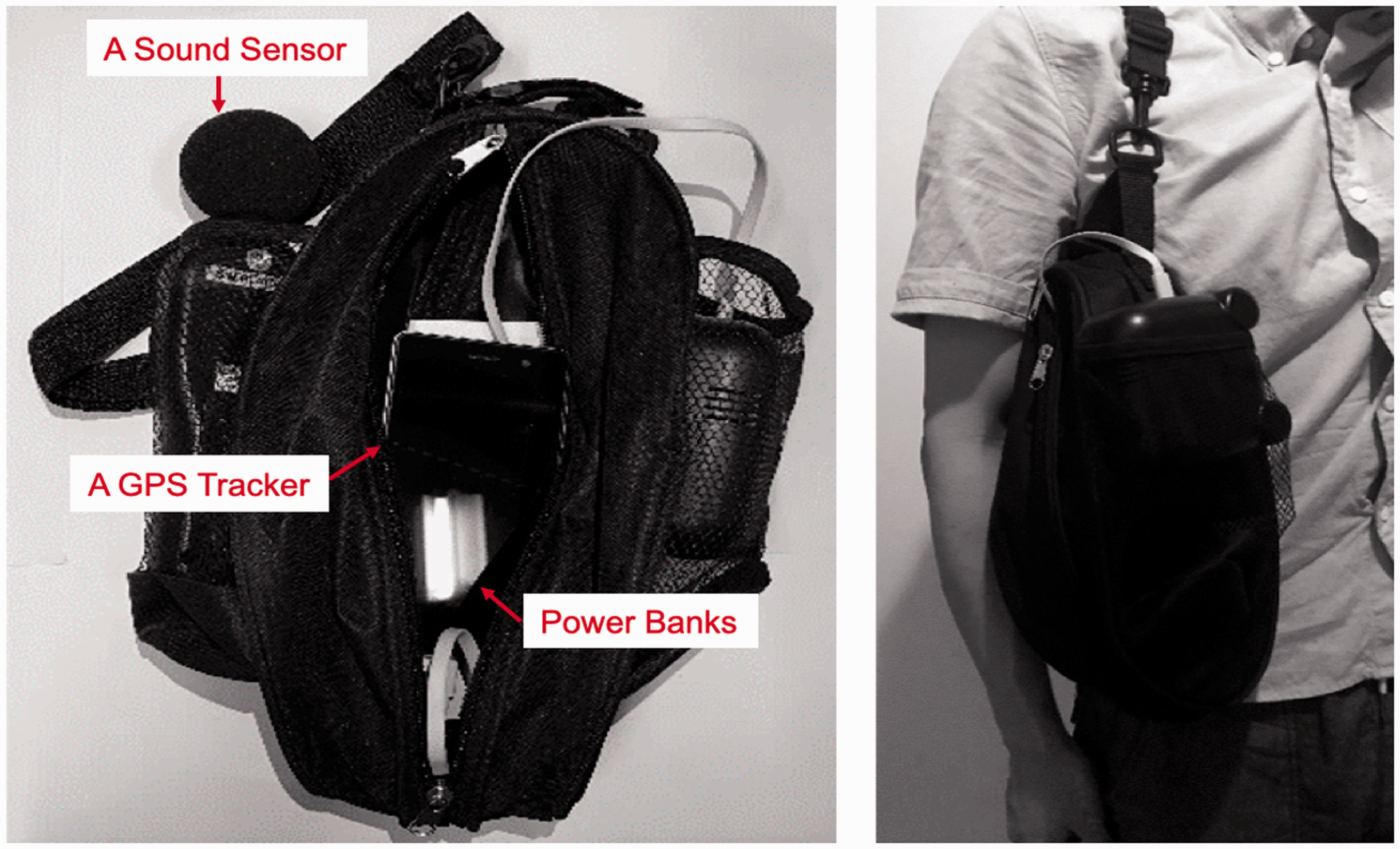
An example of the setup of the sensor bag.
In addition, participants were asked to complete an activity-travel diary for the two survey days. They were requested to record detailed information on their daily activities after each activity was performed in sequence in an activity log and then transfer the information from the log sheet to an activity-travel diary at the end of each survey day. Questions on the type, companions, location, start time and duration, indoor/outdoor, and evaluations of whether noise is a problem for that particular activity were asked in the activity diaries. Specifically, individuals logged the start time and duration of each of their daily activities. The question of whether the activity is inside a building had a binary choice. The questions on the activity type, companions, and location were single-choice questions, with a wide range of choices, together with an option for participants to fill in their answers if none of the choices apply. The choices were based on past time–geographic studies of people’s activity-travel patterns. These studies have developed a widely used activity categorization scheme that is constructed based on empirical results on individuals’ everyday lives (Ellegård, 2018). The choices of activity types include several categories: study/work, recreation, shopping, personal affairs, housework, recreation, and sleep. The choices of activity companions include alone and being with friend, family, relative, child, and other people. The choices of activity location include home, work, and other locations. If participants selected other locations, they were requested to provide the name and address of the locations.
Before the data collection, participants signed an informed consent form and participated in training sessions to ensure their full understanding of the instructions and procedures of the entire survey. After the data were collected, data triangulation and cross-validation were conducted. To ensure the accuracy of the input of the activity diaries of each participant, the geographic information (e.g. activity time, location, indoor/outdoor) of each activity provided by the participants in their activity-travel diaries were cross-checked with and corrected based on the precise spatiotemporal information of his/her GPS trajectories. In total, 46 participants were recruited, among whom 33 participants completed the two-day GPS trajectories, sound measurements, and activity diaries data collection process. There were 504 activity records collected from the 33 participants. On average, each participant had about 15 records of activities for the two survey days.
Variables and measures
This study focuses on how activity-related contexts and measured sound levels are related to individuals’ sound evaluations during their daily activities. There are three types of variables: activity-related contexts, measured sound level of each activity, and sound evaluation of each activity. Variables of activity-related contexts and measured sound level of each activity are treated as the independent variables, and the sound evaluation of each activity is treated as the dependent variable.
The activity-related contexts include individual attributes, and the location, time, type, and companion of daily activities. Individual attributes include gender, ethnicity, education level, and employment status. Activity location is categorized into home, workplace, and other locations. The rationale is that people have different purposes for daily activities in these locations and have different levels of familiarity with and control over these locations, which may further influence their sound evaluations (Jeon et al., 2011). Activity time is categorized into day (from 7 am to 7 pm), evening (from 7 pm to 11 pm), and night time (from 11 pm to 7 am). This follows the division of time of the LDEN. However, since this study intends to examine the effects of different periods of a day on how individuals evaluate sound when undertaking their activities, we do not add penalty to the measured sound levels during different time periods. Activity companion is treated as a binary variable: alone and with others. The rationale is that the presence of companion(s) may influence people’s attention to their surrounding sound (Bild et al., 2018). Activity type is classified into five categories, including work and study, personal affairs, housework, shopping and recreation, and sleep. The division follows the commonly used time–geographic activity categorization scheme (Ellegård, 2018), and further, different activities may require different levels of individual attention and engagement, which may further influence their sound evaluations (Herranz-Pascual et al., 2010). Specifically, personal affairs include personal care, healthcare, errands, having meals, and other personal activities. Housework includes activities such as cleaning, preparing meals, and taking care of children or family members. Shopping and recreational activities primarily include watching TV, using the phone and social media, and visiting friends or relatives of the participants.
The measured sound level of each activity for each participant was calculated based on real-time minute-by-minute A-weighted sound levels that are recorded by the portable sound sensors through aggregating these records over the time duration of each activity into an equivalent sound level. It follows the calculation of the A-weighted equivalent continuous sound level of each activity (LAeq,Activity). LAeq,Activity is based on a similar idea as the A-weighted equivalent continuous sound level over a period of time (LAeq,T), which is widely used to evaluate continuous environmental sound (World Health Organization, 1999). LAeq,T is calculated using a logarithmic function to aggregate the fluctuating sound levels over a period of time T (Passchier-Vermeer and Passchier, 2000). It transforms the every-minute A-weighted sound levels through exponentiation, computing the arithmetical average, and logarithm for the A-weighted equivalent continuous sound levels. LAeq,Activity further considers the time period T as the duration of each activity and it is calculated based on Formula (1) introduced by Neitzel et al. (2004), where nij is the number of minutes that subject j conducted activity i. LAeq
ijk
is the real-time A-weighted sound level recorded by the sound sensor for subject j with activity i at time k. Other calculations are similar to the calculations of LAeq,T, with the transformations of exponentiation, arithmetical average, and logarithm.

The sound evaluation of each activity was measured by the question “Is noise a problem?” in the activity diaries. Participants were asked to provide a rating on a four-point scale after each of their daily activities was performed (1 = “noise is not a problem at all”, 2 = “noise is slightly a problem”, 3 = “noise is moderately a problem”, and 4 = “noise is extremely a problem”). Instead of soliciting participants’ self-rated perceived sound levels of each activity, this question focuses on first whether people noticed their surrounding sound as a problem during each of their daily activities and further whether the sound interfered with their activities. In this way, participants could focus more on the experiences of their daily activities rather than trying to specify the perceived sound levels (Bild et al., 2018), which helps to minimize the attentive listening triggered by sound-specific questions (Botteldooren et al., 2016). Among the 504 activity records, 316 (62.7%) were rated “noise is not at all a problem”, 163 (32.3%) were rated “noise is slightly a problem”, 19 (3.8%) were rated “noise is moderately a problem”, and 6 (1.2%) were rated “noise is extremely a problem” during particular daily activities. Based on the distribution of the 1–4 scores, they were re-coded into a binary variable: noise was or was not a problem for a particular activity. Specifically, 316 (62.7%) of the 504 activity records rated “noise is not at all a problem” and 188 (37.7%) rated “noise is a problem”. Not that individuals’ evaluation of whether a sound is perceived as noise is referred to as a sound evaluation in this paper.
Statistical analysis
To examine how measured sound levels and activity-related contexts are related to sound evaluations at the activity-episode level, multilevel logistic regression analysis was employed for the following reasons. First, given that sound evaluation is treated as the dichotomous response variable (i.e. “noise is/is not a problem”), a logistic model is needed to constrain estimates of the dependent variable to values ranging from 0 to 1. Second, given that the analysis is based on participants’ activities and each participant performed more than one activity, the activity records are not independent (i.e. some activities were performed by the same participant). This violates the assumption of regression models that every observation (activity) is independent of each other. Thus, a multilevel design is needed. This study employed a two-level multilevel model that includes individual-level socio-demographic data and activity-level attribute data. The multilevel logistic regression modeling was implemented using the Ime4 package in R Version 3.6.0.
Results
Descriptive analysis
Most of the participants (94%) are Hispanic and African Americans. A majority of the participants are relatively low-income and rent apartments. About 60% of the participants do not have a regular job, while the employed participants have jobs such as factory workers, security guards, front desks, and babysitters. Key demographic characteristics of the 33 participants are shown in Table 1.
Key demographic characteristics of the 33 participants.

The individual-based measured sound levels and sound evaluations of different socio-demographic groups are shown in Figure 2. Male participants tend to be exposed to lower measured sound levels with a higher percentage of considering their surrounding sound not as noise compared to the female participants. African American participants tend to be exposed to lower measured sound levels with a higher percentage of considering their surrounding sound not as noise compared to the Hispanic and White American participants. Participants who received education from college and above and participants who are employed tend to be exposed to slightly higher levels of measured sound, but they tend to show a higher percentage of considering their surrounding sound not as noise compared to their counterparts.
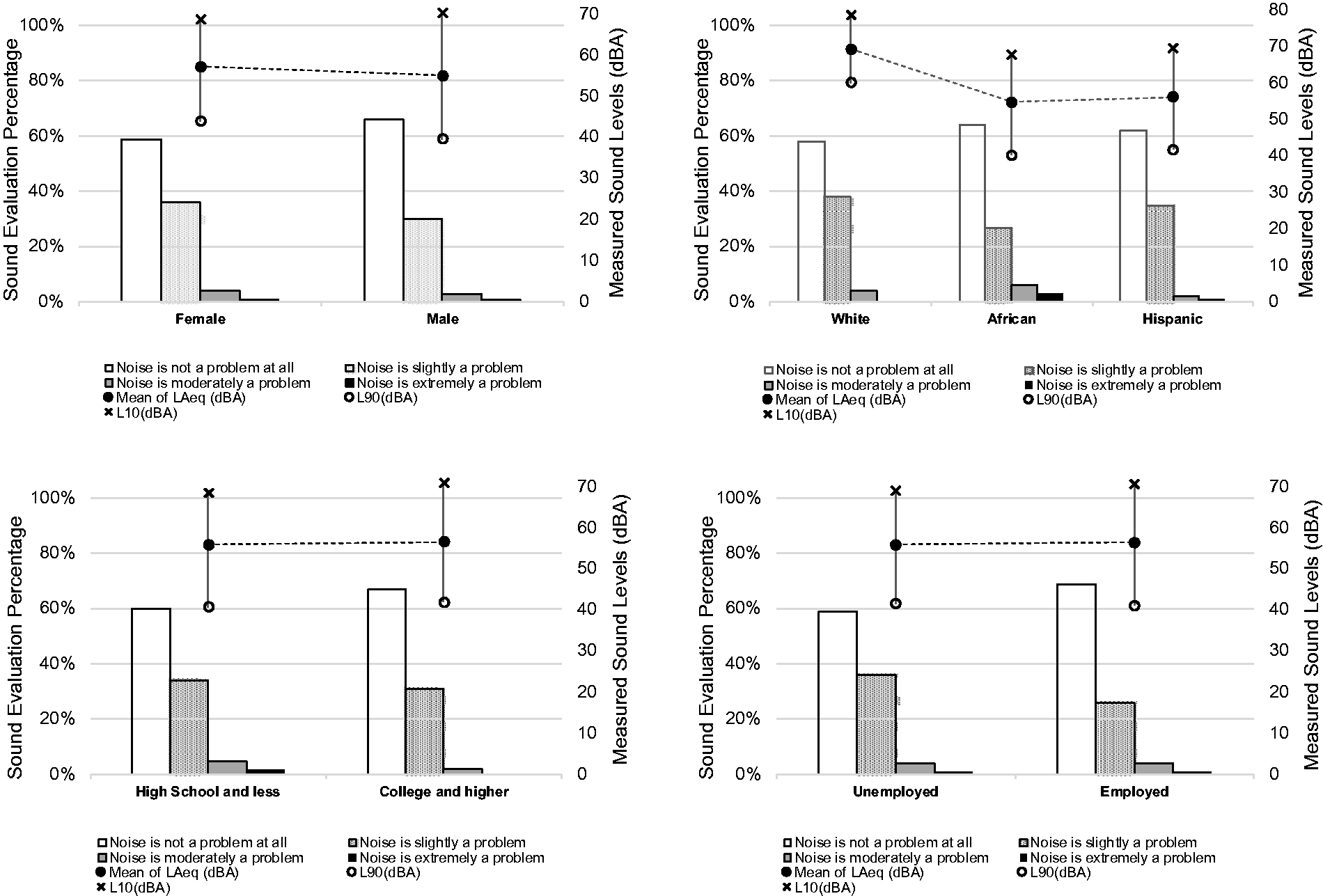
Sound measurements and evaluations of different socio-demographic groups.
The detailed descriptive analysis of both sound measurements and evaluations of the 504 activities in different activity contextual groupings is shown in Table 2. It shows that when participants are conducting activities during the daytime, they tend to be exposed to higher average measured sound levels with a higher percentage of considering their surrounding sound as noise compared to those during the nighttime. Further, when people are conducting activities at locations other than at home or their workplace, they tend to be exposed to higher average measured sound levels with a higher percentage of considering their surrounding sound as noise compared to those at home and the workplace. Moreover, when people are conducting activities with companion(s), they are exposed to higher average measured sound levels with a higher percentage of considering their surrounding sound as noise compared to those conducting activities alone. In addition, when people are undertaking work or study-related activities, they are exposed to higher average measured sound levels with a higher percentage of considering noise is a problem than when they are doing other types of activities. People tend to be more tolerant of noise when they are sleeping and when they are conducting recreational or shopping activities.
Sound measurements and evaluations of the 504 activities in different contextual groupings.

Figure 3 shows more information about activity companion(s), measured sound levels, and sound evaluations. Note that activities conducted with children and other persons are the two categories with the highest percentage of considering noise as a problem. Among the 23 records of activities conducted with children, 20 are maintenance activities that include taking care of children while performing other housework such as cleaning their apartment or cooking meals. Other such activities mainly include taking care of children such as picking up the children at school, helping the children in taking a shower, and getting ready for bed. These results suggest that either taking care of children or doing housework with an eye on the children can sometimes lead to pressure, and in these situations, people are more easily bothered by noise. It is also interesting that activities conducted with other people are frequently associated with more noise problems. Potentially, people could have a lower tolerance for an annoying sound produced by other persons compared to that produced by their family members, relatives, or friends.
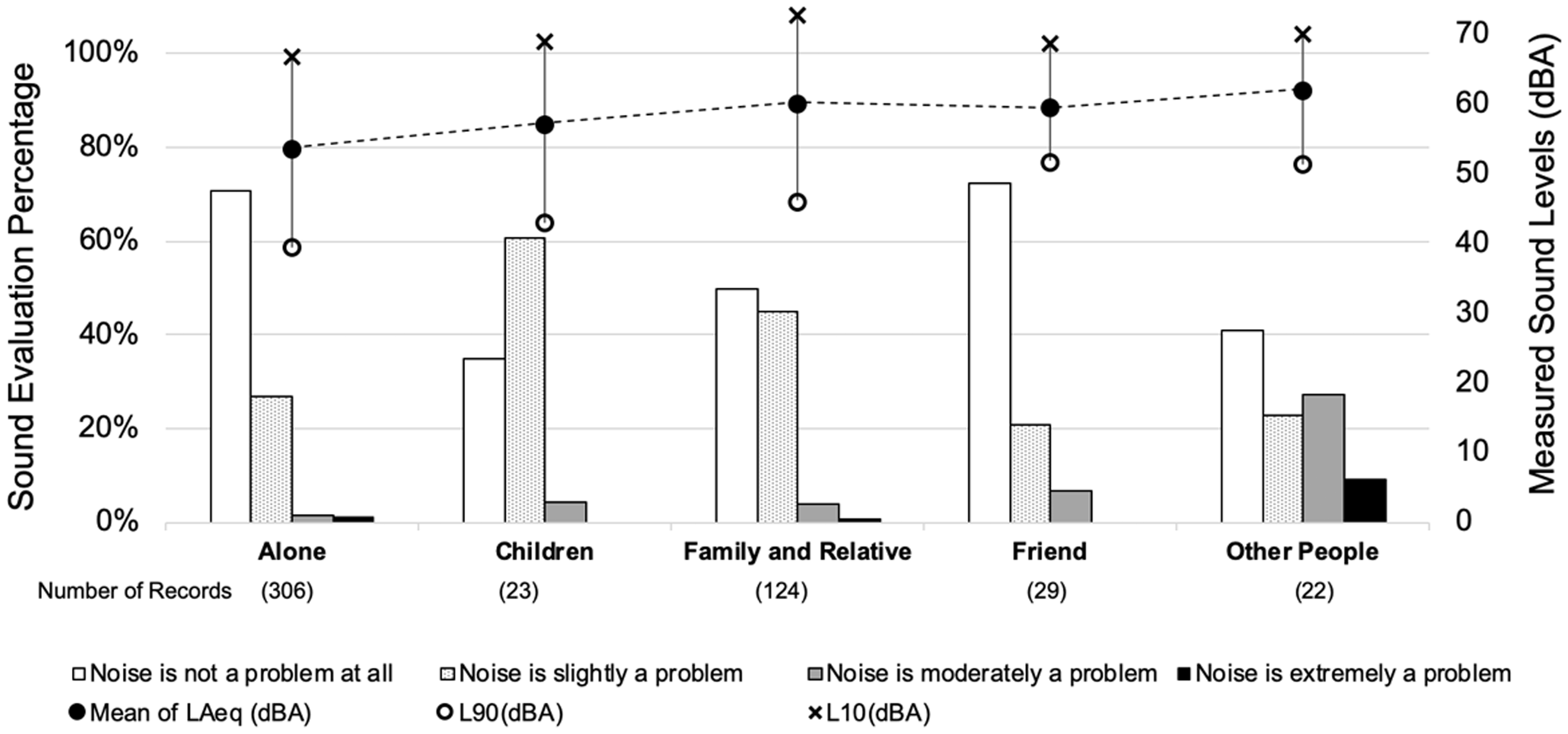
Sound measurements and evaluations in different categories of activity companion.
Figure 4 shows more information about activity locations, measured sound levels, and sound evaluations. Noticeably, there are only 15 records of outdoor activities, with the remaining 489 activities having been conducted in indoor urban microenvironments. In terms of the outdoor activities, activities such as walking dogs in the street and running in parks were rated as “noise was extremely a problem”. In terms of the activities in indoor urban microenvironments, the average measured sound levels and percentage of considering noise as a problem at non-residential locations tend to be higher than that of participants’ residential locations. Further, at hospitals and health centers, the percentage of people who consider noise is moderately and extremely a problem is relatively high compared with those at other locations. In addition, at places such as shopping malls and grocery stores, although the average measured sound levels are relatively high, there is a lower percentage of people who consider noise as moderately and extremely a problem.
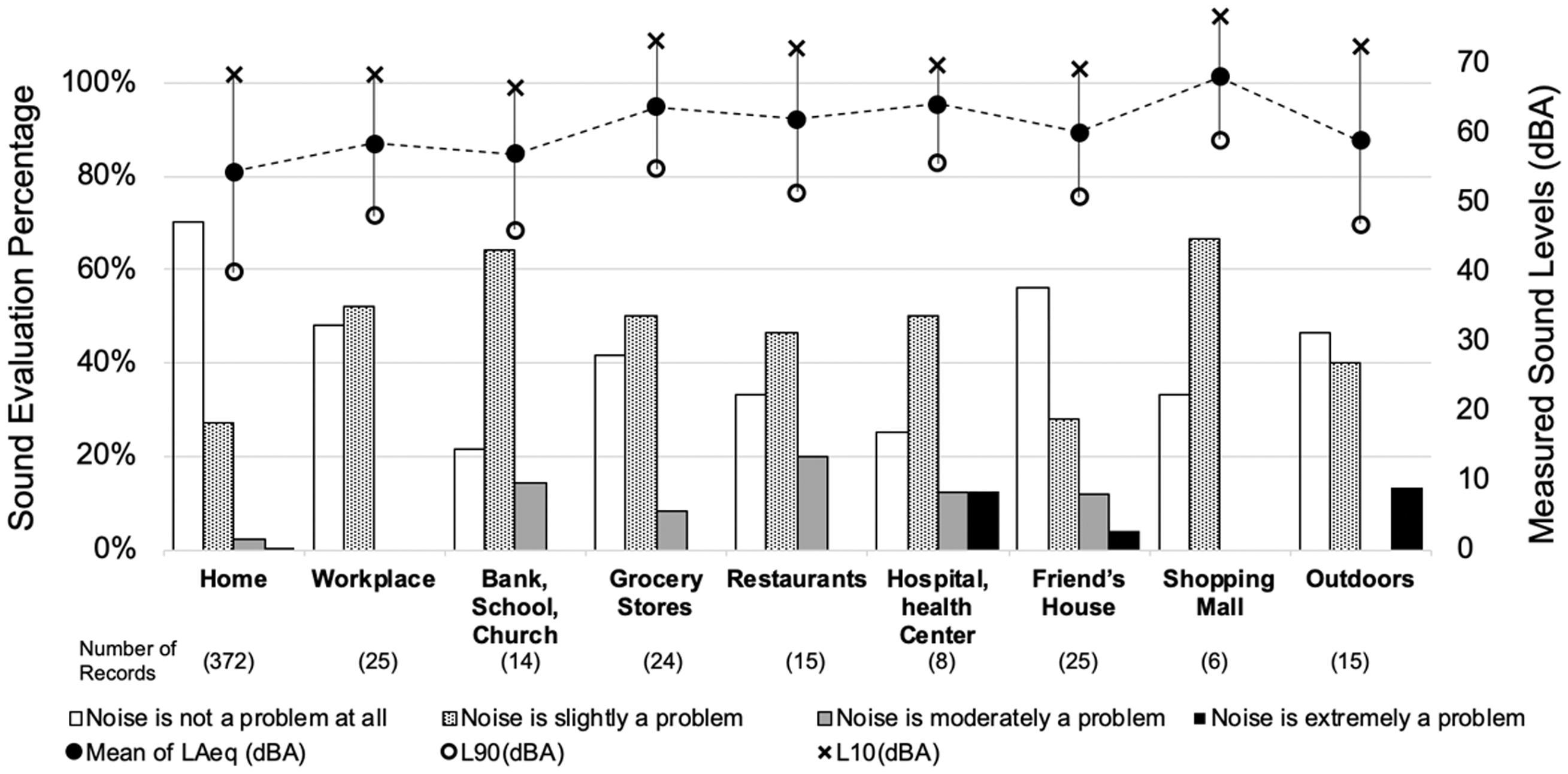
Sound measurements and evaluations in different categories of activity location.
Multilevel logistic modeling results
Multilevel logistic models reveal how measured sound levels and activity-related contexts are associated with individuals’ evaluations of whether the surrounding sound is perceived as noise. Table 3 presents the random and fixed effects in two random-intercept multilevel logistic regression models in explaining sound evaluations. Model 1 considers individual characteristics and measured sound levels of each activity. Model 2 further adds four categorical variables in terms of activity-related contexts. It is notable that when adding the activity-related context variables, the measured sound levels of each activity are no longer statistically significant. This suggests that adding the activity-related contextual variables eliminates the significance of the measured sound levels in explaining sound evaluations. In other words, activity-related contexts including activity time, activity location, activity type, and the presence of companion(s) play more significant roles in explaining sound evaluations. Although individual characteristics, including race, gender, education, and employment status, are insignificantly associated with individuals’ sound evaluations, these variables are important covariates that should be controlled for.
Detailed results of the multilevel logistic modeling.

AIC: Akaike Information Criterion; BIC: Bayesian Information Criterion; Est.: parameter estimate; S.E.: standard error.
Significance level: ***P-value < 0.001, **P-value < 0.01, *P-value < 0.05, and P-value < 0.1.
In terms of the significant variables in the final model (Model 2), there are several major findings. First, when other variables are controlled for, the odds of participants considering their surrounding sound as noise when conducting an activity during the daytime is 4.136 times of that during the nighttime. Second, when other variables are held constant, the odds of participants considering their surrounding sound as noise at locations other than the workplace or at home is 5.116 times that compared to when the participants are at their home. Third, different types of daily activities are significantly associated with people’s sound evaluations. The odds of participants considering their surrounding sound as a problem when they are undertaking work and study-related activity is higher compared to those when they are conducting other types of activities. Compared to the odds of participants considering noise as a problem during study or work-related activities, the odds of that during housework, personal affairs, sleep, and recreational or shopping activities is 0.313 times, 0.204 times, 0.202 times, and 0.165 times, respectively. It indicates that when people are doing housework, they tend to be more likely to consider their surrounding sound as noise. Further, when people are undertaking recreational or shopping activities, they are less likely to consider their surrounding sound as noise compared to when they are undertaking other types of activities.
Discussion
This study has explored how measured sound levels collected by portable sound sensors and particular activity-related contexts are related to how individuals evaluate whether their surrounding sound is perceived as noise when they perform their daily activities. When activity-related contexts are taken into account, measured sound levels that individuals are exposed to when performing an activity are no longer significantly associated with individuals’ sound evaluations. This supports the notion that sound is not just a physical feature but also a socio-psychological perception, and as a result, measured sound levels can only explain a very limited amount of annoyance and disturbance that people experience in their daily life (Lercher and Schulte-Fortkamp, 2003; Marquis-Favre et al., 2005). Instead, individuals’ evaluations of whether a sound is perceived as noise depend highly on specific activity-related contexts. Drawing upon the time–geographic approach, activity-related contexts can be understood in terms of both individual attributes and activity characteristics like the location, time, type, and companion(s) of activities. Activity location, time, and type were found to be significantly associated with people’s sound evaluations.
The findings of this study indicate that at locations other than home and work, people are exposed to higher levels of measured sound and more easily disturbed by noise. While previous studies have widely discussed noise problems at home or work locations (Basner et al., 2014; Miedema and Vos, 1998; Ouis, 2001), this study argues that sound environments in non-residential locations and diverse urban microenvironments should also be examined. Similarly, this study shows that individuals are more easily bothered by noise when conducting activities during the daytime compared to those activities during the nighttime. While past studies have paid much attention to the annoyance and disturbance caused by noise during evening and nighttime (World Health Organization, 1999), interferences by noise when conducting daytime activities, given its significant influence on individuals’ sound evaluations, should also be examined. With regard to activity type, this study shows similar findings with previous studies. When people are conducting recreational and shopping activities, they are least likely to be disturbed by noise. This is consistent with the finding of Herranz-Pascual et al. (2017) that when people are doing recreational activities that make them happy and relaxed, they have more tolerance for noise. When people are conducting work and study-related activities, they are the most likely to be disturbed by noise. This is because study and work-related activities require more attention and engagement from individuals, so that they are more easily bothered by high levels of sound (Herranz-Pascual et al., 2010; Lercher, 1996).
To the best of our knowledge, this is the first study to examine individual-based sound measurements and evaluations at the activity-episode level among a group of relatively low-income ethnic minorities in cities. The findings concerning this population group are different from those of previous studies that focused on middle-class professionals and college students (Bild et al., 2016; Ge et al., 2009; Steffens et al., 2017). First, participants of this study who are employed and have higher educational level tend to be more tolerant of noise, which is different from the finding in previous studies (Miedema and Vos, 1999; Yu and Kang, 2008). This is probably because participants of this study with higher education levels tend to have a job, but they tend to have low-skilled jobs where they are exposed to high levels of sound and they gradually get used to these noisy environments. Accordingly, they become more tolerant of noise compared to the unemployed participants. Second, daily activities and the activity-related contexts of the study participants are different from those in previous studies. While previous studies found that middle-class participants have access to quiet leisure spaces with enjoyable social companions in pleasant environments (Bild et al., 2016, 2018; Steffens et al., 2017), the participants of this study have higher burdens of housework and childcare activities and less access to quiet daily activity spaces (e.g. quiet outdoor leisure spaces, healthcare facilities, and work and study environments), which can further generate more pressure and noise complaints.
This paper has several conceptual contributions. First, it argues that adopting the time–geographic approach advances understanding of the emerging activity-centric framework in soundscape studies. The time–geographic approach provides a powerful space–time perspective to enhance our understanding of people’s daily activities, their exposure to measured sound levels, and their sound evaluations at the activity-episode level. This helps us develop an analytical framework that can be used in future studies for understanding various activity-related contexts and their different effects on individuals’ sound evaluations in their everyday lives. Second, it contributes to a people-based approach to assessing the relationships between sensor-based measured sound levels and human-centric sound evaluations in diverse urban environments. While conventional place-based soundscape studies focus on sound in outdoor environments in urban open spaces and public parks (Bild et al., 2016, 2018), this study provides more accurate assessments of person-specific sound exposures at different geographic locations and times in both indoor and outdoor urban environments. This greatly enriches our understanding of human-centric soundscapes through emphasizing how individuals undertake their daily activities and how they perceive sound as they perform their daily activities.
In addition to conceptual contributions, this paper also makes methodological advancements through integrating methods of activity diaries, GPS tracking, and real-time sound sensing. First, the mixed methods approach enabled us to collect accurate individual-based and person-specific sound measurements and evaluations during participants’ daily activities. A relatively standard protocol to collect data and cross-validation among different datasets improved the accuracy of data collected from each participant. This further contributed to a dynamic approach to capturing individuals’ daily activities and the spatiotemporal dynamics of sound in various urban microenvironments, which helped to mitigate the UGCoP (Kwan, 2012, 2018). Second, the mixed methods approach provided contextualized information about individual-based sound measurements and evaluations as their life unfolds in real-life settings and situations. This contributes to existing methodologies of in situ soundscape evaluation studies through capturing the complexity of and richness in people’s activities and sound-related phenomena in their everyday life. Last, by using multilevel modeling that considers both individual-level and activity-level data, it helped to control for individual-level differences in sound evaluations and examine the associations between individual-level demographic data and activity-level contextual and sound-related data.
The results of this study also have important practical implications for human-centric and context-aware urban planning and development. First, urban planners and policymakers should learn from more diverse perspectives of soundscape evaluations, not just from dominantly privileged populations but also from marginalized populations in urban areas such as low-income people, ethnic minorities, and unemployed persons. Furthermore, urban professionals should pay attention to improving sonic environments at not just people’s residential locations but also multiple activity spaces and microenvironments (e.g. leisure spaces, healthcare facilities, work and study environments, and childcare facilities) for these populations in their everyday lives. More broadly, in addition to mapping sound levels and implementing noise control policies, urban professionals can adopt the method and the model proposed in this study to understand in what circumstances and by whom a sound is perceived as noise as urban residents’ daily activities unfold at specific geographic locations and times. This provides valuable guidance for developing a human-centric and context-aware approach to improving urban sonic environments and constructing healthy cities.
Conclusions
This study adopted a time–geographic approach to developing an activity-centric framework for understanding the effects of activity-related contexts and measured sound levels on individuals’ sound evaluations in urban areas. The activity-related contexts included individual attributes, activity type, the presence of companion(s), activity time, and activity location of each activity. This study has shown that whether a sound is perceived to be noise largely depends on the specific activity-related context. When considering the activity-related context, the measured sound levels of each activity of an individual are no longer significant in influencing his/her sound evaluations. When controlling the measured sound levels of each activity, different aspects of the activity-related context are significantly associated with individuals’ sound evaluations. When individuals are undertaking a work or study-related activity, and when they are undertaking an activity during the daytime, at other locations other than home and work, or with companion(s), they have a higher tendency to consider their ambient sound as noise.
This research has several limitations that need to be addressed in future studies. Given the difficulties involved in collecting individual-level GPS data (e.g. costly, time-consuming, labor intensive, and privacy concerns), the survey only had a very limited number of participants. However, the study is still fruitful in that it shows that the conceptual framework and innovative mixed methods are useful for enhancing our understanding of urban soundscapes. More studies with larger sample sizes utilizing the analytical framework and methods proposed in this paper are needed to further corroborate the findings of this research. Moreover, considering the rich socio-cultural meanings associated with sound that may also influence individuals’ evaluations and perceptions of sound, comparative studies of the role of activity-related contexts in different socio-cultural backgrounds can be conducted. However, the collection of high-resolution spatiotemporal data can lead to concerns of privacy violation, especially in the Canadian or European Union-context. Therefore, when collecting, analyzing, and disseminating the individual-level spatiotemporal data, protecting participants and avoiding the disclosure of their information should be a priority. Even in the U.S., all researchers engaged in human subjects research are required to be certified for human subjects protection training, and all study protocols and procedures must go through vigorous review and obtain approval by the respective institutional review boards before any research activities can take place to ensure adequate protection of participants’ privacy and data confidentiality (this applies to the study reported in this paper). Additionally, qualitative methods can be used to provide a more contextualized and nuanced understanding of the ways in which individuals perceive sound differently in diverse urban environments.
Footnotes
Author note
Mei-Po Kwan is also affiliated to Department of Human Geography and Spatial Planning, Utrecht University, Utrecht, the Netherlands.
Acknowledgement
The authors would like to thank the anonymous reviewers for their valuable comments.
Declaration of conflicting interests
The author(s) declared no potential conflicts of interest with respect to the research, authorship, and/or publication of this article.
Funding
The author(s) disclosed receipt of the following financial support for the research, authorship, and/or publication of this article: This work was funded by the National Natural Science Foundation of China (Grants No. 41529101, 41571144). In addition, Lirong Kou was supported by UIUC Graduate College Dissertation Travel Grant and Ferber and Sudman Dissertation Awards while conducting this research. Mei-Po Kwan was supported by a grant from the Research Committee on Research Sustainability of Major RGC Funding Schemes of the Chinese University of Hong Kong.