



Abstract
This paper seeks to determine the propensity of racial minorities to live in gated communities. A recent study by Plaut in this journal finds that nonwhites are more likely to live in gated communities than whites for both renters and homeowners. Such a finding would indicate a major change in housing patterns. I replicate and build upon her study by including multiple years of data, disaggregating the nonwhite variable into its important racial components, and then interacting race with specific housing type (multi-family units vs. single family units). I find that her potentially innovative results are statistical artifacts. For homeowners, the results generally indicate that nonwhite individuals are not more likely to own a home in a gated community, especially for single family detached units. At best, they are no more or no less likely than white residents to own a home in a gated community. Minority renters are sometimes more likely to indicate that they live in a gated community, but generally only for multi-family rental units. Differences between African American and Latino gating patterns are also discussed.
Introduction
Gated communities (GCs) have become a common feature in the housing market. A recent study by Plaut (2011) points to data suggesting that nonwhite renters and homeowners are more likely to live in GCs than white residents. In summarizing her research findings from the 2005 American Housing Survey (AHS), she states that “among residents of gated communities, being nonwhite is associated with greater likelihood of living in gated communities, for both renters and owners” (Plaut, 2011: 769). If her results are robust, they would suggest that race is becoming a less important determinant of an individual’s choice to move into a GC. At a more macro-level, the results would suggest that GCs are becoming less likely to be enclaves for upper class and upper middle-class whites.
While these results may be encouraging regarding increased diversification of GCs, they may also be artifacts of statistical methodology. I build off Plaut’s results by first testing the replicability of her findings. I then improve upon the methodology by disaggregating the nonwhite variable into component races and interacting race with housing type (multi-family units vs. single family units). I test whether or not GCs are becoming less segregated for both renters and homeowners and add multiple years of analysis.
Suburban segregation and gated communities
The process of suburbanization and the growing segregation of individuals by income and predominantly race, dominated housing trends in the post-World War II era. Middle- and upper-class whites fled cities for a variety of reasons, but the migration of African Americans following jobs to northern cities is a common sociological explanation for this “white flight” (Cutler et al., 1999; Frey, 1979; Marshall, 1979). Massey and Denton’s (1987, 1988) research of suburbs noted diffuse and expansive suburban segregation compared to central cities during the 1970s and 1980s. They found suburbs outside central cities to be demographically homogenous and typically composed of white residents. Recently, studies have also shown increases in African Americans and other minorities moving to suburbs (Anacker et al., 2017; Clark, 2009; Crowder et al., 2012; Farley et al., 1997; Fischer, 2003; Freeman, 2008; Frey, 2004, 2011; Krysan and Farley, 2002; Spivak and Monnat, 2013), increases in racial mixing in suburbs (Lee, 2017), and a general decline in measures of suburban segregation over the past 30 years (Fischer, 2003).
GCs have become a hallmark symbol of suburbanization and their proliferation has been a predominantly suburban phenomenon (Low, 2003, Vesselinov and Le Goix, 2012). Thus, GCs may exacerbate existing urban/suburban segregation patterns. Low (2003) defines GCs as neighborhoods having a type of secured entrance, typically a gate or a wall, preventing access to non-residents. Residents of GCs often enter a code into a keypad and/or a security guard occupies an entry station to ensure only residents and their guests have access to the neighborhood and its amenities. The phenomenon of gating conjures up images of elite residential developments walled off from the outside world. Often developed in suburban areas, GCs have received substantial scrutiny in the academic literature concerning their effects on neighborhood demographic composition and their contribution to income and racial segregation. Pejoratively described as fortresses (Blakely and Snyder, 1997; Caldeira, 1996; Low, 2003; Sanchez et al., 2005) with fearful residents hiding behind the comfort of gates and walls (Lang and Danielsen, 1997), early research on GCs reached conclusions that GCs tended to be predominantly composed of homogenous, white, upper-class residents lacking racial and ethnic diversity (Blakely and Snyder, 1997; Le Goix, 2005; Low, 2003; Richter and Goetz, 2007) and that they contribute to suburban segregation (Le Goix, 2005).
Of all minority groups, African Americans and Latinos consistently rank the lowest on levels of gating, especially as homeowners (Vesselinov et al., 2007). On the other hand, Latino and particularly African American renters consistently report living in GCs (Danielsen, 2007, 2008; Sanchez et al., 2005; Vesselinov et al., 2007). The propensity for African Americans and Latinos to increasingly live in rental GCs partially corroborates previous research that suggests rental GCs are more racially and ethnically diverse and less segregated than communities composed of single family homes (Ellen, 2000; Richter and Goetz, 2007; Sanchez et al., 2005). However, in a study of Denver GCs, Richter and Goetz (2007) report that rental GCs are less wealthy and less educated than homeowner communities. Using data from 2001–2005, Danielsen (2007) notes that renters (nearly 12%) include those individuals renting in low-income, public, and subsidized units that may include security gates.
One metric of social mobility is homeownership levels. Owning a home compared to renting requires a certain level of financial capital and stability in order to obtain a mortgage loan. As homeowners, the Latino population may be gating at a higher rate and trajectory than the African American population. Vesselinov (2008, 2012) uses the 2001 AHS, examining gating in the Southwest among the Latino population. Especially for Latinos, education appears to be a determining factor in their likelihood of gating, even more so than for similarly educated white individuals. This pattern exists for both renters and homeowners in her research.
Even with recent studies reporting a decline in segregation in GCs, especially among gated rental communities, they all tend to note that segregation levels remain in an absolute sense and are still problematic in many GCs across the United States. However, Plaut (2011) claims that minorities are overrepresented in GCs and that being nonwhite leads to a higher propensity to live in a GC, regardless of being an owner or a renter. The history of social and housing inequality in the U.S., especially for marginalized populations and racial minorities, makes Plaut’s results either encouraging for diversity in housing, or they paint an inaccurate picture of GCs.
The purpose of my study is not to disparage her research, but to empirically test the robustness of the findings. I argue that her nonwhite variable must be disaggregated into different races. Dichotomizing the race variable into white versus nonwhite could mask racial differences in gating. I also consider type of housing and its interaction with race. Multi-family housing units are different than single family detached units for both renters and homeowners. With the exception of expensive condominium and townhome units, multi-family housing tends to be more affordable to own and rent than single family detached units. In the replication and methodological update to the Plaut study, I expect her results to be statistical artifacts once the interactive effects of race and housing type are considered for both renters and owners. The lone exception, based upon the extant literature is for minority renters of multi-family housing units. After analyzing her 2005 data, I then extend the statistical models to the other years for which similar data are available (2001, 2003, 2007, and 2009).
Methodology: Replicating Plaut (2011)
Following the table of data provided by Plaut (2011), I attempt to clean the data according to her description in the article. For all variables, responses of “don’t know,” “refused to answer,” “not applicable,” “not reported,” or “missing” are dropped from the analysis. Table 1 depicts the variables for the analyses including the original AHS variable label and the coding mechanisms used. 1
Independent variables.
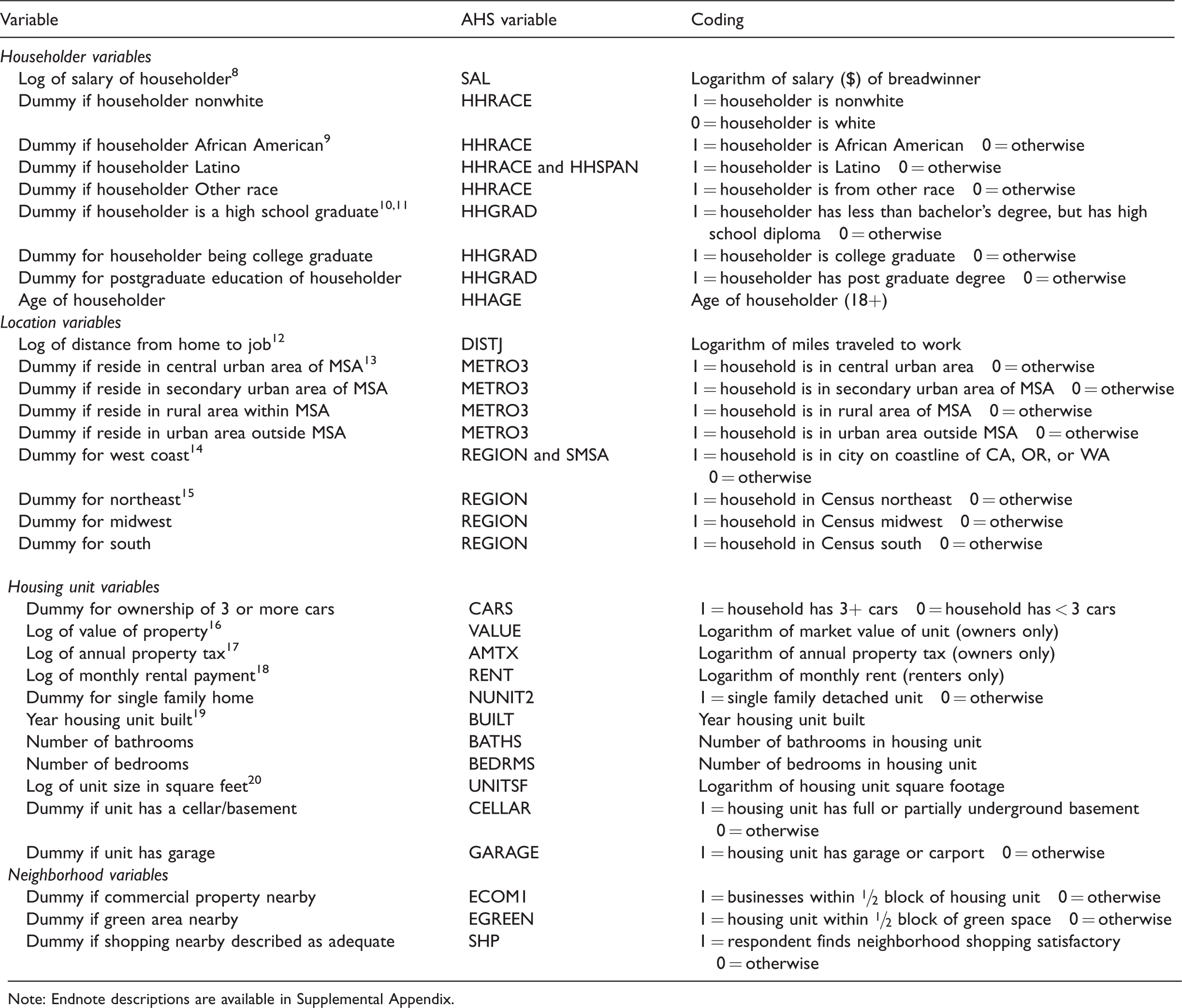
Note: Endnote descriptions are available in Supplemental Appendix.
The dependent variable for all analyses is the binary
The main variables of interest are the race variable and the single family detached housing variable. In the AHS, the
A single family detached residence variable is coded 1 if the respondent lives in a single family detached home, and 0 otherwise. This variable is created through recoding the
In the replication analysis, the single family detached variable and the nonwhite variable are separate independent variables. As an extension to Plaut’s work, I argue that (1) the nonwhite variable needs to be disaggregated by race, and (2) an interaction may exist between race and the type of housing on the likelihood of gating for both renters and homeowners. The nonwhite variable considers all nonwhite individuals as a single code. Important racial differences may exist that explain patterns of gating for both renters and homeowners. Secondly, housing type should be considered as it interacts with race for both homeowners and renters. Gating may vary by race and type of housing. Therefore, in subsequent analyses, I disaggregate the race variable into several dummy categories (African American, Latino, and Other) with “white” householders as the reference category. 2
Replication results
Table 2 (Model 1) and Table 3 (Model 4) depict the replication results for the Plaut (2011) study for renters and homeowners, respectively. The first substantive column in each table lists the coefficients reported by Plaut. She only includes the coefficients for statistically significant variables. For renters, my results are similar to Plaut’s findings in terms of strength and direction of the coefficients, with a few exceptions. Replication discrepancies from Plaut in Model 1 include the salary of the householder, age of the householder, distance from job, and whether or not a green area is nearby, but none of these variables are variables of interest in regards to racial segregation in GCs. In general, Plaut’s results for renters replicate, with nonwhites being more likely to live in a neighborhood surrounded by a gate. I find this result to be statistically significant at the 99% confidence level.
Renters from 2005 AHS—Logistic regression results.
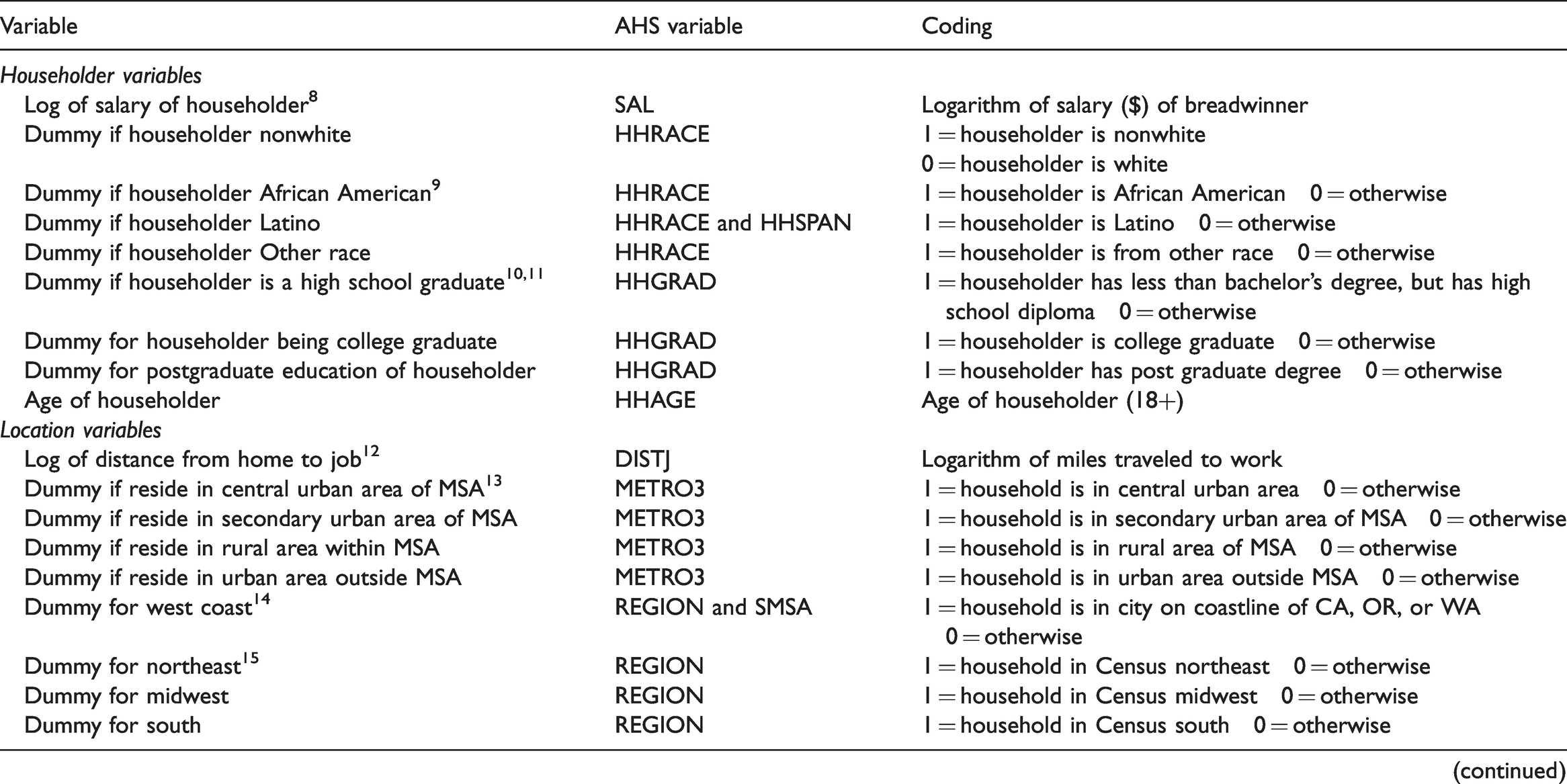
Note: Standard errors for Model 3 clustered by SMSA—See Supplemental Material Appendix D for SEs of models. l.
*p < 0.10; **p < 0.05; ***p < 0.01.
Homeowners from 2005 AHS—Logistic regression results.
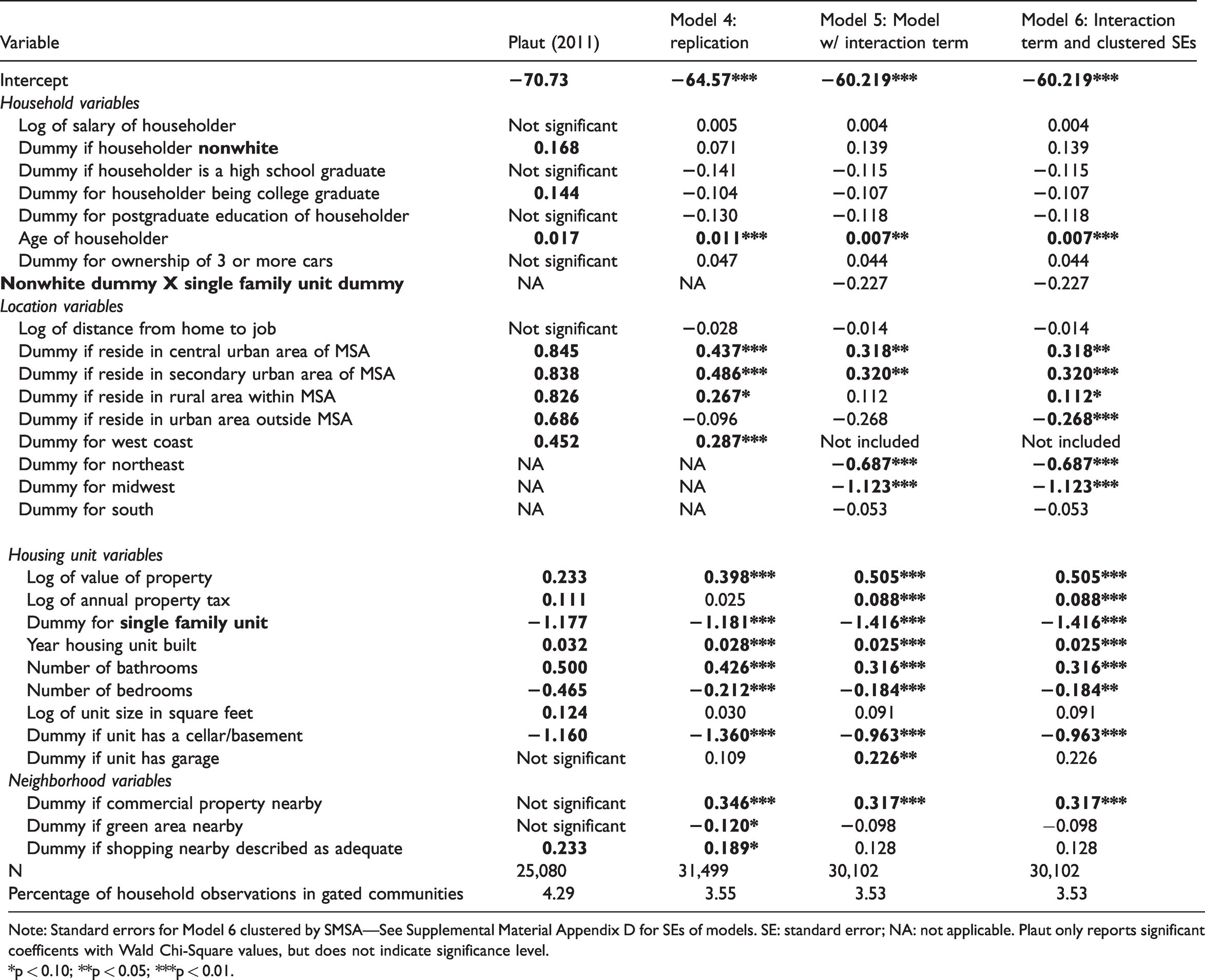
Note: Standard errors for Model 6 clustered by SMSA—See Supplemental Material Appendix D for SEs of models. SE: standard error; NA: not applicable. Plaut only reports significant coefficents with Wald Chi-Square values, but does not indicate significance level.
*p < 0.10; **p < 0.05; ***p < 0.01.
In regards to homeowners, I am unable to successfully replicate Plaut’s findings (Table 3, Model 4). Many variables that she finds to be statistically significant, I find no effect and vice versa. Her variable of interest, whether or not the head of the household is nonwhite, is statistically insignificant in my replication. She finds that nonwhite homeowners are more likely than white homeowners to live in a GC. I find a similar positive coefficient, but it is not statistically significant. The positive coefficient in my analysis, though not statistically significant, may potentially reflect a promising change in racial segregation of GCs. The null finding on the nonwhite coefficient indicates that nonwhites and whites do not differ statistically on the probability of living in a GC, which may reflect progress in minorities moving to GCs. However, and very importantly, Plaut’s results and my replication results may be a function of statistical artifacts. In the next section, I improve upon Plaut’s study to include interactions between variables and the disaggregation of the race variable in addition to clustering standard errors to account for unobserved metropolitan area characteristics. 3
Updating Plaut (2011)
One potential issue with the findings is that mobile homes appear to be included in the analysis. There is no indication of how they are coded or included in Plaut’s (2011). For the updates to the models, I purge the data of mobile homes. Many are gated, but mobile home communities are not typically considered GCs in the traditional sense. Second, the west coast variable may be too restrictive in controlling for regional characteristics. Therefore, the updated models include dummy variables for Census regions, with the Census west region as the reference category.
Most importantly for this analysis, however, is a factor that may be driving the results of Plaut and the replication—there is no consideration of the interaction between type of housing (single family detached vs. multi-family) and the nonwhite variable. I first interact the nonwhite and housing type (single family) variables. Table 2 Model 2 includes the logistic regression results for renters and Table 3 Model 5 includes results for homeowners when including this interaction. The coefficient on the interaction term is statistically significant for renters (−0.610). However, unobserved Metropolitan Statistical Area (MSA) characteristics could also account for patterns of gating. Without directly observing these variables, one approach is to cluster the standard errors of coefficients by MSA. This statistical consideration is not present in previous models, including Plaut’s (2011). Table 2 Model 3 and Table 3 Model 6 include clustered standard errors by MSA. Levels of significance for variables change with the inclusion of clustered standard errors. While the coefficient on the interaction term between nonwhite and single family is not significant for both renters and homeowners, the constitutive variable of single family is statistically significant at the 99% confidence level for both renters and homeowners, and the constitutive variable of nonwhite is statistically significant at the 95% confidence level for renters. 4
Interpretation of interaction terms and their constitutive variables is somewhat challenging in logistic regression models. One approach to making substantive sense of the interaction terms and constitutive variables is to plot predicted probabilities with 95% confidence intervals for various values of the constitutive variables. Figure 1(a) depicts the predicted probabilities of gating comparing white and nonwhite renters across housing type, while Figure 1(b) depicts the same comparison, but for homeowners. Hollow circles represent multi-family housing and solid circles represent single family detached housing. Also illustrated are 95% confidence intervals. If the confidence intervals overlap for a particular type of housing (reading horizontally across the figure), then there is no statistically significant difference between whites and nonwhites.
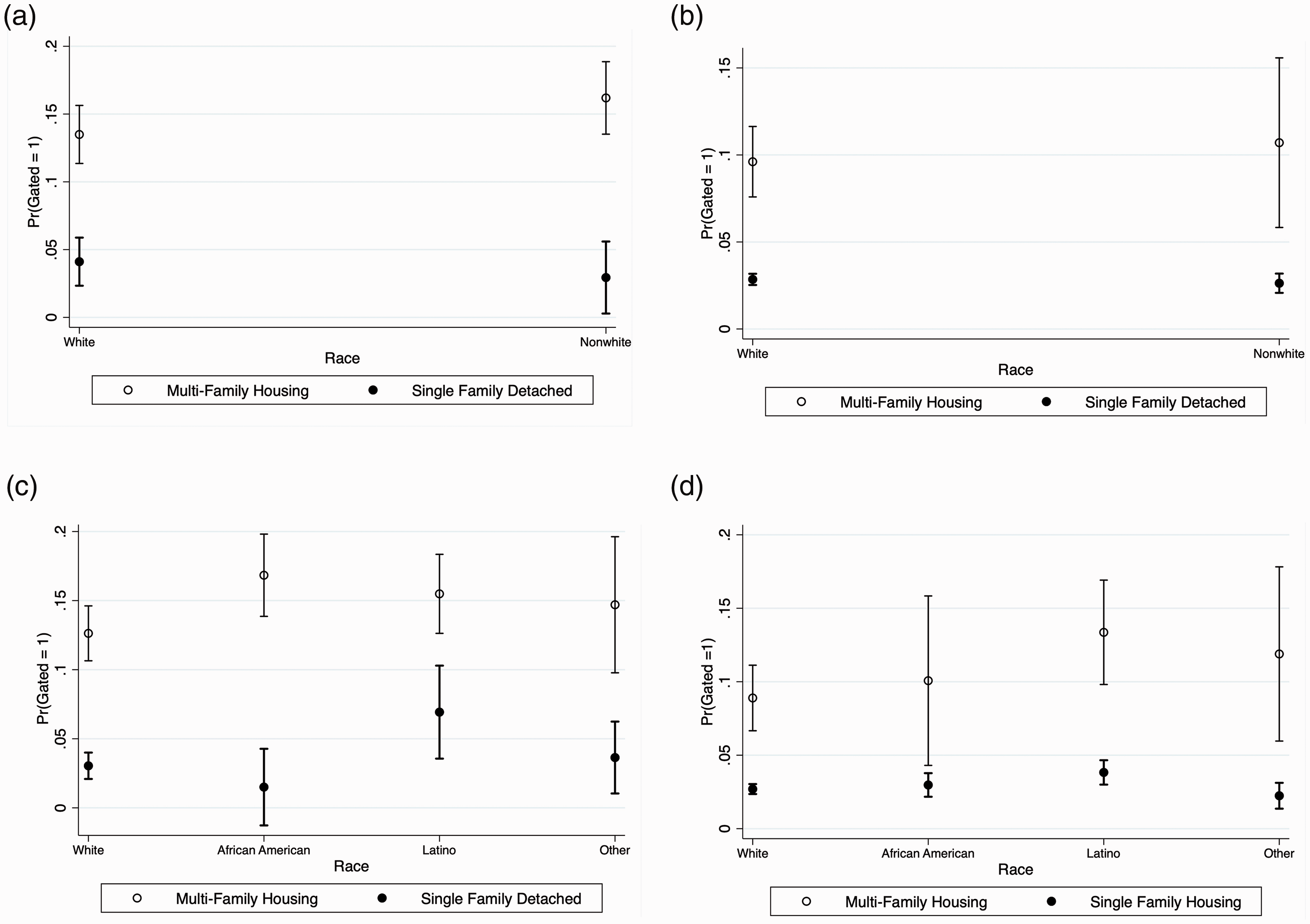
(a) Predicted probabilities of gating for renters—2005 Model 3—clustered standard errors by MSA. (b) Predicted probabilities of gating for owners—2005 Model 6—clustered standard errors by MSA. (c) Predicted probabilities of gating for renters—2005 — clustered standard errors by MSA. (d) Predicted probabilities of gating for owners—2005 — clustered standard errors by MSA.
In Figure 1(a), nonwhite renters have a slightly higher predicted probability of gating than white renters in multi-family housing units (hollow circles), but the confidence intervals overlap. Therefore, the coefficients are not statistically different. For renters of single family detached units (solid circle), nonwhite renters are slightly less likely to live in a GC than white renters. However, this difference is not statistically significant since the confidence intervals overlap. It appears that nonwhite renters are neither more or less likely to live in a GC for either type of rental housing. Once the interaction of housing type and race is considered along with clustering the standard errors, Plaut’s results for renters disappear.
Turning to homeowners in Figure 1(b), the exact same relationships appear. With overlapping confidence intervals, nonwhite homeowners are neither more or less likely to live in a GC. This relationship applies for both multi-family owners (hollow circles) and single family detached housing owners (solid circles). Once the interaction of housing type and race is considered along with clustering the standard errors, Plaut’s results for owners disappear.
Despite these results calling into question Plaut’s findings, as mentioned previously, the nonwhite variable should be disaggregated into component categories and then interacted with housing type to gain a fuller understanding of gating patterns by race. Therefore, I rerun the logistic regressions by separating the nonwhite variable into component race categories and interacting with housing type. Standard errors remain clustered by MSA. I then graph the predicted probabilities in Figure 1(c) and (d). 5
Figure 1(c) contains the results for renters. White renters of multi-family units have a lower predicted probability of gating compared to African Americans, Latinos, and all Other races, but the differences are not significant (hollow circles) since the confidence intervals of the three racial categories overlap the white confidence interval. African Americans, Latinos, and Other races are statistically just as likely as white renters to indicate that they live behind a gate for multi-family housing units. For single family renters (solid circles), all confidence intervals overlap. While Latinos and Other races have higher predicted probabilities of gating than whites, and African Americans have a lower predicted probability than whites, the differences are not statistically significant.
Turning to homeowners (Figure 1(d)), all of the confidence intervals overlap with white owners of multi-family housing (hollow circles). White owners of multi-family units are not more or less likely to live in a GC than minorities. This pattern also exists for single family detached owners. White owners of single family detached units are not more or less likely to live in a GC than minorities.
There are no statistically significant differences among minority groups when compared to whites for both renters and homeowners in both multi-family and single family detached housing. Plaut’s claims that nonwhites are more likely to live in GCs essentially disappear once race and housing type are interacted and standard errors are clustered to account for unobserved MSA characteristics. However, her study and my replication only include 2005. With four additional years of data available on gating in the AHS, an important consideration is to determine if patterns of race and gating change across the decade from 2001–2009.
Extensions (2001–2009)
The AHS includes the variables from the Plaut study for the years 2001–2009 (the AHS is only published every other year). I run the exact same logistic regressions separately for each year and calculate predicted probabilities of gating by race and housing type. For visual simplification, I place all of the predicted probabilities into Table 4. 6 Bold italicized probabilities indicate a statistically significant difference from the white predicted probability for the respective year and type of housing.
Predicted probabilities of gating by race and year.

Renters
With the exception of 2007, African Americans are not statistically more likely to indicate that they are renting single family detached units in GCs. In 2007, African Americans are actually less likely to indicate they rent a single family detached unit in a GC compared to whites (1.71% and 6.55%, respectively), statistically significant at the 95% confidence level. Except for 2003 for Other races, all of the predicted probabilities of minority single family detached renters are not statistically different from white single family detached renters in regards to gating. For renters of multi-family units, African Americans are more likely to indicate that they live in a GC compared to whites for 2009. Latinos are more likely to live in these housing units for two of the five years studied (2007 and 2009), and Other races only in 2001. The predicted probability of African American multi-family unit renters living in a community surrounded by a gate increases steadily from 15.88% to 24.64% between 2001 and 2009. In 2007 and 2009, the predicted probabilities for African Americans and Latinos surpass 20% for these housing units. These differences are statistically significant and greater than white multi-family housing renters in 2007 (for Latinos) and 2009 (for African Americans and Latinos). Are these figures a sign of increased gated rental community diversity or simply an indication of the presence of gates in low-income, public, and subsidized housing units? Data availability and privacy in the AHS prevent such an in-depth examination, but when examining the homeownership patterns and previous findings by Danielsen (2007) and Sanchez et al. (2005), the initial supposition is that the results for multi-family rental units are likely being driven by low-income housing. Danielsen’s (2007) AHS research of multiple years indicates that approximately 12% of renters identified living in public housing.
Owners
For single family detached owners in GCs, minority ownership significantly exceeds whites only in 2001 (Latinos) and 2007 (African Americans and Latinos). Results from 2007 are interesting, but may be a function of an outlier year. This is the year where the predicted probability of African American renters of single family detached units is significantly lower than that of whites and significant at the 95% confidence level. Looking at African American single family detached GC homeownership for 2007, the predicted probability is 7.36% and significantly different from whites at 4.49%. This 7.36% predicted probability is the highest probability for ownership of single family detached units across all years and races. In this year, the Latino predicted probability is also 6.04% for owning a single family detached unit in a GC. Examining the change in predicted probabilities in the survey year before and after 2007 reveals an interesting pattern. For African Americans, the predicted probability in 2005 is 2.97%, increases dramatically to 7.36% in 2007, and then drops quite precipitously in 2009 to 4.48%. Though not as dramatic, the Latino predicted probabilities go from 3.83% in 2005, increase to 6.04% in 2007, and decrease to 5.12% in 2009. The predicted probabilities for whites increase each year from 2005–2009. One conjecture is that 2007 represents the height of the housing bubble and subprime lending industry that targeted low-income minorities (Rugh and Massey, 2010). A future look at foreclosure patterns could help determine if this supposition is accurate.
Outside of 2007, only in 2001 are Latinos more likely to indicate that they own a single family detached home in a GC compared to white owners. For multi-family unit ownership, only Latinos are more likely to live in a GC based upon results for 2003, 2007, and 2009. With homeownership being a sign of social mobility, this finding may be encouraging for diversification of gated multi-family communities. It is impossible to know if these units are apartments and duplexes of low quality or more middle- and upper-class apartments and condominium units. In addition, it may be more common for Latinos to live in extended family units which may provide not only social stability, but also greater financial stability for ownership. Gating is also a common pattern in Latin America (Low, 2003), so Latinos may be more likely to search for any type of GC.
In totality, the evidence of minorities being more likely to own units in GCs as suggested by Plaut is not confirmed, especially for single family detached homes. At best, the results suggest that minorities are neither more or less likely than whites to own a home in a GC. If the increased likelihood of Latinos owning multi-family units in GCs is an increase in high quality, middle- and upper-class housing, then there may be signs of increased white-Latino diversity in communities. Nevertheless, the results appear to indicate that African Americans continue to lag behind in housing mobility. 7
Conclusion
Results from this research indicate that recent findings regarding a decrease in racial segregation in GCs may not be an accurate reflection of housing patterns. More specifically, a recent study by Plaut (2011) finds that nonwhites are more likely than whites to live in GCs for both renters and homeowners. I replicate and build upon her study, discovering that her results are largely driven by a lack of consideration of housing type, its interaction with race, and statistical methodology. When interacting housing type with race, I find that her results of the 2005 AHS disappear.
Extending the analysis to include AHS survey years 2001–2009, the results show that African American, Latino, and Other race renters of multi-family units are sometimes more likely to live in a GC than whites, but this result may be a function of the rental units being low-income housing. For homeownership, a sign of social mobility, Latinos are more likely than whites to indicate owning a multi-family unit in a GC. The result does not extend to African Americans. For single family detached homes, nonwhites are generally not more likely than whites to live in a GC as suggested by Plaut. The notable exception is the year 2007, but the result is likely a function of subprime lending practices and the height of the housing bubble.
The results from this study highlight the importance of not only replication, but rigorous research design and statistical methods. Theoretical design considerations like the coding of race into dichotomous or polychotomous variables have profound implications for statistical tests and inferences. I attempt to highlight the importance of advanced statistical model specifications, like the use, interpretation, and data visualization of interaction relationships in social research. Careful attention to these methods have social implications and affect our understanding of the social world and in this case, housing dynamics.
In addition, findings from the research are timely not only as a re-investigation of original results 10 years later with additional data and more rigorous tests, but also because of increased awareness of social justice and systemic racism issues. Early studies of GCs and race in the late 1990s and early 2000s focused on citizens “walling themselves behind gates” into exclusive neighborhoods. Income and race may have played a role in these decisions according to early studies. Plaut’s results would suggest that American society has begun to overcome these issues in regards to GCs with her 2005 data. Racially diverse GCs would signal either an openness to living in diverse neighborhoods among a predominantly white population and/or underrepresented populations making socioeconomic advances providing them opportunities to live in GCs. Using additional years of data and different statistical methods, I find this to not be the case, especially with single family housing ownership.
Future research should delve further into the suppositions presented in this research, namely, by examining housing quality and neighborhood demographics of housing units, especially in the multi-family gated rental communities where minorities are clearly more likely than whites to live. In addition, the outlier findings of 2007 having more minority single family homeownership only to disappear in 2009 should be examined to determine if they are related to the effects of subprime lending and the housing market crash.
Supplemental Material
sj-pdf-1-epb-10.1177_23998083211038945 - Supplemental material for Revisiting recent findings on gated communities and racial homogeneity
Supplemental material, sj-pdf-1-epb-10.1177_23998083211038945 for Revisiting recent findings on gated communities and racial homogeneity by Daniel S Scheller in EPB: Urban Analytics and City Science
Supplemental Material
sj-pdf-2-epb-10.1177_23998083211038945 - Supplemental material for Revisiting recent findings on gated communities and racial homogeneity
Supplemental material, sj-pdf-2-epb-10.1177_23998083211038945 for Revisiting recent findings on gated communities and racial homogeneity by Daniel S Scheller in EPB: Urban Analytics and City Science
Supplemental Material
sj-pdf-3-epb-10.1177_23998083211038945 - Supplemental material for Revisiting recent findings on gated communities and racial homogeneity
Supplemental material, sj-pdf-3-epb-10.1177_23998083211038945 for Revisiting recent findings on gated communities and racial homogeneity by Daniel S Scheller in EPB: Urban Analytics and City Science
Supplemental Material
sj-pdf-4-epb-10.1177_23998083211038945 - Supplemental material for Revisiting recent findings on gated communities and racial homogeneity
Supplemental material, sj-pdf-4-epb-10.1177_23998083211038945 for Revisiting recent findings on gated communities and racial homogeneity by Daniel S Scheller in EPB: Urban Analytics and City Science
Supplemental Material
sj-pdf-5-epb-10.1177_23998083211038945 - Supplemental material for Revisiting recent findings on gated communities and racial homogeneity
Supplemental material, sj-pdf-5-epb-10.1177_23998083211038945 for Revisiting recent findings on gated communities and racial homogeneity by Daniel S Scheller in EPB: Urban Analytics and City Science
Footnotes
Acknowledgement
The author would like to thank the editor(s), anonymous reviewers, and Joanna Martinez for helpful comments on this manuscript.
Declaration of conflicting interests
The author(s) declared no potential conflicts of interest with respect to the research, authorship, and/or publication of this article.
Funding
The author(s) received no financial support for the research, authorship, and/or publication of this article.
Supplemental material
Supplemental material for this article is available online.
Notes
References
Supplementary Material
Please find the following supplemental material available below.
For Open Access articles published under a Creative Commons License, all supplemental material carries the same license as the article it is associated with.
For non-Open Access articles published, all supplemental material carries a non-exclusive license, and permission requests for re-use of supplemental material or any part of supplemental material shall be sent directly to the copyright owner as specified in the copyright notice associated with the article.
