



Abstract
In this paper, we analyse the spatial distribution of anti-EU and populist vote across Italian municipalities. A clear geographical divide is found, with northern municipalities supporting anti-EU parties and southern ones the populist parties. This knowledge is fundamental for the development of effective place-specific policies.
The study analyses the distribution of political discontent in Italy using the results of the 2018 Elections for the Italian Chamber of Deputies.
1
Figure 1 displays a bivariate map reporting the share of valid votes for parties with populist and/or strong anti-EU inclination at the municipal level. The classification of parties as populist or anti-EU is based on the 2019 Chapel Hill Expert Survey (Jolly et al., 2022). Share of votes for populist and anti-EU parties in Italian municipalities. Notes: We defined as populist those parties (MoVimento Cinque Stelle) with a value higher than 7.5 on the question about the position on direct versus representative democracy, which ranges from ‘0 = Elected office holders should make the most important decisions’ to ‘10 = “The people,” not politicians, should make the most important decisions’. Following Dijkstra et al. (2020), we coded as anti-EU those parties (Fratelli d’Italia and Lega Nord) scoring less than 2.5 in the ‘EU Position’ question, which goes from ‘1 = Strongly opposed’ to ‘7 = Strongly in favour’.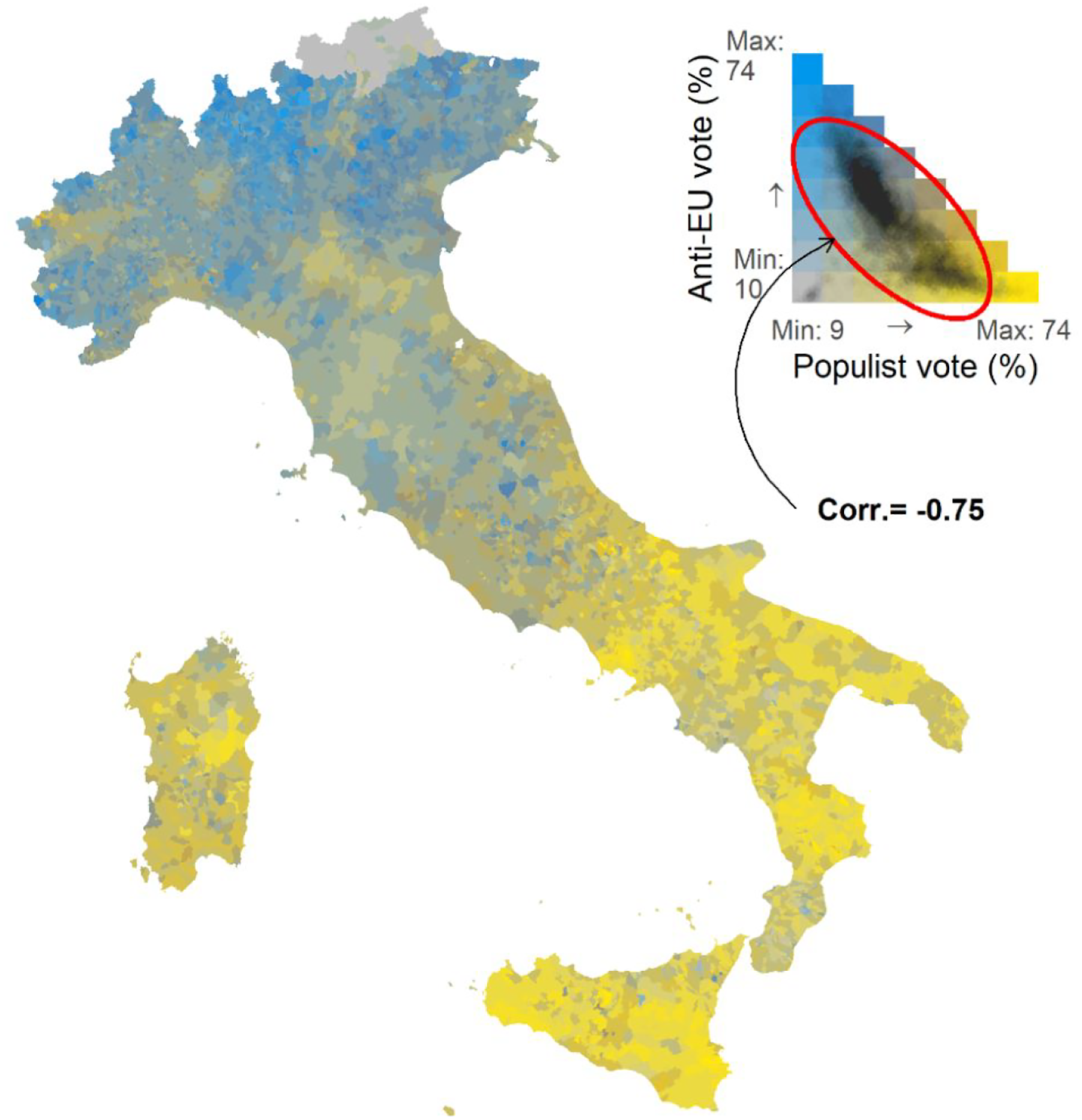
Votes for populist or anti-EU parties are often analysed jointly as they both express political discontent. However, studying them separately allows one to observe a geographic pattern in the way Italian electors expressed their dissatisfaction. Indeed, votes for populist or anti-EU parties are unevenly distributed across the country and they are negatively correlated. Areas with relatively high anti-EU attitudes are localized in the North, especially in Lombardia, while regions with relatively strong populist stances are concentrated in the South. The central part of the country is characterised by a lower degree of polarisation. In this area, the share of protest votes is either low or more evenly divided between anti-EU and populist positions.
Figure 2 integrates the election outcomes with the population size of municipalities. Compared to Figure 1, the cartogram highlights a larger share of population concentrated in the Centre and the North compared to the South. As for the voting patterns, anti-EU support in the North appears less rampant due to its concentration in rural areas with fewer inhabitants. The cartogram confirms the predominance of strong populist narratives in the South. Interestingly, contrarily to what happens in the Centre and the North, political discontent also dominates in large municipalities. Cartogram of the share of votes for populist and anti-EU parties in Italian municipalities. Note: Area is proportional to the population in each municipality in 2018.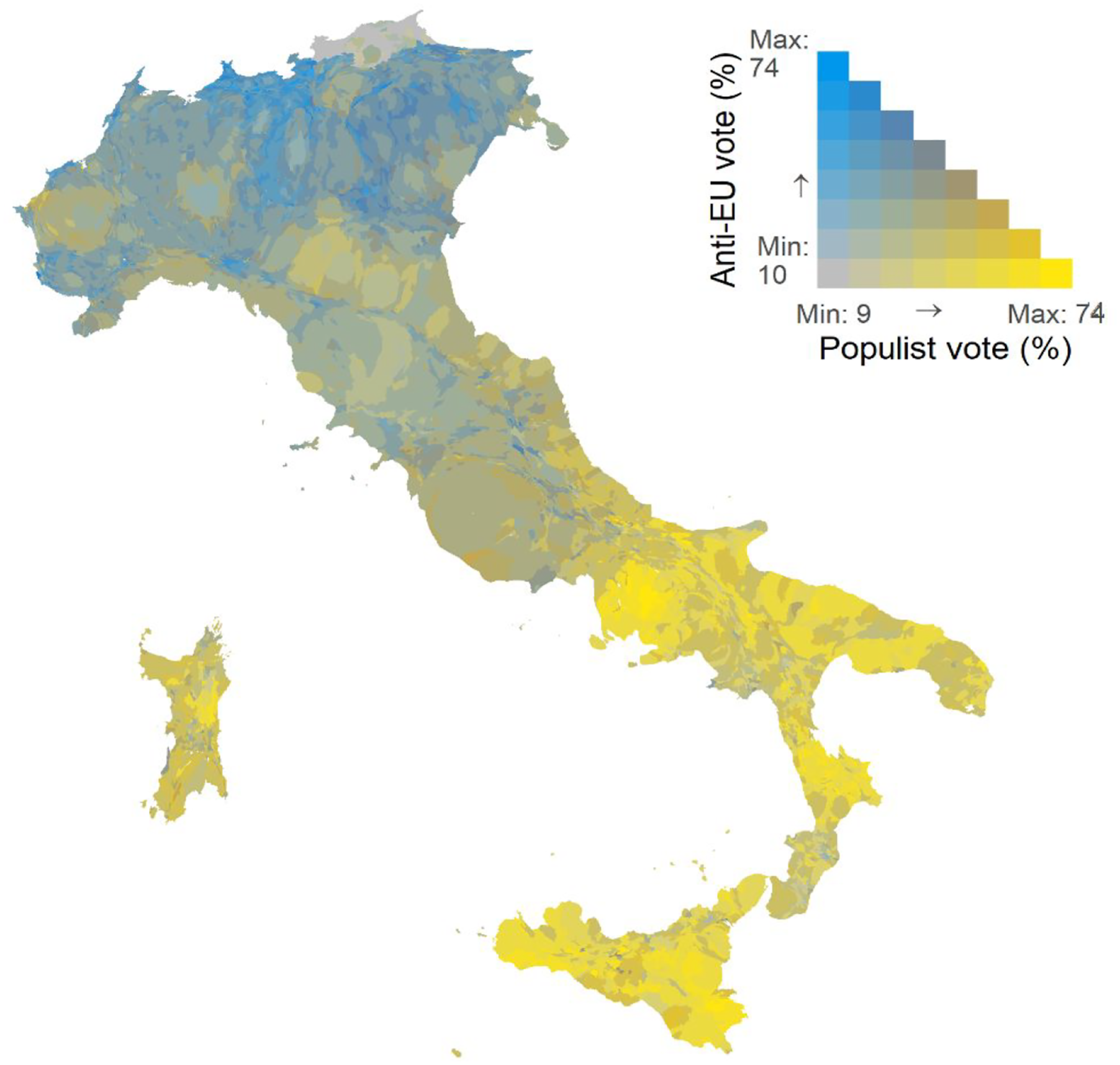
The literature on the geography of discontent pointed at economic struggle as a key factor in the rise of anti-system stances (Dijkstra et al., 2020; Rodríguez-Pose, 2018). Indeed, while the South has a long history of weak economic performance and lack of employment opportunities, the once more prosperous North has also experienced an economic decline in the last decades. What emerges from these maps is that there are also strong differences regarding whom the voters blame for their condition. Anti-EU parties find their culprit out of the country, that is, in Brussels’ bureaucrats, while populist movements blame the corrupt elites within the country (Mudde, 2004).
These findings contribute to the understanding of the geographic distribution and electoral consequences of discontent across Italian municipalities. This knowledge is fundamental for the development of effective place-specific preventive policies.
Footnotes
Declaration of conflicting interests
The author(s) declared no potential conflicts of interest with respect to the research, authorship, and/or publication of this article.
Funding
The author(s) received no financial support for the research, authorship, and/or publication of this article.
