




Abstract
Waybill data can reflect the transport process of express delivery in different cities, providing an important basis for revealing intercity logistics connectivity. However, current research neglects the critical function of routing information in waybill data, making it difficult to realistically represent intercity connectivity in the express delivery network. This study uses waybill big data with routing information to map the spatial distribution and network structures of intercity express delivery networks in China, and identifies three main types of network communities: interprovincial communities, regional hub communities, and corridor pattern communities, so that a more accurate and realistic representation of intercity connectivity can be presented.
Express delivery significantly boosts consumption and promotes the internet economy as a key way of resources distribution among cities. The waybill big data has a large sample size and strong timeliness, making it an important dataset that reflects the logistics and economic connections among cities, which can provide a new perspective for revealing intercity logistics connections (Sun et al., 2023). However, the community structure of the express delivery network has not been extensively studied, impeding our understanding of the parcel transport structure in the express delivery network.
We obtained 23,321,471 waybill data for February 2022 from the Express batch query master (https://kd.d1kf.com/) based on the coding rules of express electronic waybill. Express Delivery Network was then geo-visualised using Gephi 0.9.6 (see Bastian et al. (2009) for details). To prevent Gephi software from exceeding its limits, parcel traffic links with a transport flow lower than 1,000 were removed, resulting in an express delivery network of 2966 links covering the transport flow of 41,517,846 parcels. The city nodes are partitioned into communities using a modular community detection algorithm to analyse the types of intercity express delivery network communities, as illustrated in Figure 1. The spatial distribution and community structure of intercity express delivery network in China.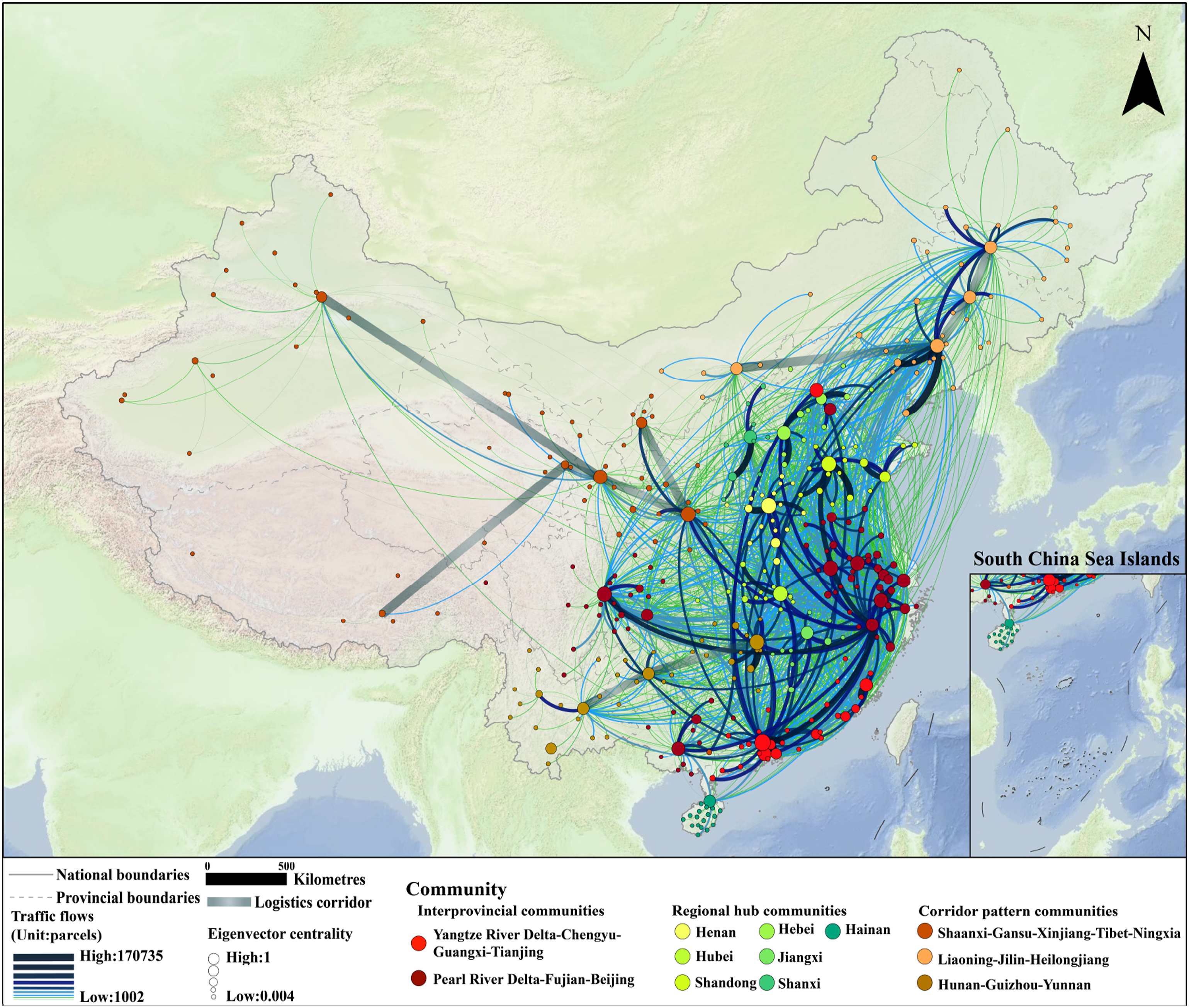
Three main types of community structures within the express delivery network are identified. Firstly, interprovincial communities include the Yangtze River Delta–Chengdu–Chongqing–Guangxi–Tianjin community and the Pearl River Delta–Fujian–Beijing community. These communities are interconnected thanks to well-established infrastructure and high economic vibrancy, resulting in a large number of long-distance interprovincial associations among cities (Dong et al., 2021). Secondly, the Henan, Hubei, and Shandong communities are closely linked to the interprovincial communities with the provincial capitals as the regional hubs. However, in those communities, the external connectivity is relatively limited and singular, showcasing the strong role of regional transit hubs and lower levels of connectivity between non-central cities and the ones outside the region. Finally, provinces in the northeast, southwest, and northwest regions of China are closely connected to neighbouring provinces, demonstrating a significant corridor pattern (Chen et al., 2018). For example, communities such as Shaanxi–Gansu–Xinjiang–Tibet–Ningxia, Liaoning–Jilin–Heilongjiang, and Hunan–Guizhou–Yunnan exhibit this pattern. These communities, due to their economic development levels and geographical features, often rely on a single parcel transportation channel, leading to closely linked belt-like connections between neighbouring regions.
Overall, we have identified the network communities of intercity express delivery, enriched our understanding of the degree of economic interdependence between different regions in China, and shown that settlement structure is influenced by economic, transport, and location factors.
Footnotes
Acknowledgements
Thanks to OpenAI’s ChatGPT for helping to polish the article. ChatGPT 3.5 text polishing has improved its readability.
Declaration of conflicting interests
The authors declared no potential conflicts of interest with respect to the research, authorship, and/or publication of this article.
Funding
The authors disclosed receipt of the following financial support for the research, authorship and/or publication of this article: This work was supported by the National Natural Science Foundation of China [42271195, 72173101].

Data Availability Statement
The study data are subject to data confidentiality requirements and cannot be published. However, the data can be obtained by contacting the authors upon reasonable request.