



Abstract
The study finds empirical evidence regarding the role of corruption in the development of human capital in Nigeria for 1996–2019 period. Using ARDL technique to examine the long-run and short-run relationship between corruption and human capital development, and VECM to assess the causal effects, the analysis involves the inclusion of two corruption indicators (corruption index and control of corruption) as well as two human capital development measures (human capital index and life expectancy at birth). Findings obtained are consistent with efficiency-reducing theory (corruption is harmful), as the empirical evidence indicates that corruption has a significant impact on human capital development, suggesting that the incidence of corruption is a crucial element in the development of human capital. Further evidence reveals that there exists bidirectional causality between corruption and human capital development, implying that both the level of corruption and human capital development are interlinked and mutually inducing. Hence, the entrenched phenomenon of corruption in the country seems to have presaged long-term poor human development. It is therefore suggested that aside existing institutions established to curb corruption, such policy measures, which include addressing factors that incentivise corruption such as inappropriate regulatory frameworks, rent-seeking dispositions, among others, need to be initiated and promoted.
Introduction
Given that the quest for mitigating corruption formed the heart of the Sustainable Development Goals (SDGs), many countries have recognised that tackling corruption requires the concerted attention of both government and private bodies. Corruption which is widely viewed as the impediment to social progress due to the erosion of trust in government and undermining of the social contract it often generates. The pervasiveness of corruption in most developing countries, although a global problem, is a cause for concern across the globe. According to World Bank (2018), the impact of corrupt practices on the poor and most vulnerable is disproportionate, since it engenders increasing costs and inhibiting access to services such as health, education and justice. These deny the poor of an equal opportunity in the society (perpetuation of inequalities) and preclude the government from effectively investing in human capital. Corroborating this argument, Mauro (1995) and Gyimah-Brempong (2001) argue that corruption can divert talent and resources in the economy, which include human resources, towards rent-seeking activities that have no significant impact, rather than productive activities. Hence, attainment of a high level of human capital development may entail zero-tolerance policy towards corruption, including improved systems, standards and norms required to sustain anti-corruption drive.
Considering the huge economic cost of corruption, a number of empirical studies has been conducted by few concerned scholars. For instance, Wei (2000) and Habib and Zurawicki (2001) examine the effect of corruption on foreign direct investment. These authors posit that corruption could discourage foreign investors. Mauro (1996) and Tanzi and Davoodi (1997) find an adverse association between investment and corruption. In the work of Leite and Weideman (1999) and Abed and Davoodi (2000), a negative relationship is found between real per capita GDP growth and corruption. Also, Mo (2001) asserts that corruption reduces the GDP growth by about 0.72%. Al-Marhubi (2000) suggests that the association between inflation and corruption is positive, while Gupta et al. (2001) equally find a direct link between corruption and military expenditure. Based on 65 countries, Bahmani-Oskooee and Nasir (2002) argue that countries with higher levels of corruption seem to have experienced real depreciation in their respective currencies. In addition, by retarding economic growth, high corruption causes a rise in income inequality and poverty (Gupta et al., 1998). Given the foregoing empirical evidence, it can be suggested that there are many studies on the effect of corruption on various macroeconomic variables. However, an empirical focus on the nexus between corruption and human capital development seems to be limited. Thus, this often necessitates the call for a study on the linkage between corruption and human development in Nigeria context.
This development has drawn increased attention to corruption-human capital nexus among economists. For example, recently, assessing by the citizens at the district level, Nguyen et al. (2017) posit that an adverse association exists between corruption and the standard of Vietnamese primary education, while Hoa (2019) shows that, overall, corruption negatively impacts human capital in Vietnam. Hoinaru et al. (2020) stress that corruption is poverty-driven element, which highly features in developing countries. Their conclusion is based on the assertion that higher levels of corruption are connected with low levels of sustainable development. Also, the study of Achim (2017), based on a sample of 185 countries, indicates that corruption significantly undermines the ease of doing business, and thus serve as a major obstacle to human development. The findings of Absalyamova et al. (2016) on sustainable development affirm that a rise in the corruption rate of the socioeconomic systems of a country could trigger a reduction of more than 1% of the value of sustainable human capital development index. In 22 sub-Saharan African (SSA) countries, corruption poses a long-term challenge to the sustainable development (Forson et al., 2017). For Nigeria, Yaroson et al. (2016) using secondary school enrolment and the Human Development Index as proxies of human capital development reveal that corruption is a key challenge to human capital development. But the current study differs with the use of human capital index developed by Feenstra et al. (2015)—Penn World Table (PWT9) which follows the years of schooling and returns to education, and life expectancy at birth (population health).
However, some authors argued that corruption could be a mechanism that increases the efficiency of a state. Their argument anchored on the premise that in countries with high red tape where institutions are not properly functioning due to institutional bottlenecks, corruption could help eliminate barriers to new firms. Studies in this line include Aidt et al. (2008) and Ebben and de Vaal (2011), while similar older studies are Leff (1964) and Huntington (1968). These proponents are termed optimists. On the other hand, authors that negate this view stress that while corruption can counteract the impact of excessive regulations in a system, it does undermine the effectiveness of regulatory frameworks which may not necessarily engender improved economic performance (Dreher & Gassebner, 2011; Gupta et al., 2000). This implies that there are polarised views on the nexus between corruption and human capital development. Indeed, the dichotomy between efficiency-reducing theory and efficiency-enhancing theory has given rise to divergent views on corruption-human development debate.
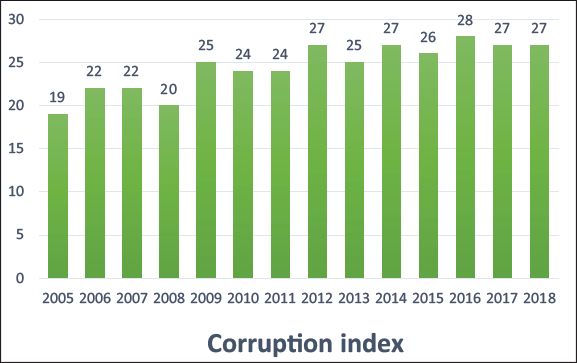
Furthermore, following the annually released Corruption Perception Index (CPI) by the Transparency International (TI), as Nigeria often falls within the rank of the most corrupt countries of the world, coupled with the wide range of conflicting arguments, this study is critical to addressing Nigeria’s peculiar case. In essence, the study sets out to offer a solution to this question: Does corruption adversely or positively influence the quality of human capital in Nigeria? Thus, given that corruption seems to be pervasive in the country, this study also intends to examine how Nigeria’s level of corruption affects human capital development.
In view of the foregoing, the question as to how corruption affects the level of human capital development remains unresolved. To the best of our knowledge, the role corruption plays in the development of human capital has not only been mixed but also diverse. Insufficient evidence on this critical issue, and the existence of a large range of controversial cases shape the objective of this study. Since the seeming deficiency in the literature and opposing views among researchers could result in misleading and untenable recommendations by policy makers, the growing quest for proffering a solution to human capital development challenges in Nigeria further necessitates the need for the study. Hence, to achieve the study objective, we employ Linear Autoregressive Distributed Lag (ARDL) bounds test to cointegration and VECM Granger causality test. These techniques are significant to determine the long-run impact of corruption on human capital development in Nigeria.
The Level of Corruption and Human Capital Development in Nigeria: An Overview
Over the years, the persistent low human capital development in Nigeria has generally been viewed as a bad case for the countries in spite of the numerous programmes initiated to improve human capital in the country. No period the level of Nigerian human capital development seems to have moved beyond the low level (see Table 1). This has been one of the unresolved problems. The impaired human development has consistently led to poor growth; reduced standard of living, increased poverty rates and unrealistic attainment of national goals, including SDGs. Hence, the challenge of improving human capital is becoming increasingly urgent. The possibility of getting away from the crisis of Nigerian socioeconomic problems depends on the good chosen measure of sustainable human capital development, although not sufficient to take measures to improve the investment climate. They can be complemented by programmes aimed at promoting the country’s human capital development. However, the high level of corruption in Nigeria, especially in the public sector, could have an adverse effect on the effectiveness of such measures (World Bank, 2018).
Nigeria’s HDI Trends based on Consistent Time Series Data and New Goalposts.


Literature Review
Theoretical Argument
The prevalence of corruption in most developing countries is often regarded as governance issue which seems to be pervasive in most public settings or institutions (Hoinaru et al., 2020). Although to different extents, corruption exists in all economies, regions and cultures. While there has been no common consensus in the literature on the definition of the concept of corruption, it is widely defined as ‘the abuse of public office for private gain’ (World Bank, 1997). On the other hand, Human development is commonly defined as ‘expanding the choices people have to lead lives that they value’ (UNDP, 2001). These could be attained only by creation of human capabilities that might be enhanced through human resource development such as good health, education and skill training. Hence, good governance may strengthen the indicators (mostly health and education) of human capital development. It has been canvassed that ensuring the effective control of corruption is crucial to human development (Mauro, 1995).
However, regarding the effect of corruption, two opposing views have been advocated for in the literature: efficiency-reducing and efficiency-enhancing view. Proponents of the efficiency-reducing effect stress that corruption retards the wheels of business and commerce, thereby inhibiting economic growth and causing distortions in the allocation of resources. Consequently, it has a deleterious effect on efficiency. Scholars found in this category are; McMullan (1961), Krueger (1974), Myrdal (1968), Tanzi and Davoodi (1997) and Mauro (1995). In contrast, proponents of the efficiency-enhancing effect claim that corruption stimulates the wheels of business and commerce, and enhances economic growth and investment levels. Thus, corruption leads to efficiency and better performance in an economy. Advocates of this approach include; Leff (1964), Huntington (1968), Friedrich (1972) and Nye (1967).
Given the divergent positions, it could be asserted that there seems to be controversies regarding the role of corruption in the literature. While there is a number of good points on how human capital development is affected by corruption, it is mostly found that less corrupt countries tend to have a higher rate of human development compared to more corrupt countries (Gupta et al., 1998; Rose-Ackerman, 1997). Overall, state power could be exercised in a way that does not promote sustainable human development. In this case, corruption may be termed dangerous to the economy. However, lack of empirical evidence can give rise to uncertainty as to the extent of the effect of corruption on economic development, which may lead to increasing agitations on whether less corrupt countries seem to have a higher rate of human development than more corrupt countries. As a result, the link between corruption and human development needs further investigation.
Empirical Evidence
Over the years, it has been suggested that a sound understanding of the character and style of governance seems to be a significant aspect of the explanation for underdevelopment or the low human capital development in most developing countries. In view of this, there has been increasing interest among scholars with respect to governance-human capital nexus, while studies on the relationship between governance and economic growth have dominated the literature. For instance, Habyarimana (2018) indicates that, in Rwanda between 1996 and 2015, there exists pro-cyclic nexus between governance and economic growth as the level of economic development and growth found not to be only depended on fixed capital formation and labour force, but also on good governance. Other authors that equally study the link between governance quality and economic growth include; Mustafa and Jamil (2018) for 12 Asian countries; Samarasinghe (2018) for 45 countries; Lahouij (2016) for few chosen oil-importing MENA countries; Bayar (2016) for the transitional economies of the European Union; Fayissa and Nsiah (2013) for sub-Saharan Africa; and among others. These authors commonly find that governance quality has strong connection with growth, and that the quality of governance is positively related to economic growth, but weak institutional quality tends to have a negative influence.
Regarding the effect of governance quality on human capital, using pooled OLS estimation approach, Muhammad, Egbetokun and Memon (2015) assess the role governance plays in human capital-led growth for 134 countries between 1996 and 2011. The authors argue that the size of the estimates of human capital is higher for countries that have medium governance quality compared to high quality governance countries. On the other hand, focusing on 14 Asian countries, Mustafa (2012) investigates the effect of human capital and governance on Average Labour Productivity (ALP) and Multi Factor Productivity (MFP) over the of period 1966–2010. Findings indicate that higher institutional quality and human capital positively impact ALP growth, while institutional quality is found to be insignificant for MFP growth. Qizilbash (2001) analyses corruption-human development linkage in a conceptual manner. In another study, using a full information maximum likelihood approach, Akhter (2004) investigates the nexus between corruption and human development empirically. The author argues that higher economic globalisation causes a rise in the level of economic freedom, thereby improving human capital. It is also found that higher economic globalisation could cause a reduction in the level of corruption, which in turn enhances improved human capital. Gupta et al. (2000) state that corruption may either increase or lower the cost and quality of health care and education services. Their analysis further shows that corruption will cause a rise in child and infant mortality rates, a rise in the percentage of low-birth weight babies in total births, and a rise in the rate of dropouts in primary school. It is also confirmed that corruption decreases life expectancy and literacy, and increases infant mortality rates (Kaufmann et al., 1999).
Based on related studies on Nigeria, Ibrahim (2013) assesses how investment in education and human capital development could solve the problems of poor governance and sustainable development with the use of secondary data. Findings reveal that having the necessary amount of people with the required education and experience is critical to economic and political development which is viewed as a reflection of good governance and human capital development. While examining the determinants, sources, challenges and opportunities of investment in education in Nigeria, using granger causality test; Satope and Aremo (2013) posit that investment in education would alleviate poverty and enhances the nation’s human capital development. Ojo et al. (2014), in their study, argue that the link between governance styles and the achievement of socio-economic development is greatly dependent on the conducts within the institutions of governance. More recently, Yaroson et al. (2016) examine the effect of corruption on human capital development in Nigeria. These authors argue that overall corruption is detrimental to human capital development. Authors that also support the adverse effect of corruption on human capital include; Nguyen et al. (2017) and Hoa (2019) on Vietnam; Hoinaru et al. (2020) for developing countries; and Achim (2017) for 185 countries. On the other hand, Aidt et al. (2008) and Ebben and de Vaal (2011) offer opposing views that the effect of corruption on human capital could be positive.
Overall, this review establishes that the level of corruption and the quality of human capital can be related, but needs to be further examined. Nonetheless, the limited attention accorded this topical issue, coupled with the conflicting conclusions, in terms of policy implications, it could lead to uncertainties. This can be seen as one of the biggest gaps and issues in the literature given the seemingly dampening effect of corruption on any economy. For example, Akçay (2006) stresses that corruption can distort the fundamental function of the government. Hence, the need to assess empirically the nexus between corruption and human capital development in Nigeria’s context defines the main thrust of the study.
Methodology
Conceptual Framework
In order to analyze corruption-human capital nexus, we follow the conceptual framework developed by Akçay (2006). This framework is built on the efficiency-reducing hypothesis, which suggests that by retarding economic growth and causing a reduction in social spending like those on health and education, corruption inversely relates to human development. Thus, this assertion is demonstrated in Figure 3.
Hence, corruption-human development nexus is specified as;

Where HUMD is defined as human development. COR represents corruption indicators, while X represents other potential determinants of human capital development. In the study, two human development indicators are used. Human capital index (HUM) developed by Feenstra et al. (2015)—Penn World Table (PWT9) is employed as the human development indicator. The index is computed following years of schooling and returns to education. Life expectancy at birth (population health) is another human development indicator used. Two corruption indicators used, include corruption index [CI] (Corruption Perception Index [CPI] compiled by Transparency International [TI] and control of corruption constructed by Kaufmann et al. (2010)—World governance indicators [WGI]. GDP per capita (constant 2010 US$), and government consumption expenditure as a ratio of GDP, and domestic credit to private sector (% of GDP) are included as control variables. Data on these variables are sourced from World Development Indicators.

Variable Description and Measurement.

Model Specification
The study employs linear autoregressive distributed lag (ARDL) bound tests to cointegration based on Pesaran et al. (2001), and Shin et al. (2011). This approach is followed because of its advantages over other cointegration techniques such as Johansen (1991); Johansen and Juselius (1990). Unlike other related techniques, it is applicable irrespective of order of integration (I(0) or I(1)), but must not be I(2) and above. Also, it can be used even in the case of small sample size, and no matter whether some regressors are endogenous. Hence, the model is specified as follows;

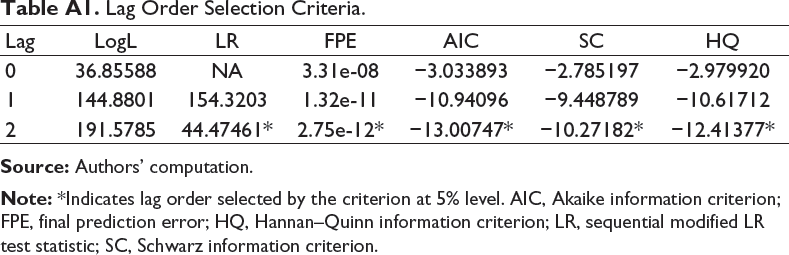
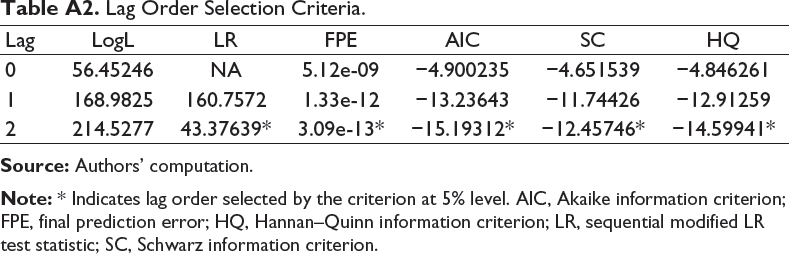
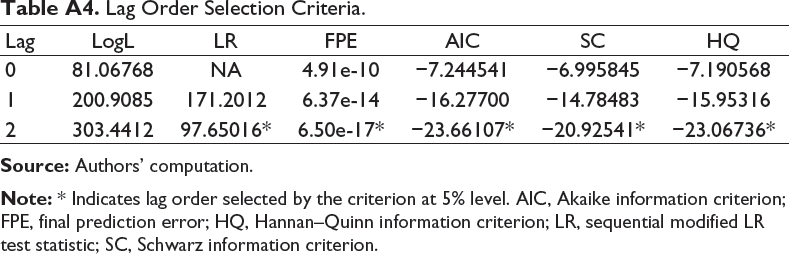
Where, HUMD & COR are as defined previously (human capital development and corruption indicators); GDP is the GDP per capita (constant 2010 US$); GOV represents government consumption expenditure as a ratio of GDP; domestic credit to private sector (% of GDP) is represented by PCREDIT. Equation (2) entails two segments of results. The short-run cointegration nexus covers the first segment (∂1, ∂2, ∂3, ∂4, ∂5), while the second segment captures the long-run nexus between corruption and human capital development (∂6, ∂7, ∂8, ∂9, ∂10). In line with Schwarz Information Criteria (SIC), the number of lags selection is given as; ., following a step-down approach subject to 2 lags maximum. In the model, only control of corruption indicator is not transformed into natural logarithm prior to estimation, as it has negative values. Furthermore, the null hypothesis of no long-run association between corruption and human capital development is tested against the alternative hypothesis as;

If the computed F-statistic exceeds the upper bound value at the significance level (1%, 5% or 10%), the null hypothesis of no cointegration is rejected. In the model, the existence of cointegration implies that it is appropriate to confirm the causal relation between corruption and human capital development. Hence, if the variables are cointegrated, based on Engle and Granger (1987), a causal nexus among the variables in at least one direction should exist. Following this, VECM Granger causality is applied in order to ascertain any causal association between the variables in the long-run as well as in the short-run. This approach could offer a reliable guide for effective policy making. The model for this technique is specified as;


Where ECT indicates lagged error correction term. In the model to test the null hypothesis of no short-run causality against the alternative hypothesis, it is given as;

Also, long-run causality is tested as follows;


Thus, we reject the null hypothesis of no short-run causation if the F-statistic of the estimates of explanatory indicators are statistically significant at 5% level. Similarly, the significance of the estimates of ECTt − 1, which also has to be negative, implies the existence of long-run causal associations.
In the study, considering the significance of the stability test, both Cumulative Sum (CUSUM) and Cumulative Sum of Squares (CUSUMSQ) would be examined to verify the stability of the model based on the long-run and short-run relations obtained. These tests are based on the proposition of Brown et al. (1975) which deem applicable even with unknown structural break points, unlike Chow test that requires the specification of break points.
Empirical Results and Discussion
Summary Statistics and Correlation Analysis
Summary Statistics.

Correlation Matrix.

Unit Root Test
In order to ascertain the level of integration of the series, the unit root test is conducted based on Augmented Dickey–Fuller (ADF) and Philips–Perron (PP). In Table 5, the results indicate that human capital index, life expectancy at birth and corruption index are integrated at order zero (I(0)) at 5% level of significance. In contrast, control of corruption, GDP per capita, government consumption expenditure and domestic credit to private sector are integrated at order one (I(1)). Given the mixed order of integration of the variables in the model, ARDL technique seems appropriate to determine the cointegration among the series.
Cointegration and Stability Test
Unit Root Test.

F-bounds Test for Cointegration.

ARDL Long-run and Short-run Estimates
ARDL Long-run and Short-run Estimates.

On the control variables incorporated in the model, results show that GDP per capital and domestic credit to private sector has a significant and positive long-run and short-run effect on human capital development indicators included, while government consumption expenditure has an adverse impact but significant. Based on the existence of the positive relationship, these findings imply that a rise in GDP per capital can lead to an increase in the level of human capital development, which is in consistence with some previous studies and economic theory (such as Aghion et al., 2009; Anwar & Nguyen, 2010; Barro, 1991). Also, the positive impact of domestic credit to private sector on the quality of human capital indicates that the level of financial development in an economy has a significant influence on human capital development. This corroborates the argument of some authors (Geda et al., 2006; Odhiambo, 2009; Quartey, 2008) who stress that financial sector development is critical to poverty reduction, and thus human capital enhancement. In contrast, government consumption expenditure has an adverse effect on human capital development in Nigeria. This estimated outcome is not surprising as in most developing countries, large government consumption expenditure has been found to be inefficient and ineffective in nature (Rousseau & Yilmazkuday, 2009). Also, government consumption expenditure with distortionary effects, which could trigger low private spending and investment, would also produce an adverse impact (Samargandi et al., 2015).
Granger Causality
VECM Estimates.

VEC Granger Causality test/Block Exogeneity Wald Tests.


In sum, the findings of the study reveal the destructive effect of corruption on the quality of human capital in the country, as evidence indicated that corruption adversely affects long-term human capital development. The effect of corruption on the level of human capital development holds true for human capital index, and life expectancy at birth. Hence, in support of the existing argument, since corruption could undermine the regulatory framework and the effective functioning of state institutions, it would distort incentives for improved human capital (Chêne, 2014). Overall, it is not surprising that corruption is found to have contributed to the low level of human capital in Nigeria, considering its perceived role of engendering costs; making access to capital more costly; undermining institutional efficiency; introducing uncertainties; and raising vulnerability to extortion (Transparency International, 2009). In line with Jiang and Nie (2014), the critical implication of these results is to mitigate the conditions that give way to the thriving of corruption, such as inappropriate regulatory frameworks, rent-seeking dispositions, and other social ills, to allow for improved human capital. Thus, corruption eradication drive could be a panacea for human development challenge in Africa’s biggest economy (Nigeria).
Conclusion
Considering the polarised views in the literature—efficiency-reducing theory (corruption is disadvantageous) and efficiency-enhancing theory (corruption is advantageous), the main contribution of the study is to find empirical evidence for the exact role of corruption in the development of human capital in Nigeria for 1996–2019 period. With the use of ARDL technique for examining the long-run relationship between the variables, and Vector Error Correction Model (VECM) for assessing their causal relations, the analysis involves the inclusion of two corruption indicators (corruption index and control of corruption) as well as two human capital development indicators (human capital index and life expectancy at birth). Columns 1 and 2 represent the exclusive examination of the effect of corruption index and control of corruption on human capital index, respectively, whereas columns 3 and 4 account for the exclusive effects of these corruption indicators on life expectancy at birth accordingly. The empirical results are explicitly discussed within the extant empirical literature.
In contrast to efficiency-enhancing view, findings obtained are consistent with efficiency-reducing theory which stresses the deleterious effect of corruption on human capital development. Specifically, the empirical evidence indicates that both control of corruption and corruption index have a significant long-run and short-run impact on human capital index as well as life expectancy at birth, implying that variations in corruption index or control of corruption can explain variations in the level of human capital development. This further suggests that an increase in corruption index and improved corruption control could result in enhanced human capital development. Thus, the incidence of corruption is a crucial element in the development of human capital. In general, corruption can be seen as antithetical to public and social welfare policy.
Moreover, the study also finds evidence for the causal relationship between human capital development and corruption as there exists bidirectional causality between two corruption indicators and human capital development variables included. Hence, it is confirmed that there is correlation between a higher level of corruption and a lower level of human capital development, suggesting that the level of corruption and human capital development are interlinked and mutually inducing. On the one hand, a low level of human capital development can exacerbate the incidence of corruption in Nigeria, and on the other hand, corruption is a ‘poor human capital-driven virus’ which substantially hampers human capital development. Given that corruption can undermine the regulatory framework and distort incentives for improved human capital, the entrenched phenomenon of corruption in Nigeria presages long-term poor human
development.
The implication of the study’s findings is that government should be more serious with the issue of corruption. Although there are existing institutions established to curb corruption, government should not rely on them alone as vehicles to address this menace to a desired level. Further efforts should be made to augment the activities of these institutions with a view to reducing corruption to the barest minimum. Such policy measures, which include addressing factors that incentivise corruption such as inappropriate regulatory frameworks, rent-seeking dispositions, among others, need to be initiated and promoted. These indicators are fundamental in the incidence of corrupt phenomena.
In this study, we have only employed two corruption indicators from two different sources (Transparency International and World governance Indicators), while for human capital development, two indicators are also used (human capital index and life expectancy at birth). In order to find a basis for future studies, it is suggested that corruption measures from other sources (like Freedom House index of political rights, Political Risk index of Political Risk Services International Country Risk Guide (PRS), and others) should be considered with the inclusion of other human capital development measures (for example, average years of schooling, infant, and mortality rate released by the World Bank and others). Thus, more interesting empirical outcomes can be obtained.
Appendix A
Column 1
Lag Order Selection Criteria.
Column 2
Lag Order Selection Criteria.
Column 3
Lag Order Selection Criteria.

Column 4
Lag Order Selection Criteria.
Footnotes
Declaration of Conflicting Interests
The authors declared no potential conflicts of interest with respect to the research, authorship, and/or publication of this article.
Funding
The authors received no financial support for the research, authorship and/or publication of this article.
