




Abstract
Education, as a public good, necessitates state expenditure. As a concurrent subject, it requires co-sharing of financial, regulatory and developmental functions in a federal polity. Public expenditure on education in India is around 4% of GDP. However, analysis shows that only 1% is borne by the Union while 3% is borne by the states together. The long pending goal of spending 6% of GDP on education, needs to be equally shared by both the central and the state governments lest the development of education remain a lofty ideal.
Keywords
Introduction
Education is critical for economic and social development at large while benefiting individuals who acquired it. Its critical nature is discerned particularly in the perspectives of human capital, human development and human rights. Economic framework and human capital perspective connects the education with productivity of labour and thereby the individual’s earnings and economic growth (Barro & Sala-i-Martin, 2004; Becker, 1962, 1964; Barro, 1997; Blaug, 1972, 1976a, 1976b; Chattopadhyay, 2015; Dennison, 1967; Schulz, 1961, 1964; World Bank, 2020). According to Gary Becker, the knowledge, skills and other attributes acquired through formal schooling or training and that embodied in human beings is a human capital which is in other words a productive asset on its own (Becker, 1962, 1964). Continuation of research studies on returns to education observed both the private and social returns (Psacharopoulos, 1985, 2006; Psacharopoulos & Patrinos, 2004). Further, capability approach to human development has asserted that acquiring knowledge through education enhances individuals’ capabilities thereby their functioning (Sen, 1999). In the human rights perspective, education is one of the fundamental rights of human beings (UNCRC, 1948). Although rights perspective is valid for the life-long learning, it is more so for the children of school-going-age as discerned in the Child Rights Convention (CRC, 1989).
Importance of education for economic growth and development had been discerned by the pre-classical and classical economists but such propositions were consolidated and presented as a human capital theory testable and predictive power by the neo-classical economists (Blaug, 1976a, 1976b). In this evolution, expenditure on education turned-out to be an investment, instead of consumption expenditure (Blaug, 1972). On the question of who has to invest in education (private vs public), classical economists were explicit in articulating that it is the state responsibility fulfilling its welfare function (Blaug, 1972, 1976a; Motkuri, 2016). Particularly Adam Smith and J. S. Mill were keen about state role in educational development (Motkuri, 2016). Human capital theory as well, in fact, justifies the public investment in education based on social returns for the same. Empirical evidence has shown that along with private returns to education there are social returns as well (Psacharopoulos, 1985, 2006; Psacharopoulos & Patrinos, 2004). Accordingly, the experience of developed countries indicates that their educational development is catered largely by public institutions and public expenditure on education (UNESCO, 2022). East Asian countries’ (Tigers) growth experience as well indicates a key role of education and public investment in the same (Birdsall et al., 1993). Owing to inadequate public expenditure, developing countries have to rely on educational institutions of private sector actors and household private expenditure (UNESCO, 2022).
Knowledge and skills attained through education embodied in human being is a productive asset and hence policy instrument for eradicating inter-generational poverty as well as fulfillment of the state’s welfare function (World Bank, 2018). Besides, principle of equity and social justice necessitates universal access to education, either at free of cost or affordable. Therefore, there has not been much disagreement on education being viewed as a public good, among the economists, social scientists and policy makers (Locatelli, 2018; Tilak, 2003; UNESCO, 2022). Therefore, it is well established and also witnessed in the developed country context that public investment is necessary and essential for educational development of the people and economy. Public good nature of education desires and demands public finances or expenditure for educational development in a country or state. But insufficient budget allocation along with inefficiency in public expenditure on education is a well-established fact in developing (middle and low income) countries like India. Such an inadequate investment in education is keeping the educational development in these countries at a lower level than at the expected or desired level (World Bank, 2020). However, investment in education in general and public investment in particular is crucial for developing countries to have level playing field in the emerging knowledge-based economies and yet to be unveiled fourth industrial revolution wherein education considered beyond the number of years of schooling emphasizing the learning achievements to play key role (Hanushek & Woessmann, 2007; World Bank, 2018, 2019, 2020).
Moreover, in the federal contexts, role and the contributions of the Union and Provincial governments in respect of financial allocations for education has been a matter of discussion and debate. In a constitutional framework, the Constitution of India made a provision that kept education in the State list, giving state governments a complete responsibility of education. But later, education was transferred 1 to Concurrent list with the effect of Constitution (42) Amendment Act that was enacted in December 1976. It made both the Union and Provincial (State) governments equally responsible for the educational development in the state as well as at the national level. However, vertical distribution of investment obligations for education between centre and states still lie on the state governments. Federal political structure of India, the financial relations among the Union and the states, along with their contributions to expenditure on education development, has also been a cause of concern, especially in higher education. The National Education Policy (NEP) 2020 of India proposes to raise allocation to education from 4 to 6% but is silent about the way it is to be borne by the Central and the State governments.
In this backdrop, the present paper examines the situation of public expenditure on education in India and carries time-trend analysis for the past three decades. The focus of this paper is on the Central and State government contributions in financing education in the country. The analysis is based on secondary sources of data as mentioned in the section ‘Data Sources and Methods’.
Financing Education in India: A Review
The foundation for modern education system in India was laid during the Colonial regime when the large parts of the country/sub-continent were directly or indirectly ruled by the British. Selective initiatives in this regard begin with the activities of the missionaries of the time and subsequently the British East India Company followed by the Crown regime had made some initiatives in India after their policy debate and discussion on establishment and educational expansions in the British territory how it serves their interest in the country. One of the constraints for expansion in education system during the pre-independence period was inadequate allocation of financial resources (Naik, 1978; Nurullah & Naik, 1974). Ever since the British initiatives had begun discussion centered around the allocation of financial resources required for educational development. Other than public subscription /financing, although there were such initiatives of private or parents’ financing children education, they were very limited. There were some charity-based or philanthropic initiatives and community-based contributions in financing the education. Education was, however, largely financed through public funding through grants-in-aid. Mobilisation of resources for the education was a political and policy question then and it continued to be so even now. The Colonial Government facilitated the local governments in meeting the finances of education from its local revenue (land) taxes, which was the major source of tax revenue for the government. Slow progress in education was partly due to inadequacy of financial resources required.
Post-independence, recognising the importance of education in nation building, increasing the capacity of skilled and professional human resources for administration and industry and thereby for its social and economic development, the Government of India laid down certain initiatives. There have been series of studies by various committees and commissions in India which have been making their policy recommendations with an understanding of the inherited system of education. Again, the constraint the educational development in India during the post-independence that it has been inflicted with is the resource mobilisation for the same. The Central Advisory Board of Education’s (CABE) Committee of 1944 in its report on Post-War Educational Development in India (also known as Sargent Report) envisaged mobilising resources in realising compulsory primary/ elementary education during the next 40 years. Post-Independence policy making in evolving a national education system was, however, felt particularly at the All India Education Conference held in 1948 that it was too long a time (40 years) to wait for realising the compulsory education. Accordingly, CABE had appointed a Committee (Chaired by B. G. Kher) in 1948 to examine existing financial resources and suggest ways and means of raising finances required for the different stages of a comprehensive system of education (GoI, 1951).
For achieving the universal compulsory elementary education, the Kher Committee envisaged it within a time span of next 16 years in three plan phases: extending compulsory elementary education programme for 40% of 6–11 years age children in the first-5-years phase; for the remaining 60% in the second-5-years phase; and it would be expanded to all the 6–14 years-age children in the third-phase of 6-years-span. Meanwhile the Constituent Assembly made it a part of the directive principles of the state that universal school attendance among the school-age (6–14 years) children needs to be achieved during the next 10 years period. Importance of the Kher Committee, however, is that it has recommended indicative financial responsibilities and contributions of Union and State Governments to achieve universal compulsory elementary education in the states and in the country. It envisaged and recommended that while state governments would be contributing to 70% of resources required, the Union government would bear the other 30%.
Subsequent reviews on progress in education in the post-independence plan-era particularly at the end of second-5-year plan and during the third-5-year plan had noted the failure of the Indian state in achieving the targets set for education. The Education Commission (Chaired by D. S. Kothari) of 1964–1966 was set-up for comprehensively reviewing progress, structure of the education system and to recommend a policy for accelerating the educational and human resource development in the country. Among its recommendations, along with that regarding change in the structure of education system (10+2+3) and critical role of teachers, their adequacy and need for their training, a crucial aspect was about the financial implications for the educational development in the country (Tilak, 2006, 2007). The Education (Kothari) Commission (1964–1966) had recommended for public expenditure on education an amount equivalent to 6% of country’s Gross Domestic Product (GDP). Union Government of India in its first NEP in 1968 based on the recommendation of the Kothari Committee, it had accepted such financial implications; expenditure on education equivalent to 6% of GDP. 6% of GDP. Same was emphasised in the second NEP of 1986 and Programme/Plan of Action in 1992. The recent, third in series, NEP-2020 has also made such intent. But such financial commitment has never been fulfilled during the last seven decades.
With the empirical evidence of social returns to education, human capital theory justifies the public investment in education while the experience of developed countries indicate their educational development has been associated with public institutions and public expenditure on education, (UNESCO, 2022). But most of the studies on public expenditure on education in India while inferring that education is a public good and public investment in education is necessary, found it insufficient and short of requirement 2 (Bhakta, 2014; De & Endow, 2018; GoI, 1966; Mazumdar, 1983; Mukherji, 2013; Panchamukhi, 1989; Tilak, 1993, 1997, 2002, 2006, 2007). However, there has not been much focus on centre–state contributions to public expenditure on education and hence the focus of the present study.
Data Sources and Methods
Major sources of data for the following analysis are Budget documents of Union Government, Reserve Bank of India’s (RBI) State Finances, and Ministry of Education (MoE)’s Analysis of Budgeted Expenditure on Education (ABEE).
Public expenditure on education in India consists of budgeted expenditures of both the Union Government as well as the respective State Governments. Further, although Education Ministries and Departments at the Centre and in the States are major sources of expenditure on education in India, other Ministries and Departments as well have increasingly varied in spending on education. Other departments like the welfare departments (of SCs/STs/OBCs and Minority) also incur certain part of their expenditure on education-related programmes and activities especially in terms of scholarships, school buildings and hostels. Budget Accounts or Estimates of both the Centre and the States governments, classifies expenditure on education under the major heads with codes 2202 and 2203 (revenue) and 4202 and 6202 (capital & loan)—these cover expenditure on education including the sports and youth services, and art and culture. Although this budget major head (BMH) covers the educational expenditure of education department along with those few others, it does not cover many other departments which spend certain amounts on education-related programmes and activities.
To rectify such under-reporting of expenditure on education, the concerned MoE has undertaken an annual exercise to compile all the expenditures incurred on educational programmes and activities by various other Ministries and Departments at the Centre and at the State level, and made it available for public use for research and policy purposes. It was published as ABEE. This ABEE indeed provides more comprehensive coverage of expenditure on education. Such MoE exercise of annual budget expenditure on education covered the period from 1999–2000 to 2019–2020.
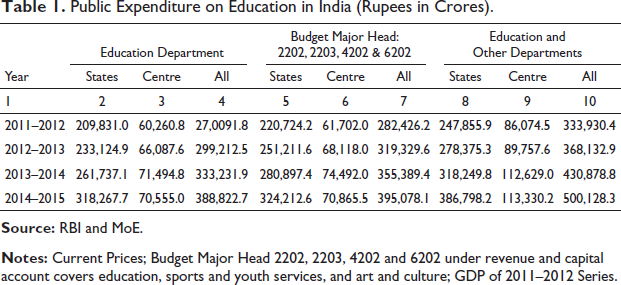
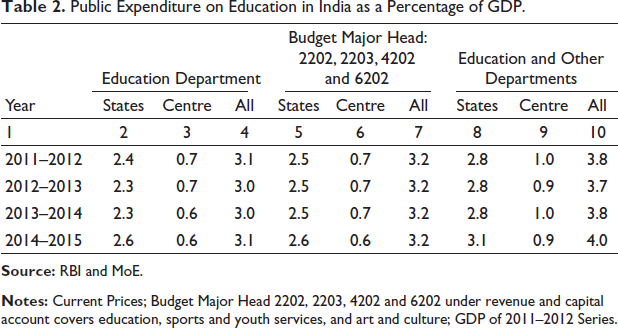
For illustrative purposes, Table 1 presents the expenditure on education by the reporting sources or accounts: Education Department, BMH (2202, 2203, 4203 and 6202) and the ABEE data as reported by MoE covering expenditure on education by the Education and Other Departments. The expenditure on education as reported by Education Department is less than what is reported under the BMH classification representing education which also covers few other departments but which is still not comprehensive. Both these reporting sources have expenditure on education considerably lower than that of expenditures of Education Department combined with other Department as reported by MoE. Such differences are explicit in not only absolute amount of expenditure on education but also observable for education expenditure as a percentage of GDP (Table 2). Expenditure on education by BMH as a percentage of GDP was hovering little above 3%, whereas the combined expenditure on education by Education and Other Departments was nearly 4%. There is nearly 0.6 to 0.8 percentage points difference between these two reporting figures.
Public Expenditure on Education in India (Rupees in Crores).
Public Expenditure on Education in India as a Percentage of GDP.
The data inconsistency matters while analysing public expenditure on education as it has implication for the final expenditure figures, which also has been debated often by researchers and policy makers. Having a comprehensive account of all the expenditure on education in the country across Ministries and Departments at the Centre and in the States helps in this context. Similarly, the classification of revenue or/and capital account also is important to assess the public expenditure. Further the series of GDP estimates also matters while deriving the percentage of expenditure, as the new series would result in a lower figure vis-à-vis older series.
The present paper is based on the data sourced from Reserve Bank of India (RBI) and Ministry of Education (MoE) anchored to the 2011–2012 GDP series. The RBI compiles the state budgets and builds the time-series values. To reiterate the data sources used, the state-level public expenditure on education in all states by BMH is sourced from the RBI; the Union Government expenditure on education on this BMH is compiled from its budget documents and ABEE annual series is used to obtain expenditure on education by the Education Department and Other Departments.
With an intention to examine the situation and make a trend analysis for the last three decades, the RBI compiled expenditure on education (based on BMH) from 1990–1991 to the latest (2019–2020). However, as mentioned earlier, the MoE compilation of more comprehensive coverage of expenditure on education is available for all sectors (states and centre combined) from 1951–1952 to 2019–2020. Separately for states and centre, it is available from 1999–2000 to 2019–2020. This later series is extended for the period for which RBI data for state sector BMH is available (1990–2091 to 2019–2020), through a simple linear estimation using RBI data (BMH) points or values and MoE all sectors combined values to make separate comparable series for state and central sectors.
Trends in Public Expenditure on Education and Centre–State Contributions
It is evident from Figure 1, that the comprehensive nature of expenditure on education made by the Education as well as Other Departments, as a percentage of GDP, is in the range of 3 to 3.5% during the previous two decades (1990s and 2000s) and is in the range of 3.5 to 4% for the present decade starting from 2010 (Figure 1). The expenditure on education based on BMH as a percentage of GDP is considerably lower compared with the MoE compiled expenditure on education covering more broadly all education-related expenses.

The expenditure on education solely by Education Department as a percentage of GDP is far below that of comprehensive expenditure; and only marginally different from that of BMH. The small difference observed in this respect between BMH and that of Education Department are on two accounts. First, BMH based account covers not only education but also expenditure on sports and youth services along with art and culture. Strictly speaking they may not represent education, especially the art and culture. Expenditure on these activities is, however, very small. Second, BMH on education covers beyond education department but does not cover expenditures by all other Ministries and Departments which are also spending a part of their budgets on educational programmes or activities. Despite these differences, all the three reporting sources or accounts have, unsurprisingly, followed similar trend during the last three decades.
The trend in expenditure on education as a percentage of total budgeted expenditure (of both Centre and State combined) is presented in Figure 2. It was 10 to 12% of total budgeted expenditure combined of revenue and capital, during the previous decades (1990s and 2000s), and increased to 12% or above during the present decade (2010s) (Figure 2a). Education share in the total budget expenditure is little higher in the revenue account when compared with its share in the total of revenue and capital expenditure. In the Revenue Account expenditure, education share was <14% during the previous two decades, it increased to 15% or above (Figure 2b).

Union Government Share
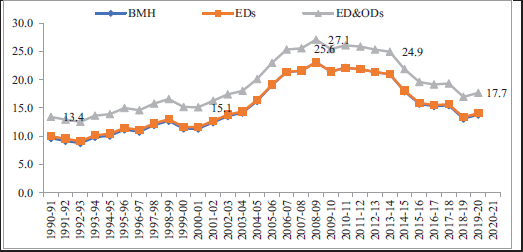
Then it is interesting to know the share of Centre (Union Government) in the total public expenditure on education in India given the fact that education is listed as a concurrent subject in the Constitution of India which implicates equal responsibility of both Centre and States in educational development in the country. The share of the Centre in all the three reporting sources or accounts on expenditure on education shows that it increased throughout previous two decades (1990s and 2000s) from 10 to 15% (varied by reporting sources or account) to its peak of 20 to 25% at the end of first decade of this century (Figure 3). Thereafter a declining trend is observed; for the latest year it is less 16% in 2019–20 (see Figure 3). The trend shows that share of Central Government in expenditure on education grew consistently from 1990s to 2010–2011 during which period it increased from 13.4% to a peak of 27.1%! It declined from 24.9% in 2014–2015 to 17.7% in 2019–2020. The declining trend is prominent in the recent past. A similar trend is found in the other data sources of Education Department and the BMH. But Centre’s share shows an improved trend in the comprehensive data source of the MoE over that of the BMH source.
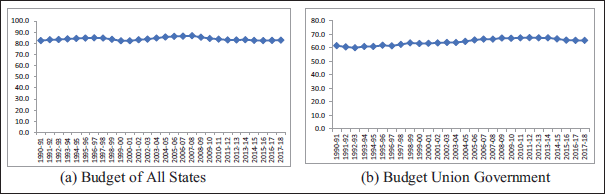
Then what is the expenditure made by Education Department (i.e., MoE) as a percentage of the total public expenditure on education? The expenditure made by the department under the Central Government is hovering around 60 to 70% (Figure 4b), while the same for state governments is around 80% (Figure 4a). That means between 30 to 40% of total public expenditure on education of the Central Government is incurred by Ministries and Departments other than the Education (MoE) Department. Due to the combined expenditure of education and other departments the share of the Centre constitutes a higher percentage in the total public expenditure on education (Figure 3).
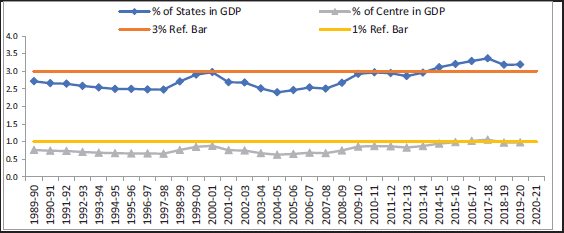
The public expenditure of the Centre and the States on education as percentage of GDP shows startling findings. The Central Government expenditure on education is well below 1% whereas the State Governments’ stake is in the range of 2 to 3%. It is appropriate to mention here that the Union Government expenditure on education as a percentage of GDP has constantly been around 0.5% till mid-2000s and reached 1% during late 2010s (Figure 5).
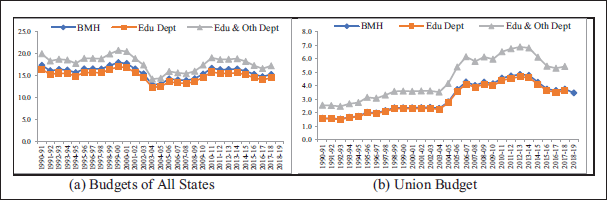
It is also important to look into expenditure on education by Centre and the States (of education and other departments combined) as a percentage of their total budget expenditures. While the states’ expenditure on education as a percentage of their total budget expenditure (revenue and capital combined) is in the range of 15 to 20% (Figure 6a), the Centre’s expenditure on education as a percentage of its total budget expenditure has been <7%. It was around 3% till early 1990s and shown a steady increase till early 2000 (around 3%) then exhibited a jump reaching to 6% (Figure 6b).
As a large part (>98%) of expenditure on education is incurred through the revenue account, it would be appropriate to consider expenditure on education as a percentage of total budgeted expenditure in the revenue account. Figure 7 illustrates that all states’ expenditure on education (combined of education and other department) as a percentage in their total budget expenditure in revenue account has remained at >20% all through the three decades. Not only that, even the BMH based expenditure for states is also hovering around 20% all through the analysis period (Figure 7a).
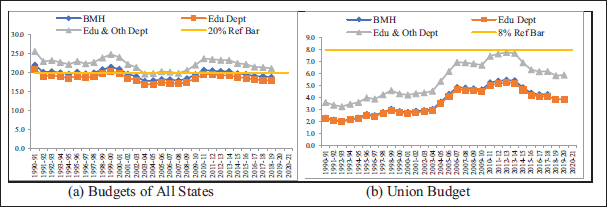
The Union government’s expenditure on education as a percentage of its total budget expenditure in revenue account has been observed to be <10%. It has shown an increasing trend since early 1990s to the beginning years of second decade (say 2010s) of this century; where it has increased from 3.5% to nearly 8% (Figure 7). Thereafter, it began declining; for the latest year it is only 5%. It is to be noted that, in fact, the ABEE of MHRD accounted all the expenditure on centrally sponsored schemes related to education in the Centre’s expenditure on education.
Overall, the Indian state is spending 4% of its GDP and 15% of total budget (public) expenditure on education. While all states together spend 3% of GDP on education, Centre is spending around 1% of GDP. While all states together spend >20% of their budget expenditures on education, Centre is spending <10% of its Union Budget expenditure. Centre’s contribution is around 20% of total public expenditure on education in India (Centre and States together), while the rest is borne by the States.
Concluding Remarks
Public expenditure on education is critical for educational development in a country or state given the public good nature of education. In a federal structure of polity, both the governments at Centre and those at the State level play a key role in educational development of the nation and are the main stakeholders in funding education. In India, education being a concurrent subject, the central government also has a role in deciding the priorities and direction, as well as shouldering the burden of allocating the resources. It is evident from the above analysis that the Central Government is relatively spending lower than the states, thereby proving its lesser commitment to public education.
The NEP 2020 proposes to increase the expenditure on education which is presently at 4% of GDP to 6%. Whether the Centre is going to shoulder the required increase in the education budget is a matter of concern. The central and state governments should proportionately share the expenditure on education. Otherwise, states are already burdened with spending considerable proportion of their expenditure on education against other competing demands on their development agenda. Despite a lower commitment of financial resources, Central Government would be playing a predominant role in the direction and regulation of the education sector, which is apparent from the NEP 2020. This could give rise to conflict and friction between the state and central governments, given that some propositions of the NEP may not be in consonance with the goals of the state governments. The Central government has to improve its stake in policy by making adequate resources available to the states so that financial burden of the policy shift is borne equally by the states and the centre.
Footnotes
Declaration of Conflicting Interests
The authors declared no potential conflicts of interest with respect to the research, authorship, and/or publication of this article.
Funding
The authors received no financial support for the research, authorship, and/or publication of this article.
