




Abstract
The life of people born in Dalit families is more challenging than others and the challenges upturn manifold if a downtrodden seek a livelihood in the field of entrepreneurship. Although, entrepreneurship is a risky affair for everyone it discommodes the Dalit community more. The paucity of societal support and resources, and above all lower caste label makes it highly troublesome for Dalit to cross the threshold of entrepreneurship and stay therein. Government and a few other organizations assure to provide all possible facilities and assistance to the Dalit aspirants through diverse schemes but many times these assurances are found outlying from reality. This empirical research article aims to provide qualitative insight into the previously published articles, research papers, and reports allied to the challenges of Dalit entrepreneurship. The thematic analysis technique has been applied for literature review using NVivo Software. The upshots of the study clearly depict that Dalit entrepreneurs are frequently confronted with severe difficulties, particularly due to the unfair conduct of various stakeholders. This research study will make a considerable contribution to the Dalit literature and outcomes will assist the policymakers to enhance the efficiency of entrepreneurial schemes to the expected level.
Introduction
In the older era, Dalits were shunned by society and were barred from participating in any socio-economic or political activity (Koundal, 2016, p. 21). Ages after, the agony of these castes was discerned, and endeavours were made by the various social reformers, British and later by governments to elevate the oppressed castes (Uplaonkar, 1982, p. 159). Major reforms were synergized by affirmative action and downtrodden earned the right of participation in public sector jobs and in education. Right to literacy amplified mindfulness among them and employment improved their living standards. With the benefit of reservation quota, from 1951–1952 elections onwards, Dalit people elevated even to political power (Sharma, 2021). But all this was not enough to mend their social standing in the society (Pick & Dayaram, 2006, p. 293). Livemint (2013) reported that this evolution did not provide Dalit the social dignity, such presence in reputed positions just reinforced the perception that their success is not skill-based but solely owing to the use of reservation crutches.
So the issue is, what should be a better way of progression? Addressing the same context, some literary content claimed that entrepreneurship might be a more positive means of backward people’s socio-economic perk-up. If the consensus of numerous intellectuals is accepted, it may be stated that genuine growth for socially deprived people lay in the corporate sphere rather than depending merely on quotas. Babasaheb Ambedkar was also quite optimistic about market evolution and treated it as a ladder to the progression of humankind (Omvedt, 2017). ‘Dalit Indian Chamber of Commerce and Industry’ shows the faith that the gap of social discrimination can be crossed through the bridge of capital. Entrepreneurship and economic growth could assist the Dalit community’s social advancement (Kurian, 2007, p. 374) so these two measures have been recognized as effective instruments for combating caste prejudice. The concept of diminishing the caste impact using the power of capital is unexcelled in the true sense (Indurkar, 2017). Entrepreneurship may have been glorified by various publications for Dalit’s furtherance, but opting for entrepreneurship is nothing less than a wager for the backward caste person as they have to shoulder all the potential risks to a greater extent than the person of general caste. This route to Dalit entrepreneurship is not lenient; the hardship of the early stages of start-ups, as well as the variety of business hurdles until success, are enough to dampen the exhilaration of thousands of aspiring Dalit entrepreneurs.
Literature Review
In the literature review section, only those statements from various publications have been presented which have been utilized by researchers for the coding, necessary for thematic analysis.
Mishra (1996) discovered that Dalit organizations were in losses due to highly ineffective management, inappropriate fund utilization, and lacked risk appetite. Omvedt (2005) analysed that some anti-incumbency activists demanded reservation in private sectors but did not encourage entrepreneurship because if Dalits became moneyed and united then they would become satisfied and would not clash with the government. Lokhande (2006) identified many challenges, namely, inadequate education, economic backwardness, inadequate financial support, lack of self-assurance along with risk-bearing ability. However, inadequate business management expertise and apathetic attitude of government officials towards Dalit entrepreneurs were the prime identified challenges. Prakash (2009) observed that caste was important in the market since it was essential for creating business networks and dealing with competition. Caste restricted the activities of lower-caste individuals by imposing limitations on capital, land, labour, access to loans, and other requisites for any enterprise.
Thorat and Sadana (2009) explained that Dalit lacked private funds due to denied property rights in past. Moreover, they had to encounter discouraging prejudice in terms of access to inputs and services as well as the selling. Jodhka (2010) discovered that Dalits were refused loans due to lack of a strong reference or absence of collateral. They faced intricacy in arranging funds and getting a suitable location for their workplace. Asking dues from upper caste customers was a dare. Their businesses were addressed with caste names, which had a bad effect on their earnings. Kochadai (2011) revealed that Dalit entrepreneurs were considerably behind their peers in business growth and venture start-ups due to a restricted portfolio of managerial skills. Mahajan (2011) identified Dalit entrepreneurs as prejudiced victims. They were largely inexperienced and unaware of loan schemes. And limited funds were detrimentally affecting their output and earnings.
Rajagopal (2011) outlined that credit rating system, tight collateral requirements, insufficient debt, delays, poor government schemes, and caste prejudice as key obstacles to Dalits. A Dalit could have a loan for a caste-related business, but not for any other profession. Gaikwad (2012) detected prejudice, curb on industry selection, rancour by government agencies, unfit hiring, and social segregations as external challenges; while the absence of role model, dearth of boost, family bickering, difficulty in marriage alliances with Dalit entrepreneurs, and snags in obtaining financial benefits were named as internal entrepreneurial challenges. Deshpande and Sharma (2013) found entrepreneurship among Dalits in a bad shape; they were found poor individuals with low education, low assets, poor networks, low productivity, and related to traditional occupations. They faced caste discriminatory barriers in expanding their business and prejudice from their customers.
Iyer et al. (2013) reported that most Dalit companies failed because of discrimination, a lack of education, and financial constraints. Unregistered businesses, on the whole, lacked official assistance. They also had a deficiency in critical social networking capabilities. Chauhan (2014) explained that caste impact, family issues, low self-perception, limited social networks, low education, technical skills, and geographic constraints affected the business competency of Dalits. Kapur et al. (2014) described that arranging to finance was the biggest problem for the Dalit entrepreneurs, as they neither had collateral nor the rich community networks. Paramasivan and Selvam (2014) noticed Dalit entrepreneurs were disguising their caste identities to prevent prejudice from competitors, buyers, sellers, the workforce, and various government agencies.
Indurkar (2015) explored that banks were unwilling to fund Dalits due to caste position and concerns about their ability to repay. Other obstacles identified were a lack of inherited wealth, a lack of business background, and a lack of an ideal environment for entrepreneurship. Lokhande (2015) discovered that Dalit entrepreneurs were largely affected by social prejudice, low self-confidence, weak infrastructure, poor attitude of financial institutions, delays, stiff competition, marketing, indifferent attitude of customers, pressure to remain in customary professions, and recovery of the bills. Naig (2015) found that in Tamil Nadu the interruption in the reclassification of industrial land and the rejection of a loan owing to a lack of collateral were the key concerns.
According to Paramasivan (2015), most Dalits did not pursue entrepreneurship because they were scared that people will not buy their goods. Dalit also lacked a traditional entrepreneurial base; therefore they faced various challenges in entrepreneurship. Prakash (2015) discovered that it was difficult for Dalits to enter the crucial business networks. They faced discrimination in prices, orders, loans, interest rates, business terms, and respite for payments. Even state machinery was found biased against Dalit entrepreneurs. Raghavendra (2015) reported that snags in acquiring land and providing collateral security for bank loans had been the key challenges for Dalit entrepreneurs. Lal (2016) reported a deficiency of money as a key issue. Dalit lacked the traditional business networks that were essential for enterprises. It was also said that government institutions cannot be Dalit allies until they face a penalty.
Lokhande (2016) analysed that weak industrial infrastructure, limited funds, late payments, meagre demand, unskilled workforce, dearth of raw material, incomplete market information, intense rivalry, inefficient management, inferior workplace, inept training, and faulty transit arrangements had troubled Dalit entrepreneurs. Livemint (2016) reported that for Dalit getting access to vital business networks was more difficult than getting debt from banks. Lum (2016) presented that Dalit often did not get credit from banks, they were perceived inferior, some industries were prohibited to them and their community was also deficient in role models. Oza (2016–2017) revealed that castes historically connected with the business sector had the advantage in terms of business expertise and strong networks. However, these benefits had not been available to Dalits.
Asokan (2018) analysed that the system had always favoured older and larger companies, and had made it hard for Dalit to cross the threshold of the supply chain. Gowda and Gonchikar (2018) identified insufficient technical abilities, raw material scarcity, inadequate exposure, social restrictions, a strict repayment schedule, and lack of marketing due to a lesser budget as key challenges. Mosse (2018) analysed that Dalit entrepreneurs had narrow access to capital, collateral networks, infrastructure, good workspaces, and raw materials. And they had a presence in a biased market. Indurkar (2018) explored that Dalit lacked both business experience and start-up capital. Loans and networks were not approachable to them. They faced toil in getting their payments, promotion of business, and resource mobilization.
Mitul and Agha (2018) explored that market access, collateral issues, and managerial skills were some vital Dalit troubles. In addition, revealing Dalit status could have led to their social boycott by other businessmen. Singh and Agarwal (2018) concluded that Dalit entrepreneurs lacked economic, social, educational, and training resources and the stigma of being untouchable had kept Dalit out of some industries. Jena (2019) explained that Dalits were denied debts due to insufficient collateral and market reluctance. They also lacked market and family support, technology, market intelligence, worth raw materials, management, and entrepreneurial skills.
Khan (2019) expressed that Dalit entrepreneurs had poor access to credit. Due to some unfortunate cases, bankers had created an unfavourable image towards them. Munshi (2019) observed that caste networks used to offer insurance, employment, and business loans to their members, but Dalit entrepreneurs lacked it. Raj and Anand (2019) expressed that Dalit entrepreneurs had a deficiency of education, collateral and business networks. They lacked commercial resourcefulness due to societal prejudice. Raj and Anand (2019) discovered that Dalit entrepreneurs were hesitant to reveal their caste identity for fear of being labelled as outsiders in the business sphere as they required support from networks.
Badigannavar et al. (2020) revealed that the Dalit entrepreneurs’ poor economic performance was largely attributable to a lack of networking. Madaboyina (2020) identified that less education and awareness, hard competition, monetary constraints, technical problems, managerial inefficiency, low social support, inability to take risks, and lack of entrepreneurial base were some key Dalit entrepreneurial challenges. Planning Commission (n.d.) reported that stiff competition, scarcity of raw material, inadequate finance, incomplete marketing knowledge and training, scanty space; inferior infrastructure and electricity supply, poverty, limited network, social repulsion, and caste prejudice were some serious Dalit entrepreneurial challenges.
Methodology
The present empirical research study is an attempt to provide qualitative research insight into the previously published articles, research papers, and reports allied to the challenges of Dalit entrepreneurship. An extensive literature review has been done for the study so that the results can be extended to a generalized level. For content analysis, the technique of Word-Cloud and thematic analysis has been applied with the help of NVivo software so that trustworthy outcomes could be reached. Word-Cloud, which software crafted on grounds of word frequency, provides accurate recommendations for theme development. The themes for the present research can be defined as the various challenges that Dalit people encounter in the entrepreneurial world. For thematic analysis, the entire content of the literature has been encoded into suitable themes. Each publication’s interpretations have been encoded into themes in such a way that no key statement has been turned a blind eye. Most of the themes have been kept largely exclusive, yet some themes have had to be aggregated with the main theme as those have been found to be largely correlated or causal to the main problem. This aggregation has also given a concrete meaning to the final outcomes.
Results
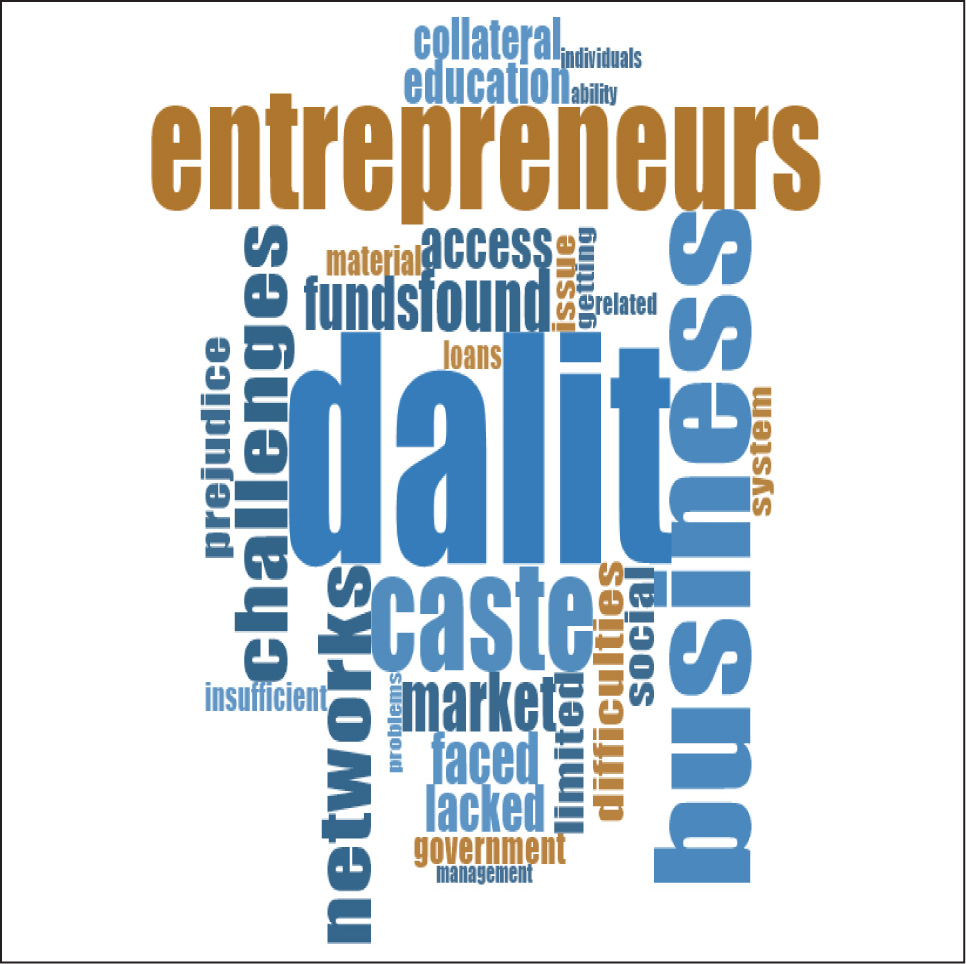
A Word-Cloud has been built to spotlight recognizable themes based on the word frequencies detected by the NVivo software from the intact publications.
A Word-Cloud is a visual depiction of the terms that are prominently present in the selected text. High-frequency words in the content look larger and bolder into the image. Figure 1 emanates that other than general words some noteworthy words like networks, insufficient, prejudice, collateral, education, access, loans, material, funds, social, market, lacked, faced, management, government, and so on, have been addressed pervasively in the literature. Therefore, these prevalent words helped in the creation of the apropos theme. Themes can be interpreted as mentioned challenges strained from the literary content.
Broadly a total of thirteen challenges have been identified by the thematic analysis of the select literature. Challenges identified from select literature have been introduced in tabular style so the strength of each challenge and the number of publications in which the specific challenge has been divulged, may be easily comprehended. Table 1 consists of themes, which can be better understood as challenges. Column ‘Files’ exhibit the number of publications that have assertions about a specific challenge. ‘References’ column gives the information about total statements encoded for a given challenge. The proportion of each challenge has been given in the last column ‘Percentage’ so that the overall strength of each challenge can be discovered within reviewed literature.
Challenges Faced by Dalit Entrepreneurs.

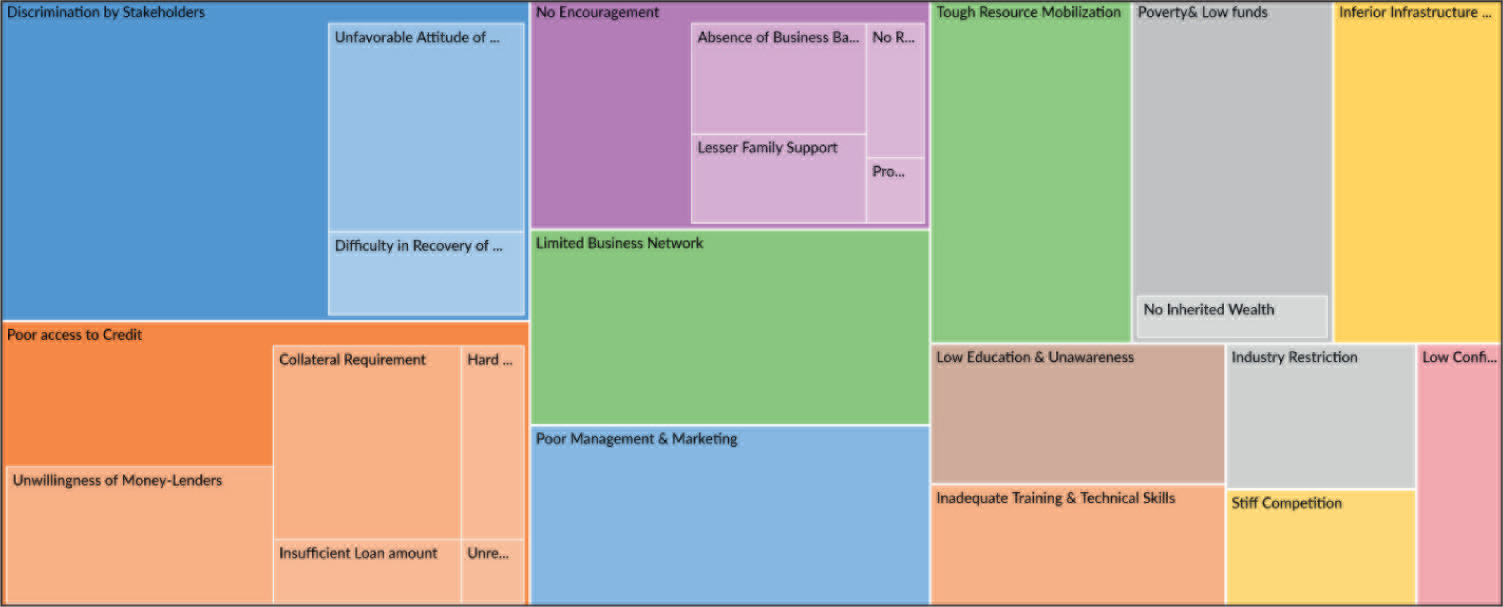
Table 1 displays all the challenges discussed in the literature and is able to make other relevant disclosures related to these challenges. Scanning of the same revealed that Dalit entrepreneurs face a variety of concerns and constraints in the entrepreneurial world. If statements cited in the literature are examined from the standpoint of statistics, one can see that the prominent issue in the path of Dalit entrepreneurship with 18.6% is the discriminatory attitude of various stakeholders. Stakeholders are those parties that are connected to any business internally or externally and exert a significant impact on its performance. Typically they are suppliers, customers, employees, agents, governments, and so on, but here the apathetic attitude of the government towards the Dalit has been displayed with a separate sub-theme so that it can be emphasized that not only the society but even the administration is involved in the discriminatory conduct. Numerous customers do not purchase goods from Dalits due to conservative thinking; such references are included in the theme ‘Discrimination by Stakeholders’ but another concern related to customers is worth sharing here with a separate sub-theme as it exposes a different angle of caste-based prejudice. A total of 4 publications mentioned the issue that upper-caste customers do not pay their dues to Dalit sellers just to retain their caste sway.
Difficulties in obtaining loans emerged as the second most significant category of the hurdles in Dalit entrepreneurship accounting for 16.59% of total references. Lending below demand, hard credit conditions, and firms being unregistered, have been revealed as some of the credit-based obstacles. But two hardest challenges amid credit-based issues came out as the demand for collateral, and lenders’ reluctance to lend to Dalit. Both of these concerns have been found in the same ratio in the total content. Collateral is said to be a foremost condition for loans, and most of the first-generation Dalit entrepreneurs are unable to meet this requirement because unlike upper castes they do not inherit the assets from their ancestors, which can be used as collateral. The lenders’ negative attitude toward Dalit can be categorized as both a discriminatory and a credit-related concern. But this challenge has been kept in the category of ‘Poor access to credit’ because for Dalit it is one of the leading reasons for not being able to acquire loans for business purposes. However, the researcher is not disregarding the social affiliation of this challenge in any way. If this challenge is considered in conjunction with the misconduct of various stakeholders, it will amplify the problem of social discrimination to the percentage of 23.12%, which is pointing towards a worrisome social trend. In terms of publications also, a maximum number of literary content (32) have been found to cite discriminatory behaviour of stakeholders, and almost the same number of publications (31) mentioned the challenges related to loans. Thus it is revealed that both, social discrimination and credit-related issues are quite talked obstacles to Dalit Entrepreneurship.
Another hurdle found in the literature is a lack of encouragement for entrepreneurship among Dalit. With 10.59%, this problem ranked third on the list of major challenges. It is doleful that Dalit entrepreneur does not get encouragement even from their family members. Successful Dalit businesspeople are not publicized in the country, and due to which no strong role model emerged whom Dalit aspirants could follow. A lack of business background and an inclination towards reservation has also proved to be responsible for a pessimistic approach towards entrepreneurship. The fourth vexatious issue with 8.54% proportions faced by low caste entrepreneurs has been revealed as an absence of a substantial business network. Networks are believed valued in any business because they assist entrepreneurs in obtaining diverse business deals and act as catalysts for the growth of a business. But in network connections, Dalit entrepreneurs lag far behind the upper caste businessmen. Inefficient management and poor marketing have been visible to be quite unpleasant for Dalit entrepreneurs with a total of 16 reference statements.
Other notable barriers accountable for the unfortunate performance of Dalit entrepreneurs include difficulties arising in mobilizing resources, and poverty. These constraints have been found in Dalit literature with 7.53% each. The percentage of these challenges may be low in the presented literature, but it is really tough for Dalits to face numerous defies in mobilizing appropriate business resources. Due to the state of poverty, many Dalits hesitate to even think of being in business. In inheritance, these people do not get wealth or resources but only the challenges. The Dalit’s limited access to good infrastructural facilities turns up as another mentionable trouble with 6.53% of code strength. Inadequate training and technical skills, and low education and unawareness amongst Dalit have been found as additional troubles, but with relatively modest proportions. A total of 6 reference statements mentioned the industry-based restrictions, that is, perception is present in society that Dalit could be good for leatherwork but not for the food business. It is truly disgraceful that people are still judged by their caste status and not by their skills. Stiff competition, and low confidence and risk ability with 2.51% each, have been discovered as the two weakest challenges in literature.
Based on strong shreds of evidence, it is exposed that Dalit entrepreneurs are anguished from a diverse range of defies. Each challenge has its own set of commercial repercussions that are sufficient to deter a Dalit from being in business. Furthermore, nearly every publication has identified more than one challenge in Dalit enterprises, thus, it is not an exaggeration to say that Dalit entrepreneurship is another name for torment. It is worth noting here that the percentage of challenges does not reflect the seriousness of them but their recurrence in the presented literature. That is, how many times this challenge has been recognized as a difficulty in Dalit entrepreneurship. But no matter how little the percentage of any issue is, the impact it has on Dalit entrepreneurs is always found excruciating.
The hierarchy Chart represented in Figure 2 is providing a pictorial view of the research finding to represent final inferences just at a glance. It can be understood as an image of thematic analysis based on the percentage of each challenge.
Conclusion
Entrepreneurship in India is acting as a way to better the socioeconomic status of Dalits (Shankar, 2019, p. 2206). But they suffer superfluous challenges as a result of caste prejudice (Gaikwad, 2012, p. 6). Deshpande (2010) observed that social caste patterns to a great extent define and impact one’s career in India. Many people’s discernments of Dalits are restricted to jobs of reservation or low-wage employment. Accepting Dalit individuals as entrepreneurs are frowned upon by society. The empirical inferences arising out of intensive literature review illustrate that the societal issues continue to plague Dalit people even in today’s emerging milieu. Entrepreneurship is a type of socioeconomic activity, in which along with numerous arrangements, many individuals need to be contacted, but as soon as high caste stakeholders got to know of the businessman’s low caste status, social bigotry begins against them. This detest has many faces and it originates from a variety of sources. Customers deny buying Dalit-made products, suppliers delay the supply of raw materials, agents trouble them with stringent terms and conditions, creditors refuse loans to them, and debtors do not pay the dues on time. Financial hardship is also included in the obvious trouble of Dalit businessmen. Caste networks have also been proven to have a substantial influence on the profession (Nandi, 2010, p.6), although such social capital has not been effortlessly accessible to Dalit. Many times, these people must do business while concealing their caste in order to prevent caste-based harm. Even if a lower caste person managed to enter entrepreneurship; their ventures are continuously impeded by discriminatory societal behaviour, inadequate facilities, and a lack of finances. The study also uncovers that even official actions have been found disheartening them on several occasions. Entrepreneurship has been found less endorsed profession amid Dalit due to a lack of impetus from family, friends, and inclination towards quota-based jobs. Low-quality education and a lack of required skills aggravate their pitiful situation. All of these obstacles shatter their enthusiasm, and eventually that of thousands of other Dalit aspirants. The extrapolations arising from thematic analysis clearly pointed out societal challenges to be far more happening than any other worriment. However, this study article does not imply that financial or any other botheration should be neglected in any circumstance. But it advocates that before anything, society and the system both need to amend their outlook toward Dalit, and stakeholders have to think beyond caste. Moreover, the debt and collateral laws in the country must be aligned with the concept of social fairness.
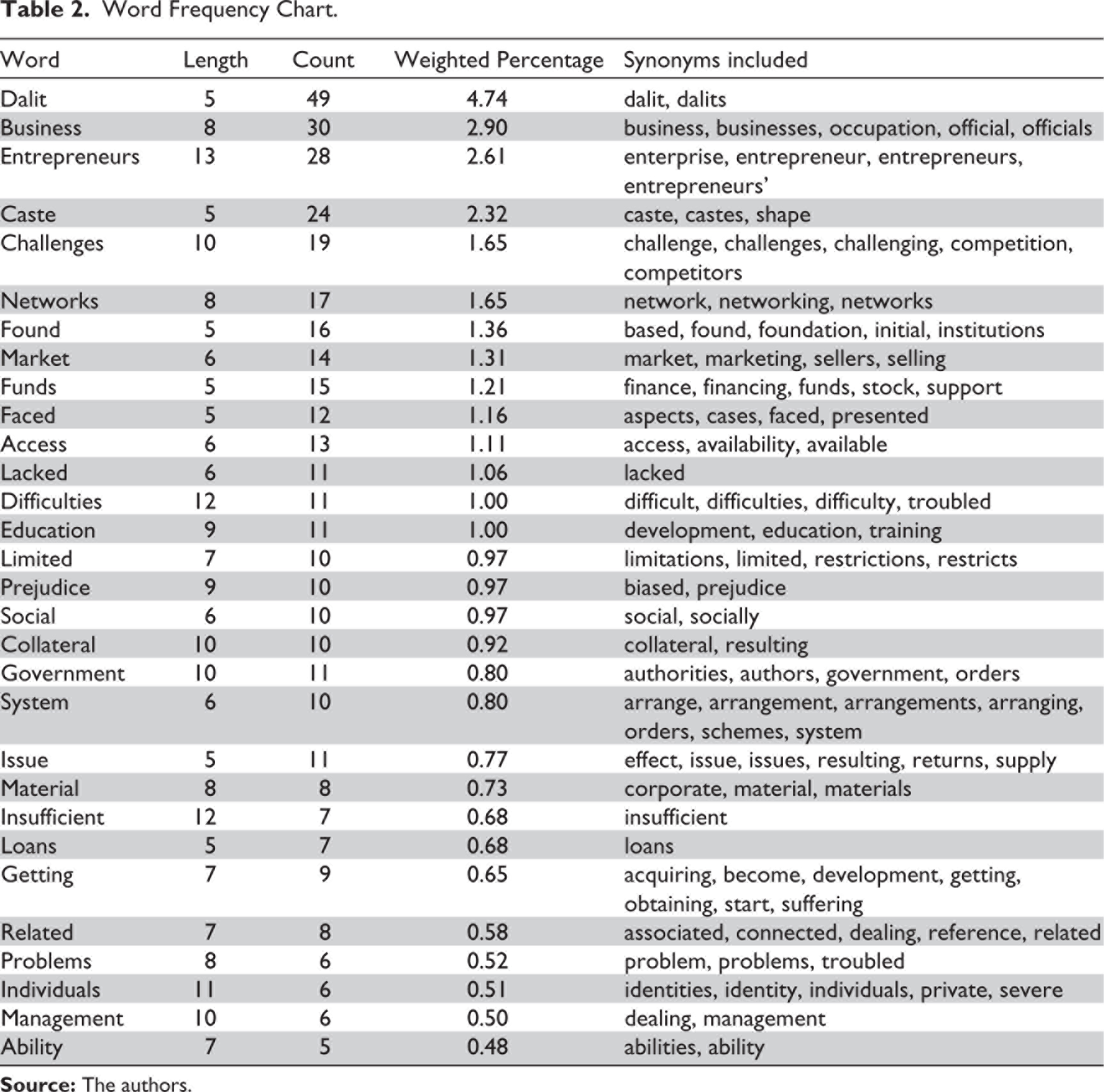
Word Frequency Chart.
Footnotes
Declaration of Conflicting Interests
The authors declared no potential conflicts of interest with respect to the research, authorship and/or publication of this article.
Funding
The authors received no financial support for the research, authorship and/or publication of this article.