



Abstract
This article seeks to understand the agenda of the government of Punjab behind the recent construction of the cultural heritage of sant/guru Valmiki which is attracting a sizable population of the Dalit community known as Balmikis in the state. In this context, the article explores the historical role of the Adi-Dharam Samaj, an anti-caste reformist movement by the Balmiki community. This movement has adopted various new modes and strategies to mobilize the community. It also subscribes to the philosophy of Ad Dharm to define a separate religious identity for Dalits, especially the Balmiki community separate from Hindus and Sikhs. It has also adopted a distinct path of ensuring Dalit social mobility without following the dominant modes like Sanskritization and conversion. The making of Dalit cultural heritage is a significant development in a realm that explores the extremely marginalized community within Dalits, and their attempt at identity articulation and assertion in contemporary Punjab.
Introduction
The foundation stone was laid by the then Chief Minister Prakash Singh Badal in October 2013. The event has been celebrated as a moment of pride for the historically marginalized community, traditionally known as Chuhras (sweepers/scavengers) in Punjab. Before the emergence of this Valmiki 1 heritage, ‘the community consecrated their identity and heritage in barebones temples, overshadowed by the mighty village gurdwara’ (Singh, 2014). A local Balmiki leader and activist, in an interview with the author, stated that he regarded it as a symbol of pride and self-respect for the community. He further observed that ‘now we have a separate religious space like other religious communities of Sikhs and Hindus in Punjab’ (the information is based on a long discussion with Om Prakash ‘Anarya’, held on 18 December 2019, during my fieldwork in the city of Amritsar). It is important to note that Dalit 2 social mobility and assertion within the landscape of the Punjab have been rooted in the emergence of separate cultural heritages, instead of taking the electoral route as is the case with other states like Uttar Pradesh and Maharashtra (Jaffrelot, 2003).
However, heritage building for the socio-political and cultural mobility of the community is not restricted inside the geographical terrain of the state of Punjab. A similar attempt has also been made in Uttar Pradesh while constructing the Guru Ravidass Janam Ashtan Mandir or Seer Goverdhanpur in Varanasi. The All India Adi Dharm Mission laid down the foundation of Ravidass heritage in 1957. Later on, sants of Dera Ballan of Punjab and Dalit national leaders played a significant part in the process of socio-political mobilization of the community, using the cultural heritage of sant/guru Ravidass. Now, thousands of devotees largely belonging to the Chamar community, from all parts of the country and even abroad, pay their visits to the temple (Hawley & Juergensmeyer, 2004, pp. 18–21).
In the context of Punjab, the intervention of the state government and the politics of negotiation led by caste contestation between Balmiki and Hindus are the major factors behind the formation of Valmiki heritage. This aspect has been explained in the first section of the article in a detailed manner. The second section explores the cultural assertion of the Balmiki community that is mainly centred on the newly constructed heritage of their patron sant/guru Valmiki in Punjab. In this context, the role of Dalit agencies, particularly the leadership of Darshan Ratan ‘Ravan’ and his movement (i.e. Adi Dharm Samaj) are cases in point. They have played a significant role in consolidating the religious boundaries of the community by formulating their own diverse rituals, symbols, scriptures, salutations, nomenclature and an alternative religious philosophy which is based around the newly built heritage of Valmiki. This section also argues that the art of resistance and negotiation with the state has never been lost in the vision and agenda of Dalit agencies while defining their distinctive ‘self’ in comparison to mainstream religious communities. In conclusion, the author argues that the act of constructing cultural heritages through a marginalized section of the society has provided a deeper meaning to Indian democracy and led to an increase in the demands to study such heritage.
The Emergence of the Dalit Cultural Heritage of Valmiki: An Outcome of the Politics of Interaction, Contestation and Negotiation in Punjab
Valmiki Tirath Dham (temple) was inaugurated by the Punjab state government on 1 December 2013 along with a museum and panorama to woo the sizable population of Dalits’ in Punjab. Noticeably, the Mazhabi and Balmiki communities in Punjab form an umbrella caste category called Chuhras and they constitute the largest population of Scheduled Castes population among the Dalits in the state. On the occasion of Valmiki Jayanti (birth anniversary), during his speech at Valmiki Tirath, Chief Minister Prakash Singh Badal said that ‘it is a matter of pride for the state government that is offering tributes to Bhagwan Valmiki by developing the site for the devotees’ (The Hindustan Times, March 29, 2013). Before the making of Valmiki heritage, there was a longstanding dispute between Dalits and Hindus over the control of this land. It has been historically regarded as a ‘contested space’ where politics of claim and counter-claim were deeply entrenched for many decades. Navprit narrates it as a site ‘where different and opposing memories of the sacred exist’ (Kaur, 2014, pp. 46–49).
Historically, there are two contrasting mythologies of the Hindus and Dalits that are floated in and around the sanctity of this space. On the one hand, oral narrative of the Hindu mahants and other heads of the ashram claim that this space belongs to Bhagwan Ram because he used to visit Maharishi Valmiki in this space. On the other hand, Balmikis have believed that this is the space where their guru lived and devoted his entire life in the bhakti of the nirgun-God. According to their popular belief – which is doubtless of local origin – Valmiki wrote his celebrated epic, the Ramayana, near around this hallowed site of the ‘pool of nectar’. It was here, too, that Sita stayed during the period of her vanvasa (banishment). Here again, the twin sons of lord Rama were taught the Ramayana. Therefore, this space belongs to Bhagwan ‘Valmiki’ and his devotees.
According to the available literature in the form of Dalit memoirs, pamphlets and oral narratives, the contestation among Hindus and Balmikis and their claims over this land started around the 1940s. During this period, Balmiki Sabha of Punjab had launched various non-violent protest movements to control the worship places of their religious guru Valmiki in Punjab. A major ‘Dalit satyagraha’ was launched in Amritsar to take control of their holy space under the name of Ram Tiarth Morcha. It has been stated that upper-caste Hindu priests (mahants/purohits) did not allow the Balmiki Chuhras to enter the premise of the tirath 3 or to take bath in the sacred pond due to the practice of untouchability. Against such discriminatory practices, Balmikis of Punjab launched a non-violent social protest movement to enter into the premise of the Valmiki tirath. At last, the British administration allowed them to celebrate the religious festival in the memory of Guru Valmiki. Permission was also granted for taking bath in the sacred pool (sarovar) and a piece of land was also provided for building a small shrine for Valmiki ashram along with other Hindu temples.
Similarly, the strong presence of state intervention has been expressed in the words of a Hindu priest who narrated his views during my field visits on the inauguration day of the Valmiki heritage in 2016. He was gazing at the life-size building of the heritage (Figure 1) and told me that ‘sarkar (government) was on their side because they (Dalits) have numbers and we (Hindus) lack both numerical strength and state support’. His entire concern was not simply losing space in the state politics of Dalit appeasement but also his financial loss as well. He said to the author ‘people would prefer to see this newly built heritage because of its attractiveness’. It seems true because thousands of people including bigwig political leaders prefer to make their first visit at Valmiki heritage rather than other existing Hindu ashrams (based on field observation).
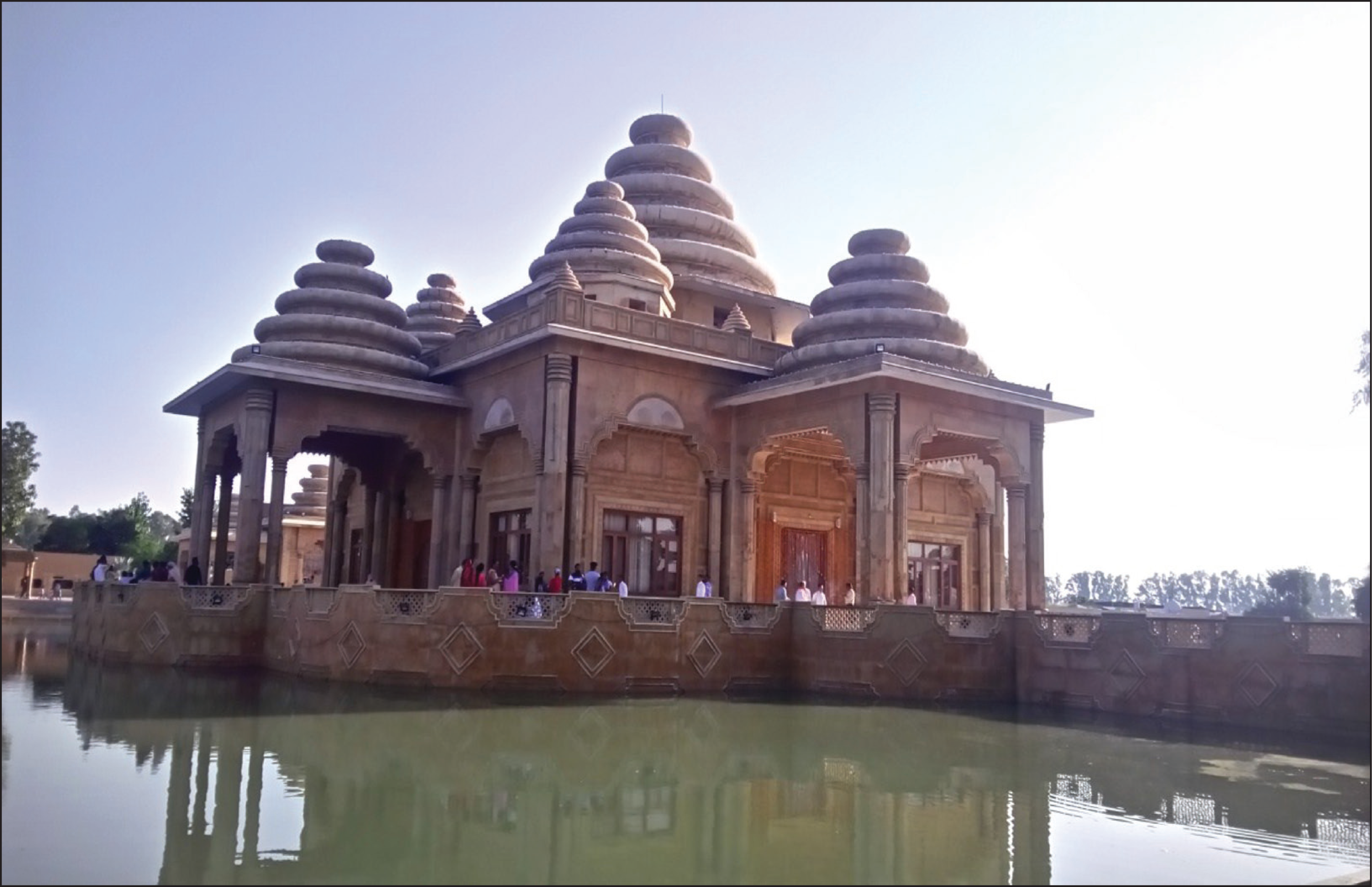
The construction of this cultural heritage has radically transformed the sacred space of the tirath and overshadowed other existing small temples, mostly those belonging to the Hindu gods and goddesses (based on field observation). Such a development has produced new meanings for Dalit cultural politics in Punjab: one where the state selects and legitimizes the mythology of Dalits while relegating the claims of Hindus to the marginal. Secondly, it also provides a new meaning to the space and that now entirely belongs to Bhagwan ‘Valmiki’ rather than to Lord Rama. Furthermore, in the cultural policy of the state, Valmiki heritage is popularized by the Punjab government as ‘must-see-tourist destination’ of the holy city of Amritsar. In his long speech, Badal stated that ‘realizing the paramount significance and sanctity of this historic place the state government had made concerted efforts to develop it’ (The Hindustan Times, March 29, 2013).
In this entire process, the politics of state intervention and negotiation have become a central concern requiring further explanation. The politics of the negotiation of Dalits with the state is not a new phenomenon in Punjab. Its roots are deeply entrenched in the methods and strategies of Ad Dharm 4 that were used to assert an independent identity for Dalits in colonial times. In this regard, Juergensmeyer has written a chapter on the politics of the nexus between state and untouchables under the title of Hope from God and Help from the King. He argues that historical ‘circumstances’ bound them together. On the one hand, the untouchable leaders and ideologues of the Ad Dharm sought to affect the state’s policies and gain positive benefits in order to assert their independent identity from mainstream religious and political communities. On the other hand, during this time period, the power of the colonial state was challenged by nationalist, Congress and other dominant socio-religious movements. Therefore, the British government needed support and loyalty from a substantial segment of the untouchable population during this difficult time. In other words, mutual threats, calculative motives and strategic moves of the state and Dalit agencies had made them allies in the past (Juergensmeyer, 2009, p. 140).
However, such politics of Dalits and other subaltern groups in the country has been presented as ‘mindless submission’, ‘sectarian’, ‘pro-British’ and therefore ‘anti-national’ in the dominant framework of the Nationalist and Marxist writings. On the contrary, the state and its agencies have been viewed by Dalits in a distinct manner. In such visualization, the irony of ‘submission’ and the ‘dual nature’ of the state have never been lost. They also adopted a distinct approach towards the state and other historical agencies. Such an alternative vision of the Dalits and other marginalized sections has been historically formed on the basis of their experience of interaction with and repression through state. It provides them with a distinct perspective towards the centres of power which can be traced from their ‘hidden’ cultural and metaphorical universe. For instance, state and its agencies are metaphorically represented by Dalits through the symbols of ‘nature’ or ‘distant god’ (Juergensmeyer, 2009, p. 141; Nagaraj, 2010, p. 25).
According to such metaphors, the state is perceived as ‘complex’ and ‘transformative’ agency. Like nature or god: the state acts erratic and beastly at one time and friendly, generous and benevolent at another. Such conceptualization of the state and its nature according to the subaltern worldview has largely contested the ‘uniform view’ of the ultra-nationalists and Marxists which provide only a single dimension perspective of the state and its nature: a source of oppression and, exploitation. The 1931 census has been regarded as the high time of the Dalit politics of interaction and assertion in colonial Punjab. During this time, untouchables proceeded to list themselves under the separate category of Ad Dharm religion. Later on, this movement was dominated by Ad Dharmi Chamars. They excluded the other communities like Balmikis. 5 In comparison to the Balmikis, Chamars have excelled virtually in every sphere, be it in education, urbanization, jobs, occupational change, cultural advancement and political mobilization (Puri, 2004, p. 4). Many of them have settled abroad (Europe, North America and the Middle East) and have provided monetary support to their brethren back home, including the support for forming a separate cultural heritage for the cultural and social advancement of their community. On the other hand, Balmikis have limited economic resources. Caste-based discrimination within Dalits and their traditional occupations (i.e. mostly sweepers and scavengers) are major hurdles for their cultural and political development in comparison to other Dalits in Punjab.
Balmiki leaders and activists are fully aware of their historical exclusion and the socio-economic constraints faced by the community in the present context. In the light of such circumstances, the community has organized an anti-caste movement under the banner of Adi Dharm Samaj in Punjab in recent times. Darshan Ratan ‘Ravan’ is the founder head of this movement which started around the 1990s with the aim of reviving the aboriginal past of the untouchables in order to secure a respectful identity for Dalits. It also aims to secure an independent religious identity for their community from mainstream religious communities (i.e. Hindus and Sikhs). For achieving this purpose, community leader like Ravan made concerted efforts which have been discussed in the second section of the paper in a detailed manner.
Interestingly, Ravan through his speeches and writings has remembered the historical role and active participation of Balmikis in the Ad Dharm movement of the 1920s. It is important to note that Balmiki leaders and ideologues had actively participated in the movement along with Ad Dharmi Chamars. But their (Balmikis) historical involvement and struggle has been rarely been noticed due to the politics of caste consciousness within Dalits in Punjab (Ravan, 2010). Now, Ravan is keenly involved to revive the legacy Ad Dharm through its new avatar of Adi Dharm Samaj for the socio-political and cultural upliftment of the Balmikis. Caste cleavages among these two major caste groups are getting sharper due to the identity politics of Dalits in contemporary Punjab. Balmiki leaders including Ravan have alleged that the benefits of state reservation in public jobs and education are largely secured by Ad Dharmi Chamars. To this effect, Balmikis had organized a strong movement for separate reservations within the Scheduled Caste category under the Balmiki and Mazhabi Sikh Reservation Bachao Munch in Punjab. As a result, the state of Punjab adopted the policy of ‘reservation within reservation’ for the extremely marginalized section of Dalits like the one adopted by the state of Andhra Pradesh.
The mainstream political parties of the state (i.e. the Congress and the Akali Dal) have played their own part in consolidating this caste resentment among the Dalits in Punjab. In this context, Ravan has supported and appreciated the efforts made by the Akali Dal towards the betterment of their community. He also alludes that Akali Dal has taken various ‘Dalit-oriented steps like legal stay from the Supreme Court in a case related to the Balmiki–Mazhabi reservation issue, reservation in the judiciary, regularization of sanitation workers after twenty-five years’ (The Indian Express, November 21, 2016a). Ravan is mobilizing his community in the hope of stitching a new alliance with the Akali Dal and a break-away faction of the Congress. Such attempts, however, also contribute to consolidating the boundaries of intra-Dalit politics in Punjab. Interestingly, it has been argued that Ad Dharmi Chamars and Balmikis are the traditional supporters of the Congress Party (Ram, 2017, p. 55). On the other hand, the Akali Dal and its leadership have been taking various steps to strengthen and enlarge their Dalit support base in Punjab. It is important to note that SAD supremo Prakash Singh Badal and President Sukhbir Badal both attend the annual religious congregation organized by Adi Dharm Samaj at Amritsar (The Indian Express, December 2, 2016b).
Ravan through his speeches and writings reminds that the major political development regarding the community is the construction of Valmiki heritage with the support of SAD. He appreciates the role of the state government in settling the dispute between the various stakeholders and their diverse political allegiances. His appreciation seems valid because in the entire process of making this heritage; the state government and its agencies were deeply involved. For instance, the Dhuna Sahib (sanctum sanctorum) of the ancient Valmiki Tirath was a site of dispute for many decades between two warring groups headed by Mahant Baldev Giri and Mahant Malkeet Nath. The latter group is getting political support from O. P. Gabbar, who is the local leader of the SAD. On the other hand, Baldev Giri, who is headed the other oppositional group is patronized by various Hindu organizations on the issue of his claim on the piece of land where Dhuna Sahib is situated. Ideological and political differences among such groups are considered the major reason of the delay in the project of making Valmiki heritage (The Hindu, October 28, 2013). To resolve this dispute, the state government headed by CM Badal established the Valmiki Tirath Development Board under the direct supervision of the Chief Minister and ‘amicably resolved the dispute’ by bringing the stakeholders to a position of ‘mutual compromise’. The intervention of the state government ‘amicably resolved the dispute’ and succeeded to arrive at the ‘mutual compromise’. As per the new agreement, Luv-Kush Paathshala, where Valmiki is said to have taught the sons of Sita, as well as the adjoining portion was handed over to Mahant Baldev Giri while Dhuna Sahib is now under the control of the Valmiki Tiarth Vikas Board (The Tribune, September 10, 2014). After the completion of the project, Ravan stated that ‘Valmiki heritage has been constructed beyond our imagination’ (The Indian Express: November 21, 2016a). Now, it has become a centre for Dalit cultural assertion and an epicentre for constructing a distinct Dalit identity in Punjab.
Adi Dharam Samaj: Construction of Distinct Dalit Identity Around the Valmiki Heritage in Contemporary Punjab
‘Valmiki heritage should neither look like a Hindu temple nor a Gurdwara’ was stated by the founder leader of the Adi Dharm Samaj. According to him, the construction of this heritage is crucial in the formation of ‘an independent identity of the Balmiki community’ (The Indian Express, November 21, 2016a). Moreover, the community wished to free the heritage from the shadow of dominant cultural traditions and their institutions (i.e. Sikhs and Hindus) in Punjab. The genesis of separateness, according to Ravan, has been manifested in the diverse history and cultural tradition of Dalits in the past. In such a way, Ravan is subscribing to the radical philosophy of the Ad Dharm. This movement is considered the first systematic and organized attempt of untouchable assertion in Punjab.
He proclaims that ‘We are not Hindus, Sikhs, Christians and Buddhists’. He further adds that ‘our qaum (community) is Aadivasi and we are the original inhabitant of this land. Here, Ravan is eulogizing the Ad Dharm ideology. According to Ad Dharm mythology, the untouchables were the original inhabitants of India. The Aryans came and destroyed it all with so much cruelty and injustice that the Dalits forgot their own identity and rich cultural heritage. Religious philosophy of the Ad Dharm has played a significant role in the formation of separate religious identity of Dalits in the past (Prashad, 1995, pp. 83–84; Takhar, 2005, pp. 132–133). Such an alternative vision of the untouchables that was there in the past has not lost its enigma in the cultural and political imagination of the Balmiki leaders in the present context as well.
Therefore, Adi Dharm Samaj negotiated with the state agencies at various levels, particularly over the architectural design, the making of the idol of lord Valmiki and the installation of religious scripture in the central premise of the Valmiki heritage. With regards to the making of the architectural design of the Valmiki heritage, the state government provided this task to the Architecture Department of the Guru Nanak Dev University, Amritsar. One member of the committee, Dr K. S Chahal told the author that ‘we have been given instructions by the state government to build the design of the heritage according to the wish of the community members’. He further stated that ‘the entire process was very hectic because of diverse suggestions being given by the stakeholders of the community who were very keen and conscious about the development of the architecture of the Valmiki heritage’. According to Chahal, ‘the religious sants, leaders, activists and intellectuals of the community all have one common point about the making of this building that “it should neither look like Hindu temple nor a Gurdwara”’ (The Indian Express, November 21, 2016a).
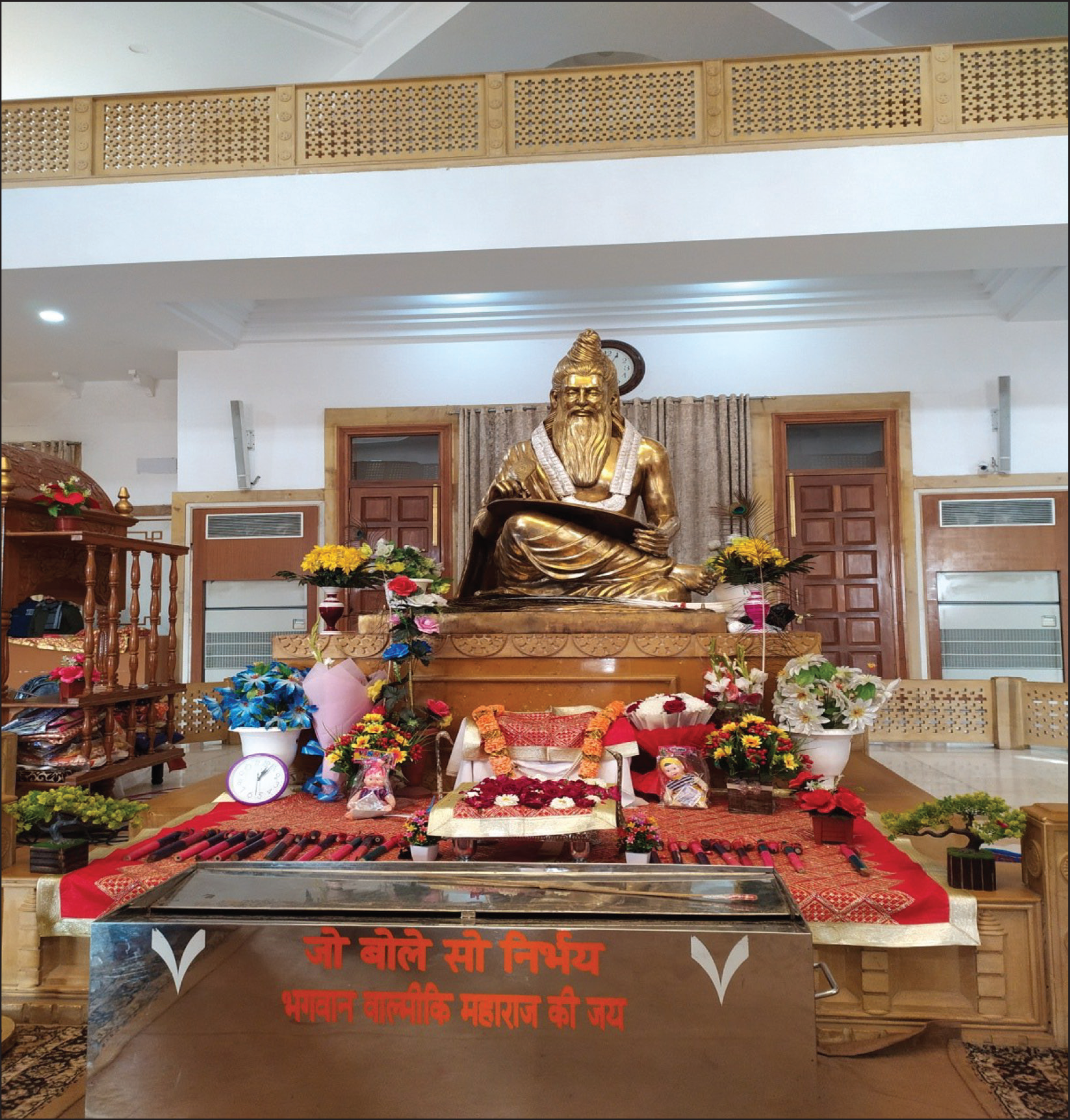
The idol of lord Valmiki was also asked to be recreated because the previous one seemed to be more Hinduized and failed to highlight the personality of ‘Adi’ Guru ‘Valmiki’, according to Ravan. As a result, it was changed and reconstructed. The new image along with a ‘Kalam’ (the pen) in Valmiki’s hand represents the slogan given by Dr Ambedkar to ‘educate, organize and agitate’. Appropriating of the image of Dr B. R. Ambedkar is again a site of intra-Dalit conflict among the two major Dalit castes (i.e. Ad Dharmi Chamars and Balmikis). The image of Valmiki has its own significance in the old religious philosophy of the extremely marginalized communities like Balmikis in Punjab. In fact, the Ad Dharm movement projected the image of Valmiki as a Dalit nirguni (devotee of God without attributes) along with Ravidass and Kabir to mobilize the untouchables in colonial Punjab. This resulted in separating the image of guru ‘Valmiki’ from the integrative myths of Hindus and helped found the expression of alternative Dalit theology in comparison to mainstream religious identities (Takhar, 2005, pp. 132–133).
In the long run, Balmiki sabhas have facilitated the institutionalization of an alternative Balmiki culture in cities and in rural areas in the state, based on the teachings and lifestyle of the saint and guru Valmiki. In fact, the illustrious image of ‘Adi Guru’ has played a significant role in mobilizing the outcastes, especially the Chuhras of Punjab. Leaders and activists also formed separate worship places for their guru and started to celebrate the Valmiki Jayanti ( Valmiki’s birth anniversary) in Punjab (Ram, n.d., p. 62). In this sense, Balmikis of Punjab forged their own alternative path which was based on native religiosity and local imagination of the community. They are/were not following the conventional route of social mobility through Sanskritization 6 and conversion 7 and contested the process of Hinduization which has been rarely discussed in major scholarly writings on Balmikis (Lee, 2021; Prashad, 1995). Sanskritization has been commonly defined by eminent sociologist M.N. Srinivas ‘as the process by which a “low” caste or tribe or other group adapts the customs, rituals, beliefs, ideology and style of life of a high, in particular a “twice-born” (dwija) caste’. For him, ‘sanskritization of a group has usually the effect of improving its position in the local caste hierarchy’ (Srinivas, 1998, p. 88). What made the emancipation project of Balmiki different from that of Sanskritization and conversion was their emphasis on acquiring social respect without crossing caste boundaries in the context of Punjab.
In fact, they categorized themselves separately as ‘Balmikis’ in the 1931 census. The resonance with their guru’s name evokes a sense of confidence and self-respect among them, so much so that a large number of them prefer to be identified as ‘Balmikis’ rather than by their customary caste titles, like Chuhras, which are collared with derogatory connotations (Bhatti, 2000; Singh, 2003). The cultural and political importance of the image of Valmiki has never been lost in the imagination of the state either. In fact, the state government had taken out a procession with this idol on a specially fabricated bus for a six-day state-wide tour prior to its installation (The Times of India, 2016). Now, a new 8-feet tall idol of Bhagwan Valmiki that weighs 80 kilograms has been installed within the premises of the heritage (Figure 2).
The placement of the idol of Yoga Vasistha in the central premise of the temples along with the idol of Valmiki is another marker of difference from its mainstream religious identity. The Adi Dharm Samaj objected against the installation of the Ramayana written by Tulsidas because it promotes the notion of avatar, thereby giving prominence to lord Rama and Hindu philosophy. On the other hand, Yoga Vasistha is known to have expounded the theory of the nirguna Brahman. It is because of the philosophy of the nirguna concept of the divine that the concept of avatars is not deemed acceptable (Takhar, 2005, p. 139). In accordance with the teachings of Valmiki, the community does not offer bhakti (devotion) to Rama. In fact, the concept of worshiping Rama and other major Hindu Gods is not prominent among Balmikis of Punjab (based on field observation).
Apart from such efforts to disassociate from mainstream religions, the Adi Dharm Samaj along with its leaders and ideologues have made other concerted efforts as well. They have formulated new rituals, symbols, nomenclatures, salutations, etc. to re-establish the aboriginal identity of Dalits, particularly of Balmikis, in recent Punjab. In this context, they have written their own religious texts in order to build their separate religious identity. The central religious tract of Adi-Dharm Samaj is Adi-Nitnem 8 which begins with the stuti (adoration) of Valmiki. It closes with the utterance, Jo Bole So Nirbhay, Srishtikarta Valmiki Dayavaan Ki Jai (fearless is the one who utters: Victory to Shrishtikarta Valamiki Dayavaan); whereas in the Sikh religion, the Ardas concludes with Bole So Nihal, Sat Sri Akal (blessed is the one who utters: True Is the Immortal One).
The reference to nirbhay (fearless) is ‘not only symptomatic of the historical oppression of the Dalits at the hands of the upper castes but is also reflective of their determined willingness to confront it head on’ (Ram, 2008, p. 1358). The salutations are also formulated selectively in order to project their unique and independent religious identity. The followers of Adi Dharm Samaj have adopted the greetings of Jai Guru Valmiki (Victory to Guru Valmiki) in order to differentiate themselves from other religious communities and to signify their departure from the mainstream religious identities in Punjab. Sat Sri Akal (True Is the Immortal One) is the greeting of the Sikhs, while Jai Ram Ji Ki or Jai Sita-Ram (Victory to Ram or Victory to Sita Ram) is the greeting of the Hindus.
In the religious tract of the Balmikis, the days and months are also mentioned differently compared to the Hindu calendar. For instance, if Monday is named after Adi, that is Lord Valmiki, the supreme creator of the universe, Tuesday is ‘Madduvaar’, which reminds one of a valiant aboriginal hero ‘Madhu’ who was killed by Hindu god Vishnu through deceit. Similarly, in the case of monthly calendar where January is rechristened as ‘Shristi’ (the supreme nature) and July is named as Megh after the aboriginal icon Meghnaad. Certain expressions are also used after the names of the followers which denote their aboriginal past. The most commonly used titles are Ravan, Adivanshi, Daitya, Daanav, Anarya, Shambook, Lankesh, Meghnaad, etc. The women have similar titles to their name as used in the Adi culture like Tungbhadra, Keksi, Tamsa, Vrinda, Pracheta, Sujata, etc. While formally addressing a fellow Balmiki, the term Veer (brave man) is used for males, Veerangi (valiant woman) is used for females.
Spiritual and religious gatherings (satsang) are known as Yogamrit (and the religious place of worship, which is the Adi Dharm temple, is named as Anant). Marriages performed in the way prescribed by the Adi Dharm Samaj are known as Aatamyog (i.e. as two souls come together to carry on the lords’ creation). These marriages are performed in a special way where four vows are exchanged by the couple and their families. All the ceremonies related to birth, marriage and death are performed according to Adi-customs as prescribed in the Adi-Nitnem. All the disciplinary affairs taking place during religious gatherings are organized by volunteers. The male volunteer groups are called Eklavya Rakshaks and the female unit is named Jhalkari Vahni.
Adi Dharm Samaj has its own flag of a sky-blue colour in which the religious insignia of Adi Pavan Satya (which looks like the English alphabet ‘V’) is inscribed. It has been adopted as the Kaumi Nishan (community symbol) of the Balmiki Samaj in order to clearly distinguish it from other religions. Narrating the significance of this flag, Ravan observed that ‘it is the symbol of Dalits’ past and evidence of their Aadivaasi identity (Ravan, 2014, pp. 12–18). The Dalits, especially the Balmikis of Punjab, proudly hoist flags with the symbol of Adi Pavan Satya inscribed on it in their religious places and on vehicles during religious processions and occasions (based on observation).
The Adi Dharm Samaj, under the leadership of Ravan, organizes seminars and workshops to awaken the Dalit youth to their socio-political and religious position in the society. In this context, mass rallies and religious processions are also organized in the various parts of the state of Punjab. Ravan himself writes extensively on issues like caste discrimination, Dalit atrocities, social injustice and struggle for dignity and self-respect in a radical manner. His speeches and ideas are compiled in the form of books, pamphlets, leaflets, booklets and magazines published through their own publication press (i.e. ADHAS). The writings are available at nominal prices and often even free of cost at religious congregations and seminars of the Adi Dharm Samaj.
Conclusions
The prominent cultural theorist & critic, Stuart Hall regards negotiation as a moment of struggle and resistance (Hall, 2016, pp. 187–188). The emergence of a separate Valmiki cultural heritage for the extremely marginalized section within Dalits has presented such a distinct example of resistance in the context of Punjab. Now, thousands of devotees from Punjab and abroad visits this sacred space. For them, Valmiki’s heritage has become the symbol of their pride and self-esteem. It has become the vehicle of social mobility and cultural assertion for the highly stigmatized Dalit caste group (i.e. Chuhras) without following the footsteps of the dominant modes of conversion and Sanskritization in Punjab. They are further consolidating their religious boundaries through the formulation of their separate religious scriptures, architectural design, ritual, symbols, salutations, flag, etc., and most importantly through distinct religious philosophy of sant tradition.
The emergence of Dalit cultural heritage on the landscape of the ‘holy city’ of Amritsar has triggered a new debate in the realm of identity politics in Punjab. Dominant historical narratives and the historiography of Punjab have fixed the spatiality of Amritsar around Sikh and Hindu religious identities. This is because of the existence of their religious shrines of Darbar Saheb (Golden Temple) and Durgiana Temple. In this context, Snehi has argued that nationalist and religious ‘historiography proposes fixity of religious boundaries; thereby almost erasing the role that “other” narratives play in shaping city’s history’ (Snehi, 2018, pp. 1–3). The prominence of this newly emerged Dalit heritage has been witnessed through the visits of political leaders across party lines in the recently held 2022 assembly elections and equal coverage and reporting being given to them by national and local news agencies and print media. It will be interesting to see how the on-going project of making a panorama and museum at the site of Valmiki Tirath takes shape. For academia, it would be significant to capture the changing nature of Dalit cultural politics through the formation of Valmiki heritage in recent times. It has also transformed the previously conceived notion regarding religious deras and their spaces of being ‘little fiefdoms’ (Singh, 2017, pp. 20–23) into a ‘historic archive’ in which the memories of dispossession, and of exploitation, along with moments of pride and self-respect of the downtrodden section of the society would be preserved.
Footnotes
Declaration of Conflicting Interests
The author declares that there is no conflict of interest with respect to the research, authors and publication of this article.
Funding
The author received no financial support for the research, authorship and/or publication of this article.