



Abstract
The question of the development of Scheduled Castes (SCs) and its analysis received considerable attention during the post-Independence period. The Central and State governments have been launching several programmes and institutions for the economic and social progress of the SCs as well as raising the consciousness of their rights. The Ambedkar statues and the construction of Ambedkar Bhavans/community halls are a platform for organizing the SCs to debate and articulate key issues and concerns; fostering solidarity among SCs is an important initiative of the government, across the country. The core objectives of the study are to examine the distribution of Ambedkar Bhavans/community halls in the districts and budgetary allocations and the expenditure incurred towards the construction of the halls. The other objective is to assess the utilization of Ambedkar Bhavans/community halls and the activities undertaken in them and their impact on the empowerment of Scheduled Castes in the selected districts. The empirical study highlights that the members of the community are making use of the community halls to debate the issues of their surroundings and the implementation of government schemes, besides organizing their social functions and economic activities. However, there is no rationality in allocating the budget for the land and the construction of buildings across the districts in the state.
Introduction
The social stratification in India is characterized by a rigid caste-based hierarchy, in which the Scheduled Castes (SCs) were called untouchables. For centuries, the SCs in India have remained socially backward, economically impoverished and politically marginalized. It is perceptible that these people were also denied the right to educational and cultural opportunities and basic human rights. At this juncture, they required special and targeted interventions to safeguard their interests and realize their accelerated socio-economic development. The earnest attempts of Dr. B. R. Ambedkar, who fought for social justice and drafted the Constitution of India, essentially with two objectives: dignity and emancipation of the untouchables. Article 341 (Clause 1) of the Indian Constitution notifies the untouchables as SCs. It prescribes protection and safeguards for the SCs, Scheduled Tribes (STs) and other weaker sections to promote their political, educational and economic interests and remove social disabilities (Ministry of Social Justice, 2017–2018).
In addition to this, the assurances made to the SCs have been institutionalized via statutory agencies like the National Commission for the SCs. The Ministry of Social Justice and Empowerment is the nodal ministry to oversee and ensure that the SCs are protected. The Scheduled Castes Development Bureau of the Ministry aims to promote the welfare of SCs by undertaking educational, economic and social empowerment programmes. It also coordinates and monitors the programmes launched by the Central and State governments to protect and promote SCs across the country (Ministry of Social Justice, 2017–2018).
The empowerment of social groups, including SCs, has several components. Different disciplines or institutions have adopted different parameters for defining and analysing the concept. According to Bailey and Koney,
empowerment is a multi-dimensional social process that helps people gain control over their own lives. It is a process that fosters power (i.e. the capacity to implement) in people for use in their own lives, their communities and their society, by acting on issues that they define as important (Bailey & Koney, 1992).
The current study defines empowerment as the availability and accessibility of space or community centres to SCs to protect their identity, address issues and concerns about their security, social dignity and economic development, and participate in institutions and development processes at the grassroots level, as defined by Bailey and Koney.
The Concept of Bhavans/Community Halls
The concept of ‘bhavans’ or community halls for marginalized communities is not a recent phenomenon in India. Such facilities exist across the globe. The history of community centres can be traced in the United States of America to the efforts of settlement workers and other activists in the inner areas of fast-developing cities. In the United States of America, during the 1910s, workers used the school buildings after school hours as a neighbourhood social centre. School buildings were used for various community activities, including imparting free education to poor children. Edward J. Ward, a local Presbyterian minister, was involved in various educational and recreational activities, became a staunch advocate of the cause, and made it a national campaign (Stubblefield & Keane, 1994).
Community centres prepare people for citizenship through group activities, civic clubs, classes and actual practice in self-government. Because each club or group is self-governed, the entire centre is self-directed and self-controlled through delegates elected from each club regularly meeting in a central council. The centres may provide proper training in self-government, a real opportunity to develop those qualities on which genuine self-direction depends. If we want a nation that shall be self-governed, not just nominally self-governed, we must train our young people in self-direction (Follett, 1918).
Indian Situation: Demand for Identity and Self-respect
The demand from SCs for space, self-identity, self-respect and articulation of their rights concerning socioeconomic, political and cultural aspects began much before the country attained independence. The social movements, such as Ad Dharma in Hyderabad State in the 1920s, and Ravidas Deras (Ravidas was a Punjab Dalit poet-saint), enlightened the SCs community.1,2,3,4 These movements primarily focused on, economic empowerment, political assertion, cultural transformation, spiritual regeneration and abolishing untouchability. In all these movements, community space/bhavan/hall played a crucial role in articulating their legitimate rights and emancipating them from Hindu society’s socio-economic and cultural hegemony (Ram, 2012). Sant Sarwan Dass, the representative of Guru Ravidas laid the foundation stones for various Ravidas Deras that provided education to Dalits free of cost and united them in the struggle for equity and dignity and a vision for the future. The Deras not only emerged as centres of spiritual gatherings for Dalits but also have become prominent spaces for social protests. Dera Ballan, Ravidas Deras, Ravidas Chak Hakrim and Deras of Sant Jagatjit Giri were instrumental in bringing about social consciousness among the Dalits of Punjab (Ram, 2008).
The Ad Dharma social movement has played a vital role in creating consciousness among the SCs, focusing on SC’s identity and self-respect. Dalit organizations, such as Adi-Hindu Mahasabha, Youth League of Ambedkarties, Adi-Hindu Social Services League and the champions, such as Bhagya Reddy Varma, B. S. Venkat Rao and Arige Ramaswamy, during the pre-Independence period, have advocated for the rights, self-respect and welfare of SCs in the region. Bhagya Reddy Varma was the president of the Adi-Hindu Social Services League and the pioneering organization of Dalits in the Hyderabad State in the 1920s. These movements, especially Adi-Hindu Mahasabha-Youth League of Ambedkarties, contributed to establishing Ambedkar Bhavans and community halls across the undivided Andhra Pradesh in the early 1930s.
The Buddha Vihars, which came into existence in the early 1950s in Maharashtra, played a vital role for Dalits in discussing socio-cultural and political issues (Nikalje & Darokar, 2013). During the British rule, Christian missionaries also played a role in providing space for education and shelter, which emancipated the marginalized communities to discuss and debate their rights.
The Constitution of India envisages special provisions for the country’s socially and economically deprived sections to achieve self-respect and socio-economic progress and inclusive development. During the post-Independence period, the Government of India and State Governments have launched several socioeconomic development programmes to empower weaker sections, including SCs. Ambedkar Bhavans, or community halls, have been built in all the country’s villages and cities as one of the steps for the liberation and empowerment of the SCs. Consequently, various cultural associations and educational institutions also contributed to the consciousness among Dalit communities across the nation.
Background to the Ambedkar Bhavans/Community Halls Scheme
The Constitution of India envisages special protection for socially and economically deprived sections of society to ensure their socio-economic development and achieve equality with others. The provision of quality education that provides an individuals’ well-being is an important tool for empowering the weaker sections. The construction of community halls within the village has been considered to enable and encourage people to discuss and debate several issues that would empower the downtrodden. However, the present study explores the empowerment of the SCs from the aspect of an ‘increase in resources and capacities to bring people together around common goals and interactions, increasing their participation in decision-making and problem-solving processes. The government of India aims to sponsor the scheme for the construction of houses for the poor and community halls in Dalit localities. A major change came during the Seventh Five Year Plan (1985–1990) when the Working Group on the Development and Welfare of SCs and STs recommended the construction of community halls.
In the undivided Andhra Pradesh, the construction of the community halls was minimal, and there was no separate budget allocation for the construction of community halls. However, the elected representatives like Members of the Legislative Assembly (MLAs) and Members of Parliament (MPs) used to sanction some budgets for constructing community halls in some villages that were in dire need of delegation. The budget sanction for community halls was made only at the request of the community and village elders. There was no data related to the state’s budget allocations and sanctions of community halls. But after the formation of the Telangana State, the government has come up with separate budget allocations for SCs under the name of the Scheduled Castes Special Development Fund (SCSDF). Under the SCSDF, separate budget allocations were made under the infrastructure development scheme. Since 2016, special budget allocations have been made, and it maintains a dedicated database. The article is divided into two sections. The first part deals with academicians’, administrators’ and activists’ perspectives, while the second session delves into field observations. This experiment compares scholarly and community viewpoints on Dalit concerns.
Methodology
The present study is empirical, and the findings are mostly based on a primary survey. The study area is purposively selected, covering the districts with the highest SCs population in the state. Based on the same strategy, two Mandals from each district; and two villages from each Mandal were selected. Accordingly, two districts and four Mandals, a total of eight villages, were selected for the study (Table 1). The study adopted both historiography and empirical methods. The primary data was collected through a questionnaire and interview schedules. To capture the qualitative data, group discussions were held with the community elders and youth. The fieldwork was conducted from January to March in the year 2020.
Sample Villages Selected under the Study.

Part-I
Findings and Discussion
An attempt is made here to discuss the perceptions of academicians and activists about Ambedkar Bhavans in mobilizing SCs around the concerns and factors affecting the community, which would provide insights into the subject under discussion. In India, the establishment of Dr. B. R. Ambedkar’s statues and bhavans/community halls have a historical legacy. They reflect the consciousness of marginalized communities rather than merely constructing a multi-story building or structure. They are centres for knowledge, targeting generation of awareness among the SC community on various social, economic and political aspects of the community. Dr. Ambedkar led the movement to emancipate Dalits from their dehumanized position and became the first social reformer who rose from the community of untouchables and led a movement at the national level for the liberation of Dalits in India.
Perceptions of Academicians, Administrators and Activists
In the early 1930s, Ambedkar took the initiative to establish study centres and community halls called Raja Gruha, where the statue of Buddha was installed. During the post-Independence period, in the early 1960s, Dalit youth started library halls across the states to empower the youth. Moreover, the State Governments have initiated measures to erect Ambedkar statues and bhavans/community halls in their respective state capitals, districts and block headquarters.
Consequently, in the erstwhile Andhra Pradesh, during Nizam’s rule in the 1920s and 1930s, Bhagya Reddy Varma and others fought to construct Ambedkar Bhavans/community halls for Dalits. It is undeniable that the Karamchedu event, which erupted on 17 July 1985, in the Prakasham district of Andhra Pradesh, was a significant incident in the name of untouchability, in which six Dalits were massacred, several Dalits were severely injured, and three Dalit women were raped. Hundreds of Dalits in the village were displaced after their houses were burnt and looted. This gruesome incident made the SCs unite and fight against the upper castes in the state. Ambedkar statues have been installed in the villages to inspire the Dalits. This has increased consciousness and unity among Dalits and led to the construction of Ambedkar Bhavans with their contribution. Unlike churches or temples, Ambedkar Bhavans/community halls have played a crucial role in articulating their rights to the community and government.
Scholars such as Gundemeda Nagaraju, Department of Sociology and K.Y. Ratnam, Department of Political Science, and Jilukara Srinivas, Department of Telugu from the University of Hyderabad and Prof. K. Srinivas, Department of Political Science from Osmania University, expressed that Ambedkar statues and bhavans/community halls are the symbols of identity and self-respect of Dalits and promote unity among them to fight for their legitimate rights. They opined that bhavans/community hall structures should reflect the ideology of Dr. B. R. Ambedkar. In this regard, the physical structures of community halls must be structured or reshaped, projecting the values of Ambedkar and providing space for educating the Dalits. Further, the scholars have highlighted the following concerns for promoting consciousness in the community.
Accessibility to Shared Spaces and Facilities
The adequate availability and accessibility of shared spaces and facilities are the most important concerns of Dalits in the hinterland. Historically, SCs are not allowed to access public and private spaces. The public space could be a school building, public health office, gram panchayat office, water tank, religious space, burial ground, playground, intellectual space or any facility that contributes to their social, political and economic advancement. The private space could be caste-based bhavans or facilities, such as Kamma Bhavan, Reddy Hostel, Vysya Hostel, or community/caste bhavans at Tirupathi and Srisailam, which are accessible to the respective communities. This is partly because of their isolated residence from the main village and partly due to untouchability, social discrimination and economic marginalization in the village.
Unlike the caste communities, such as Other Backward Classes (OBCs), Other Castes (OCs) and others, the Dalit residential localities do not have adequate shared spaces and facilities. In Telangana, most Dalit houses are very small and hardly have space for social and economic activities. In this context, the significance of exclusive space in the form of Ambedkar Bhavans/community halls in rural areas plays a vital role in protecting the dignity of the community.
Accessibility of Ambedkar Bhavans/Community Halls Across the SC Sub-castes and Gender
In Telangana, there are 60 sub-castes within the SCs. Of these, Mala and Madiga sub-groups have more access to resources compared to other sub-castes. The population of these two sub-castes is much higher than other sub-castes within the community. Hence, the dominance of these groups in access to resources in the publicly funded programme is more compared to other sub-castes. Apart from this, Ambedkar Bhavans are established by the government, in places where the population density of these sub-castes is more. Eventually, access to resources is more prone to these groups.
The existing bhavans/community halls are primarily constructed in the localities of Mala and Madiga sub-castes. Moreover, their accessibility to women is negligible. During the field study, women respondents expressed that the male members have a patriarchal attitude towards women. In his book ‘Antarani Vasantham’ (2011), Kalyana Rao mentions that ‘my father is a slave to the whole village and my mother is a slave to my father’ (Rao Kalyan, 2011). Therefore, there should be equity in constructing Ambedkar Bhavans in terms of their accessibility to all SC sub-castes and to women as well.
Dalit Community Organizations
Dalits in Telangana started the autonomous ‘Adi-Andhra’ self-respect movement in 1906, the first organization in Andhra Pradesh. It was led by Bhagyareddy Varma, Arigay Ramaswamy and B. S. Venkatrao to educate the Dalits about their rights (Omvedt, 1994). Later, in Andhra Pradesh, the Dalit Maha Sabha (DMS) social movement worked with the prime objective of consolidating the strength of Dalits. It brought revolutionary solidarity among the oppressed, which led to the Dalit democratic movement. It also served to construct libraries and cultural centres, which became concentrations of political activity (Ratnam, 2008, p. 21). Though Dalit organizations and elected Dalit leaders sought to build Ambedkar Bhavans/community halls in the district offices, they were few and far between. Jilukara Srinivas, the academic and Dalit activist, argues that the major drawbacks of the completed buildings were the ‘Poverty of Idea’ and ‘Poverty of Space’ in Dalit localities. In most villages, the community halls were constructed within 25 or 30 square yards; the accommodation was quite inadequate for organizing meaningful programmes. As there were no Ambedkar Bhavans/community halls at the Mandal level, the officials are now gradually starting to construct the community halls at the Mandal level.
Maintenance of Bhavans
The activists from various social organizations belonging to SCs suggest that the bhavan should be constructed on one or two acres with all facilities. It can also be made as a commercial centre. The government is constructing the buildings at the Mandal and village levels. But still, the ownership of the building is a question mark, whether it should be under the control of government officials, the SC community or Gram Panchayat. In every village, the responsibility should be attached to Gram Panchayat. For appropriate utilization of the facility, a Dalit ward member should be assigned the day-to-day maintenance.
Unity Among Dalit Leaders
Unity among Dalits is important for realizing the ideals of Dr. B. R. Ambedkar. In some villages, Dalit leaders, who are very active in social movements and politics, fought to allocate more space for constructing community halls and succeeded in their efforts. These bhavans are being used to organize programmes on Ambedkar’s ideology and conduct public meetings.
The foregoing discussion on the study of Ambedkar Bhavans/community halls raises issues that need to be examined and assessed. They are:
The location-related issues: where to locate? In Mala or Madigapalle or the savarna locality? Adequate space—land and architectural designs: land required to construct an ideal building for organizing community activities; what should Ambedkar Bhavan symbolize? Budget allocation for construction and maintenance of buildings Ownership and day-to-day maintenance: government department/community/caste associations? Kind of activities: what activities are to be promoted and permitted—private, social and political?
Empowerment of the SCs, for the present study, includes increasing resources and capacities to bring people together around common goals and interests and increasing their participation in decision-making and problem-solving processes.
Part-II
In this section, an attempt is made to analyze community members’ budget allocations and perceptions on the availability and accessibility of shared space and facilities and the concerns regarding their development.
Budget Allocations
The budget allocation for the construction and maintenance of Ambedkar Bhavans/community halls from 2014–2015 to 2020–2021 is ₹56,704.9 lakhs. The expenditure during the same period is ₹3,231.54 lakhs which accounts for 5.7% of total allocations. However, the amount allocated in the state for this programme is more during 2018–2019 (Table 2). However, the allocations for the bhavans at the district level and revenue divisions have increased progressively since 2014–2015 from just ₹200 lakh to ₹18,000 lakh in 2018–2019, with the latter representing the highest level of allocation. The budget allocation for the village-level community halls has also increased enormously from 434 lakhs during 2014–2015 to 1,026.4 lakhs during 2015–2016. The building of community halls at the Mandal level did not begin until just 2 years ago, and it was not until the 2018–2019 fiscal year that it became a factor in the low level of spending. This is the primary reason that contributes to the low level of expenditure.
Budget Allocation for Ambedkar Bhavans/Community Halls during 2014–2015 to 2020–2021.

Budget Allocations for Ambedkar Bhavans/Community Halls at the Village Level
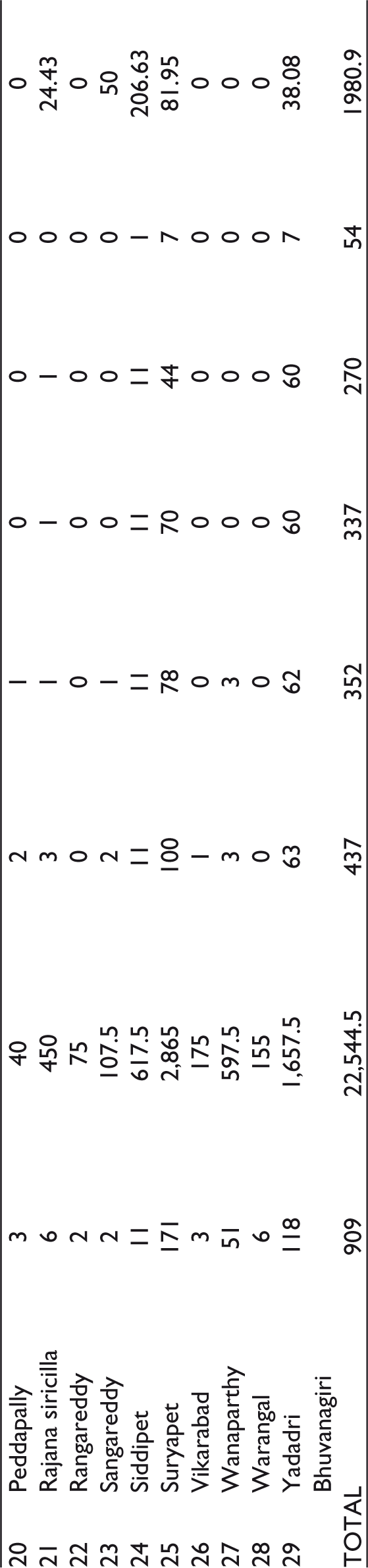
The Scheduled Castes Development Department (SCDD) allocates a budget for constructing Ambedkar Bhavans at the district headquarters and community halls in rural areas. According to the statistics, the government has approved 909 community halls between 2016–2017 and 2021, for which a budget of ₹22,544.5 lakh was allocated. Out of the 909 Community halls, construction sites were identified for 437 (48.1%) and 352 (38.7%) site handovers were done. The tenders were finalized for 337 (37.1%), 270 (29.7%) were grounded and only 54 (6%) were completed. There is observed variation in the allocation of budget across the districts. The highest numbers of community halls were sanctioned in Nalgonda, Suryapet, Yadadri Bhuvanagiri and Nizamabad districts. And the remaining small fraction of the centres was allotted to Jogulamba Gadwal, Medchal–Malkajgiri, Nirmal, Sangareddy and Rangareddy districts (Table 3).
Details of the Amounts Allocated for Ambedkar Bhavans/Community Halls at the Village Level (District and Year-wise) from 2016–2017 to 2020–2021.

Utilization of Ambedkar Bhavans/Community Halls at the District Level
The bhavans at the district headquarters are chiefly used to organize public meetings, marriages and other events. In the Ambedkar Bhavan, located in Warangal Urban District, social organizations such as Mala Jangam Welfare Association—Telangana State, Dalitha Girijana Teachers Union, Madiga Reservation Porata Samithi, Telangana (MRPS-TS) District Meeting, Gurukul the School, The Buddhist Society of India, Savithri Bai Phule Praja Samskhema Sangam, Madiga Reservation Porata Samithi (MRPS), Ushodaya Publications, Telangana Mazdoor Union, Praja Telangana, Telangana Vaddara Sangam, Bahujan Students Federation, All Pensioners Retired Persons Association and Madiga Employees Federation have conducted public meetings for discussing issues, challenges and concerns related to respective association/organizations. Private colleges like Threshold Junior College and Sneha Junior Colleges have organized freshers’ parties. Cera Care Natural Health New Life Centre has organized an awareness camp on health status. Religious organizations like Church Together Fellowship have organized pre-Christmas meets, and one Christian marriage was held in 10 months. In the Ambedkar Bhavan, located in Nalgonda headquarters, it was found that youth festivals were held there, and it was also used for sports meets in the last 10 months. However, it is also noticed that no government programme has been conducted in the bhavan.
Availability, Quality and Maintenance of Facilities in the Ambedkar Bhavans at the District Level
The Ambedkar Bhavans, located in the headquarters of Warangal Urban District and Nalgonda District, were constructed on two acres of land, and the ambiance around the bhavans is peaceful. In both Warangal Urban and Nalgonda districts, the bhavans can accommodate 1,000 people. In Nalgonda District, the bhavan has accommodations with special rooms for the guests. And such a facility is not found in the Ambedkar Bhavan located in the Warangal Urban District. There is a special kitchen in Ambedkar Bhavan in Warangal Urban District, and such a facility is not found in Ambedkar Bhavan in Nalgonda District. The maintenance of toilets and bathrooms in the Ambedkar Bhavan was unsatisfactory. Choked drains in toilets are a common sight, and the cleanliness of the toilets was not up to the mark. In some of the bhavans, the bathroom doors and windows were damaged, making them unusable. The bhavan in the Nalgonda district was found unclean, the housekeeping people are not regular in their duties, and there has been no supervision from the officials concerned.
Hiring Charges of the Ambedkar Bhavans
The SCDD maintains the Ambedkar Bhavans at the district level. A Junior Assistant looks after the maintenance of the Ambedkar Bhavan. They are also responsible for booking the slots for organizing the programmes during various occasions, at the request of community persons and other social organizations. Regarding the tariff, the officials of the SCDD, Warangal Urban District, said that for marriages or other functions for SC/STs, it is ₹10,000 per day, and for Other Backward Classes (OBCs) and Other Castes (OCs), it is ₹15,000 per day. In the case of public meetings for officials/associations, it is ₹5,000 per day, and ₹1,000 is charged for power consumption per day.
Financial Management
The amount received from users is deposited in Dr. B. R. Ambedkar Bhavan’s account, which is maintained by the officials of the SCDD in Warangal Urban District. However, in Nalgonda District, such an account is not maintained in managing the funds. The officials receive an acknowledgment whenever the amount is collected from the patrons.
Details of Rental Savings of Bhavans
The SCDD of Urban Warangal District officials said that 5–6 programmes occur every month, and an average of ₹35,000–40,000 is mobilized through the service. It is also noticed that before hiring the bhavan for different programmes, the concerned organizations/associations have to deposit the tariff in the account of the Ambedkar Bhavan. The officials of the SCDD of the Nalgonda district said there is a procedure for utilizing the Bhavan for various activities, but it is not followed. They narrated that the individuals or organizations come with recommendations from politicians for using the bhavan. They reported that until now, they had not received charges from the organizations/associations who have utilized the Ambedkar Bhavan. Moreover, it is also observed that the people who use Ambedkar Bhavan for their events never pay even the power bill and do not even pay for cleaning the Bhavan.
The officials of the SCDD of Warangal Urban district said that for a period of 10 months, from May 2017 to February 2018, they received a rental income of ₹4.85 lakh. For 11 months, from May 2020 to March 2021, they received a rental income of ₹601,430 (six lakhs one thousand four hundred and thirty only). The SCDD officials of the Nalgonda district said they had not received any rental income from Ambedkar Bhavan. During the survey, the bhavan was under renovation; hence it was not in use.
Ambedkar Youth Organizations at the Village Level
During the field survey, it was observed that the educated youth in several villages have formed Ambedkar youth organizations and are striving for space to construct community halls. In this context, it is important to discuss the structure of the Ambedkar organizations and their functioning. The majority of the people from the study villages said that they had formed the organization for unity among the community. In Chervugattu village of Nalgonda District, the people are not educated, and they are not availing any kind of facilities in the name of the Ambedkar youth organization. In the other seven villages, educated people benefit from some schemes from the government for the community’s welfare under the name of the Ambedkar youth organization. In the SC community, two dominant sub-castes, Mala and Madiga, are spread in the villages. They do not have good relations because of the SC categorization movement. So, in all the villages, the Mala and Madiga wards are in different locations, and each community has Ambedkar youth organizations.
Poverty and inter-caste discrimination are among the main reasons in Chervugattu for forming the Ambedkar youth organizations. It is noticed that Kottapally, Kottakonda, Kondaparthy and Inavole villages of Warangal Urban District, have moral support from civil society and community associations like Mala and Madiga. Once or twice a month, the community leaders interact with the village community people and give suggestions for strengthening the organization. Such interaction of civil organizations and community-based associations is not found in Narkatpally village of Nalgonda district. The people from Chervugattu, Dugnevalli and Pamangandla villages said that they do not have any association with community-based organizations, and none of them come to interact with the people.
Structure of the Organization
The study tried to capture whether there is a proper structure in the functioning of Ambedkar youth organizations in the selected villages. The villages, such as Kottapally, Kondaparthy and Inavole in Warangal Urban District are found to have full-fledged committees with a formal structure, such as the president, vice-president, secretary, treasurer, cultural secretary and sports secretary. These villages are very active in social movements, and the population of the SC community is high in the villages compared to other social groups. It is observed that in these villages the SC population is high and because of that the educated youth is more in number. Because of that, full-fledged committee members exist in Ambedkar youth organizations to mobilize the community members in availing the government schemes and discussion on issues related to Dalits.
In the Nalgonda district, the villages, such as Chervugattu, Pamangandla and Dugnevalli do not have full-fledged committees. Still, they are headed by the president and vice presidents, functioning just for their namesake. This is because of the lack of awareness about and participation in social movements. In such villages, it is also found that there is a high migration of SC community people to Hyderabad, the capital city of Telangana. In villages, such as Kottapally, Kondaparthy, Inavole and Kottakonda in Warangal Urban District, around 10–15 members are active in the organization. In the case of the villages in the Nalgonda district, there are only 4–6 members on the committee who are not active in looking after the organization (Table 4). It is found that in all eight villages, no women are part of the organization because of the men not involving them in the organization.
Office-bearers of Ambedkar Youth Organizations.

Construction of Ambedkar Bhavans/Community Halls at the Village Level
Each village selected for the study has a different history in initiating the proposal for having a community hall in the village. The community people of Kottakonda, Kottapally, Inavole and Kondaparthy villages in Warangal Urban District had initially decided on the construction of the community halls with their own funds and named them SC community halls. Later, the community halls were renewed with financial assistance from local MLAs and MPs funds. The same has happened in the villages of Dugnevalli and Narkatpally in the Nalgonda District. But whereas, in the villages of Pamangandla and Chervugattu, the community hall proposal was initiated by the local MLA and funded under the SC sub-plan budget allocations (Table 5).
Funding Details of Ambedkar Bhavans/Community Halls.

The study found that none of the community leaders of the 8 study villages had approached the higher authorities for the sanction of community halls. It is found that the MLAs have allocated ₹25 lakhs from the SC sub-plan for the construction of community halls in Inavole village of Warangal Urban district and Narkatpally village in Nalgonda district. During the field visit in 2018, it was observed that the community hall works are in progress in Inavole village, and in Narkatpally, the tenders were not called for the construction of the community halls.
However, on an average, in all eight villages, it took 2–3 years, from the sanctioning year, to complete the community halls. It is observed that the people from Kottapally, Kottakonda, Kondaparthy, Dugnevalli and Chervugattu are not satisfied with the space allocated for the construction of the community halls. However, the people from Inavole, Pamangandla and Narkatpally are satisfied with the space that is given for the community halls. In all the villages, local MLAs have inaugurated the community halls.
The study ascertained the purposes for which the community uses the community halls. Except for the Kottapally village, the community halls are used for various functions in all other seven villages. This is because, in Kottapally village there is no proper space for organizing functions and the other seven villages have adequate space for organizing small events. Except in Chervugattu and Dugnevalli villages, in the other six villages Ambedkar birth and death anniversary celebrations are organized every year. Because the majority of the young people have moved away to other places, leaving the villages with mainly the old, there is a dearth of information among the populace in Chervugattu and Dugnevalli villages regarding how to organize Ambedkar festivities (Table 6). Except in Kottakonda, Chervugattu and Dugnevalli, in all other five villages, regular meetings are held by the youth.
Utilization of Ambedkar Bhavans/Community Halls.
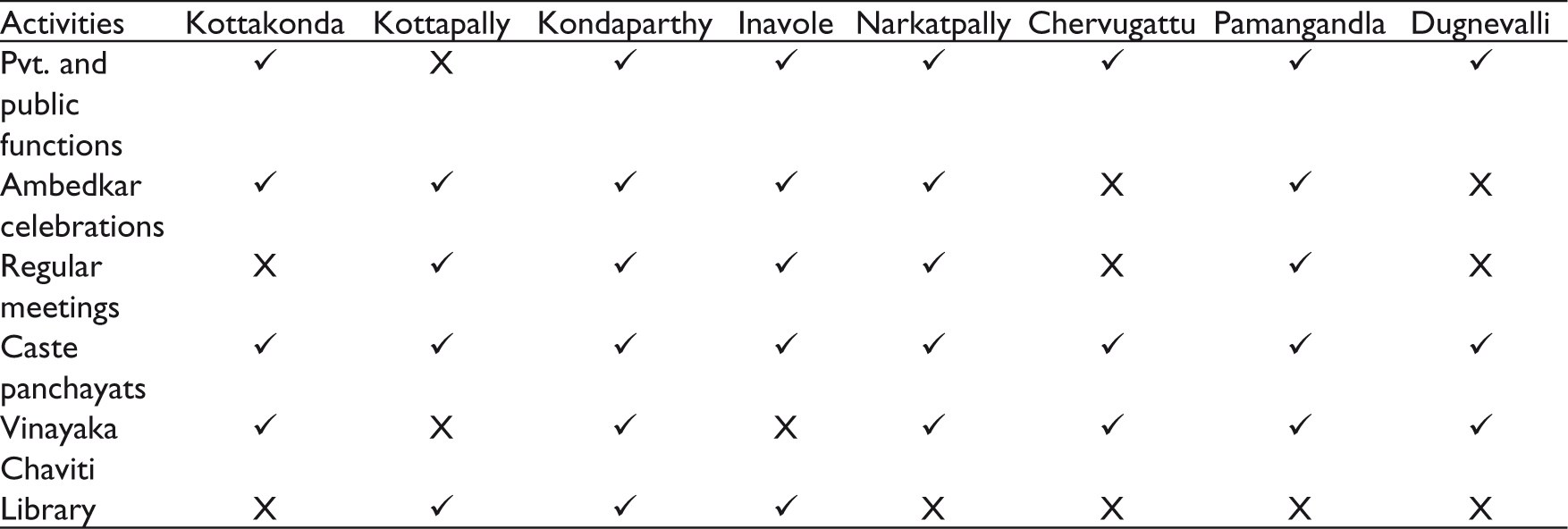
However, regular Panchayats related to the community are held in all the villages. Except for Kottapally and Inavole in all other six villages, Vinayaka Chaviti celebrations are organized because the people from these villages believe in Hinduism. In Kottapally and Inavole, the community members follow Christianity. People from all eight villages reckon that the community halls are helpful but need adequate space. In the villages such as Kottapally, Kondaparthy and Inavole, a library is also functioning with some books donated by the community elders.
The study tried to identify what kinds of facilities are available in the community halls. Newspapers are available only in the villages, such as Kottapally, Kondaparthy and Inavole. However, it is found that in all community halls, utensils are available, which are useful for various occasions for the community people. In some of the villages, the amount was shared by the community persons who bought the utensils; in some other villages, the politicians donated the utensils. The sound system is available in Kottapally, Kondaparthy and Narkatpally. Every morning they play songs, and sometimes it is used for public announcement. Toilet facilities, which were sanctioned recently, are available only in Inavole and Narkatpally villages because of the availability of space. A compound wall is available in Kondaparthy and Narkatpally, but it is not available in other villages because of insufficient space. Seating furniture like chairs is available in Kottapally, Kondaparthy, Inavole and Narkatpally villages (Table 7).
Facilities Available in Ambedkar Bhavans/Community Halls.

Maintenance of Community Halls
The respective local community people maintain all community halls. In Kottapally, Kondaparthy, Inavole, Narkatpally and Pamangandla villages, the community people clean the community halls and feel it is their responsibility to do so. Such practices are not seen in other villages, such as Kottakonda, Dugnevalli and Chervugattu. However, whenever the people gather in the community halls, they discuss issues related to community development and the issues that are to be taken to officials and elected representatives. In all the villages, people raise funds by pooling the contributions from the community members for organizing events like Vinayaka Chaviti or Ambedkar celebrations. The amount ranges from ₹200 to ₹300 per household. It is noticed that community members render services to poor people whenever they need help on various occasions.
Conclusion
Ambedkar Bhavans/community halls are not simply buildings or structures providing facilities for organizing social, recreational and cultural events. Nonetheless, they symbolize the dignity of SCs and provide a meeting place to organize various events of SCs with self-respect. These buildings enable Dalits to demand their rightful share of opportunities in the economy and polity by accessing government programmes and interventions, and institutions of governance; such access and participation would pave the way for the empowerment of SCs. Ambedkar Bhavans and Community Halls serve as the icons of Dr. B. R. Ambedkar and his ideas of liberty, equality and fraternity.
The major drawbacks of the constructed buildings are ‘the poverty of idea’ and ‘poverty of space’. Due to these, the constructed buildings lack homogeneous architectural, symbolic representation and sufficient space. In most villages, the community halls were constructed within an area of 25 or 30 square yards; the space is quite inadequate for organizing any functional programmes. At the Mandal level, there are no Ambedkar Bhavans and community halls. According to the study, it is observed that the concept of low cost is not useful and is ‘designed to fail’. The amount allocated for each community hall is just 2–3 lakhs, which is inadequate to meet the construction cost, particularly with the rising cost of building materials. Many community halls are not useful even for celebrating birthdays or other functions. The community halls, mainly located in the villages, do not have proper compound walls and proper infrastructural facilities. It is to be noted that, the officials decide the place and design of the community halls without involving local people in the decision-making process.
It is also noticed that the political system has done little to protect and promote Dalit identity and self-respect. Disunity among the SCs as evidenced by organizations such as Madiga Dandora and Mala Mahanadu has helped raise the consciousness of Dalits. However, elected representatives from the Dalit community have little autonomy to speak about the problems of Dalits as political party directions and higher-level leadership govern them. Adi-Hindu Bhavan, Hyderabad also played an important role in bringing awareness to the community. The most important activities that have been conducted include organizing a library movement, establishing schools for Dalits and organizing seminars, workshops and social activities. However, the bhavans were mostly used by one community among the SCs.
Since recently, the Government of Telangana has accorded importance to the self-respect of weaker sections through caste-based community buildings and Ambedkar Bhavans/community halls. Unlike other communities, SCs do not have the required resources, such as space and funds for the construction of community buildings; hence, the construction of Ambedkar Bhavans/community halls is a welcome trend in the state. The distribution of Ambedkar Bhavans/community halls is uneven across the districts. In the past 3 years, the community in the formerly Warangal district submitted about 102 applications, out of which 25 community halls were approved based on their effectiveness, while in the Nalgonda district, out of 95 applications, 89 had their requests to build community halls approved by the government. Budget allocation varies across the districts; some districts receive higher grants than others. The construction of Ambedkar Bhavans/community halls is in different stages. In the case of Nalgonda, out of 89 community halls, nine buildings have been completed, and the remaining are in different phases of construction. The slow pace of construction has been a major weakness of the scheme. The major advantages of the development of SCs in the sample villages are that the Ambedkar Bhavans/community halls are very useful to the SC community in several aspects to empower themselves socially, economically, culturally and politically. The core members of the organizations gathered and maintained chit funds’ financial transactions and used them to organize public and private events. Thus, the space in the halls is used for discussions and solving the issues of the community which indeed is helping them to step forward to integrate with the mainstream society.
Footnotes
Acknowledgements
The author wishes to thank Prof. E. Revathi, Professor G. Nagaraju, Professor Ch. Balaramulu, and Chakradhar Jadhav for their enormous comments and suggestions while drafting the paper. The author is grateful to the anonymous referees and Editor, Contemporary Voice of Dalit, for providing insightful and detailed comments on earlier drafts of the paper.
Declaration of Conflicting Interests
The author declared no potential conflicts of interest with respect to the research, authorship and/or publication of this article.
Funding
The author disclosed receipt of the following financial support for the research, authorship, and/or publication of this article: The author received financial support from Scheduled Castes Development Department (SCDD), Ministry of Social Welfare, Government of Telangana, India, for this research.