



Abstract
This article attempts to discuss various protest movements especially issues related to mining in Odisha. Although Odisha is a mineral-rich state, the article only discussed the environmental movement interlinked with mining in Odisha. This article also focuses on the nature, strategies, outcomes, and situations of different environmental movements in Odisha. The important environmental movements interlinked with mining issues are discussed such as the Kalinganagar movement, the anti-POSCO movement, Kashipur (UAIL) movement, the Niyamgiri movement, and the BALCO movement of Odisha.
Keywords
Introduction
Movement for the forest and natural resources has been an emerging phenomenon worldwide throughout human history. The protests in the twenty-first century are emerging rapidly and becoming more viable for industrialization. The conflicts of the pre-industrial period were not much viral in society due to the lack of media facilities. The demand for industrial products is increasing day by day which leads to more capitalists and more activation of the capitalist mode of production. The process of industrialization and capitalist mode of production significantly depends on land access and access to natural resources. Initially, the forest dwellers, traditional hunters, and peasants regulated and managed the natural resources with forests in the pre-industrial period but after industrialization, the power has been given to the individual as well as the government. Industrial societies are refusing the involvement of traditional hunters, gatherers, and peasants for forest conservation as a living and livelihood. The exploitation of natural resources started in the name of development and industrialization since the regulating power was provided to the government. The government has control over the natural resources and full responsibility taken for forest regulation, after the introduction of industrialization.
The developmental projects related to mining are the POSCO project to set up industry and mine in Jagatsinghpur District, the Niyamgiri Vedanta project of refinery and mining in Rayagada and Kalahandi districts, and the BALCO project, and unfortunately did not lead to spin-offs of industrial development as planned by the policymakers and investors. The capital opposition of ecological and social justice convergence results from the movements’ embededness in lived ecologies, whether in the wooded highlands of Niyamgiri, Gandhmardan, or Maliparbat, or in the fragile coastal ecologies of Jagatsinghpur, Gopalpur, and Baliapal. Their claims for justice and protection include both humans and non-humans living in the socio-ecological milieux that comprise their lifeworlds. People’s and ecology’s interconnections and interdependence are expressed in a continuous process of synthesis of justice and ecological. Given that bringing ecology and justice together in the context of a runaway global capitalism has become an existential question for humanity in the period from the industrial revolution to today (during which it has had a significant impact on the environment), the synthesis being carried out in Odisha’s movements may be their most valuable contribution to the world (Kumar, 2014).
The developmental projects result in the loss of livelihood, environmental destruction, massive displacements, loss of agricultural land, and disruption of traditional patterns of life (Reddy, 1998). All the developmental projects are destructive in nature. There is widespread infringement of fundamental rights. The popular protest movements in Odisha such as Kashipur movement, Anti-POSCO movement, Niyamgiri movement and Kalinganagar movement have protested against developmental projects for their basic livelihood. The tribals, women, dalits, and destitute people have been directly impacted by the developmental projects. They are afraid of losing their livelihood, dignity, land, forest, and water supplies, as well as the looming threat to their traditional culture. The government is making a concerted attempt to sell tribal lands to investors through assurances, tax breaks, and investment incentives. Tribal people have entered the market economy during the last 50 years as a result of different development efforts. People in Odisha affected by the project are no longer willing to suffer displacement and its attendant consequences such as occupational degeneration, social disorientation, pauperization, loss of dignity, and frequently being cheated out of compensation amounts, all of which serve to make the experience painful (Naik, 2020). The environmental protest movements are opposed to the industrial and development plan in Odisha. Most of the people’s movements in Odisha in the past were either poorly organized or had their voices muffled by various factors including the government’s deprivation to their demands. But, in Odisha, we had the Baliapal People’s Movement, which was effective in fighting for people’s aspirations and rights in the 1980s. On the other side, Baliapal demonstrates how the combined might of a powerful state halted by single-minded devotion to a goal via united mobilization. In India, therefore, there is no alternative than ceaseless fight to give effect to fundamental human rights of rural people (Raj, 2017).
There have been the most powerful and prominent environmental movements in Odisha such as the anti-POSCO movement against Pohang steel and mining to save their main livelihood and environment, the Niyamgiri movement against the Vedanta refinery and mining operation to protect their rights to natural resources and livelihoods, Kashipur movement against UAIL company to save their ancestral land and source of livelihood, Kalinganagar movement against TATA steel to save their land, livelihood and environment and the very successful movement in 1980s anti-BALCO movement against BALCO company to save the religious place and to protect the livelihoods and environment which are discussed in this article. In this context, it is most important to focus on the strategies, nature, and factors of the emergence of the people’s movements which would provide great insights into the current environmental conflicts. In Odisha, conflicts have been arising among the tribals against developmental projects due to the loss of livelihoods, displacement, land acquisition, and environmental disruption (Mishra, 2006). The protest movement starts initially for their livelihood and later it names the environmental movement.
The literatures reviewed above depict the environmental movement and the elements that contribute to its birth, regardless of any development schemes. The literatures explored the livelihood as well as ecological issues that contributed to the formation of the environmental movement. The Gandhamardan movement was although a successful and popular movement in Odisha, there is hardly any studies related to the case. Nonetheless, owing to tribal domination in resource-rich areas, religious thought plays an important role. As a result, all mining-related aspects and storytelling in resource-rich region of Odisha must be considered.
In this context, the article focuses on different environmental movements related to mining in Odisha. There are several conflicts that emerged after independence and especially after economic reform in 1991 due to the liberal policies of industrial development in Odisha. The environmental movements for mining and industrial development in Odisha are the Kalinganagar movement, the anti-POSCO movement, Kashipur (UAIL) movement, the Niyamgiri movement, and the BALCO movement.
Niyamgiri Movement
The Niyamgiri Hill covers around 250 square kilometers from the part of Rayagada and Kalahandi districts of Odisha which ranges the part of the Karlapat and Kotgarh biodiversity landscape. The endemic and threatened kinds of habitats, flora, and fauna are living in the dense forest of Niyamgiri Hill. The hills were announced as the elephant reserve by the State Government of Odisha on August 2004. Moreover, there are two rivers such as Nagavali and Vanshadhara, which originated from the hills. Moreover, more than 36 small streams are flowing from the hills. There are 602 types of plants available in the hills, from which more than 300 species of herbs and medicines.
The availability of high-quality bauxite attracts investors to invest in the extraction and industrial sector. The sterlite industry was proposed to set up an alumina refinery and mining extraction project in Niyamgiri. The mining project proposal of Vedanta Company was agreed upon by the Odisha mining corporations (OMC), and then the MOUs were signed on 5 October 2004. Though the refinery setting needs more land area for the operation, the land-acquisition process was started in mid-2006. After the initiation of land acquisition, local people united to oppose the project. Unfortunately, the opposition was not very powerful and effective. The forceful land acquisition was started and the greed of local people for money and development favoured the company to start up the refinery. Despite the local people’s opposition, the refinery work was progressive, and illegally established the factory. But later, when the matter comes for the mining operation on the hill, the tribals become violent for their life and livelihood threat. The Dongria Kondhs have realized the evil effect on their lives and livelihoods after industrialization. More than 8,000 Dongria Kondhs and other adivasis communities have initiated the protest by raising their voice against the bauxite mining project. Although the habitats tribals believe the ‘hills’ as the deity and their lifesaver, they will not leave the hills for mining. They started the protest to save their ‘Niyamraja’ from the Vedanta mining project. The importance of religious and cultural practices is overvalued than the development prospect in tribal areas. Moreover, the local tribals are following the ‘law’ prescribed or ordered by their Deity Niyamraja other than any law.
There was a strong opposition group that emerged not only locally but also across the country with a global chunk. The conflict became more vibrant, not only the local tribals actively participated but also the activists and environmentalists across India, NGOs, political organizations, and international organizations were supported significantly. They opposed the mining project and pointed out the adverse impact of mining on the environment and the local livelihood (Nayak, 2014). Niyamgiri Hills are covered with dense green forests which balance the natural environment and the occurrence of rainfall in the local area. The main sources of sustenance of the local tribals are land use for agriculture and farming, collection of minor forest products, and water resources (perennial streams). The source of livelihood would be destroyed after the mining operation with the environmental damage, pollution, and contamination of water resources of the total area and a direct impact on their culture and religious thoughts (Niyamraja). Despite the establishment of an alumina refinery in Lanjigarh, the activists visited the area to find the feasibility to start a protest against the proposed mining project (Borde, 2017). They have initiated awareness programmes through meetings to aware the local people regarding the evil effects of the mining operation.
In the initial time, company and government officials have convinced the local tribals by promising high aspirations of development consequences such as social infrastructure (health and education facilities), job security, and compensation to the landless. But after the local tribes realize the harsh effect, they were not convinced by the company’s provision front the cost of their spiritual thought and livelihood. The Dongria Kondhs are following the deity ‘Niyamraja’ and ‘Dharaniipenu’, who is their source of life. There was a clash between materialistic promises such as financial support and development and the non-materialistic belief in the deity ‘Niyamraja’ and ‘Dharanipenu’. The tribals were not influenced by the development consequences and raised their voice against the company to save their God (Niyamgiri Hills; Pandey, 2018).
The tribals are not only depending on the forest for their livelihood, but the hills are also more than their life. They have realized that giving up their land and livelihood that not only pushes them into poverty but also the loss of life. The income and the life of tribals are dependent on the selling of forest products after the collection. There are firewood pickers, a collection of fruits, roots, and leaves, and a sale in the market for sustenance and cultivation of millets, rice, pulses, and seeds through farming. The source of life is fully lying in the forest and getting everything from the forest which is ‘mother’ for them (Mahapatra, 2005). They will not allow the development process to start in their continent; their duty and goal are to keep safe their mother. They have not accepted the development proposal to get better facilities by the cost of livelihood loss. Local tribals said ‘We will lose our life and livelihood, and the area become desert if we accept the proposal. The development is in our hands, and we are the development hope of the future, not interested to depend on any company. We want to live by the forest like our ancestors without development wedge’.
The conflicts have been started since the introduction of the refinery construction by the organization ‘Niyamgiri Surakhya Samiti’. Then after, the strategies from other successful movements were followed by the activists such as the experience of the same anti-development movements in Odisha, knowledge, and suggestions from the leaders of successful movements, and the national level participation in the resistance. The different organizations throughout the country come forward to support the Niyamgiri conflicts. The groups of supporters consist of different categories such as tribals, dalits, women, youths and pretty traders, and small businessmen who have joined the resistance against the development proposal in Niyamgiri Hill. The aim and focus of multiple groups were summed up with one point ‘to save the Niyamgiri’. The NSS activists faced many issues to convince locals (dalits) initially for rallies and protests, but afterwards, they realized and united all together throughout the struggle.
The role of women and their sacrifice were largely appreciated in the Niyamgiri mobilization process. Not only men but also huge numbers of women have actively participated. The company can attract men by providing free liquors and mobilizing them to agree with the mining proposal, but it did not apply to women. The struggle had favoured the women’s participation without any greed from the company and dedication towards the struggle. Initially, women, dalits, and youths have not supported the protest of the influence of getting jobs, money, and educational facilities for generations. Later, they realized the illusion of development, their family relations disturbance by the free liquor of the company, and the negative consequence of the forest destruction. They got to know without technical education and literacy would not be able to get a job and they do not have education which clearly shows that not going to get a job. Aftermaths, all have joined the struggle movements through road blockades, rallies, and awareness campaigns against Vedanta.
The tribals have formed a group and decided to show the movement’s action through collective marches. The strategy was to come down from the hills together (>5,000 tribal) by beating weapons, blowing horns, and holding traditional weapons, and singing and shouting songs against mining and saving the hill. After hearing and looking at these activities, all the foothill residents feared and shut down their doors but the tribals were not intended to harm local people. They have only marched aggressively towards the refinery gates and the police station. They only wanted to show their strength of mobilization against the Vedanta Company. The mobilization was started with mass bicycle rallies, marches, loudspeakers, leafleting villages and welcoming adivasis to involve in the andolan, padayatra, rastarokas, and dharnas and encouraging mass arrests and people chains to struggle against the mining (Borde & Bluemling, 2021).
After all kinds of efforts made by the protestors, only the Supreme Court judgment has left a ray of hope for their struggle. After the enactment of the Forest Right Act (FRA), of 2006, the tribal people have the right to protect and manage the forest through the legal act. The FRA played a vital role in the protest movement of Niyamgiri. In April 2013, the Supreme Court judgment has come out for the protest movement which emerged to oppose the factory and mining project of Vedanta. The judgment was directed to hold Gram Sabha in Niyamgiri Hills by the Government of Odisha and given full power to the local people whether they wish to sacrifice their religious rights for the mining project or not. To follow the judgment, the Government has identified 12 villages from both districts (Kalahandi and Rayagada) and come out with the rejection decision by Gram Sabha meetings in August and July 2013. Moreover, the ministry of environment, forest, and climate change (MOEFCC) ultimately rejected the forest clearance for the mining project of Vedanta on 9 January 2014. After the final decision of rejection by the Supreme Court, Government still trying to re-attempt the proposal on the hill, but it was clearly ordered by the Supreme Court that consent from Gram Sabha before reopening the project. Therefore, the danger of development and mining projects still surrounds the area; the local people need to be more alert and aware of any circumstances in the future.
Kalinganagar Movement
Kalinganagar is in the Jajpur district of Odisha and consists of 12,000 acres of land, 83 revenue villages, and 10 Gram Panchayats of two blocks such as Sukinda and Danabadi. The Government of Odisha has identified Kalinganagar to set up an industrial hub for its favourable conditions for industrial development. The several advantages of the Kalinganagar follow: firstly the NH-200 connects the Paradip Port by the pathway of iron ore and chromite belt of Jajpur and Keonjhar districts. Most of the local habitats are scheduled tribes and high numbers of scheduled castes, which depend on agriculture for their survival. The core occupation of the local people was agriculture and especially rice cultivation. The livestock also occupied the main source of livelihood due to the availability of large grazing land areas.
All the favourable points fascinated the investors to set up the industrial complex in Kalinganagar by signing MOUs with the Government of Odisha. The MNCs like TISCO, VISA industries, MAL industries, AML steel and power, National Steel and Power, National Steel and Agro-industries, Tube investment India, Dinabandhu Steel, and Uttam Galva Steels have attracted and signed MOUs with Odisha Government.
Initially, the local people were not opposing the project due to the development promises by the State Government. The local development consists of employment opportunities, to improve the standard of living and compensation for land loss which compel them to support the project with trust. The land acquisition process was started by the IDCO as compensation for land loss in 1992 and 1994. Even though the land was acquired, the local people were allowed to cultivate their agricultural land till 1997. After 1997, the forceful displacement has taken place and sent them to Trijanga and Gobarghati resettlement colonies. The displaced people were not appointed for any job in the industries which propelled them to start opposing. They have started a protest movement with the help of other activists, all together deployed in dharanas by demanding to get the job, but police brutality forces them to stop. The local people have not expected the brutality of the police which was heartbreaking for them. The organization named ‘Sukinda Adivasi Harijan Ekta O Surakhya Parishad’ was formed to protect the local people’s interests and named later ‘Bisthapan Birodhi Janmanch, Sukinda’. The organization has tried to stronger the protest movement through rallies, road blockades, marches, and dharnas but the police brutality created fear among agitators
The tribes of Kalinganagar started a blockade on the national highway of ‘Madhuban Chawk’ on 2 January 2006. Agitators were planned not to compromise by any prorogation or persuasion of State Government. The local people expressed their issues emotionally and each attempt of the Government failed to convince the tribals. The place, the 13 protestors were killed by police brutality was named by the agitators as ‘Bir Bhumi’. The women also joined the road blockades and rallies, and the agitators from Odisha, Chhattisgarh, Jharkhand, and Andhra Pradesh have also been involved to encourage and not give chance to put a stop to the roadblock (The Times of India, May 24, 2006). There was a seven-point charter demand which also includes the complete termination of displacement and drawing the attention of the judicial system to the issues. After the economic blockades, the judicial system was forced to look over the issues and advised the State Government to take favourable and suitable measures as soon as possible.
The political force was emerging significantly with the local tribal’s slogan and unprecedented unity; the neighbouring states have come forward to join in the political enforcement against the steel plant. The more vibrant political force resulted in the announcement of a package consisting of the displaced family would get the recognition of a family member of Tata Steel, provide all the facilities, and would take care of all the development of the displaced. The rehabilitation and resettlement would be monitored in regular order, maintain a record of the socio-economic condition every month regularly and provision identity cards for the displaced families. Moreover, employment benefits would be provided to the displaced family with revised compensation after the interaction with locals. A task force of seven tribal members was formed to monitor all the issues related to displacement and resettlement. The company has announced and claimed that the package was the leading and best package in the country. On the contrary, protestors were silent and had no reaction or reply to the action of the company.
Instead of mass rallies, dharanas, street protests, marches, property damage, collective actions, and blockades, the project started to function, and it is in operation still. Therefore, the struggle was not able to stop the industrial process. Even though the efforts of agitators and local people were an influential struggle, they could not able to put a stop to the project. The Government of Odisha has provided compensation to displaced people, killed, and injured other than to stop the project. The protest movement against the industrial complex of Kalinganagar was not successful.
Anti-POSCO Movement in Jagatsinghpur
Odisha has a huge amount of major minerals such as steel, iron ore, and bauxite. The easy access to minerals and environment-friendly business attracts investors and becomes the favourite destination. The Odisha Government has decided to a setup steel plant in Jagatsinghpur which was proposed by POSCO. The proposed project area comprises 4,004 acres of land (both private and government), but only 11% of 438 acres were private land and 89% were 3,566 acres of Government land. Even though a large part of the land was government land, the local landless people were cultivating betel since the ancestral period in Government land. The Odisha Government has signed MOUs with the largest steel-making company POSCO, as per the proposed project agreement, the integrated steel plant would produce a capacity of 12 million tons of steel per year and build a port for exporting industrial products. The company had planned to invest ₹51,000 crores in two phases and it would facilitate local development
The core occupation of the local people is agriculture, especially Paan (betel) cultivation. The tribal people are cultivating betel in government land since the ancestral period. There are more than 200 acres of land cultivated by tribal vulnerable groups. Not only there are Paan cultivation but also cashew cultivated to export. Other than Paan and cashew cultivation, they are dependent on fishing to survive their family. Though the proposed project has planned to construct a port on the river, it would destroy the source of livelihood as fishing. POSCO has insisted local people accept the proposed project by the provision of employment, but the local people were only familiar with cultivating, sowing, plowing, and selling the Paan leaves. Therefore, the local people were not influenced by the employment promise and raised their voices for the rejection of the project. It was also very hard for POSCO to employ unskilled people in industrial activities. It is reported that there were 5,000 betel vineyards cultivated in three Gram Panchayats by 10,000 cultivators. The cost of a single leaf is ₹1 which cultivators are earning high profits. Betel cultivation does not need a large area of land to produce but it needs sufficient freshwater available in that area. According to the Kujanga tehsil office, more than 400 families and 22,000 people would have to displace for the proposed project.
The protest against the POSCO project was started by the local people to protect their main source of livelihood. The local people’s livelihood is fully dependent on betel vineyard cultivation, pisciculture, cashew nut cultivation, and fishing in Jatadhari and Mohana Rivers where a captive port is planned to establish. Other factors such as displacement, water contamination, poor management, and environmental damage propelled local people to struggle against POSCO. The organization named ‘POSCO Birodhi Chhatra Sangram Samiti’ was formed by the NSS activists to start the protest. Other organizations like CPI at Paradip and ‘Khandadhar Surakhya Samiti’ have come forward to support the protest movement against POSCO. Resistance has emerged at Binoi against the lease of iron ore mining to POSCO at Khandadhar. The protest movement gradually spread over countries with the support of various activists and intellectuals.
Initially, people joined to work for the POSCO project to get employment and earn more wages. After the awareness campaign by activists, the local people realized the adverse impacts and loss of livelihood which awaken them to leave industrial work. The local people and the activists started to raise their voices against the POSCO proposal. The main strategies of the POSCO movement have started from the non-cooperation of local people to company work to save their land rights. Moreover, the strategy of movement was the non-violent direct action (physical blockade by agitators including women and children who are not allowed by government officials to enter the proposed area) with peace. Not only the local people and environmentalists from Odisha have shown their interest but also nationally other organizations, activists, and political parties with international organizations’ support. From 2005 to 2006, the leader of ‘Narmada Bachao Andolan’ named Medha Pathak who has been invited and joined the movement; another leader was Swami Agnivesh and then got support from different states and political parties.
The FRA, of 2006 had favourable support from the local inhabitants and came into force on 1 January 2008. According to the act, those who have been staying for more than four generations (75 years) provide them with the right to protect and manage forests (Chandhoke, 2007). The act has also provisioned special power to the Gram Sabhas for the recognition of rights. The Government of Odisha and POSCO have failed to convince the member of Gram Sabhas which was formed to take the decision regarding forest protection followed by the FRA act, 2006. The Gram Sabha has denied giving the forest land to the government for the industrial purpose which is possible by the recognition of the forest right. The anti-POSCO agitators have filed a complaint against the violation of the FRA 2006, improper assessment of environmental clearance, and illegal land acquisition.
After 4 years of struggle, the people of Dhinkia, Gadakujanga, and Nuagaon panchayats of Jagatsinghpur, Odisha have compelled POSCO company to stop the industrial work by the legal law to abandon its 12 million steel plant setups. The protestors have struggled a lot to bring their right back and to gain legitimacy for their ecological narratives; finally, POSCO withdrew its project. Therefore, the success was brought by the dedication of local people and especially women, national and international support, and the strategies of activists.
Kashipur Movement
Odisha is a mineral-rich state and the Kashipur block of the Rayagada district comprises high-grade bauxite (less silica). The high-grade quality of bauxite attracts investors to invest in mineral extraction and industrial development. The Utkal alumina had come forward to invest in mining and the alumina company to produce $1 billion through the joint venture of ALCAN and Hindalco. The proposed plan for mining was Baphlimali Hills of Kashipur block which contains 200 million tons of bauxite ore. The several advantages of the proposed mine site have attracted UAIL to invest as follows: high-quality bauxite deposit, land lower value, cheap labour available, availability of water from perennial streams, railway lines, and transportation facilities (railway facilities near to mine site (Tikiri) and another railway line to Vizag port). The proposed project areas were dominated by the tribals as seven types of STs who are more than 50% of the total population. The main occupations of local tribals were agriculture and especially shifting cultivation due to the availability of hill slopes which is favourable for it. The local people were also dependent on forest products to sustain their lives and earn money to survive. In the initial days, the mining works have been supported by the locals for the greed to get jobs, compensation, more financial assistance, and development. Though the company promised to provide all kinds of development, money, and employment, the local people were influenced to support it. After the realization of the destructive nature of development, local people started to oppose the project. Most of the tribals had no pattas or legal documents for their land which they are going to exclude from compensation for the land loss. Those who have a legal document of land can get the compensation amount. The life and livelihoods of local tribes were dependent on natural resources, forests, and hills. Most of the tribals were small and marginal farmers and adopted the slopes of hills to cultivate crops and sustain their families. There was a powerful protest movement started against the UAIL project to save the source of livelihood and to protect the rights over the hills, forest, and land. Environmental damage and natural resource destruction are also forcing factors to raise voices against the company (Debaranjan, 2007).
The organization named ‘Prakrutika Sampada Surakhya Parisad’ was formed to aware of the tribal rights of forests and to unite the local people against the UAIL mining project. The tribal peoples were led to regulate the organization and the main aim was to protect natural resources. The movement was supported by outsiders and activists, based on Gandhian strategy. The agitators protested peacefully by following the Gandhian strategy of non-violence. The agitators include many women, students, and youth of tribal and dalit communities who actively participated (Naik, 2012; Naik, 2020). The protest was spreading the message of local dissatisfaction and non-approval of the project through songs and dances. The strategy of ‘Gandhian Satyagraha’ in resistance was followed which includes non-cooperation and non-violence such as stopping and blockading all company-related work, relay hunger strike, and disagreeing to vacate their village.
Not only local tribals but also the leaders from other successful movements such as the Gandhamardan movement, Chilika, and Baliapala movements have come up to support the struggle against UAIL to save forest rights. They had come to Kashipur to express their successful experience of movement and the strategies for winning over their rights. After the meetings with these leaders, local people were motivated and revealed their strengths and hope for a movement to achieve their rights. But there was sudden police brutality and firing, three tribals were killed. After the fear making, it became easy for the police to fulfill its goals. The UAIL company has got all the support from administrations such as block levels to district levels along with state level and political leaders. They were indicted to get financial support from the company and left the local tribal people in the cave of deprivation. The planned project has started the work without any obstacles by pushing local people into more vulnerable conditions. The protest movement of Kashipur was a tragic movement that was unsuccessful movement.
Anti-BALCO Movement
Gandhamardan Hill is in the western part of Odisha which spreads over the Bargarh and Balangir districts. The length of the hill is 300 square kilometers, and the height (peak) measurement is 1004.6 m. There are several unique features of the hill since the mythological period to the modern age. In the mythological view, Hanuman has taken away one part of the hills. The hill has rich biodiversity and enormous varieties of flora and fauna in the natural ecosystem. It is reported by the Botanical Survey of India that 220 plant species of medicinal featured plants with economic value are available on the hill. There are 2,700 angiosperms and 125 species of precious medicinal plants. The forest cover enables several medicinal plants which facilitate income for local habitats; Local people are collecting and selling in the market and setting up ayurvedic shops in the foothills. The availability and accessibility of medicinal herbs have forced us to set up an ayurvedic research centre. The famous ayurvedic college and research centre in Nrusinghanath was established in the foothill of Gandhamardan. The local tribals and peasants are regulating and managing the forest resources since their ancestral time. The residing habitats (flora, fauna) around the hills are regarded by the local tribals and farmers. The local habitats believe in the Gandhamardan as their mother who is providing everything to meet the human needs for survival like food, fodder, and water for drinking and farming purpose. It is also believed that the hill was the site of the monastery of Nagarjuna (Huen-Tsi-ang referred to as Po-lo-mo-lo-ki-li). The hill had a huge monastic establishment in the past which compel local people to respect the hill as ideal.
Initially, the local people supported the planned project by hoping to get a job and an improved standard of living. The local people started to work in the BALCO mining activities as a labourer due to more wage rates than other workers. Most of the local people are tribals and farmers, dependent on forest resources to sustain life and water resources for farming. The landless people of the locals are surviving their life by collecting and selling forest products in the market. There is more than one lakh residing villagers depending on forest resources and water resources. Even though in the starting days of mining work, locals were engaged in BALCO work to strengthen their economic condition and future generation safety. They have realized the destructive feature of mining activities through the awareness campaign of activists at the village level. Initially, the activists found a way to convince local people through their belief in spirituality and religious thought on the temple. By visualizing the future destruction of natural resources activists were coming forward to be aware and convince locals to save their core source of life and livelihood. The struggle against BALCO was initiated by the religious factor and then it converted to livelihood issues and environmental concerns. The economy and the ecological relationship were reflected by spiritual thought. The local people were visualized and experienced the direct effect of the mining activities as the Garuda Sthambha collapsed by blasting, air pollution and sound pollution by blasting, and water contamination by the mining activities (economic times, 1988). The tribals were feared to enter the forest for the collection of minor forest products as their main source of livelihood (Mishra et al., 2001). The tribal people are more religious and spiritual, and there is a belief developed in the local people that Gandhamardan hill is God, and Nrusinghanath and Harisankar temples are protecting them from any kind of negative attacks. Therefore, when there was a crack in the Nrusinghanath temple and collapsed Garuda Stambha, pushed them to awaken against BALCO. Mining projects would push the tribals into poorer conditions without a sustainable livelihood and natural environment. The local habitats realized that the mining operation would disturb their survival and then started the protest. When BALCO was ready to extract bauxite from its mining operation, people especially women and children were lying down on earth to stop the vehicles (jeep and trucks) and shouted that ‘if you want to hit then hit on our backside but not in the stomach’. The local people were called the BALCO monster and were not allowed to destroy their main source of livelihood and life Gandhamardan Mountains (Indian Express, 1987). All the local workers have refused to work for the BALCO mining project who was engaged initially to earn more wages. There were many activists and heterogeneous leadership in the struggle against BALCO and they reported to the locals regarding the negative effect of mining on life, the environment, and their beliefs. The outsider activists were presented to the local people to realize the evil effects such as livelihood loss, dry up of streams, forest destruction, loss of biodiversity, the threat to flora and fauna, break and damage of ancient Nrusinghanath temple, and the landless situation in future. They have filed a notice by incorporating all the above issues with the disagreement and unhappy expression through filing a public notice in the High Court of Odisha. At the same time, there was an incident of stolen of Lord Nrusinghanath from the temple and the suspect was BALCO. There was a camp organized by NSS (Sangharsh Bahini Volunteers), who lived with the local villagers to know their wishes and motive for the mining project in 1985. The NSS camp was organized by the Sambalpur University Students and students were allotted to each foothill village to study the motivation towards mining activities of local tribals. ‘Whether the local people need development or their rights on forest and livelihood’. The result of the camp was satisfactory as the local people claimed their dependency on the hill and how their life depends on the forest other than the support for mining and development.
An organization was formed by activists and with local collaboration to initiate and regulate the protest movement on the Nrusinghanath side named ‘Gandhamardan Surakhya Yuva Parisad’ in 1986. The activists such as Niranjan Bidrohi, Gautam Biswal, Ashutosh, Khageswar, Dhananjay, and Diamon have initiated the organization with the convenorship of Niranjan Bidrohi. They conducted meetings and workshops to aware locals of the adverse effects of mining such as silting of streams, dust pollution, the threat to wild animals and animals that can run into the village by fear, microclimate variation, and reduction of rainfall by tree cutting, soil erosion, deforestation, and environmental damage. The protest was started with the slogan ‘BALCO Hatao, Gandhamardan Bachao’ through mass rallies, slogans, road blockades, and a signature campaign. Direct action was made by the local people by lying down in front of BALCO vehicles to stop and local labourers of BALCO left work which resulted in many arrests and litigations against the protestors. It is reported by the local women that the women worker of BALCO was abused by the BALCO officials and employees. The exploitation of women workers pushed them to leave BALCO work and join the protest movement. The local youth came forward and escalated their support and interest by the inspiration of the late Sevananda Vanaspati, Swami Gyanananda Saraswati, and Prasanna Kumar Sahoo, not only the local youth but also the role of women was remarkably appreciated by the agitators. The youth were more mobilized by looking at the 66,000 valuable trees falling and disturbing the economic source of thousands of local tribals. The protest was moving towards different recognition and strength by the religious symbol Nrusinghanath Temple destruction along with livelihood and environmental issues. Women used to feel down in front of BALCO material-loaded vehicles along with their children and ask them to cross them. The daringness of women and great dedication to get their rights back turn the movement towards success path. There were nearly 1,300 agitators arrested and a case was filed against them due to road blockades and more than 50% of women were harassed. The role of women was more significant and appreciated and it was possible after the visit of Sunderlal Bahuguna (a popular environmentalist). He addressed the women frequently by spending 5 days in that area to show his interest in the movement and then more women expressed their interest in the BALCO movement. The news was rolling out everywhere that a saint comes from the Himalayas to look over the destruction by BALCO. He met various groups of university students, staff, and press reporters and motivated them to strengthen the protest.
A high-level expert committee was formed by the prime minister under the chairmanship of Dr Nag Chaudhury to examine and assess the impact on the environment, ecology, and the local population of the developmental project (BALCO mining). The report was summarized by the Nag Chaudhury committee in such a way that was in the favour of BALCO and by suggesting opening the operation immediately and reexamining the environmental clearance with modification if necessary. The report was advised to acquire the ‘humane concept’ and ‘principle of equity’ with the process of the mining operation. In the meantime, the ‘Environmental Department of Delhi’ has rejected the environmental clearance which enables protestors to relax and celebrate the moment. After the rejection of environmental clearance, BALCO had to withdraw from the project. Indeed, it was a victory movement for the agitators at the cost of their sacrifices, dedication, and unity to get back their rights. Not only did one individual or group’s effort have made the successful path but also mass active participation with the active involvement of women gets them into success.
If there were mining, the area would have converted to the desert and the local tribals would have more vulnerable conditions with a loss of livelihoods. If there were not any kind of direct displacement by the mining operation, if mining took place there would be indirect displacement and migration due to loss of water resources and livelihood. Even though the enactment of the FRA was not initiated in that period, the strong leadership and unity brought them the final triumph. After the postponement of the BALCO project, local were happily living their life with their traditional livelihood and the ‘Gandhamardan Surakhya Yuva Parisad’ (GSYP) still exist to look over any evil attack on the Gandhamardan hill.
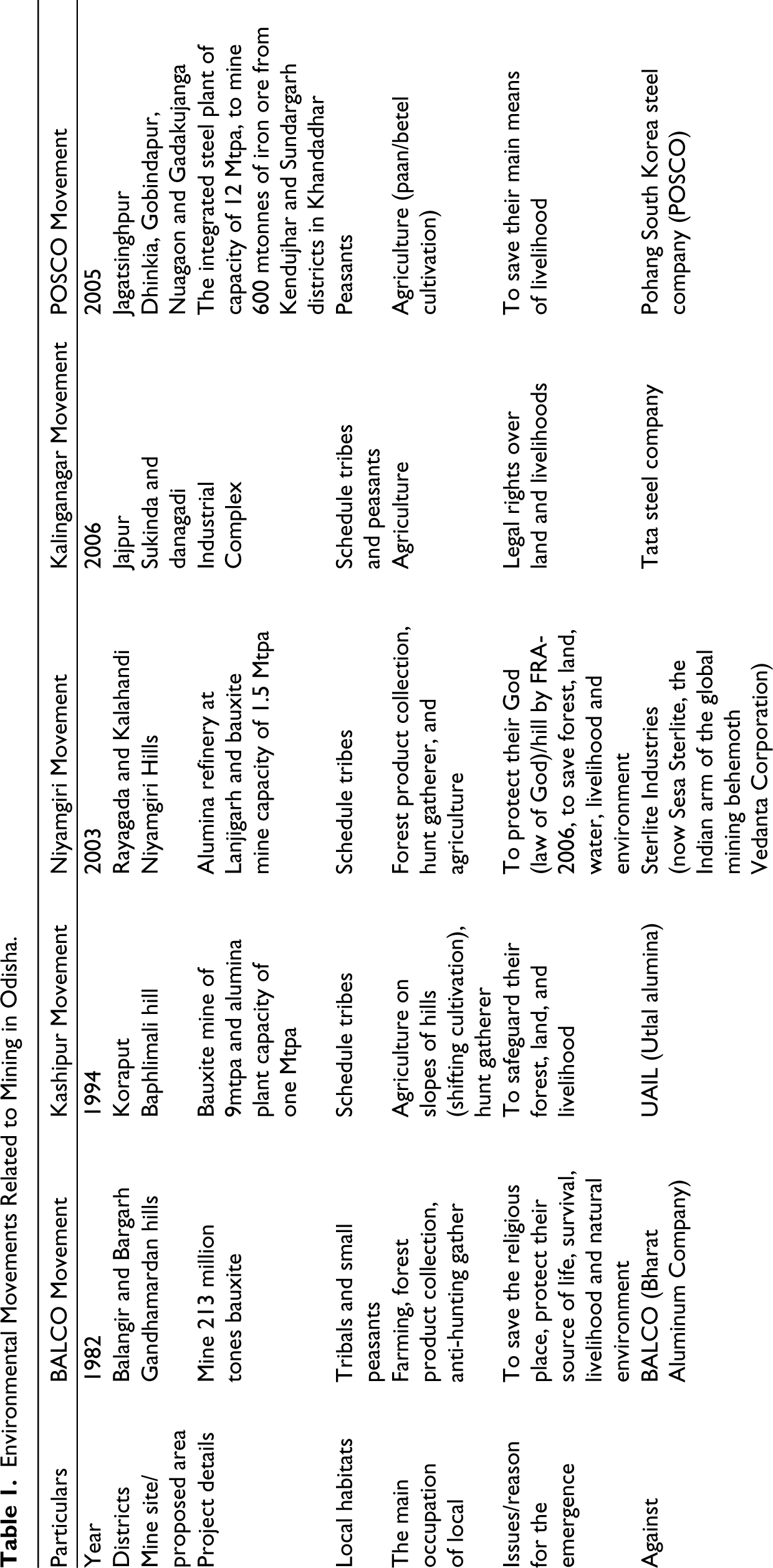
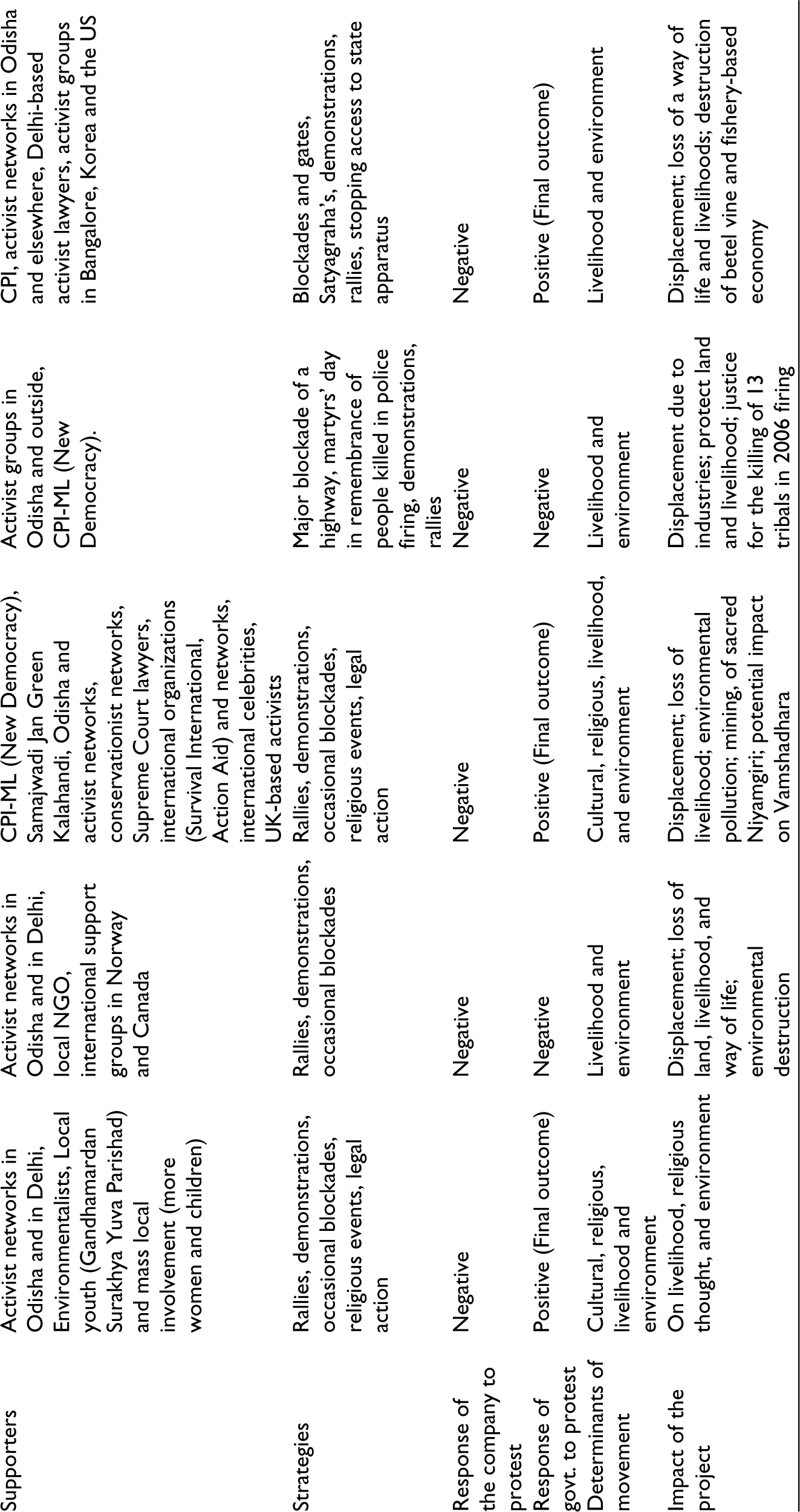
Environmental Movements Related to Mining in Odisha.
Conclusion
It is very clear regarding the strategy, nature, and need of social movement from the review of the environmental movement. Moreover, it is observed that all the conflicts are protest movements that arise to protect livelihood rights and environmental concerns, often planned to oppose the government and industrial capitalists. Though the projected plan revolves around the local tribal people, the protest movements were led by the tribes of Odisha. The tribes are situated very near to nature, and they are closely associated with the natural resources for which they have more knowledge about their rights and source of livelihood. The main source of livelihood depends on natural resources since the ancestral period and their forefathers lived and were sustained by natural resources. The protest movements in Odisha have got the national motivation for other conflicts in different states in the recent era. The developmental projects were planned in which droves threaten the natural biodiversity, damage the environment, and local loss of livelihood. The developmental projects in tribal areas would put them in more poor conditions and more vulnerable conditions. Tribals are not happy with the development phenomena, they think they are the hope of their future development and want to be self-sufficient with nature rather than depend on any company. The predominant factors such as mass active participation with intellectual strategies compelled the capitalists to terminate the project and leave the area which is the success story movement. At the same time, the faulty strategies of the main organization of the movement and more political dichotomy (involvement) are the main determinants for the failure of the movement. The movements related to mining were a great inspiration and made an example of the emergence of other movements in India. Mining movements in Odisha emerged to save livelihood rights and protect biodiversity and the environment. Most of the mining sites are in tribal areas where they are dependent fully on the forest and natural resources for survival purposes. The popular protest movements related to mining which discussed are the POSCO movement, Kashipur movement, Kalinganagar movement, Niyamgiri movement, and the BALCO movement. The similar characteristics of all the protest movements lie in all the areas are tribal dominated, common factors of all the movements are livelihood issues and environmental issues which propel tribals to resist, and the initial response was positive but later negative to the developmental project. All the above movements were similar factors which compelled local tribals to participate actively to save their source of sustenance which was fully based on natural resources.
Footnotes
Declaration of Conflicting Interests
The author declared no potential conflicts of interest with respect to the research, authorship and/or publication of this article.
Funding
The author received no financial support for the research, authorship and/or publication of this article.