



Abstract
Natural forests play a key role in maintaining the planet’s ecosystems and are also crucial to rural livelihoods, particularly in less developed nations. Indigenous groups still need access to contemporary conveniences and possibilities for employment in remote parts of less developed nations. As a result, the use of forests significantly contributes to household subsistence and income. The economic impact of forest resources on the millions of rural households close to forests has recently been the research focus. This study aims to quantify the distributional influence of forest revenue on economic inequality among rural families in the Gandhamardan Hill area of the Balangir and Bargarh districts of Odisha. It also sought to ascertain absolute and relative forest income. The primary data or information were gathered by utilizing focus groups, direct interviews, structured household-level surveys, and key informant interviews. The results showed that 61.9% of the households in the sample engaged in activities related to the forest. Most of the local population participates in agriculture and forestry as the main source of livelihood. After agriculture revenue, forest income represented the second-most significant income portfolio. The income share for bushmeat was larger than the income share for other forest products. The economic disparity among the studied families was reduced by forest income. Therefore, restricting forest access would negatively affect rural people’s welfare and widen economic gaps. The knowledge from the current study is crucial for creating sustainable forest management policies and strategies that will preserve and increase the economic value of using forests without jeopardizing biodiversity preservation.
The Context
A large part of the world’s population lives in developing countries where the agriculture sector plays a vital role in their economy. These countries have economic backwardness and lower productivity compared to their counterpart in developed countries. India’s economy has grown significantly in the last few decades due to livelihood diversification in various sectors. Gradually the human–environment relationship becomes more transforming in nature with the development regime, which predominantly affects the dependency on forest resources and sustainable development in rural areas. The forest resource-based livelihood is an alternative to agriculture, generating employment and income for forest dwellers. The forest resource or natural resources are facilitating the way of sustenance such as animal husbandry, dairy and collection of minor forest resources and fuel to use. An estimated 1.6 billion people, or 25% of the global population, rely on forests for their subsistence needs, livelihoods, employment and income (UN, 2021). According to the State of the Environment report, there are 1.21 billion total rural populations living in India, out of them 0.7 billion rural people depend directly on agriculture, fisheries, forest produce and other natural resources-based livelihoods for sustenance. Forest dwellers in the State are more than 100 million, and 54% are Scheduled Tribes (ST) (Sankaran et al., 2002). The tribal communities are dependent on the forest and natural resources for their livelihood using the forest resources and protecting, conserving and balancing ecology through various cultures and rituals (De, 2012). The well-off people and policymakers are planning to extract natural resources. Natural resources are a part of tribal living and livelihood. However, the resource extraction would not only push them into poor conditions but also a combination of negligence, ignorance, greed and power, resulting in forest destruction and environmental degradation in developing countries (Pandey, 2010). Although the forest and natural resources are connected with the traditional life and livelihood of tribals, they are forced to pay for the environmental and forest destruction as a cost for the development and economic enhancement through industrialization, which pushes the local tribals into poor and vulnerable condition (Padel & Das, 2010).
Forests play a vital role in maintaining the balance in ecology, managing and reducing natural disasters and the prevalence of soil erosion. To conserve forests and the environment, the Government is taking different actions and doing several activities for the local people’s involvement. According to National Forest Policy 1988, Odisha Forest Sector Vision, 2020 and Joint Forest Management Resolution, 2011 have provided the guidance and rules to manage the forest in Odisha, which assures livelihood to the forest-dependent local tribal population. Forest products have been essential for the sustenance of civilized society since the immemorial period. Globally, nearly 1.6 billion rural people are using forest products as medicines, foods, construction materials and fibre. There are two types of forest products such as timber and non-timber products. A timber product contains wood categories for construction as industrial round wood, sawn wood, wood-based panels and pulp. The biological materials, except wood material, are called non-timber forest products (NTFPs). The NTFPs are collected from the forest for human use (de Beer & Mcdermott, 1989). Forest or biological products have socio-economic, ecological, political, cultural or religious value. The significant value of the forest products extracted from the forest for human use will be considered for this study.
Literature Review
Rural Living and Forest Livelihoods
With an estimated 1 billion out of 1.2 billion destitute families reliant on forest resources, forests play a key role in rural lives globally. Approximately 350 million people rely heavily on these woods for their food and livelihood since they reside in or adjacent to thick forests (Cavendish, 2002). Forest resources are essential and fundamental for people’s livelihoods and the country’s economy. Local populations rely on forest resources for a variety of goods, including fuelwood, building supplies, food, and medicine. However, most of the world’s impoverished rely on forests. In fact, a forest provides a variety of advantages to rural residents throughout the developing world. Forestry supports rural livelihood by playing a key role as a safety net and insurance against risks and shocks, as seasonal income gap-fillers during times of low agricultural income and seasonal shortfalls, as tools for eradicating poverty, and as a source of economic security (Teshome, 2015).
The international community has been paying closer attention to rural development and family economies that depend on revenue from forests during the past 10 years. This is primarily due to the growing understanding that forests may play a significantly more substantial role in achieving the Millennium Development Goals’ objectives for reducing poverty and the significant association between forest areas and poverty (Tieguhong & Nkamgnia, 2012). Governments, foreign donors, and non-governmental organizations are therefore increasingly turning to the forestry industry for answers to end poverty. Therefore, there is still a need for empirical research on the role of forests in family economics and rural development. Given that revenue from forests helps in reducing income disparity and also helps to provide food security for households. Moreover, the success or failure of preserving and managing these forests sustainably will have a huge impact on millions of people who depend on them.
In many nations, forests have impacted substantially by lowering economic disparity and eradicating poverty among those who depend on forests for their livelihood. The main sources of living for the people in underdeveloped countries are like forests provide a wide variety of commodities and services to families living in and surrounding forests (Behera, 2009; Dash et al., 2016). According to studies from throughout the world (Babulo et al., 2009; Jagger et al., 2014; Pouliot & Treue, 2013; Shackleton et al., 2007), the forest and non-forest environmental earnings significantly contribute to rural livelihoods. In contrast, lower income households are more reliant on it as a result of the absence of other sources (Shackleton, 2008). Around 1 billion people worldwide depend on dry woods for their livelihoods. Considering that 60% of rural Africans are impoverished and the dry woodlands are an essential resource basis for sustaining livelihoods and fostering economic growth. Materials from the dry forests are meeting many of the continent’s 320 million inhabitants’ basic necessities. About a quarter of a billion people live in or near dry forests in Sub-Saharan Africa, where poverty and underdevelopment in terms of infrastructure, government services, markets, and jobs are distinguishing features for most of its parts. They rely on these resources for a variety of goods, including building materials, food, cropland, fuel wood, and non-wood products (Mwangi, et al., 2006; Oksanen et al., 2003; Petheram, 2006).
The average share of forest revenue in overall income was 22%, according to findings from a meta-analysis of 51 case studies from 17 countries. As a result, several researchers stressed that NTFPs are a significant source of income and have a significant levelling impact. Supplemental forest income helps to minimize economic inequality, according to findings from the Gini coefficient and Lorenz curve research, and it is crucial to the well-being of disadvantaged rural household’s livelihood strategies (Mamo et al., 2007).
The increased awareness of rural people, extensive reliance on forest products and the linkages between poverty and forest use lead to the scientific interest in establishing the economic dependency on forest products and comprehending its causes which have grown over the past several years. The main justification for doing such studies is that an empirically based understanding of interactions between people and forests may be used to develop alternative plans for securing livelihoods, reducing poverty, and conserving dry forests. Additionally, understanding the value of environmental revenue is crucial for understanding the trade-offs and synergies between usage and protection in the context of the environmental conservation debate. Economic valuation studies carried out in several nations with dry forests, and woodlands revealed economic contributions from the forest ranging from 6% to 45%. According to studies, the degree of dependent people varies greatly between households due to a variety of factors, including household size, wealth status, education, livestock and land ownership, awareness levels, age, gender, and access to markets and forests as well as non-farm activities (Cavendish et al., 2000; Sjaastad et al., 2005; Thondhlana et al., 2012).
The relationship between wealth and the exploitation of forest products is a topic frequently examined in literature on forest reliance. While some studies revealed that poorer families extract more forest products and were more reliant on them than wealthy ones whereas others discovered that households with higher annual income harvested more forest products than those with lower annual income. However, wealthier were relatively less reliant on forests than their lower counterparts. It means the link between forests and prosperity may vary depending on the location, and it emphasizes that we still need to improve our understanding of many situations and geographical regions (Kar et al., 2012; Teshome et al., 2015).
Additionally, the economic significance of forest products may differ depending on the type of traditional source of livelihood. For example, the farmers, agro/semi-pastoralists, sedentary pastoralists, and pastoralists have different social and cultural backgrounds, geographic provenances, and histories of close relationships with nature and their resource use patterns may differ. It follows logically from the investigations into the relationship between forest dependence and specific sites. The livelihoods are required in order to tailor policy and management interventions intended to support rural livelihoods and encourage sustainable resource use to the diversity of intercommunity populations (Thondhlana et al., 2012).
Forest resources continue to be crucial for rural livelihoods and for providing food security for rural families in developing countries, despite fast economic and agricultural growth (Angelsen et al., 2014; Das, 2010; Hogarth et al., 2013; Kar & Jacobson, 2012). In the developing world, small landholder farmers continue to depend heavily on forest-based livelihoods for their income (Wunder et al., 2014).
In Northern Ethiopia, behind agriculture income, the revenue from forest environmental sources makes up the second-largest portion of the average family income. It dramatically lowers income disparity and assesses rural poverty. According to findings from other research, wood fuel are accounted for the most significant income share of forest revenue, which varied from 32% to 33% of total family income. Brazil nut cash revenue and forest income were closely associated in the Bolivian Amazon. While some academics have emphasized the value of forest revenue and also cautioned that conservation efforts may worsen poverty unless additional steps are taken to alleviate it. Despite government prohibitions, local populations in Bangladesh frequently collect NTFPs from national parks. This demonstrates that revenue from the forest still matters to households at all income levels. There are many dry forest areas where empirical research on the degree of people’s reliance on forests and the determinants of forest reliance are still crucial areas of research that need to be addressed. It is true even though existing studies from various dry forest areas have increased our knowledge of various aspects of forest–people interaction.
The relationship between the local community and the department managing the forestry resources is the same in many developing nations. Local populations are pushed to use illegal means to satisfy their wants for forest resources since they are seen as rivals, primarily leading to overuse, depletion, and degradation of forest resources. Since public sector organizations have been unable to stop deforestation and degradation via their exclusive administration of the woods (both state-owned and communal), community-based forest management is being tested in Pakistan as an alternative (FAO, 2009). Numerous studies in Asia have discovered that community-based forest management has a good effect on reducing deforestation (Rahut et al., 2015). According to several reports (Byron & Arnold, 1999; FAO, 2008; Neumann & Hirsch, 2000), rural families rely on wild natural resources to assist their present consumption demands and to act as a safety net during difficult times. More commercial exploitation of forest products and other natural resources has been theorized for the potential to enhance rural lives (Belcher & Schreckenberg, 2007; Milne et al., 2006; Scherr et al., 2004). However, empirical support for these talks has been weak (Agrawal & Redford, 2006). Many studies that aim to evaluate the significance of forest products have employed qualitative methods, producing inventories of valuable species but offering little insight into their absolute or relative importance (Neumann & Hirsch, 2000; Vedeld et al., 2000).
In India, like in every developing nation, forest food is significant in ensuring food security. Forest goods offer a safety net to homes in isolated rural regions in times of need, when it is difficult to get food to such locations, or when they lack the money to buy food. The majority of the research on forests and the livelihoods that are derived from there which emphasizes the value of forestry resources to rural households in preventing a rise in poverty brought on by unanticipated shocks like flood, drought, the death of family members and livestock, family illness, and many other consequences (McSweeney, 2004, 2005; Pattanayak & Sills, 2001). In times of famine, rural populations might rely on forestry resources for food and money (Angelsen & Wunder, 2003; De Beer & Mcdermott, 1996).
Rural poverty in India is commonly associated with poor access to cultivable land or low production. Even though the collection of obtained products from common property resources or forests resources go mostly undetected and are not even recorded in national accounting. Nonetheless, around 100 million people in India live in and around forests and rely on gathering and selling NTFPs for a living. Consequently, the problem of rights to access and revenue from NTFPs is critical for the forest dwellers’ survival and livelihood. The question of whether forest resources reduce poverty and income inequality has received a lot of attention for research on rural livelihoods based on forests, particularly in the context of resource-dependent rural areas of developing countries (e.g., Cavendish, 1999; Das, 2012; Fisher, 2004; Nerfa et al., 2020). According to the above studies, households that employ forest resources experience a reduction in poverty and economic disparity. However, most of these studies were conducted in Africa, and research on forest dependence among India’s poor is scarce and inconsistent. The studies that have already been done on India have either valued the fuelwood that has been taken out of its forests (Chopra, 2006), examined the cash incomes from NTFPs (non-timber forest products) activities or linked household income to forest reliance (Narain et al., 2008). The National Sample Survey data, for example, primarily provide information on the volume of firewood collected but no information on the uses of other types of forest products like fodder and NTFPs. Even though these studies have significantly contributed to our understanding of fuelwood or NTFP-based forest dependence in rural India, they primarily rely on these data. As a result, this information must reveal how forests function as a safety net and a way out of poverty, limiting our understanding of rural livelihoods depending on forests (Mahapatrra et al., 2005).
Reddy and Chakravarty (1999) find that if income from forestry were set to zero in India (under the scenario of complete restrictions on extracting forest resources), poverty would rise by about 28%, which cannot be offset even by a 10% increase in income from other sources. This conclusion is based on data from the National Sample Survey. It is given that forests allow low-income people to generate additional revenue that could push them above the poverty line. Nevertheless, compared to this drop in poverty, the above evidence indicates that excluding forest earnings from the household account would result in a more significant percentage increase in poverty because poor households would be more negatively impacted than non-poor households.
McSweeney (2002) thought about what ‘forest reliance’ meant and emphasized the significance of analytic scale and the lens used to evaluate data. She emphasized in her case study that evaluations at the village level yield quite different interpretations than assessments at the global or household level. Many analyses of ‘forest dependency’ or ‘forest reliance’ are based on case studies in regions with high levels of forest cover, which may be anticipated to have greater levels of accessible forest resources and, as a result, higher levels of ‘forest dependency’. Additionally, heavily wooded locations sometimes need more access to shops, government services, and other urban conveniences. Higher levels of poverty, fewer work prospects, and social and political marginalization are predicted to have an impact on forest usage (Sunderlin et al., 2005). Agriculture and forestry may be alternate development and specialization routes. According to Angelsen and Jagger (2014), there is a negative correlation between agricultural land and relative and absolute forest revenue when comparing locations. These findings about the importance of road and forest access trade-offs, and the factors that influence available livelihood possibilities have significant ramifications for development policy and practices. Families in rural areas typically engage in a wide variety of occupations to fulfil their basic requirements and raise their living levels (Ellis, 1998). Ellis’s (1998) review noted that diversification is a heterogeneous process influenced by a variety of social and economic factors, including seasonality, differentiated labour markets, risk spreading, coping, credit market imperfections and inter-temporal savings and investment strategies. However, in general, the ability to diversify aids in improving livelihood security and raising income in situations where there is not a single dominant income source available. People utilize forest resources where they are there to fulfil their basic requirements, as marketable items to earn money, and, where market conditions allow as raw materials in a range of processed goods (Angelsen & Jagger, 2014).
There is often higher pressure to convert more forest land with market access to non-forest activities, and distant forest area tends to be less valuable and hence more likely to be protected because of urban expansion. The same elements that support the preservation of forests may also support the continuation of poverty (Angelsen & Wunder, 2003).
The infrastructure for travel and other forms of communication needs to be improved in these locations. They frequently have minimal agricultural potential, harsh temperatures, and steep topography. Because it has been difficult and expensive to extract the timber and there has not been much demand to put the area to other uses (Sunderlin et al., 2008).
The availability of alternate sources of work or income is limited. People in the region must rely on mixed, low-intensity, subsistence-oriented systems since markets for inputs and outputs are far away and expensive to access. Long journeys are frequently required in the commercial trade of agricultural and forestry products to get the goods to markets. There are high transaction costs in the form of transportation costs, losses from perishable goods, official and unofficial tariffs, taxes and bribes, as well as uncertain demand and prices once the goods are on the market. Producers frequently have to rely on roving dealers, who generally have better negotiating power than local vendors.
Farm-gate pricing continues to be low in comparison to retail prices because these middlemen face high costs and hazards when bringing commodities from rural places to market; more distant places have been found to have higher degrees of forest reliance (Sunderlin et al., 2005). Where there are prospects for off-farm income which frequently represents a vital path out of poverty (Haggblade et al., 2010; Ruiz-Pe’rez et al., 2004). There is few wage employment and many of them move to cities searching for work. Although remittances may be used to invest in successful farming ventures, when the young, strong, and better-educated depart, it can further limit capacity in their home communities.
It is projected that the availability of forest resources would affect the types of forest products utilized and sold. The overall amount of revenue from forest sources is anticipated to increase in settlements that are in or close to forests. Despite adverse market conditions, proximity to forests and distance from marketplaces is favourably associated. However, there is a positive correlation between proximity to forests and distance from markets, even while poor market accessibility may restrict the benefits of greater forest resource availability as a source of income. Settlements with abundant forested resources and easier access may produce more money from the forest. Additionally, residents of forest areas frequently face political and economic marginalization. Many of them are indigenous or have traditional subsistence-based livelihoods and are culturally conservative (Sunderlin et al., 2005). Others include immigrants who fled impoverished areas in search of better economic chances or those who are disadvantaged because of their social standing within a community. They could have minimal political and social capital and be relatively weak. Communities in wooded regions frequently need to be noticed and receive inadequate services from the Government as a result of these factors as well as another effect of their isolation. They have subpar primary healthcare, inadequate agricultural extension services, inadequate human capital levels, and other self-reinforcing cycles typical of poverty (Belcher & Schreckenberg, 2007).
Tribals and Forest Resources/Tribals and Forest Livelihoods
The term ‘tribe’ conjures up pictures of impoverished people living in isolated areas with distinct territorial and natural affinities, typically without specialization of economic tasks and activities. Tribes in India have generally been defined in terms of their geographical and social isolation from the greater Indian society (Xaxa, 2014). Tribal people are typically straightforward, honest, and hardworking people, but many others may not perceive them that way, raising concerns of equality, discrimination, and substantial threats to tribal people’s absolute right to life. The shifting cultivation and gathering of edible forest products have been the foundation of the indigenous people’s (also known as Adivasis) traditional way of life. A degree and pattern of land and forest resource exploitation which guaranteed their ability to generate income independently made a system viable. A highly diverse production pattern and changing cropping pattern helped to maintain sustainability as well. Tribal people aggressively adapted to the highland environment by cultivating a wide array of crops when shifting cultivation started to wane starting around the second decade of the twentieth century. The chance of a crop failure was completely reduced despite the fact that the physical output of these crops was relatively low in contrast to that of contemporary mono-crop farming approaches. A dietary basket that was nutritionally balanced was also part of this method of support. Therefore, it may be said that tribal people were possibly the first ‘social ecologists’ because of their economic circumstances, which were based on subsistence and conservation ideals.
Socially speaking, traditional life was founded on tribal tribes’ usufructuary rights to the land and woods. Also, the production system was ‘extensive’. In order to preserve and maintain the long-term productivity of livelihood resources, the ‘common pool’ character of resources supported customary rights and restrained production intensification. Hence, a system of ‘property’ rights over land and forests was a foundational element of the viability of indigenous people’s means of subsistence. Because of this, compared to the area of the ‘territory’, the livelihood system’s ‘carrying capacity’ was limited, and it frequently maintained a small population. Tribal populations and forest resources have historically coexisted in harmony. The economic, religious, political, and social structures of the tribal people of Orissa reflect their way of life processes, which cannot be understood without an awareness of many parts of the forest that surrounds them (Behura, 1990, 1996; Mallik & Panigrahi, 1998). Resolving these concerns is crucial for India since the country’s rural areas endure a substantial amount of livelihood instability (Das, 2012), and the majority of people with low incomes are concentrated in those states where individuals who depend on the forest are most impoverished (Mehta & Shah, 2003).
It is also anticipated that culture and ethnicity would affect resource utilization. Notably, it is anticipated that indigenous peoples, who have a long history of living in and using forests, would increase the proportion of forest products in their income portfolios. The Indian Constitution acknowledges and divides ‘Backward Classes’ into three groups. The Hindu caste system’s Scheduled Caste or Dalit, historically known as the ‘untouchables’, the ST or Adivasi, which are indigenous people, and the Other Backward Classes are among them. It is acknowledged that certain groups have been socially and economically disadvantaged, and the Constitution allows for positive discrimination to help them.
Moreover, forests are essential for reducing income disparity. All households might not get profit equally from common resources because of different stakeholders, such as rich and poor households; employ various techniques to derive benefits. Also, the inclusion of forest revenue in their overall income is anticipated to lessen inequality because people with low incomes are susceptible groups due to a lack of assets and income.
Methodology
This article is based on both primary and secondary data. The secondary data contains several pieces of literature and reports to strengthen the theoretical argument. However, the primary data includes a direct interview by field survey. The data have been collected from the residing villages (forest dependent) of Gandhamardan Hill. The study area is located in two blocks, Khaprakhol and Paikmal, in Odisha’s Bargarh and Balangir districts. The sample size for the study is 604, and a random sampling method has been used. The study area (Gandhamardan Hill region) has been chosen due to the residents near the forest. Statistical tools are used to analyse the collected data to justify the objective. A statistical tool like descriptive statistics includes a percentage and analysis of variance which has been used to support the argument numerically or quantitatively. The qualitative information gathered through key informant interviews was subjected to content analysis. The research questions guided the categorization of the data into significant units and themes. The conversation made use of the narrative summaries. The information of forest-based livelihood and economic conditions was gathered and summarized in descriptive statistics that produced through percentages and averages. To make understanding easier, the results were compiled into tables and the ANOVA (F test) is employed to test the significant relation and differences between various parameters. This article intended to build the relationship between socio-economic variables and forest-based income sources. How the local economy is related to the forest-based livelihood would be examined. Moreover, the article aims to find out the economic condition of the local region of Gandhamardan Hill and the different livelihood sources which are related to forest.
Discussion
The economic condition of the Gandhamrdan Hill area has become more vulnerable even though the world economy is growing at a rapid rate. The higher economic development and advanced technology in the contemporary world have made people more advanced and prosperous stage. 65.89% of the local population is in deplorable condition as their annual income is below 1 lakh. The poor condition of the local people accounts due to the less education and skill among local people and the lack of preference for non-farm livelihood sources other than farming. The people who practise agriculture and farming on a common basis have an annual income of less than 3 lakh, which is 28.80%. There are a minimal number of households whose annual income is above 3–4 lakh as 5.29%. The annual earnings of a few people are above 4 lakh due to their involvement in regular or salaried jobs other than the farming or non-farming sector. Notably, only a few people have an education above higher secondary, and few people have a higher education which hindering people from engaging in sectors other than farming (Table 1).
Economic Condition of Local People.

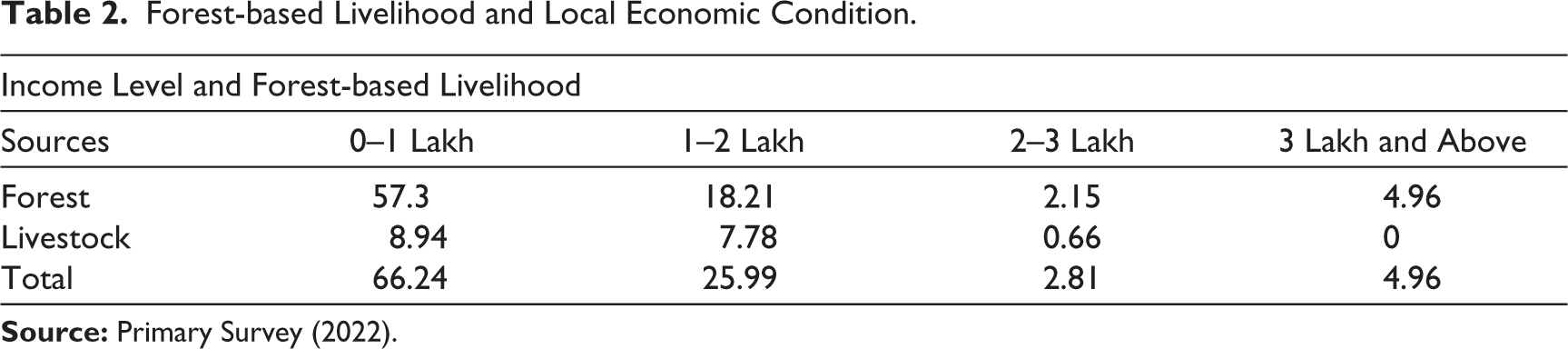
In the Gandhamardan Hill area, there are primarily two forms of forest-based livelihoods: livestock and forestry. The majorities of the locals (57.3%) are reliant on forestry and belong to low-income groups (0–1 lakh), whereas 8.94% are involved in livestock. People between 1 and 2 lakh rely on forests than livestock (7.78). However, people with higher incomes (2–3 lakh and beyond) are less reliant on forest-based livelihoods. Only 2.81% of the 2–3 lakh people rely on forests and livestock because the number of high-income groups is very less and having formal jobs and other businesses. Furthermore, the affluent group relies on forest-based livelihoods at a higher rate than other income groups. It is obvious that people from low-income groups rely more on forestry and livelihood than others. Even though more number of local people are involved in forestry, the income from forestry is lesser. The local economic condition is not improved significantly by the livelihood sources like livestock and forestry due to the low valuation of forest products (Table 2).
Forest-based Livelihood and Local Economic Condition.
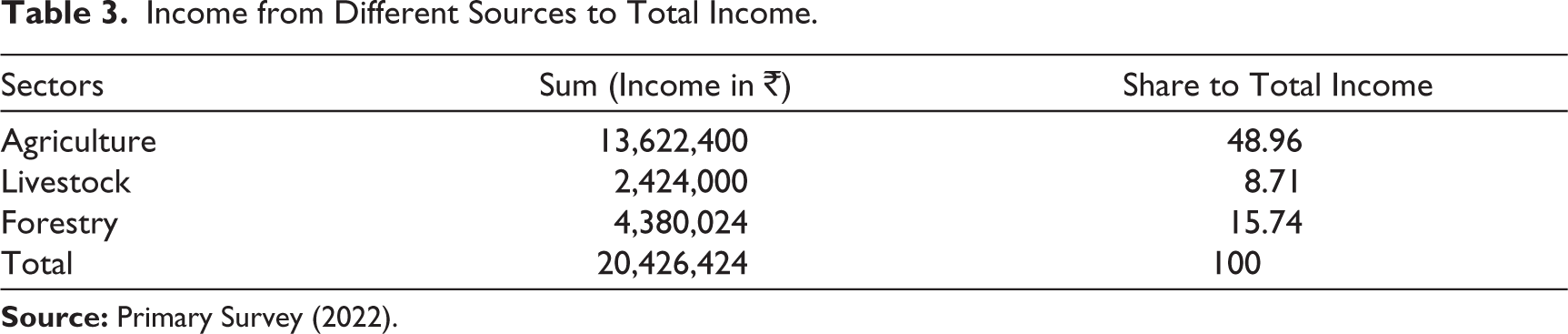
Large portions of the local population are dependent on agriculture and get 48.9% or more of the overall income. It is shown in Table 3. Total income (₹13,622,400) from agriculture is higher than other sources which holds 48.96%. The local people are selling the agricultural product to the government which priced higher than forest products. The forestry sector only contributes 15.74% to the total income whereas livestock holds only 8.71%, it is because of the variability in price and local people are not getting proper value to their forest products and livestock. Because of the subordinate character of the livelihood, the low-value price of forest products, the scarcity of grazing pasture, and the uncertainty for livestock, fewer individuals depend on forestry and livestock as a primary source of income. Due to their low education, a high number of people are involved in different primary sectors than other sectors. Moreover, a low level of education and illiteracy plays a vital role for the high involvement in farming than non-farm sectors. In Gandhamardan Hill, the majority of the local population works in agriculture and also other jobs are also associated with farming (Table 3).
Income from Different Sources to Total Income.
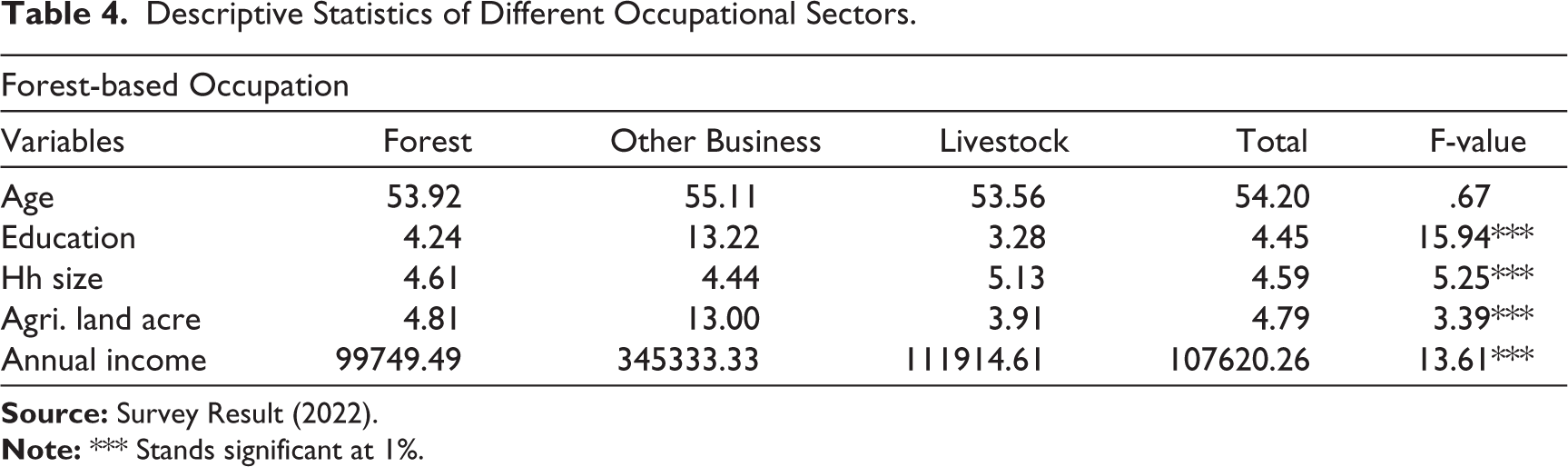
The descriptive analysis demonstrates differences in age, education, household size, agricultural land ownership and economic features between various livelihood sources.
The F-test has been used to confirm the existence and lack of distinctions among various occupations or sources of income. The ANOVA (F-test) technique is used to evaluate all of the continuous independent variables such as age, household size; education, farm size, and annual income. These variables are used to check the difference of the independent factors for the secondary occupation. The difference has also been determined by using independent factors like age, education, household size, land ownership, and annual income. The socio-economic factors such as education (F = 15.94), household size (F = 5.25), land holding (F = 3.39) and annual income (F = 13.61) are influencing the choice of secondary occupation with less than 1% significant value. Therefore, there is a strong relationship between these socio-economic characteristics with the livelihood sources like forestry, agriculture, livestock and other businesses. However, age has no effect on the choice of occupation (Table 4).
Descriptive Statistics of Different Occupational Sectors.
As the majority of people rely on the livelihood sources like forestry, agriculture and livestock, these sectors play an important role in the local economic condition nearby Gandhamardhan Hill region. The primary sector provides revenue and aids in maintaining most of the tribal households in nearby area. There has been a shift in how individuals make a living; some now work in non-farm (business and other jobs) and service sectors. However, the primary sector is what the majority of the locals rely on. Another important aspect is the need for more infrastructures in rural areas, which prevents people from working in the non-farm industry because it is uncertain. In the examined communities, factors including poor education levels, a lack of infrastructure amenities, access to credit, and lack of knowledge are common causes of limited or no diversity. In the Gandhamardan Hill area, there is a significant, overwhelmingly favourable correlation between different socio-economic parameters and sources of income. The examined communities are, nevertheless, close to and surrounding the forest and other available natural resources. The majority opt to work in forestry, agriculture and livestock which are rising significantly. The Government should place a priority on shifting people’s modes of subsistence from farming to non-farming or other major sectors.
Policy Perspectives
The abundance of natural resources in Gandhamardan Hill has not contributed to any development of the local tribal population. The contemporary world is changing and utterly different with new initiatives and technological advancement. A nation’s industrial and infrastructural development is driven the economy to a developed world. Growth and development are becoming a target through rapid industrialization or structural transformation. On the other hand, rapid development and industrialization of the geographical area contribute to high environmental emissions. No doubt, we need development, but it is a time to encourage sustainable development, which would be environmentally friendly rather destruction-led development. Natural resources such as forest products and water resources (streams) can be used to develop the local economy.
Education
The majorities of residents in the research region need to be more literate and adequately educated, which keeps them from participating in the formal sector. Only low-paying employment like farming can be facilitated by a lack of education and discouraging people from entering non-farming or service sector jobs. The most important thing is to promote education and make local tribes and non-tribes aware of the importance of education for their strength and skill development. They may increase their income and boost the local economy by furthering their education.
Food Processing
The study found that many forest products can improve the standard of life for the local population by increasing their market value. As a result, well-designed institutions could provide a favourable setting for developing programmes for education and awareness raising on sustainable harvest. Gandhamardan Hill’s forest resources provide the local inhabitants with food and shelter. Therefore, the state’s rural economy as a whole depends on the sustainable development of its forest resources. However, it was found that the State’s development strategy needed an essential element in managing forest resources. The State Government should have a clear strategy by recognizing the economic relevance of managing forest resources in a way that considers people and institutions at the village level and, more importantly, combines it with the local economic development plan.
Higher value addition can only be feasible through food processing facilities. The minor forest products that are gathered by the locals and sold to local merchants are valued extremely low. Due to the traders’ monopolistic pricing and lower appreciated price for the forest products, the people need to be motivated to gather forest products. The local development process should be the Government’s primary concern. This development not only makes it easier for workers or gatherers of forest products to get the right procurement price, but it also makes it easier for locals to find jobs outside of farming. In other words, livelihood diversification can be possible through initiatives for local economic development.
The Government has launched several programmes for the communities that rely on forests and other natural resources, such as FRA (Forest Right Act, 2005). However, the recipients are unaware of these initiatives. The issue arises because the recipients’ knowledge is necessary for the programmes to function as intended. Government should thus concentrate on increasing local knowledge among its representatives. The policy efforts will help and benefit the residents of Gandhamardan and the state government’s long-term income benefits.
Conclusion
In the Gandhamrdan Hill region, livelihood based on the forest is more prevalent. The majority of the local population is tribal and reliant on the resources of the forest. The study area has a higher concentration of people who live off the land. A sizable portion of the local tribal population works in agriculture, and very few people hold jobs outside of farming. Few members of the tribal community who are not farmers and depend on forestry make up the majority of the local population. It is challenging to rely upon forest goods as their main source of revenue because they are getting minimum income for subsistence. Collecting forest products is thus secondary employment for the native population there. As the leading sector agriculture is important to the local economy. Due to the favourable conditions of the readily accessible water resources and other Government incentives, the people are selecting agriculture as their primary source of income. However, it is important to note that relatively few individuals hold official employment due to a lack of training and education. Despite the fact that more local people work in agriculture, the economic situation there could be better. They only receive money that helps to support their family. The choice of work and several socio-economic characteristics are significantly correlated. The sizes of the farm, household size, revenue from all economic activities, and education all have an impact on the forest-based source of income. However, it is tragic to note that local people are not economically strong with the forest-based living source of income.
Since forestry, agriculture and livestock were prioritized, they are leading forest-based income sources for most people. The primary sector contributes to local tribal households’ maintenance costs and generates income. The way people earn a living has changed, and some now work in non-farm (business and other jobs) and service sectors. However, the majority of locals rely on the primary sector. The inability of residents to work in non-agricultural industries due to a lack of infrastructure in rural areas is a further important factor. Limited or no diversity in livelihoods is a common problem in the communities under study. Common contributing factors include low educational attainment, a lack of infrastructure amenities, access to credit, and ignorance.
Despite the fact that more local tribal members work in agriculture, the area’s economic situation is dire. They only receive money that helps to support their family. The choice of work and several socio-economic characteristics are significantly correlated. The sizes of the farm, revenue from other sources, and education all have an impact on the principal source of income. Similar connections exist between secondary occupation and education. Due to the fact that the majority of the locals and tribal members lack formal education, farming may be a more viable option than other types of employment. Since most locals and tribe members lack formal education, farming may be a more viable option than other types of employment. The Government should prioritize the creation of a centre for medicinal and forest products and educational facilities for community improvement in impoverished areas like Gandhamrdan Hill.
Footnotes
Declaration of Conflicting Interests
The author declared no potential conflicts of interest concerning this article’s research, authorship and/or publication.
Funding
The author received no financial support for this article’s research, authorship and/or publication.