




Abstract
Informal settlements across the global South face escalating climate risks, entrenched energy poverty and deep spatial inequalities. This article examines how decentralised solar energy can enhance climate resilience and advance energy justice in these contexts, drawing on a comparative analysis of Dharavi (India), Rocinha (Brazil) and Diepsloot (South Africa), and an empirical survey from Lephalale (South Africa). A systematic evidence-mapping review was conducted across major academic databases and grey-literature sources, followed by qualitative cross-case comparison. The study sites were selected as cases based on their high informality, climate exposure, energy poverty and documented decentralised solar initiatives. The survey in Lephalale focused on energy inequality, coal dependence, governance participation and attitudes towards renewable energy. Findings show that decentralised solar systems can improve safety, affordability and local resilience and can challenge forms of ‘energy apartheid’, but their transformative potential depends on inclusive governance, pro-poor financing, long-term maintenance arrangements and strong intermediary organisations. Successful projects emerge where communities co-design, co-own or co-manage systems, supported by federations, cooperatives or grassroots networks. The article concludes that decentralised solar solutions must be embedded within justice-oriented urban and energy policies that address underlying structural inequalities, recognise informal settlements as legitimate urban spaces and institutionalise community participation.
Keywords
Introduction
Cities in the global South face growing climate vulnerabilities, with rising temperatures, extreme weather events and resource stress disproportionately affecting marginalised communities (Ansah et al., 2024). Limited infrastructure, weak disaster preparedness and governance gaps heighten these risks (Healy & Barry, 2017). Rapid urbanisation has intensified sustainability challenges, as cities consume over 75 per cent of global energy and generate around 70 per cent of carbon emissions (Nutkiewicz et al., 2018). Inadequate affordable housing fuels unplanned development and informal settlements, reinforcing energy poverty and social inequalities (Ayeni et al., 2025; Khan, 2015).
Peri-urban areas in sub-Saharan Africa and other low- and middle-income countries are expanding rapidly, often in irregular and poorly planned ways. This produces fragmented development patterns, infrastructure deficits and environmental pressures that are now a major global concern (Ayeni et al., 2025). In many such cities, basic services and reliable energy remain concentrated in wealthy, formalised neighbourhoods, while many low-income residents in informal settlements face intermittent supply, hazardous energy sources and rising tariffs (Altala, 2025; Bloomer & Boateng, 2024).
Energy poverty remains a critical barrier to sustainable urbanisation, particularly in sub-Saharan Africa and South Asia, where unreliable power and high costs limit education, healthcare and economic opportunities (Bloomer & Boateng, 2024; Sovacool, 2012). At the same time, global debates on climate change mitigation and just energy transitions emphasise the need to decarbonise energy systems while addressing distributional and procedural inequalities (Healy & Barry, 2017; Reboredo & Carmody, 2025). Historically, energy transitions have unfolded over long periods and have been deeply intertwined with political economy and social change (Bhutada, 2022). The current shift towards renewables is therefore better understood as a contested socio-technical transition than as a purely technical substitution.
Existing climate and energy policies often prioritise centralised, grid-based or utility-scale projects, such as large-scale solar farms and private–public partnership (PPP)-led infrastructure (Creutzig et al., 2017). While such interventions are vital at the national level, they frequently bypass informal settlements because of tenure insecurity, infrastructure deficits and governance exclusion. Upgrading centralised grids to integrate intermittent renewables and rising electricity demands also requires substantial investment in new protection schemes and control technologies (Hossain et al., 2018). As a result, many informal areas remain energy-poor even as grid-connected middle-class suburbs expand their use of distributed solar and other low-carbon technologies.
By contrast, decentralised solar energy systems, such as rooftop photovoltaics (PV), mini-grids, microgrids and solar street-lighting, can be designed, owned and governed at the scale of communities, cooperatives or households. They are particularly relevant for informal settlements because they can deliver affordable, modular and relatively rapid energy access in areas that centralised systems have historically overlooked. However, their actual contribution to climate resilience and energy justice, and the conditions under which they succeed or fail, remain unevenly documented across different contexts.
This article, therefore, addresses four interrelated research questions:
How, and to what extent, do decentralised solar energy initiatives in informal settlements reduce climate vulnerability and energy poverty? Under what governance, financing and spatial conditions do decentralised solar interventions advance or undermine energy justice, including energy equity, energy poverty reduction and the dismantling of energy apartheid? What roles do intermediaries, grassroots organisations and collective agency play in shaping the design, governance and outcomes of decentralised solar projects? What lessons and policy design principles can be drawn from a comparative analysis of Dharavi (India), Rocinha (Brazil) and Diepsloot (South Africa), and how do these resonate with empirical perceptions from a coal-dependent municipality such as Lephalale in South Africa?
To address these questions, the article develops a justice-oriented conceptual framework that links informality, climate resilience and decentralised solar energy. The framework adopts energy justice—encompassing distributional, procedural and recognitional dimensions—as an overarching analytical lens to examine how energy systems allocate benefits and burdens, structure participation and recognise marginalised groups.
Building on this, the study employs a systematic evidence-mapping approach that combines a structured literature review with supporting empirical evidence. It presents the four case studies—Dharavi, Rocinha, Diepsloot and Lephalale—and undertakes a comparative analysis to identify shared patterns and context-specific dynamics.
Guided by the energy justice framework, the article analyses the four cases using three key dimensions: distributional, procedural and recognitional justice. Energy poverty and energy apartheid are treated as indicators of inequality, rather than separate concepts. This approach helps move beyond simple description to show how decentralised solar either improves or fails to improve justice outcomes in informal and marginalised communities. The article concludes by outlining policy and practice implications for advancing just and climate-resilient decentralised solar transitions in informal settlements.
Conceptual Framework: Energy Justice, Informality and Decentralised Solar
Informal settlements across the global South are shaped by structural inequalities, including historical injustices, spatial exclusion and economic marginalisation, which collectively constrain access to affordable, reliable and safe energy. These conditions underpin persistent forms of energy injustice, making energy access not only a technical issue but also a sociopolitical one. This article proposes a framework that adopts energy justice concepts—distributional, procedural and recognitional justice—as an overarching analytical lens to understand how energy systems allocate benefits and burdens, structure participation and recognise marginalised groups (Sovacool & Dworkin, 2015). Within this lens, energy poverty (material deprivation) and energy apartheid (systemic exclusion) are conceptualised as observable manifestations of deeper structural injustice rather than standalone analytical categories.
At the centre of the framework is decentralised solar energy, understood as a socio-technical system embedded within governance processes, local practices and enabling conditions. Technologies such as rooftop PV and mini-grids offer potential pathways to expand access, particularly where formal grid systems are absent or unreliable. However, their impacts are contingent and relational, shaped by how they are implemented, governed and financed. The functioning of decentralised solar is mediated through governance and community intermediaries and financial, technological and spatial enablers, which together form the core interacting system. Intermediaries—including community organisations, cooperatives and NGOs—facilitate participation, mobilise resources and translate local needs into implementation processes. At the same time, enabling conditions such as affordability, financing mechanisms, spatial form and regulatory frameworks determine the feasibility and sustainability of these systems.
The framework identifies two sets of outcomes. On the one hand, positive outcomes (transformation pathways) include improved energy access, reduced spatial inequality and enhanced climate resilience. On the other hand, risks and negative implications (exclusion pathways) include unequal access, market exclusion, technical failure and the potential reinforcement of existing inequalities. These dual pathways highlight that decentralised solar is a contested intervention rather than an inherently equitable solution.
The framework emphasises feedback loops, through which outcomes reshape governance arrangements, market conditions and structural inequalities over time. This reflects a non-linear and adaptive system, where decentralised solar both influences and is influenced by the broader socio-economic and institutional context. Figure 1 schematically represents this justice-oriented solar energy framework. The framework views the energy transition as a dynamic, iterative socio-technical system rather than a straightforward task. Structural inequalities are more than just forerunners, but continuously interact with governance arrangements, justice frameworks and enabling conditions. These dimensions co-evolve through feedback loops, where interventions such as decentralised solar both shape and are shaped by institutional, spatial and socio-economic dynamics. The arrows indicate reciprocal system interactions, intended transformation pathways, risk and exclusion dynamics and feedback loops, highlighting the non-linear and contested nature of decentralised energy transitions.
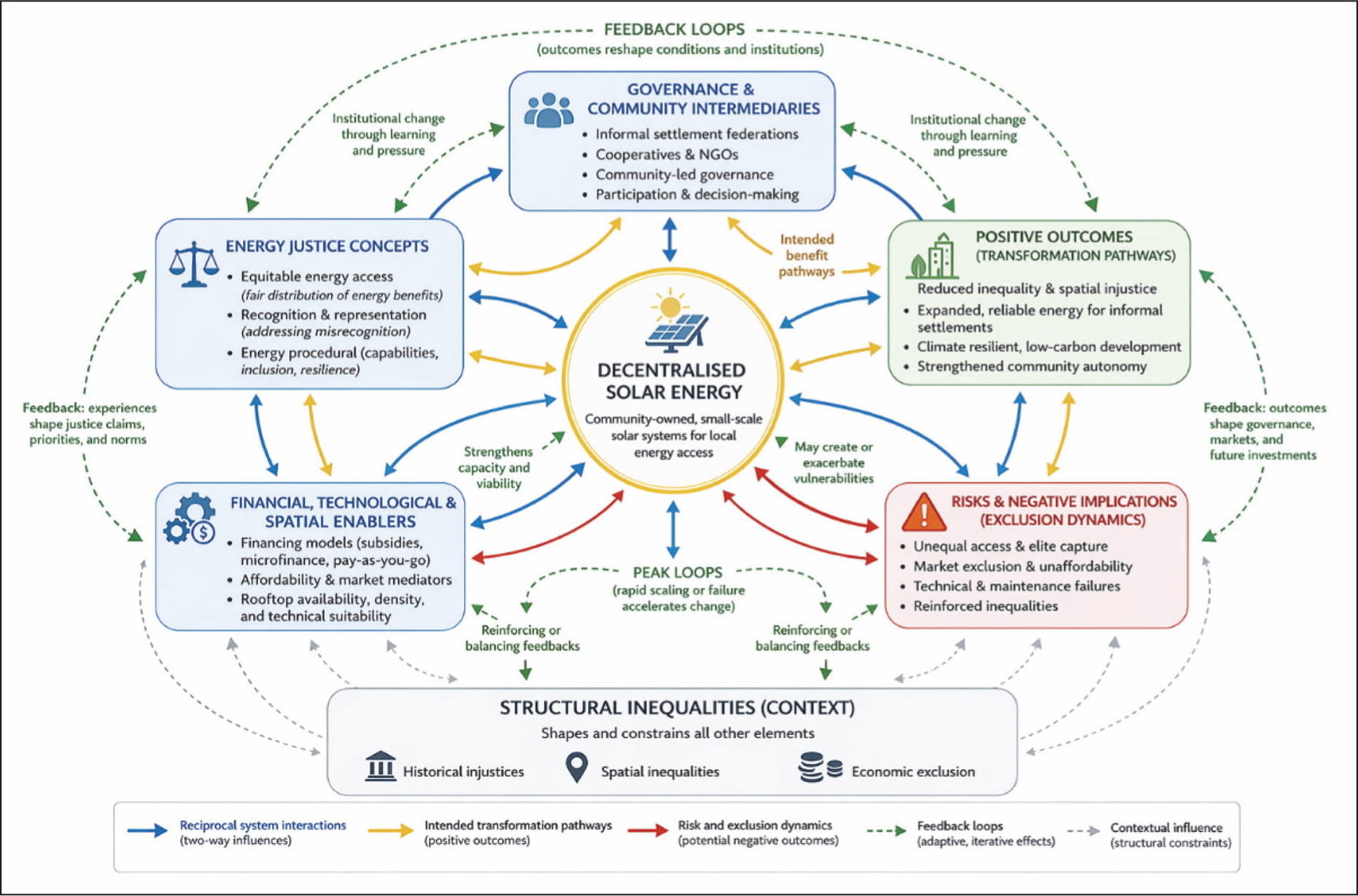
The framework moves beyond a ‘win-win’ representation by incorporating the potential contradictions and unintended consequences of decentralised energy systems. While such systems can enhance access, resilience and local autonomy, they may also reproduce exclusion through affordability barriers, uneven technical capacity and elite capture. By integrating both positive and negative pathways, the framework reflects the contested and politically embedded nature of energy transitions, particularly in marginalised and informally governed contexts.
Methodology
Systematic Evidence-mapping Review
This study employed a literature-based comparative analysis, complemented by empirical survey evidence, to examine the transformative potential of decentralised solar energy for climate resilience and energy justice in informal settlements. Rather than a full PRISMA-style systematic review, a systematic evidence-mapping approach was used to identify, screen and synthesise academic and grey-literature sources across multiple disciplines.
Searches were conducted in Scopus, Web of Science and Google Scholar, supplemented by targeted searches of institutional repositories and organisational websites (e.g., United Nations, World Bank, International Renewable Energy Agency, municipal governments and community-based organisations). The main search period extended from the inception of each database to 2025, reflecting the long historical arc of energy transitions (Bhutada, 2022) while ensuring the inclusion of recent research.
Boolean operators (AND, OR, NOT) and truncation (*) were used to refine and expand search terms across databases by capturing related keywords and variations. Illustrative keyword combinations included: ‘solar energy’ AND (‘informal settlements’ OR ‘slums’ OR ‘favelas’); ‘energy poverty’ AND ‘urban Global South’; ‘decentralised energy’ OR ‘microgrids’ AND ‘informality’; ‘energy justice’ AND (‘community-led’ OR ‘cooperative solar’); ‘climate resilience’ AND ‘informal settlements’ AND ‘renewable energy’.
Titles and abstracts were screened using the following inclusion criteria: (a) focus on urban informal settlements or comparable low-income contexts in the global South; (b) substantive engagement with decentralised solar energy or other small-scale renewable energy systems; (c) relevance to energy justice, energy equity, energy poverty, climate resilience or just energy transitions; (d) peer-reviewed articles, book chapters, or robust institutional/community reports.
Exclusion criteria included purely technical studies with no socio-spatial or governance analysis, purely rural electrification cases and opinion pieces without empirical or conceptual depth.
Case Selection and Empirical Context
From the reviewed literature, four cases were selected: Dharavi (Mumbai, India), Rocinha (Rio de Janeiro, Brazil), Diepsloot (Johannesburg, South Africa) and Lephalale (Limpopo, South Africa). Case selection followed an iterative process guided by the conceptual framework and research questions. These cases were chosen because they represent dense, low-income settlements characterised by informality, climate vulnerability and energy poverty; demonstrate the presence of decentralised solar initiatives (including community-scale interventions); offer sufficient academic and grey literature to enable triangulation of governance, financing, participation and justice outcomes; and collectively reflect diverse sociopolitical and energy-governance contexts across the global South.
Qualitative content analysis was conducted using a coding framework derived from the conceptual framework and research questions. Key thematic categories included: (a) types and scales of decentralised solar interventions; (b) baseline energy poverty and patterns of energy apartheid; (c) governance structures across municipal, community and national levels; (d) the roles of intermediaries, federations and grassroots organisations; (e) financing mechanisms and ownership models; (f) tenure and regulatory constraints; and (g) distributional, procedural and recognitional justice outcomes, including gendered dimensions. Coding was undertaken using Microsoft Excel to organise, compare and refine themes, supported by colour-coding and pivot tables to enable systematic cross-case analysis.
Despite being the fourth case study, empirical survey data from Lephalale are incorporated as supporting evidence. The survey, conducted as part of a broader study on just energy transitions in a coal-dependent municipality, provides insight into community perceptions of energy access, affordability, governance and transition risks. Structured questionnaires were administered across formal and informal areas, capturing perspectives on energy access and affordability, coal dependency and anticipated employment impacts, participation in decision-making, attitudes towards renewable energy and spatial inequalities in electrification.
Key findings reveal pronounced patterns of energy injustice and transition tension: 74.1 per cent of respondents perceived unequal energy access, particularly affecting informal settlements; 83.3 per cent reported exclusion from energy decision-making, with 70.4 per cent identifying government as the dominant actor; and 85.2 per cent expressed support for renewable energy despite widespread concerns about affordability. At the same time, 87 per cent anticipated job losses linked to coal phase-out, underscoring the socio-economic risks of transition. Spatial disparities were particularly stark, with full electrification in formal areas compared to no access in the Thulare Park informal settlement.
These empirical insights complement the case study analysis by grounding the conceptual framework in lived experience, illustrating how energy poverty, energy apartheid and governance exclusion shape both perceptions and the practical feasibility of decentralised solar transitions in South Africa.
Limitations and Scope
As a primarily literature-based and survey-supported analysis, this study is subject to several methodological limitations. Three of the four case studies (Dharavi, Rocinha and Diepsloot) rely predominantly on secondary sources, including academic literature, NGO reports and grey literature, which vary in depth, methodological rigour and temporal coverage. Many decentralised solar initiatives are documented through project-based reporting with limited longitudinal evaluation, making it difficult to assess long-term performance, durability and scalability across contexts.
While the inclusion of survey data from Lephalale provides important empirical grounding, it is also constrained by the challenges of primary data collection in complex and resource-limited settings. These include potential sampling biases, reliance on self-reported perceptions and limitations in capturing rapidly evolving socio-economic and energy dynamics. As such, the empirical component is intended to provide contextual insight rather than statistically generalisable findings.
The cross-case comparison enables the identification of recurring structural patterns related to energy justice, governance and decentralised solar implementation. However, it cannot fully capture the internal heterogeneity of each settlement, nor the diversity of actor interests, informal practices and temporal dynamics that shape energy transitions on the ground. Furthermore, differences in data availability across cases limit the extent to which direct comparisons can be made.
Accordingly, the findings and policy recommendations should be interpreted as analytically indicative and context-sensitive, rather than universally generalisable. Their applicability is most relevant to urban contexts characterised by similar configurations of informality, structural inequality and governance constraints.
These limitations point to the need for future research that is longitudinal, participatory and mixed-method in design, with greater emphasis on in-situ data collection, comparative ethnographic work and the tracking of decentralised solar initiatives over time. Such approaches would enable a deeper understanding of how socio-technical systems evolve, how justice outcomes materialise in practice, and how unintended consequences or trade-offs emerge across different contexts in the global South.
Case Studies
Dharavi, Mumbai
Dharavi exemplifies the convergence of climate vulnerability, energy poverty and spatial inequality that characterises many informal settlements in the global South. With an estimated population approaching one million residents in a compact area, overcrowding, insecure tenure and overstretched infrastructure heighten exposure to heat, flooding and environmental hazards (Abunyewah et al., 2018; Dovey & Tomlinson, 2012). Irregular grid supply, overloaded networks and the presence of informal electricity cartels reproduce entrenched energy injustice (Kovacic et al., 2016; Nutkiewicz et al., 2018).
Within this context, decentralised solar initiatives have emerged as a means of improving energy access and resilience. A distinctive feature of Dharavi is its strong network of intermediary and grassroots organisations, particularly the National Slum Dwellers Federation and the women-led Mahila Milan (World Economic Forum, 2025). These federated groups facilitate resident mobilisation, coordinate savings schemes, negotiate regulatory barriers and support community engagement in upgrading initiatives.
Projects such as Project Brighten, implemented in partnership with technical experts and national ministries, illustrate how intermediaries bridge the gap between state institutions, private providers and residents to support decentralised solar adoption in highly constrained settings (Abramova et al., 2021). Rooftop PV installations and community-scale systems have been piloted on selected buildings, with an emphasis on improving lighting, safety and indoor comfort. However, scaling remains limited by tenure insecurity, informal cartels and fragmented regulatory frameworks (Dovey & Tomlinson, 2012).
Dharavi thus demonstrates how federated savings groups and women-led intermediaries can simultaneously address financial, organisational and recognitional dimensions of energy justice. Their roles extend beyond implementation to include the articulation of justice claims within broader urban planning and decarbonisation debates (Peddibhotla et al., 2024).
Rocinha, Rio de Janeiro
Rocinha is one of the largest informal settlements in Latin America, located on a steep hillside in Rio de Janeiro. It faces chronic climate exposure, including landslide and flood risks, as well as persistent energy inequality, with unreliable grid access and high electricity tariffs (Arcidiacono et al., 2017). Many residents spend a disproportionately high share of their income on electricity, exacerbating energy poverty and reinforcing social vulnerability.
Within this environment, decentralised solar projects have offered an alternative pathway for enhancing energy justice and climate resilience. Central to these initiatives is the role of local organisations, especially Revolusolar and the Sustainable Favela Network, which function as key intermediaries in the deployment of community-owned solar systems (Catalytic Communities, 2018; International Cooperative Alliance, n.d.). These organisations coordinate participatory governance processes, train local technicians, mobilise grant and cooperative financing and negotiate with municipal and regulatory bodies.
Solar cooperatives on community buildings have reduced energy costs, improved supply stability and created local employment opportunities, including for women and youth (Arcidiacono et al., 2017; IRENA, 2024). Revolusolar’s model of cooperative ownership and benefit-sharing illustrates how decentralised solar can be embedded within existing social infrastructures, generating distributional and procedural justice gains. Nonetheless, coverage remains partial, and initiatives must navigate complex regulatory regimes and political volatility.
The case of Rocinha highlights the importance of cooperative governance and intermediary networks in translating the technical potential of distributed solar into durable community benefits. It exemplifies how grassroots agency can problematise existing norms and push for more democratic energy futures (Kovacic, 2022; Peddibhotla et al., 2024).
Diepsloot, Johannesburg
Diepsloot is a rapidly growing settlement on the northern periphery of Johannesburg, characterised by a mix of formal Reconstruction and Development Programme (RDP) housing, backyard shacks and informal structures. It reflects the enduring spatial inequities and energy injustices shaping South Africa’s urban landscape (Barnard-Naudé & Chryssostalis, 2022; Kovacic et al., 2016). Despite formal electrification efforts, many households continue to rely on unsafe or informal sources, including candles, paraffin and illegal connections, which contribute to fire hazards, crime risks and heightened vulnerability to extreme weather (Gilili, 2022).
Two contrasting solar initiatives in Diepsloot illustrate the importance of governance and intermediaries. A municipal-led solar street-lighting programme failed almost immediately due to poor maintenance, institutional fragmentation and unclear responsibilities for operations and repair (Gilili, 2022). By contrast, Project Sunshine, led by Greenpeace Africa and the Philile Foundation, successfully installed crowdfunded solar lights in key public areas, enhancing safety and mobility (Ngakane, 2017). Here, NGOs and local committees acted as intermediaries, mobilising residents, coordinating installations and framing energy access as a matter of justice.
However, the long-term sustainability of Project Sunshine has been challenged by funding constraints and the absence of formalised maintenance frameworks. Diepsloot thus highlights two critical insights: (a) decentralised solar systems require clear, long-term governance and maintenance structures; and (b) community-led intermediaries are essential for initiating and sustaining decentralised energy solutions in contexts where municipal support is limited or ambivalent.
Lephalale (Limpopo), South Africa
Lephalale illustrates how informal settlements across the global South face escalating climate risks, persistent energy poverty and deep spatial inequalities. Although the municipality reported high grid connectivity (93%) (Lephalale Local Municipality, 2023), many low-income households—particularly in informal areas—continue to struggle with affordability, unreliable supply and limited alternatives. As a result, access to electricity does not translate into meaningful energy security.
The town’s economy remains heavily dependent on coal, with major infrastructure including the Matimba and Medupi power stations and the Grootegeluk Coal Mine. Recent developments, such as the Exxaro Resources and Cennergi Lephalale Solar Project (Exxaro, 2023), reflect a shift towards renewable energy. However, the project primarily supplies electricity to the coal mine under a long-term agreement, raising concerns about who benefits from the transition. While it may reduce emissions and support industry, it does little to address energy access challenges faced by the surrounding low-income and informal communities.
This uneven distribution of benefits highlights how energy transitions can reinforce existing inequalities if not carefully governed. Wealthier households are more able to adopt alternative energy sources such as solar, while poorer communities remain dependent on costly and unreliable grid electricity. In this context, decentralised solar has the potential to improve access, reduce vulnerability and support climate resilience.
However, as this case demonstrates, decentralised renewables can only advance equitable and climate-resilient urban futures when embedded within broader socio-technical and political transformations. Without addressing issues of affordability, governance and inclusion, such interventions risk reproducing the very inequalities they seek to resolve.
Comparative Analysis
The comparative analysis shows that decentralised solar energy can contribute to climate resilience and energy justice, but only under specific sociopolitical and governance conditions. Across Dharavi, Rocinha and Diepsloot, decentralised solar emerges as a context-responsive solution to energy poverty in dense informal settlements, where unreliable grid access, high costs and unsafe energy alternatives increase vulnerability to climate and socio-economic risks. However, Lephalale—examined through empirical survey evidence—demonstrates that similar patterns of exclusion persist even in a coal-dependent municipality, highlighting that energy transitions are shaped as much by governance and inequality as by technology.
The case studies highlight both shared challenges and context-specific pathways. In Dharavi and Rocinha, strong intermediary structures and community-based governance play a central role in enabling decentralised solar initiatives. Federated savings groups, cooperatives and local networks facilitate participation, mobilise resources and support co-ownership models, contributing to improved energy access, reduced costs and enhanced local resilience. These cases illustrate how decentralised solar can support climate adaptation and livelihood resilience, particularly when embedded in collective action and flexible governance arrangements.
In contrast, Diepsloot reflects the fragility of decentralised solar interventions where institutional support is weak, and maintenance responsibilities are unclear. While NGO-led initiatives such as solar street-lighting demonstrate potential benefits—particularly for safety and mobility—the lack of sustained governance and financing mechanisms limits long-term impact. This underscores that decentralised solar alone is insufficient without stable institutional frameworks and accountability mechanisms.
Lephalale reinforces these insights by illustrating the constraints of transitioning within a coal-dependent and centralised energy system. Despite high levels of grid connectivity, survey findings reveal persistent energy poverty, affordability challenges and strong perceptions of exclusion from decision-making. The absence of intermediary structures and limited decentralised solar implementation highlights how procedural and distributional injustices constrain the uptake of alternative energy solutions, even where community support is high.
Across all four cases, a consistent pattern emerges: Decentralised solar can enhance climate resilience, energy access and social inclusion, but its outcomes are uneven and contingent. Where governance is participatory, intermediaries are active, and financing models are inclusive (as in Dharavi and Rocinha), solar initiatives are more likely to deliver equitable and sustained benefits. Where these conditions are absent or weak (as in Diepsloot and Lephalale), interventions remain limited, fragile or exclusionary.
Overall, the comparison demonstrates that decentralised solar should not be understood as a standalone technical fix, but as part of a broader socio-technical and political transformation. Advancing climate-resilient and just urban futures in informal settlements requires not only technological deployment but also inclusive governance, equitable financing and sustained institutional support that address the structural drivers of energy inequality.
Discussion
Guided by the energy justice framework, this discussion analyses the four cases through three operational dimensions: distributional, procedural and recognitional justice, using energy poverty and energy apartheid as empirical indicators of injustice rather than standalone concepts. This approach ensures that the analysis moves beyond descriptive categorisation to examine how decentralised solar reshapes (or fails to reshape) justice outcomes in informal and marginalised urban contexts.
Distributional Justice: Conditional Benefits and Climate-resilient Livelihoods
Across the cases, decentralised solar contributes to distributional justice by improving access to energy, reducing costs and enhancing climate resilience—but only under specific enabling conditions. In Dharavi, rooftop PV and micro-grid initiatives reduce reliance on hazardous informal connections and improve thermal comfort (Abramova et al., 2021; Nutkiewicz et al., 2018). In Rocinha, cooperative solar models lower energy costs and stabilise supply, delivering measurable benefits to households (Arcidiacono et al., 2017). In Diepsloot, solar street-lighting enhances safety and mobility, particularly for women and children (Gilili, 2022; Ngakane, 2017).
These outcomes reflect partial reductions in energy poverty, understood here as a distributional injustice linked to inadequate access to affordable and reliable energy (Sovacool & Dworkin, 2015). However, the benefits remain uneven and fragile. Without sustained financing, governance support and maintenance systems, interventions fail to scale or endure.
Evidence from Lephalale reinforces this limitation. While respondents strongly support renewable energy and identify solar as a pathway to improved well-being (Valodia, 2023), high costs and persistent inequality constrain access. This highlights that decentralised solar can improve distributional outcomes, but cannot, on its own, resolve structurally embedded energy poverty.
Procedural Justice: Governance Exclusion and Participation
Procedural justice—relating to participation and decision-making—emerges as a critical determinant of outcomes. In Lephalale, 83.3 per cent of respondents reported exclusion from energy decision-making, reflecting highly centralised governance structures. Similar dynamics are evident in Diepsloot, where weak or inconsistent municipal support undermines local initiatives (Gilili, 2022).
This exclusion sustains conditions of energy apartheid, defined here as systemic and institutionalised disparities in access and service quality (Reboredo & Carmody, 2025). In these contexts, communities remain dependent on unreliable or unsafe energy systems, with limited capacity to influence alternatives.
By contrast, Dharavi and Rocinha demonstrate that procedural inclusion enhances both equity and system durability. Intermediaries such as the National Slum Dwellers Federation, Mahila Milan, Revolusolar and the Sustainable Favela Network facilitate participatory governance, enabling communities to co-design, implement and manage solar systems (Abramova et al., 2021; Catalytic Communities, 2018). These processes align with broader findings on ‘politics from below’, where community agency reshapes energy transitions (Peddibhotla et al., 2024).
Recognitional Justice: Intermediaries, Community Agency and Gender
Recognitional justice focuses on whose knowledge, needs and identities are acknowledged in energy systems. Across the cases, intermediaries and grassroots organisations play a central role in enabling recognition, particularly for marginalised groups.
In Dharavi, women-led organisations such as Mahila Milan embed gendered perspectives into energy governance, linking energy access to health, safety and livelihoods (IRENA, 2024). In Rocinha, cooperative structures ensure that local knowledge informs decision-making and that benefits are retained within the community (Arcidiacono et al., 2017). In Diepsloot, NGOs facilitate community mobilisation, although impacts remain constrained by weak institutional support (Ngakane, 2017).
These examples demonstrate that decentralised solar can support recognitional justice by validating local knowledge and addressing gendered dimensions of energy poverty. However, in Lephalale, the absence of strong intermediaries and limited community participation indicate a failure of recognition, where local needs and experiences are insufficiently incorporated into energy planning.
Structural Inequality and the Limits of Decentralised Solar
Across all four cases, the persistence of structural inequality constrains the transformative potential of decentralised solar. Conditions such as insecure tenure, high tariffs, infrastructural deficits and coal dependency reproduce patterns of energy apartheid and energy poverty, limiting who benefits from energy transitions (Kovacic et al., 2016; Reboredo & Carmody, 2025).
These dynamics are reinforced by dominant representations of informality as disorderly or deficient, which justify exclusionary planning practices and limit investment in informal areas (Altala, 2025; Kovacic, 2022). As a result, decentralised solar initiatives often remain small-scale, experimental or externally driven.
The Lephalale case illustrates these constraints clearly. Despite strong public support for renewable energy, coal dependency, high costs and governance exclusion prevent meaningful uptake. This confirms that decentralised solar cannot substitute for structural reform but must be embedded within broader socio-technical and political transformations (Healy & Barry, 2017; Peddibhotla et al., 2024).
Synthesis: Operationalising Energy Justice in Practice
Decentralised solar advances energy justice when the following conditions are present:
Distributional justice: improved affordability and access through inclusive system design. Procedural justice: meaningful participation and co-production in governance. Recognitional justice: incorporation of local knowledge and gendered experiences.
Where these conditions are absent, interventions remain limited, fragile or exclusionary. This demonstrates that energy poverty and energy apartheid are not separate analytical categories, but outcomes of failures across the three dimensions of energy justice.
Conclusion and Policy Implications: Towards Just, Decentralised Solar Transitions
This article has examined how decentralised solar energy can advance climate resilience and energy justice in informal settlements through a comparative analysis of Dharavi, Rocinha and Diepsloot, complemented by empirical evidence from Lephalale. Guided by an energy justice framework, the analysis focused on three key dimensions—distributional, procedural and recognitional justice—treating energy poverty and energy apartheid as indicators of inequality rather than separate concepts. This approach enabled a more grounded understanding of how decentralised solar systems shape, and are shaped by, justice outcomes in marginalised urban contexts.
Across the cases, decentralised solar delivers important benefits, including improved affordability, enhanced safety, reduced energy poverty and increased adaptive capacity. However, these outcomes remain uneven and highly dependent on governance arrangements, intermediary support, community agency and broader structural conditions. The findings, therefore, highlight that decentralised solar is not a standalone solution but a contingent and context-dependent pathway.
The article concludes that decentralised solar solutions must be embedded within justice-oriented urban and energy policies that address underlying structural inequalities, recognise informal settlements as legitimate urban spaces, and institutionalise meaningful community participation. In this way, decentralised renewables can contribute to more equitable, gender-responsive and climate-resilient urban futures—but only when understood as part of broader socio-technical and political transformations, rather than as isolated technical fixes.
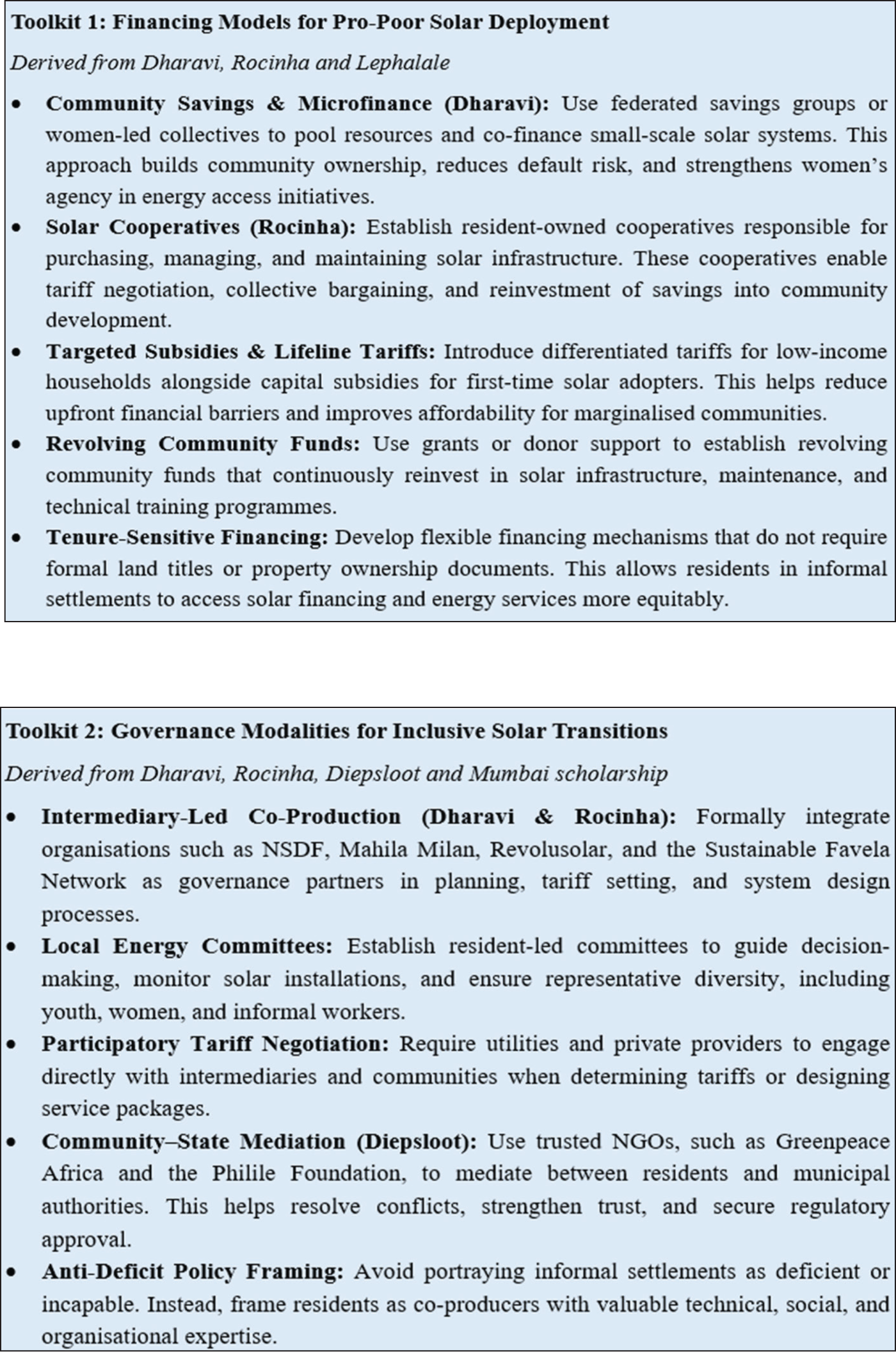
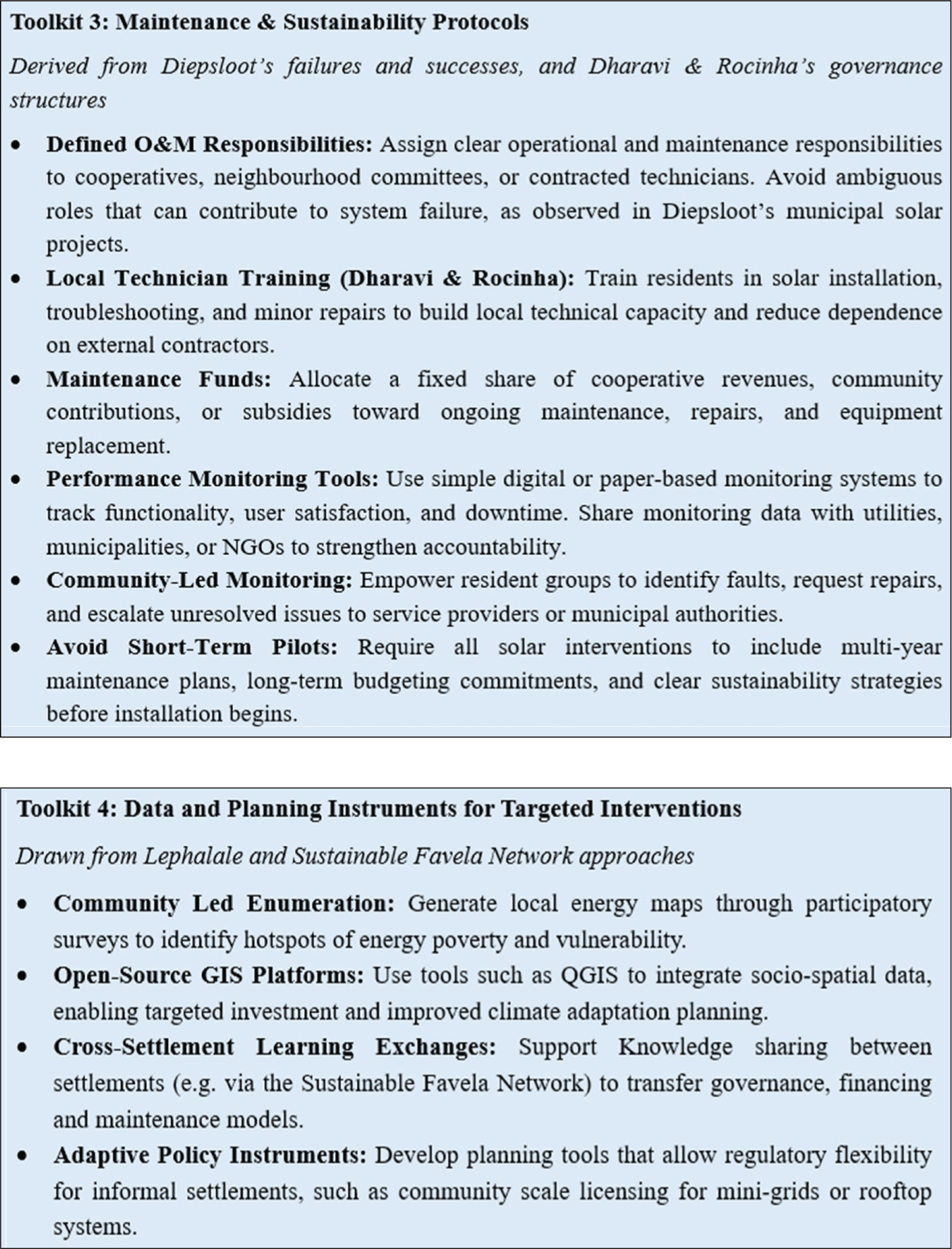
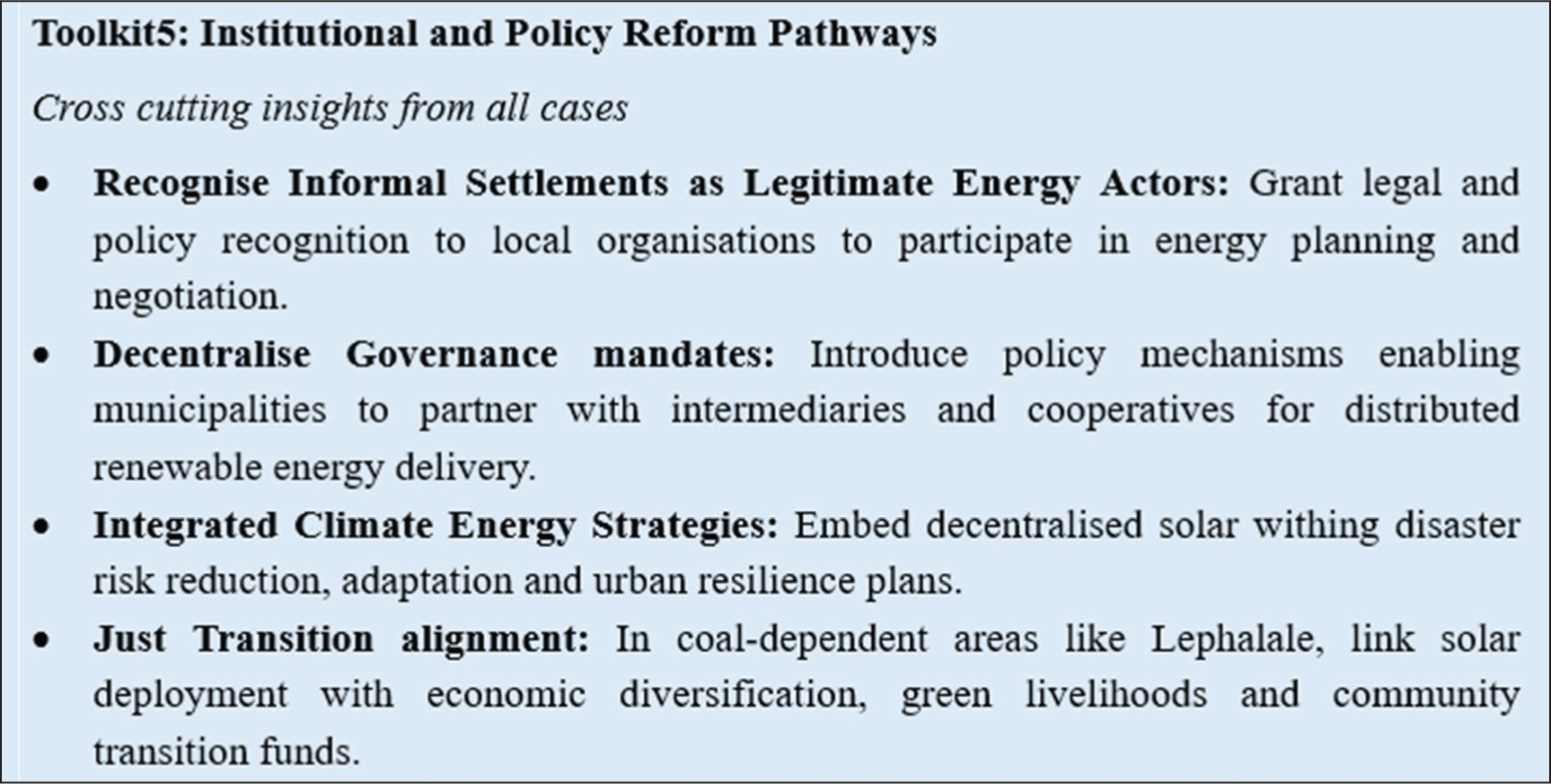
Building on the evidence, five clusters of policy and practice implications emerge as practical toolkits for practitioners and policymakers (Figure 2).
Recognise Informal Settlements in Climate–Energy Strategies
Informal settlements must be explicitly recognised within national, provincial and municipal climate–energy strategies. Tenure-sensitive regulations that legitimise community-scale solar installations are crucial in contexts where land titles are uncertain (Agegnehu, 2025). The relative success of Dharavi and Rocinha—where flexible regulatory arrangements enabled experimentation and community-scale projects—contrasts sharply with Diepsloot and Lephalale, where the absence of policy inclusion and secure rights has often locked informal areas out of energy programmes. Formal recognition within plans and budgets is therefore a precondition for scaling just decentralised solar solutions.
Design Pro-poor Financing and Ownership Models
Solar affordability is central to achieving energy justice. Capital subsidies, lifeline tariffs, microfinance and revolving community funds can reduce upfront cost barriers (Creutzig et al., 2017; Louie, 2025). Cooperative and trust-based ownership structures, as seen in Rocinha, enable residents to share costs, negotiate fair tariffs and maintain systems collectively (Catalytic Communities, 2018; ICA, n.d.). Dharavi’s federated savings groups further demonstrate how grassroots financial mechanisms can support small-scale but durable energy improvements (Abramova et al., 2021; World Economic Forum, 2025). Policymakers should design financial instruments around the economic realities of low-income households, including flexible payment schemes, targeted subsidies and support for community energy trusts.
Institutionalise Intermediaries and Gender-responsive Governance
Intermediaries—including informal-settlement federations, women’s groups, cooperatives and NGOs—should be formally recognised as governance partners rather than peripheral actors. Their involvement through co-production agreements, local energy committees and participatory planning processes enhances procedural and recognitional justice (Ahmad et al., 2024; Peddibhotla et al., 2024). Gender-responsive mechanisms, such as reserving seats for women in governance structures and supporting women-led enterprises in solar installation and maintenance, are crucial for addressing the gendered dimensions of energy poverty (IRENA, 2024). Rocinha and Dharavi illustrate how intermediary-led coordination sustains decentralised systems, while Diepsloot and Lephalale show the consequences of weak or absent intermediary structures.
Secure Long-term Operations and Maintenance
Sustainable decentralised systems require clear operations and maintenance frameworks. Policy instruments should define roles, responsibilities and cost-sharing arrangements among households, communities, intermediaries and municipalities. Community-based technical training programmes—such as those initiated in Dharavi and Rocinha—can build local expertise, create livelihoods and reduce reliance on external contractors (Abramova et al., 2021; Arcidiacono et al., 2017). Diepsloot’s experience demonstrates how solar initiatives deteriorate rapidly when maintenance responsibilities are ambiguous or underfunded (Gilili, 2022). Robust operation and maintenance contracts and dedicated funding streams are therefore essential for ensuring system reliability and user satisfaction over time.
Use Data and Networks to Challenge Deficit Narratives
Data-driven and networked approaches can be used to challenge deficit-based representations of informality. GIS mapping, remote sensing and community-led surveys can identify hotspots of energy poverty and climate vulnerability that are often obscured in official statistics (Abunyewah et al., 2018; Altala, 2025). The Lephalale survey illustrates how community-generated data can expose energy apartheid and governance exclusion, informing more targeted interventions. Comparative learning networks between settlements—such as the Sustainable Favela Network in Rio—can support the transfer of effective governance, financing and maintenance models (Catalytic Communities, 2018).
Crucially, policies must move beyond framing informal settlements as unstable or deficient spaces requiring expert intervention. Instead, they should recognise the institutional capacities, social networks and technical knowledge that exist within these communities (Kovacic, 2022). The achievements in Dharavi, Rocinha and parts of Diepsloot demonstrate that informal settlements are capable of co-producing energy solutions when recognised as legitimate urban actors. Lephalale shows the limitations that arise when communities remain excluded from planning and governance processes.
Footnotes
Declaration of Conflicting Interests
The authors declared no potential conflicts of interest with respect to the research, authorship and/or publication of this article.
Funding
The authors received no financial support for the research, authorship and/or publication of this article.