



Abstract
This article examines the variant Chinese characters used in Japan. On the basis of past research, this article redefines the so-called nihon (no) zokuji (demotic characters used in Japan) as follows: they refer to the Chinese characters which, after having been introduced to Japan, were developed by the Japanese literati, excluding genuine kokuji (characters made in Japan) and demotic characters transmitted from China. The article also discusses the research materials on the Japanese demotic characters, drawing particular attention to two points: one is the considerable amount of influence the wayō shodō (Japanese style calligraphy) imparted to the generation of the Japanese demotic characters, and the other forms the initial causes for the generation of certain wazokuji (demotic characters used in ancient Japan) when the Japanese adopted the Chinese characters under certain cognitive consciousness.
Introduction
I have devoted the last dozen years or so to the study of the sounds and glosses in the old
handwritten manuscripts of the Buddhist sutras seen in Japan, especially those written by
Japanese monks, from the perspectives of the study of Chinese characters and the history of
the Chinese language. During my research, I have noticed that, among the words, characters,
and those that appear in various commentaries, explained by the sounds and glosses made to
them, the existence of some unrecognized demotic characters that are usually considered as
having been transmitted from China.
1
They are found, for example, in: Shin’yaku kegonkyō ongi
shiki, which was written in the Nara period, hand-copied at the end of the Nara
period, and now housed with the Ogawa Family; the Hōen edition of Hokekyō
tanji, the oldest handwritten manuscript of Hokekyō
ongi;
2
the
Mukyūkai Library edition of Daihannyakyō ongi,
3
one of the Mukyūkai series;
4
and the sounds and glosses
provided in the ancient hand-copied manuscripts for single Buddhist sutras kept in the Tenri
Library.
5
All these
have been studied in my past writings. In addition, I have, in recent years, developed an
interest in the cursive script of the Heian period (794–1192), especially the ancient
manuscripts of ‘Four Copies’ (shishō) (Kōyōshō,
Yakushushō, Hōyōsho, and Kokuruishō) by
Kenʼi of Shin’gon School of Buddhism. I have examined them from the perspective of the
collation of the ancient books, especially the documents related to Buddhism. In the process
of going through the ‘Four Copies’, I have discovered that the writing of the Chinese
characters have some notable features. One of the striking features is that some of the
characters belong to wazokuji (Japanese demotic characters that developed
over long-term use of the Chinese characters in Japan rather than China). This has led me to
write a few papers about it in the form of case studies. For example, I published ‘An
examination of several examples of the mistaken demotic characters in Japan: Based on the
study of Kōyōshō 日本讹俗字例考——以《香要抄》为资料’. In May 2018, I published ‘A Re-examination of the
graphic variants used in Japan: Se(i) 㔟 and  based on a study of the Four Copies
日本俗字“㔟”“
based on a study of the Four Copies
日本俗字“㔟”“ ”再考——以兼意“四抄”为主要资料’. In this paper, I
discussed in detail some historical backgrounds of ‘sei/se (㔟) and
”再考——以兼意“四抄”为主要资料’. In this paper, I
discussed in detail some historical backgrounds of ‘sei/se (㔟) and 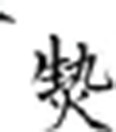 ’, as well
as how wayō shodō (Japanese style calligraphy) influenced the appearance of
the wazokuji, such as a series of the characters ‘sei/se (㔟) and
’, as well
as how wayō shodō (Japanese style calligraphy) influenced the appearance of
the wazokuji, such as a series of the characters ‘sei/se (㔟) and
 ’. After the conference, to which my
earlier version of this paper was presented, Prof. Lee Kyoo-kap invited me to contribute
this paper to the volume in which he serves as the editor. I have taken a few initial steps
in doing this research but have not yet arrived at any definite conclusions. For some
aspects I have come to a conclusion or two, but they are not yet definite. However, I have
come to realize that the study of the graphic variants used in Japan in general is a project
that needs further scrutiny. It is in that spirit that I offer the present paper to other
researchers (for criticism and comments).
’. After the conference, to which my
earlier version of this paper was presented, Prof. Lee Kyoo-kap invited me to contribute
this paper to the volume in which he serves as the editor. I have taken a few initial steps
in doing this research but have not yet arrived at any definite conclusions. For some
aspects I have come to a conclusion or two, but they are not yet definite. However, I have
come to realize that the study of the graphic variants used in Japan in general is a project
that needs further scrutiny. It is in that spirit that I offer the present paper to other
researchers (for criticism and comments).
Graphic variants used in Japan
Demotic characters
The demotic characters have a long history, and the study thereof also has a long history. Ever since Xu Shen’s 许慎 Shuowen jiezi 说文解字 of Eastern Han, the dictionaries and rhyme books in successive dynasties often mentioned or studied the demotic characters. In the Tang dynasty, such specialized works as the Langzhi 郎知 edition of Zhengming yaolu 正名要录 and Ganlu zishu 干禄字书 by Yan Yuansun 颜元孙 appeared. In addition, such well-known works as Zhongjing yinyi 众经音义 by Xuanying 玄应 and Yiqiejing yinyi 一切经音义 by Huilin 慧琳 also appeared. After the Song and Yuan dynasties, Xinji cangjing yinyi suihanlu 新集藏经音义随函录 (also known as Kehong yinyi 可洪音义) by Kehong 可洪, Longkan shoujing 龙龛手镜 by Xingjun 行均, Ming dynasty’s Gusuzilüe 古俗字略 by Chen Shiyuan 陈士元, Qing dynasty’s Jingdian wenzi bianzhengshu 经典文字辩证书 by Bi Yuan 毕沅, and the Republican period’s Songyuan yilai suzipu 宋元以来俗字谱 by Liu Fu 刘复 and Li Jiarui 李家瑞 focused on the arrangement and compilation of the demotic characters.
In recent years, with the burgeoning and flourishing of Dunhuang studies, the study of the demotic characters seen in the Dunhuang materials has continuously been expanded and deepened ever more. This has not only taken the study of the demotic characters a step further but has also broadened the research horizons. My teacher Jiang Lihong 蒋礼鸿 (Jiang, 1959) discussed three major aspects of the study of demotic characters in ‘Demotic characters and orthography’, ‘the significance of studying the demotic characters used in China’ and ‘Steps and methods of studying the demotic characters’. This work has to this day played an instructive role for the study of the demotic characters.
There are different definitions of the term ‘demotic characters’ in this field of study.
In the paper just quoted above, Jiang Lihong mentioned: The demotic characters are those which do not conform to any of the six ways of
writing 六书 in the Chinese script (this is the view of most past researchers, but in
point of fact many demotic characters do conform to the six ways of writing). The
common people in their daily life used most of them. They were regarded as unorthodox
and nonstandard characters. It should be noted that only when the criterion of
‘orthography’ was set up, could the boundary of the demotic characters be drawn.
Another of my teachers, Guo Zaiyi 郭在贻 (Guo, 1992), also mentioned: The so-called ‘demotic characters’ are referred to in reference to the ‘proper
characters’. While the proper characters are those approved by the government, the
demotic characters are the popular characters circulating among the ordinary people.
As regards to the proper characters and the demotic characters, Yan Yuansun of the
Tang dynasty said: ‘All the demotic characters are used in those writings which do not
need to use refined words as used in the books on accounting, official documents,
contracts, and prescriptions. Using the demotic characters would not be improper in
other writings. If they were changed to the proper writings, it would not in any way
improve the contents. Those characters that are used in the memorials to the throne,
letters, written judgments, are to avoid any criticism. As for the proper characters,
they all have rationality in the graphic forms, and can be used in the (official)
writings, examinations and stone tablets.
In the above paragraph, Yan Yuansun made clear some special features and the range of the uses of proper characters, demotic characters and commonly used characters. In his opinion, the demotic characters were a kind of simple and easy character form that could not be used on formal occasions. According to him, the common characters also belonged to the demotic characters. However, they had a wider range of use, covering a longer period of time. In other words, the common characters were the demotic characters that had been used for a long time.
On the basis of the past studies, Zhang Yongquan 张涌泉 (Zhang, 1995) provided a definition of the demotic
characters from a perspective wider than ever before: Any variants that are different from the orthodox characters can be regarded as
demotic characters, which can be simplified or complex ones. They can also be those
that were created in later or earlier times. The boundary between the demotic and
orthodox characters keeps on changing in the transformation of characters.
Although the scholars have not yet reached a consensus of the definition of the demotic characters, their differences are on the whole not so divergent. The three scholars’ definitions mentioned above represent the traditional views in the field of study of demotic characters.
In recent years, researchers in the field of the study of Chinese characters have paid much attention to the study of the demotic characters. From the characters in the Dunhuang documents to the stone inscriptions of the Northern and Southern Dynasties, from those in the unearthed documents to the block-printed received materials, the source of the demotic characters has continuously expanded, having yielded a good harvest of research findings. The study of the demotic characters has come to occupy a ‘hot point’ in the field of Chinese character studies. And it has spread to the other countries where the Chinese characters were received in the past.
On the demotic characters used in Japan
The demotic characters and the graphic variants.
The research done in the countries that belong to the sphere of kanji culture have not only a long history, but also rich findings, especially in Japan and Korea. There certainly are differences between the Japanese and Korean scholars in their understanding of the graphic forms. While many Chinese scholars engage in their research in terms of the ‘proper’ versus ‘demotic’ characters, the Japanese and Korean scholars engage in their research in terms of ‘orthographical forms’ and ‘variant characters’. He Huazhen 何华珍 (He, 2011) has pointed out that the understanding of what are ‘proper characters’ and ‘demotic characters’ differs from that shared by the Chinese and Japanese scholars. In Japan, in such lexicographic work as Ruiju myōgishō, the use of the terms ‘demotic’, ‘common’ and ‘proper’ is taken from Ganlu zishu. In the field of the study of Chinese characters, the use of the term ‘demotic characters’ is infrequent, while the term ‘variant characters’ is more frequent. This can be traced to the fact that an Edo period scholar, Nakane Genkei, first used that term, and other scholars have adopted it. In Itaiji kenkyū shiryō shūsei, compiled by Sugimonto Tsutomu, is a complete collection of research materials of the Japanese and Chinese demotic character studies. The definition of ‘demotic characters’ given in Kanji hyakka daijiten reads: ‘It is a term used in contrast to the standard, proper characters, those simplified as well as embellished forms, belonging to the variant characters.’ Therefore, just as He Huazhen said, the range of Japanese ‘variant characters’ includes not only ‘demotic character forms’ and ‘common character forms’, used by Yan Yuansun, but also kana, ‘simplified characters’, ‘erroneous characters’, ‘loan characters’, kokuji and so on. These roughly correspond to the ‘demotic characters’ used in China.
As one of the subjects of this paper is wazokuji, first put forward by some Japanese scholars in the Edo period who relied on the distinction between ‘proper characters’ and ‘demotic characters’, I will also discuss wazokuji using this distinction. The former term came into being after the latter term was introduced. It may thus be said to involve a ‘dynamic’ concept. The latter term came into being in the actual process of character use, and the term ‘graphic variants or variant characters’ was introduced when Chinese dictionaries were compiled. In the dictionaries it was necessary to separate the form of a character and the meaning of a word expressed by the character. This led to the creation of the term itself. It may thus be said to involve an undynamic concept.
The term ‘demotic characters’ includes ‘graphic variants or variant characters’ in the narrow sense, as well as loan characters, interchangeable characters, dialect characters, specially made characters, erroneous characters and even incorrect, but (generally) accepted, characters. Thus, the demotic characters cover a wider range of characters than the graphic variants/variant characters; they are dynamic. This sort of dynamic versus undynamic distinction is the boundary between graphic variants/variant characters and the demotic characters. 6
Chinese and Japanese demotic characters.
He Huazhen (He, 2014) has suggested ‘international demotic characters’ and ‘demotic characters specific to different countries’. The former refers to the demotic characters in the countries that are in the ‘sphere of kanji culture’. The latter refers to the demotic characters that, because of the cultural differences between the countries that adopted the Chinese character, became popular within respective countries. Some of these characters have different structures of the demotic characters in that certain specific components are transformed, or all the components are completely changed as in the demotic characters in North and South Korea.
The distinction He Huazhen made seems valid in separating the demotic characters made outside of China but, on account of these cultural differences between countries, the demotic characters would differ from one country to another. However, it would be better to use ‘Chinese demotic characters’ than ‘international demotic characters.’ The term ‘Chinese demotic characters’ is taken from my teacher Jiang Lihong, who used ‘中国俗文字’. 7 The Chinese demotic characters spread to Japan and the Korean peninsula contained in a great quantity of manuscripts – handwritten, transcribed and block-printed – and thus the ancient documents of these countries all reflect their legacies. If the Japanese kana used the strokes of the Chinese cursive or running script, we would know that before the Japanese kana developed, the Chinese characters were borrowed in their entirety, including the demotic characters. So, we are justified in using the term ‘Chinese demotic characters’ without sacrificing the accuracy of any of their aspects; it amounts to the same definition with the ‘demotic characters transmitted from China’ I used before.
The term ‘Japanese demotic characters’ is also known as wazokuji (倭俗字), wazokukaji 倭俗讹字 and wazokuji (和俗字). This paper has adopted the term ‘Japanese demotic characters’ for two reasons: for one thing the character wa 倭 carries a derogatory sense, but aside from that, the term is equivalent to the ‘Chinese demotic characters’ put forward by my teacher Jiang Lihong.
As already mentioned, Japanese scholars in the Edo period used the term wazokuji. In the fourth volume of Dōbun tsūkō, Arai Hakuseki examined its origins from the perspective of ‘using the same characters in Chinese and Japanese writing’. 8 Arai used the expression ‘Japanese demotic writings’ and ‘Japanese demotic characters’ which refer to the demotic characters not used in China, but used in Japan. Also, making reference to the relationship between them and the proper characters in China, Arai classified wazokuji into five major categories: kokuji, loaned use, misuse, erroneous characters and simplified characters. This is a kind of systematic study this Japanese scholar in the Edo period made on the Japanese demotic characters. Although his classification is not entirely accurate because of some limits to its applicability when the history of the Chinese characters is taken into account, the term wazokuji shows an outcome of the Chinese characters which had developed in Japan. Jin Ye 金烨, a student of He Huazhen, devoted a chapter in his M.A. Thesis A Study of Dōbun tsūkō and wazokuji. (2014) to the content of wazokuji as used by Arai.
Shortly after Arai Hakuseki, Dazai Shundai wrote a book Wakai seika,
which focused on the erroneous graphic forms written by the Japanese of the
time.
9
The
preface to Wakai seika reads, in part: the characters have proper and also demotic forms … as for the demotic characters
in our country [Japan], we do not entirely know the standard script. When we write
the characters in the standard script, most of them would not be so written by the
Chinese.
He therefore mentioned that in order to correct the errors in the Japanese demotic characters, ‘we need to get rid of the old habits, and then learn the rules of the Chinese standard script’. It is not difficult to see here that the main cause of the erroneous forms of the Japanese demotic characters is that we are not familiar with the standard script. When Dazai wrote his book, he amassed more than 280 cases of the erroneous characters in the past. In his book, he put the erroneous forms of the Japanese demotic characters in the upper column, and put the corresponding ones written by the Chinese scribes in the lower column. The difference between them can be clearly seen. Apart from this, he also pointed out: ‘Some like to create some strange graphic variants. Although these characters may not be wrong, they still bring on complexities to the use of proper characters, having allowed me to clarify them. Our children should avoid these mistakes.’ So his purpose of compiling this book was ‘a hope for our children to avoid the mistakes of the Japanese demotic characters’. This is a viewpoint shared by the Edo period scholars.
In the early Edo period, Kaibara Ekken
10
in his book Wazoku
dōjikun (edited by Ishikawa Ken, 1990) pointed out unequivocally: It is because many do not learn the standard script and do not know how to use
proper characters, they make many mistakes in executing the strokes of an individual
character. There are thus erroneous graphic forms. If people do not learn the
standard script, there will be more mistakes in the cursive script. There are now
many famous calligraphers in our country, but because they do not learn the standard
script, there are mistakes in their handwriting.
He emphasized that people should learn the standard script before practising calligraphy.
It is not hard to see that the scholars in the Edo period used the term
wazokuji from the perspective of writing the Chinese characters and
practising calligraphy. Their standard of judgement is basically the normalized,
standard script in traditional dictionaries, especially Zihui 字汇 and
Zhengzitong 正字通 of the Ming dynasty, to serve as the criteria of
erroneous graphic forms. Kondō Seigai
11
clearly pointed out: ‘When talking
about erroneous characters, Zhengzitong is more reliable than any other
dictionaries. The title of the book is worthy of the content. Thus, in my book I
singularly use Zhengzitong.’ Moreover, the term wazoku
kaji is used in his book with the following explanation: There are many sources of the erroneous graphic forms of the Japanese demotic
characters such as writing 杦 for 杉 and writing 㔟 for 勢. The Chinese would not make
such errors. My purpose of including these characters is to make people become aware
that there are erroneous graphic forms. (Sugimoto, 1974).
In the three volumes of Seikairoku, Kondō Seigai discussed many
characters in detail. For example, for what he regarded as wazoku, he
pointed out the erroneous graphic forms and analysed the reasons for these errors. I
take the following characters as examples: 濃 乃: Dialectal pronunciations of 濃 and 乃 are quite close, and so sometimes 乃 is
borrowed to stand for 濃 as in Shinano 信濃. This is wrong (p. 194). 錢 孱 


 : The character
  is vulgarly simplified to
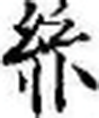 whose sound is
 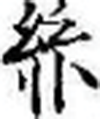 ,
meaning a shuttle used to weave hats. This is not the same character as 絲 (p.
219).
,
meaning a shuttle used to weave hats. This is not the same character as 絲 (p.
219).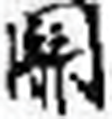 : The latter is a frequently used
simplified form.
: The latter is a frequently used
simplified form. 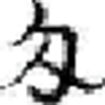 is an erroneous form, the
characters 淺, 賤 and 箋 all use
is an erroneous form, the
characters 淺, 賤 and 箋 all use 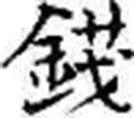 incorrectly (p. 220).
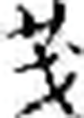 : In such characters as 森, 淼, 姦,
焱, 畾, 轟 and 蟲, the three components are regarded as constituting one character. So
to write the lower portion of ‘
: In such characters as 森, 淼, 姦,
焱, 畾, 轟 and 蟲, the three components are regarded as constituting one character. So
to write the lower portion of ‘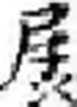 ’ as ‘以’ is wrong (p. 257).
In the book Seikairoku, there are many other examples such as those
given above, and I have cited only a few of them. And yet, we would know the reasons for
these Japanese demotic characters. They are the loan characters as in 乃; the stroke
abbreviations as in 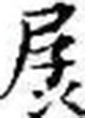 ; the simplified forms as in 戔 which
is written
; the simplified forms as in 戔 which
is written 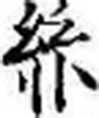 ; the amalgamation of three
components into one as in the lower portion of 孱 rendered as
; the amalgamation of three
components into one as in the lower portion of 孱 rendered as 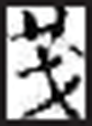 (以).
These demotic characters cannot be seen in Chinese, and they should thus be regarded as
Japanese demotic characters.
(以).
These demotic characters cannot be seen in Chinese, and they should thus be regarded as
Japanese demotic characters.
From the standpoint of ‘orthography’, the Japanese scholars mentioned above believed that the ‘Japanese demotic characters’ were all fallacies and errors that called for rectification. However, if we consider these demotic characters from the perspective of the dissemination and development of the Chinese characters, the emergence of the Japanese demotic characters has its special historical and cultural background; it is the result of dissemination and development of the Chinese characters in Japan. This is worthy of further scrutiny.
On the study of the Japanese demotic characters
Redefinition of Japanese demotic characters
Notwithstanding the availability of much scholarship from the Edo period and the contemporary kanji scholars, I feel that there is still a need to redefine what the Japanese demotic characters really are.
The Japanese kanji refers to those characters when modern Japanese is written. The way of writing the Japanese kanji is inherited, in a fundamental way, from classical Chinese. In ancient Japan, the people used literary Chinese in toto, and adopted the Chinese writing system. So, from the perspective of using the characters, ancient Japanese and Chinese books do not really have any significant differences. However, in the process of the actual use of the characters, with widespread use and a long-lasting history, the system of the Japanese kanji has developed and transformed immensely. The most conspicuous aspect is both the creation of kanji made in Japan (also known as kokuji) and a plethora of the demotic characters.
Genuine Japanese kokuji not belonging to the category of wazokuji.
Used in writing Japanese, the kokuji, also known as ‘nissei kanji’ (日制汉字), ‘wasei kanji’ (和制汉字), ‘waji’ (倭字), ‘waji’ (和字), ‘wazokuji’ (和俗字) and so forth, refer to a portion of the kanji created by the Japanese. In Arai Hakuseki’s Dōbun tsūkō we found 81 kokuji. This is the first time the term kokuji was used. However, the actual number of kokuji should be more than that. Under the editorial supervision by Hida Yoshifumi, Sugawara Yoshizō compiled the book Kokuji no jiten (1999). It has 1553 characters, so far the largest number. 12 However, scholars have disagreements on the criteria of determining the Japanese kokuji. He Huazhen (He, 2004) has examined this problem and pointed out that the Japanese kokuji have only two types. One is those characters that are unique to Japanese. Among them there are characters that are freshly created or that have modified a certain portion of the structure of a Chinese character. The other type refers to those kokuji that happen to have graphic forms the same as the Chinese characters (including those characters with known pronunciations but without any meanings, or those with unknown pronunciations and meanings). The former should belong to the category of genuine kokuji. The latter is the ‘incidental’ kokuji. It is a kind of phenomenon of different characters with the same graphic forms, ‘transnational homographs’, as it were, in the cultural sphere of Chinese characters, thus belonging to a special type of kokuji.
I would think that the genuine kokuji could not be counted as wazokuji. It is because these characters were originally created by the Japanese by making reference to the principles of creating Chinese characters, such as syssemantographs and phonetic compounds, resulting in entirely new kanji, not based on any Chinese way of naming things or of any Chinese concepts. They were created outside of a notion of ‘proper characters’ or ‘demotic characters’. As Lu Xixing 陆锡兴 (Lu, 2002) pointed out, the Japanese kokuji are fit for their own mode of thinking. It reflects a special componential feature of nationality.
The creation of Japanese demotic characters in the process of a long-term use of the Chinese characters by the Japanese.
In the same way as the ‘demotic characters transmitted from China’ were created during a long history of Chinese character use in China, the Japanese demotic characters were created during a long historical process of Chinese character use in Japan. Viewed from a historical perspective, the Heian period is roughly the nascent stage of creating the Japanese demotic characters.
The Asuka and Nara periods correspond to the time from the Sui to high Tang dynasty in China. It was that time that Japan was acquiring knowledge about China in practically all its cultural elements. But at that time Japan did not yet have any writing, even though magana already was in use. The people were still using the Chinese characters (for most of their writings). When viewed from the use of the Chinese characters, this period belongs to the stage of ‘inheritance and dissemination’. At that time, a great number of Tang manuscripts were brought to Japan. Through the hands of the Japanese copyists, the Chinese characters spread to many parts of Japan. As for the structure of the characters used at that time, it mainly displays the elegant standard script, and the Japanese of that time faithfully emulated the original. Zhang Yongping 张永平 (Zhang, 2018) pointed out that ‘The graphic variants in the Tang hand-written manuscripts are extremely many, and the reason for this is the pursuit of the copyists for the “beauty” in the variant graphs in terms of calligraphy’. Also, the Japanese of that time were extremely faithful to the originals of what they were copying. The upshot of such a practice brought two major consequences. First, Middle Chinese demotic characters, together with Tang copies of texts, spread throughout Japan in great quantities. Second, the admiration for and fondness of the original Chinese texts meant that the Japanese had left many erroneous characters uncorrected. One error led to another; a spurious character was piled on top of another spurious character. This, in fact, is the initial cause of so many demotic characters in the Japanese kanji.
After a period of borrowing and studying Chinese characters, under whose influences the Japanese writing system began its life, the big curtains of the history of the Japanese language were opened. That was in the Heian Period. Reflecting upon the writing of Chinese characters, the trend towards Japanization became intensified. Although the standard script of Chinese was a major player, the execution of the strokes of Japanese characters became more roundish, which is an example of Japanization. Especially after the mid-Heian period, the Japanese kana became popularized, and accordingly the writing of Japanese became unrestrained and simpler. Moreover, in the process of the Chinese characters spreading to Japan there also appeared changes and innovations, each showing different degrees of development. These manifested themselves in the copying of Buddhist sutras, since the copyists no longer had the mentality of the earlier scribes who respected the original texts and tried to maintain their appearances, styles and characters forms. The copyists wrote down the texts according to the actual use of the characters of the time with an emphasis placed on the ease and speed of writing, resulting in the appearance of a plethora of abbreviated characters. With the introduction of Chinese calligraphy, especially of cursive and running styles, into Japan, there developed ‘Japanese-style Chinese calligraphy’, that became quite popular. Some of the demotic characters transmitted from China had once again become unfamiliar to the people because ‘cursive styled writing got standardized’. It is also because of the differences in the understanding of the Chinese characters between the Chinese and Japanese, that heaped miswriting and improper use of the characters on top of another layer. This serves as an important reason why the great scholars in the Edo period came up with the term ‘erroneous Japanese demotic characters’.
Japanese demotic characters as the modifications of the Chinese characters not seen in the demotic characters transmitted from China.
The demotic characters seen in Japanese texts (including hand-copied manuscripts and block-printed editions) are numerous. They can be divided into the following two types.
Demotic characters transmitted from China (or Chinese demotic characters).
As already mentioned, when many Confucian and Buddhist texts were brought to Japan, the ancient Japanese scribes faithfully copied the original graphic forms. Fang Guoping方国平 (Fang, 2007) commented as follows: ‘In order to maintain the styles and features of the original texts, the Japanese scribes copied the original writing styles and graphic forms, including the demotic characters of the past dynasties, all intact.’ In this way, a large number of the Chinese demotic characters from different dynasties were brought to Japan. Thus, if we open the ancient texts kept in Japan, even though they were copied in Japan, we still find that most of the demotic characters are the same as those in the Dunhuang demotic characters and the stone inscriptions of Wei, Jin and the Northern and Southern dynasties. For example, during the Wu Zhou 武周 period, from the first year of Zaichu 载初 (689) to the first year of Shenlong 神龙 (705), 17 Zetian xinzi 则天新字 were promulgated. However, when Emperor Tang Zhongzong 唐中宗 came to the throne, and changed the country’s title back to Tang, the political changes were instrumental in the withdrawal of all these characters. In the 10th month of the second year of Kaicheng 开成 (837), Emperor Tang Wenzong 唐文宗 issued a decree to abolish Zetian xinzi and replace it with the original characters. Thus, the research materials of Zetian xinzi available in China must be obtained mainly in unearthed documents, stone inscriptions and Dunhuang documents. In Japan, however, there are many materials in which Zetian xinzi can be found as in Wangbo shixu 王勃诗序 housed in Shōsōin, epitaphs and Tang hand-copied Buddhist sutras that were brought to Japan in the Wu Zhou period, especially the Huayanjing 华严经. Even in the sounds and glosses Japanese provided for Huayanjing, Zetian xinzi occupies an important part of the content. I have done some research on the Zetian xinzi in Shin’yaku kegonkyō ongi shiki written in the Nara period. I found that 16 Zetian xinzi were used in this work. These 16 characters were used 43 times. Since in some places two identical characters appear, the real count could be 51 times. It is this work that has the most Zetian characters that form the new Zetian xinzi study materials.
Many demotic characters in Japanese texts share the demotic characters transmitted from
China. It follows that when studying them, the texts available overseas, especially
those in Japan, are very important. Based on the demotic characters that appear in the
text housed in the Dainenji Temple in Kyoto, Wang Xiaoping 王晓平 (Wang, 2010) says: These characters can be compared with the variant characters in the
Shijing seen in China. They can also be compared with the demotic
characters in the Dunhuang documents. We can by such comparative studies find out
how the dissemination of the demotic characters may have taken place. This requires
further studies.
I agree.
Japanese demotic characters.
The Edo scholars call these kind of characters wazokuji. But each scholar has different criteria for judging what the demotic characters are, making it difficult for us to define what exactly is the wazokuji. The most influential view on this is that of Arai Hakuseki, who in his Dōbun tsūkō comprises four large categories: ‘loan usages’, ‘mistaken usages’, ‘erroneous usages’ and ‘simplified/abbreviated forms’. As already mentioned, He Huazhen and his student, Jin Ye, examined this work. I would here like to discuss wazokuji from another angle, that is, I will consider it in terms of the origins of the wazokuji, which might be equivalent to the outcome of the evolutionary changes of the Chinese characters in Japan.
He Huazhen (He, 2014) has
pointed out: In the Jōyō kanjihyō, there are 235 simplified characters that differ from the
present Chinese simplified characters. These different simplified characters spread
to Japan, and have lasted for generations. But most of these graphic forms had
already appeared in the ancient Chinese documents.
In He Huazhen’s paper, he described the historical backgrounds of these ancient Chinese documents.
Most Chinese scholars consider wazokuji as ‘demotic characters transmitted from China’. For example, in the second chapter of A Study of the Chinese Demotic Characters 汉语俗字研究, ‘An overview of the ancient and present demotic characters’ (古今俗字大观), Zhang Yongquan (Zhang, 1995) discusses the Japanese demotic characters, pointing out that such demotic characters as 广, 𡛷, 仏, 国, 帰, 発, 変, 歩, 両, 斉, 竜, 悪, 薬, 勧, 豊, 与, 塩, 斎, 軽, 県, 暁, 雑, 児, 従, 嬢, 銭, 総, 継, 弁, 灰, 渓 and so on are all the demotic characters that have been used for a long time in China. I agree. However, it must be noted that, although these characters were initially accepted as demotic characters, in the mind of the Japanese scribes there was no distinction between ‘proper’ and ‘demotic’. These characters were adopted because of convenience, and in the following I explain my reasons.
I once had a chance to devote myself to a study of the demotic characters in
Shin’yaku kegonkyō ongi shiki. In it there are many demotic
characters such as 豊, 塩 and 継, but there are a series of characters in which the
component 巠 is written as 至, 𡉊 and 𢀖, and the component 卆 is written as 卒. I have also
found quite a few cases of the graph In pre- and post-Tang, the character 弁 was frequently borrowed to represent 辨 or 辯.
Apart from the similarity in sound, it might have had something to do with the
abbreviated graphic forms of 弁. It therefore follows that in China or Japan the
scribes were influenced by the common people’s habit in writing simplified graphic
forms.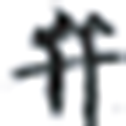 used as 辨 and also as 辯. This
indicates exactly that one special feature of the ‘Japanese borrowed demotic characters’
is ascribed to the convenience of writing and the loan use due to similarities in
pronunciation. As Kondō Seigai mentioned in Seikairoku: ‘The
pronunciation of 弁 and 卞 is similar to that of 辨, thus these two characters were
borrowed to represent 辨’. Zhang Yongquan (Zhang, 2003) has also pointed out:
used as 辨 and also as 辯. This
indicates exactly that one special feature of the ‘Japanese borrowed demotic characters’
is ascribed to the convenience of writing and the loan use due to similarities in
pronunciation. As Kondō Seigai mentioned in Seikairoku: ‘The
pronunciation of 弁 and 卞 is similar to that of 辨, thus these two characters were
borrowed to represent 辨’. Zhang Yongquan (Zhang, 2003) has also pointed out:
Such characters as mentioned above have long been regarded as demotic characters in Japanese history. Some of them were even called wazoku kaji by the Edo scholars. It must be pointed out, however, that in terms of the end result, many of these characters had changed from the demotic characters to the ‘common use characters’. Some of them were incorporated into the ‘presently-used characters’ (tōyō kanji), 13 and also into the ‘commonly used characters’ (jōyō kanji)’. 14 In the sense that the jōyō kanji is ‘official’ (sanctioned by the government), the characters in the list can be called ‘proper characters’. This is consonant with what Zhang Yongquan (Zhang, 1995) has observed: ‘The boundary between the demotic and the proper characters keeps on changing as the time changes.’
Thus, it may be said that the scope of the ‘Japanese demotic characters’ we should be
discussing in this paper narrows down considerably. After the Chinese characters were
introduced to Japan, and as they were used for a long period, the demotic characters
emerged. They were not found in China. The demotic writings or characters used in Japan
are not used by the Chinese people. In short, they refer to the ‘new’ demotic characters
excluding the genuine kokuji not found in the demotic characters
transmitted from China. Some of them were from China, and some created in Japan. As
already mentioned, He Huazhen (He,
2014) pointed out that most of the 235 simplified characters in the
jōyō kanjihyō are found in the ancient Chinese documents. The
‘demotic characters specific to different countries’ that gained circulation in Japan
are as follows: 壓—圧 團—団 應—応 邊—辺 貳—弐 圍—囲 釋—釈 擇—択 澤—沢 譯—訳 驛—駅 氣—気 廣—広 鑛—鉱 擴—拡 傳—伝 轉—転 圓—円 假—仮
On the whole these characters are not found in the commonly used comprehensive
dictionaries of the characters or words, though some of them can be found in
Hanyu dazidian 汉语大字典 or Zhongwen dacidian 中文大辞典 such
as 圧, 弐, 択 and 拡 only with notes such as ‘same as 壓’ and so on without indicating (any
historical) sources. The only exception is ‘円’ and ‘圓’ under whose entry in the
Hanyu dazidian: Jiongbu 汉语大字典 · 冂部 there is Qingbaileichao
zhouchelei 清稗类钞舟车类 by Xu Ke 徐珂, who is one of our contemporaries. This,
therefore, is no help to us in the question of (historical) provenance. However, under
the radical 囗 of Nanji itai jiten, Ariga Yōen (2000) gives the character 圓 under
which he provides 円. According to the guide to the use of his work, this indicates that
the character is taken from the ancient forms, Zhou characters (籀文), simplified
characters, identical characters and demotic characters found in the
Jiyun 集韵, Yupian 玉篇, Zhengzitong
正字通, Kangxi zidian 康熙字典 and Songyuan yilai suzipu
宋元以来俗字谱. We should therefore conclude that these characters originated in China. It is
only because they are seldom used in Chinese that we do not encounter them. Apart from
these, such demotic characters as we cited above, 囲, 伝 and 仮 can be seen in Chinese
sources, but they all have different pronunciations and meanings in Chinese. They belong
to what He Huazhen called ‘the coincidentally the same kokuji’. They
happen to be a kind of ‘different characters with the same graphic forms’ in China and
Japan. However, Lu Xixing (Lu,
2002) has pointed out that such Japanese demotic characters as 図 and 仮 were
transformed from the Chinese cursive scripts and were the regularized simplified
characters. They are not newly created. For the following five sets of the ‘demotic
characters specific to different countries’, namely: 釋—釈 擇—択 澤—沢 譯—訳 驛—駅,
Lu Xixing believes that they were truly created in Japan, and the method of creating these characters is based on ‘the analogy of pronunciation, whereby the use of 尺 substitutes 睪’. According to He Huazhen (He, 2014), writing the component 睪 as 尺 is the result of a historical process the Japanese had gone through in their work on the translation of Chinese documents, especially Chinese Buddhist sutras. He has also pointed out: ‘If we look for the use of 睪 as 尺 in Middle Chinese documents, we can find traces of such a use in China, not Japan. But the Japanese succeeded it, and even included it in the Jōyō kanjihyō.’
The conclusion He Huazhen reached that writing the component 睪 as 尺 can be traced to China is of much interest. If he can come up with convincing evidence, that will be a tremendous advance in the study of the Japanese demotic characters.
As regards the component 睪 written as 尺, which then formed a group of
kanji, in the section entitled ‘Abbreviated characters’ in
Dōbun tsūkō, Arai Hakuseki has observed: 釈 is the same as 釋. In Babaron (Abhidharma Mahāvibhāṣā Śāstra),
Shaka 釋迦 is written as 尺加. Since the character 釈 was created and also 訳 was created
to represent 譯, the later generations succeeded using these erroneous forms. For
example, the component 睪 in the characters 擇, 懌, 澤 and 驛 were all substituted by 尺.
They are all wrong forms.
In Seikairoku, Kondō Seigai also says: ‘釋:…尺, same as above. Just as
in the example 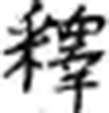 , 釈, 澤, 譯, 擇 and 驛 all contain 睪 as a
component. They are all written incorrectly as 尺.’
, 釈, 澤, 譯, 擇 and 驛 all contain 睪 as a
component. They are all written incorrectly as 尺.’
From what is quoted above, we see that the two scholars have regarded these usages as ‘wrong’ and ‘incorrectly written’. Dazai Shundai in his Wakai seika has warned us never to use these abbreviated characters in the wazoku. The examples he gave include 澤 written as 沢 and 釋 written as 釈. His view is naturally made on the basis of the Standard Chinese Script or Proper Characters. However, this series of characters had already become daily used characters in Japanese. The nuance of the ‘demotic characters’ had already faded away.
It should be noted here that at present no variant form of 釋 (or simplified form with the component 尺) can be found in Japanese reference works. According to Arai Hakuseki, we should first find examples of scribes using 尺 to substitute 釋 on account of their same pronunciation. They then created the character 釈, and then, only after that, a series of characters with the component 睪 were changed systematically to 尺. However, Arai Hakuseki did not provide any detail of Babaron; therefore, we have no idea whether it was in some manuscript of the Tang or any other period or a Japanese copy made in whatever time period. I have searched for any evidence on many occasions without result. However, I did find that in Japanese ancient manuscripts, especially from the middle of Heian period to the beginning of Kamakura period, 釋 was written frequently as 尺.
While researching on the Kōyōshō by Ken’i, I have found two ancient handwritten manuscripts, the old editions kept in Ishiyama-dera Temple and in Daigoji Temple. 15 Under the entries ‘Maoxiang 茅香’ and ‘Baijiaoxiang 白胶香’ in their last volume, there is a quotation ‘大日經義尺’. After examination, we have discovered that this is quoted from Dainichikyō gishaku 大日經義釋 which was written by Yixing 一行, a Tang Buddhist monk. Therefore the character 尺 stands for the word 釋.
In addition, under the entry ‘Niutou xiang 牛头香’ in the first volume of Shōtoku
taishi denryaku compiled by Fujiwara no Kanesuke, Ken’i quotes the following sentence: Our present Majesty is promoting the prosperity of  教
(Buddhism) and has begun to make figures of Buddha. Our Majesty thus interprets
Sanskrit to appreciate the virtue thereof, widely bequeathing woods and issued an
edict to have the Baekje artisans to carve the sandalwood Buddha figures, make the
Guanyin Goddess of Mercy several feet high, and safely place them in the Hisodera
Temple in Yoshino.
16
教
(Buddhism) and has begun to make figures of Buddha. Our Majesty thus interprets
Sanskrit to appreciate the virtue thereof, widely bequeathing woods and issued an
edict to have the Baekje artisans to carve the sandalwood Buddha figures, make the
Guanyin Goddess of Mercy several feet high, and safely place them in the Hisodera
Temple in Yoshino.
16
What is interesting is that 教 means 釋教, but the character 釋 in 釋梵 is written as
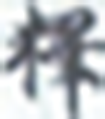 , a commonly seen Chinese demotic
character. In the Kōyōshō quotation seen above, the same character has
two different graphic forms. We do not know whether the original Shōtoku taishi
denryaku already had two different graphic forms or whether the scribe of the
Kōyōshō unintentionally wrote them that way. This is something we
need to examine further. From this book, however, we can gather that in the handwritten
manuscripts of Fujiwara Norinaga and others, it is common to see 釋 written as
尺.
17
We also
find that in the Hōyōshō there are two places in which we find 同經釋文云
written as 同經尺文云. The first one is adjacent to ‘Fahua yin xun 法华音训’ (sound gloss to the
Sad-dharma Puṇḍárīka Sūtra), and the latter one is adjacent to ‘Fahua yinyi 法华音义’
(Sounds and Glosses to the Sad-dharma Puṇḍárīka Sūtra). Therefore, we can see that the
two places refer to the ‘Fahua shiwen 法华释文’ (Annotations made to the Sad-dharma
Puṇḍárīka Sūtra). This was written by the Buddhist monk of the Hōsōsō School of Buddhism
by the name of Chūzan 仲算 (also written as 中算), who lived in the mid-Heian period.
However, not all the instances of 釋 are written as 尺 in the Hōyōshō.
There are also some cases in which 釋 is written as
, a commonly seen Chinese demotic
character. In the Kōyōshō quotation seen above, the same character has
two different graphic forms. We do not know whether the original Shōtoku taishi
denryaku already had two different graphic forms or whether the scribe of the
Kōyōshō unintentionally wrote them that way. This is something we
need to examine further. From this book, however, we can gather that in the handwritten
manuscripts of Fujiwara Norinaga and others, it is common to see 釋 written as
尺.
17
We also
find that in the Hōyōshō there are two places in which we find 同經釋文云
written as 同經尺文云. The first one is adjacent to ‘Fahua yin xun 法华音训’ (sound gloss to the
Sad-dharma Puṇḍárīka Sūtra), and the latter one is adjacent to ‘Fahua yinyi 法华音义’
(Sounds and Glosses to the Sad-dharma Puṇḍárīka Sūtra). Therefore, we can see that the
two places refer to the ‘Fahua shiwen 法华释文’ (Annotations made to the Sad-dharma
Puṇḍárīka Sūtra). This was written by the Buddhist monk of the Hōsōsō School of Buddhism
by the name of Chūzan 仲算 (also written as 中算), who lived in the mid-Heian period.
However, not all the instances of 釋 are written as 尺 in the Hōyōshō.
There are also some cases in which 釋 is written as 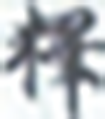 which
is a demotic character. Thus, the demotic characters 尺 and
which
is a demotic character. Thus, the demotic characters 尺 and 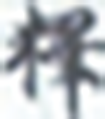 for 釋
are found in the ‘Shishō’. In addition to this, we also find that in the Mukyūkai
Library edition of Dai hannyakyō ongi, 注釋 is written as 注尺. The author
of the sounds and glosses to this work, which has many recensions, was most likely the
Buddhist monk named Jūyo of the late Heian period.
18
We have looked through the oldest
edition kept in the Mukyūkai Library, as well as the most complete edition kept in the
Tenri Library, and found that 注釋 were all written as 注尺.
19
The term 注釋 (commentary) is the most
frequently used expression in the sounds and meanings provided for the texts. It must,
therefore, have been quite clear to the writers, the scribes and the readers exactly
what this expression meant.
for 釋
are found in the ‘Shishō’. In addition to this, we also find that in the Mukyūkai
Library edition of Dai hannyakyō ongi, 注釋 is written as 注尺. The author
of the sounds and glosses to this work, which has many recensions, was most likely the
Buddhist monk named Jūyo of the late Heian period.
18
We have looked through the oldest
edition kept in the Mukyūkai Library, as well as the most complete edition kept in the
Tenri Library, and found that 注釋 were all written as 注尺.
19
The term 注釋 (commentary) is the most
frequently used expression in the sounds and meanings provided for the texts. It must,
therefore, have been quite clear to the writers, the scribes and the readers exactly
what this expression meant.
Although we have not yet found the earliest unambiguous example of 釋 written as 尺, it
is quite possible to date to around the time of ‘Shishō’, namely after the mid-Heian
period. We have also examined the variant graphs in the Shōsōin documents in the
Kanji hyakka daijiten in which 澤 is written as  , 譯 is
written as
, 譯 is
written as  , 驛 is written as
 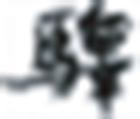 and 釋
is written as
and 釋
is written as  (Satō, 1996). However, we have not found any
example of 睪 substituted by 尺. It is certainly unwise to be absolutely certain about
this, but according to the current stage of our study, the time period in which these
variant graphs were made must be after the mid-Heian period.
(Satō, 1996). However, we have not found any
example of 睪 substituted by 尺. It is certainly unwise to be absolutely certain about
this, but according to the current stage of our study, the time period in which these
variant graphs were made must be after the mid-Heian period.
Such characters as 釋, 澤, 譯, 擇 and 驛 having changed from the 睪 to the 尺 series were initially regarded as ‘demotic characters’, ‘mistaken’ or ‘erroneous forms’. However, a series of the 尺 characters had already been incorporated in the standard characters in Japan.
This paper is presented as Part One. The next installment, Part Two, will begin with ‘Research materials for the Japanese demotic characters’.
Footnotes
Declaration of conflicting interests
The author declared no potential conflicts of interest with respect to the research, authorship and/or publication of this article.
Acknowledgment
Translated from Chinese by Takashima Kenichi.
There are both characters and words, mainly the former, and as one distinctive feature of the sounds and glosses of the Japanese Buddhist sutras is to collect difficult characters.
At the end of this edition, there is a time notation ‘Second year of Hōen’, which is the year 1136, at the end of Heian era.
Dai Hannyakyō Ongi (Vol. 1), known as the ‘Mukyūkai edition’, is kept in the Mukyūkai Library. This edition has many other editions, but it is regarded as having been hand-copied relatively early and is the finest edition of all. It is referred to as ‘Dai Hannyakyō Ongi of the Mukyūkai series’.
Evidential studies show that it is a manuscript belonging to the early Kamakura period (1185–1333).
It was written in the ninth year of Kōan (1286).
This definition, to which I agree, was first put forward by Chen Wuyun [陈五云], with whom I had an occasion to discuss this.
The term is seen in Zhongguo suwenzixue yanjiu daolun [中国俗文字学研究导论].
Arai Hakuseki (1657–1725) was a politician, poet and Confucian scholar of the early- to mid-Edo period, also an accomplished scholar of the Zhu Xi [朱熹] idealist Confucian school of history, geography, philology and literature.
Dazai Shundai (1680–1747) was a Confucian scholar of the mid-Edo period.
Kaibara Ekken (1630–1714) was a Confucian scholar, naturalist, educator and herbalist of the early Edo period.
Kondō Seigai (1723–1807) was a Confucian scholar in the middle and late stages of the Edo period.

The Japanese Government promulgated the tōyō kanji list in 1946; it consists of 1850 characters in total.
In 1981 the Japanese Ministry of Education added 196 characters to the tōyō kanji list and abolished the policy of simplifying and restricting the use of characters in tōyō kanjihyō.
These two old editions are believed to date to the late Heian period. The old edition kept in the Daigoji Temple has the date notation ‘First year of Hōgen’ (1156). The old edition kept in the Ishiyama-dera Temple does not record a date, but it is generally assumed to have been written in the fourth year of Kyūan (1148).
This was written by Fujiwara Kanesuke (877–933), a court poet of the mid-Heian period.
Fujiwara Norinaga is a well-known poet and a calligrapher of the late Heian period. In the field of studies of poetry and calligraphy of Heian Japan, it is considered that he obtained Ken’i’s handwritten manuscript of the Shishō and copied it.
The year of his birth and death are unknown.
The Mukyūkai Library edition does not record any date. However, according to the studies by Tsukishima Hiroshi and others, it should be an edition of the early Kamakura period. But the Tenri Library edition has the date ‘ninth year of Kōan’ (1286).