




Abstract
Xianluoguan Yiyu is a series of Siamese-Chinese vocabularies compiled by the Ming and Qing government for translation or interpretation teachings. In choosing transcription characters, the compilers emphasized the agreement on initials and main vowels more than distinctions between voiced and unvoiced consonants. Various manuscripts reflect some phonetic characteristics in different periods during two centuries, in which it is proved that the sound changes of ʔb- > b- > m- and ʔd- > d- > l- were completed no later than the later period of the 17th century.
Introduction
In order to promote the communication and deepen the mutual understanding between the Central Kingdom and non-Chinese regimes around, the Chinese government of the Ming dynasty instituted the Office of Interpreters (Siyiguan 四夷馆) in the year 1382, which was affiliated to the National Academy (Hanlinyuan 翰林院), and its staff were selected from the Imperial College (Guozijian 国子监) by the Ministry of Rites. 1 The Department of Siam was an additional institution established within the Office in 1579, which had been working until a certain Qianlong reign year after 1748 when it was consolidated into the Office of Translators (Siyiguan 四译馆) (Chun et al., 2018). Various Siamese-Chinese vocabularies were compiled during more than two centuries, in which there are three manuscripts published from the 1970s, as follows:
manuscript A (hereafter MA), the China National Library collection (Figure 1); 2
Manuscript A.

manuscript B (hereafter MB), Inaba Kunzan collection (Figure 2); 3
Manuscript B.
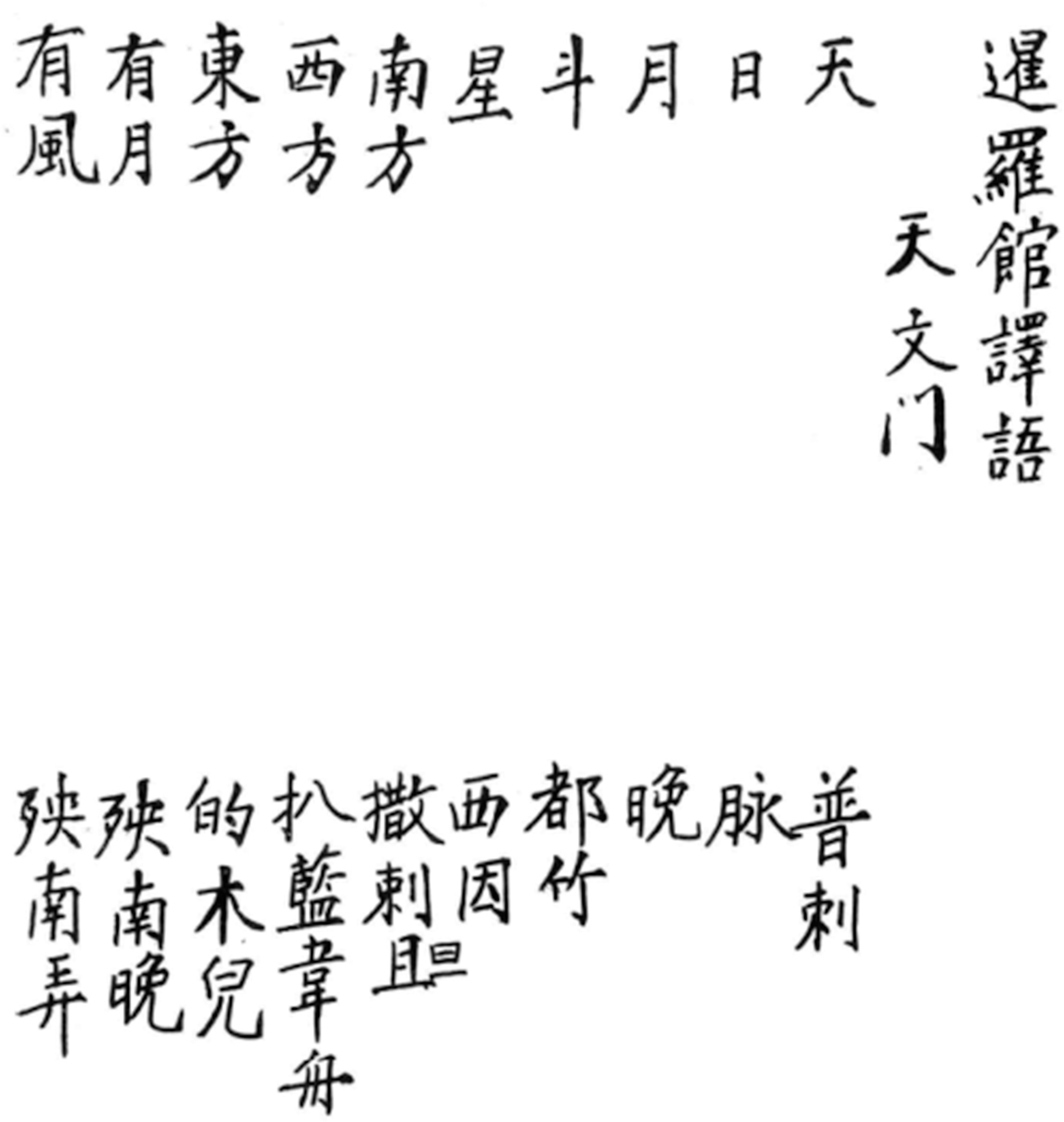
manuscript C (hereafter MC), the Palace Museum collection (Figure 3). 4
Manuscript C.
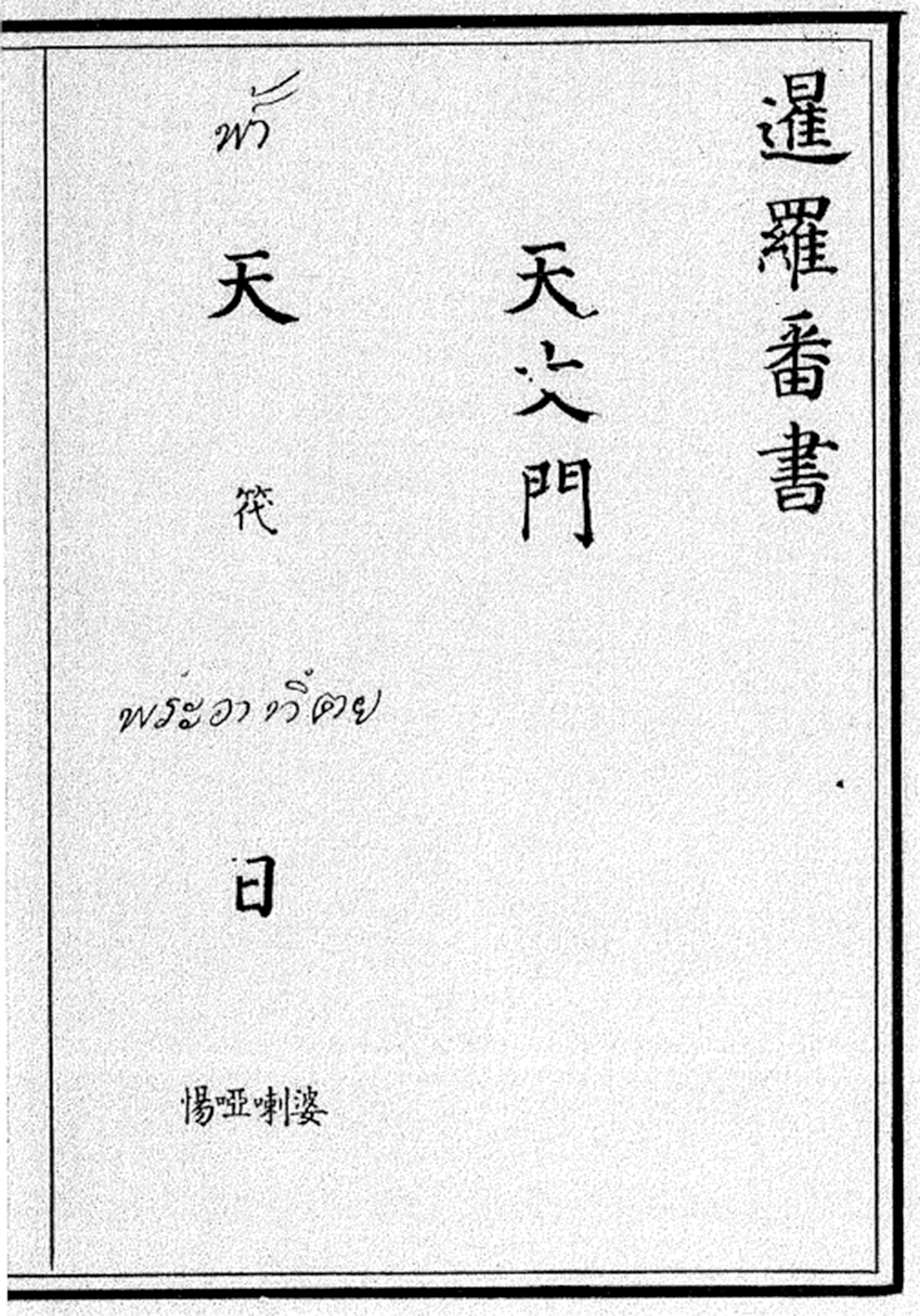
In contrast with MB, used for oral interpretation without Siamese scripts, MA and MC, being coincident with each other in compilation style, are more precise in detail in order to serve as literal translations, 5 except that the Chinese transcriptions in MA are read from left to right, while those in MC are read from right to left.
Comparing different manuscripts may show us their differences and similarities in compilation style. The present article intends to collate the entries in its first three sections of astronomy, geography and chronometry of various manuscripts and to discuss some problems in Siamese-Chinese transcription.
Chinese transcription concerning consonantal clusters of type CL-/cC
There are various consonantal clusters in Kam-Tai languages, that is, double consonants consist of aspirated or unaspirated stops as the first consonant and l-, r-, w- as the second one. Considering consonantal clusters in Siamese are the most abundant, Li (1977) divided those in Tai languages into three categories: nasal, alveolar and velar, and accordingly we narrate the consonants in three parts.
Consonantal clusters prefixed by stops
Because Chinese characters are monosyllabic without consonantal clusters, the compilers had to transcribe a Siamese consonantal cluster by two characters, in which the first one represents the prefix and the second one represents the main syllable (second consonantal + final). Such combinations are proved by Chinese translation history to be the closest to the originals in auditory sensation.
The examples in the Table 1 are those syllables with consonant clusters pl- and bl- in the Siamese language. The Siamese scripts and Chinese transcriptions in the entry “earth” of the three manuscripts are divergent, but all of their lexical meanings are connected to “earth”. The bra in MA is one of the prefixes to indicate the term of Siamese Royalty, which is omitted in MB in order to present common speech. According to contemporary Thai language, *din (earth) is a synonym for da la nii and tha ra ṇii in MA and MC, respectively. Because the compiling date and aim of the manuscripts were quite different, and also because most of the Siamese envoys who entered China could not speak Chinese, these facts resulted in different translations by cognitive biases and semantic divergences of speech among the manuscripts.
Consonantal clusters prefixed by velars
The examples in the Table 2 are those syllables with consonant clusters kl- and gl- in the Siamese language. In the following examples, only the entries for ɡlɔɔʔd 6 (arise) are identical for both MA and MC, but their Chinese transcriptions seem to show a certain difference by characters lü 律 and le 乐, in which the divergence between vowels is ignored.
Consonantal clusters prefixed by alveolars
In contemporary Thai language, the initial clusters sr- and dr- are both pronounced s-. The fact that dra (dawn) in the following examples is transcribed into tuola 驼喇 shows that dr- was pronounced dr- or thr- at that time, not s- as in contemporary Thai. That the Siamese word for “pond” is transcribed into suola 梭喇 in MA but into sa 洒 in MC shows that ancient sr- was already pronounced s- as in contemporary Thai. Actually, sa is not a word meaning “pond” by itself. The transcriber might omit -r- in accordance with oral Thai reading rather than write sra correctly as in MA.
In addition, what needs to be explained is that medial -l- and -r- are identical in their calligraphic forms in MA, and it must be decided by experience whether -l- or -r- ought to be chosen in transliteration. These two letters are differentiated clearly in MC, but because there is not a consonant r- in Chinese, the transcriber had to follow the ancient tradition of Chinese Buddhist transcribing, that is, to use l- for both l- and r-.
Consonantal clusters of the type cC-
The examples in the Table 3 are those syllables with consonant clusters tr-, dr- ,and sr- in the Siamese language. In the Siamese script shown in Table 4, the function of the consonantal prefix s- put ahead of the syllable waaŋ is to mark the transformation of its tone, which reads sa in actual spelling. The transcriber treated such consonants as two syllables and transcribed them into two characters, that is, suowang 梭望 for swaaŋ. The word for “sunny” is pfon haaj, in which the first syllable means “rain” and the second syllable means “disappear”. The whole compound word meant “the rain stops” originally, and is extended in the meaning “sunny”.
Examples of Siamese-Chinese transcription (PL-).
Examples of Siamese-Chinese transcription (KL-).
Examples of Siamese-Chinese transcription (TL-).
Examples of Siamese-Chinese transcription (cC-).
The exmaples in the Table 4 are those syllables with pre-initial consonant g- and s- in the Siamese language. Li (1977) described the consonants *kw-, *khw- and *gw- as velars with the labial rounded. In the evolution to the Modern Tai dialects, both the elements of velars and labial rounding may coexist, or one of them may be lost. The consonant *gw- generally read khw- or kw- in all Tai dialects including Thai, but its evolution dates have not been clear so far. The Chinese transcription divergence of “smoke”, kewan 可晚 in MA but kuan 宽 in MC, shows that the pronunciation of gwan (smoke) is the same as that in contemporary Tai language.
Chinese transcription of implosives
The examples in the Table 5 are those syllables with ʔconsonant initial ?b- in the Siamese language. The consonantal clusters prefixed by a glottal stop ʔd or ʔb in Siamese script read actually as implosive ɓ and ɗ. The present paper follows the general standard of transliterating Thai script, marking them as ʔd and ʔb.
There are two common laws of sound change in Kam-Tai languages (Zeng, 2014), that is, ʔb- > b- > m-/v- (singular tones) and ʔd- > d- > n-/l- (singular tones). Qin (2005) believed that ʔd and ʔb might be reconstructed as *ʔbv- and *ʔdr- anciently. Hechi Zhuang dialect in Guangxi Province preserves a labialization form ʔbv-, for example, ʔbva4 (muddy water outflows the fields); the Shijia language of the Northern Tai Branch preserves a traau1 (star) with a devoiced initial, which is cognate with the synonym ʔdaau1 in the Mashan Zhuang dialect in Guangxi Province. These two laws of sound change evolved inconsistently in various languages of the Kam-Tai Branch and its process is reflected factually in MA and MC.
A Chinese transcription character with initial l- in the entry “thin” of MC proves that Siamese was in the process of ʔb- > b- in MA (1579), while the process of ʔb- > b- > m-/v- was completed in MC (1748). The latter sound change was already completed in Mangshi Dai dialect at the end of Ming times (Zeng, 2014).
The examples in Table 6 are those syllables with consonant initial ?d- in the Siamese language. In MA, Siamese initial ʔd- is occasionally transcribed into Chinese d- as bvaa ʔdɛɛŋ (glow) into fading 筏顶 and ʔdɛɛn kan (bound) into diangan 典赶, but in most cases it is transcribed into Chinese l- as ʔdaaw kai (eastern constellations) into laotai老台 and taat ʔdɛʔd (sunshine) into dale 打勒. Statistics concerning Siamese initial ʔd- in MA shows that there are 20 per cent of examples corresponding to Chinese d-, while 80 per cent of examples correspond to Chinese l-. The evolution from ʔd- to l- was completed before the compilation of MC, where all Siamese syllables with initial ʔd- are transcribed into Chinese l-.
Chinese transcription of consonantal finals
A complete set of final stops are preserved in Siamese but are entirely lost in Mandarin. The Chinese compilers intended to add a vowel to the final stop or delete the stop directly.
The examples in Table 7 are those syllables with coda -b, -d, and -k in the Siamese language. It is shown in the above examples that most Siamese final stops are ignored in both manuscripts, except occasionally being marked by bu 布 for -ʔb in MC.
Nasal finals -n and -ŋ in ancient Chinese are well preserved in Mandarin but -m changed into -n, so the compilers had to borrow -n or -ŋ in their own language for transcribing Siamese -m, or even add a character with initial m- to indicate the labial final.
The examples in Table 8 are those syllables with coda -m in the Siamese language. It is evident in the above examples that MA tends to use Chinese characters with final -n to transcribe Siamese syllables with -m, while MC tends to use a special mu 姆 to indicate -m by its initial m-. There is a specific phenomenon that needs to be explained in that the transcriptions in MA are unidentical concerning Siamese -om, that is, zhen 枕 for com but dong 董 for tom, which was caused by the fact that there is not a rhyme -om in Chinese, so the compiler had to substitute it with -oŋ and transcribe the word tom “gather” into dong 董, but when -m is followed by a dental sound as com loŋ (sink), it might be read as -n through regressive assimilation and be transcribed by zhen 枕.
Conclusion
The fact that the phonological systems of two languages are not identical causes certain difficulties in Siamese-Chinese transcription. In choosing the transcription characters, there is a principle being carried out from MA to MC, that is, the Siamese-Chinese agreement on initials and main vowels is the chief factor to be considered, while the distinction of voiced or unvoiced consonants is the secondary factor. When there are no precise Chinese equivalents available, the chief principle to choose transcription characters is to follow the pronunciation of the initial or main vowel as closely as possible.
The linguistic volume of MC is reflected in the transcription characters on Siamese implosives, which proves that the sound change of ʔb- > b- > m- (singular tones) and ʔd- > d- > l- (singular tones) was completed no later than the later period of the 17th century.
Examples of Siamese-Chinese transcription of initial ʔb-.
Examples of Siamese-Chinese transcription of initial ʔd-.
Examples of Siamese-Chinese transcription of final stops.
Examples of Siamese-Chinese transcription of final -m.
Footnotes
Acknowledgement
I would like to express my special thanks to Dr Han Mengru for her useful suggestions and editorial assistance.
Declaration of conflicting interests
The authors declared no potential conflicts of interest with respect to the research, authorship and/or publication of this article.
See Wang Zongzai 王宗载’s Siyiguan Kao 四夷馆考 (Collection of the École française d’Extrême-Orient) for its history in the early period.

Gugong (2018). This manuscript, titled Xianluo Fanshu 暹罗番书 (Siamese Scripts), proves to be a transcript by the Military Bureau, in the format of thread-banding 25.7 × 17.5 cm, double edged border 21.5 × 15.5 cm and blank type page without folding marks (Chun et al., 2018).
No matter how serious the compilers were, a few scribble confusions still exist there. Taking the entry “drip”, for example, its Siamese form is jaʔd but the relevant Chinese transcription is ya 押 in MC and ye 拽 in MA. The vowel divergence indicates that the ye might have been a scribble confusion of ya.
.The first two numbers (01, 02, 03) mark the chapter “astronomy”, “geography” and “chronometry” respectively. The last three mark the numerical order of the entry in the chapter. For example, “MA 01039” indicates the 39th entry in chapter “astronomy”.
Siamese script manifests that it is a word consisting of three syllables, but the Chinese compiler used four characters in transcription. Considering the Chinese transcriptions tuo 拖 and tuo 脱 are homophones for Siamese tha, we may assume that one of the characters might be a redundancy caused by clerical error.
The Siamese letter ʔd indicates a -t when it is used as a final consonant.