



Abstract
Numerous characters that are presumably the names of rituals in the Shang dynasty’s oracle-bone inscriptions were also discovered in the bronze inscriptions of Western Zhou. It is likely that the names of the rituals and their script, along with their method of practice, had been passed from the Shang to the Zhou. However, despite sharing the same name, there are differences between the Shang and the Zhou’s rituals. For example, in the Shang period, Liao (燎) is conducted as part of a ritual praying for crops or rain, or for before or after hunting expeditions and patrols. In the Western Zhou period, however, they developed the latter method into a ritual to be performed before and after a conquest. Similarly, Di (禘) is a ritual concerning ancestral spirits and other various divine spirits, which was written as 帝 during the Shang period; during the Western Zhou period, the ritual was written as 啻 and transformed into a ritual concerning descendants of a direct bloodline. This study will discuss the script related to the rituals, Liao (燎) and Di (禘), that were passed down from the Shang to the Zhou and elucidates on the aspects of culture and systems inherited by the Zhou along with what these characters represent.
Introduction
The bronze inscriptions from Western Zhou illustrate the Zhou king and his vassals performing various rituals, such as Liao (燎), Di (禘), Dao (𠦪), and You ( ). Liu Yu (2008) remarked that similar rituals were also discovered in the Shang dynasty’s oracle-bone inscriptions as the Zhou people inherited them from the Shang. In other words, the Zhou people had adopted the rituals, their names, and their written expression from the Shang people. However, while the Shang and the Zhou share rituals with the same name and the same written expression, there are differences between their objectives for such rituals and the conditions under which they are performed. This study focuses on two rituals, Liao (燎) and Di (禘), to verify this matter, and considers the transmission of the characters from the Shang to the Zhou and their relation to the culture and systems these characters represent.
Further, this study will reference this author’s research concerning each of the rituals mentioned below and examine the changes that occurred between the Shang and the Zhou (Sato, 2014, 2018). Furthermore, for argument’s sake, in each case, I will first verify the Zhou’s methods as the recipient of each of the characters and ritual techniques and then investigate and verify the Shang’s methods.
The character Liao (燎)
The Zhou’s Liao (燎)
As Xu Zhongshu (1988: 1110) points out, the character Liao (燎) is a depiction of wood and brushwood piled on to one another in a crisscross manner, and the dots added to the sides show the flames rising, while the parts that follow the shape for fire (火) indicate a burnt offering using compound ideograms (see Figures 1 and 2).
In Shuowen Jiezi (说文解字, Explaining Graphs and Analyzing Characters; Xu and Duan, 1981), the first volume of chapter 10, in the section of fire (火), it is written: “𤊽, 祡祭天也。” (Liao (𤊽(尞,燎)) means to dedicate to heaven (天) by a burnt offering), and in Zhouli (周礼, Rites of Zhou), offices of spring (春官), Dazongbo (大宗伯), it is written: “以槱燎祀司中、司命、飌師、雨師。” (By the burnt offering (槱燎), we dedicate the star of Sizhong (司中), the star of Siming (司命), the god of the wind, and the god of the rain) (Editorial committee of Annotated Thirteen Classics, 2000: 530). Liao (燎) generally means to dedicate to heaven (天) or nature gods through a burnt offering. However, the bronze inscriptions of Western Zhou reveal a different property of Liao (燎).

Liao (燎) in oracle-bone inscriptions (Liu and Feng, 2019: 131).

Liao (燎) in bronze inscriptions from Western Zhou (Zhang, 2018: 563).
Xiao Yu Din (小盂鼎) (Chinese Academy of Social Sciences Archaeology Institute, 2007; hereafter JC: 2839) 隹八月既望, 辰才(在)甲申。昧喪(爽), 三左三右多君, 入服酉(酒) 明, 王各(格)周庙。□□□□宾。𢓊 (延)邦宾 (It was the day of Jiashen (甲申) past the full moon of the eighth lunar month, the officials and lords of small states had entered before dawn and began drinking. At dawn, the King arrived at the Zhou temple (周庙)……The guests of honor removed their traveling attires and took their seats facing East. Yu (盂), hosting the enemy’s flag, the … of Gui state(鬼方) entered the third gate. Yu (盂) said, “The King had ordered me, Yu (盂), to lead the…… in a conquest to conquer Gui state (鬼方) … we captured three [tribal chiefs of the enemies], won 4802 enemy heads, captured 13,081 prisoners-of-war, … horses, 30 chariots, 355 oxen, and 38 sheep.” Yu (盂) continued and said, “……rewarded my achievements on the battlefield. The achievements were one of the enemy chiefs, 237 enemy heads, … prisoners-of-war, 104 horses, and one hundred and……chariots.” … The King called the lord of Fei
(费伯) over to order Yu (盂) to instruct him to bring in the prisoners along with the enemy heads through the gate, had them offered in a small room on the west side of the palace. …entered and performed Liao (燎) at the Zhou [Temple](周[庙]).…) 其旅服, 東乡(向) 盂以多旂佩, 鬼方子□□入三門。告曰:“王[令(命)]盂, 以□□伐鬼方, □□馘□, [执嘼(酋)]三人, 隻(获)馘四千八百又二馘, 孚(俘)人万三千八十一人, 孚(俘)马□□匹, 孚(俘)车卅两, 孚(俘)牛三百五十五牛, 羊卅八羊。”盂或告曰:“□□□□, 乎(呼)&(蔑)我征, 执嘼(酋)一人, 孚(俘)馘二百卅又七馘, 孚(俘)人□□人, 孚(俘)马百四匹, 孚(俘)车百□两。”……王乎(呼)费白(伯)令(命)盂以人馘入門, 献西旅,
□□入燎周[庙]。……
其旅服, 東乡(向) 盂以多旂佩, 鬼方子□□入三門。告曰:“王[令(命)]盂, 以□□伐鬼方, □□馘□, [执嘼(酋)]三人, 隻(获)馘四千八百又二馘, 孚(俘)人万三千八十一人, 孚(俘)马□□匹, 孚(俘)车卅两, 孚(俘)牛三百五十五牛, 羊卅八羊。”盂或告曰:“□□□□, 乎(呼)&(蔑)我征, 执嘼(酋)一人, 孚(俘)馘二百卅又七馘, 孚(俘)人□□人, 孚(俘)马百四匹, 孚(俘)车百□两。”……王乎(呼)费白(伯)令(命)盂以人馘入門, 献西旅,
□□入燎周[庙]。……
Guobo 隹王伐逨鱼, (The King conquered Laiyu (逨鱼), then conquered Chaohei (潮黑) and arrived at Zongzhou (宗周). The King performed Liao
(燎) at Zongzhou (宗周). Ten sets of cowries were given to the lord of Guo (郭伯)  Gui (郭伯
 簋) (JC: 4169)
 (延)伐&(潮)黑, 至。燎于宗周。易(赐)
  (郭)白(伯)
 貝十朋。……
 . …)
. …)
Baoyuan Gui (保员簋) (Wu, 2012; hereafter MT 5202) 隹王既燎, 厥伐东尸(夷)。才十又一月。公反(返) 自周。己卯, 公才(在) (After the King finished performing Liao (燎), the Duke conquered Eastern savage (东夷). It was the 11th lunar month. The Duke returned from Zhou (周). On the day of Jimao (己卯), the Duke was in  。 保员邐(列)。屖(辟)公易(赐)保员金车, 曰:“用事。“……
 . Baoyuan (保员) attended. The Duke gave a bronze carriage to Baoyuan (保员) and said, “With this, you shall serve me.”)
Xiao Yu Din (小盂鼎) has several missing characters. However, it describes that Yu (盂), the vessel owner, reported to the King at the Zhou temple (周庙) after conquering Gui state (鬼方), the number of enemy heads they decapitated, and the number of prisoners they had taken in and offered at the Zhou temple (周庙), and that they had performed the Liao
(燎) rituals. In other words, the Liao (燎) is performed as part of the dedication ritual. Guobo 维四月既旁生魄, 越六日庚戌, 武王朝至燎于周庙。……武王在祀, 大师负商王纣悬首白旂, 妻二首赤斾, 乃以先馘入, 燎于周庙。 (Huang et al., 2007: 436, 440) (Early April, on the sixth, on the day of the Gengxu (庚戌), King Wu (武王) arrived early morning at the Zhou temple (周庙) and performed Liao (燎)….When King Wu (武王) was going to perform the rituals, before the other enemy heads were being dedicated, the Master (大师) had already entered the Zhou temple (周庙), carried Zhou (纣) the Shang King’s head hanged in a white flag while carrying on his back the heads of Zhou (纣)’s two wives hanged in a red flag and had performed Liao (燎).) Gui (郭伯
 簋) is also an example of Liao (燎) being performed after a conquest, and the dedication ritual is represented with the character燎. Baoyuan Gui (保员簋), on the other hand, depicts that the Liao (燎) was performed before the conquest. Thus, the Liao
(燎) ceremony is likely a ritual wherein the Zhou had prayed to their ancestral spirits for victory in their conquests and a ritual where their gains were dedicated to and their ancestral spirits, who were for their protection.
簋) is also an example of Liao (燎) being performed after a conquest, and the dedication ritual is represented with the character燎. Baoyuan Gui (保员簋), on the other hand, depicts that the Liao (燎) was performed before the conquest. Thus, the Liao
(燎) ceremony is likely a ritual wherein the Zhou had prayed to their ancestral spirits for victory in their conquests and a ritual where their gains were dedicated to and their ancestral spirits, who were for their protection.
The traditional literature also show similar scenarios. In the above Yi Zhou Shu (逸周书, Leftover Zhou Writings), the chapter of Shifu (世俘篇), it shows that after the Zhou destroyed the Shang, King Wu(武王) takes the head of King Zhou (纣王, the last King of the Shang) along with the two head of his wives and have them dedicated at the Zhou temple (周庙). In this dedication, the Liao (燎) rituals are performed after a conquest.
While, although it is not found in the records of the Western Zhou period, Liao (燎) was also performed to worship the gods of heaven (天) and nature gods, and it may have been the basis for descriptions in later literature, such as Shuowen Jiezi (说文解字) and Zhouli (周礼).
The Shang’s Liao (燎)
Then, we investigate whether the oracle-bone inscriptions from the Shang dynasty also show a connection between Liao (燎) and their conquests.
Guo (1977–1982). Hereafter HJ 385 贞: 𠦪(祷) 年于岳, 燎三小 (Ask: Should there be a burnt offering (Liao 燎) of three sets of sacrificial lambs and cleave three oxen to pray (Dao 𠦪) to the god of the mountains for a fruitful harvest of grains?) , 卯三牛。 (Ji, 1991)
HJ 12853 壬午卜, 于河𠦪(祷) 雨, 燎。 (The divination on the day of Renwu (壬午): when prayers (Dao 𠦪) are offered to the god of the Yellow River for rain, should Liao (燎) be performed?)
The Liao (燎), as seen in the Shang dynasty’s oracle-bone inscriptions, as in the examples quoted above, tend to be part of the ritual when praying for a fruitful harvest of grains or rain. Liu Yuan (2004a) perceives Dao (𠦪) as a verb that describes the purpose of the ritual and Liao (燎) as a ritual verb that explains the content of the ritual ceremony. These often target nature gods such as the god of the Yellow River (河) and the god of the mountains (岳), and may have been the source of the Zhou dynasty’s Liao (燎) to dedicate to heaven (天) and the nature gods.
HJ 34185 己亥卜, 田率, 燎土豕, 兇豕, 河, 豕, 岳[豕]。 (The divination on the day of Jihai (己亥): to hunt(田) in the land of Lu (率), there should be a burnt offering (Liao 燎) of a pig to the god of the land, a pig to 兇, a pig to the god of the Yellow River, and a [pig] to the god of the mountains.)
Chinese Academy of Social Sciences Archaeology Institute (1980–1983) Hereafter TN 658 其先燎, 逎省[鼓]。 (Should Liao (燎) be performed first, and then go patrolling [the land of the Gu (鼓)]?) HJ 22293
甲子卜, 燎禽羊。 (The divination on the day of the Jiazi (甲子): should we perform Liao (燎) on the captured sheep as an offering?)
However, as in the three examples above, there are cases where Liao (燎) is performed before hunting (田) or patrolling (省). The example of HJ 22293 is a burnt offering (Liao 燎) of a sheep caught during hunting; perhaps as horses, oxen, and sheep were obtained through fighting the Gui state(鬼方) in Xiao Yu Din, the sheep may have been obtained through war. These are examples of performing Liao (燎) as part of the ritual to pray for a successful hunt or patrol, or to express their gratitude when they returned successful. Several researchers have remarked that in ancient times, hunting and patrolling had an indivisible relation to that of a conquest, 1 and this indicates that they had performed Liao (燎) before and after their conquests. It may have been derived from Liao (燎) as part of a ritual to pray for rain and the harvest of grain.
There are also example usages of the character Liao (燎) at the end of the Shang and early Zhou in oracle-bone inscriptions from Zhouyuan (周原).
H11: 4 (Cao, 2002: 4)
2
……其微楚。/厥燎, 师氏舟燎。 (To perform Liao (燎), should the master officer (师氏) perform Liao (燎) in the boat?)
The master officer (师氏) may be an official position in military affairs, and since he performs the Liao (燎), it may relate to a conquest, but there is no clear evidence.
Thus, we can see that the Zhou dynasty inherited the name and the character of Liao (燎) from the Shang dynasty, but did not faithfully inherit the method. In particular, they developed the need to be performed before and after hunting and patrolling, and made it the main ritual to be performed before and after conquest.
The character Di (禘)
The Zhou’s Di (啻)
The character that indicates Di (禘) differs between the Shang and the Zhou. The Zhou use the character 啻, while the Shang use the character 帝, as shown in the next section (see Figures 3 and 4). As to the origin of the character 帝, Xu (1988: 23) claims it is an ideogram that means to pile or bundle wood and to burn offerings during rituals, and the reason one or two horizontal lines are included above is to indicate the worshiping of heaven. Thus, just as with Liao (燎), this means the character represents a burnt offering.
Some usages of Di (啻) in bronze inscriptions from Western Zhou are as follows.
Xiao Yu Din (小盂鼎) (JC 2839) ……□□大釆, 三周入服酉(酒)。王各(格)庙, 祝𢓊(延)。□□□□□邦宾, 不(丕) 祼, □□用牲啻(禘) 周王、[武] 王、成王。…… Di (帝) in oracle-bone inscriptions (Liu and Feng, 2019: 42). Di (啻) in bronze inscriptions from Western Zhou (Zhang, 2018: 11). (…In the morning, three individuals entered and began to drink. The King arrives at the temple, and the priest assists. … The honored guests perform the ceremony of drinking, … offered a sacrifice and performed Di (禘) for the spirits of King Wen (文王), King [Wu] ([武]王), and King Cheng (成王). …)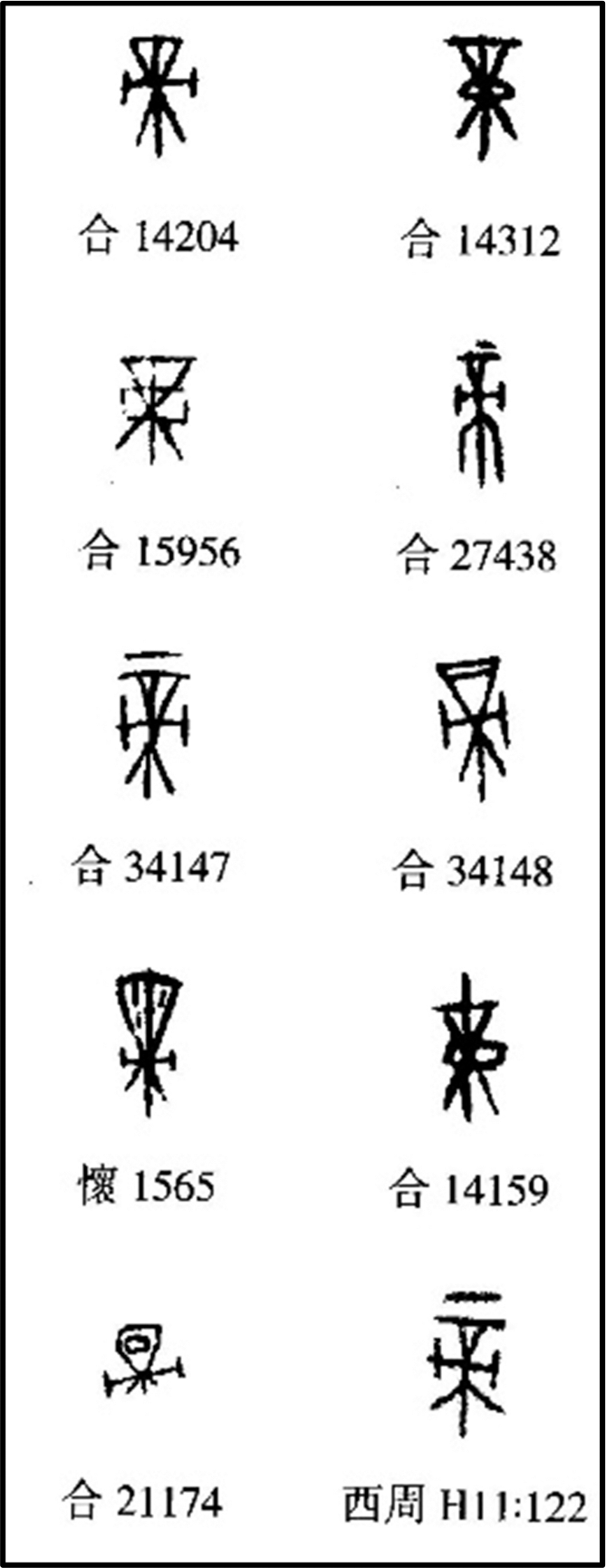

La Ding (剌鼎) (JC 2776) 唯五月, 王才(在) [初], 辰才(在)丁卯, 王啻(禘)。用牡于大室, 啻(禘) 卲(昭) 王, 剌御。王易(赐)剌贝卅朋。 …… (On the fifth lunar month, the King resided in [the land of Chu (初)], and on the day of Dingmao (丁卯), performed Di (禘). At the hall, to perform the Di (禘) for the spirit of King Zhao (昭王), a bull was used for the ritual sacrifice to which La (剌) attended. The King gifted 30 sets of cowrie to La (剌). …)
Xian Gui (鲜簋) (JC 10166) 隹卅又四祀, 隹五月既望戊午, 王才(在) (In year 34, on the day of the Wuwu (戊午) after the full moon on the fifth lunar month, the King resided in Pang Capital ( 京, 啻(禘) 于
 (昭) 王。鲜𥣫(蔑) (历), 祼。王
 (璋)、祼、玉三品、贝廿朋。 ……
 京) and performed Di (禘) for the spirit of King Zhao (昭王). Xian (鲜) was rewarded and was bestowed drink. The King [bestowed] the Zhang (璋), the vessel to be used in Guan (祼) ceremonies, three sets of Jade utensils, and a set of 20 cowries. …)
Fan You (繁卣) (JC 5430) 唯九月初吉癸丑, 公 (On the day of Guichou (癸丑) in the beginning of the ninth lunar month, the Duke performed You rituals ( 祀。雩旬又一日辛亥, 公啻(禘)
  辛公祀。卒事, 亡敃公&(蔑) 緐(繁) &(历), 易(赐) 宗彝一肆、车马两。
3
……
辛公祀。卒事, 亡敃公&(蔑) 緐(繁) &(历), 易(赐) 宗彝一肆、车马两。
3
…… 祀). Eleven days after (the previous offering),
4
on the day of Xinhai (辛亥), the Duke performed Di (禘) and You rituals (
祀). Eleven days after (the previous offering),
4
on the day of Xinhai (辛亥), the Duke performed Di (禘) and You rituals ( 祀) for the spirit of Duke Xin (辛公). The rituals were completed without facing any troubles. The Duke praised Fan (繁) and gifted a set of bronze vessels used in rituals at the ancestral shrine, a carriage, and two horses. …)
Da Gui (大簋)(JC 4165) 唯六月初吉丁巳, 王才(在) 奠(郑), &(蔑)大&(历), 易(赐) (On the day of Dingsi (丁巳) in the beginning of the sixth lunar month, the King was residing in Zheng (郑). The King praised Da (大) and presented him with a grain-fed red bull, saying, “Use this to perform the Di (禘) for your father’s spirit.” …) (骍)
(骍)  (犅), 曰:“用啻(禘) 于乃考”……
Boyou Gui (伯斿簋) (Wu, 2016; hereafter MX 436) 唯二月初吉丁卯, 王易(赐)白(伯)斿牲五, 啻(禘)唯用奠。…… (On the day of Dingmao (丁卯) in the beginning of the second lunar month, the King bestowed Boyou (伯斿), a set of five sacrificial animals, and Boyou (伯斿) used them when performing Di (禘). …)
Out of these, Xiao Yu Din (小盂鼎) is the latter half of the previously quoted sentences. Xiao Yu Din (小盂鼎), La Ding (剌鼎), and Xian Gui (鲜簋) are Di (啻) performed for the Kings of Zhou. Fan You (繁卣), Da Gui (大簋), and Boyou Gui (伯斿簋) were Di (啻) performed for the ancestors of the King’s vassals. Except for Boyou Gui (伯斿簋), which does not state for whom the ritual is being performed, they are all rituals relating to the ancestral spirits. Besides Boyou Gui (伯斿簋), Xiao Yu Din (小盂鼎) is a combined ceremony that worships multiple ancestral spirits. On the other hand, all others are dedicated ceremonies that worship a single ancestral spirit. Furthermore, Xiao Yu Din (小盂鼎), La Ding (剌鼎), Da Gui (大簋), and Boyou Gui (伯斿簋) use sacrifices during Di (啻).
Shirakawa Shizuka (2002: Vol. 1, Part 1, 53 and Vol. 2 Part 2, 147) states that the character 啻 is the first form of 啇 (適, 嫡), and in Western Zhou, Di (啻) was the name of a ritual performed for direct ancestors. The evidences for this are Dikao (啻考) and Dikao (帝考), found on bronze inscriptions such as Yongshu Mai Gui (勇叔买簋) (JC 4129). Qiu Xigui (2012: 123) states that the characters 嫡 and 適 both follow the pronunciation of Di (啻), and the pronunciation of Di (啻) is the same as the pronunciation of Di (帝), thus they should be read as Dikao (嫡考). Also, one can see in Dizong (啻宗) in Jinbo You (晋伯卣) (MT 13279) and Dijun (啻君) (prince) on Huyingji Ding (胡应姬鼎) (MX 221), that they both can also be read as Dizong (嫡宗) (the head family of a clan) and Dijun (嫡君) (patriarch). Further, considering these examples as a reference, there will be no contradiction in considering Di (啻) to be a ritual for the direct bloodline.
The Shang’s Di (帝)
Then, we investigated whether the Shang dynasty’s Di (禘) can be seen as a ritual for the direct bloodline. As stated above in oracle-bone inscriptions, the character 禘 is written as 帝.
HJ 3506 帝(禘) 黄奭, 三犬。 (To perform Di (禘) for Huangshi (黄奭), should three dogs be used as a sacrifice?)
HJ 12855/Chinese Academy of Social Sciences, History Institute (1999); hereafter HB 3487 □午卜, 方帝(禘) 三豕㞢(侑) 犬, 卯于土牢, 𠦪(祷) 雨 二月。 (For the divination on the day of …wu (□午), should Di (禘) be performed for the gods of direction by offering three pigs, offer a dog, cleave a set of sacrificial oxen to the god of the land, and ask for rain? Second lunar month.) HJ 32063
乙酉卜, 帝(禘) 伐自上甲。 (For the divination on the day of Yiyou (乙酉), in offering a sacrifice through Di (禘) and Fa (伐), should we start from Shangjia (上甲)?)
The unique characteristics of Di (帝) as seen in the oracle-bone inscriptions is explained well by Dong Lianchi (1994). Firstly, the target of the rituals through Di (帝) is divided into four types: King’s forefathers (先公先王), deceased vassals, the gods of direction, and other various gods. Included in the King’s forefathers are Wanghai (王亥), Xiayi (下乙), (Zuyi (祖乙), and Shangjia (上甲). As for deceased vassals, as quoted from HJ 3506, Huangshi (黄奭), Huangyin (黄尹), or his spouse are included. For the gods of direction, East, West, South, North, and as seen among those in HJ 12855/HB 3487, Fang (方) and the Queen mother of the West (西母) are included. As for other gods, the god of the Yellow River and others are included. In addition, besides making offerings and performing ceremonies to Di (帝) for a single deity, there are also combined ceremonies where multiple deities are worshiped together, as seen in HJ 32063. As seen in HJ 3506, 12855, and HB 3487, some of them include sacrifices.
Both the Shang’s Di (帝) and the Zhou’s Di (啻) can be performed for a single deity or can be performed for multiple deities, and both can include sacrifices. However, in the case of the Shang’s Di (帝), the target of the ritual is not limited to the direct ancestors and ancestral spirits, including deceased vassals, the gods of direction, a god of nature, such as the god of the Yellow River, and so on. It is significantly different from that of the Zhou.
Furthermore, Liu Yuan (2004b: 70–71) stated that, just as in Liao (燎), Di (帝) is not something that is performed on its own, as seen in HJ 12855 and HB 3487; rather, it is a method of sacrificial offering and is a part of a ritual that prays for rain or a fruitful harvest of their crops. More specifically, it indicates burning the sacrifice over wood.
Concerning Di (禘), Liu Yu (2008: 29) points out that the Zhou people inherited the Di (帝) rituals of the Shang people and remodeled them into the Zhou people’s most important rituals to pray to ancestors. However, the Zhou did not simply inherit the Shang’s Di (帝) without any alterations. They changed the Shang’s method of sacrificial offerings called Di (帝) into a ritual for direct ancestors, and changed the character from 帝 to 啻.
Conclusion
This study focused on the characters Liao (燎) and Di (禘) from Shang dynasty oracle-bone inscriptions and the bronze inscriptions of Western Zhou. The transmission of characters from the Shang to the Zhou and its relation to the culture and systems that those characters represent were explored with a specific focus on the methods of the rituals that were performed. In the case of Liao (燎), the Zhou developed and inherited the use of rituals that are performed before and after military-related activities, such as hunting and patrolling. In the case of Di (禘), while the Shang’s Di (帝) included other deities and did not make the ancestral spirits the sole target for their offerings, the Zhou changed it to a ritual to worship their ancestors and changed its character from 帝 to 啻.
On one hand, it is said that the Zhou inherited the writing from the Shang along with their culture and systems, such as the method of their rituals. On the other hand, in reality when those rituals and the characters representing them were examined, one discovers differences and gaps in the rituals between the Shang and the Zhou. When we focus on such things that look the same at first glance, we can discover the reality of the succession from the Shang to the Zhou.
Footnotes
Acknowledgements
This study is a revised version from a Japanese paper originally published in the 12th Annual Meeting Society for Cultural Interaction in East Asia, “The Chinese Character as a Medium of Cultural Interaction: Dissemination and Influences,” held on 8 November 2020.
1.

2.
It should be noted that the words carved into this piece has a line between “其微楚” and the sentence that follows, therefore these are different sentence. Thus, for this paper “其微楚” is not going to be translated.