



Abstract
This paper attempts to critique phonocentrism based on linguistic signs and explores the cognitive functions of Chinese characters through semiotic concepts and approaches. From the semiotics of writing, this paper suggests a model of Chinese characters’ perceptive cognition which works on schema of character codes and signification. This model logically demonstrates the process by which consumers recognize Chinese orthographic signs and associate with certain meanings. This paper also analyzes the process of signification performed by consumers in the Sinosphere. Specifically examining some cases of branding strategies by Chinese and Korean companies, it endeavors to test the efficacy of the model by applying it to the model for perception cognitive of Chinese character. This study aims at expanding the discursive space for the incorporation of convergence theory and methodology. Presenting a semiotic model of sensory perception, the paper attempts to contribute to the establishment of semiotics based on Chinese characters which display eminent iconic, symbolic and cognitive functions.
Phonocentric semiotic signs
Human civilization and its development have been understood and interpreted mainly from the perspective of phonocentric languages. Studies of 50 writings of the world demonstrate the phonocentrist point of view that considers texts merely as a means to record the trace of linguistic signs. Ignace Gelb (1962), who researched the principles of writing in the world, complains that to linguists, writing is a mere signifier to make a language visible and a recording tool. Linguists, Gelb argues, thus cannot go beyond the phonocentric world view that human thoughts and ideas occur only through speaking(Gelb, 1962: 8-15).
Linguists’ logic in their phonetic language-based perspective has been absolutely influenced by Ferdinand de Saussure, who laid a foundation for many semiotic principles. Saussure defines a sign as a linguistic sign that is created when the signifier and the signified are combined; that is, a sign is a psychological combination of an acoustic image and an idea. What is notable in Saussure’s semiotics is that no function of a character exists. In other words, he considers writing as a mere auxiliary tool to record the voice in a spoken language and the only reason for the presence of writing is to represent spoken words.
In Saussure’s (1916) work Course in General Linguistics, he establishes semiology as an academic field. He emphasizes synchronic, not diachronic, linguistics because, he argues, it is necessary to examine the usage patterns of contemporary language rather than syntax, phonology or analogy of forms. Saussure, who understood language as a structure of sign system, presents langue/parole, associative relationship/syntagma, and diachrony/synchrony. However, Saussure’s semiotics does not include a logographic system or any theory of logogram. European linguists who succeeded Saussure’s structural linguistics also consider the functions of characters as a secondary codical concept that highlights linguistic presence. Until the early 20th century, therefore, European linguistic studies had utilized linear approaches comparing and analyzing how phonetics and linguistic forms and grammatic structures had changed and developed over time. Linguists had focused on the comparative analysis of forms and phonology of Latin, French, Greek and Sanskrit languages while tracing their similarities with Indo-European languages.
Some linguists still cling to the idea of alphabets’ superiority. In emphasizing the efficacy of alphabets, they consider that pictograms simply lack symbolicity and abstrusity. They compare the pictographic system to the mental state of primitive people or of children who tend to specifically express objects or actions rather than using symbols or abstract notions. For instance, each of them separately may draw a tree vertically and from left to right, or right to left, without any recognition of sign, direction or order. The claim here is that pictographic writing does not follow any rules but communicates only through pictures. To highlight their arguments, these linguists use some pictograms that are indeed without any functioning symbolic codes, such as some African or American-Indian pictograms which convey messages by mere cartoonistic means. It is true that in these simple forms of pictograms there exist no symbolic features that can bring tacit agreement and comprehension. In a similar vein, for the discussion of ‘simplistic’ pictographic features, the talk of Chinese oracle-bone inscriptions is almost always used to emphasize that Chinese characters are inferior to the alphabet system by identifying the former as simple pictograms.
Chinese characters and the semiotic of writing
The anthropologist Edward Burnett Taylor (1883) is also considered to display the same problem, according to Gelb (1962), by categorizing the types of characters based on linguistic signs from the phonocentrist linguistic point of view. Gelb also criticizes Taylor, who has demonstrated the evolvement of pictograms to syllabic characters in his typology, as bound by ethnocentric emphasis of the superiority of the alphabet system. Similarly, Roy Harris (1996: 7), who studied the system of semiotic signs, offers an indirect criticism of Taylor’s type of models by stating that the last stage of development in characters will not be of alphabet letters. To Harris, Taylor’s theory is fixated on the development of characters with no consideration of text users’ socio-cultural context or the cognitive function of characters.
Jacques Derrida (1967: 10) argues that grammatology discredits such an ethnocentric view and attempts to build a character-centered world view, avoiding phonocentric linguistic signs. He is bound by the ethnocentric view that emphasizes the superiority of the alphabet system of European civilization to the systems of Asia and Africa.
This paper thus attempts to critique phonocentrism based on linguistic signs, and explores the cognitive functions of Chinese characters through semiotic concepts and approaches. Chinese characters, the communication tools in the East Asian Sinosphere, perform a cognitive function through icons and symbols. Unlike an alphabet letter, each orthographic element contains the meaning of a certain word; and a derivative word from an orthographic element also conveys the meaning based on systematic and rational rules. Icons, symbols and a cognitive function all operate simultaneously in logographic Chinese characters that have expanded into a symbolic meaning from pictorial icons of hieroglyphs.
In terms of the semiotics of writing, Chinese characters are more complicated than alphabetic letters in their forms but the advantage is that they can directly convey meaning through a cognitive function that associates icons and symbols. Neat square-block characters, they are arranged with iconic motives and associate derivative meaning within a stable square frame. Such a structure in a set frame enabled the continuous cognition of principles which contributed to the smooth transition from hieroglyphs to ideogram.
Recently, Chinese characters have been created without square frames to convey newly visualized meaning through the combination of various images. As a strategy to heighten their brand recognition, corporations in the Sinosphere attempt to draw associated meanings from the visualized elements of Chinese characters. Visualized Chinese characters enhance consumers’ attention, visibility and legibility, and hence, in order to effectively attract consumers, companies actively use these visualized Chinese characters for their logos, packages and commercial posters.
From the semiotic perspective, this paper suggests a model of Chinese characters’ perceptive cognition which works on schema of character codes and signification. This model logically demonstrates the process by which consumers recognize Chinese orthographic signs and associate them with certain meanings. This paper also analyzes the process of signification performed by consumers in the Sinosphere. Specifically examining some cases of branding strategies by Chinese and Korean companies, it endeavors to test the efficacy of the strategies by applying them to the model for cognitive perception of Chinese characters. This study also aims at expanding the discursive space for the incorporation of convergence theory and methodology. Presenting a semiotic model of sensory perception, the paper attempts to contribute to the establishment of semiotics based on Chinese characters which display eminent iconic, symbolic and cognitive functions.
Iconicity of Chinese characters
Such a view is an uncritical acceptance of Saussure’s concept of phonetic language signs based on aural elements. In semiotics, it was Anne Marie Christin who first drew attention to a visualization of writing. Christin contributed to the expansion of a script’s functionality by founding the Center of Writing and the Image at the Paris Diderot University in 1987, where she pioneered studies of the visualization of alphabets, scripts and images, a text in a picture, and images of hieroglyphic Chinese characters, among others. Her studies draw attention to the semiotic phenomenon in which an ordinary everyday writing is transformed into an image. She thus moves beyond diachronic perspective, newly focusing on a synchronic study of writing.
For instance, focusing on the script in a picture, Christin (2002: 7) analyzes the visual elements of alphabet letters. She explains that the Latin script ‘Primus Pater Patriae’ in Botticelli’s Portrait of a Man with a Medal of Cosimo the Elder means ‘the Father of the Nation’. Analyzing the relation between the script and the painting, she contends that this demonstrates the visual value of a script in Botticelli’s picture as the painter conveys the message to promote the Medici family through a painting. Her studies brought a new perspective, enabling a script to independently perform its visual function. Harris (1996: 13), who published on the semiology of writing and presented semiotic concepts, also argues for the need to replace Saussure’s theory of characters as a mere auxiliary code.
Chinese characters, which started with the graphic letters of the oracle-bone scripts, are not just pictograms, but characters in which the icon and the symbol represent certain aspects of the contemporary life. When Chinese oracle-bone inscriptions were discovered in 1899 by Wang Yirong, a scholar of ancient scriptures, linguists concluded that Chinese pictograms were for a recording of politics, weather and hunting, among other things, during the Shang dynasty, 3300 years ago. Then, comparing alphabet writing systems, they emphasized that Chinese characters evolved from pictograms.
From a semiotic point of view, oracle-bone scripts are not simple pictograms or pictorial images from artistic activities. These scripts are pictorialized objects, animals and human activities that are icon-operated signs. The culture of the Shang dynasty people reached such a level, which was not expressible with mere pictures, that they created characters signs using symbols.
This can be proven by the thematic varieties in the combination of the oracle-bone scripts. One example would be a symbolic and abstract character represented by the combination of a pictogram for ‘hunting’ and another for ‘weather’: a method used to create a new character through an incorporation of different visual signs. If symbols work in a simple pictorial pattern, any non-professional can also easily interpret the 3000 oracle-bone scripts written on turtle plastrons or on animal bones. However, only 1500 of them have been deciphered. Symbols of oracle-bone scripts reflect the Shang dynasty’s politics, and its socio-cultural context; and the key to deciphering the inscriptions, the Shang people’s shared scripts, is to understand the symbols.
Legibility of Chinese characters
Unlike alphabets, Chinese characters are orthographic symbols which are highly emblematic and legible due to their recognizability. Each character is uniquely built with an iconic and a semiotic structure. Ha Youngsam (2019), who carries out research on the principles and interpretations of Chinese characters, asserts that by merely looking at a Chinese character, one can recognize its meaning, which indicates a phenomenal contemplation of Chinese characters. The French phenomenologist Maurice Merleau-Ponty (1952: 12-18) also contends that one needs to pause for contemplation in order to figure out the meaning. This refers to the mental process of those who are familiar with Chinese characters as they look at an unknown character and try to figure out its meaning by the structure of the character. People in the Sinosphere may understand what Merleau-Ponty states. Andrea Stauder (2018: 370-371), who studies the representational nature of characters, suggests that Chinese characters, like Egyptian ones, are highly associative in that they enable viewers to promptly recognize their meanings.
An intriguing fact in studies of characters and their images is that the visuality of alphabets and that of Chinese characters are differently perceived. For example, it is hard to project an image of the ‘wind’ by using the alphabet. We can think of the wind from the word meaning ‘wind’, but the word itself does not display the wind. Only through the information provided by the context, and thoughts of the blowing wind, can the listener visualize the wind blowing. On the contrary, a Chinese character, being derived from a hieroglyph, directly describes or evokes the windy scene or an image of wind conveying the sensory perception of the wind. The Chinese character ‘fēng 風’ (wind) from the oracle-bone inscriptions displays the wind blown by ancient China’s phoenix with large wings and a tail. The hieroglyph conveys the imagination of the ancient Chinese people to whom the wind came from the bird’s flapping of its wings and tail, and the bird’s overall movement.
Associative meaning of Chinese characters
The moment a Chinese character in the square block is disassembled, there occurs a signification for the comprehension of the meaning. The cognitive process in interpreting a Chinese character ensues at two levels: interpretation while writing and while looking at it. Chinese characters are formed by a logical combination of radicals; each dot, line or slash has its own writing rules. The code and rules of Chinese writing have a long history: a development process that made the Chinese characters’ artistic and aesthetic excellence possible, as seen in Chinese calligraphy.
Chinese writing and reading offer clues to a cultural context of Chinese characters and show the aesthetics of reception and sense of Chinese culture. A compound ideograph, ‘xiě 寫’ (transcribe), is a combination of ‘mián宀’ (house) and ‘xì 舃’ (shoes). Its meaning derives from an ancient courtiers’ custom when meeting their king, of taking off their shoes outside the king’s residence and bringing them indoor. Later, its meanings were expanded to include ‘transcribe’ or ‘copy’. China is composed of the Han and 55 minorities with 53 different languages. Chinese writing is more than a mere communication tool; it is also an aesthetic activity that connects them all as the people of one nation. A moment such as when they are writing Chinese characters in the air with a finger – when an oral communication is impossible – is symbolic to their common identity as Chinese. Chinese characters are their uncommon, dignified artwork. One can see a unique beauty when viewing Chinese characters from an artistic perspective.
As for their meaning, Chinese characters maintain an absolute independence of pronunciation. The strength and attraction of Chinese characters is that regardless of changes or differences in pronunciation among different people and regions, their meanings remain the same. For instance, the directional character ‘nán 南’ (south) reads only in one syllable, but is multi-syllabic in Japan and is pronounced as ‘nam’ in Korean. However, the meaning (south) is still the same everywhere. As such, Chinese characters’ independence of pronunciation enhances their comprehensibility.
From a semiotic perspective, Chinese characters’ cognitive function can be viewed in two different ways. First, one can evaluate the visual elements of Chinese characters by the aesthetics of reception. The second way is to examine the signification of Chinese characters. The cognitive function of those who comprehend a visualized Chinese character combines aesthetics of reception and signification. The former is an evaluation of visualized elements of the characters: a reaction in it can be reception, rejection or disinterest. Those who are not familiar with Chinese characters can appreciate their interesting visual elements and calligraphy, while those who know the meaning of Chinese characters evaluate the aesthetic value of the characters. In Chinese writing, a semantic net is formed in an association process with the signifier and signified which are combined to convey the meaning of a Chinese character. An examination of the cognitive function of Chinese characters is to analyze the structural features of iconic elements and the semantic net in an association process for the characters. An association process includes all the semantic memories that occur while looking and figuring out the meaning of the characters. A cognitive process occurs instantaneously with the combination of a character’s meaning and the context of a personal experience.
Denotational and connotational functions
A signification in Chinese characters occurs in two different functions: for denotational and connotational meaning. These two functions were adopted by Beatriz Garza-Cuaron (1991: 28-29) from the concept in semantics that a certain character’s meaning is generated by the combination of a specific indication of an object/image (denotational) and an association of a related concept to them (connotational).
The former, as defined in a dictionary, refers to a specific meaning that represents an overall object indicated by a Chinese character. Its function is to classify or categorize objects. Indicating an object, a Chinese character conveys one concrete meaning. When one sees a specific Chinese character, one instantly recognizes and classifies what the character represents; this is the function of denotational meaning. Among the six basic principles of Chinese writing, the strongest denotational function is performed by pictographs, ideographs and logical aggregates. The denotational function is also iconographic as indicated by characters’ shapes imitating real objects.
Newly alerted to diseases by the recent outbreak of COVID-19, those in the Sinosphere, for instance, may refresh their perception of the meaning and the pictograph of ‘jíbìng 疾病’ (disease). Associated with the character are an arrow, a person, a bed or sweating, which one instantaneously classifies and associates with the character, through a denotational function in one’s brain. A close analysis of the denotational function would be as follows. The character ‘jí 疾’ (sickness) is an aggregate, a combination of ‘chuáng 疒’ (getting sick) and ‘shǐ 矢’ (arrow) which brings an image of a person pierced by an arrow. In addition, ‘bìng 病’ (disease) is a pictogram combining ‘chuáng 疒’ (getting sick) and ‘bǐng 丙’ (south). As in oracle-bone inscriptions, ‘jí 疾’ (sickness) represents a person who, as if in a hot southern region, sweats in a bed.
On the other hand, connotational function in recognizing the meaning of a Chinese character is performed through the context of a personal experience in addition to the knowledge of a dictionary definition, as mentioned above. This function is performed by an active cognitive process. Unlike alphabet letters, each Chinese character carries out connotational function through one’s knowledge and personal context. Connotational function triggers perception obtained through the semantic net in one’s brain.
For example, as examined above, one who recognizes ‘jíbìng 疾病’ as ‘disease’ has gone through a cognitive function to obtain denotational meaning by associating the character with the images of an arrow, a person, a bed and sweating. At the same time, there occurs a connotational function with one’s own personal context such as one’s experience (or other people’s) of recovery from a disease. When seeing a poster with Chinese characters, about ‘prevention of disease’, people reflect on its meaning by bringing forth certain contexts and memories of their experience of a disease.
The notion of the cognitive model
Recently, many more companies in the Sinosphere use Chinese characters for brand recognition by combining visual elements and meanings of Chinese character signs. The strategy for impressing their brand on their customers’ mind can be achieved in two ways. First, they change the typography of the Chinese character, enhancing visibility. Second, they make images of the radicals of Chinese characters, and this induces enjoyment and interest in their customers. And third, they mix other languages to actively deliver the meanings of the Chinese character.
From the semiotics of writing viewpoint, the use of Chinese characters by a company is a promotion strategy for maximizing the effect of brand reminders, by compounding the visibility and meaning of Chinese characters. It conveys the meaning of brands into Chinese characters and creates a new visualized Chinese character. This is possible as Chinese, a logographic language, unlike the alphabet, is recognized by its visual distinctiveness and each of its words implies certain meaning.
The perception cognitive model of Chinese character signs shows the logical process of perceiving and associating Chinese characters’ meanings which identifies the structures of radicals, and associates and generates meanings. This model also indicates the generative process of meanings in the consciousness of people in the Chinese character culture area, who have studied and experienced Chinese characters.
The perception cognitive model of Chinese character signs has a close relationship with the meaning-generation process. From the semiotics point of view, the perception cognitive model of Chinese character signs implies two semantic ideas: the codes in characters and schema, and the semiosis.
Codes in characters are working within the perception cognitive model of Chinese characters signs. They regulate the patterns of combinations of Chinese characters by systemic placement in a square, a sequence, and orders of radicals. Codes in characters of Chinese character signs are the conventions performed by members of the society, which relate to the rule of types, constituting the combination patterns of radicals which members in the communities within the Sinosphere share as well as being familiar with the codes in the characters.
The codes in characters also control the rules of writing; however, they control not only the rules of writing activities, but also the perceptional area of decoding such as reading activities. When Chinese character signs are decoded by the receiver (readers, for instance), communication occurs. Recognizing Chinese character signs by eye, the receiver performs cognitive functions, which can connect signs and referents in the interpretation area of the brain if the receiver has knowledge of various forms of Chinese character signs in their memory.
As for the schema, it works in the perception cognitive model of Chinese character signs. People in Sinosphere share the schema (basic knowledge) of general principle in Chinese characters writing and reading, which enables them to interpret Chinese characters. The schema helps to connect the information from radicals in characters and to decode, share and identify the referents of Chinese character signs, and intervene in the selection process of the semantic net. For example, a person perceives the Chinese character sign of ‘ma 馬’ (horse) and decodes it in radicals that associate the head, mane, tail and four legs of a horse. The person then identifies the horse, from various animals in the mammalian category, and associates the meanings that the horse connotates, such as velocity, valor, horse racing and so forth.
The perception cognitive model of Chinese characters
The perception cognitive model of Chinese character signs applies the decoding model of semantics, which perceives and recognizes texts and images. Also, semiosis effects on semiotics work in this model. When a decoder’s sense captures radicals in a Chinese character, the person recalls the meaning from the semantic net, and semiosis connects to the radical forms, icons and the semantic net of Chinese characters, which induces the performance of cognitive activities. The semiosis of Chinese characters is thus a psychological process that links a Chinese character captured in a sense to the generation of meaning in the cognitive area. We can now schematize the perception cognitive model of Chinese character signs, as shown in Figure 1.
Perception cognitive model of Chinese character signs.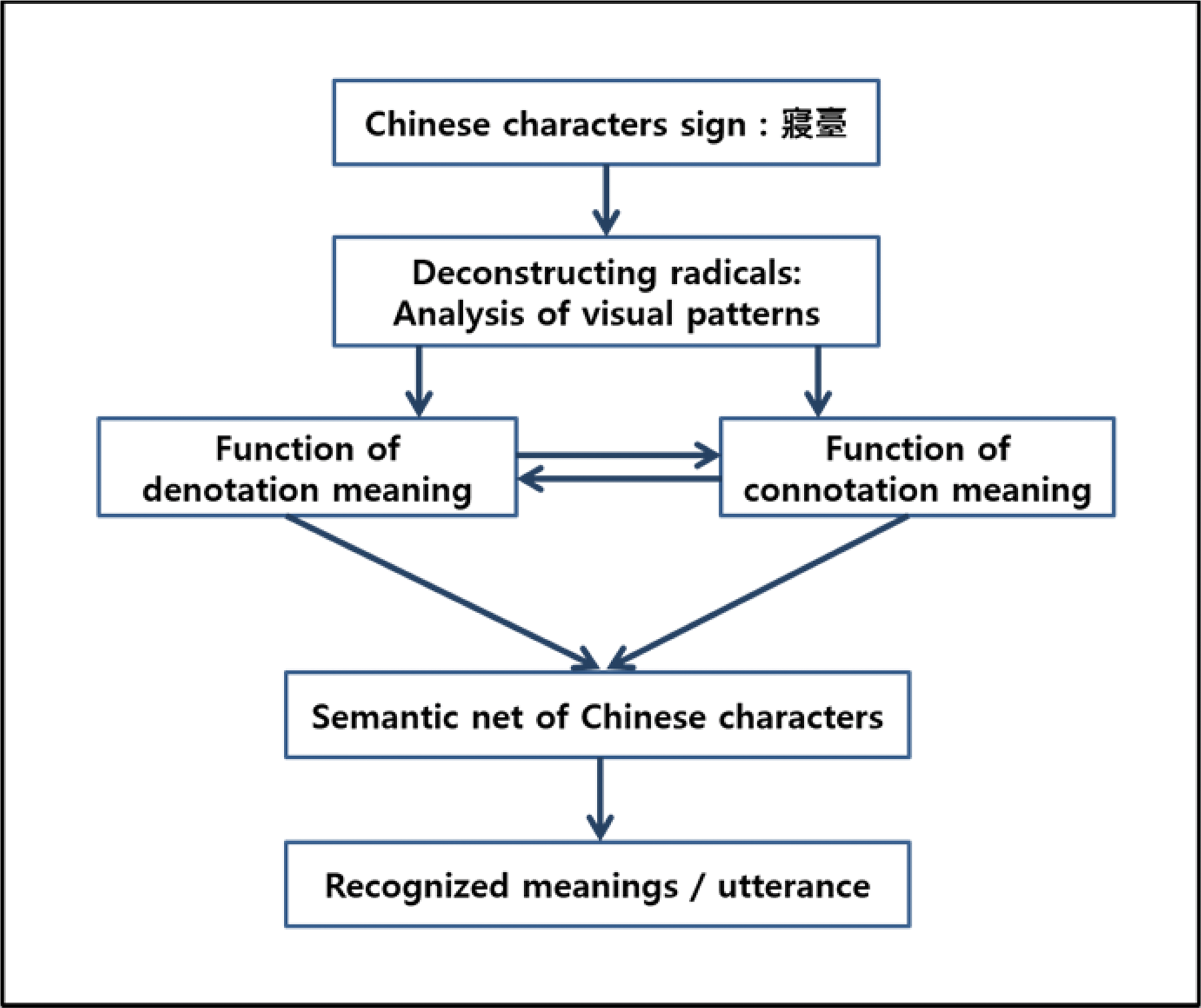
The ‘cognitive model’ is adopted from Martine Cornuéjols’ (2001: 157-158) ‘interpretational model’ that explains the process of recognizing a character and its meaning. The cognitive model applies the ‘interpretive model’ (established from the observation of people who interpret various texts) to the characteristic features of Chinese letters. The cognitive model is to visually demonstrate the process of the semiotics and interpretive semantics in a viewer’s recognition of a Chinese character’s meaning.
The step-by-step functions of the perception cognitive model of Chinese character signs can be summarized as follows. The first step is to break down the visual identity of a word, meaning the structure of the common Chinese character that makes up a single word. Readers perceive the single character, break down the visual elements of the common radicals and identify the reference object of the Chinese character signs. They identify the common radicals, which are remembered through past learning and experiences, and figure out the meaning. This process is done in a matter of seconds. For example, the character ‘chimdae 寢臺’ (bed) consists of ‘chim 寢’ (sleep) and ‘dae 臺’ (high place). If the decoder perceives these Chinese character signs, the brain destructs the radical systems of ‘chimdae 寢臺’ (bed), ‘myeon
The second step is to generate a meaning process through the association of the Chinese character that operates through the referential function and the implied meaning function. When a reader breaks down common Chinese characters, the meaning process occurs in which the referential meaning and implied meaning are analyzed to understand what the words represent. The denotational meaning function is the dictionary meaning that refers to the totality of things or the object at issue. The implied meaning function occurs when the information, knowledge and experience acquired by the person based on the dictionary meaning are linked to each other. For example, the interpreter identifies a bed, among the various objects on which people sleep, through the bed’s denotational meaning function. Comparing the bed with other objects on which people sleep, such as a sofa, chair or the floor, they identify the bed as furniture. Through the connotational meaning function, the bed is connected to a variety of semantic networks, including furniture on which one rests pleasantly, the birth of a child, the place of a person’s death, and the pain of a sick person. The interpreter’s contextual information, which is buried in the Chinese characters, becomes involved in the symbols. Depending on the interpreter’s contextual information, the meaning of the bed is not fixed, but rather is spread across a variety of meanings.
The brand association of Chinese characters
Maria Giulia Dondero (2006: 29-31) argues that characters in photos, advertisements or pictures grant and fixate the meanings of projected images and enhance their associativity. As such, Chinese characters with their pictographic nature can garner advertisement effects by enabling consumers to associate them with a certain brand.
Chinese symbols are thus effective marketing tools for people in the Sinosphere. It is desirable to direct a company’s branding strategy towards potential consumers who share the character codes, schema and meaning processes of Chinese symbols. To demonstrate the usefulness and effectiveness of the perception cognitive model of Chinese character signs, this study will analyze cases of Chinese-symbol applications to brands: the use of Chinese characters in brand-naming or logos to engage consumers and convey the meaning/value of brands.
In 2015, Alipay, the Chinese mobile payment company, changed its logo (See Figure 2). The brand image is conveyed through a combination of a typography of newly created Chinese symbols and alphabet letters. For the 900 million Chinese consumers using Alipay and potential consumers in the Sinosphere, it delivers the corporate image of a mobile payment service. When consumers see Alipay’s logo, the perception cognitive model of Chinese character signs starts working. They will start breaking down the common radical ‘sustain’ (支) from the logo; for example, ‘ji 支’ (to sustain) is a combination of ‘wu 又’ (also) and ‘sib 十’ (10). The interesting point is that ‘wu 又’ (also) is transformed into an image that conveys aesthetic value. The referential meaning function works on the level of acceptance aesthetics. Consumers will focus on the typography of ‘wu 又’ (also) and connect it to the semantic network of Chinese symbols. ‘Wu 又’ (also) strengthens the meaning of the slogan ‘Zhīfùbǎo 支付宝’. The latter causes the function of referential meaning to operate, and generates the associated meaning that sustains and maintains the delivery of treasures and objects to humans. Besides, ‘wu 又’ (also) connects with the English name ALIPAY, creating the sense of trust and faith. The simultaneous use of Chinese symbols and English strengthens the corporate image for consumers in Sinosphere.
Logos of Alipay and Shin 辛 Ramen.
Shin Ramen from Nongsim, a Korean ramen brand, is a representative case of successful branding strategy using the Chinese character ‘shin 辛’ (hot). When consumers in Chinese character-based cultures perceive ‘shin 辛’ (hot), the perception cognitive model of Chinese character signs starts working. On the level of denotational meaning function, the hieroglyphic character ‘shin 辛’ (hot) is an image of a tool with which tattoos were applied to a slave’s body; hence, the spiciness is associated with a slave’s painful life. Among various ramen products available, consumers may choose Shin Ramen, as they associate it with the sense of stimulation in its hot, spicy taste (‘shin辛’). The implied meaning function is at work through the contextual information of Shin Ramen; the information, the story of Shin Ramen’s taste, and memories contribute to the choice. In other words, the Chinese character ‘shin 辛’ (hot) performs the cognitive function of reminding consumers of the ramen’s taste.
Chinese characters and the image of characters
Chinese characters have a powerful brand-association potential which more and more companies recognize and try to take advantage of. ‘Xǐ Chá 喜茶’, the number one Chinese tea company with 451 chain stores, is one of those that successfully utilizes a combination of Chinese symbols and character images. ‘Xǐ Chá 喜茶’, a brand of a sensational appeal to younger generations, has increased its company value by combining a character image with the meaning of ‘Xǐ Chá 喜茶’. When customers recognize the logo of ‘Xǐ Chá 喜茶’ in the level of denotative meaning function, they perceive the radicals of ‘ju 壴’ (the drum), ‘gu 口’ (mouth), ‘cho 艹’ (grass) and ‘yeo 余’ (I). They then recognize the associative meaning of gaining pleasure through tea. The image of ‘Xǐ Chá 喜茶’ shows the act of drinking, while not knowing what the drink is. The Chinese characters ‘Xǐ Chá 喜茶’ thus provide information on what brand of drink it is and that it is a delightful drink. The implied meaning function of ‘Xǐ Chá, 喜茶’ is associated with a semantic network reminiscent of drinking ‘Xǐ Chá 喜茶’, after hours of waiting (See Figure 3).
Logo of Hey tea (喜茶).
Another company also constructs the branding strategy by combining Chinese characters, alphabet letters and character images, greatly appealing to young people’s tastes. The brand name, Myeongrang Skull, consists of the Chinese character sign ‘míng lǎng 明朗’, the English word ‘skull’ and the character image of the skull, to interact with customers. This brand also uses the semantic net in the level of binary opposition to strengthen brand awareness in customers (See Figure 4). Logo of ‘明朗 skull’.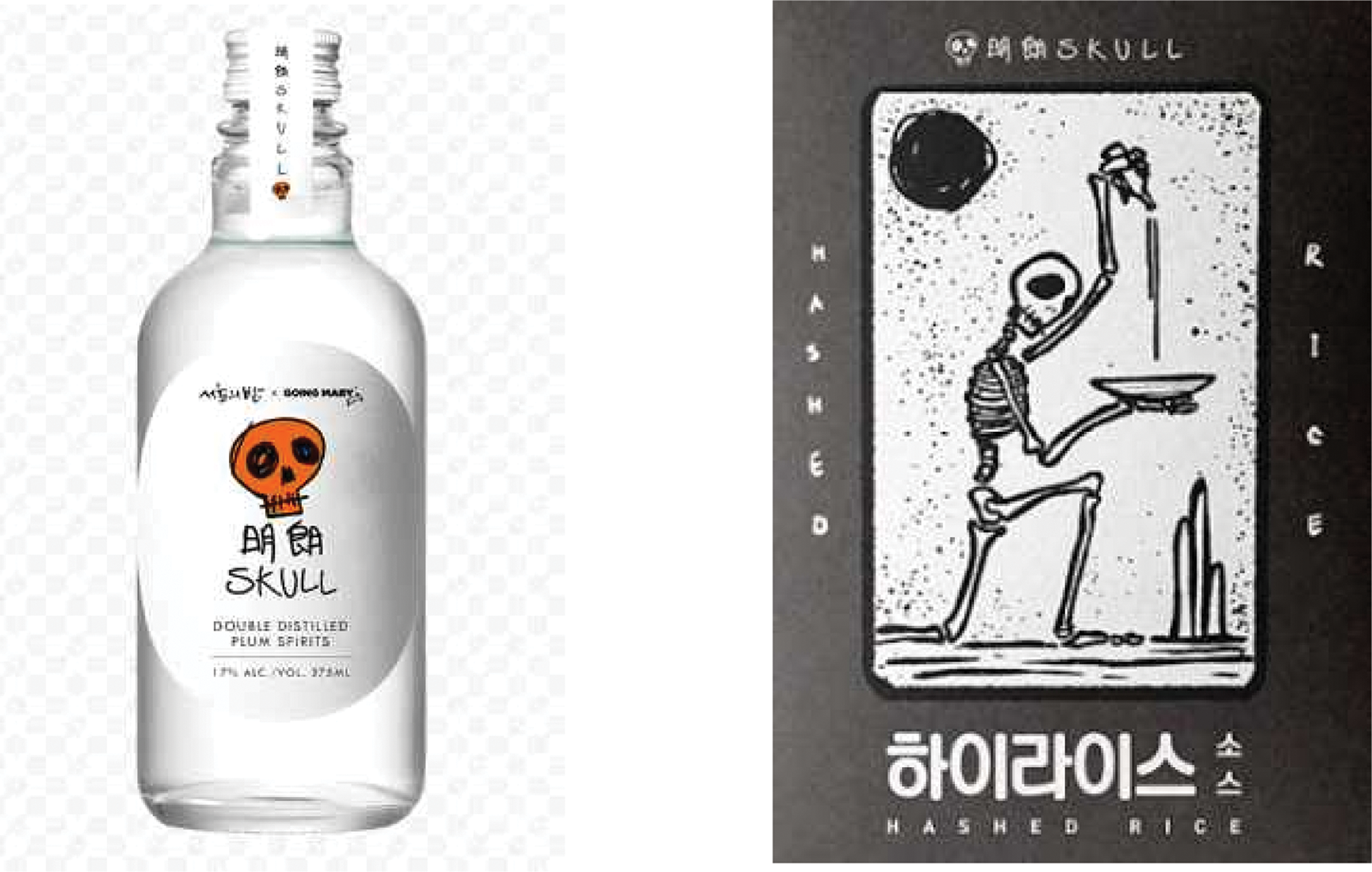
At the level of denotational meaning function, the word ‘míng lǎng 明朗’ (bright and pleasant) is a composition of ‘míng 明’ (bright) and ‘lǎng 朗’ (clear). Myeong (明) ‘bright’ consists of radicals, ‘rì日’ (day) and ‘yuè 月’ (moon), which connects with the semantic meaning of bright and joy. ‘Lǎng 朗’ (clear) is the combination of ‘yuè 月’ (moon) and ‘liáng 良’ (beautiful). While ‘míng lǎng 明朗’ (bright, clear) means ‘bright and pleasant’, the English word ‘skull’ symbolizes death. The clearly incongruent binary opposition between the Chinese characters ‘míng lǎng 明朗’ (bright, clear) and the English word ‘skull’ delights consumers and impresses the brand image on them. At the level of connotational meaning function, however, the individual context information could intervene in the interpretation of the Chinese characters and the English words. As excessive drinking behavior could be associated with death, the Chinese character signs ‘míng lǎng 明朗’ (bright, clear) conveys the impression of a positive, joyful alcohol culture. Therefore, when consumers recognize the bottle’s packaging, they accept the projected potential enjoyment value from the liquor through the Chinese characters. That is, by adding the word ‘skull’ and the skull image, the message that ‘excessive drinking could bring death’ is conveyed, which enhances the awareness of the brand.
The associative meaning of Chinese characters
In launching its new coffee brand ‘baegmidang 百味堂’ (house with one hundred flavors) in 2014, Namyang Dairy Products has in the logo the year 1964 and an image of cows, informing about the company’s history (See Figure 5). Seeing ‘baegmidang’ in the Korean writing system, Hangul and English alphabet letters alone, however, consumers find it hard to decode the meaning of the brand name. From Hangul, ‘baegmi’, Korean readers could guess several meanings such as ‘white rice’, ‘one hundred flavors’ or ‘white eyelash’, none of which they can be sure of. However, when the Chinese characters ‘百味堂’ are added, viewers can pinpoint the meaning of the brand name, since ‘百味堂’ delivers the clear (literal) meaning ‘house with one hundred flavors’, exhibiting the company’s taste-value explicitly. “Baegmidang 百味堂” enhances brand awareness to the potential customers. Logo of baegmidang (百味堂).
A similar case is that of Kyochon, the leading company in the fried chicken market in Korea, which launched the new brand ‘sinhwa 辛火’ (spicy chicken made by the fire) in April 2020 with the logo of ‘sinhwa 辛火’ and images of red pepper, pepper sauces, chicken and salad. In Korean, ‘sinhwa 辛火’ could mean ‘myth’, a historical story or ‘the historical character’. Therefore, if Kyochon wrote sinhwa in Hangul only, the meaning of the brand name would not be clearly understood. Therefore, Kyochon uses the Chinese character ‘辛火’ (spicy chicken made by the fire) for consumers to associate the hot taste in the character (See Figure 6). The naming of sinhwa (辛火).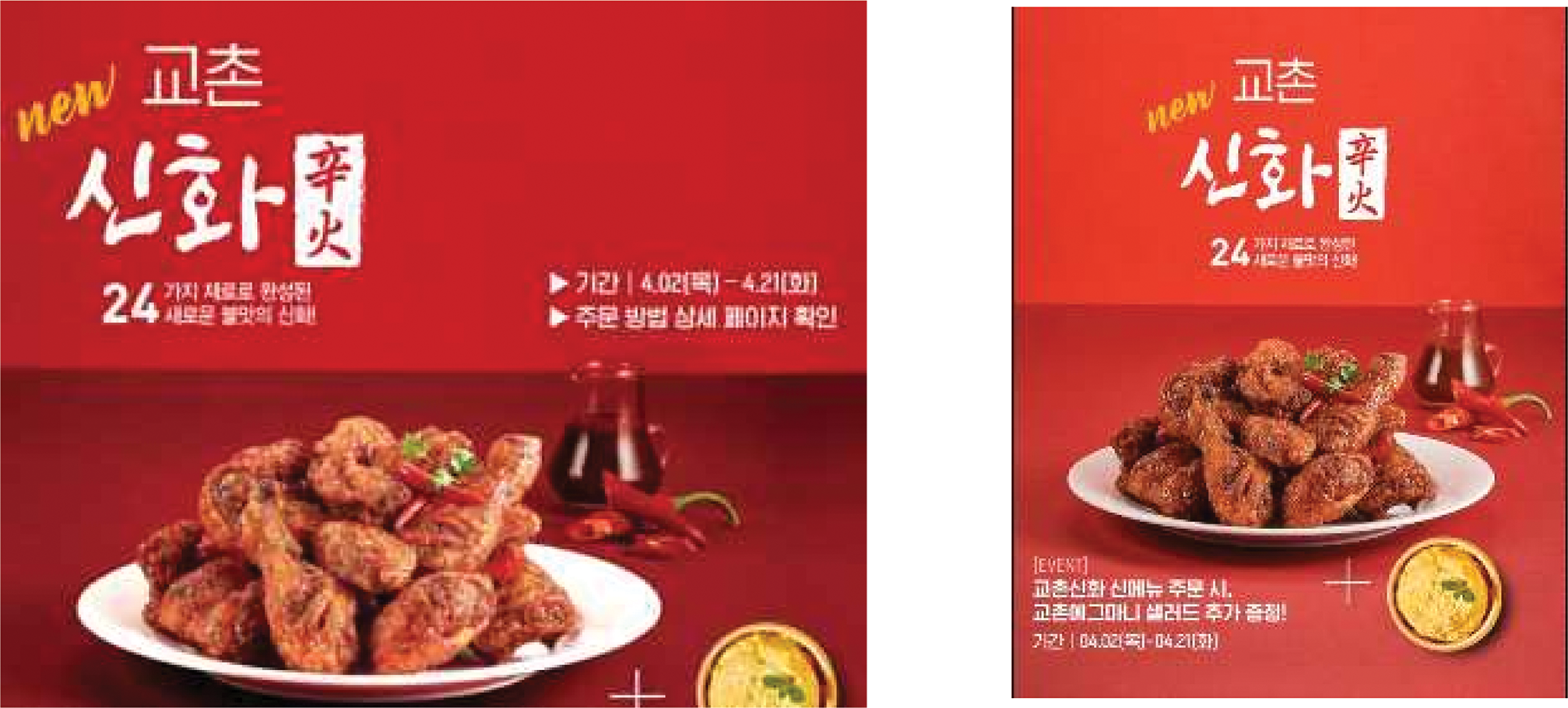
Conclusion
This paper explores the cognitional functions of Chinese characters, based on the notion and the methodology of the semiotics in writing, avoiding the phonocentric, morphologic approach of Chinese characters: it analyzes the logic of cognitional process of Chinese characters from the viewpoint of integrating semiotics and semantics. This article attempts to verify that Chinese character signs possess the character attributes with prominent visibility, legibility and strong iconicity which is lacking in alphabet languages as the latter are based on sound.
From the perspective of semiotic writing, this study demonstrates the process of cognition and association of Chinese characters by people in the Sinosphere. Also, it explains the notion of code in characters, schema and semiosis. Semiosis works actively in the writing and the reading of Chinese characters, as arranged for the introduction of cognitional functions of the character. It is a process used by people in the Chinese character culture area in their attempt at the cognition and the decryption of Chinese characters; in other words, the logical analysis of the connection of Chinese characters through the icon, the symbol within the semantic net in the cognitive area. The study also attempts to demonstrate the semiosis of people while working for the denotative meaning and the connotative meaning functions. It is argued that in readers’ decoding of Chinese characters, denotative meaning and connotative meaning function are automatically connected with the semantic net in Chinese characters.
This article’s main focus is the perception cognitive model of Chinese character signs, as constructed by the visualized model of logical semiosis process of the characters, which is performed unconsciously by the reader. The model identifies the meaning connected with specific semantic nets rather than the endowment process of meaning by a reader’s mere glance at a certain character’s visual image.
Through the case studies, an actual application of brand strategy using Chinese characters is demonstrated as enhancing brand awareness as practiced by various Korean and Chinese companies: the strategies can involve the use of a Chinese logo or the naming of the brand in Chinese to induce reactions from consumers, which promotes the brand values of companies.
Also exhibited so far are the concept and methodology of the semiotic writing in constructing Chinese characters and these characters’ effectiveness in conveying meanings and messages; and how the cognitive model of Chinese characters could be used at the interdisciplinary level, for the research of the algorithm model and the application of the characters to artificial intelligence data.
Footnotes
Acknowledgements
Many thanks for the cooperation from researchers at the Center of |Semiotic, Cognitive and Interactive Contents at Inha University. Thanks also to the staff at Center of Chinese Characters at Kyungsung University for their comments and suggestions on the initial draft.