




Abstract
The use of lethal research methods on cetaceans has a long and complicated history in cetology (the scientific study of whales, dolphins and porpoises). In the current era, collecting data through the hunting of whales (sometimes referred to as scientific whaling) remains a source of considerable conflict in various fora, including scientific ones. Based on interviews and documents, this article explores how marine mammal scientists articulate the validity of particular practices and research at both the International Whaling Commission and in professional scientific societies. Drawing on cultural theory, the article explores scientists’ boundary work, describing the purity and pollution of particular whaling practices in different institutional contexts. Respondents on either side of the debate argued for the pure or polluted nature of various positions, often utilising particular idealised values of science: objectivity, honesty and openness regarding how conclusions were drawn. The nature of boundary work performed is then related to the institutional context within which it takes place. This article thus highlights how science’s role in environmental conflicts can be assessed through boundary work that denotes who can legitimately speak for science, on what topics and how science is stage-managed.
Introduction
‘Science’ and ‘scientific knowledge’ are labels that grant considerable authority in most modern societies, entailing as they do the implication of objective, decisive knowledge of reality. As such, scientists themselves are often granted considerable influence in adjudicating in many conflict issues in society. However, in practice, it is rarely as easy as letting ‘science’ spell things out and in many conflicts actors on both sides will endeavour to employ the language of science in advocating particular positions (Weingarten, 1999). Similarly, among the community of scientists, there are also disagreements about the state of scientific knowledge and indeed the nature and role of science in society. Indeed, science may be invoked as justification for practices considered taboo in wider society. Utilising the issue of lethal research (the killing of animals to generate scientific data) within cetology (the scientific study of whales, dolphins and porpoises), this article aims to analyse the discursive strategies employed by scientists in demarcating science around an ethically controversial issue. Drawing primarily upon qualitative interviews with marine mammal scientists, this article applies the concept of ‘boundary work’ as a way of understanding respondents’ argumentative strategies – notably utilising an institutional approach inspired by cultural theory as an analytical tool. The guiding research question is how the scientists embroiled in discussions of lethal research legitimise or delegitimise particular practices through pollution and purity-based boundary work. This article thus contributes to understanding different scientific positions and how these positions are influenced by their different institutional contexts.
Whales are ‘boundary creatures’, mammals placed at border zones (or liminal spaces), between water and air, inner and outer, while their crossing of national boundaries also presents challenges for both research and management. This boundary-crossing nature makes them ripe for symbolic interpretation in many societies (Bryld and Lykke, 2000; Kalland, 1993). Indeed, in many places, whales often serve as metonyms for nature as a whole, with their decline seen as emblematic of nature’s treatment in general within capitalist modernity (Kalland, 1993, 2009). Whales and whaling thus become flashpoints around which broader environmental debates can be illuminated. Lethal research on cetaceans presents a compelling case for examining scientists’ own understandings of science and how it relates to particular norms and values. Contested both within and outside scientific institutions, it involves a practice (the killing of cetaceans) that is considered highly controversial in many parts of the world. In this case, science may legitimate otherwise illegitimate action. Such lethal research is confined to ‘whaling nations’ (see below), it thus provides an example of how values of broader society may restrict or enable science. Finally, values change and science’s relationship to these values change with it. The largest professional cetology society, the Society for Marine Mammalogy (SMM) has published research guidelines that, in part, address lethal research (Gales et al., 2009). Another society examined in this research, the European Cetacean Society (ECS) has conducted several workshops aimed at drafting ethical guidelines. These two cases highlight the evolving nature of science’s relationship to ever-changing society: with struggles over how life can be rendered ‘killable’ prominent. It thus also links into academic investigations of economies of life and death and the boundary-making they entail. This gives the paper relevance beyond whales and whaling, with relevance for topics as diverse as animal testing to international migration (cf. Lopez and Gillespie, 2015).
This article is structured as follows: in the next section, the theoretical approach is elaborated: theories of boundary work and institutions are described and discussed. This is then followed with a brief history of lethal research in the field of cetology, within the context of the global whaling debate. Methods are then described, followed by presentation of data and analysis. The article then concludes with discussion of when and how purity and pollution claims are utilised by cetologists dealing with ethical issues.
Boundary work, institutional context and scientific values
A feature of controversies in which scientists find themselves on different sides is that the issue of epistemic authority is brought to centre stage. Scientists search to show that they are the most competent and trustworthy ones, in contrast to those scientists on the other side. The strategy used in the effort to achieve epistemic authority for an issue is labelled boundary work. This concept, originating in the work of Gieryn (1999), utilises a geographic metaphor to describe scientists’ practices. In this depiction, scientists engage in struggles to demarcate the boundary of science and the concomitant authority to arbitrate over the nature of reality. The reason for this is that science always has a jurisdiction: scientists’ epistemic authority and credibility are shaped by drawing sharp boundaries between, for example, what is known and not known; what are facts and values. Boundary work thus entails ‘the discursive attribution of selected qualities to scientists, scientific methods, and scientific claims for the purpose of drawing a rhetorical boundary between science and some less authoritative residual non-science’ (Gieryn, 1999: 4–5). The boundaries of science are constantly reworked in political conflicts, with the ‘map’ of science endlessly shifting as society changes (Gieryn, 1999: 12).
It is important to note that boundary work also occurs within the drawn boundaries of science. In this work, scientists seek to distinguish among themselves. Boundary work is thus employed in struggles for authority within the scientific community (Swedlow, 2007, 2017). By successfully carving out and controlling a particular knowledge area, certain types of knowledge are accorded legitimacy in contrast to competing knowledge holders. This entails (after Douglas, 1966[2002]) the making of pollution and purity claims – scientists argue that their opponents have been polluted by the non-scientific, whilst simultaneously highlighting the purity of their own position. As such, drawn science–non-science boundaries thus become resources for boundary work within science, constructing boundaries between scientists based on their levels of pollution (Swedlow, 2007: 634).
Boundary work – irrespective of being between science and non-science or within the scientific community – is strategical and practical action (Gieryn, 1999: 23). Stage management is often part of this strategy through which actors can publicly present their knowledge as true and relevant for the issue at stake (Hilgartner, 2000). It means that parts of the knowledge production process are placed backstage, beyond any external gaze, whereas front stage a suitable portrayal of science is placed. This means that, for example, front stage science is framed as distinct, certain and pure, i.e. uninfluenced by non-scientific factors, whereas it may in fact be the result of far-reaching collaboration between science and policy and laden with great uncertainty. Boundary work thus involves attempts to draw boundaries, both between science and non-science and between various epistemic communities. Furthermore, the boundary may also be a site of interaction – whilst the boundary is repeatedly withdrawn, it also functions as a space for communication between communities – a boundary space (Mahony, 2013). Boundary work, including pollution and purity claims, pushes certain groups (including scientists) into positions of scientific and policy-making authority (Swedlow, 2017: 828).
The boundaries of science as described by Gieryn are cultural boundaries (1999) and it is generally accepted within that the socio-cultural context of science affects the extent that science is able to adjudicate in political conflicts (Lidskog and Sundqvist, 2002). This article seeks to apply one theory of cultural context, the theory of socio-cultural viability (usually cultural theory, for short) to the different boundary spaces examined (below).
Cultural theory has its origins in a heuristic aid created by Mary Douglas (1970[2003]; see 6 P and Mars, 2008 for a discussion of various criticisms that have been raised against cultural theory). It argues that the way people organise themselves and their environment typically follow particular patterns. These can be classified along two axes. The first relates to the extent that an individual is incorporated into bounded units (commonly called group) and is high when people spend a large amount of time interacting with those in their social unit. The second relates to the extent that one’s life is circumscribed by externally imposed prescriptions (grid); it refers to constraints in social action and is high when there are numerous explicit social classifications such as rank or gender (Thompson et al., 1990: 5). From these two axes, four ‘ideal-type’ ways of organising social relations, dubbed ‘social solidarities’, emerge: egalitarianism (low grid, high group), hierarchical (high grid, high group), individualism (low grid, low group), fatalism (high grid, low group).
The social solidarities.
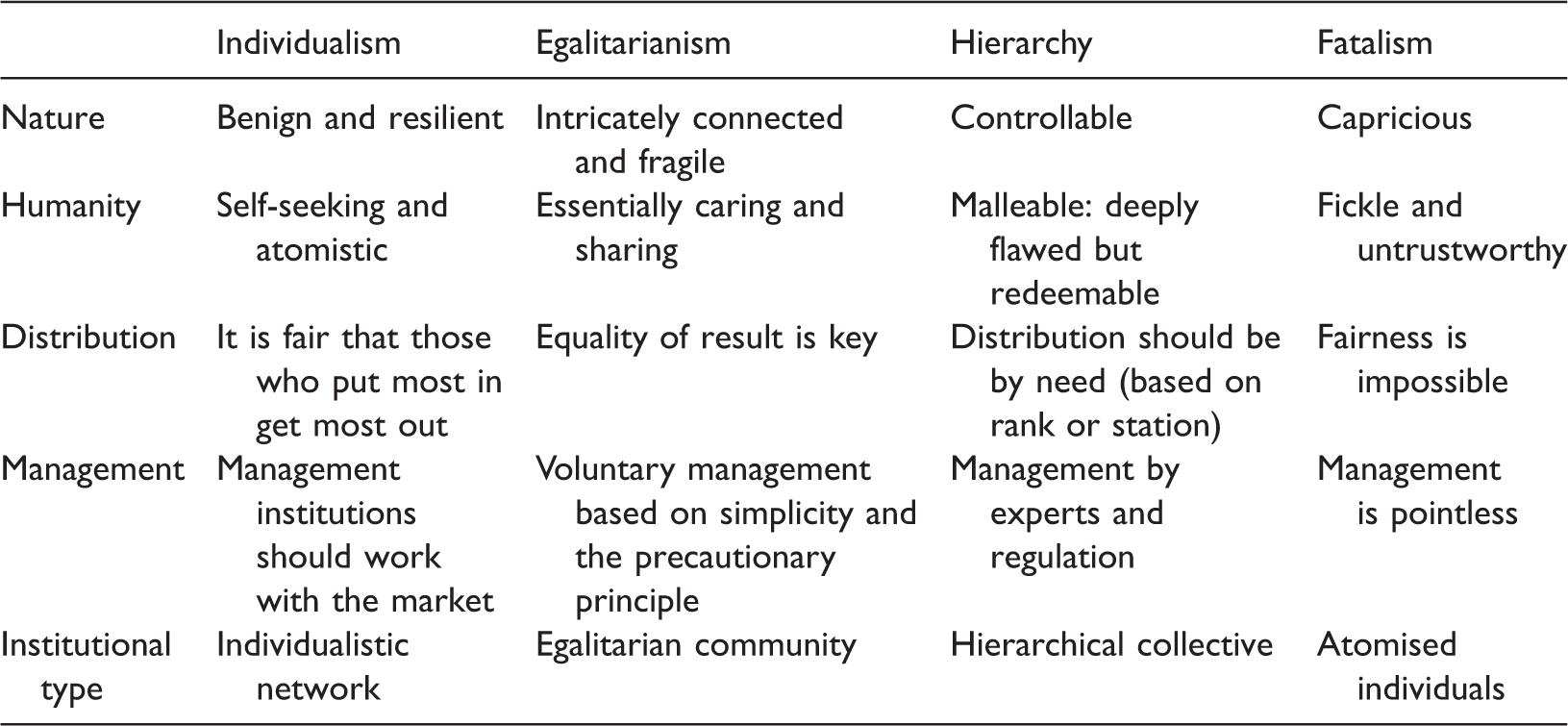
Adapted from Swedlow (2017) and Thompson (2003).
Each of the social solidarities will generate their own storyline around an issue, contradicting those of the other solidarities (Thompson, 2013: 427). In examining particular situations, cultural theorists typically describe what solidarities are present within a given situation/institution and which are excluded. Indeed, it is unusual for a single solidarity to be totally hegemonic – the contradictions inherent to their own limited worldview render them unsustainable – and typically one solidarity may be dominant, but the others will be present and will wax and wane as particular circumstances change (Verweij et al., 2011). Power in cultural theory terms is conceived as the ability of members of different solidarities to enact ‘their’ boundaries within the world: to order the world according to their narrative over that of the others (Thompson, 2008: 142–145).
Boundary types.
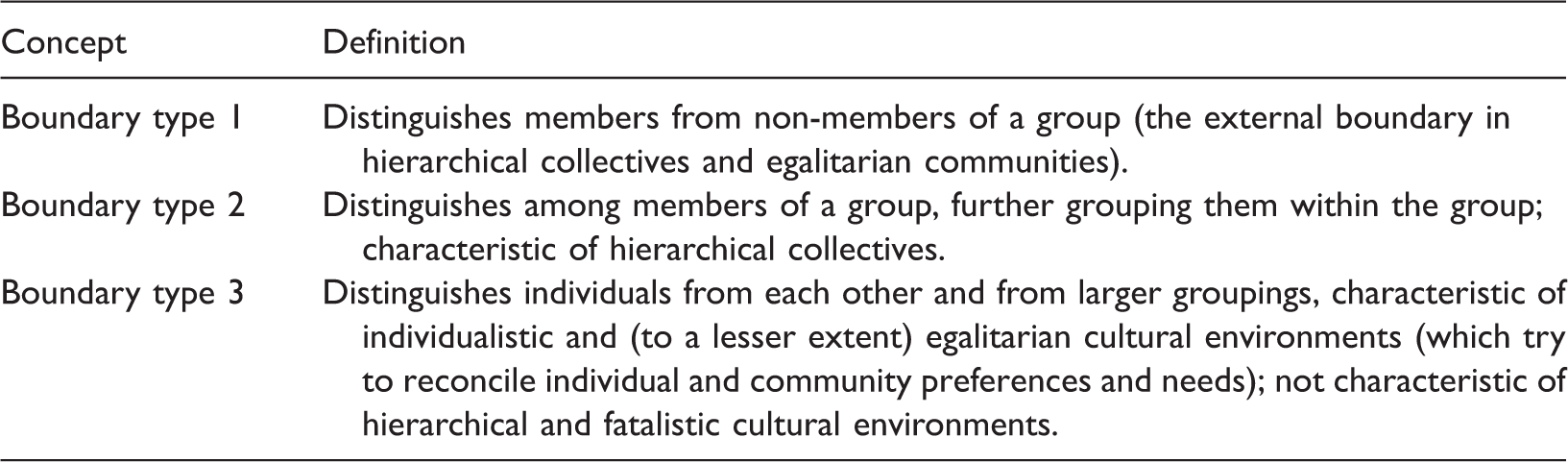
Adapted from Swedlow (2017).
Types of boundary work.
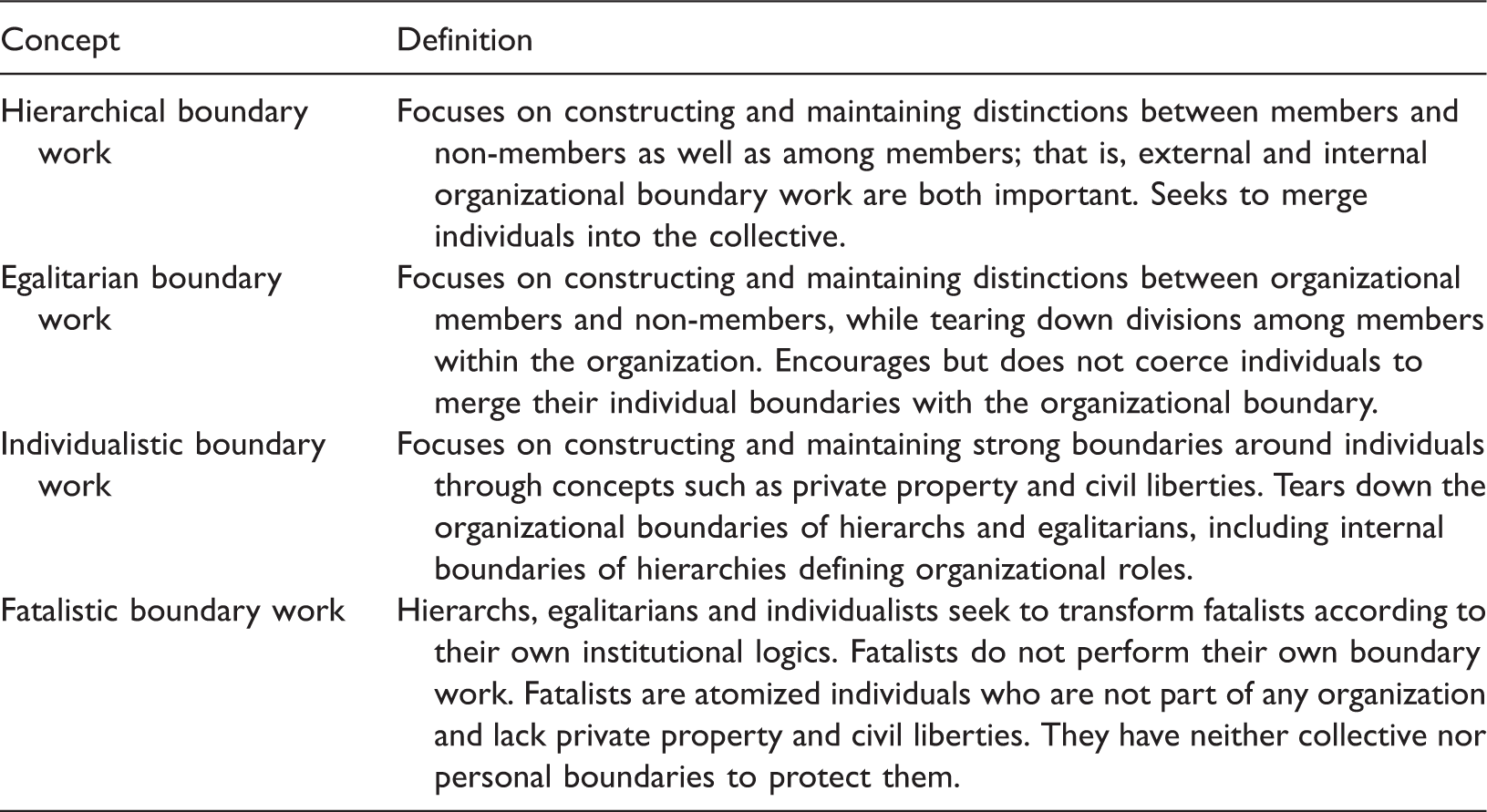
Adapted from Swedlow (2017).
This article examines boundary making practices, primarily in two different discussion sites – at the International Whaling Commission (IWC) and within the ECS. The IWC is the main international body regulating whaling. It has primarily a political function, whilst also containing a Scientific Committee (see below). The ECS is one of the main professional societies for marine mammal scientists, holding a conference annually. The article explores the purity and pollution claims-making practices of different respondents. It thus describes and analyses how ‘science’ is framed in different contexts, interpellated with particular moral standpoints. Science is thus conceived as a ‘moral enterprise’ (Collins and Evans, 2017), with attention paid to the so-called values of science. After Merton (1973), these are considered to be: (a) Communalism, a commitment to the common ownership of scientific discoveries, with intellectual property rights given up in exchange for recognition and esteem; (b) Universalism, truth-claims are evaluated in terms of universal or impersonal criteria, i.e. not based on race, gender, religion or nationality; (c) Disinterestedness, scientists are awarded for acting in a selfless manner, separate from their own personal beliefs and activism; (d) Organised scepticism, before being accepted, ideas must be tested and subjected to rigorous, structured community scrutiny. These values have been discussed, criticised and complemented (see e.g. Mitroff, 1974; Mulkay, 1976). In contrast to much criticism towards them, we do not see them as values that are necessary followed by science, but only as a set of norms that most would agree should guide science. Attention is thus paid to purity and pollution claims around these four values. Furthermore, such claims are then assessed drawing on cultural theory, examining how the cultural organisation and context of both sites is rendered manifest in respondents’ representations.
Background – science and whaling
It is a challenge to discuss the sociology of cetology without reference to the global whaling debate. Summarising greatly (see Dorsey, 2013; Epstein, 2008; Kalland, 2009; Singleton, 2016 for fuller accounts), in the pre- and post-Second World War period, the whaling industry waxed greatly, driven by demand for whale oil. This led to a precipitous decline in many whale populations. This decline was an important early issue for the nascent environmental movement, which lobbied for a ban on all whaling. This led, in 1982, to the passing of the 1982 moratorium on whaling by the IWC, the international body formed on the back of the 1946 International Convention for the Regulation of Whaling (ICRW). At the IWC, national representatives are tasked with regulating whaling globally and resolving international disputes. Since then, whaling has continued in different parts of the world, remaining a controversial practice. Whaling has thus remained an important symbol of humanity’s destructive relationship with nature to the environmental movement, whereas it has also become a symbol of whaling nations’ ‘local cultures’, the defence of which often grants whaling local popularity disproportionate to the practice’s extent (Brydon, 1990; Kalland and Sejersen, 2005; Mathisen, 1996; van Ginkel, 2004). Typically, meetings of the IWC are depicted as a dysfunctional deadlock, with anti- and pro-whaling groups pouring considerable energy and resources into attempting to decisively defeat the other (Friedheim, 2001; Kalland, 2009). Indeed, it has been argued that anti- and pro-whaling advocates are no longer arguing about the same thing, with different moral universes of whales and whaling extant (Blok, 2011). The ICRW states that whaling management should be ‘based on scientific findings’ (ICRW, Article V, 2.) and since 1951, the IWC has possessed a scientific committee. Scientists remain prominent actors in all whaling conflicts. The subcommittee addressing scientific whaling (below) is a particular site of confrontation, with member countries’ scientists facing off against one another along well-worn battle lines.
Lethal research 1 methods have a long history within cetology. Indeed, during the days of the global whaling industry, cetologists acquired considerable data from hunted whales, while scientific innovations allowed for the commercialisation of various whale products (Burnett, 2013; Dorsey, 2013). These cetologists were acculturated to the ways and methods of whalers, in some cases seeing their role as ensuring the continuation and sustainability of the whaling industry (Roberts, 2015). Dependant on the whaling industry to carry out their research, early cetologists struggled to highlight the precipitous decline in numbers of many species. Since the 1982 moratorium on whaling (implemented in 1985–1986), lethal research has remained a prominent flashpoint within a deadlocked IWC. ‘Special permit whaling’ (hereafter scientific whaling) remains one of the ways that whales may be hunted under the aegis of the IWC. 2 Indeed, the right for nations to take whales beyond agreed quotas for purposes of scientific research was enshrined from the outset in the ICRW. At various times since 1985, South Korea, Norway, Iceland and Japan have carried out scientific whaling. The most recent scientific whaling activities have been Iceland’s 2003–2007 programme and Japan’s on-going programmes. In 2012, South Korea submitted a proposal to carry out scientific whaling, but withdrew under anti-whaling pressure (Choi, 2017: 2537). Whilst uncontroversial in 1946 (Dorsey, 2013: 117), post-moratorium scientific whaling has been an issue of intense disagreement in the IWC, with critics seeing it as thinly veiled commercial whaling (Kalland, 2009: 23). The latest development in the conflict around scientific whaling was a 2014 International Court of Justice ruling that Japan’s research programme in the Pacific was incompatible with the 1946 ICRW. Subsequently, Japan issued permits for two scientific whaling programmes and resumed scientific whaling activities during the 2016–2017 Antarctic season (Agence France-Presse, 2017), in the face of continued criticism by opposing scientists and elsewhere (Clapham, 2017). At the same time, other forms of whaling continue to provide samples from which scientists in a variety of nations generate data.
In sum, hunting whales remains a prominent environmental issue, deadlocked around fundamentally different moral understandings of what whales are (cf. Blok, 2011). Much of the current conflict in the IWC concerns the practice of scientific whaling, with much discussion centring on the ‘scientific nature’ (or lack of) of such practices. Furthermore, whilst scientists are involved all whaling conflicts, their interactions within one another have previously seldom been the focus. This paper begins to fill this gap. As an issue with inherently moral elements – i.e. what rights do ‘whales’ and ‘science’ have? Discussion on lethal research thus represents an excellent case for examining how scientists perform pollution-based boundary work in different boundary spaces when called upon to mediate in controversial matters, around whaling and on other matters. This constitutes the background for this article, which discusses how scientists embroiled in discussions of lethal research legitimise or delegitimise particular practices through pollution- and purity-based boundary work.
Methods
The main sources of data are 13 interviews with cetologists. This sample was identified initially on a purposive basis – respondents were selected based on prior knowledge that they had been involved in some way in discussions relating to the ethics of conducting lethal research on marine mammals. For example, if a respondent had published an article on a topic then they would be contacted. Other interviewees were then selected through snowball sampling on the recommendations of prior interviewees. Effort was made to select respondents on both sides of the global whaling debate.3 As such, researchers from the Faroe Islands, Norway and Iceland were interviewed (Interviewees 1–3). The remaining respondents were affiliated with institutions in Australia (Interviewees 4 and 6), USA (5 and 13), the UK (7–8 and 10–11), Spain (9) and New Zealand (13). This should be acknowledged as a crude measure – all respondents had employment histories and research experience in several countries. Among the sample were government employed scientists, university affiliated researchers and those whose work was funded by non-governmental organisations. All bar one respondent (Interviewee 10) were men. Researchers at different stages of their careers were spoken to, including senior members of several nations’ scientific delegations to the IWC as well as newly graduated postdoctoral researchers. Likewise, levels of day-to-day research activity varied, with several senior respondents stating (often ruefully) that they are largely occupied as research managers. A notable lacuna in this sample is the absence of any scientists from Japan’s Institute of Cetacean Research (ICR), the most prominent organisation conducting scientific whaling. Overtures were made to several ICR-affiliated scientists, however, all declined to be interviewed. One responded with a written statement, while another referred the lead researcher to the ICR website. These and other documents were utilised in order to gain some insight to ICR boundary work, being incorporated into further collected research material (below). Whilst this is not ideal, it is not crippling – focus is upon scientific boundary work rather than passing judgement upon scientific whaling itself.
Interviews were semi-structured and were conducted by telephone (Respondents 1–3, 5–7 and 11) or face-to-face (4, 8–10, 12–13) as circumstances dictated. All but one of the face-to-face interviews were conducted while the lead researcher was acting as a volunteer during the 2014 and 2015 ECS conferences. These provided opportunities for observing ECS boundary activities and for informal conversations with marine mammal scientists and students, which supplemented interview data collected. The 2015 conference also provided an opportunity for the lead researcher to observe and participate in a workshop on ethics among society members.
Attending ECS conferences also provided access to further research material on ethics in marine mammal science. This comprised emails with ECS members and ECS documents (e.g. a sheet for judging presented posters). This was added to sundry other material, which included articles in scientific journals on lethal research, ICR documents and various emails between the lead researcher and respondents.
A comment should be made on ethics: the cetacean science world is small and ethical debates may be fierce. As such, efforts have been made to render respondents anonymous in the text. Likewise, on several occasions, respondents wished that certain parts of the conversation be kept off the record, relating to personal conflicts with other researchers or their organisations and this has been respected.
Results: Pollution and purity in marine mammal science
During this research, a variety of different ethical questions were discussed and pollution-based boundary work was in evidence throughout. Instead of covering every incidence of boundary work what follows centres around respondents’ comments on two sites of scientific debate/conflict. The first spirals out of on-going conflicts in the IWC (above) exploring why the reasons a whale dies matters for science. The second explores a different setting and looks at boundary work in professional marine mammal science societies, most prominently the ECS. Both the ECS and its sister organisation the SMM have made moves to produce ethical guidelines for members (above). The IWC and professional societies thus present contrasting boundary spaces within which boundary work may be compared. What follows are four subsections describing different aspects of boundary work among respondents.
The dead whale in the room: Lethal research and the collection of ‘useful’ data
All respondents agreed that data can be produced from a dead whale. Disagreements centred on the value of such information and whether this justified the active killing of a whale. Thus, different categories of whale corpses emerge based on how a whale dies. These can be seen on a scale of controversy, from stranded whales to bycatch whales, to whales hunted for food through to scientific whaling (cf. Bierman and Mansfield, 2014; Lopez and Gillispie, 2015). Consistently, respondents articulated a view that a dead whale is a potential source of data and it is better to avail oneself of opportunities that arise. Respondent 12 put it clearly: I mean we get so much information out of stranded animals, but they’re all limited by the fact that they are stranded animals, so we have to make certain assumptions and so forth. But someone who is an extreme animal rights person might say: ‘well it was all killed by fishing, we boycott fishing, we never want to use these information’. That would be a shame. I don’t want to see marine mammals die through fishing nets, but if they are dying through fishing nets let's use them. There has been some people that have complained about using information from the pilot whale hunts, because that justifies the taking the animals. … [But] We’re taking animals anyway, if we can get some science out of it, then the animals haven’t died for nothing. I don't feel anybody is arguing with me about using this set of samples. Because this set of samples were not killed for scientific purposes, these were killed by a regular [non-scientific] programme in Japan and I'm just using a by-product. So we knew this data was available from earlier and from early on in the project this was our approach. We wanted to get a measure of how much energy they deposit, which at the moment [is] not possible to do without invasive research basically and our kind of reasoning behind it was that this data is collected, it is used, there [are] no plans in Iceland to resume scientific whaling …’. (Respondent 4) People have said that there’s no defendable reason why you’d need to kill a whale … to answer a biological question. Well of course there are things you could only do by killing a whale. I mean I could posit that it’s important to work out what the change of the relative mass of the liver is in animals through ontogeny as they grow. Now I could only do that by killing a whale and measuring its mass and cutting its liver out and measuring its liver. But unless I’ve got a really good reason why that’s an important piece of information then it would be entirely unethical in my view to proceed to do that. (Respondent 6)
The question of relevance
In discussing lethal research, respondents on both sides of the discussion were able to list information that was difficult to obtain without using a dead animal, usually reproductive or dietary information. Likewise that there are pros and cons to any research method and thus the best method for any situation is dependent on the question being asked. Respondents, however, drew different boundaries on relating to the value of such research based on certain normative concerns. In the case of lethal sampling programmes at the IWC, disagreement revolved around the value of such research for the management of cetacean populations worldwide. For example, one Icelandic respondent stated: Some scientists in the committee were arguing that we could obtain the same or similar research from non-lethal methods and there was a lot of discussion about that but we did not agree to that on the primary objective … for the primary objective which is that we need a high quality and detailed data on the diet composition in Icelandic waters during summer when whales are here and not only a list of species and their proportions that whales are eating it is very important for the multi-species modelling … (Respondent 3) there are questions for which you have to kill animals but the question is are those questions important enough to kill an animal and are they related to the context of the management and in terms of how the Japanese frame what they’re doing … none of those questions relate to management by the IWC. … The one argument they’ll sort of come back to a lot of the time is you can’t tell what these animals are eating and that’s really important. Well actually it isn’t to whaling management first of all. The various things that go into the IWC’s mystery black box of how many whales are there and how many were there and how many can we kill has nothing whatsoever to do with diet. But that’s why the switch has gone, in all these countries … You know ecosystem management is the flavour of the month. ‘We need to manage these … We can’t manage species in isolation, we have to manage them as part of their ecosystems and in order to do that we have to find out what their role in the ecosystem is’. Well ok fine but it’s very hard to do that and if you kill a whale and you find that it’s got … herring in its stomach or whatever, ok that tells you that whales eat herring. (Respondent 5)
Pollution and purity in marine mammal science
In making arguments about research methods, several boundary-making practices were observed from various respondents. It was common for respondents to suggest that science was being polluted from various sources. So, for example, scientific whaling (in particular, on-going Japanese whaling) was regularly depicted as being driven by ‘political’, ‘cultural’ or ‘commercial’ needs rather than by a genuine desire to garner scientific knowledge. Multiple respondents from anti-whaling nations (4, 5, 6, 8, 11 and 13) thus questioned the disinterested, selfless nature of scientific whaling: Well I don't think actually there is a debate [about lethal research]. I think the issue is that within the rules of the International Whaling Commission there is … In Article 8 of the convention that allows whaling for scientific purposes and for Japan and to a lesser extent Iceland and Norway they've needed to use this clause to allow them to go whaling and so they then instructed their scientists to come up with a scientific programme … What we've seen recently with the International Court of Justice judgment is that that court has decided that Japan's whaling wasn't primarily for scientific purposes. That it was essentially commercial whaling, just using this loophole. So apart from the few scientists who've been kind of pressurised by their governments to generate scientific programmes to overcome the loophole I don't think there really is a debate. (Respondent 11) Absolutely, it’s a political excuse. The Icelandics went scientific whaling because they weren’t allowed to go commercial and they wanted to continue whaling and that’s a fact so they made up some reason for why they were going to go and put their scientists in a terrible position to having to defend it scientifically. I was at the meeting … when the Icelandics had to present their scientific whaling case and … on the science side it was really nasty stuff, it was a really nasty debate … I remember seeing [a geneticist] in tears and thinking ‘fuck this is horrible and this is really nasty’. But we had to say something about otherwise it would appear that it was credible science and it’s just not! … And we’re all forced into this horrendous position of having to have these arguments around it when it’s just not the case. That’s the problem with this whole scientific whaling of Japan, it’s a nonsense, it’s a sham and I have to waste my time and other people have to waste their time in very unpleasant arguments that are never resolved so it’s intensely frustrating yes. It’s not valuable science. (Respondent 6) [the Japanese] will say ‘we’ve published 200 papers’ and actually if you take out all the ones that are submitted as documents to the International Whaling Commission Scientific Committee and then take out [one researcher] … he publishes like crazy. I mean it’s stuff that’s absolutely useless to research. Not to mention bizarre in some cases but he’s contributed … if you look at the Japanese list of papers they say they’ve published in refereed journals, a very big chunk of that is this guy! (Respondent 5)
In this quote, the respondent demarcates certain documents as of lower status on two levels: by the type of research documents (IWC submissions rather than in journals) and by research’s relevance to the normative standards of resource management (see above).
By contrast, several respondents argued that scientific judgement of lethal research was being polluted by cultural shifts in anti-whaling countries. The emergence of whales as symbols of the environmental movement meant that research from scientific whaling was not being treated fairly (cf. Morishita, 2006). Some researchers even referred to whales as having become ‘totem animals’ in anti-whaling countries (respondents 2 and 9). It was clear that these respondents were drawing on anthropologist Arne Kalland’s analytical construct the ‘superwhale’ (1993) – something that has also been noted in Japanese prowhaling advocacy (Blok, 2011). This symbolism is suggested as leading to the political and cultural censoring of research from scientific whaling programmes in certain scientific journals, within the opaque process of peer review (Fukui et al., 2005; Torrissen et al., 2012: 1). Similarly, a reluctance to appear to endorse Japanese whaling was cited by two respondents as a factor in researchers’ unwillingness to utilise data from Japanese scientific whaling (Respondents 4 and 9).
Respondents would also periodically draw attention to the apparently abnormal nature of the controversy – pointing out that such questions about lethal research are less problematic in other scientific fields: My experience comes from studies of fish. This question of lethal and non-lethal sampling is simply not an issue so there must be a reason why this is an issue when you come to mammals [that is] completely gone when you come to talk about fish. (Respondent 2)
In sum, common to both sides of the debate on lethal research methods was the suggestion that those with opposing views had been polluted by the non-scientific, impairing their judgement. In such circumstances, respondents consistently appealed to an ideal vision of the scientist as unbiased, open-minded and objective in collecting and interpreting data (‘disinterested’ in Merton’s language), whereas for some respondents, it was implicit several stated it explicitly: I think a good scientist is someone who is genuinely interested in how the natural world works and thinks about it a lot and really and really does try and work out the very best way to understand the element of answering a question that they can and you shouldn’t look at that as to kill or not to kill. (Respondent 6) A good scientist is a person, which is trying to maintain his or her objectivity as much as they can throughout the scientific process. From the way … so in our kind of fields, the way they are going to collect information to the way they analyse information to the way they present the information … to the way they make estimations and inferences about the information. I guess that’s the way I would define a good scientist. So you can see there that you can have a range of opinion about sampling methods and then you can have a range of opinions about analytical methods but I guess the point is throughout these different steps of the scientific method you do not interfere, if you prefer, with the process of estimation and inferences, so you’re not loading your personal views on what the information tells you. And so one of the … interesting things to always find as a scientist and actually that really challenges your way of thinking, that really helps you to … stay on the objective path is to find yourself sometimes challenged with your preconceived ideas about what results might look like so you might go into a study thinking this is very likely to show something like this and actually finding yourself and saying well actually that’s not the case. So you should never be married to your predictions or to your hypotheses. (Respondent 7) I won’t say that the US government is unbiased in that regard. You know the stuff that we do, obviously I don’t like whaling but I do think we’re a lot more neutral about this sort of stuff and you know we don’t get censored if we came out with something that said, as we do you know, oh this population is increasing really well, we do that with a lot of populations. Nobody says ‘wait a minute … that doesn’t fit our policy at the IWC, you can’t say that’. … I would … bet a lot of money it’s not true in Japan.
Necessary pollution
It would be incorrect to interpret the foregoing as suggesting that respondents believed scientific purity was possible. Indeed, speaking to respondents about ethical discussions, workshops and guidelines in professional societies at times revealed ambiguous attitudes towards pollution. Attending the ECS conferences, it was possible to discern clear examples of boundary work. Indeed, the process of submitting research was an obvious example. Similarly, prizes were awarded for the best presentation and poster, requiring senior members of the ECS to function as judges. In making these judgements, similar boundary work as documented above is also present. So, for example, the judging form (in 2014 at least), contained sections on ‘scientific content’, where a vision of a logical approach is articulated (sample question to judge ‘Contains sound, logical, viable arguments?’ or ‘Do conclusions follow results?’). At the same time, however, assessments based on the current state of knowledge and what problems are considered interesting are also extant (‘Does this present a new method or technique?’, ‘How important are results to current knowledge?’). One of the judges was quite explicit about how he saw the boundary work that took place: Essentially what you see here is that … 80 or 90 per cent of the presentations are made by students … only a small percentage of bachelor students go to PhD studies. Just a small percentage of the … people who doctorate go for the postdocs and just a small percentage later on become professional researchers so it's a long career … So then, this is not bad science, this is good science and above everything it’s proper science. But it's still pretty young science. Many of these people will not be scientists in 20 years’ time but the science requires this process of just selecting the best people and that's one of the processes. So it's good science, which quite often is a science that would not progress. (Respondent 9)
In contrast, in discussions about ethics around workshops and guidelines in both the ECS and SMM, respondents articulated a more ambivalent position on pollution from society. Whilst the foregoing suggests society is a source of scientific pollution, respondents acknowledged that science exists to serve society and the knowledge it generates responds to the questions society throws up. Indeed, this is implicit to the notion (above) that the quality/value of science must be judged to particular values. Likewise, on some level, science must abide by the norms of societies within which it is practiced. While around several issues many respondents again articulated an idealised, unpolluted ideal, a couple of respondents utilised the language of pollution in the opposite way. In these cases, to be too cut off from society (to be pure) also led to the risk of irrelevancy: But the argument has always been, and continues to be ‘the [SMM] is there to provide scientific advice or the best possible science. If we start getting involved in taking positions on controversial issues then we will be accused of our science being biased’ and I think that’s true to a certain extent and I think it’s a cop out to another … We don’t live in an ivory tower, we can’t afford to live in an ivory tower … I mean we are the advocates for these animals, we know them better than anybody else does because we study them and we’re the ones that should be speaking for them when they need to be spoken for. But obviously it’s not our job to start lobbying … politicians about this stuff. There are NGOs who do that but we can provide a scientific perspective and we can’t divorce ourselves from the consequences of some of the actions … we can’t divorce ourselves from the issues and the consequences of those issues. (Respondent 5) If you’re involved in real-world conservation everyone has to have some sort of human dimension aspects in there. And I’ve actually written papers comparing the fields of conservation biology and conservation practice, so sort of conservationists where you’re science but you’re also doing a lot of engagements so you might not be … you might spend very little time in the lab but … you’re very science literate. You have to be, you have to understand … being able to put together a GIS plot and so on and those who are biologists and just happen to be working on endangered species. So there’s sort of a gradation and yeah a lot of people who say they are conservation biologists I wouldn’t … consider to be conservation biologists because it is interdisciplinary and it is implied unless you’re actually going that extra mile to try and engage and try and make sure that work gets to the right place to try and have that … real-world application. So then you’re just a biologist doing conservation biology and there’s a lot of old-school conservation biologists who are of the opinion you must be very, very specialised, you mustn’t advocate, you must be very ivory tower and I wouldn’t really consider them to be conservation scientists. (Respondent 13)
Discussion – purity and pollution claims in context
These data have presented scientists’ ethical considerations regarding lethal research methods. Respondents actively perform boundary work, levelling pollution and purity claims to endorse or dismiss various rhetorical positions. In making pollution claims, respondents generally appealed to normative ideals similar to that of Merton of disinterested, sceptical scientists involved honestly in a common knowledge production project, generally depicting opponents as subverting this ideal. Of particular, interest is how pollution and purity appear to vary somewhat as regards the positivity or negativity. This highlights how science is never a single monolithic entity, but a series of practices in different times and places. As such, what these data represent are in fact debates in particular contexts. Returning to the cultural theory described earlier, this section thus explores the different institutional contexts represented by respondents and the further boundary work this indicates.
For many respondents, the ongoing conflict at the IWC scientific committee was the clearest discussion site on the ethics of lethal research. In a high-stakes, conflict scientists seek to maintain a particular vision of what science is. In this regard, they are very much constrained by the boundaries as set by the IWC itself – the contest rages over whether the data collected is of value for management of whaling – does the science practiced answer the management questions asked? This then becomes a linked discussion about whether other methods are better. There is thus agreement that data are generated from dead whales but conflict over whether killing whales for science is a valid practice that generates useful information. Throughout the history of the IWC, there have been continued boundary-making conflicts over what science may or may not discuss (see Epstein, 2008 for an illuminating description). However, since the 1986 moratorium, the primary role of its scientific committee around whaling has been in stock assessment (Epstein, 2008: 132–134). One can thus see that respondents’ arguments are very much related to the boundaries of the setting within which discussion takes place.
Previously, several writers have argued that the ostensibly science-based arguments around whaling have more to do with politics than science per se (e.g. Epstein, 2008; Heazle, 2006; cf. Clapham, 2015). What is placed front-stage is a science free from political considerations, yet constrained. This is a product of the structure of the IWC. In the language of cultural theory, the IWC appears to be largely structured as a hierarchical organisation: externally, it has clear boundaries of membership, whilst within there are strong boundaries of authority for different groups. Notably, it is an organisation primarily comprising states and indeed, state authority largely remains paramount. This is most clearly represented by the objection clause, which allows any state to effectively ignore an amendment to the ICRW provided it reacts in time. This is what allows Norway to continue its commercial whaling activities. The objection procedure clause was part of the ICRW from the very beginning (1946, Article V, 3.) to encourage the community of whaling states to cooperate in the immediate post-war period (Dorsey, 2013). The option of scientific whaling is a further hangover from the original treaty, granting states the right to issue scientific whaling permits as they see fit (1946, Article VIII). The structure of the IWC effectively reflects a particular hierarchical layout: it demarcates individual member states as the principle authority on (a) whether to follow collective decisions and (b) what science is relevant. Scientific whaling programmes ultimately depend on individual nations’ decisions about what research is needed/carried out and then, when it is discussed within the IWC’s scientific committee, it becomes a battle with the narrowly defined boundaries of what is taken to be (whaling) policy-relevant science. Thus, much of scientists’ boundary work – its purity and pollution claims – reinforces the overall hierarchical structure of the IWC. In Swedlow’s conceptualisation, two types of boundary work are taking place: the scientists here attempt to include or exclude certain researchers/programmes from the scientific space through pollution and purity claims (Type 1). At the same time, the boundaries of relevant science and its front-stage position have already been demarcated within the greater whole of the IWC (Type 2). This is suggestive of a hierarchical institutional structure. Indeed, how management science is conceived at the IWC (stock sizes and maximum sustainable yields), reflects a hierarchical view that nature is knowable, measurable and ultimately controllable. Summarising, continual boundary work at the state level ‘stage manages’ science, ensuring it is prominent, but in a very particular form.
This is not to say, however, that the IWC and the whaling policy landscape in general are purely hierarchical. Indeed, despite the IWC’s overall hierarchical structure, voices of other solidarities have made themselves heard and have even dominated: with management science repeatedly ignored, first by a largely individualistic whaling industry and then subsequently by nations and environmental organisations voicing an egalitarian perspective on nature (Singleton, 2016). Scientists are aware of the boundaries and actively seek to manipulate them in their arguments. However, they may struggle to alter the institutional structure framing the debate; it is clear from several respondents’ responses that there is considerable frustration over the constraints of the debate. To several respondents, these constraints mean that the IWC subcommittee is not a site of science. In contrast to idealised notions of open-ness and discussion, these conversations were characterised by participants talking past one another: for example in the scientific committee, it becomes very political when you reach that stage, maybe if you look at the IWC through time it really just ends up in statements by a list of scientists and by counterstatements by others and these are very political in nature so it is … in my mind the real scientific debate is not carried really through [to] reach a common conclusion, which should be the usual way in scientific forums so we usually end up by agreeing not to agree. (Respondent 3)
Another respondent (8) expressed a desire that the IWC dissolve itself, to allow for a more holistic approach to cetacean conservation (cf. Burns and Baker, 2000). Scientists do push against the boundaries – indeed the history of the IWC has shown that the boundaries do periodically get redrawn – but at present the overall hierarchical structure delimits their actions and discussions as anything else would threaten the state-based order. Indeed, other IWC subcommittees, where there is greater concord generally, manage to work with greater effectiveness (Respondent 13), in part because they are less likely to threaten the greater hierarchical structure.
In contrast, looking at professional societies like the ECS, a different institutional picture emerges with both hierarchical and individualistic boundary work on display. The former most prominent in the various societal routines (abstract submissions, ethical guidelines etc.) that effectively determine who is or is not considered a scientist within the social space (Type 1 boundary work). At the ECS conference itself, however, the picture is much more individualistic: scientists network, get feedback and engage in professional discussions in the brief moment cetology is made manifest. The spirit is largely one of a meritocracy with work being judged, acknowledged and celebrated by peers. All is not perfectly equal of course – ‘[b]ig individuals have more power than small individuals’ (Swedlow, 2017: 833), with participants making a name for themselves. Such a combination of hierarchy and individualism is not unusual – most markets require structure to ensure some sort of level playing field is maintained. Respondents’ boundary work reflects this individualistic stance – purity and pollution claims are employed selectively in order to advance particular positions and individuals, for example Respondent 13’s distinction between ‘conservation scientists’ and ‘biologists’ (above). Thus, some ethical stances/researchers are framed as abrogating science’s duty and need to respond to the changing needs of society, rather than being stuck in an ivory tower. In Swedlow’s definition, this is Type 3 boundary work, distinguishing individuals from one another.
Conclusion
In the contemporary era, the deliberate killing of whales has become a controversial issue, emblematic of various other conflicts around nature and the way society interacts with it. Scientific practices play an integral role in these conflicts, interpellated with ways of knowing and interacting the world and concomitant valuations of different human and nonhuman lives. Whilst science is often given a prominent role in such discussions, the interactions of various scientists themselves generally receives less focus. Utilising the case of scientific whaling, this article has thus contributed by presenting by showing how cetologists involved in ethical debates position themselves and others involved. In particular, two different sites have been studied: the IWC’s scientific committee and the ECS. As in other environmental conflicts, scientific actors perform boundary work: they make pollution and purity claims that seek to credit or discredit particular bodies of scientific work. However, analysing these claims utilising cultural theory reveals that the types of boundary work performed reflect the underlying institutional cultures within which they take place. The two institutions examined are organised according to logics of different social solidarities and this is reflected in their boundary work.
Within the IWC, a largely hierarchical organisation, a particular form of science is placed front stage with a narrow definition of what is considered relevant to management of whale stocks, to the frustration of many respondents. Pollution claims are employed to attempt to discredit opponents within this predefined space. Ultimately, however, unless the institutions within which the debate takes place change, it seems that conflict over scientific whaling is set to continue. By contrast boundary work at the ECS, as a professional society showed elements of hierarchy and individualism. Hierarchy was manifest in the various standards required to gain entry within the professional society.However, much of this boundary work can be seen to be primarily about maintaining an individualistic ‘broad church’ space for members. At the ECS, participation is largely up to individual members with individuals competing to network and gain influence over others. In such, an institution boundary work becomes about distinguishing individuals from one another. Pollution and purity are variously called upon to distinguish particular individuals from one another and at times accusations were made that others were 'too pure' (and thus aloof to worldly issues) in bids to raise up particular work or moral stances.
This article has highlighted how cultural theory analyses can be employed to highlight the contextual dimensions of scientific conflicts. Boundaries are drawn and science is stage-managed in processes guided by the narratives actors articulate about the world, which relate to their institutional belonging (social solidarities) (Swedlow, 2017). These insights can then be taken further to explore other contexts within which science is embroiled and the role scientists play in enacting particular institutional structures and the concomitant valuations of knowledge and lives this entails (cf. Lopez and Gillespie, 2015). Staying with whaling, one could focus on the countries where whaling takes place and explore how members of competing social solidarities have led to the promulgation of particular (lethal) research programmes. Taking Iceland as an example, the development of the modern Icelandic state and certain forms of Icelandic nationalism have been rooted at various times in discursive narratives of the bold seizing of the ocean’s bounty (individualism) and/or its rational utilisation (hierarchy). This has fed into its scientific whaling programmes and local conflicts over them (cf. Brydon, 1996, 2006). Such future research could also further examine how science is stage-managed – when are scientific voices prominent and when is the inherent uncertainty of science on view or concealed? In a time when science is often expected to be part of the solution of environmental conflicts, knowledge about how it works in concrete cases – and why it may even fuel conflicts – is of increasing importance.
Footnotes
Acknowledgements
The authors would like to thank all respondents and the European Cetacean Society, the members of which were both welcoming and generous with their time. Thanks also to both peer reviewers and seminar participants at the Swedish Biodiversity Centre, to whom a draft was presented.
Declaration of conflicting interests
The author(s) declared no potential conflicts of interest with respect to the research, authorship and/or publication of this article.
Funding
The author(s) received no financial support for the research, authorship and/or publication of this article.