



Abstract
Farmers today are increasingly facing pressure from policy and market forces to improve their environmental performance. Yet – despite widespread recognition of the negative externalities of agriculture on a national and global scale – many farmers would argue that, as “custodians of the countryside” they have always respected and cared for the local environment, and play a central role in creating and maintaining the countryside as we know it today. In this paper, we use evidence emerging from research with farmers across England and Wales to explore farmer accounts of environmental concern and action in the context of both traditional farming values and contemporary imperatives. We draw particularly on scholarly work around constructs of “good farming” to consider the extent to which environmental concern has been accommodated within a wide range of farming contexts across England and Wales. Our findings highlight an intrinsic sense of care towards the environment among farmers and reveal how environmental management has in many ways become an integral part of farming discourse; recognised as synergistic with personal and business goals concerning (i) personal respect for the environment and conservation; (ii) countryside custodianship; (iii) farm legacy and succession; (iv) “good” agricultural practice and compliance with regulation; and/or (v) financial profitability. We discuss some of the issues arising from our findings and offer our thoughts on implications for efforts to encourage farmers to carry out environmentally beneficial activities. Whilst expressions of environmental concern do not necessarily equate to effective action on the ground, recognising that many farmers believe environmental management to be part of good farming practice provides a more positive foundation for engaging with them on this topic than assuming they need to be cajoled into action.
Introduction
This paper shows how farmers across England and Wales draw on both traditional values and contemporary imperatives to make sense of environmental management as part of “good” farming practice. It argues that environmental concern has been accommodated within a wider range of agricultural identities than previously acknowledged.
The broader context of this analysis – the relationship between agriculture and the environment – is familiar but continues to exercise academics, policy makers, influencers and publics. The environmental impacts of agriculture are now well recognised, with post-war intensification associated with local and global issues such as wildlife decline, habitat destruction and water pollution (Skinner et al., 1997; Stoate et al., 2001; Winter, 1996, 2013). The need to mitigate these impacts is enshrined in policy instruments such as agri-environmental schemes (AES), introduced in the UK in 1987 in the form of Environmentally Sensitive Areas. The 1992 MacSharry reforms to the EU Common Agricultural Policy (Kay, 1998; Winter et al., 1998) marked the real turning point in a shift from a productivist to a post-productivist policy framework (see Evans et al., 2002; Walford, 2003; Wilson, 2001) with some consequences for farmer identities. Although farmers continued to farm and take commodities to market, the policy context was one of production constraint (quotas, set-aside, stocking restrictions etc.), explicitly or implicitly linked to “greening” through AES (Jones and Clark, 1998; Whitby, 1996). Since the global food price increases after 2007 (Gilbert and Morgan, 2010), a new policy era is marked by a continuing concern for the environmental impact of agriculture but co-existing with a renewed emphasis on efficiency and productivity. Sustainable intensification is coined as the term to encompass the challenge of producing more but doing so in an environmentally benign way (Garnett et al., 2013). This focus on sustainable food production, as distinct from the narrower environmental conservationism of agri-environment schemes, might be described as heralding what has been termed a “neo-productivist” paradigm (see Evans et al., 2002; see Wilson and Burton, 2012, 2015), in which sustainability objectives are incorporated into an adapted or “repositioned” productivist framework which is environmentally conscious but still significantly orientated to financial performance (Evans, 2013; Marsden and Sonnino, 2008; Pelucha and Kveton, 2017; Rannikko and Salmi, 2017).
Against this political backdrop, a considerable body of research now exists on how farmers engage with environmental issues and whether or not government policy (particularly AES) has led to a positive change in farmers’ core attitudes towards on-farm environmental management (e.g. Lobley and Potter, 1998; Morris and Potter, 1995; Riley, 2011b; Wilson, 1996; Wilson and Hart, 2000, 2001). Recent analyses have particularly focused on how the environment relates to farming identities and have debated the extent to which cultural concepts of the “good farmer” (and the production-related values enrolled in these) are compatible with agri-environmental priorities (Burton, 2004; Burton et al., 2008; Haggerty et al., 2009; Huttunen and Peltomaa, 2016; McGuire et al., 2013; Riley, 2016a; Stock, 2007; Sutherland and Darnhofer, 2012). This paper enriches these debates by demonstrating the various ways in which environmental concern has been accommodated within a range of different farming contexts. Our analysis leads us to suggest that farmer identities have evolved – partly though building on more traditional concepts such as stewardship and succession – to accommodate contemporary expectations and understandings about environmentally responsible agriculture within (some) notions of good farming.
We begin the paper by discussing research on farmer environmental activity, especially work that has explored cultural notions of the “good farmer”. In particular, we focus on emerging evidence about the fluid, heterogeneous and environmentally compatible nature of the good farming identity. We then introduce our research project and methods. Interviews with 244 farmers across England and Wales provide empirical evidence and this is presented according to five themes, each of which links environmental management and good farming in different ways. We recognise that expressed environmental concern is not always paralleled by environmentally benign farming on the ground – particularly as farmers have been found to frequently underestimate the environmental impact of their activities (Silvasti, 2003) and may not recognise the need for change. Nevertheless, our findings suggest that most farmers essentially wish to farm in a manner that avoids harm wherever possible, but these intentions need to be viewed within the constraints of ensuring profitability which, understandably, remains a key concern for most farmers. Explicitly recognising this provides a more positive premise for encouraging and enabling environmentally friendly farming than assuming that farmers need to be cajoled into impact-mitigation by modifying their values. As such, in discussing our empirical findings we reflect on what they imply for how we engage with farmers on environmental matters, including within the context of future research.
“Good farmer” identities and environmental management
In attempting to understand how farmers engage with the environment, a growing body of research has turned to social psychological theories and, in particular, those relating to self-identity. Stryker’s interpretation of identity theory (see Stryker, 1980, 1994; Stryker and Burke, 2000) posits that behaviour is partly determined by the extent to which actions are perceived by the individual as aligning with their sense of self. Accordingly, for instance, a farmer who believes they are a conservationist is more likely to carry out conservation behaviour than one who does not (Lokhorst et al., 2014). Importantly, self-identity is shaped and maintained in relation to social setting and, since an individual operates within multiple social networks, the self is constructed of multiple identities which are dynamically constructed and expressed, or “made salient”, across different social contexts (Packer and Van Bavel, 2014; Stryker and Burke, 2000). Identities that are expressed most frequently in a person’s everyday social environment become more central to the overall sense of self (taking on greater importance in the salience hierarchy) than those expressed only rarely.
Within the agricultural community, there is a strong emphasis on being a “good farmer” and the conceptualisation of this identity has been argued to play an influential role in determining environmental action. In particular, Burton et al. (Burton, 2004; Burton et al., 2008; Burton and Paragahawewa, 2011; Burton and Wilson, 2006) contend that the good farmer identity is centred on productivist ideals that judge farming skills primarily according to the levels of food production achieved. The good farmer construct is thus argued to inhibit environmental action by placing an emphasis on productivist goals that conflict with, or at least take precedence over, conservationist identities and environmental objectives. Much of this vein of work uses Bourdieu’s theory of capital as its theoretical underpinning. According to Bourdieu (1986), capital exists in social (i.e. resources mobilised through social networks) and cultural (i.e. resources in the form of knowledge, skills and behaviours) form as well as economic (i.e. financial and material resources). Crucially, capital can be transferred between these three forms by symbolic capital – a socially legitimised version of capital that is often conceptualised as social status or prestige. Burton and Paragahawewa (2011) argue that demonstrating farming skill through visible indicators of food production is essential to the creation of symbolic cultural capital; and it is this which facilitates recognition of the individual as a good farmer by his/her peers. AES measures that constrain conventional indicators of food production are, therefore, resisted because they reduce the ability of farmers to create symbolic cultural capital. For instance, the provision of habitat features such as ponds, rough grass and weeds conflicts with the maintenance of “tidy” fields with “straight lines”, which farmers conventionally associate with optimal productivity (Egoz et al., 2001; McEachern, 1992; Silvasti, 2003).
In part challenging the above argument, recent work highlighting the nuanced and pluralistic nature of the “good farmer” identity indicates that the construct may not be as contrary to environmental objectives as some research suggests. Indeed, Burton (2004) himself points out that farmer identities are not homogenous and it cannot be assumed that concepts of good farming are consistent across all farm types and geographical locations. Evidence indicates, for instance, that symbols of good farming in upland (Riley, 2016a), livestock (Haggerty et al., 2009) and organic (Huttunen and Peltomaa, 2016; Saunders, 2016; Stock, 2007; Sutherland and Darnhofer, 2012) contexts vary from the commercial arable farming that Burton (2004) studied and can include, or at least allow room for, environmental objectives. For instance, Stock (2007) shows how organic farmers in the US Midwest held their own conceptions of good farming, which negated conventional farming and stressed “a moral and reflexive concern for the environment … and an explicit concern for the health and wellbeing of their customers and people in general” (Stock, 2007: 88). Furthermore, and reflecting the dynamic nature of identity, Haggerty et al. (2009) discuss how ideas of good farming among New Zealand livestock farmers have altered in response to changing policy contexts. In the 1970s, policies aimed at intensifying agricultural production incentivised high stocking rates, leading to the widespread “improvement” of marginal land and producing a “cultural framework in which landscape conversion in the name of maximum productivity was the only ‘right’ way to farm” (Haggerty et al., 2009: 772). However, when the environmental issues associated with intensification became apparent many farmers invoked “traditional” ideals of animal husbandry and stewardship to reject intensive stocking rates as antithetical to good farming. Sutherland and Darnhofer (2012) demonstrate that good farming identities are also influenced by changing economic and market circumstances. They suggest that old (primarily productivist) symbols of good farming are being re-negotiated as financial success becomes increasingly disconnected from yield maximisation and more reliant on income generation through other means such as organic production, diversification and direct payments.
The emerging recognition that subjectivities associated with the “good farmer” concept are subject to spatial, contextual and temporal shifts and contestations has important implications for the way in which farmer engagements with environmental management, and AES in particular, are evaluated. For example, Riley (2016b) demonstrates how, for hill farmers in the Peak District, AES activities have been accommodated within regional concepts of good farming. Riley found that, in many cases, farmers’ long-term engagement with AES had led to an assimilation of its principles into their existing knowledge culture. Farmers were able to recognise what the schemes were trying to achieve and view the outcomes of environmental activities over a longer time horizon. Given this recognition, the schemes provided them with the opportunity to generate cultural capital through demonstrating skill and adaptability in, for example, the maintenance of field boundaries and successful habitat management (see also Lobley et al., 2013). Riley observes that positionings of the “good farmer” had broadened to include environmental objectives; to the point that “‘ignoring the environment’ or farming in a manner negligent of the environmental consequences was no longer a viable position. ‘Good farming’ in this new context is environmentally aware, if not environmentally pro-active” (Riley, 2016a: 73).
This paper builds on the above literature by providing evidence of the changing place of environmental concern across a range of farm types and locations. The importance of contextual specificities (e.g. farming systems) in informing nuanced notions of good farming remain salient, but our findings also reveal how an intrinsic sense of environmental care on the part of farmers, as well as policy and consumer/market based imperatives, are resulting in the environment being accommodated within the subjectivities of a much broader range of farmers than those identified thus far (i.e. organic, hill and livestock farmers). The extent to which environmental concern translates into effective action on the ground and/or whether this represents a type of neo-productivism or “corporate-environmental food regime” (Levidow, 2015) based on a superficial (and potentially ineffective) engagement with ecological principles requires further investigation but, regardless, we believe our findings have important positive implications for engaging farmers on environmental matters. This is an issue to which we return in the discussion.
Methods
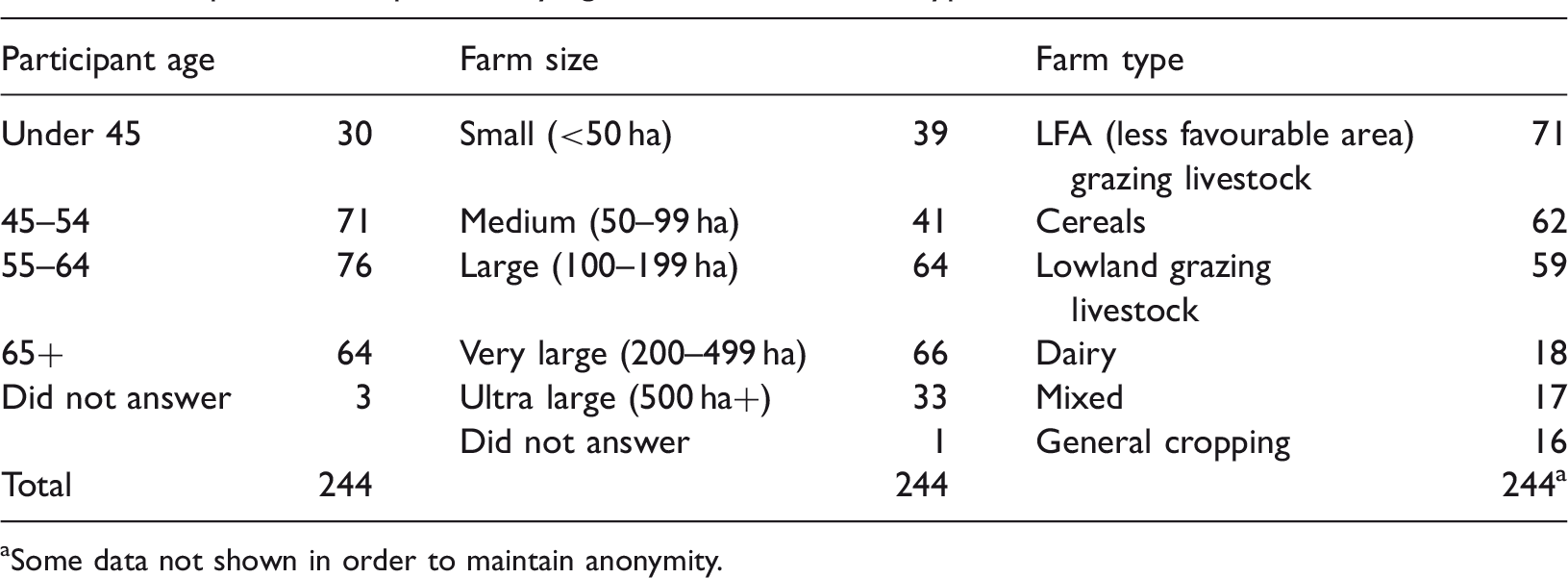
Our empirical material derives from a survey undertaken as part of the UK’s Department of Environment, Food and Rural Affairs (Defra) funded Sustainable Intensification Research Platform (SIP); a multi-partner research programme exploring opportunities and risks for the sustainable intensification of agriculture (see www.siplatform.org.uk). The survey consisted of face-to-face interviews which aimed to understand farmer perceptions of their current business, social and environmental situation; establish existing levels of formal and informal agri-environmental management practices; and explore the attitudes, barriers and opportunities relating to these. The interviews were conducted across seven case study areas in England and Wales, chosen to capture a variety of landscape types and farming systems (see Morris et al., 2016). These were; the Avon, Conwy, Eden, Nafferton, Taw, Upper Welland, and Wensum and Yare (Figure 1). The survey sample (provided by Defra and the Welsh Government) was stratified to reflect the main farm types
1
in each area. The sample was of “commercial farms”
2
only of 20 ha or greater. The farm type, size and age of respondents are shown in Table 1. Registered holders were initially contacted by letter, followed by a telephone call inviting them to participate in the research. In total, 244 farmers (34 in the Upper Welland, 34 in the Eden, 36 in the Nafferton, and 35 in each of the other four catchments) were interviewed over the course of six months in the Spring/Summer of 2015.
Map showing locations of the SIP case study areas. Respondent frequencies by age, farm size and farm type. Some data not shown in order to maintain anonymity.
The findings discussed here primarily emerge from the survey’s qualitative questions around environment and resource management. These aimed to explore participants’ views and practices concerning environmental management in general rather than specifically regarding formal AES, though it is notable that 78% of farms held a current AES agreement (this is broadly comparable to national uptake 3 ). The survey questions of particular interest to this paper were: what types of formal environmental management plans were held for the business and whether these had led to management changes; which farming activities were believed to be most beneficial, and which the most detrimental, to the environment; and perceptions of the value of farming to the local community and wider society. The resulting data were analysed through an inductive approach, using the computer software package NVivo as a tool to organise the material into meaningful themes that could be further refined and interpreted. The themes discussed below reflect the elements most pertinent to the relationship between good farming and environmental management that emerged from this process. Quotes have been selected to illustrate the themes and are presented anonymously but are contextualised by an accompanying description of the farm size, type and case study area.
Because the themes that emerged through this process derive from open questions, it is not possible to draw quantitative conclusions regarding proportions of farmers who would or would not agree with their sentiments, since many may have expressed agreement (or otherwise) had they been directly asked about the theme. Hence, whilst our data emerge from a primarily quantitative style method designed to be broadly representative of the UK farming population, we cannot claim representativeness in all our findings. Thus, whilst we do provide numbers regarding how many farmers made relevant comments, we stress that the value of the findings presented here lies in their inductive emergence from open questions rather than in their representativeness. We do also report some supporting statistical data from the survey’s closed questions where possible.
To provide some international context for the study area; whilst the farms in our study varied in size and type, in general farms in England and Wales are smaller than those found in the US, Canada and Australasia, but larger than in most European countries (for instance, in 2013, the average UK farm size was 94 ha compared to 16 ha across the EU (Eurostat, 2015) and 176 ha in the US (USDA, 2018). UK agriculture since the 1980s has seen a broad polarisation between more intensive arable farming in the east and south east of England, and pasture-based livestock systems in the west and north of England and in Wales; regions which also contain considerable tracts of less-favourable upland areas (Haines-Young and McNally, 2001). Traditionally, farmers have been seen as integral members of the rural community and family farming in particular holds an important place in rural culture and society (Berry, 1987; Gasson and Errington, 1993; Pretty, 2013; Winter and Lobley, 2016), though there has been sustained concern around the erosion of ties between farmers and communities amid social change in rural areas (Lobley et al., 2005; Newby et al., 1978; Reed et al., 2002). Deeply held cultural values associated with farming and the farmed countryside – Britain’s “green and pleasant land” – (and, moreover, the “right to roam”) arguably heighten public expectations around the responsibilities of farmers towards the local environment. Since most farmland is relatively visible due to high population density and mixed land use involving public access to farmland via an extensive rights of way network, farmers may feel they are particularly open to scrutiny in this regard.
Environmental management as part of good farming
As we discuss in turn below, a high level of environmental concern among farmers emerged in relation to (i) a personal respect for the environment and conservation objectives; (ii) cultural expectations around farmers as custodians of the countryside; (iii) a desire to keep the land in good health for farm legacy and succession reasons; (iv) perceptions of good agricultural practice and the need to comply with regulation; and (v) the ability to increase financial profitability through accessing AES payments and meeting market demands. Although our research was not able to directly assess the extent to which environmental concern is translated into forms of symbolic capital within the farming community, its presence in relation to wider cultural concepts and business practices does suggest that environmental management is becoming an increasingly accepted (and avoidable environmental harm an increasingly unacceptable) part of being recognised as a “good farmer”.
Personal respect for the environment – “I’m not saying we always get it right but we do try”
Throughout the interviews farmers professed a concern for wildlife and portrayed themselves as seeking to farm in an environmentally responsible way, irrespective of their participation (or otherwise) in a formal AES scheme. This was particularly apparent in responses to the question, “What do you consider to be the main activity on the farm that benefits the environment?” Part of the motivation for responsible management came from a personal appreciation of the environment, with respondents talking about how, for example, they love working in the countryside and seeing wildlife on the farm. This aligns with existing research demonstrating that farmers have a strong attachment to the landscape, nature and wildlife, which is developed through long-term experiential engagement with their land (Fish et al., 2003; Gray, 2000; Setten, 2005; Vergunst, 2012). It is unsurprising, therefore, that farmers expressed care for the environment and talked about seeking to do their best for wildlife and/or disliking causing harm (explicitly mentioned by 20 farmers). Environmental success was relayed with a sense of enjoyment, satisfaction and pride: [The field margins] do protect the water and help birdlife and everything else, which I love and we all love. We now see birds that I haven't seen since I was a kid. (Very large-sized General cropping farm, Wensum & Yare, 52069) I like to see my swallows, my birds, all my other animals, so if I can manage around them and not cut that field until they've nested and gone, then I do that. (Medium-sized Lowland grazing livestock farm, Taw, 10019) Spraying is always the concern – but I can't see how it's really avoidable. We can be careful, when we spray as far as insecticides go, to avoid bees and such like … But it's something we can't really get round. (Ultra-large-sized Cereal farm, Upper Welland, 31039)
The high rate of interviewees claiming no detrimental impact as a result of their activities may be evidence of farmers underestimating their environmental impact, as has been reported elsewhere (Inman et al., 2018; Silvasti, 2003) (although we cannot ascertain this from our survey). Nevertheless, whatever the reality of their farming practices, in most cases the farmer’s intention is to look after the environment and avoid causing harm. As the respondent quoted below stated, farmers may not always successfully protect the environment but, in general, they “do try”: We try not to kill bees, we try not to run on ground when it's not fit to run on. It doesn't always work, sometimes you have to depending on the season. All I can say is we try not to be detrimental. … I like to think we're environmentally aware, put it that way. I'm not saying we always get it right but we do try. (Ultra large-sized Cereal farm, Upper Welland, 32015) I think we're doing as best we can. … As a farmer you see all sorts of people farming, doing things which I wouldn't do … You see animals poaching,
7
dreadful poaching in the winter to save a bale of straw. No. Out-wintering cattle – no, absolutely no. Down here the rainfall's way too high … You'll make a mess and … you'll have to drag the hay to … [the cattle] …, so it’s more trouble than it's ever worth. (Medium-sized Lowland grazing livestock farm, Taw, 10022)
Countryside custodianship – “If somebody doesn’t look after it, it won’t look like that”
The farming activities cited by interviewees as most beneficial to the environment
8
were numerous and varied across the farm types. However, particularly notable among those representing livestock farms was a sense that it was not possible to single out one particular activity, as it was their whole farm system and general approach that was important (expressed by 67 farmers, 41 of whom were LFA or lowland grazing livestock farmers). For instance; Just the way it's farmed [is beneficial to the environment]. It’s an extensive system with sheep and cattle, which is good for wildlife. At the time of foot-and-mouth disease we lost a lot of stock and noticed that all the birds went – the peewits and curlews etc. It was very quiet. (Very large-sized LFA grazing livestock farm, Nafferton, 42054) The environment we live in is one that has been created by farming, so as long as we keep farming it it will continue along. As long as we don't tweak things in the wrong way. (Very large-sized LFA grazing livestock farm, Taw, 10017) Well, you've only got to sit here and have a look around … If somebody doesn't look after it, it won't look like that. (Large-sized Cereal farm, Upper Welland, 32026) Good farmers do look after the environment. They maintain the environment which has been created over several generations of farming. (Large-sized Mixed farm, Nafferton, 42093)
Farm legacy and succession – “Looking after what we’ve got”
The idea of a “good farmer” as someone who is mindful of the environment is not just about caring for the countryside for the sake of wider society. There was also a general recognition that looking after the land is essential to ensuring a long term, sustainable farm business (directly mentioned by nine farmers). As one farmer put it; “that's all part of farming isn't it, looking after it as best you can for as long as you can” (Medium-sized Lowland grazing livestock farm, Taw, 10019). Sustaining the health of the environment is seen as integral to safeguarding the farm business for successive generations: We want our grandchildren and great-grandchildren, a few generations down the line, we want them to be here farming and still making a profit because we’ve looked after what we've got. (Very large-sized LFA grazing livestock farm, Taw, 10016)
As the reference to “making a profit” quoted above highlights, environmental management can be seen as a fundamental part of economic accomplishment over a medium to long time period (as we also discuss further below). Interviewees drew connections between some aspects of environmental health and agricultural success, with some referring to the importance of soil health and the pollination benefits of insects for crops. Avoiding detrimental environmental impact is, therefore, acknowledged as making sense from a business point of view, as the following example demonstrates: I think with every farming activity you have to think about the environment and the weather conditions. I mean it's no good going into a field when it's really wet and making a mess and leaving ruts everywhere, because it knocks-on onto the ecosystem and it also spoils the soil structure and everything. So you've got to be sensible and think about it. So if you're careful you can avoid detrimental impact. (Very large-sized General cropping farm, Wensum & Yare, 52092)
“Good” agricultural practice and regulation – “The good guys are doing it anyway”
Further evidence of environmental management being seen as an integral part of contemporary agricultural business practice emerged in response to questions about whether farmers had formal (i.e. “written down”) environmental management plans 11 and, if so, whether these had led to changes in their farming practices. In this analysis, environmental management was presented as part of good business practice irrespective of the legislation that requires it.
Respondents reported a high uptake of formal environmental management plans, with 93% stating they have at least one plan. This finding says something about the expectation that farms should hold some sort of formal plan relating to environmental management. Indeed, many farmers said that they had to have them for cross-compliance reasons (the obligation for farmers to comply with certain environmental management requirements as a condition of receiving area-based farm payments). What is particularly interesting though is that, despite high uptake, 48% of farmers said that having a formal plan(s) had not resulted in changes to their farming practices. Generally, these farmers felt that the plans merely reiterated what they saw as “common-sense” and were based on practices that they were already carrying out (a point explicitly raised by 29 farmers). For instance, one cereal farmer explained; To be quite honest most of these things I keep because it's a statutory requirement to do so. I've had to dip into our manure management plan and nutrient management plan for cross-compliance inspection and things like that. There are so many of these things now that we have to do because we're required to, but I don't use them for farm management purposes really, because most of it we were doing anyway. (Very large-sized Cereal farm, Avon, 71012) I think most farmers will consider this a box-ticking exercise. We do them because we've got to have them. It's a carrot and stick thing isn't it, the crucial one here is the soil management one, and certain things are just a no no, like outdoor pigs on slopes … But more importantly it's the threat of legislation if things go belly up – that's the reason people [have a formal plan], because they have to … The good guys are doing that sort of thing anyway. (Very large-sized General cropping farm, Wensum & Yare, 51084) We maintain our ditches, we maintain our hedges. We've never cut our hedges every year, we've always managed to maintain some berries on the hedges. We haven't done this consciously, it's just something that's been done without really thinking, probably because it's always been done that way. (Large-sized cereal farm, Upper Welland, 31016) Nothing actually specific, but just generally trying to be good farmers. (Large-sized LFA grazing livestock farm, Taw, 10027) Good farming practice. Planting trees and maintaining hedges etc. (Small-sized Lowland grazing livestock farm, Conwy, 20012)
Financial profitability through environmental management – “Providing a good source of income”
Another theme present in our data is the link between participation in formal AES and financial security of the farm business. Reflecting evidence observed elsewhere (e.g. Saunders, 2016; Sutherland and Darnhofer, 2012), there was some reference to how payments derived from participation were seen as a legitimate source of income for the “good farmer”. For instance, one farmer openly valued AES both for its contribution to sustainable land management and for the financial security it provides: Some of the environmental schemes obviously have good benefit, providing a good source of income every year, and they help look after the farms as well. (Medium-sized General cropping farm, Wensum & Yare, 51051) We used to farm right up to the edges, we would never have grown nothing on the margins, but now we get paid for doing that so that's brilliant. I think my grandfather would turn in his grave if we saw what we were doing. But then my father used to say he wanted to get paid for nothing and that's what we basically do. [Interviewer]: But your grandfather would have wanted to see things grown on it? Absolutely. Every inch of it. (Very large-sized Lowland grazing livestock farm, Avon, 72002)
Whether it is for reasons of regulatory-compliance or direct financial gain, environmental management appears to have increasingly become part of the farm business agenda. As Sutherland and Darnhofer (2012) argue through focusing on the link between economic and cultural capital, assessments of farming success have become more about profitability and survival than productivity alone. Another indicator of this is the increasing prevalence of farm assurance schemes, which are designed to offer consumers confidence in the quality of products, and the principles of which usually include an element of environmental “good practice”. Seventy-eight percent of farms in our survey were involved in at least one farm assurance scheme and participation was significantly associated with farm size (90% of farms over 200 ha were involved in at least one scheme). 13 This is indicative of how, despite costs associated with scheme participation, farmers are increasingly finding that such certification is required in order to achieve the best price for their produce, as large purchasers seek to respond to consumer demand for quality, transparency and environmental responsibility (see Campbell, 2013; Campbell et al., 2012). Assurance schemes thus act to disconnect profitability from (food) productivity and assess “good” agricultural practice according to alternative (consumer-driven) principals. Inevitably, an element of box-ticking is likely in the assurance scheme process (as with the formal environmental management plans discussed above). Thus, Rosin (2008) argues that audit practices are establishing a “new spirit of farming” in which “successful farming is increasingly associated with the individual’s ability to conform to an audit’s structures” (p. 45) and which is “substantially distinct from existing (more productivist) orientations toward good farming practice” (p. 46).
We, therefore, agree with Saunders’ (2016) assertion that a narrow notion of productivism that focuses on food production is “unhelpful in trying to understand how some farmers seek to be productive in different ways” (p. 401). Taken together with our earlier discussions about personal respect for the countryside and environment, plus synergistic win-wins between environmental action, productivity and long-term business sustainability goals, we can begin to reconceptualise environmental concern as not just co-existent with, but integrated into, and inseparable from, the more economically oriented notions embedded in the good farming identity. Whilst there can be tensions between intrinsic farmer motivations and the objectives of formal structures such as AES and farm assurance schemes, a consequence of these practices is that responsible environmental behaviour does not necessarily depend on farmers strongly identifying with a “conservationist” ideology, as producers seek to adapt to a more environmentally conscious marketplace.
Discussion
Our findings have shown that the integration (at least in principle) of environmental management into agricultural practice is driven by interrelated personal, cultural and economic objectives that together contribute to the good farmer identity. These objectives include conservation, custodianship, farm legacy and succession, “good” agricultural practice and compliance with regulation, and profitability. Each objective will be prioritised differently by different farmers and enrols a multitude of non-environmental factors that may take precedence in many instances, so the level of credence given to environmental management will vary significantly between individual “good farmers”. The nuance and complexity involved in the good farmer identity – or rather identities – should not be underestimated (see also Naylor et al., 2016). However, awareness of the relationship between the environment and different agricultural objectives creates a firm space for environmental management within conceptualisations of the good farmer. To a certain extent this has always been the case, but it is arguably increasingly true in the context of long-term participation in AES (Huttunen and Peltomaa, 2016; Riley, 2016a), and growing policy and market demands for “environmentally friendly” food (Saunders, 2016; Sutherland and Darnhofer, 2012). Admittedly, this latter trajectory carries an inherent risk of corporate-environmental (Friedmann, 2005) style farming, leading to token gestures and greenwashing rather than concerted and meaningful action. As noted earlier, this might be aligned with the idea of a neoproductivist agriculture which acknowledges the need to be environmentally conscious in response to consumer demand and policy imperatives whilst retaining a focus on food production (or at least profit maximisation), rather than being grounded in a “purer” agroecological approach (Anderson, 2009; Levidow, 2015; Wilson and Burton, 2015).
Nevertheless, the observation that many farmers express concern for the environment and believe environmental management to be part of good farming provides a more positive foundation for improving on-farm environmental actions than assuming that farmers generally need to be persuaded into “looking after the environment”. However, as we have already noted, this finding raises its own issues. In particular, whilst farmers may have good intentions, these do not necessarily translate into effective action on the ground. We have observed that farmers often draw parallels between good farming and good countryside custodianship, but conserving an agricultural landscape does not necessarily result in benefits to biodiversity (Fish et al., 2003; Egoz et al., 2001). Furthermore, the “symbiotic ideology” of custodianship serves as a potential barrier to acknowledging environmental harm and the need for change (Ellis, 2013; Kessler et al., 2016). The widely reported attitude-behaviour gap is also relevant here, as it is generally acknowledged that individuals do not always act in accordance with their stated values. Economic drivers, for instance, may override environmental considerations and lead to detrimental activities (as in the case of interviewees who continued to spray insecticides despite recognising their harmful environmental impact) or restrict the ability of the farmer to devote the resources necessary for achieving conservation objectives. Farmers may also lack the requisite skills, knowledge and confidence to be able to effectively implement environmental management practices (Lobley et al., 2013). Having the ability to adopt environmental measures is just as important as willingness (Mills et al., 2017). Furthermore, if farmers already believe that they are “good farmers” who look after the environment as part of their normal business practice, then there is a danger that they will not feel the need to improve their current environmental management and will resist external attempts to encourage this. The fact that the majority of our interviewees did not believe their farming activities had an avoidable detrimental impact on the environment perhaps points to such complacency.
Finally, the heterogonous nature of good farmer identities means that deep-seated productivist values will inhibit openness to taking environmental action in some cases. The relative lack of symbolic capital associated with environmental management due to the low visibility of related activities (Burton and Paragahawewa, 2011; Riley, 2011a) compounds this issue and results in many farmers taking little interest in the conservation actions of their neighbours, leading Riley et al. (2018: 644) to argue that for some “there has been insufficient change in the “rules of the game” (and farming habitus) to update symbols of good farming to be associated with AES management”. This may, however, continue to change over time as social norms in the farming community alter (Mills et al., 2017) and as the social and political landscape in which it operates continues to transform (Riley et al., 2018). The continual (re)formation and performance of identities, both individual and collective, represents promise for a more concerted incorporation of environmental values into concepts of the “good farmer”. As Bell (2010: 203) describes in his exploration of sustainable farming in Iowa (though without referring explicitly to the “good farmer” identity): Sustainable agriculture involves more than sustainable practice. It is about the practice of the self – or, better put, it is about the practice of selves, new selves, new men and new women and new dialogues between and among them. It is about new conceptions of the unfinished wholes within which we all live. It is about new cultivations of farming, and that means both new senses of what a farm is and can be and new senses of what a person is and can be.
Approaches to promoting environmental action within the farming community should aim to recognise and bolster the conservation-oriented aspects of the good farmer identity by, for example, providing greater recognition and feedback on their environmental activities including the relative success of their AES schemes. This is important because being able to witness environmental benefits as a direct result of management is key in motivating farmers to carry out such activities (Emery and Franks, 2012; Fielding et al., 2005; Uetake, 2014; Yeboah et al., 2015). Results-oriented schemes that reward farmers for biodiversity outcomes may also hold promise in this regard, as they enable farmers to measure their own success and to build cultural capital through demonstrating skill, innovation and proficiency (Burton and Schwarz, 2013; Fleury et al., 2015). Such schemes can, however, be problematic where indicators of success are difficult to define (e.g. when environmental benefits are non-localised and/or intangible) or where outcomes are affected by external influences over which the farmer has no control (e.g. the weather) (Burton and Schwarz, 2013). Creating new social norms based on the environmental aspects of the good farmer identity may also be facilitated through the use of farmer collectives (McGuire et al., 2013; van Dijk et al., 2016).
Engagement in any of these or similar initiatives relies, however, on farmers recognising that despite their best intentions more needs to be done to improve environmental management on their farm. One-to-one on-farm advice, whilst expensive, is likely to be the most effective way of helping farmers identify environmental issues, particularly in the case of individuals who are not well networked. This should be approached in a way that creates an equal partnership with farmers, addressing the environmental aspects of their identity, respecting their knowledge of the land and offering a sense of long-term ownership over the environment (see also Mills et al., 2017).
Conclusion
Drawing on recent empirical research across England and Wales, this paper has examined the extent to which the environment is now accommodated within farmer conceptualisations of good farming practice. The analysis has highlighted a concern for the environment among farmers across a range of farm types, sizes and locations, and revealed ways in which environmental management is interconnected with both traditional farming values and business-oriented goals. Specifically, we have shown how contemporary ideas about what it means to be a “good farmer” can encompass environmental management, specifically in relation to farming objectives around; (i) staying true to a personal respect for the environment and conservation; (ii) fulfilling the role of farmers as custodians or stewards of the countryside; (iii) looking after the farm to ensure successful legacy and succession (iv) achieving agricultural and environmental win-wins through “good” agricultural practice and complying with regulation; and (v) running a profitable farm business that adapts to policy and consumer demands and incentives regarding environmental standards. Thus, whilst we do not dismiss the importance of productivist values to conceptions of being a good farmer, we contend that these have become entangled with environmental concerns to the extent that responsible environmental management is now frequently seen as part and parcel of good farming (regardless of whether the farmer’s actions are driven primarily by conservation or business motivations) (see also Fish et al., 2003).
Our research, therefore, supports recent arguments that symbols of good farming are no longer necessarily confined to indicators of production (Naylor et al., 2016; Sutherland and Darnhofer, 2012) and that the good farmer identity has broadened to accommodate recognition of skill in environmental management alongside traditional agricultural production (Riley, 2016a; Saunders, 2016). Importantly, the breadth of our study has enabled us to reveal how modifications to the good farmer identity are not limited to specific types of farming system but can be observed across a wide range of farming contexts; from the small to the large, the arable to the livestock, and the “traditional” extensive family farm to the “modern”, more intensive, agribusiness. We are not suggesting that environmental concern is universal within farmers’ interpretations of the “good farmer”, but it is significant that the principle of good farming being compatible with environmental concern can be applied to multiple farming situations.
Whilst our conclusions lead us to take a generally optimistic view towards the place of environmental management within the good farming identity, we have also raised a number of issues pertaining to this and are left with a number of unanswered questions. In particular, there is a need for further research to explore whether conceptions of good farming as incorporating environmental concern are reflected in farmers’ on-farm actions – i.e. does seeing a “good farmer” as someone who takes care of the environment correlate with better environmental outcomes on the ground compared with more narrowly productivist interpretations of this identity? Future work might also consider what the implications of a good farmer identity that incorporates environmental concern are for the way in which researchers, policy-makers and conservation organisations engage with farmers on this topic. Encouraging more effective and widespread environmental management might, for instance, involve re-framing the issue to more explicitly acknowledge – and build on – farmers’ positive intentions towards the environment. That some framings of “good farming” integrate and entangle farming and conservation implies that policies to encourage sustainable intensification may be pushing at an open door.
Footnotes
Highlights
Environmental concern has become accommodated within contemporary accounts of good farming in a number of ways Our findings are based on qualitative evidence from a face-to-face survey with 244 farmers across England and Wales. Farmers drew connections between environmental management and a number of farming objectives including conservation, custodianship/stewardship, farm legacy, productivity and profitability. Whilst farmers may have good intentions these do not necessarily translate into effective action on the ground. Approaches to promoting environmental action should acknowledge farmers’ positive intentions and build on conservationist aspects of the good farmer identity.
Acknowledgements
We are grateful to the farmer interview teams in England and Wales (Hannah Chiswell, John Hyland, John Lynch, Lisa Norton and Marian Raley) and to the many farmers who participated. Particular thanks also go to Susanne Jarratt for her helpful thoughts on the initial ideas for this paper.
Declaration of conflicting interests
The author(s) declared no potential conflicts of interest with respect to the research, authorship, and/or publication of this article.
Funding
The author(s) disclosed receipt of the following financial support for the research, authorship, and/or publication of this article: The research on which this paper is based was funded as part of Defra’s Sustainable Intensification Research Platform (Project LM0302).